Corporal Punishment in Public Schools
 Corporal Punishment in Public Schools:
        A Teacher’s Perspective

      William Allan Kritsonis, PhD


                                          1
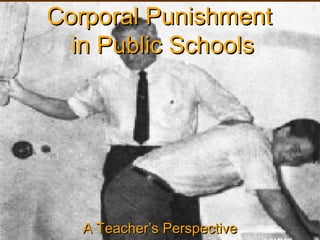
Corporal Punishment
  in Public Schools


   A Teacher’s Perspective   2
Discipline…not the same as Punishment

   Learning how to effectively discipline a child is an
    important skill that all parents and teachers need to
    learn.
   Discipline is not the same as punishment!
   Discipline has to do more with teaching , and involves
    teaching a child/student…
      right from wrong

      how to respect the rights of others

      which behaviors are acceptable and which are not

      how to be self-confident, self-disciplined, and how to
       control his/her impulses
      to not get overly frustrated with the normal stresses of
       everyday life
                                                3
   Do we spare the rod and spoil the child or use
    corporal punishment to correct inappropriate
    behavior?

   These two viewpoints are quite controversial…
        Some are very passionate about spanking
        Others are adamant about using alternative
    disciplinary measures

   Discipline can be PAINFUL or PLAUSIBLE depending
    on who is on the receiving end!

   Corporal Punishment: painful, intentionally inflicted
    physical penalty administered by a person in
    authority for disciplinary purposes. Forms of CP:
    beating, whipping, paddling, flogging

   Alternative measures: peaceful, calm, and usually
    entail counseling, instruction, and chances for
    betterment.                             4
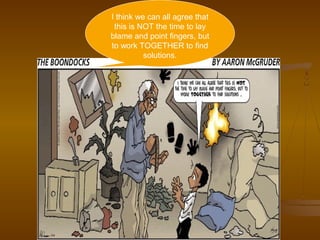
I think we can all agree that
 this is NOT the time to lay
blame and point fingers, but
to work TOGETHER to find
          solutions.


                                5
How to prevent Corporal Punishment from starting…
    establish clear behavior expectations and guidelines
    focus on student success and self-esteem
    seek student input on discipline rules
    use a “systems approach” for prevention, intervention
     and resolution
    develop levels of incremental consequences
    enforce rules with consistency, fairness, and calmness
    plan lessons that provide realistic opportunities for
     success
    monitor the classroom environment continuously to
     prevent off-task behavior and student disruptions

    provide students with social skills training and
     instruction, character education, student recognition,
     and involve them in peer mediation
                                                6
Arguments Against Corporal Punishment
   It perpetuates a cycle of child abuse and it
    teaches children to hit someone smaller and
    weaker when angry.
   CP is often not used as a last resort, but as a
    first resort for minor misbehaviors.
   Injuries can occur, bruises are common, there
    can be broken bones, and even deaths have
    been reported.
   Schools are the only institutions in the United
    States in which striking another person is
    legal. CP is not permitted in prisons, mental
    hospitals, or the military.
                                       7
Arguments Against Corporal Punishment Cont…
Educators should understand…
 they expose themselves to potential personal
  liability for damages when they paddle children.
 despite of authorization by local/district policy
  and parental consent , suits can still be filed
  alleging the paddling was excessive or
  negligent, resulting in bodily injury.
 every year there are reported cases in which
  parents have filed
    Abuse charges
    Criminal complaints
    SBEC complaints
    Personal suits for damages
                                       8
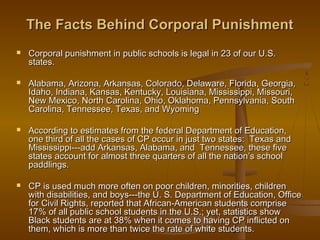
The Facts Behind Corporal Punishment
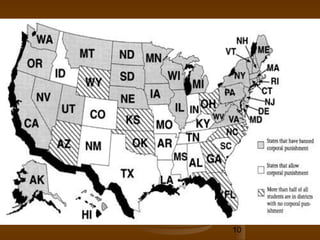
   Corporal punishment in public schools is legal in 23 of our U.S.
    states.

   Alabama, Arizona, Arkansas, Colorado, Delaware, Florida, Georgia,
    Idaho, Indiana, Kansas, Kentucky, Louisiana, Mississippi, Missouri,
    New Mexico, North Carolina, Ohio, Oklahoma, Pennsylvania, South
    Carolina, Tennessee, Texas, and Wyoming

   According to estimates from the federal Department of Education,
    one third of all the cases of CP occur in just two states: Texas and
    Mississippi---add Arkansas, Alabama, and Tennessee, these five
    states account for almost three quarters of all the nation’s school
    paddlings.

   CP is used much more often on poor children, minorities, children
    with disabilities, and boys---the U. S. Department of Education, Office
    for Civil Rights, reported that African-American students comprise
    17% of all public school students in the U.S.; yet, statistics show
    Black students are at 38% when it comes to having CP inflicted on
    them, which is more than twice the rate of white students.
                                                          9
10
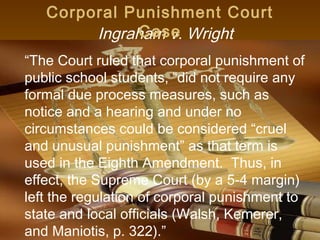
Corporal Punishment Court
             Case
        Ingraham v. Wright
“The Court ruled that corporal punishment of
public school students, “did not require any
formal due process measures, such as
notice and a hearing and under no
circumstances could be considered “cruel
and unusual punishment” as that term is
used in the Eighth Amendment. Thus, in
effect, the Supreme Court (by a 5-4 margin)
left the regulation of corporal punishment to
state and local officials (Walsh, Kemerer,
and Maniotis, p. 322).”            11
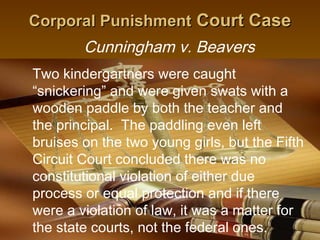
Corporal Punishment Court Case
        Cunningham v. Beavers
Two kindergartners were caught
“snickering” and were given swats with a
wooden paddle by both the teacher and
the principal. The paddling even left
bruises on the two young girls, but the Fifth
Circuit Court concluded there was no
constitutional violation of either due
process or equal protection and if there
were a violation of law, it was a matter for
the state courts, not the federal 12
                                   ones.
Corporal Punishment Court Case
             Fee v. Herndon
In this situation, the parents “authorized” appropriate personnel
to punish their emotionally disturbed child with three paddle
swats; and even though these parents consented, they filed
suit against the principal for this beating, claimed their child
spent six months in a psychiatric hospital which costs them
$90,000, and brought action against the special education
teacher who allegedly failed to intervene in the spanking. The
District Court for the Southern District of Texas, dismissed the
case for failure to state a claim, and the parents appealed. The
Court of Appeals dismissed the case as well and stated that: 1)
Texas law afforded adequate post punishment civil and
criminal remedies, and 2) Texas law did not impose upon the
teacher a duty to intervene in the corporal punishment.
                                              13
Corporal Punishment and the Judicial System

• Public school children have no recourse in federal court under the
  due process clause of the Fourteenth Amendment for allegations of
  abuse of corporal punishment.
• There have been efforts to eliminate corporal punishment, but NO
  ONE has succeeded!
• Even when corporal punishment has been arguably excessive,
  federal courts have remained unmoved. (Cunningham v. Beavers)
• Even when corporal punishment has been authorized by
  parents, federal courts have stuck to their guns. (Fee v. Herndon)
• To lessen the chances of damage suits, most schools specify that
  corporal punishment can be used only
       •   under certain circumstances
       •   by certain people
                                                    14
       •   in accordance with certain procedures and policy
GOD Ordained Corporal Punishment
                   as a Method of Discipline
   Many believe that corporal punishment is a GOD ordained method of
    discipline, that there are situations where it is the best option; and that
    completely ruling it out as a discipline option is in direct conflict with GOD’s
    advice!
    GOD tells us:
      Proverbs 13:24 states, “He that spareth his rod hateth his son: but he
        that loveth him chasteneth him betimes.
      Proverbs 22:15 states, “Foolishness is bound in the heart of a child; but
        the rod of correction shall drive it far from him.
      Proverbs 23:13-14 says, “Withhold not correction from the child: for if
        thou beatest him with the rod, he shall not die. Thou shalt beat him with
        the rod, and shalt deliver his soul from hell.

   Along with the aforementioned Bible verses, some will argue:
     CP did them no harm and they live productive lives.
     They are resilient to harm and sarcasm.
     It is effective, especially in emergency situations like a kid running in the
       street or touching something that could harm them.
     They stress that abuse and spanking are two different things.
                                                              15
My Perspective on Corporal Punishment

   I am an advocate of CP.
   Corporal punishment should be a means of discipline if all other measures
    of correction have exhausted themselves.
   There should be levels of punishment, chances, warnings, counseling
    sessions, and parent involvement. However, if those still do not work then
    we should try an alternative method which should be CP.
   I feel that this act helps a child to remember that pain is not pleasant and if
    you do not want to experience such pain then don’t keep misbehaving.
   I feel this will save a great deal of paperwork such as referrals and detention
    notices.
   CP will free the office, in school suspension rooms, detention halls, and
    alternative campus learning centers of misbehaved children.
   Teachers should explain their reasoning for the paddling and show the
    student that all other means were tried and were unsuccessful. This way,
    the student sees the reasoning behind the punishment and can hopefully
    see that it was HE/SHE who could not apply themselves and follow the
    rules and it was US who went above and beyond in trying to address
    misbehavior before it came to this final measure!!!

                                                             16
RESOURCES
Center for Effective Discipline. (2007a). School
 corporal punishment alternatives. [On-line].
 Available: www.stophitting.com

Center for Effective Discipline. (2007b).
 Arguments against corporal punishment.
 [On-line]. Available: www.stophitting.com

Center for Effective Discipline. (2007c). U. S. :
 Corporal punishment and paddling statistics by
 state and race. [On-line]. Available:
 www.stophitting.com                   17
RESOURCES cont…
The Young Earth Creation Club. (2007). Corporal
  punishment (spanking) is strongly supported by
  God in the Bible. [On-line]. Available:
  www.creationists.org

Walsh, J., Kemerer, F., & Maniotis, L. (2005). The
 educator’s guide to Texas school law. Austin:
 University of Texas Press.

World Corporal Punishment Research. (2007).
 Corporal punishment in US schools. [On-line].
 Available: www.corpun.com/counuss.htm
                                     18

Dr. William Allan Kritsonis - Corporal Punishment in Public Schools, PPT.

  • 1.
    Corporal Punishment inPublic Schools Corporal Punishment in Public Schools: A Teacher’s Perspective William Allan Kritsonis, PhD 1
  • 2.
    Corporal Punishment in Public Schools A Teacher’s Perspective 2
  • 3.
    Discipline…not the sameas Punishment  Learning how to effectively discipline a child is an important skill that all parents and teachers need to learn.  Discipline is not the same as punishment!  Discipline has to do more with teaching , and involves teaching a child/student…  right from wrong  how to respect the rights of others  which behaviors are acceptable and which are not  how to be self-confident, self-disciplined, and how to control his/her impulses  to not get overly frustrated with the normal stresses of everyday life 3
  • 4.
    Do we spare the rod and spoil the child or use corporal punishment to correct inappropriate behavior?  These two viewpoints are quite controversial… Some are very passionate about spanking Others are adamant about using alternative disciplinary measures  Discipline can be PAINFUL or PLAUSIBLE depending on who is on the receiving end!  Corporal Punishment: painful, intentionally inflicted physical penalty administered by a person in authority for disciplinary purposes. Forms of CP: beating, whipping, paddling, flogging  Alternative measures: peaceful, calm, and usually entail counseling, instruction, and chances for betterment. 4
  • 5.
    I think wecan all agree that this is NOT the time to lay blame and point fingers, but to work TOGETHER to find solutions. 5
  • 6.
    How to preventCorporal Punishment from starting…  establish clear behavior expectations and guidelines  focus on student success and self-esteem  seek student input on discipline rules  use a “systems approach” for prevention, intervention and resolution  develop levels of incremental consequences  enforce rules with consistency, fairness, and calmness  plan lessons that provide realistic opportunities for success  monitor the classroom environment continuously to prevent off-task behavior and student disruptions  provide students with social skills training and instruction, character education, student recognition, and involve them in peer mediation 6
  • 7.
    Arguments Against CorporalPunishment  It perpetuates a cycle of child abuse and it teaches children to hit someone smaller and weaker when angry.  CP is often not used as a last resort, but as a first resort for minor misbehaviors.  Injuries can occur, bruises are common, there can be broken bones, and even deaths have been reported.  Schools are the only institutions in the United States in which striking another person is legal. CP is not permitted in prisons, mental hospitals, or the military. 7
  • 8.
    Arguments Against CorporalPunishment Cont… Educators should understand…  they expose themselves to potential personal liability for damages when they paddle children.  despite of authorization by local/district policy and parental consent , suits can still be filed alleging the paddling was excessive or negligent, resulting in bodily injury.  every year there are reported cases in which parents have filed  Abuse charges  Criminal complaints  SBEC complaints  Personal suits for damages 8
  • 9.
    The Facts BehindCorporal Punishment  Corporal punishment in public schools is legal in 23 of our U.S. states.  Alabama, Arizona, Arkansas, Colorado, Delaware, Florida, Georgia, Idaho, Indiana, Kansas, Kentucky, Louisiana, Mississippi, Missouri, New Mexico, North Carolina, Ohio, Oklahoma, Pennsylvania, South Carolina, Tennessee, Texas, and Wyoming  According to estimates from the federal Department of Education, one third of all the cases of CP occur in just two states: Texas and Mississippi---add Arkansas, Alabama, and Tennessee, these five states account for almost three quarters of all the nation’s school paddlings.  CP is used much more often on poor children, minorities, children with disabilities, and boys---the U. S. Department of Education, Office for Civil Rights, reported that African-American students comprise 17% of all public school students in the U.S.; yet, statistics show Black students are at 38% when it comes to having CP inflicted on them, which is more than twice the rate of white students. 9
  • 10.
  • 11.
    Corporal Punishment Court Case Ingraham v. Wright “The Court ruled that corporal punishment of public school students, “did not require any formal due process measures, such as notice and a hearing and under no circumstances could be considered “cruel and unusual punishment” as that term is used in the Eighth Amendment. Thus, in effect, the Supreme Court (by a 5-4 margin) left the regulation of corporal punishment to state and local officials (Walsh, Kemerer, and Maniotis, p. 322).” 11
  • 12.
    Corporal Punishment CourtCase Cunningham v. Beavers Two kindergartners were caught “snickering” and were given swats with a wooden paddle by both the teacher and the principal. The paddling even left bruises on the two young girls, but the Fifth Circuit Court concluded there was no constitutional violation of either due process or equal protection and if there were a violation of law, it was a matter for the state courts, not the federal 12 ones.
  • 13.
    Corporal Punishment CourtCase Fee v. Herndon In this situation, the parents “authorized” appropriate personnel to punish their emotionally disturbed child with three paddle swats; and even though these parents consented, they filed suit against the principal for this beating, claimed their child spent six months in a psychiatric hospital which costs them $90,000, and brought action against the special education teacher who allegedly failed to intervene in the spanking. The District Court for the Southern District of Texas, dismissed the case for failure to state a claim, and the parents appealed. The Court of Appeals dismissed the case as well and stated that: 1) Texas law afforded adequate post punishment civil and criminal remedies, and 2) Texas law did not impose upon the teacher a duty to intervene in the corporal punishment. 13
  • 14.
    Corporal Punishment andthe Judicial System • Public school children have no recourse in federal court under the due process clause of the Fourteenth Amendment for allegations of abuse of corporal punishment. • There have been efforts to eliminate corporal punishment, but NO ONE has succeeded! • Even when corporal punishment has been arguably excessive, federal courts have remained unmoved. (Cunningham v. Beavers) • Even when corporal punishment has been authorized by parents, federal courts have stuck to their guns. (Fee v. Herndon) • To lessen the chances of damage suits, most schools specify that corporal punishment can be used only • under certain circumstances • by certain people 14 • in accordance with certain procedures and policy
  • 15.
    GOD Ordained CorporalPunishment as a Method of Discipline  Many believe that corporal punishment is a GOD ordained method of discipline, that there are situations where it is the best option; and that completely ruling it out as a discipline option is in direct conflict with GOD’s advice!  GOD tells us:  Proverbs 13:24 states, “He that spareth his rod hateth his son: but he that loveth him chasteneth him betimes.  Proverbs 22:15 states, “Foolishness is bound in the heart of a child; but the rod of correction shall drive it far from him.  Proverbs 23:13-14 says, “Withhold not correction from the child: for if thou beatest him with the rod, he shall not die. Thou shalt beat him with the rod, and shalt deliver his soul from hell.  Along with the aforementioned Bible verses, some will argue:  CP did them no harm and they live productive lives.  They are resilient to harm and sarcasm.  It is effective, especially in emergency situations like a kid running in the street or touching something that could harm them.  They stress that abuse and spanking are two different things. 15
  • 16.
    My Perspective onCorporal Punishment  I am an advocate of CP.  Corporal punishment should be a means of discipline if all other measures of correction have exhausted themselves.  There should be levels of punishment, chances, warnings, counseling sessions, and parent involvement. However, if those still do not work then we should try an alternative method which should be CP.  I feel that this act helps a child to remember that pain is not pleasant and if you do not want to experience such pain then don’t keep misbehaving.  I feel this will save a great deal of paperwork such as referrals and detention notices.  CP will free the office, in school suspension rooms, detention halls, and alternative campus learning centers of misbehaved children.  Teachers should explain their reasoning for the paddling and show the student that all other means were tried and were unsuccessful. This way, the student sees the reasoning behind the punishment and can hopefully see that it was HE/SHE who could not apply themselves and follow the rules and it was US who went above and beyond in trying to address misbehavior before it came to this final measure!!! 16
  • 17.
    RESOURCES Center for EffectiveDiscipline. (2007a). School corporal punishment alternatives. [On-line]. Available: www.stophitting.com Center for Effective Discipline. (2007b). Arguments against corporal punishment. [On-line]. Available: www.stophitting.com Center for Effective Discipline. (2007c). U. S. : Corporal punishment and paddling statistics by state and race. [On-line]. Available: www.stophitting.com 17
  • 18.
    RESOURCES cont… The YoungEarth Creation Club. (2007). Corporal punishment (spanking) is strongly supported by God in the Bible. [On-line]. Available: www.creationists.org Walsh, J., Kemerer, F., & Maniotis, L. (2005). The educator’s guide to Texas school law. Austin: University of Texas Press. World Corporal Punishment Research. (2007). Corporal punishment in US schools. [On-line]. Available: www.corpun.com/counuss.htm 18