3
Chapter 1
ISSUES AND MEASUREMENT
PRACTICES IN THE SCHOOLS
We must start where men who would improve their society have
always known they must begin—with an educational system
restudied, reinforced, and revitalized.
—Lyndon B. Johnson
January 12, 1965
Issues and Themes
Testing is an integral part of the life story of all American children. The
American public supports verifying the quality of public education through
accountability. This press for educational accountability has increased both
the number and importance of educational assessments in the schools. An
assessment is a multidimensional method for collecting data that usually
includes testing. Educational testing is normally conducted to measure the
status of the child on one dimension, such as arithmetic, whereas an assess-
ment is designed to provide multiple sources of data. A battery of tests is
often the core component of the assessment. Batteries are a collection of
tests that are designed to measure different parts of the curriculum—e.g.,
mathematics, reading, and science.
01-Wright-45489.qxd 11/20/2007 11:02 AM Page 3
High-stakes assessments are educational measures that have significant
negative consequences for failure. The No Child Left Behind Act (NCLB; P
.L.
107-110, 2002) is the latest major stimulant for the use of high-stakes assess-
ments in public education. During the past 20 years, federal court rulings
have supported both the use of these high-stakes tests and the sanctions that
are applied when children and schools fail to measure up. One outcome of
the No Child Left Behind Act mandates is a major boon for the publishers of
educational tests. Over a billion dollars are now being spent by the states to
develop, administer, and score these new mandated tests. The whole face of
testing is changing rapidly with the introduction of technology into the
assessment process. With all of these changes, the education profession has
scrambled to provide statements of ethical principles and practitioner guide-
lines for testing programs.
By reading and studying this chapter you should acquire the competency to
• Describe the relationship between accountability, assessment, and
testing
• Explain the major reasons why children are assessed
• Describe the three assumptions made by test developers
• Discuss the relationship of formative and summative testing in the
classroom
• Contrast norm-based and criterion-referenced tests
• Describe the case law related to the selection of students for admis-
sions into advanced high school programs
• Explain how case law has affected the college admission process
• Explain how case law has affected the practice of educational testing
and assessment
• Present and discuss the core ethical canons related to educational
testing
Accountability, Assessment, and Testing
Accountability refers to the linkage and balance between the outcome of
an enterprise and the efforts and resources used to achieve that outcome. In
education, assessment provides an accounting of how much children learn
4– –PART I EDUCATIONAL ASSESSMENT IN AMERICA
Learning Objectives
01-Wright-45489.qxd 11/20/2007 11:02 AM Page 4
in school and what resources are expended on achieving those learning out-
comes. The need for accountability grew in this country as the cost of educa-
tion grew. In the 1960s, the cost of public education was not just the largest
part of each states’ budget; it was actually equal to the cost of running every
other state agency combined.
Educational accountability requires that all students be assessed to
quantify what they have learned and what skills they have developed.
Commercially published tests of student achievement have been around
since the 1920s. The publishers of these tests have formed a cozy relation-
ship with the schools that bought into their use for school and student eval-
uation. By the 1980s, virtually every school system could make the illogical
boast that their school district was above average. A West Virginia physician
(John J. Cannell, M.D.) was first to ask the question: If the average is in the
middle of the data, how it is possible for everyone to be above average
(Phelps, 2005)?
The 19th century saw the first efforts in the United States to determine
the success of schools in meeting local and statewide goals for the education
of children. The first attempt to assess a large American school system
involved a test administered to the children of Boston in 1845. That testing
program was organized by Massachusetts’s new state school superintendent,
Horace Mann (Crocker, 2003).1
With this effort to assess educational out-
comes, the students of Boston were tested for their understanding of the
facts that they were learning in the new “common schools” of Boston. In
1864, the Board of Regents of New York initiated a statewide “preliminary
test” for junior high–aged school students. This measure was used as a basis
for allocating state funds to the various school systems.2
This was supplanted
by a mandated set of examinations known as the New York Regents
Examinations in 1878, which assessed all high school students (New York
State Education Department, 1987).3
The assessments of student educational progress can be accomplished
using several different methods. In this text there is a chapter describing
alternative approaches to assessment (Chapter 9) and another describing the
use of essay tests (Chapter 7). However, the paper-and-pencil test with mul-
tiple choice questions is the dominate method of constructing all the state-
mandated tests designed for the assessment of achievement. The advantages
to this approach to assessment include the fact that these “objective tests”
are less expensive to score and involve less effort by local school personnel
to develop and administer than do alternative assessment approaches. Also,
data from these tests are readily quantifiable and familiar to the policy mak-
ers and the general public. The downside of this approach to assessment is
that the multiple choice questions used to build these measures tend to
Chapter 1 Issues and Measurement Practices in the Schools– –5
01-Wright-45489.qxd 11/20/2007 11:02 AM Page 5
stress rote learning, favor students from middle-class backgrounds, and are
based on a technology born under a cloud of tacit racism (see Chapter 2).
In summary, accountability in education is an inevitable requirement that
is associated with spending large amounts of public tax funds. Educational
accountability requires that an assessment be made of the outcome of the
educational process. One method of assessment involves using paper-and-
pencil tests. Typically these tests are primarily composed with multiple choice
format questions. When there are several tests that make up the assessment,
the term test battery is appropriate to describe the measurement.
WHY DO WE TEST?
At one level we test to protect the health and physical status of the child. This
type of testing starts at the moment of birth. Typically, it is the attending
obstetrician who welcomes the newborn into the world, and it is this physi-
cian who is first to formally assess the child. That medical status examination,
the Apgar, is an observational rating scale that is administered one minute
after the birth of the child and again four minutes later (see Table 1.10). From
this starting point, the growing child will be assessed and measured by a
pediatrician on a regular basis.
By the age of four, children enrolled in Head Start programs are tested
to determine how well those centers are doing their jobs. This is one of the
accountability functions of testing. This assessment process is then repeated
in the public schools under a federal mandate beginning in third grade and
extending into the high school years.
In 1965 President Lyndon Johnson’s legislative package included a new
act directed toward providing federal assistance to the nation’s public schools.
This act, the Elementary and Secondary Education Act (ESEA, 89-10, 1965)
provided money to improve the educational achievement of children living
in poverty. One part of this act created a method to measure the impact of
the improvements being instituted throughout the schools of the country.
That method resulted in the development of what is known as the Nation’s
Report Card (National Assessment of Educational Progress [NAEP]). Today
this measure provides a picture of how well each state is doing in educating
its children.
Also, we test to measure how much progress each child is making toward
developing proficiency in core areas of learning. The driving issue here is also
one of accountability in education. This type of testing was begun during the
1990s and became mandatory in 2002 under terms of the revised ESEA, now
6– –PART I EDUCATIONAL ASSESSMENT IN AMERICA
01-Wright-45489.qxd 11/20/2007 11:02 AM Page 6
known as the No Child Left Behind (NCLB) Act. Today, all 50 states have
both specified what all children are expected to learn at each grade level in
the core subjects (reading, mathematics, and science) and have developed
tests to measure achievement in those areas. Naturally, our schools have
revamped their curriculums in an effort to stress these core subjects. This has
had a negative impact on the variety of subjects and disciplines taught in the
schools (Jennings & Rentner, 2006).
The curriculum most public school children are exposed to has been
skewed away from the arts and humanities and toward the content covered
by the mandated assessments (Dillon, 2006; Manzo, March 2005). This has
done great damage to those curriculum areas that are not tested. As a result,
the curriculum followed in most schools now de-emphasizes areas such as
the arts, social studies, modern language, and physical education while pro-
viding extra doses of basic skills-development drill and practice in reading,
mathematics, and science.
Chapter 1 Issues and Measurement Practices in the Schools– –7
A
P
G
A
R
Table 1.1 A Proposal of a New Method of Evaluation of the Newborn Infant
SOURCE: From “A proposal of a new method of evaluation of the newborn infant,” by V. Apgar, 1953, Current
Researches in Anesthesia & Analgesia, 32, p. 261–267. Reprinted with permission from Eric Apgar.
Appearance (Skin
Color)
Pulse
Grimace (Reflex
Irritability)
Activity (Muscle
Tone)
Respiration
0 Points
Blue-gray, Pale All
Over
Absent
No Response
Absent
Absent
1 Point
Normal, Except for
Extremities
Below 100 bpm
Grimace
Arms and Legs
Flexed
Slow, Irregular
2 Points
Normal Over
Entire Body
Above 100 bpm
Sneeze, Cough,
Pulls Away
Active Movement
Good, Crying
A score is given for each sign at one minute and five minutes after the birth. If there are problems
with the baby, an additional score is given at 10 minutes. A score of 7–10 is considered normal,
while 4–7 might require some resuscitative measures. A baby with Apgars of 3 and below requires
immediate resuscitation.
Sign
01-Wright-45489.qxd 11/20/2007 11:02 AM Page 7
To verify the old adage that no bad idea stays dead forever, a number of
states are using these student data from the NCLB Act to award teachers with
pay raises. Merit pay is incredibly difficult to institute fairly. There are so
many differences between schools and the children who populate them that
a system based on student achievement test scores is inherently flawed. The
pressure for merit pay is an extension of the accountability focus of policy
makers who look at schools in much the same way as they look at corpora-
tions. The dismal results from almost two centuries of trying this in Great
Britain have been ignored in the United States (Wilms & Chapleau, 1999).
Those same state-mandated tests perform a second accountability
function: They provide the data needed to determine if various groups of
students within each school are making progress toward the goal of being
proficient in the core subjects. This function of the mandated tests is linked
to the NCLB requirement that all identified groups of children are proficient
in the core subjects by the year 2014. Each school must show that all
groups—including children receiving special education, Native American
children, non-Hispanic Black children, Hispanic children, children with one
or more disabling conditions, Anglo-White children, and children from
impoverished homes—are making Adequate Yearly Progress (AYP) toward
the goal of universal proficiency by 2014. The various states have each iden-
tified specific standards for student learning and have established proficiency
targets for the children of each grade level. Those targets or benchmarks
are unique to each state but must be approved by the U.S. Department of
Education (U.S. Department of Education, 2007). The argument can be made
that the policy of evaluating all schools exclusively on arbitrarily established
standards for learning, and fixed levels of achievement, do not do justice to
Case in Point (1a)
8– –PART I EDUCATIONAL ASSESSMENT IN AMERICA
A group of music educators in Florida spent three years and $90,000 develop-
ing a music test that can be used as a part of a statewide assessment (Gupta,
2005). This test is presented on a CD and is answered by students on machine-
scorable multiple choice forms. This test is scheduled to be a part of the
statewide assessment program in 2008. By going on the offensive and forcing
their subject into the state testing system, music educators have saved a place
for themselves in the school curriculum. Many other subjects such as art and
physical education may find that they have less space in the curriculum as
they are not part of the statewide tests.
For more
information, see
“Considerations on
Point” at
www.sagepub.com/
wrightstudy
01-Wright-45489.qxd 11/20/2007 11:02 AM Page 8
the diversity of communities, students, and schools. The central requirement
of the NCLB legislation (viz., that all children achieve at a proficient level by
2014) is one that will result in nearly all schools failing to meet the mandate
(Linn, 2007b).4
School Strategies
Schools have taken steps to reduce the number of children scoring
below the level of proficient on these mandated assessment tests. One step
involves the introduction of a published achievement test during first and
second grades. This achievement testing provides the teachers with data that
can identify weakness in the curriculum and spot those children who may be
at risk of failure on the mandated assessment in third grade. Other steps
schools can take may involve after-school and summer remediation programs
or revising the school’s curriculum to emphasize the elements measured by
the assessment program. Yet another strategy involves the addition of sup-
plementary instructional staff to tutor and provide individualized assistance
to children identified as being at risk for failure.
Chapter 1 Issues and Measurement Practices in the Schools– –9
For more
information, see
“Considerations on
Point” at
www.sagepub.com/
wrightstudy
Case in Point (1b)
Perhaps the best strategy that a school can take to improve test scores is to
involve the teachers in reviewing the curriculum and the tasks required on
the mandated test. One component of such a review relates to the learning
standards that are being measured on the assessment and verifying that the
school’s curriculum provides all students with instruction in those areas
(Kristoback & Wright, 2001). The second component is one that is frequently
overlooked. This involves assuring that all the test’s modalities are familiar to
all students. For example, a school that teaches spelling by having children
memorize spelling lists, and then tests its students by having them write
down the dictation of their teacher, may do badly on a standardized spelling
test. Standardized tests measure spelling achievement by having children
mark all the words in a printed passage that are not spelled correctly. If
children never saw this method for testing spelling achievement, they will
not score well no matter how good they may be at spelling. Their low scores
will not indicate what they know, only their lack of familiarity with that par-
ticular modality of testing.
01-Wright-45489.qxd 11/20/2007 11:02 AM Page 9
Testing is also done in the classroom by classroom teachers. For the most
part the measures used by teachers are created by teachers or borrowed and
modified by the teachers from the publisher of classroom textbooks. These
teacher-made tests may be designed to check on student understanding and
used in “real time” to inform the ongoing classroom instruction (see Chapter 6).
In this way, testing occurs in a formative environment. A formative test is one
used to check on the efficacy of the teaching-learning process. It can identify
problems in understanding and guide the teacher in reteaching difficult top-
ics and assisting students in achieving the instructional objective.
Alternatively, teacher-made tests may be designed to provide an “end of
the instructional unit” summary of what each child has learned. This is
known as the summative function of tests. Summative testing provides data
needed to make objective judgments about the child, including assigning
report card grades. To the extent possible, teachers should always work
toward assigning grades that do not appear to be either arbitrary or capri-
cious. For this reason, test data built from measures of the curriculum that
were actually taught should be at the core of the report card grades.
Testing is also done to determine the special needs that some children
may have for additional learning support and individualized education. This
type of testing is part of the process of making an entitlement decision. An
entitlement decision can provide extra assistance to a child who has fallen
significantly behind his or her peers in terms of classroom achievement. The
regulations of the various states provide that all children are entitled to a
thorough and efficient education. An assessment is one approach that can
provide the necessary data to document the need for assistance.
Finally, testing is also done to determine which children are selected to
receive advanced or specialized educational opportunities. This type of test-
ing can be as prosaic as deciding if a young child is ready to attend kinder-
garten or should wait for a year.
10– –PART I EDUCATIONAL ASSESSMENT IN AMERICA
Case in Point (1c)
Eighty years ago, the first tests for infants and young children were devised
by Arnold L. Gesell at Yale University. It was Gesell who introduced the word
readiness into the lexicon of educators. His research demonstrated that
children have points in their development when they are mentally or physically
ready to acquire a new skill or learn a new concept. Instruction before that time
of readiness is futile, but once the child has reached readiness, then learning
proceeds rapidly (Gesell & Thompson, 1929). Until recently, this construct was
For more
information, see
“Considerations on
Point” at
www.sagepub.com/
wrightstudy
01-Wright-45489.qxd 11/20/2007 11:02 AM Page 10
Chapter 1 Issues and Measurement Practices in the Schools– –11
widely employed by public schools to decide which children were ready for
admission into kindergarten and first grade and which should wait a year. In
2000, the use of these assessments for readiness screening was deemed un-
acceptable by the National Association of Early Childhood Specialists in State
Departments of Education (NAECS/SDE, 2000). School readiness tests are still
widely used and are even mandated in several states (Stephens, 2006).
Today, parents are more likely to hold their children back from enrolling
in kindergarten (Datar, 2003; Gootman, 2006; Russell & LaCoste-Caputo,
2006). This voluntary delay in starting public education is being done more
frequently in states where grade promotion from third grade is contingent on
a test score.5
Parents who do this want their children to be a year older and
more mature than their peers entering school (Brock, 2006). This practice is
so widespread that it has its own sobriquet: “academic redshirting.”
About half of the states require that specialized educational programs be
made available to the brightest and/or most gifted students in the schools.
Admission into these programs typically involves cognitive tests covering
dimensions such as mental ability and creativity. This type of cognitive testing
Figure 1.1 “Which Is Yours?”
SOURCE: The New Yorker Collection, 1962. James Stevenson, from cartoonbank.com. All
rights reserved.
“Which is yours?”
01-Wright-45489.qxd 11/20/2007 11:02 AM Page 11
is also linked to college admission and certain scholarship award programs.
Parents of gifted children are generally not satisfied with the NCLB testing pro-
gram and the resulting curriculum modifications in the public schools. These
parents see the present curriculum, with its heavy emphasis on drilling basic
skills in reading, mathematics, and basic science, as not meeting the needs
of their children (DeLacy, 2004; Reed, 2004; Tierney, 2004). These parents are
secure in the belief that their children will pass any state assessment and want
them to have an educational experience rich in complex thinking tasks, and
they want an educational program that is supplemented with advanced course-
work in the sciences and arts. Research has supported this parental concern. A
study using computer adaptive testing in Idaho demonstrated that as educa-
tional resources are focused on children who have the greatest educational
needs, advanced students experience minimal achievement growth. This
reflects that observation that the new curriculum over-teaches concepts that
the advanced students already understand and know (Clark, 2005).
To make matters worse, there is a clear and direct relationship between
measures of cognitive ability and the outcome on statewide assessments
(Burson & Wright, 2003). In other words, those children who are the most
gifted in academic ability do well on the high-stakes tests while those who
have less cognitive ability are less likely to score at the level of proficient.
This raises a question of what the state-mandated high-stakes tests actu-
ally measure. These assessments are supposed to be a measure of how well
students have achieved the state’s approved learning standards. A general
criticism of the tests is that they lack cognitive richness and are not designed
to elicit complex thinking (Lane, 2004). Research has documented that many
of the questions included on statewide assessments are written in a way that
requires less complex thinking than the state’s own standards may require
(Webb, 2002, 2005).
Because there is no federal mandate requiring the states to address the
differential educational needs of academically gifted children, many of those
programs for the academically talented or gifted have been truncated or even
eliminated to provide the resources needed to help the academically less
able reach the goals of the No Child Left Behind Act (Berger, 2007). This has
not gone unnoticed by the parents of gifted children, who have become
vocal critics of the No Child Left Behind Act (Clark, 2005; Cloud/Thornburg,
2004; DeLacy, 2004; Goode, 2002).6
TYPES AND VARIETIES OF TESTS
There are four sources of achievement tests administered in the public
schools today: classroom tests and quizzes, published achievement tests, and
12– –PART I EDUCATIONAL ASSESSMENT IN AMERICA
01-Wright-45489.qxd 11/20/2007 11:02 AM Page 12
the high-stakes tests required by the state education departments. In addi-
tion to these there are a myriad of other tests that are administered as part
of guidance activities, by reading specialists, by school psychologists, and by
speech and language therapists. A primary focus of this book is on achieve-
ment testing in the schools.
The four sources of achievement tests can be further organized into two
groups. One group consists of tests and quizzes made by the classroom
teacher. Teacher-made tests are described in some detail in Section III,
Chapters 6, 7, 8, and 9. The second group consists of the published tests and
assessments that are developed by private contractors and public agencies.
Published Tests
One type of school-based achievement test is published by the large con-
glomerated education publishing houses. Each year hundreds of millions of
published tests are taken by students in the United States. This represents bil-
lions of dollars in revenue for the test publishers each year. These corporations
publish numerous products and offer a range of consulting services in addition
to providing educational measurements. Included among the major publishers
are Pearson Assessments (www.pearsonassessments.com), Riverside Publish-
ing (www.riverpub.com/products/index.html), CTB McGraw-Hill (www.ctb
.com), and Harcourt Assessment (https://harcourtassessment.com).
A second source of published tests is the various state departments of edu-
cation. Under the provisions of the No Child Left Behind Act of 2002, all states
must assess their public and charter school children starting in the third grade.
This assessment must involve a test based on the state’s approved learning
standards. Because there are consequences for schools that do not meet the
Adequate Yearly Progress (AYP) mandate of the NCLB Act, these tests are
referred to as high-stakes tests. Not only can schools and educators be excori-
ated over poor student performance, but in eight states grade promotion for
the children is contingent on achieving good scores on these measures.
Chapter 1 Issues and Measurement Practices in the Schools– –13
Case in Point (1d)
In addition to parents, school administrators have also begun to encourage the
grade retention of primary grade children who are at risk for not passing the
statewide assessment test in third grade. A clear example of this is the State
of North Carolina, which initiated a required test, the North Carolina End of
For more
information, see
“Considerations on
Point” at
www.sagepub.com/
wrightstudy
01-Wright-45489.qxd 11/20/2007 11:02 AM Page 13
14– –PART I EDUCATIONAL ASSESSMENT IN AMERICA
Grades Test. Since requiring that test, the number of students retained in
kindergarten and first and second grades has increased twofold. Grade repeti-
tion is a major expense for the schools. It now costs North Carolina approxi-
mately $140 million a year to educate these extra children (those who were
not promoted) in the primary grades.
In 22 of the 50 states there is also a mandated test for high school grad-
uation (Olson, August 2006). In 2007, approximately 65% of all high school
seniors were required to pass a state test to qualify for their diploma. For
these students, the term high-stakes is especially poignant. With a few excep-
tions, like Oregon, most state education departments do not actually write or
score their own tests. These tasks are outsourced to private contractors (for
more detail, see Chapter 11).
The final group of published tests used in the schools is provided by the
College Board and the American College Tests, the ACT. There is a descrip-
tion of these two competing admission testing programs in Chapter 12.
Scoring Criteria
One way to classify tests is by the way they are scored. A published test
may be scored using an absolute standard or criterion. These tests are
referred to as being criterion referenced and are used to demonstrate
whether the student has reached a required level or standard of achieve-
ment. For example, the 50 statewide mandated assessment tests each have a
required level of success that children must reach to be graded as proficient.
Other examples of criterion-based tests include licensing tests such as the
PRAXIS published by ETS and the Class III Pilots Written Examination admin-
istered by the Federal Aviation Administration. In each of these cases there
is a required passing score expressed in terms of the number of questions
answered correctly that the test taker must obtain to pass or be proficient.
A second approach to scoring published tests is to employ a norm-reference
group. A norm-referenced test is scored by comparing the raw scores from
a current test taker with the scores achieved in the past by a sample of
subjects used to establish the expected scoring pattern for the test. This
group used to set the expected pattern of scores is referred to as the “norm
group.” Thus, each test taker is assigned a score that has been compared to
01-Wright-45489.qxd 11/20/2007 11:02 AM Page 14
a standard established by previous test subjects. The comparison group may
have been established once in the past when the test was originally pub-
lished. This model is followed by the popular Terra Nova achievement test
published by CTB/McGraw-Hill.
Many states have it both ways. They report the scores of individual
students in terms of a criterion based on cut scores and also report norm-
based scores to the schools. These norm-based scores can be aggregated and
the average score calculated for each school. These data are then reported in
the local press and published as part of a required school report card. This
school report card is designed to make it easy for parents to see which
schools in a community are doing better than others. Unfortunately, private
and parochial schools are not required to use the state assessment and rarely
make a public report of the results of their own testing programs.
Administration
Published tests can be administered to groups of students in classrooms
or even given to hundreds at a time in large halls. Group-administered educa-
tional measurements can involve a single dimension test, such as a test of
mental ability (e.g., Otis Lennon School Ability Test [OLSAT] from Harcourt
Assessment), or, they can be multifaceted, covering a range of different curricu-
lum areas (e.g., Iowa Tests of Basic Skills [ITBS] from Riverside Publishing).
Tests such as the ITBS are referred to as test batteries. In this context, the
word battery refers to the fact that there are two or more parts to the test,
much like a musical batterie (homophone), which can be used to describe the
different drums in the percussion section of a band, or an artillery battery,
which describes two or more cannons able to fire projectiles together.
Tests are also administered one-on-one. These are usually diagnostic mea-
sures designed to identify specific areas in which the student is experiencing
learning problems. These tests may also measure mental ability with individ-
ually administered instruments, such as the battery of mental ability tests
of the Wechsler Intelligence Test for Children, third edition (WISC III), from
Harcourt Assessment.
Individually administered diagnostic tests can be customized for the
child by the psychologist who is doing the testing. An example of this is
curriculum-based assessment (CBA), which involves a brief series of prob-
lems or tasks taken from the curriculum material that the child is studying.
The repeated measurement over time using these brief tests, known as cur-
riculum probes, provides a picture of the progress a child is making toward
learning the subject area or required skill.
Chapter 1 Issues and Measurement Practices in the Schools– –15
01-Wright-45489.qxd 11/20/2007 11:02 AM Page 15
Information Sources
With the hundreds of different tests available to use in the schools, there
is a need to find unbiased sources of information about these measures. Not
all educational tests are created equal, and many commercially published
assessments are rubbish. Others may be well designed but are still inappro-
priate for a particular school to use. The first step in selecting the optimal
published test for a school’s use involves identifying the goals for testing. It
is an axiom of measurement, that the test must match the purpose and goals
defined by the educators of the school. Once that has been decided, it is then
appropriate to review all of the possible measures that could meet the iden-
tified goals for testing.
The largest collection of tests is the one maintained by the Educational
Testing Service. That collection extends from the present time and goes back
over a hundred years. All in all, there are over 25,000 published tests main-
tained in the ETS collection. Online test descriptions can be reviewed on the
ETS Web page (http://ericae.net/testcol.htm#ETSTF then open “ETS Test
Collection Page ETS”). Independent reviews and evaluations of tests are avail-
able from the Buros Institute of Mental Measurements on the campus of the
University of Nebraska, Lincoln. A total of over 4,000 tests are described and
reviewed in this collection. These reviews and descriptions can be found on
the Buros Web page (http://buros.unl.edu/buros/jsp/search.jsp). In 2007, the
fee for this service is $15 per test review.
ASSUMPTIONS MADE BY TEST DEVELOPERS
With the plethora of assessments and tests used to measure our children, few
educators ever consider the basic assumptions that underlie this endeavor. The
first assumption is empirical. This assumption is one implying the belief that by
carefully observing small aspects of a child’s behavior it is possible to make an
informed conclusion about what he or she has learned or is able to do.
The second assumption is one linked to the adequacy of the coverage
provided by the test. It is never possible to exhaustively assess every bit of
knowledge and every skill a child has learned through instruction. Therefore,
all educational tests are only a small sample of what the child knows or can
do. This leads to questions of how adequate is the curriculum coverage pro-
vided by the test. Does the test evaluate only a select portion of the content
being evaluated? Or does the test measure the full domain? To assure com-
plete coverage, the test should include an array of items selected randomly
from the whole domain of possible content areas designated for assessment.
16– –PART I EDUCATIONAL ASSESSMENT IN AMERICA
01-Wright-45489.qxd 11/20/2007 11:02 AM Page 16
This is a goal rarely achieved by professional publishers and almost never by
classroom teachers. A test should be viewed as a sample of behaviors. As a
sample, a test is not a perfect representation of the full domain of knowledge
or skills being evaluated.
Another point is that all tests and assessments represent the perfor-
mance of the child at one moment in time. The condition of the child
changes on a regular basis, and therefore we should anticipate that all test
and assessment scores are going to vary. These two points combine to imply
that the outcome of all tests includes a component of error and that all test
scores have a degree of instability. This point should always be emphasized,
as our society relies on the scores from tests and other assessments to make
critical personnel and placement decisions.
TRENDS IN TESTING
The use of tests and assessments in public education will increase in both the
near and long-term future. The format of educational tests will also evolve
as testing becomes more closely integrated into ongoing instruction. This
instructional integration will be facilitated by the application of modern
online technologies.
Early Use of Computers in Testing
Over the past 50 years, schools have made a number of attempts to inte-
grate computers into instruction. These efforts date from the first interactive
learning systems of the late 1960s. Systems such as the first generation of
PLATO (Programmed Logic for Automatic Teaching Operations) and TICCIT
(Time-Shared Interactive Computer Controlled Information Television)
were linked to university-based mainframe computers. These learning sys-
tems required a great deal of expertise at both the university computer
center and in the public school to operate. These interactive systems also
required expensive hardware and were very expensive to maintain.
Naturally, without federal funding this first generation of interactive instruc-
tional systems was soon considered déclassé. In part, this was also owing to
the natural limitations of the technology of the era. By 1972, it was only pos-
sible for 1,000 students to log on and use the PLATO system at the same
time (McNeil, 2004). Today, most schools have scores of computers with
broadband Internet connections. Interactive tests and tutorials were a part
of these early mainframe-supported learning systems. These first online
Chapter 1 Issues and Measurement Practices in the Schools– –17
01-Wright-45489.qxd 11/20/2007 11:02 AM Page 17
instructional programs were the true precursors of what is happening in
educational measurement today.
New Technology
The educational world was changed forever when Steve Jobs and Steve
Wozniak began to market the Apple I in 1976. Through the next three
decades, one generation of desktop computers followed another. In the
schools these computers were usually kept under lock and key in a “com-
puter laboratory.” The computer applications typically involved word pro-
cessing and the use of instructional software that was in a game format
(Wright & Lesisko, 2007).
Today there is a new technology, and the children entering school are
already sophisticated in its use. Schools are now scrambling to catch up with
the technological skills of the offspring of the X generation. Schools are now
employing online testing and assessment, including online diagnostic evalu-
ations that are matched with individualized tutorials. In a number of school
districts it is now possible for parents to communicate with teachers online
and read up-to-the-moment evaluations of their child’s progress.
18– –PART I EDUCATIONAL ASSESSMENT IN AMERICA
Case in Point (1e)
In 2003, Tennessee parents became able to access the full file of school assess-
ment data records for their children and could read the predicted likelihood
of their children passing the state-mandated state assessment. These parents
could even access and read a projected score for their children on the SAT and
ACT examination programs.
Online Report Cards
After 100 years, the era of the quarterly report card is almost over. The
online system is also eliminating the old paper grade book. Teachers can now
post grades from school or home and parents can read those grades when
they get home from work each day. This allows parents to see problems as
they develop and take action as needed. Parent conferences will no longer
For more
information, see
“Considerations on
Point” at
www.sagepub.com/
wrightstudy
01-Wright-45489.qxd 11/20/2007 11:02 AM Page 18
hold surprises for the parents, who will be well versed as to the daily progress
of their children. This form of parent–school linkage is already in large-scale
use in Arizona and will soon impact all schools (Ryman, 2005).
Computerized Grading
The evaluation of student writing is now also being done by comput-
ers online. The state of California has contracted with the Educational
Testing Service to provide an online essay examination as a part of that
state’s required high school graduation test. In 2004, 17 states adminis-
tered mandated state assessment tests to students over the Internet. That
number is growing and will soon include all schools in this country. But
it is not only the children who are being assessed online; schools have
started to use online talent tests to prescreen prospective teachers (Keller,
2004, May).
It is possible to tour this new system online and have a practice session
with it by visiting the California Education Department’s Web site:
www.cde.ca.gov/ta/tg/sr/resources.asp.
Qualitative Assessments
The second new direction in the future of testing will see the reemer-
gence of a more qualitative form of assessment. Standardized tests are
designed so that the student is required to get the one correct answer. The
new trend is toward a more open format of assessment. The introduction of
written essays and open-ended mathematics problems on standardized
assessments is a step in this direction. Perhaps a clearer picture of the future
is the new statewide testing program in Nebraska. That state has attempted
to meet part of the NCLB mandates by allowing school systems to employ a
portfolio assessment system from the third through the eighth grades. This
portfolio assessment serves as an optional part of the mandated statewide
testing program. The Nebraska program, the School-based, Teacher-led
Assessment and Reporting System (STARS), has been shown to provide a
good measure of achievement in mathematics; however, the reading assess-
ment has not proven to be as reliable as the typical standardized assessment
test (Brookhart, 2005).
Qualitative assessment such as that used in Nebraska requires a holistic,
open-ended scoring system. Holistic scoring implies that the evaluation is of
the whole of the child’s work considered in its totality and not conducted as
Chapter 1 Issues and Measurement Practices in the Schools– –19
01-Wright-45489.qxd 11/20/2007 11:02 AM Page 19
a simple summation of the quality of the various parts. In a real sense, this
process is much like selecting a Most Valuable Player (MVP) in sports. The
electors do not grade individual components of each player’s performance
but make one overall judgment of quality. This type of assessment provides
classroom teachers with information that is far more useful in planning for
instruction with individual children. This reflects the fact that evaluation data
gathered in this informal way can be integrated into the instructional pro-
gram immediately and the results of instruction can be assessed in real time
as the teaching is occurring.
LAW AND TESTING
For over 40 years the federal government has established laws mandating var-
ious testing programs. State legislatures have also been involved in establish-
ing large-scale testing programs by writing mandated tests and test policy
into state codes. Yet, there is another level where testing programs and the
legal system interact. That interface occurs through the courts and what is
referred to as “case law.”
Legislation
The use of test data, and other school records, was first addressed by the
federal government in the Buckley Amendment, or the Family Educational
Rights and Privacy Act (20 USC S. 1232g, 1974). This law details the parent’s
right to inspect and offer corrections to the educational records maintained
by the school. It also assures that information from those records is not
released without the signed permission of the parents. The exceptions to this
release rule provide for ongoing educational research, accreditation reports,
school-to-school transfers, and for the local planning of the educational pro-
gram for the child.
The last quarter of the 20th century saw a number of reports and reviews
that were highly critical of American education. These included the First
and Second International Math Study (FIMS & SIMS) and the Third
International Math and Science Study (TIMSS; U.S. Department of
Education, National Center for Educational Statistics, 2004), as well as the
widely read report, A Nation at Risk: The Imperative for Educational
Reform (National Commission on Excellence in Education,1983). The media
coverage and political fallout from these and other reviews of American
20– –PART I EDUCATIONAL ASSESSMENT IN AMERICA
01-Wright-45489.qxd 11/20/2007 11:02 AM Page 20
education created an added impetus for statewide assessment programs.
They also served to provide the background arguments for the Improving
America’s Schools Act of 1994. Much of the testing-based reform movement
was started in 1994 under the program initiated under President Clinton
known as the Improving America’s Schools Act (IASA; P
.L. 103-382, 1994).
This act was the first to require that each state develop learning standards
and monitor schools by using tests of those standards. Prior to that time, sev-
eral states had taken the lead in implementing statewide testing programs.
The states at the forefront of this movement in the 1970s and 1980s were
Florida, New Jersey, New York, Pennsylvania, and Texas. In states like New
Jersey and Texas, the business community was the force behind instituting
testing-based educational reforms.
Miracle of Texas
One example of this process can be seen in the home state of President
George W
. Bush. Texas has been a leading state in the educational assessment
movement since 1983. That year, Governor Mark White asked fellow Texan
and business leader H. Ross Perot to chair a select committee of business
leaders to identify ways to improve education in Texas. The Perot
Commission reported ideas for a number of major revisions to public educa-
tion, which were quickly passed into law and were well funded by the Texas
legislature in 1984. Part of these reforms was a call for standardized achieve-
ment tests. This resulted in the publication of the Texas Educational Assess-
ment of Minimal Skills (TEAMS) in 1985 (Haney, 2000).
This was replaced with the Texas Assessment of Academic Skills (TAAS)
in 1990. The TAAS was used to document what became known as the “mira-
cle of Texas” and served as the template for much of the No Child Left
Behind Act of 2002 (Haney, 2000). The miracle of Texas was the name given
to what was perceived to be a significant improvement in the number of
children who scored at the proficient level on the TAAS. The Texas Education
Department required many of the same things that are now a part of the
NCLB Act. These include public reports of school scores, penalties for
schools where children do poorly, and a required graduation test.
Recently there has been a reexamination of these outcomes, and much
skepticism has been expressed in the educational research literature (Haney,
2000; Kellow & Willson, 2001). Criticism of this assessment, and of the
reported success of the Texas model, led to the development of a new assess-
ment, the Texas Assessment of Knowledge and Skills (TAKS), in 2003.
Chapter 1 Issues and Measurement Practices in the Schools– –21
01-Wright-45489.qxd 11/20/2007 11:02 AM Page 21
CASE LAW
Special Education
Case law has focused on three central issues related to testing. In
general, the courts have followed a practical approach to determining the
appropriateness (validity) of a test, focusing on the consequences of the
measurement and the content that was included in the test (Sireci & Parker,
2007). The first of these cases involved the use of tests and assessments in
placing children into special education programs. The central issue in these
cases had been related to whether there was some form of measurement
bias against minorities on the standardized measures. Two old cases demon-
strate this issue. In a series of state and federal court cases between 1972
22– –PART I EDUCATIONAL ASSESSMENT IN AMERICA
Case in Point (1f)
The largest city in Texas is Houston. The superintendent of Houston’s schools
in the 1990s was Rod Paige (later U.S. Secretary of Education 2001–2005). He
reported that the assessment test scores in his district had soared and that
dropouts were an issue of the past. All of this miraculous good news was
attributed to the “tough love” of the new Texas reforms. When Governor Bush
became president, those reforms became the core of the federal legislation
known as No Child Left Behind. An investigation by the TV news show 60
Minutes (Fager, 2004) demonstrated how students who were being given their
exit interview on deciding to drop out of school were asked about their future
plans, including their education plans. If the students said that they planned
to “get a diploma someday” through the GED, they were not counted as being
a dropout. Thus, virtually no student was classified as a school dropout.
The average school test scores were also found to be manipulated.
Students who were at risk for failure were retained in a lower grade before they
had to face the test. Once they repeated that grade once or twice, they were
double promoted over the grade level where the test was required. The result
was that Houston’s high schools had bulging enrollments in grade 9 and ane-
mic enrollments in grade 10, the grade where the high-stakes test was given.
One reason for this dubious policy was that Dr. Rod Paige only gave his
high school principals one year contracts with reappointment being contin-
gent on the school’s test scores and dropout rate.
For more
information, see
“Considerations on
Point” at
www.sagepub.com/
wrightstudy
01-Wright-45489.qxd 11/20/2007 11:02 AM Page 22
and 1984 referred to as Larry P. v. Riles, the schools of the City of San
Francisco were prevented from using standard intelligence tests to place
African American children in special education classes. This was based on
the observation that all racial sub-groups within the population do not have
the same profile of test scores. Also, it was argued that the professional com-
munity was not sensitive to group differences when making placement deci-
sions. The later decisions (1984) upheld the lower court ruling and
eventually enjoined all school systems in California from using any of 20 dif-
ferent measures of mental ability when making placement decisions for
African American children.
A few years later, and a half a continent away, the case of Parents in
Action on Special Education (PASE) v. Hannon resulted in the opposite out-
come for special education testing. Here the use of standard intelligence
measures was found to be without bias and was permitted for all placement
decisions. The difference between the two outcomes is that in the latter case
the judge read and evaluated each item on the measures to determine if he
could see any obvious bias. Also, these intelligence measures were not used
as the sole criteria for a special education placement but were a part of a
larger, multidimensional assessment of the child.
High-Stakes Tests
Another area where case law has had an impact on testing is with high-
stakes tests in the public schools. Florida was among the first states to require
students to pass a graduation test before they could be awarded a high
school diploma. This was challenged in 1978 when 10 African American
students from Hillsborough County, Florida, who failed their competency
tests, sued the state for being denied a high school diploma. The plaintiffs
argued that the disproportional number of minority students who had
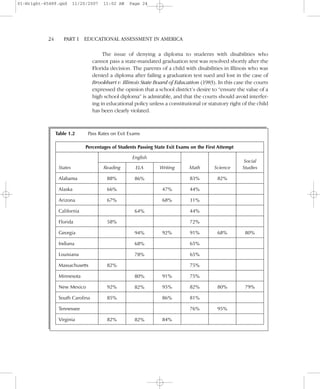
been denied a diploma was a violation of the 14th Amendment of the U.S.
Constitution (see Table 1.2).
The resolution of the case, known as Debra P. v. Turlington, happened in
1981. The courts ruled in favor of the state of Florida. This ruling came after
the court noted the fact that Florida had aligned the test items with the cur-
ricula taught in the schools, and that all students had several opportunities to
learn what was required to pass the assessment and earn a diploma. Florida
awarded those students who failed the assessment a “Certificate of
Completion,” which allowed them to enroll in adult education through which
they could work toward their diplomas.
Chapter 1 Issues and Measurement Practices in the Schools– –23
01-Wright-45489.qxd 11/20/2007 11:02 AM Page 23
The issue of denying a diploma to students with disabilities who
cannot pass a state-mandated graduation test was resolved shortly after the
Florida decision. The parents of a child with disabilities in Illinois who was
denied a diploma after failing a graduation test sued and lost in the case of
Brookhart v. Illinois State Board of Education (1983). In this case the courts
expressed the opinion that a school district’s desire to “ensure the value of a
high school diploma” is admirable, and that the courts should avoid interfer-
ing in educational policy unless a constitutional or statutory right of the child
has been clearly violated.
24– –PART I EDUCATIONAL ASSESSMENT IN AMERICA
States
Alabama
Alaska
Arizona
California
Florida
Georgia
Indiana
Louisiana
Massachusetts
Minnesota
New Mexico
South Carolina
Tennessee
Virginia
Reading
88%
66%
67%
58%
82%
92%
85%
82%
ELA
86%
64%
94%
68%
78%
80%
82%
82%
Writing
47%
68%
92%
91%
95%
86%
84%
Math
83%
44%
31%
44%
72%
91%
65%
65%
75%
75%
82%
81%
76%
Science
82%
68%
80%
95%
Social
Studies
80%
79%
Table 1.2 Pass Rates on Exit Exams
Percentages of Students Passing State Exit Exams on the First Attempt
English
01-Wright-45489.qxd 11/20/2007 11:02 AM Page 24
Advanced Program Admission
Another area in which case law is guiding the use of educational tests is
in the admission of students into advanced programs. The question is one of
the selection of children for gifted programs. An example is that of the three
selective secondary schools for the gifted in Boston. In Boston, the use of a
test score to place students into these programs for the academically talented
resulted in racial and ethnic disparities in enrollments. To correct the imbal-
ance, the school admission policy was modified to include racial set-asides.
Differential admissions programs for minority groups at these schools have
come under court review, and the three schools have all been ordered to
Chapter 1 Issues and Measurement Practices in the Schools– –25
Student
Groups
All
students
Asian
Black
Hispanic
White
Free/
reduced
lunch
Students
with
disabilities
English
language
learners
Indiana
Math
65%
79%
31%
46%
70%
42%
24%
33%
Indiana
English/LA
68%
72%
38%
49%
73%
45%
19%
28%
Minnesota
Math
75%
62%
33%
43%
80%
51%
33%
32%
Minnesota
English/LA
80%
61%
46%
52%
86%
59%
40%
30%
Massachusetts
Math
75%
84%
46%
41%
82%
Not Available
39%
42%
Massachusetts
English/LA
82%
79%
59%
51%
87%
Not Available
46%
39%
SOURCE: From Center on Education Policy; based on information collected from state departments of education.
Copyright 2002 by Center on Education Policy. Reprinted with permission.
Percentages of Students Passing on the First Attempt by Subgroups for Three States
01-Wright-45489.qxd 11/20/2007 11:02 AM Page 25
stop racial set-asides in their admissions (Wessmann v. Gittens, 1998). In
2005, it was noted that the end of the set-aside policy in Boston has resulted
in a skewing of the enrollment in programs for the gifted toward White and
Asian students and away from African American students (Sacchetti, 2005).
Higher Education
Most of the case law issues regarding admissions have taken place with
colleges and graduate schools. Most higher education institutions have the
admissions goal of creating a diverse population of undergraduate students.
This tenet is established to assure that different communities and ethnicities
are part of the culture of the institution. The assumption is that living in such
a culture becomes an important part of the learning experiences of under-
graduate students. It should also be noted that not all higher education insti-
tutions seek diversity in all dimensions of the student body. For example,
almost all the students attending Bob Jones University (evangelical Protestant)
and Ave Marie University (Roman Catholic) share a common campuswide doc-
trine and religious faith. Alverno College only accepts women, while Wabash
College is an all-male institution. Historically there are a number of colleges
that were originally established to educate African American students. Most of
these institutions of higher education are still primarily attended by African
American students.
The easiest solution for the admissions office to promote student diver-
sity is an open-door approach. The problem occurs for those institutions that
maintain a selective admissions policy while still seeking student diversity.
This can be a daunting challenge.
Early Case Law on Admissions
Over the past 50 years the legal battles over enrollment in America’s
schools and colleges have gone through a 180-degree turn. In the 1950s and
1960s the fight led by the attorney general and the Supreme Court under
Chief Justice Earl Warren was to desegregate unwilling school systems and
colleges. Most of these were located in the South and in the antebellum bor-
der states. The landmark Supreme Court decision was Brown v. Board of
Education (347 U.S. 483 [1954]). This decision did away with the concept of
“separate but equal” in all matters of public accommodation, including edu-
cation.7
During the 1960s, Attorney General Robert Kennedy brought deseg-
regation lawsuits against hundreds of school systems and the state
departments of education in a dozen states.
26– –PART I EDUCATIONAL ASSESSMENT IN AMERICA
01-Wright-45489.qxd 11/20/2007 11:02 AM Page 26
A major shift in the zeitgeist occurred during the late 1960s, and by the
1970s many school systems and most colleges were working to remove all
vestige of segregation from their student populations. During that era, col-
leges and professional schools began to take positive (affirmative) steps to
increase minority enrollment.8
Score Gap
The persistence of significant differences between the average scores of
different racial groups on all high-stakes and admissions tests is a vexing
and longstanding problem for educators (see Table 1.3). In an earlier era this dif-
ferential would have been explained as being a function of inherited differences
in ability. Today, a number of observers are willing to explain the difference in
Chapter 1 Issues and Measurement Practices in the Schools– –27
Males
Females
Table 1.3 Tables From ACT Scores by Gender and Ethnicity
National Average ACT Composite Score by Gender, 1994–2006
1994
20.9
20.7
1995
21.0
20.7
1996
21.0
20.8
1997
21.1
20.6
1998
21.2
20.9
1999
21.1
20.9
2000
21.2
20.9
2001
21.1
20.9
2002
20.9
20.7
2003
21.0
20.8
2004
21.0
20.9
2005
21.1
20.8
2006
21.2
21.0
All Students
African American/Black
American Indian/Alaskan Native
Caucasian American/White
Hispanic
Asian American/Pacific Islander
Other/No Response
National Average ACT Composite Scores by Race/Ethnicity, 5-Year Trends
2002
20.8
16.8
18.6
21.7
18.4
21.6
20.3
2003
20.8
16.9
18.7
21.7
18.5
21.8
20.6
2004
20.9
17.1
18.8
21.8
18.5
21.9
20.9
2005
20.9
17.0
18.7
21.9
18.6
22.1
20.9
2006
21.1
17.1
18.8
22.0
18.6
22.3
21.1
SOURCE: From www.act.org. Copyright © 2007. Reprinted with permission from ACT, Inc.
01-Wright-45489.qxd 11/20/2007 11:02 AM Page 27
achievement between groups in terms of group attitudes and motivation
(Thernstrom & Thernstrom, 2003) (see Table 1.4).
Confounding this problem of differential average scores on achievement
tests is the fact that there is a direct, monotonic relationship between the
income level of families and the admissions test scores of children in those
families. Likewise, there is a direct relationship between the quality of the
high school that students attend and the admissions test scores students
earn. In part, this reflects the availability of a competitive academic environ-
ment in the high schools of high-scoring students (Bridgeman & Wendler,
28– –PART I EDUCATIONAL ASSESSMENT IN AMERICA
Gender
Female
Male
Ethnicity
American Indian or Alaskan Native
Asian, Asian American, or Pacific Islanders
African American or Black
Mexican or Mexican American
Puerto Rican
Other Hispanic or Latino
White
Other
No Response (5%)
Verbal
502
505
487
510
434
454
459
458
527
494
487
Math
502
536
494
578
429
465
456
463
536
513
506
Writing
502
491
474
512
428
452
448
450
519
493
482
Total
1506
1532
1455
1600
1291
1371
1363
1371
1582
1500
1475
Table 1.4 Tables From SAT Scores by Gender and Ethnicity
SOURCE: 2006 College-Bound Seniors. Copyright © 2006 the College Board, www.collegeboard.com.
Reproduced with permission.
2006 COLLEGE-BOUND SENIORS TEST SCORES: SAT
Approximately 1.47 million test takers, of whom 53% were female
01-Wright-45489.qxd 11/20/2007 11:02 AM Page 28
Chapter 1 Issues and Measurement Practices in the Schools– –29
2004). The complexity and rigor of high school curriculums followed by
students have been shown to predict how well those students do in under-
graduate college (Glickman & Babyak, 2006).
Parental Factors
Middle-class families are likely to pay the required tuition for their
children to attend a test-preparation course and to hire academic and test-
preparation tutors (Chiles, 1997). It is clear that family income and parent
education level have a lot to do with student achievement (Joireman &
Abbott, 2004) (see Table 1.5).
Family Income
Less than $10,000/year
$10,000–$20,000/year
$20,000–$30,000/year
$30,000–$40,000/year
$40,000–$50,000/year
$50,000–$60,000/year
$60,000–$70,000/year
$70,000–$80,000/year
$80,000–$100,000/year
More than $100,000/year
No Response (35%)
ALL TEST TAKERS
Reading
429
445
462
478
493
500
505
511
523
549
503
Math
457
465
474
488
501
509
515
521
534
564
518
Writing
427
440
454
470
483
490
496
502
514
543
497
Total
1313
1350
1390
1436
1477
1499
1516
1534
1571
1656
1518
Table 1.5 Average SAT II Reasoning Scores by Family Income Group
SOURCE: 2006 College-Bound Seniors. Copyright © 2006 the College Board, www.collegeboard.com.
Reproduced with permission.
Scores not reported
01-Wright-45489.qxd 11/20/2007 11:02 AM Page 29
30– –PART I EDUCATIONAL ASSESSMENT IN AMERICA
These factors are linked to parental behaviors such as the enforcement
of homework time and the setting of limits on television watching. Home fac-
tors are central to the academic success of all students. In a recent study of
the students in several middle schools in Pennsylvania, it was found that 15%
of the variance in success on the mandated statewide assessment was
accounted for by a vector of variables that measure home life. These vari-
ables included parent education level, parent expectations for the child’s
education, hours spent reading for pleasure, the number of books and mag-
azines at home, family mobility, frequency of absenteeism by the child, and
the number of hours the child spent watching TV (Holbrook & Wright, 2004).
Howard Gardner once quipped that we can predict with surprising accuracy
whether a youngster will eventually graduate from college by only knowing
his/her zip code (personal communication, Howard Gardner, April 2007).
The score gap on admissions tests has been examined by a number of
authors, including Claude Steele. He presents evidence that there may be at
least two extraneous factors in the SAT scores of African American and Latino
children. One source is produced by the “stereotype threat” created by the test
situation (Steele, 1997, 1999). Steele has demonstrated that “stereotype threat”
occurs when minority students are placed in a high-stakes test situation. His
research has shown that in those situations minority students feel the added
stress of the stereotypical expectations held for them. The extra pressure caused
by the fear of proving the stereotype correct correlates with lower performance.
The second problematic area is related to the linguistic aspects of the
test items (Freedle & Kostin, 1997). Roy Freedle (2002) has identified differ-
ences in word utilization patterns between White and Black adolescents. This
has the potential of producing differential test item performance (Dorans &
Zeller, 2004). The unexpected and unexplained finding is that African
American test takers perform better on the hardest items and less well on the
easiest items. This is the opposite of what occurs with a population of
middle-class White test takers. If the harder items were to be given extra
weight on the test, the score gap would be reduced by a third. Also, Freedle
points out the correction for guessing that ETS applies to all the SAT II
scores disproportionately lowers the scores of minority students who make
more errors on the easier items of the test.
Standard formula for the correction for guessing on a test
composed of multiple choice questions that each have four
answer options,
total corrected raw score =
total correct − total wrong
4
01-Wright-45489.qxd 11/20/2007 11:02 AM Page 30
There is also reason to believe that tests involving essay writing may also pre-
sent a problem. Essay tasks that provide background information about the
topic for the writing assignment tend to be easier to write than essay tasks that
provide no structure or guidelines. The performance of African American ado-
lescents is best when the essay format is the hardest (i.e., no structure).
The move toward the use of computer adaptive testing may prove to
lead to an even wider score gap between White and Black students (see
Chapter 2). This reflects the way computer adaptive systems are designed
to first attempt to determine an approximate ability level for the test taker
(Cheng & Chang, 2007). This is done by presenting several items of a mid-
level of difficulty at the start of the test. Based on the student’s performance
on those items, the test taker is then presented with items assumed to match
his/her ability. If Freedle’s model is correct, it is possible that African
American students could never be presented with the more difficult level of
test items and thereby have test scores based on easier questions. The result
will be low scores that are assigned to those answering easier questions.
Affirmative Action in Admissions
It was a natural step for highly selective institutions to adopt an affirmative
action model for their admissions processes. One reason for this decision is that
the pool of available minority students who have high SAT scores is very small.
Research sponsored by ETS has shown that only 3.3% of African American test
takers scored over 1300 on the SAT I, while 9% of Hispanic students and 39% of
Anglo-White students scored at that level (Bridgeman & Wendler, 2004).
Chapter 1 Issues and Measurement Practices in the Schools– –31
Case in Point (1g)
Admission test scores are one of only two primary predictors of college poten-
tial. The other is high school class rank, which is derived from the high school
grade point average (GPA) of students. The importance of tests like the SAT II
in the admission process is increasing because high schools have begun not
reporting either a GPA or class rank (Finder, 2006). This reflects an effort by a
number of suburban high schools to remove unhealthy levels of letter-grade
stress on students. The movement began with private schools that were trying
to provide a way for the good students who attend their highly competitive
schools to be admitted into the most elite colleges (Zweigenhaft, 1993).
Those college admission officers who evaluated the entering class of
2009 reported that half or more of the applicants’ transcripts did not report the
class rank or the high school GPA. The result was that SAT II and ACT scores
were more important in the admissions decision than ever.
For more
information, see
“Considerations on
Point” at
www.sagepub.com/
wrightstudy
01-Wright-45489.qxd 11/20/2007 11:02 AM Page 31
Affirmative action plans made it possible for both selective public
schools9
as well as institutions of higher education to set minority enrollment
targets and actively work to achieve them. Such strategies took the form of
simple quotas or in some cases the addition of bonus points to the admis-
sions file of minority students.
Recently reported research into the admissions process at highly selec-
tive institutions demonstrates that several classes of students were given
preference in admission.10
The advantage given to African Americans is the
equivalent of 230 extra points on the 1600-point (SAT I) scale being added to
their test score. The advantage to Hispanic Americans has been worth 185
extra points (Espenshade & Chung, 2005). The advantage to Asian students
has been negative, equaling a loss equivalent to 50 points.
Naturally, when higher scoring students of one racial group were
rejected for admissions and lower scoring students from a minority were
accepted, tension ensued. It had to be anticipated that these affirmative
admissions systems would be criticized and come under legal challenge.11
Court Challenges
When an otherwise well-prepared non-minority student receives a letter
of rejection from a college or professional school, the personal pain can be
excruciating (Kinzie, 2007). The rejected student may well blame the admis-
sions process or others who are perceived as receiving special treatment.
The first challenge to affirmative action in admissions was a case involving
admission into the Medical School of the University of California at Davis. In
this case, a White male applicant was rejected for admission in 1974 and sued
the regents of the university on the basis of Title VI of the Civil Rights Act
of 1964 and the equal protection clause of the 14th Amendment of the
Constitution of the United States (University of California Regents v. Bakke,
438 U. S. 265 [1978]). The university had established a special admissions pro-
gram for the economically disadvantaged and members of targeted minority
groups, including African Americans, Chicanos (Mexican Americans), Asians,
and Native Americans. This special admissions process used a set-aside pro-
gram that guaranteed that there would be 16 seats available for the targeted
groups. This approach to admissions was rejected, but a separate opinion
written by Justice Powell, and affirmed by the Court, did recognize student
diversity as a compelling state interest.
The second major blow to affirmative action in admissions came from
a case in Texas. In that case, Hopwood et al. v. The State of Texas (1994),
the issue before the courts involved admission into the Law School of the
32– –PART I EDUCATIONAL ASSESSMENT IN AMERICA
01-Wright-45489.qxd 11/20/2007 11:02 AM Page 32
University of Texas, Austin. Among the many Anglo-White students who were
rejected for admission into the Law School were four who sued. The Law
School had previously created a second parallel admissions process reserved
for African American and Mexican American applicants. These targeted
minority groups were subjected to a less selective admissions test score
requirement than were Asian and Anglo-White students, including the four
who brought the lawsuit. Based on their scores on the Law School Admission
Test (LSAT) and undergraduate grades (GPA), the four who sued all would
have been admitted if they were members of either of the targeted minority
groups. At the first level, the state courts agreed with the university and its
admissions system, rejecting the Hopwood petition. On appeal, the U.S. Fifth
Circuit Court overturned that decision and effectively ended that affirmative
admissions practice (Hopwood et al v. University of Texas, 861 F. Supp. 551,
578–579 [WD. Tex. 1994] 5th Circuit [1996]).
The final defining cases for affirmative action in admissions involved two
of the colleges of the University of Michigan in 2003. The first, Gratz et al. v.
Bollinger et al., involved admission of two undergraduates into the College of
Literature, Science, and the Arts. The university used a point system to assist in
the admission decision process. Admission was granted to all students who
reached a total of 100 points using a system that included a weighted combi-
nation of test scores, GPA, and Advanced Placement (AP) course completion.
All targeted minority group members (African American, Hispanics, and Native
Americans) were automatically awarded a bonus of 20 points on their admis-
sions files. The Supreme Court held for the plaintiffs and rejected the admis-
sions model employed for undergraduates at the University of Michigan (Gratz
v. Bollinger [02-516]. U.S. [2003]). The court rejected the argument that
Michigan’s admissions office needed a simplified point system because the
number of applications was too high to give individual attention to each case.
A second case, Grutter v. Bollinger et al., at the University of Michigan
has provided guidance for all admissions systems that strive to be both highly
selective and also enroll a significant number of minorities. The university’s
law school employs a holistic approach to admissions, which includes LSAT
scores and undergraduate GPA. It also looks at “soft variables” including
enthusiasm, recommendations, the quality of the applicant’s essay, life expe-
riences, and the difficulty of the undergraduate course of study. The stated
goal of this admissions system is to select motivated and able students with
the best potential to contribute to the practice of law in Michigan.
Barbara Grutter had excellent grades and a high LSAT score, but she was
not admitted. She argued that the admissions process was biased in favor of
minority students. She won her case in the district court but had it reversed
by the U.S. Sixth Circuit Court. On appeal, that decision was upheld by the
Chapter 1 Issues and Measurement Practices in the Schools– –33
01-Wright-45489.qxd 11/20/2007 11:02 AM Page 33
U.S. Supreme Court (Grutter v. Bollinger et al., 02-241. U.S. [2003] 288 F.3d
732, affirmed). The opinion of the Supreme Court was that the admissions
system of the law school met the requirements as specified in the opinion of
Justice Powell from the Bakke case of 1978.12
The justices recognized that
there is a compelling reason for an agency of the state (University of
Michigan) to consider the race of potential students. Thus, it is possible to
include race as a variable in admissions decisions when those decisions are
made following a holistic approach to student selection.13
The compromise implied by the Bollinger cases not withstanding, in 2007
the regents of the University of Wisconsin voted to approve a policy requiring
that the race of applicants be considered as one salient factor in the admissions
process. In addition, a special scholarship program available only to students
who are members of one of three different ethnic minority groups was contin-
ued for undergraduate students of the university (Schmidt, 2007). When UCLA
initiated a holistic system in 2006 for use in the admission of undergraduate
students, that institution was able to report an increase in the proportion of
African American students of approximately 40% (Schmidt, 2007).
EDUCATIONAL ETHICS AND TESTING
Professional associations hold themselves to be keepers of the best traditions
and practices of their fields and assume that the general public will have
confidence in their work and respect for their members. To assure this con-
tinuing regard of the public, the various professional associations publish
guidelines for the ethical behavior and practice of their members. In the field
of educational testing, the primary associations with an interest in the issues
of educational measurement have published a single document on ethics.
This document is the combined effort of the American Counseling Association
(ACA), the American Educational Research Association (AERA), the American
Psychological Association (APA), the American Speech–Language–Hearing
Association (ASHA), the National Association of School Psychologists (NASP),
the National Association of Test Directors (NATD), and the National Counsel
on Measurement in Education (NCME).
The following are four principles that are drawn from that document
(Joint Committee on Testing Practices, 2005).14
1. The first of these principles for the ethical practice of testing involves
communication with those taking the test. The purpose of the test
and the areas that are to be measured should be fully understood by
the test taker prior to the time of the test. The use of scores from the
34– –PART I EDUCATIONAL ASSESSMENT IN AMERICA
01-Wright-45489.qxd 11/20/2007 11:02 AM Page 34
test should be explained and the test takers should be told how long
their results will be kept on file. This communication includes provid-
ing test takers with practice on similar materials to familiarize them
with the mechanics of the measure. Also, the test administrator
should be aware of the need for special accommodations that test
takers may require prior to the time of the administration of the test.
2. The second area involves confidentiality. It is necessary for the test
administrator to put into place procedures that ensure that the scores
from individual students are never disclosed to people not having
professional need for those data. The students’ parents are included
in the group who should have access to the test score data.
At another level, confidentiality involves the test itself. It is critically
important that test materials be stored in a secure location and never
released for review by interested others.
3. The third point is that the interpretation of the test scores should be
carried out in a way consistent with the guidelines provided by the
test developer and publisher. This also implies that the person inter-
preting the scores should be trained in the process and knowledge-
able of the test and its scores. Parents and students should be
informed of the scores and their interpretation in a developmentally
appropriate way, using understandable language. Educators who dis-
cuss score reports with parents and students should avoid educa-
tional jargon and provide clear descriptions to the parents and
students. This includes the process used by the various agencies in
setting cut scores and minimal standards for success. If there is a scor-
ing error it should be corrected immediately and that correction car-
ried through on all of the student’s records.
4. Finally, a single score on a test should never be used to determine the
placement of a student. Interpretations should always be made in con-
junction with other sources of information.
A last point involves the development and selection of tests. A test or
assessment should never be used for a purpose for which it was not designed
and has not been standardized. The test should provide a manual document-
ing that the measure is valid and reliable for the tasks it is designed to accom-
plish. Also, the measure should provide evidence that there is no consistent
gender bias or ethnic or racial group bias represented in the scores. The test
should provide users with detailed directions for the test administration as
well as for those who score the test.
Chapter 1 Issues and Measurement Practices in the Schools– –35
01-Wright-45489.qxd 11/20/2007 11:02 AM Page 35
The people of this country are investing enormous amounts of their resources
in the endeavor of public education. Therefore, it is not a surprise that the
public has expressed a need for accountability in education. To have account-
ability there must be regular assessments of educational outcomes. The most
common vehicle for those assessments is through the use of batteries of paper-
and-pencil format achievement tests. This accountability system has been ratch-
eted up under the provisions of the No Child Left Behind Act of 2002. That
legislation was designed to close gaps in the average levels of achievement
between groups of students. This act also furthered the use of high-stakes tests
in the assessment process and required that schools make adequate yearly
progress toward the goal of having all students achieving at a proficient level.
These assessments are established by each state and are based on specific stan-
dards that each state has established. This legal position established by case law
does not conform with the ethical principles established by the learned and pro-
fessional societies that have a vested interest in educational testing programs.
Educational technology is changing the format and nature of educational
assessments. Increasingly, assessment tests are administered online. The
same technology is improving the communication between teachers and
parents and making it increasingly possible for parents to be partners in their
children’s education.
Legislation and case law have provided guidance in the use of educa-
tional tests and assessments. Federal legislation ushered in a new era for
children with disabilities with the passage of laws including the Individuals
with Disabilities Educational Act (1997) and the Individuals with Disabilities
Educational Improvement Act (2004). Also, the rights of parents to control
the flow of testing data were established in the Family Educational Rights and
Privacy Act of 1974. The federal courts have also shaped testing policy by
approving the use of high-stakes assessments in making graduation and even
grade promotion decisions. These high-stakes uses of tests and assessments
are permitted even if the sanctions that are imposed are felt disproportionally
by one or more of the minority groups of students.
1. How does the British experience over the 18th and 19th centuries
with testing school students and awarding merit pay to teachers com-
pare with the current reforms in American education?
36– –PART I EDUCATIONAL ASSESSMENT IN AMERICA
Summary
Discussion Questions
01-Wright-45489.qxd 11/20/2007 11:02 AM Page 36
2. Should parents be able to hold their children out of public education
for an extra year (“academic redshirting”) to give them a developmen-
tal advantage over their peers? Explain your position.
3. What arguments can be made for and against retaining children in
third grade who do not achieve a score of proficient (pass) on the
state-mandated high-stakes tests? What do you believe should be done
with low-performing children on the state tests?
4. Should the 50 states be permitted to replace the use of standardized
tests composed of multiple choice questions with a more open-ended
form of assessment (i.e., portfolio assessments)? Explain your posi-
tion on this issue.
5. Should the business community have the ability to initiate educational
reforms in the public schools? What advantages and disadvantages are
there to having business leaders and entrepreneurs set goals and cre-
ate priorities for educational reform?
6. What specific procedures should a state department of education take
to standardize how its many school districts count the number of
students who have dropped out of school?
7. In the selection of students for special programs, and in college
admission, should educators take specific steps to ensure a propor-
tional ethnic/racial mix in the student body? If you feel that diversity is
an appropriate goal to work toward, how can this be achieved within
current case law as adjudicated?
8. Check with your local school system and ask to see a copy of its writ-
ten guidelines for the maintenance and distribution of student test
data. After reviewing that policy, determine if it seems to meet the
requirements under the Buckley Amendment.
Educational Assessment on the Web
Log on to the Web-based student study site at www.sagepub.com/
wrightstudy for additional Web sources and study resources.
Chapter 1 Issues and Measurement Practices in the Schools– –37
Student Study Site
01-Wright-45489.qxd 11/20/2007 11:02 AM Page 37
NOTES
1. The first sophisticated educational testing system emerged in Great Britain. The
British system reflecting a new nationalism started in 1710, just three years after
the Crowns of England and Scotland were united into one United Kingdom. That
testing program assessed students against national educational standards in
reading, writing, and arithmetic. By the 1860s, teachers throughout Great Britain
were even paid on the basis of student test scores, a system that lasted for
another 30 years (Troen & Boles, 2005). The result was the truncation of the cur-
riculum, and instruction focused on only those three core areas included on the
test, the famous three R’s. It also brought about the demoralization of the teach-
ing profession and widespread cheating and corruption.
2. A number of terms are used throughout this book and have both vernacular and
technical meanings. One is evaluation, a process of judging or making a decision
based on observations and/or measurements; another is measurement, a method
or device used to assign a numerical value to a characteristic of people or objects;
assessment is a broad term encompassing all the methods employed to gain infor-
mation about a person or object, including tests and other measures; and finally
test, a word describing on organized task or series of tasks employed to represent
and demonstrate knowledge, a skill, or a trait of an individual.
3. Many of the Regents examinations from the past 50 years can be seen at
www.nysl.nysed.gov/regentsexams.htm.
4. In 2006 at total of 22,873 public and charter schools failed to make Adequate
Yearly Progress (AYP; Packer, 2006).
5. The states that require a score of proficient on the state’s assessment to be pro-
moted to the next grade include Delaware, Florida, Georgia, Louisiana, North
Carolina, Texas, and Wisconsin.
6. Bowing to parent pressures, several states reconsidered their lack of education-
ally challenging programs for gifted students (Samuels, 2007).
7. This did away with the notorious case law set by the Supreme Court in 1896
known as Plessy v. Ferguson, which had permitted states and local governmen-
tal units to provide “separate but equal” facilities, schools, and programs for
identified racial groups. This court decision legalized the policy of American
apartheid.
8. A subsequent exception was in Virginia, where the Virginia Military Institute
(V
.M.I.), a public college, fought against the admission of women students
(United States v. Virginia et al., and Virginia et al. v. the United States, 94-1941
& 94-2107, § 64 U.S.L.W
. 4638 [1996]). In August of 1997, following the decision
of the U. S. Supreme Court (7–1), V
.M.I. enrolled 30 freshman women.
9. There are a number of public schools that are designated for the most talented
and/or mentally gifted students in the country. Many of these “admission by test-
ing” and highly specialized schools are located in urban centers. They include
38– –PART I EDUCATIONAL ASSESSMENT IN AMERICA
01-Wright-45489.qxd 11/20/2007 11:02 AM Page 38
Lowell High School, San Francisco; Boston Latin High School; Eastern Sierra
Academy, Bridgeport, California; Philadelphia’s Central High School; Dallas
School for the Talented and Gifted; Bronx High School for the Sciences; Buffalo’s
(NY) Honors High School; Bloomfield Hills, Michigan’s, International Academy;
and Alexander W
. Dreyfoos School of the Arts, West Palm Beach.
10. There is no evidence that a degree from a highly selective or elite college is
related to the level of success experienced by the graduate later in life. More crit-
ical are the factors of motivation, ability, and personal desire (Easterbrook, 2004).
11. The administration of President George W
. Bush was at the forefront in the fight
against any consideration of race or ethnicity in admissions decisions. Critics of
the administration have raised the issue of the provisions of the No Child Left
Behind Act, which require performance assessments that are tabulated and
reported by race when those data are never permitted for use in the admission
process (Gershberg & Hamilton, 2007).
12. Allan Bakke went to the Medical School at the University of California, Davis, and
eventually became a respected anesthesiologist in Minnesota.
13. Following the Grutter decision, in 2006 the American Bar Association began
requiring all law schools in the United States to demonstrate concrete steps
toward developing student bodies, faculties, and staffs that are racially and
ethnically diverse. In 2006, Jennifer Gratz, a plaintiff in the Gratz v. Bollinger
case, led a statewide drive in Michigan to pass Proposition 2 outlawing all forms
of affirmative action in that state. The measure passed on November 7, 2006. As
written, the new law prevents any consideration of ethnicity in admission to any
publically supported program, school, college, or professional and/or graduate
school. This law stands in opposition to the admission policies required for
accreditation of various professional programs (e.g., law).
14. The ethical principles for classroom-level testing by teachers are similar to those
for large-scale assessment tests. Those issues are presented in Chapters 6 and 7,
which focus on the use of high-stakes measures and other standardized mea-
surements in the schools.
Chapter 1 Issues and Measurement Practices in the Schools– –39
01-Wright-45489.qxd 11/20/2007 11:02 AM Page 39

ISSUES AND MEASUREMENT.pdf

  • 1.
    3 Chapter 1 ISSUES ANDMEASUREMENT PRACTICES IN THE SCHOOLS We must start where men who would improve their society have always known they must begin—with an educational system restudied, reinforced, and revitalized. —Lyndon B. Johnson January 12, 1965 Issues and Themes Testing is an integral part of the life story of all American children. The American public supports verifying the quality of public education through accountability. This press for educational accountability has increased both the number and importance of educational assessments in the schools. An assessment is a multidimensional method for collecting data that usually includes testing. Educational testing is normally conducted to measure the status of the child on one dimension, such as arithmetic, whereas an assess- ment is designed to provide multiple sources of data. A battery of tests is often the core component of the assessment. Batteries are a collection of tests that are designed to measure different parts of the curriculum—e.g., mathematics, reading, and science. 01-Wright-45489.qxd 11/20/2007 11:02 AM Page 3
  • 2.
    High-stakes assessments areeducational measures that have significant negative consequences for failure. The No Child Left Behind Act (NCLB; P .L. 107-110, 2002) is the latest major stimulant for the use of high-stakes assess- ments in public education. During the past 20 years, federal court rulings have supported both the use of these high-stakes tests and the sanctions that are applied when children and schools fail to measure up. One outcome of the No Child Left Behind Act mandates is a major boon for the publishers of educational tests. Over a billion dollars are now being spent by the states to develop, administer, and score these new mandated tests. The whole face of testing is changing rapidly with the introduction of technology into the assessment process. With all of these changes, the education profession has scrambled to provide statements of ethical principles and practitioner guide- lines for testing programs. By reading and studying this chapter you should acquire the competency to • Describe the relationship between accountability, assessment, and testing • Explain the major reasons why children are assessed • Describe the three assumptions made by test developers • Discuss the relationship of formative and summative testing in the classroom • Contrast norm-based and criterion-referenced tests • Describe the case law related to the selection of students for admis- sions into advanced high school programs • Explain how case law has affected the college admission process • Explain how case law has affected the practice of educational testing and assessment • Present and discuss the core ethical canons related to educational testing Accountability, Assessment, and Testing Accountability refers to the linkage and balance between the outcome of an enterprise and the efforts and resources used to achieve that outcome. In education, assessment provides an accounting of how much children learn 4– –PART I EDUCATIONAL ASSESSMENT IN AMERICA Learning Objectives 01-Wright-45489.qxd 11/20/2007 11:02 AM Page 4
  • 3.
    in school andwhat resources are expended on achieving those learning out- comes. The need for accountability grew in this country as the cost of educa- tion grew. In the 1960s, the cost of public education was not just the largest part of each states’ budget; it was actually equal to the cost of running every other state agency combined. Educational accountability requires that all students be assessed to quantify what they have learned and what skills they have developed. Commercially published tests of student achievement have been around since the 1920s. The publishers of these tests have formed a cozy relation- ship with the schools that bought into their use for school and student eval- uation. By the 1980s, virtually every school system could make the illogical boast that their school district was above average. A West Virginia physician (John J. Cannell, M.D.) was first to ask the question: If the average is in the middle of the data, how it is possible for everyone to be above average (Phelps, 2005)? The 19th century saw the first efforts in the United States to determine the success of schools in meeting local and statewide goals for the education of children. The first attempt to assess a large American school system involved a test administered to the children of Boston in 1845. That testing program was organized by Massachusetts’s new state school superintendent, Horace Mann (Crocker, 2003).1 With this effort to assess educational out- comes, the students of Boston were tested for their understanding of the facts that they were learning in the new “common schools” of Boston. In 1864, the Board of Regents of New York initiated a statewide “preliminary test” for junior high–aged school students. This measure was used as a basis for allocating state funds to the various school systems.2 This was supplanted by a mandated set of examinations known as the New York Regents Examinations in 1878, which assessed all high school students (New York State Education Department, 1987).3 The assessments of student educational progress can be accomplished using several different methods. In this text there is a chapter describing alternative approaches to assessment (Chapter 9) and another describing the use of essay tests (Chapter 7). However, the paper-and-pencil test with mul- tiple choice questions is the dominate method of constructing all the state- mandated tests designed for the assessment of achievement. The advantages to this approach to assessment include the fact that these “objective tests” are less expensive to score and involve less effort by local school personnel to develop and administer than do alternative assessment approaches. Also, data from these tests are readily quantifiable and familiar to the policy mak- ers and the general public. The downside of this approach to assessment is that the multiple choice questions used to build these measures tend to Chapter 1 Issues and Measurement Practices in the Schools– –5 01-Wright-45489.qxd 11/20/2007 11:02 AM Page 5
  • 4.
    stress rote learning,favor students from middle-class backgrounds, and are based on a technology born under a cloud of tacit racism (see Chapter 2). In summary, accountability in education is an inevitable requirement that is associated with spending large amounts of public tax funds. Educational accountability requires that an assessment be made of the outcome of the educational process. One method of assessment involves using paper-and- pencil tests. Typically these tests are primarily composed with multiple choice format questions. When there are several tests that make up the assessment, the term test battery is appropriate to describe the measurement. WHY DO WE TEST? At one level we test to protect the health and physical status of the child. This type of testing starts at the moment of birth. Typically, it is the attending obstetrician who welcomes the newborn into the world, and it is this physi- cian who is first to formally assess the child. That medical status examination, the Apgar, is an observational rating scale that is administered one minute after the birth of the child and again four minutes later (see Table 1.10). From this starting point, the growing child will be assessed and measured by a pediatrician on a regular basis. By the age of four, children enrolled in Head Start programs are tested to determine how well those centers are doing their jobs. This is one of the accountability functions of testing. This assessment process is then repeated in the public schools under a federal mandate beginning in third grade and extending into the high school years. In 1965 President Lyndon Johnson’s legislative package included a new act directed toward providing federal assistance to the nation’s public schools. This act, the Elementary and Secondary Education Act (ESEA, 89-10, 1965) provided money to improve the educational achievement of children living in poverty. One part of this act created a method to measure the impact of the improvements being instituted throughout the schools of the country. That method resulted in the development of what is known as the Nation’s Report Card (National Assessment of Educational Progress [NAEP]). Today this measure provides a picture of how well each state is doing in educating its children. Also, we test to measure how much progress each child is making toward developing proficiency in core areas of learning. The driving issue here is also one of accountability in education. This type of testing was begun during the 1990s and became mandatory in 2002 under terms of the revised ESEA, now 6– –PART I EDUCATIONAL ASSESSMENT IN AMERICA 01-Wright-45489.qxd 11/20/2007 11:02 AM Page 6
  • 5.
    known as theNo Child Left Behind (NCLB) Act. Today, all 50 states have both specified what all children are expected to learn at each grade level in the core subjects (reading, mathematics, and science) and have developed tests to measure achievement in those areas. Naturally, our schools have revamped their curriculums in an effort to stress these core subjects. This has had a negative impact on the variety of subjects and disciplines taught in the schools (Jennings & Rentner, 2006). The curriculum most public school children are exposed to has been skewed away from the arts and humanities and toward the content covered by the mandated assessments (Dillon, 2006; Manzo, March 2005). This has done great damage to those curriculum areas that are not tested. As a result, the curriculum followed in most schools now de-emphasizes areas such as the arts, social studies, modern language, and physical education while pro- viding extra doses of basic skills-development drill and practice in reading, mathematics, and science. Chapter 1 Issues and Measurement Practices in the Schools– –7 A P G A R Table 1.1 A Proposal of a New Method of Evaluation of the Newborn Infant SOURCE: From “A proposal of a new method of evaluation of the newborn infant,” by V. Apgar, 1953, Current Researches in Anesthesia & Analgesia, 32, p. 261–267. Reprinted with permission from Eric Apgar. Appearance (Skin Color) Pulse Grimace (Reflex Irritability) Activity (Muscle Tone) Respiration 0 Points Blue-gray, Pale All Over Absent No Response Absent Absent 1 Point Normal, Except for Extremities Below 100 bpm Grimace Arms and Legs Flexed Slow, Irregular 2 Points Normal Over Entire Body Above 100 bpm Sneeze, Cough, Pulls Away Active Movement Good, Crying A score is given for each sign at one minute and five minutes after the birth. If there are problems with the baby, an additional score is given at 10 minutes. A score of 7–10 is considered normal, while 4–7 might require some resuscitative measures. A baby with Apgars of 3 and below requires immediate resuscitation. Sign 01-Wright-45489.qxd 11/20/2007 11:02 AM Page 7
  • 6.
    To verify theold adage that no bad idea stays dead forever, a number of states are using these student data from the NCLB Act to award teachers with pay raises. Merit pay is incredibly difficult to institute fairly. There are so many differences between schools and the children who populate them that a system based on student achievement test scores is inherently flawed. The pressure for merit pay is an extension of the accountability focus of policy makers who look at schools in much the same way as they look at corpora- tions. The dismal results from almost two centuries of trying this in Great Britain have been ignored in the United States (Wilms & Chapleau, 1999). Those same state-mandated tests perform a second accountability function: They provide the data needed to determine if various groups of students within each school are making progress toward the goal of being proficient in the core subjects. This function of the mandated tests is linked to the NCLB requirement that all identified groups of children are proficient in the core subjects by the year 2014. Each school must show that all groups—including children receiving special education, Native American children, non-Hispanic Black children, Hispanic children, children with one or more disabling conditions, Anglo-White children, and children from impoverished homes—are making Adequate Yearly Progress (AYP) toward the goal of universal proficiency by 2014. The various states have each iden- tified specific standards for student learning and have established proficiency targets for the children of each grade level. Those targets or benchmarks are unique to each state but must be approved by the U.S. Department of Education (U.S. Department of Education, 2007). The argument can be made that the policy of evaluating all schools exclusively on arbitrarily established standards for learning, and fixed levels of achievement, do not do justice to Case in Point (1a) 8– –PART I EDUCATIONAL ASSESSMENT IN AMERICA A group of music educators in Florida spent three years and $90,000 develop- ing a music test that can be used as a part of a statewide assessment (Gupta, 2005). This test is presented on a CD and is answered by students on machine- scorable multiple choice forms. This test is scheduled to be a part of the statewide assessment program in 2008. By going on the offensive and forcing their subject into the state testing system, music educators have saved a place for themselves in the school curriculum. Many other subjects such as art and physical education may find that they have less space in the curriculum as they are not part of the statewide tests. For more information, see “Considerations on Point” at www.sagepub.com/ wrightstudy 01-Wright-45489.qxd 11/20/2007 11:02 AM Page 8
  • 7.
    the diversity ofcommunities, students, and schools. The central requirement of the NCLB legislation (viz., that all children achieve at a proficient level by 2014) is one that will result in nearly all schools failing to meet the mandate (Linn, 2007b).4 School Strategies Schools have taken steps to reduce the number of children scoring below the level of proficient on these mandated assessment tests. One step involves the introduction of a published achievement test during first and second grades. This achievement testing provides the teachers with data that can identify weakness in the curriculum and spot those children who may be at risk of failure on the mandated assessment in third grade. Other steps schools can take may involve after-school and summer remediation programs or revising the school’s curriculum to emphasize the elements measured by the assessment program. Yet another strategy involves the addition of sup- plementary instructional staff to tutor and provide individualized assistance to children identified as being at risk for failure. Chapter 1 Issues and Measurement Practices in the Schools– –9 For more information, see “Considerations on Point” at www.sagepub.com/ wrightstudy Case in Point (1b) Perhaps the best strategy that a school can take to improve test scores is to involve the teachers in reviewing the curriculum and the tasks required on the mandated test. One component of such a review relates to the learning standards that are being measured on the assessment and verifying that the school’s curriculum provides all students with instruction in those areas (Kristoback & Wright, 2001). The second component is one that is frequently overlooked. This involves assuring that all the test’s modalities are familiar to all students. For example, a school that teaches spelling by having children memorize spelling lists, and then tests its students by having them write down the dictation of their teacher, may do badly on a standardized spelling test. Standardized tests measure spelling achievement by having children mark all the words in a printed passage that are not spelled correctly. If children never saw this method for testing spelling achievement, they will not score well no matter how good they may be at spelling. Their low scores will not indicate what they know, only their lack of familiarity with that par- ticular modality of testing. 01-Wright-45489.qxd 11/20/2007 11:02 AM Page 9
  • 8.
    Testing is alsodone in the classroom by classroom teachers. For the most part the measures used by teachers are created by teachers or borrowed and modified by the teachers from the publisher of classroom textbooks. These teacher-made tests may be designed to check on student understanding and used in “real time” to inform the ongoing classroom instruction (see Chapter 6). In this way, testing occurs in a formative environment. A formative test is one used to check on the efficacy of the teaching-learning process. It can identify problems in understanding and guide the teacher in reteaching difficult top- ics and assisting students in achieving the instructional objective. Alternatively, teacher-made tests may be designed to provide an “end of the instructional unit” summary of what each child has learned. This is known as the summative function of tests. Summative testing provides data needed to make objective judgments about the child, including assigning report card grades. To the extent possible, teachers should always work toward assigning grades that do not appear to be either arbitrary or capri- cious. For this reason, test data built from measures of the curriculum that were actually taught should be at the core of the report card grades. Testing is also done to determine the special needs that some children may have for additional learning support and individualized education. This type of testing is part of the process of making an entitlement decision. An entitlement decision can provide extra assistance to a child who has fallen significantly behind his or her peers in terms of classroom achievement. The regulations of the various states provide that all children are entitled to a thorough and efficient education. An assessment is one approach that can provide the necessary data to document the need for assistance. Finally, testing is also done to determine which children are selected to receive advanced or specialized educational opportunities. This type of test- ing can be as prosaic as deciding if a young child is ready to attend kinder- garten or should wait for a year. 10– –PART I EDUCATIONAL ASSESSMENT IN AMERICA Case in Point (1c) Eighty years ago, the first tests for infants and young children were devised by Arnold L. Gesell at Yale University. It was Gesell who introduced the word readiness into the lexicon of educators. His research demonstrated that children have points in their development when they are mentally or physically ready to acquire a new skill or learn a new concept. Instruction before that time of readiness is futile, but once the child has reached readiness, then learning proceeds rapidly (Gesell & Thompson, 1929). Until recently, this construct was For more information, see “Considerations on Point” at www.sagepub.com/ wrightstudy 01-Wright-45489.qxd 11/20/2007 11:02 AM Page 10
  • 9.
    Chapter 1 Issuesand Measurement Practices in the Schools– –11 widely employed by public schools to decide which children were ready for admission into kindergarten and first grade and which should wait a year. In 2000, the use of these assessments for readiness screening was deemed un- acceptable by the National Association of Early Childhood Specialists in State Departments of Education (NAECS/SDE, 2000). School readiness tests are still widely used and are even mandated in several states (Stephens, 2006). Today, parents are more likely to hold their children back from enrolling in kindergarten (Datar, 2003; Gootman, 2006; Russell & LaCoste-Caputo, 2006). This voluntary delay in starting public education is being done more frequently in states where grade promotion from third grade is contingent on a test score.5 Parents who do this want their children to be a year older and more mature than their peers entering school (Brock, 2006). This practice is so widespread that it has its own sobriquet: “academic redshirting.” About half of the states require that specialized educational programs be made available to the brightest and/or most gifted students in the schools. Admission into these programs typically involves cognitive tests covering dimensions such as mental ability and creativity. This type of cognitive testing Figure 1.1 “Which Is Yours?” SOURCE: The New Yorker Collection, 1962. James Stevenson, from cartoonbank.com. All rights reserved. “Which is yours?” 01-Wright-45489.qxd 11/20/2007 11:02 AM Page 11
  • 10.
    is also linkedto college admission and certain scholarship award programs. Parents of gifted children are generally not satisfied with the NCLB testing pro- gram and the resulting curriculum modifications in the public schools. These parents see the present curriculum, with its heavy emphasis on drilling basic skills in reading, mathematics, and basic science, as not meeting the needs of their children (DeLacy, 2004; Reed, 2004; Tierney, 2004). These parents are secure in the belief that their children will pass any state assessment and want them to have an educational experience rich in complex thinking tasks, and they want an educational program that is supplemented with advanced course- work in the sciences and arts. Research has supported this parental concern. A study using computer adaptive testing in Idaho demonstrated that as educa- tional resources are focused on children who have the greatest educational needs, advanced students experience minimal achievement growth. This reflects that observation that the new curriculum over-teaches concepts that the advanced students already understand and know (Clark, 2005). To make matters worse, there is a clear and direct relationship between measures of cognitive ability and the outcome on statewide assessments (Burson & Wright, 2003). In other words, those children who are the most gifted in academic ability do well on the high-stakes tests while those who have less cognitive ability are less likely to score at the level of proficient. This raises a question of what the state-mandated high-stakes tests actu- ally measure. These assessments are supposed to be a measure of how well students have achieved the state’s approved learning standards. A general criticism of the tests is that they lack cognitive richness and are not designed to elicit complex thinking (Lane, 2004). Research has documented that many of the questions included on statewide assessments are written in a way that requires less complex thinking than the state’s own standards may require (Webb, 2002, 2005). Because there is no federal mandate requiring the states to address the differential educational needs of academically gifted children, many of those programs for the academically talented or gifted have been truncated or even eliminated to provide the resources needed to help the academically less able reach the goals of the No Child Left Behind Act (Berger, 2007). This has not gone unnoticed by the parents of gifted children, who have become vocal critics of the No Child Left Behind Act (Clark, 2005; Cloud/Thornburg, 2004; DeLacy, 2004; Goode, 2002).6 TYPES AND VARIETIES OF TESTS There are four sources of achievement tests administered in the public schools today: classroom tests and quizzes, published achievement tests, and 12– –PART I EDUCATIONAL ASSESSMENT IN AMERICA 01-Wright-45489.qxd 11/20/2007 11:02 AM Page 12
  • 11.
    the high-stakes testsrequired by the state education departments. In addi- tion to these there are a myriad of other tests that are administered as part of guidance activities, by reading specialists, by school psychologists, and by speech and language therapists. A primary focus of this book is on achieve- ment testing in the schools. The four sources of achievement tests can be further organized into two groups. One group consists of tests and quizzes made by the classroom teacher. Teacher-made tests are described in some detail in Section III, Chapters 6, 7, 8, and 9. The second group consists of the published tests and assessments that are developed by private contractors and public agencies. Published Tests One type of school-based achievement test is published by the large con- glomerated education publishing houses. Each year hundreds of millions of published tests are taken by students in the United States. This represents bil- lions of dollars in revenue for the test publishers each year. These corporations publish numerous products and offer a range of consulting services in addition to providing educational measurements. Included among the major publishers are Pearson Assessments (www.pearsonassessments.com), Riverside Publish- ing (www.riverpub.com/products/index.html), CTB McGraw-Hill (www.ctb .com), and Harcourt Assessment (https://harcourtassessment.com). A second source of published tests is the various state departments of edu- cation. Under the provisions of the No Child Left Behind Act of 2002, all states must assess their public and charter school children starting in the third grade. This assessment must involve a test based on the state’s approved learning standards. Because there are consequences for schools that do not meet the Adequate Yearly Progress (AYP) mandate of the NCLB Act, these tests are referred to as high-stakes tests. Not only can schools and educators be excori- ated over poor student performance, but in eight states grade promotion for the children is contingent on achieving good scores on these measures. Chapter 1 Issues and Measurement Practices in the Schools– –13 Case in Point (1d) In addition to parents, school administrators have also begun to encourage the grade retention of primary grade children who are at risk for not passing the statewide assessment test in third grade. A clear example of this is the State of North Carolina, which initiated a required test, the North Carolina End of For more information, see “Considerations on Point” at www.sagepub.com/ wrightstudy 01-Wright-45489.qxd 11/20/2007 11:02 AM Page 13
  • 12.
    14– –PART IEDUCATIONAL ASSESSMENT IN AMERICA Grades Test. Since requiring that test, the number of students retained in kindergarten and first and second grades has increased twofold. Grade repeti- tion is a major expense for the schools. It now costs North Carolina approxi- mately $140 million a year to educate these extra children (those who were not promoted) in the primary grades. In 22 of the 50 states there is also a mandated test for high school grad- uation (Olson, August 2006). In 2007, approximately 65% of all high school seniors were required to pass a state test to qualify for their diploma. For these students, the term high-stakes is especially poignant. With a few excep- tions, like Oregon, most state education departments do not actually write or score their own tests. These tasks are outsourced to private contractors (for more detail, see Chapter 11). The final group of published tests used in the schools is provided by the College Board and the American College Tests, the ACT. There is a descrip- tion of these two competing admission testing programs in Chapter 12. Scoring Criteria One way to classify tests is by the way they are scored. A published test may be scored using an absolute standard or criterion. These tests are referred to as being criterion referenced and are used to demonstrate whether the student has reached a required level or standard of achieve- ment. For example, the 50 statewide mandated assessment tests each have a required level of success that children must reach to be graded as proficient. Other examples of criterion-based tests include licensing tests such as the PRAXIS published by ETS and the Class III Pilots Written Examination admin- istered by the Federal Aviation Administration. In each of these cases there is a required passing score expressed in terms of the number of questions answered correctly that the test taker must obtain to pass or be proficient. A second approach to scoring published tests is to employ a norm-reference group. A norm-referenced test is scored by comparing the raw scores from a current test taker with the scores achieved in the past by a sample of subjects used to establish the expected scoring pattern for the test. This group used to set the expected pattern of scores is referred to as the “norm group.” Thus, each test taker is assigned a score that has been compared to 01-Wright-45489.qxd 11/20/2007 11:02 AM Page 14
  • 13.
    a standard establishedby previous test subjects. The comparison group may have been established once in the past when the test was originally pub- lished. This model is followed by the popular Terra Nova achievement test published by CTB/McGraw-Hill. Many states have it both ways. They report the scores of individual students in terms of a criterion based on cut scores and also report norm- based scores to the schools. These norm-based scores can be aggregated and the average score calculated for each school. These data are then reported in the local press and published as part of a required school report card. This school report card is designed to make it easy for parents to see which schools in a community are doing better than others. Unfortunately, private and parochial schools are not required to use the state assessment and rarely make a public report of the results of their own testing programs. Administration Published tests can be administered to groups of students in classrooms or even given to hundreds at a time in large halls. Group-administered educa- tional measurements can involve a single dimension test, such as a test of mental ability (e.g., Otis Lennon School Ability Test [OLSAT] from Harcourt Assessment), or, they can be multifaceted, covering a range of different curricu- lum areas (e.g., Iowa Tests of Basic Skills [ITBS] from Riverside Publishing). Tests such as the ITBS are referred to as test batteries. In this context, the word battery refers to the fact that there are two or more parts to the test, much like a musical batterie (homophone), which can be used to describe the different drums in the percussion section of a band, or an artillery battery, which describes two or more cannons able to fire projectiles together. Tests are also administered one-on-one. These are usually diagnostic mea- sures designed to identify specific areas in which the student is experiencing learning problems. These tests may also measure mental ability with individ- ually administered instruments, such as the battery of mental ability tests of the Wechsler Intelligence Test for Children, third edition (WISC III), from Harcourt Assessment. Individually administered diagnostic tests can be customized for the child by the psychologist who is doing the testing. An example of this is curriculum-based assessment (CBA), which involves a brief series of prob- lems or tasks taken from the curriculum material that the child is studying. The repeated measurement over time using these brief tests, known as cur- riculum probes, provides a picture of the progress a child is making toward learning the subject area or required skill. Chapter 1 Issues and Measurement Practices in the Schools– –15 01-Wright-45489.qxd 11/20/2007 11:02 AM Page 15
  • 14.
    Information Sources With thehundreds of different tests available to use in the schools, there is a need to find unbiased sources of information about these measures. Not all educational tests are created equal, and many commercially published assessments are rubbish. Others may be well designed but are still inappro- priate for a particular school to use. The first step in selecting the optimal published test for a school’s use involves identifying the goals for testing. It is an axiom of measurement, that the test must match the purpose and goals defined by the educators of the school. Once that has been decided, it is then appropriate to review all of the possible measures that could meet the iden- tified goals for testing. The largest collection of tests is the one maintained by the Educational Testing Service. That collection extends from the present time and goes back over a hundred years. All in all, there are over 25,000 published tests main- tained in the ETS collection. Online test descriptions can be reviewed on the ETS Web page (http://ericae.net/testcol.htm#ETSTF then open “ETS Test Collection Page ETS”). Independent reviews and evaluations of tests are avail- able from the Buros Institute of Mental Measurements on the campus of the University of Nebraska, Lincoln. A total of over 4,000 tests are described and reviewed in this collection. These reviews and descriptions can be found on the Buros Web page (http://buros.unl.edu/buros/jsp/search.jsp). In 2007, the fee for this service is $15 per test review. ASSUMPTIONS MADE BY TEST DEVELOPERS With the plethora of assessments and tests used to measure our children, few educators ever consider the basic assumptions that underlie this endeavor. The first assumption is empirical. This assumption is one implying the belief that by carefully observing small aspects of a child’s behavior it is possible to make an informed conclusion about what he or she has learned or is able to do. The second assumption is one linked to the adequacy of the coverage provided by the test. It is never possible to exhaustively assess every bit of knowledge and every skill a child has learned through instruction. Therefore, all educational tests are only a small sample of what the child knows or can do. This leads to questions of how adequate is the curriculum coverage pro- vided by the test. Does the test evaluate only a select portion of the content being evaluated? Or does the test measure the full domain? To assure com- plete coverage, the test should include an array of items selected randomly from the whole domain of possible content areas designated for assessment. 16– –PART I EDUCATIONAL ASSESSMENT IN AMERICA 01-Wright-45489.qxd 11/20/2007 11:02 AM Page 16
  • 15.
    This is agoal rarely achieved by professional publishers and almost never by classroom teachers. A test should be viewed as a sample of behaviors. As a sample, a test is not a perfect representation of the full domain of knowledge or skills being evaluated. Another point is that all tests and assessments represent the perfor- mance of the child at one moment in time. The condition of the child changes on a regular basis, and therefore we should anticipate that all test and assessment scores are going to vary. These two points combine to imply that the outcome of all tests includes a component of error and that all test scores have a degree of instability. This point should always be emphasized, as our society relies on the scores from tests and other assessments to make critical personnel and placement decisions. TRENDS IN TESTING The use of tests and assessments in public education will increase in both the near and long-term future. The format of educational tests will also evolve as testing becomes more closely integrated into ongoing instruction. This instructional integration will be facilitated by the application of modern online technologies. Early Use of Computers in Testing Over the past 50 years, schools have made a number of attempts to inte- grate computers into instruction. These efforts date from the first interactive learning systems of the late 1960s. Systems such as the first generation of PLATO (Programmed Logic for Automatic Teaching Operations) and TICCIT (Time-Shared Interactive Computer Controlled Information Television) were linked to university-based mainframe computers. These learning sys- tems required a great deal of expertise at both the university computer center and in the public school to operate. These interactive systems also required expensive hardware and were very expensive to maintain. Naturally, without federal funding this first generation of interactive instruc- tional systems was soon considered déclassé. In part, this was also owing to the natural limitations of the technology of the era. By 1972, it was only pos- sible for 1,000 students to log on and use the PLATO system at the same time (McNeil, 2004). Today, most schools have scores of computers with broadband Internet connections. Interactive tests and tutorials were a part of these early mainframe-supported learning systems. These first online Chapter 1 Issues and Measurement Practices in the Schools– –17 01-Wright-45489.qxd 11/20/2007 11:02 AM Page 17
  • 16.
    instructional programs werethe true precursors of what is happening in educational measurement today. New Technology The educational world was changed forever when Steve Jobs and Steve Wozniak began to market the Apple I in 1976. Through the next three decades, one generation of desktop computers followed another. In the schools these computers were usually kept under lock and key in a “com- puter laboratory.” The computer applications typically involved word pro- cessing and the use of instructional software that was in a game format (Wright & Lesisko, 2007). Today there is a new technology, and the children entering school are already sophisticated in its use. Schools are now scrambling to catch up with the technological skills of the offspring of the X generation. Schools are now employing online testing and assessment, including online diagnostic evalu- ations that are matched with individualized tutorials. In a number of school districts it is now possible for parents to communicate with teachers online and read up-to-the-moment evaluations of their child’s progress. 18– –PART I EDUCATIONAL ASSESSMENT IN AMERICA Case in Point (1e) In 2003, Tennessee parents became able to access the full file of school assess- ment data records for their children and could read the predicted likelihood of their children passing the state-mandated state assessment. These parents could even access and read a projected score for their children on the SAT and ACT examination programs. Online Report Cards After 100 years, the era of the quarterly report card is almost over. The online system is also eliminating the old paper grade book. Teachers can now post grades from school or home and parents can read those grades when they get home from work each day. This allows parents to see problems as they develop and take action as needed. Parent conferences will no longer For more information, see “Considerations on Point” at www.sagepub.com/ wrightstudy 01-Wright-45489.qxd 11/20/2007 11:02 AM Page 18
  • 17.
    hold surprises forthe parents, who will be well versed as to the daily progress of their children. This form of parent–school linkage is already in large-scale use in Arizona and will soon impact all schools (Ryman, 2005). Computerized Grading The evaluation of student writing is now also being done by comput- ers online. The state of California has contracted with the Educational Testing Service to provide an online essay examination as a part of that state’s required high school graduation test. In 2004, 17 states adminis- tered mandated state assessment tests to students over the Internet. That number is growing and will soon include all schools in this country. But it is not only the children who are being assessed online; schools have started to use online talent tests to prescreen prospective teachers (Keller, 2004, May). It is possible to tour this new system online and have a practice session with it by visiting the California Education Department’s Web site: www.cde.ca.gov/ta/tg/sr/resources.asp. Qualitative Assessments The second new direction in the future of testing will see the reemer- gence of a more qualitative form of assessment. Standardized tests are designed so that the student is required to get the one correct answer. The new trend is toward a more open format of assessment. The introduction of written essays and open-ended mathematics problems on standardized assessments is a step in this direction. Perhaps a clearer picture of the future is the new statewide testing program in Nebraska. That state has attempted to meet part of the NCLB mandates by allowing school systems to employ a portfolio assessment system from the third through the eighth grades. This portfolio assessment serves as an optional part of the mandated statewide testing program. The Nebraska program, the School-based, Teacher-led Assessment and Reporting System (STARS), has been shown to provide a good measure of achievement in mathematics; however, the reading assess- ment has not proven to be as reliable as the typical standardized assessment test (Brookhart, 2005). Qualitative assessment such as that used in Nebraska requires a holistic, open-ended scoring system. Holistic scoring implies that the evaluation is of the whole of the child’s work considered in its totality and not conducted as Chapter 1 Issues and Measurement Practices in the Schools– –19 01-Wright-45489.qxd 11/20/2007 11:02 AM Page 19
  • 18.
    a simple summationof the quality of the various parts. In a real sense, this process is much like selecting a Most Valuable Player (MVP) in sports. The electors do not grade individual components of each player’s performance but make one overall judgment of quality. This type of assessment provides classroom teachers with information that is far more useful in planning for instruction with individual children. This reflects the fact that evaluation data gathered in this informal way can be integrated into the instructional pro- gram immediately and the results of instruction can be assessed in real time as the teaching is occurring. LAW AND TESTING For over 40 years the federal government has established laws mandating var- ious testing programs. State legislatures have also been involved in establish- ing large-scale testing programs by writing mandated tests and test policy into state codes. Yet, there is another level where testing programs and the legal system interact. That interface occurs through the courts and what is referred to as “case law.” Legislation The use of test data, and other school records, was first addressed by the federal government in the Buckley Amendment, or the Family Educational Rights and Privacy Act (20 USC S. 1232g, 1974). This law details the parent’s right to inspect and offer corrections to the educational records maintained by the school. It also assures that information from those records is not released without the signed permission of the parents. The exceptions to this release rule provide for ongoing educational research, accreditation reports, school-to-school transfers, and for the local planning of the educational pro- gram for the child. The last quarter of the 20th century saw a number of reports and reviews that were highly critical of American education. These included the First and Second International Math Study (FIMS & SIMS) and the Third International Math and Science Study (TIMSS; U.S. Department of Education, National Center for Educational Statistics, 2004), as well as the widely read report, A Nation at Risk: The Imperative for Educational Reform (National Commission on Excellence in Education,1983). The media coverage and political fallout from these and other reviews of American 20– –PART I EDUCATIONAL ASSESSMENT IN AMERICA 01-Wright-45489.qxd 11/20/2007 11:02 AM Page 20
  • 19.
    education created anadded impetus for statewide assessment programs. They also served to provide the background arguments for the Improving America’s Schools Act of 1994. Much of the testing-based reform movement was started in 1994 under the program initiated under President Clinton known as the Improving America’s Schools Act (IASA; P .L. 103-382, 1994). This act was the first to require that each state develop learning standards and monitor schools by using tests of those standards. Prior to that time, sev- eral states had taken the lead in implementing statewide testing programs. The states at the forefront of this movement in the 1970s and 1980s were Florida, New Jersey, New York, Pennsylvania, and Texas. In states like New Jersey and Texas, the business community was the force behind instituting testing-based educational reforms. Miracle of Texas One example of this process can be seen in the home state of President George W . Bush. Texas has been a leading state in the educational assessment movement since 1983. That year, Governor Mark White asked fellow Texan and business leader H. Ross Perot to chair a select committee of business leaders to identify ways to improve education in Texas. The Perot Commission reported ideas for a number of major revisions to public educa- tion, which were quickly passed into law and were well funded by the Texas legislature in 1984. Part of these reforms was a call for standardized achieve- ment tests. This resulted in the publication of the Texas Educational Assess- ment of Minimal Skills (TEAMS) in 1985 (Haney, 2000). This was replaced with the Texas Assessment of Academic Skills (TAAS) in 1990. The TAAS was used to document what became known as the “mira- cle of Texas” and served as the template for much of the No Child Left Behind Act of 2002 (Haney, 2000). The miracle of Texas was the name given to what was perceived to be a significant improvement in the number of children who scored at the proficient level on the TAAS. The Texas Education Department required many of the same things that are now a part of the NCLB Act. These include public reports of school scores, penalties for schools where children do poorly, and a required graduation test. Recently there has been a reexamination of these outcomes, and much skepticism has been expressed in the educational research literature (Haney, 2000; Kellow & Willson, 2001). Criticism of this assessment, and of the reported success of the Texas model, led to the development of a new assess- ment, the Texas Assessment of Knowledge and Skills (TAKS), in 2003. Chapter 1 Issues and Measurement Practices in the Schools– –21 01-Wright-45489.qxd 11/20/2007 11:02 AM Page 21
  • 20.
    CASE LAW Special Education Caselaw has focused on three central issues related to testing. In general, the courts have followed a practical approach to determining the appropriateness (validity) of a test, focusing on the consequences of the measurement and the content that was included in the test (Sireci & Parker, 2007). The first of these cases involved the use of tests and assessments in placing children into special education programs. The central issue in these cases had been related to whether there was some form of measurement bias against minorities on the standardized measures. Two old cases demon- strate this issue. In a series of state and federal court cases between 1972 22– –PART I EDUCATIONAL ASSESSMENT IN AMERICA Case in Point (1f) The largest city in Texas is Houston. The superintendent of Houston’s schools in the 1990s was Rod Paige (later U.S. Secretary of Education 2001–2005). He reported that the assessment test scores in his district had soared and that dropouts were an issue of the past. All of this miraculous good news was attributed to the “tough love” of the new Texas reforms. When Governor Bush became president, those reforms became the core of the federal legislation known as No Child Left Behind. An investigation by the TV news show 60 Minutes (Fager, 2004) demonstrated how students who were being given their exit interview on deciding to drop out of school were asked about their future plans, including their education plans. If the students said that they planned to “get a diploma someday” through the GED, they were not counted as being a dropout. Thus, virtually no student was classified as a school dropout. The average school test scores were also found to be manipulated. Students who were at risk for failure were retained in a lower grade before they had to face the test. Once they repeated that grade once or twice, they were double promoted over the grade level where the test was required. The result was that Houston’s high schools had bulging enrollments in grade 9 and ane- mic enrollments in grade 10, the grade where the high-stakes test was given. One reason for this dubious policy was that Dr. Rod Paige only gave his high school principals one year contracts with reappointment being contin- gent on the school’s test scores and dropout rate. For more information, see “Considerations on Point” at www.sagepub.com/ wrightstudy 01-Wright-45489.qxd 11/20/2007 11:02 AM Page 22
  • 21.
    and 1984 referredto as Larry P. v. Riles, the schools of the City of San Francisco were prevented from using standard intelligence tests to place African American children in special education classes. This was based on the observation that all racial sub-groups within the population do not have the same profile of test scores. Also, it was argued that the professional com- munity was not sensitive to group differences when making placement deci- sions. The later decisions (1984) upheld the lower court ruling and eventually enjoined all school systems in California from using any of 20 dif- ferent measures of mental ability when making placement decisions for African American children. A few years later, and a half a continent away, the case of Parents in Action on Special Education (PASE) v. Hannon resulted in the opposite out- come for special education testing. Here the use of standard intelligence measures was found to be without bias and was permitted for all placement decisions. The difference between the two outcomes is that in the latter case the judge read and evaluated each item on the measures to determine if he could see any obvious bias. Also, these intelligence measures were not used as the sole criteria for a special education placement but were a part of a larger, multidimensional assessment of the child. High-Stakes Tests Another area where case law has had an impact on testing is with high- stakes tests in the public schools. Florida was among the first states to require students to pass a graduation test before they could be awarded a high school diploma. This was challenged in 1978 when 10 African American students from Hillsborough County, Florida, who failed their competency tests, sued the state for being denied a high school diploma. The plaintiffs argued that the disproportional number of minority students who had been denied a diploma was a violation of the 14th Amendment of the U.S. Constitution (see Table 1.2). The resolution of the case, known as Debra P. v. Turlington, happened in 1981. The courts ruled in favor of the state of Florida. This ruling came after the court noted the fact that Florida had aligned the test items with the cur- ricula taught in the schools, and that all students had several opportunities to learn what was required to pass the assessment and earn a diploma. Florida awarded those students who failed the assessment a “Certificate of Completion,” which allowed them to enroll in adult education through which they could work toward their diplomas. Chapter 1 Issues and Measurement Practices in the Schools– –23 01-Wright-45489.qxd 11/20/2007 11:02 AM Page 23
  • 22.
    The issue ofdenying a diploma to students with disabilities who cannot pass a state-mandated graduation test was resolved shortly after the Florida decision. The parents of a child with disabilities in Illinois who was denied a diploma after failing a graduation test sued and lost in the case of Brookhart v. Illinois State Board of Education (1983). In this case the courts expressed the opinion that a school district’s desire to “ensure the value of a high school diploma” is admirable, and that the courts should avoid interfer- ing in educational policy unless a constitutional or statutory right of the child has been clearly violated. 24– –PART I EDUCATIONAL ASSESSMENT IN AMERICA States Alabama Alaska Arizona California Florida Georgia Indiana Louisiana Massachusetts Minnesota New Mexico South Carolina Tennessee Virginia Reading 88% 66% 67% 58% 82% 92% 85% 82% ELA 86% 64% 94% 68% 78% 80% 82% 82% Writing 47% 68% 92% 91% 95% 86% 84% Math 83% 44% 31% 44% 72% 91% 65% 65% 75% 75% 82% 81% 76% Science 82% 68% 80% 95% Social Studies 80% 79% Table 1.2 Pass Rates on Exit Exams Percentages of Students Passing State Exit Exams on the First Attempt English 01-Wright-45489.qxd 11/20/2007 11:02 AM Page 24
  • 23.
    Advanced Program Admission Anotherarea in which case law is guiding the use of educational tests is in the admission of students into advanced programs. The question is one of the selection of children for gifted programs. An example is that of the three selective secondary schools for the gifted in Boston. In Boston, the use of a test score to place students into these programs for the academically talented resulted in racial and ethnic disparities in enrollments. To correct the imbal- ance, the school admission policy was modified to include racial set-asides. Differential admissions programs for minority groups at these schools have come under court review, and the three schools have all been ordered to Chapter 1 Issues and Measurement Practices in the Schools– –25 Student Groups All students Asian Black Hispanic White Free/ reduced lunch Students with disabilities English language learners Indiana Math 65% 79% 31% 46% 70% 42% 24% 33% Indiana English/LA 68% 72% 38% 49% 73% 45% 19% 28% Minnesota Math 75% 62% 33% 43% 80% 51% 33% 32% Minnesota English/LA 80% 61% 46% 52% 86% 59% 40% 30% Massachusetts Math 75% 84% 46% 41% 82% Not Available 39% 42% Massachusetts English/LA 82% 79% 59% 51% 87% Not Available 46% 39% SOURCE: From Center on Education Policy; based on information collected from state departments of education. Copyright 2002 by Center on Education Policy. Reprinted with permission. Percentages of Students Passing on the First Attempt by Subgroups for Three States 01-Wright-45489.qxd 11/20/2007 11:02 AM Page 25
  • 24.
    stop racial set-asidesin their admissions (Wessmann v. Gittens, 1998). In 2005, it was noted that the end of the set-aside policy in Boston has resulted in a skewing of the enrollment in programs for the gifted toward White and Asian students and away from African American students (Sacchetti, 2005). Higher Education Most of the case law issues regarding admissions have taken place with colleges and graduate schools. Most higher education institutions have the admissions goal of creating a diverse population of undergraduate students. This tenet is established to assure that different communities and ethnicities are part of the culture of the institution. The assumption is that living in such a culture becomes an important part of the learning experiences of under- graduate students. It should also be noted that not all higher education insti- tutions seek diversity in all dimensions of the student body. For example, almost all the students attending Bob Jones University (evangelical Protestant) and Ave Marie University (Roman Catholic) share a common campuswide doc- trine and religious faith. Alverno College only accepts women, while Wabash College is an all-male institution. Historically there are a number of colleges that were originally established to educate African American students. Most of these institutions of higher education are still primarily attended by African American students. The easiest solution for the admissions office to promote student diver- sity is an open-door approach. The problem occurs for those institutions that maintain a selective admissions policy while still seeking student diversity. This can be a daunting challenge. Early Case Law on Admissions Over the past 50 years the legal battles over enrollment in America’s schools and colleges have gone through a 180-degree turn. In the 1950s and 1960s the fight led by the attorney general and the Supreme Court under Chief Justice Earl Warren was to desegregate unwilling school systems and colleges. Most of these were located in the South and in the antebellum bor- der states. The landmark Supreme Court decision was Brown v. Board of Education (347 U.S. 483 [1954]). This decision did away with the concept of “separate but equal” in all matters of public accommodation, including edu- cation.7 During the 1960s, Attorney General Robert Kennedy brought deseg- regation lawsuits against hundreds of school systems and the state departments of education in a dozen states. 26– –PART I EDUCATIONAL ASSESSMENT IN AMERICA 01-Wright-45489.qxd 11/20/2007 11:02 AM Page 26
  • 25.
    A major shiftin the zeitgeist occurred during the late 1960s, and by the 1970s many school systems and most colleges were working to remove all vestige of segregation from their student populations. During that era, col- leges and professional schools began to take positive (affirmative) steps to increase minority enrollment.8 Score Gap The persistence of significant differences between the average scores of different racial groups on all high-stakes and admissions tests is a vexing and longstanding problem for educators (see Table 1.3). In an earlier era this dif- ferential would have been explained as being a function of inherited differences in ability. Today, a number of observers are willing to explain the difference in Chapter 1 Issues and Measurement Practices in the Schools– –27 Males Females Table 1.3 Tables From ACT Scores by Gender and Ethnicity National Average ACT Composite Score by Gender, 1994–2006 1994 20.9 20.7 1995 21.0 20.7 1996 21.0 20.8 1997 21.1 20.6 1998 21.2 20.9 1999 21.1 20.9 2000 21.2 20.9 2001 21.1 20.9 2002 20.9 20.7 2003 21.0 20.8 2004 21.0 20.9 2005 21.1 20.8 2006 21.2 21.0 All Students African American/Black American Indian/Alaskan Native Caucasian American/White Hispanic Asian American/Pacific Islander Other/No Response National Average ACT Composite Scores by Race/Ethnicity, 5-Year Trends 2002 20.8 16.8 18.6 21.7 18.4 21.6 20.3 2003 20.8 16.9 18.7 21.7 18.5 21.8 20.6 2004 20.9 17.1 18.8 21.8 18.5 21.9 20.9 2005 20.9 17.0 18.7 21.9 18.6 22.1 20.9 2006 21.1 17.1 18.8 22.0 18.6 22.3 21.1 SOURCE: From www.act.org. Copyright © 2007. Reprinted with permission from ACT, Inc. 01-Wright-45489.qxd 11/20/2007 11:02 AM Page 27
  • 26.
    achievement between groupsin terms of group attitudes and motivation (Thernstrom & Thernstrom, 2003) (see Table 1.4). Confounding this problem of differential average scores on achievement tests is the fact that there is a direct, monotonic relationship between the income level of families and the admissions test scores of children in those families. Likewise, there is a direct relationship between the quality of the high school that students attend and the admissions test scores students earn. In part, this reflects the availability of a competitive academic environ- ment in the high schools of high-scoring students (Bridgeman & Wendler, 28– –PART I EDUCATIONAL ASSESSMENT IN AMERICA Gender Female Male Ethnicity American Indian or Alaskan Native Asian, Asian American, or Pacific Islanders African American or Black Mexican or Mexican American Puerto Rican Other Hispanic or Latino White Other No Response (5%) Verbal 502 505 487 510 434 454 459 458 527 494 487 Math 502 536 494 578 429 465 456 463 536 513 506 Writing 502 491 474 512 428 452 448 450 519 493 482 Total 1506 1532 1455 1600 1291 1371 1363 1371 1582 1500 1475 Table 1.4 Tables From SAT Scores by Gender and Ethnicity SOURCE: 2006 College-Bound Seniors. Copyright © 2006 the College Board, www.collegeboard.com. Reproduced with permission. 2006 COLLEGE-BOUND SENIORS TEST SCORES: SAT Approximately 1.47 million test takers, of whom 53% were female 01-Wright-45489.qxd 11/20/2007 11:02 AM Page 28
  • 27.
    Chapter 1 Issuesand Measurement Practices in the Schools– –29 2004). The complexity and rigor of high school curriculums followed by students have been shown to predict how well those students do in under- graduate college (Glickman & Babyak, 2006). Parental Factors Middle-class families are likely to pay the required tuition for their children to attend a test-preparation course and to hire academic and test- preparation tutors (Chiles, 1997). It is clear that family income and parent education level have a lot to do with student achievement (Joireman & Abbott, 2004) (see Table 1.5). Family Income Less than $10,000/year $10,000–$20,000/year $20,000–$30,000/year $30,000–$40,000/year $40,000–$50,000/year $50,000–$60,000/year $60,000–$70,000/year $70,000–$80,000/year $80,000–$100,000/year More than $100,000/year No Response (35%) ALL TEST TAKERS Reading 429 445 462 478 493 500 505 511 523 549 503 Math 457 465 474 488 501 509 515 521 534 564 518 Writing 427 440 454 470 483 490 496 502 514 543 497 Total 1313 1350 1390 1436 1477 1499 1516 1534 1571 1656 1518 Table 1.5 Average SAT II Reasoning Scores by Family Income Group SOURCE: 2006 College-Bound Seniors. Copyright © 2006 the College Board, www.collegeboard.com. Reproduced with permission. Scores not reported 01-Wright-45489.qxd 11/20/2007 11:02 AM Page 29
  • 28.
    30– –PART IEDUCATIONAL ASSESSMENT IN AMERICA These factors are linked to parental behaviors such as the enforcement of homework time and the setting of limits on television watching. Home fac- tors are central to the academic success of all students. In a recent study of the students in several middle schools in Pennsylvania, it was found that 15% of the variance in success on the mandated statewide assessment was accounted for by a vector of variables that measure home life. These vari- ables included parent education level, parent expectations for the child’s education, hours spent reading for pleasure, the number of books and mag- azines at home, family mobility, frequency of absenteeism by the child, and the number of hours the child spent watching TV (Holbrook & Wright, 2004). Howard Gardner once quipped that we can predict with surprising accuracy whether a youngster will eventually graduate from college by only knowing his/her zip code (personal communication, Howard Gardner, April 2007). The score gap on admissions tests has been examined by a number of authors, including Claude Steele. He presents evidence that there may be at least two extraneous factors in the SAT scores of African American and Latino children. One source is produced by the “stereotype threat” created by the test situation (Steele, 1997, 1999). Steele has demonstrated that “stereotype threat” occurs when minority students are placed in a high-stakes test situation. His research has shown that in those situations minority students feel the added stress of the stereotypical expectations held for them. The extra pressure caused by the fear of proving the stereotype correct correlates with lower performance. The second problematic area is related to the linguistic aspects of the test items (Freedle & Kostin, 1997). Roy Freedle (2002) has identified differ- ences in word utilization patterns between White and Black adolescents. This has the potential of producing differential test item performance (Dorans & Zeller, 2004). The unexpected and unexplained finding is that African American test takers perform better on the hardest items and less well on the easiest items. This is the opposite of what occurs with a population of middle-class White test takers. If the harder items were to be given extra weight on the test, the score gap would be reduced by a third. Also, Freedle points out the correction for guessing that ETS applies to all the SAT II scores disproportionately lowers the scores of minority students who make more errors on the easier items of the test. Standard formula for the correction for guessing on a test composed of multiple choice questions that each have four answer options, total corrected raw score = total correct − total wrong 4 01-Wright-45489.qxd 11/20/2007 11:02 AM Page 30
  • 29.
    There is alsoreason to believe that tests involving essay writing may also pre- sent a problem. Essay tasks that provide background information about the topic for the writing assignment tend to be easier to write than essay tasks that provide no structure or guidelines. The performance of African American ado- lescents is best when the essay format is the hardest (i.e., no structure). The move toward the use of computer adaptive testing may prove to lead to an even wider score gap between White and Black students (see Chapter 2). This reflects the way computer adaptive systems are designed to first attempt to determine an approximate ability level for the test taker (Cheng & Chang, 2007). This is done by presenting several items of a mid- level of difficulty at the start of the test. Based on the student’s performance on those items, the test taker is then presented with items assumed to match his/her ability. If Freedle’s model is correct, it is possible that African American students could never be presented with the more difficult level of test items and thereby have test scores based on easier questions. The result will be low scores that are assigned to those answering easier questions. Affirmative Action in Admissions It was a natural step for highly selective institutions to adopt an affirmative action model for their admissions processes. One reason for this decision is that the pool of available minority students who have high SAT scores is very small. Research sponsored by ETS has shown that only 3.3% of African American test takers scored over 1300 on the SAT I, while 9% of Hispanic students and 39% of Anglo-White students scored at that level (Bridgeman & Wendler, 2004). Chapter 1 Issues and Measurement Practices in the Schools– –31 Case in Point (1g) Admission test scores are one of only two primary predictors of college poten- tial. The other is high school class rank, which is derived from the high school grade point average (GPA) of students. The importance of tests like the SAT II in the admission process is increasing because high schools have begun not reporting either a GPA or class rank (Finder, 2006). This reflects an effort by a number of suburban high schools to remove unhealthy levels of letter-grade stress on students. The movement began with private schools that were trying to provide a way for the good students who attend their highly competitive schools to be admitted into the most elite colleges (Zweigenhaft, 1993). Those college admission officers who evaluated the entering class of 2009 reported that half or more of the applicants’ transcripts did not report the class rank or the high school GPA. The result was that SAT II and ACT scores were more important in the admissions decision than ever. For more information, see “Considerations on Point” at www.sagepub.com/ wrightstudy 01-Wright-45489.qxd 11/20/2007 11:02 AM Page 31
  • 30.
    Affirmative action plansmade it possible for both selective public schools9 as well as institutions of higher education to set minority enrollment targets and actively work to achieve them. Such strategies took the form of simple quotas or in some cases the addition of bonus points to the admis- sions file of minority students. Recently reported research into the admissions process at highly selec- tive institutions demonstrates that several classes of students were given preference in admission.10 The advantage given to African Americans is the equivalent of 230 extra points on the 1600-point (SAT I) scale being added to their test score. The advantage to Hispanic Americans has been worth 185 extra points (Espenshade & Chung, 2005). The advantage to Asian students has been negative, equaling a loss equivalent to 50 points. Naturally, when higher scoring students of one racial group were rejected for admissions and lower scoring students from a minority were accepted, tension ensued. It had to be anticipated that these affirmative admissions systems would be criticized and come under legal challenge.11 Court Challenges When an otherwise well-prepared non-minority student receives a letter of rejection from a college or professional school, the personal pain can be excruciating (Kinzie, 2007). The rejected student may well blame the admis- sions process or others who are perceived as receiving special treatment. The first challenge to affirmative action in admissions was a case involving admission into the Medical School of the University of California at Davis. In this case, a White male applicant was rejected for admission in 1974 and sued the regents of the university on the basis of Title VI of the Civil Rights Act of 1964 and the equal protection clause of the 14th Amendment of the Constitution of the United States (University of California Regents v. Bakke, 438 U. S. 265 [1978]). The university had established a special admissions pro- gram for the economically disadvantaged and members of targeted minority groups, including African Americans, Chicanos (Mexican Americans), Asians, and Native Americans. This special admissions process used a set-aside pro- gram that guaranteed that there would be 16 seats available for the targeted groups. This approach to admissions was rejected, but a separate opinion written by Justice Powell, and affirmed by the Court, did recognize student diversity as a compelling state interest. The second major blow to affirmative action in admissions came from a case in Texas. In that case, Hopwood et al. v. The State of Texas (1994), the issue before the courts involved admission into the Law School of the 32– –PART I EDUCATIONAL ASSESSMENT IN AMERICA 01-Wright-45489.qxd 11/20/2007 11:02 AM Page 32
  • 31.
    University of Texas,Austin. Among the many Anglo-White students who were rejected for admission into the Law School were four who sued. The Law School had previously created a second parallel admissions process reserved for African American and Mexican American applicants. These targeted minority groups were subjected to a less selective admissions test score requirement than were Asian and Anglo-White students, including the four who brought the lawsuit. Based on their scores on the Law School Admission Test (LSAT) and undergraduate grades (GPA), the four who sued all would have been admitted if they were members of either of the targeted minority groups. At the first level, the state courts agreed with the university and its admissions system, rejecting the Hopwood petition. On appeal, the U.S. Fifth Circuit Court overturned that decision and effectively ended that affirmative admissions practice (Hopwood et al v. University of Texas, 861 F. Supp. 551, 578–579 [WD. Tex. 1994] 5th Circuit [1996]). The final defining cases for affirmative action in admissions involved two of the colleges of the University of Michigan in 2003. The first, Gratz et al. v. Bollinger et al., involved admission of two undergraduates into the College of Literature, Science, and the Arts. The university used a point system to assist in the admission decision process. Admission was granted to all students who reached a total of 100 points using a system that included a weighted combi- nation of test scores, GPA, and Advanced Placement (AP) course completion. All targeted minority group members (African American, Hispanics, and Native Americans) were automatically awarded a bonus of 20 points on their admis- sions files. The Supreme Court held for the plaintiffs and rejected the admis- sions model employed for undergraduates at the University of Michigan (Gratz v. Bollinger [02-516]. U.S. [2003]). The court rejected the argument that Michigan’s admissions office needed a simplified point system because the number of applications was too high to give individual attention to each case. A second case, Grutter v. Bollinger et al., at the University of Michigan has provided guidance for all admissions systems that strive to be both highly selective and also enroll a significant number of minorities. The university’s law school employs a holistic approach to admissions, which includes LSAT scores and undergraduate GPA. It also looks at “soft variables” including enthusiasm, recommendations, the quality of the applicant’s essay, life expe- riences, and the difficulty of the undergraduate course of study. The stated goal of this admissions system is to select motivated and able students with the best potential to contribute to the practice of law in Michigan. Barbara Grutter had excellent grades and a high LSAT score, but she was not admitted. She argued that the admissions process was biased in favor of minority students. She won her case in the district court but had it reversed by the U.S. Sixth Circuit Court. On appeal, that decision was upheld by the Chapter 1 Issues and Measurement Practices in the Schools– –33 01-Wright-45489.qxd 11/20/2007 11:02 AM Page 33
  • 32.
    U.S. Supreme Court(Grutter v. Bollinger et al., 02-241. U.S. [2003] 288 F.3d 732, affirmed). The opinion of the Supreme Court was that the admissions system of the law school met the requirements as specified in the opinion of Justice Powell from the Bakke case of 1978.12 The justices recognized that there is a compelling reason for an agency of the state (University of Michigan) to consider the race of potential students. Thus, it is possible to include race as a variable in admissions decisions when those decisions are made following a holistic approach to student selection.13 The compromise implied by the Bollinger cases not withstanding, in 2007 the regents of the University of Wisconsin voted to approve a policy requiring that the race of applicants be considered as one salient factor in the admissions process. In addition, a special scholarship program available only to students who are members of one of three different ethnic minority groups was contin- ued for undergraduate students of the university (Schmidt, 2007). When UCLA initiated a holistic system in 2006 for use in the admission of undergraduate students, that institution was able to report an increase in the proportion of African American students of approximately 40% (Schmidt, 2007). EDUCATIONAL ETHICS AND TESTING Professional associations hold themselves to be keepers of the best traditions and practices of their fields and assume that the general public will have confidence in their work and respect for their members. To assure this con- tinuing regard of the public, the various professional associations publish guidelines for the ethical behavior and practice of their members. In the field of educational testing, the primary associations with an interest in the issues of educational measurement have published a single document on ethics. This document is the combined effort of the American Counseling Association (ACA), the American Educational Research Association (AERA), the American Psychological Association (APA), the American Speech–Language–Hearing Association (ASHA), the National Association of School Psychologists (NASP), the National Association of Test Directors (NATD), and the National Counsel on Measurement in Education (NCME). The following are four principles that are drawn from that document (Joint Committee on Testing Practices, 2005).14 1. The first of these principles for the ethical practice of testing involves communication with those taking the test. The purpose of the test and the areas that are to be measured should be fully understood by the test taker prior to the time of the test. The use of scores from the 34– –PART I EDUCATIONAL ASSESSMENT IN AMERICA 01-Wright-45489.qxd 11/20/2007 11:02 AM Page 34
  • 33.
    test should beexplained and the test takers should be told how long their results will be kept on file. This communication includes provid- ing test takers with practice on similar materials to familiarize them with the mechanics of the measure. Also, the test administrator should be aware of the need for special accommodations that test takers may require prior to the time of the administration of the test. 2. The second area involves confidentiality. It is necessary for the test administrator to put into place procedures that ensure that the scores from individual students are never disclosed to people not having professional need for those data. The students’ parents are included in the group who should have access to the test score data. At another level, confidentiality involves the test itself. It is critically important that test materials be stored in a secure location and never released for review by interested others. 3. The third point is that the interpretation of the test scores should be carried out in a way consistent with the guidelines provided by the test developer and publisher. This also implies that the person inter- preting the scores should be trained in the process and knowledge- able of the test and its scores. Parents and students should be informed of the scores and their interpretation in a developmentally appropriate way, using understandable language. Educators who dis- cuss score reports with parents and students should avoid educa- tional jargon and provide clear descriptions to the parents and students. This includes the process used by the various agencies in setting cut scores and minimal standards for success. If there is a scor- ing error it should be corrected immediately and that correction car- ried through on all of the student’s records. 4. Finally, a single score on a test should never be used to determine the placement of a student. Interpretations should always be made in con- junction with other sources of information. A last point involves the development and selection of tests. A test or assessment should never be used for a purpose for which it was not designed and has not been standardized. The test should provide a manual document- ing that the measure is valid and reliable for the tasks it is designed to accom- plish. Also, the measure should provide evidence that there is no consistent gender bias or ethnic or racial group bias represented in the scores. The test should provide users with detailed directions for the test administration as well as for those who score the test. Chapter 1 Issues and Measurement Practices in the Schools– –35 01-Wright-45489.qxd 11/20/2007 11:02 AM Page 35
  • 34.
    The people ofthis country are investing enormous amounts of their resources in the endeavor of public education. Therefore, it is not a surprise that the public has expressed a need for accountability in education. To have account- ability there must be regular assessments of educational outcomes. The most common vehicle for those assessments is through the use of batteries of paper- and-pencil format achievement tests. This accountability system has been ratch- eted up under the provisions of the No Child Left Behind Act of 2002. That legislation was designed to close gaps in the average levels of achievement between groups of students. This act also furthered the use of high-stakes tests in the assessment process and required that schools make adequate yearly progress toward the goal of having all students achieving at a proficient level. These assessments are established by each state and are based on specific stan- dards that each state has established. This legal position established by case law does not conform with the ethical principles established by the learned and pro- fessional societies that have a vested interest in educational testing programs. Educational technology is changing the format and nature of educational assessments. Increasingly, assessment tests are administered online. The same technology is improving the communication between teachers and parents and making it increasingly possible for parents to be partners in their children’s education. Legislation and case law have provided guidance in the use of educa- tional tests and assessments. Federal legislation ushered in a new era for children with disabilities with the passage of laws including the Individuals with Disabilities Educational Act (1997) and the Individuals with Disabilities Educational Improvement Act (2004). Also, the rights of parents to control the flow of testing data were established in the Family Educational Rights and Privacy Act of 1974. The federal courts have also shaped testing policy by approving the use of high-stakes assessments in making graduation and even grade promotion decisions. These high-stakes uses of tests and assessments are permitted even if the sanctions that are imposed are felt disproportionally by one or more of the minority groups of students. 1. How does the British experience over the 18th and 19th centuries with testing school students and awarding merit pay to teachers com- pare with the current reforms in American education? 36– –PART I EDUCATIONAL ASSESSMENT IN AMERICA Summary Discussion Questions 01-Wright-45489.qxd 11/20/2007 11:02 AM Page 36
  • 35.
    2. Should parentsbe able to hold their children out of public education for an extra year (“academic redshirting”) to give them a developmen- tal advantage over their peers? Explain your position. 3. What arguments can be made for and against retaining children in third grade who do not achieve a score of proficient (pass) on the state-mandated high-stakes tests? What do you believe should be done with low-performing children on the state tests? 4. Should the 50 states be permitted to replace the use of standardized tests composed of multiple choice questions with a more open-ended form of assessment (i.e., portfolio assessments)? Explain your posi- tion on this issue. 5. Should the business community have the ability to initiate educational reforms in the public schools? What advantages and disadvantages are there to having business leaders and entrepreneurs set goals and cre- ate priorities for educational reform? 6. What specific procedures should a state department of education take to standardize how its many school districts count the number of students who have dropped out of school? 7. In the selection of students for special programs, and in college admission, should educators take specific steps to ensure a propor- tional ethnic/racial mix in the student body? If you feel that diversity is an appropriate goal to work toward, how can this be achieved within current case law as adjudicated? 8. Check with your local school system and ask to see a copy of its writ- ten guidelines for the maintenance and distribution of student test data. After reviewing that policy, determine if it seems to meet the requirements under the Buckley Amendment. Educational Assessment on the Web Log on to the Web-based student study site at www.sagepub.com/ wrightstudy for additional Web sources and study resources. Chapter 1 Issues and Measurement Practices in the Schools– –37 Student Study Site 01-Wright-45489.qxd 11/20/2007 11:02 AM Page 37
  • 36.
    NOTES 1. The firstsophisticated educational testing system emerged in Great Britain. The British system reflecting a new nationalism started in 1710, just three years after the Crowns of England and Scotland were united into one United Kingdom. That testing program assessed students against national educational standards in reading, writing, and arithmetic. By the 1860s, teachers throughout Great Britain were even paid on the basis of student test scores, a system that lasted for another 30 years (Troen & Boles, 2005). The result was the truncation of the cur- riculum, and instruction focused on only those three core areas included on the test, the famous three R’s. It also brought about the demoralization of the teach- ing profession and widespread cheating and corruption. 2. A number of terms are used throughout this book and have both vernacular and technical meanings. One is evaluation, a process of judging or making a decision based on observations and/or measurements; another is measurement, a method or device used to assign a numerical value to a characteristic of people or objects; assessment is a broad term encompassing all the methods employed to gain infor- mation about a person or object, including tests and other measures; and finally test, a word describing on organized task or series of tasks employed to represent and demonstrate knowledge, a skill, or a trait of an individual. 3. Many of the Regents examinations from the past 50 years can be seen at www.nysl.nysed.gov/regentsexams.htm. 4. In 2006 at total of 22,873 public and charter schools failed to make Adequate Yearly Progress (AYP; Packer, 2006). 5. The states that require a score of proficient on the state’s assessment to be pro- moted to the next grade include Delaware, Florida, Georgia, Louisiana, North Carolina, Texas, and Wisconsin. 6. Bowing to parent pressures, several states reconsidered their lack of education- ally challenging programs for gifted students (Samuels, 2007). 7. This did away with the notorious case law set by the Supreme Court in 1896 known as Plessy v. Ferguson, which had permitted states and local governmen- tal units to provide “separate but equal” facilities, schools, and programs for identified racial groups. This court decision legalized the policy of American apartheid. 8. A subsequent exception was in Virginia, where the Virginia Military Institute (V .M.I.), a public college, fought against the admission of women students (United States v. Virginia et al., and Virginia et al. v. the United States, 94-1941 & 94-2107, § 64 U.S.L.W . 4638 [1996]). In August of 1997, following the decision of the U. S. Supreme Court (7–1), V .M.I. enrolled 30 freshman women. 9. There are a number of public schools that are designated for the most talented and/or mentally gifted students in the country. Many of these “admission by test- ing” and highly specialized schools are located in urban centers. They include 38– –PART I EDUCATIONAL ASSESSMENT IN AMERICA 01-Wright-45489.qxd 11/20/2007 11:02 AM Page 38
  • 37.
    Lowell High School,San Francisco; Boston Latin High School; Eastern Sierra Academy, Bridgeport, California; Philadelphia’s Central High School; Dallas School for the Talented and Gifted; Bronx High School for the Sciences; Buffalo’s (NY) Honors High School; Bloomfield Hills, Michigan’s, International Academy; and Alexander W . Dreyfoos School of the Arts, West Palm Beach. 10. There is no evidence that a degree from a highly selective or elite college is related to the level of success experienced by the graduate later in life. More crit- ical are the factors of motivation, ability, and personal desire (Easterbrook, 2004). 11. The administration of President George W . Bush was at the forefront in the fight against any consideration of race or ethnicity in admissions decisions. Critics of the administration have raised the issue of the provisions of the No Child Left Behind Act, which require performance assessments that are tabulated and reported by race when those data are never permitted for use in the admission process (Gershberg & Hamilton, 2007). 12. Allan Bakke went to the Medical School at the University of California, Davis, and eventually became a respected anesthesiologist in Minnesota. 13. Following the Grutter decision, in 2006 the American Bar Association began requiring all law schools in the United States to demonstrate concrete steps toward developing student bodies, faculties, and staffs that are racially and ethnically diverse. In 2006, Jennifer Gratz, a plaintiff in the Gratz v. Bollinger case, led a statewide drive in Michigan to pass Proposition 2 outlawing all forms of affirmative action in that state. The measure passed on November 7, 2006. As written, the new law prevents any consideration of ethnicity in admission to any publically supported program, school, college, or professional and/or graduate school. This law stands in opposition to the admission policies required for accreditation of various professional programs (e.g., law). 14. The ethical principles for classroom-level testing by teachers are similar to those for large-scale assessment tests. Those issues are presented in Chapters 6 and 7, which focus on the use of high-stakes measures and other standardized mea- surements in the schools. Chapter 1 Issues and Measurement Practices in the Schools– –39 01-Wright-45489.qxd 11/20/2007 11:02 AM Page 39