Bug and issue tracking Things change, stuff happens capturing these things, this stuff, in a ordered way will save lots of later pain Issue tracking is a simple yet powerful way to manage change and it fits right on top of software bug-tracking tools Any changes to a development plan can be handled as issues
Project issues An issue is any query or occurrence that might have an impact on a project could be a software bug could be a request for a change to something could be something that just needs done an action from a meeting a task Whatever it is, following a simple process will help keep track of things
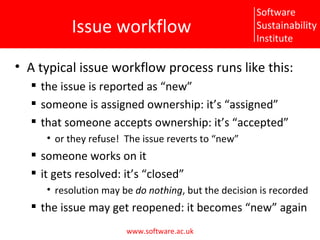
Issue workflow A typical issue workflow process runs like this: the issue is reported as “new” someone is assigned ownership: it’s “assigned” that someone accepts ownership: it’s “accepted” or they refuse!  The issue reverts to “new” someone works on it it gets resolved: it’s “closed” resolution may be  do nothing , but the decision is recorded the issue may get reopened: it becomes “new” again
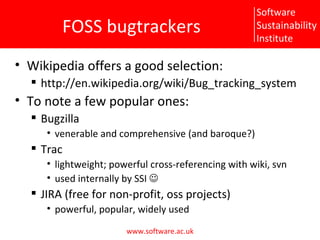
FOSS bugtrackers Wikipedia offers a good selection: http://en.wikipedia.org/wiki/Bug_tracking_system To note a few popular ones: Bugzilla venerable and comprehensive (and baroque?) Trac lightweight; powerful cross-referencing with wiki, svn used internally by SSI   JIRA (free for non-profit, oss projects) powerful, popular, widely used
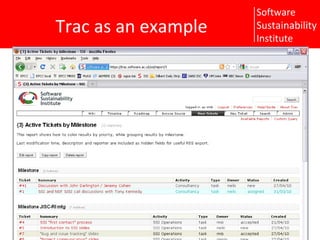
Trac as an example
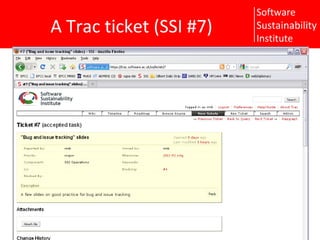
A Trac ticket (SSI #7)
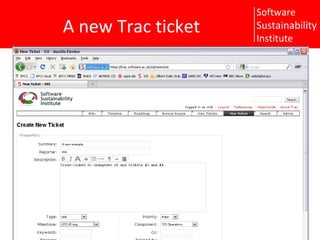
A new Trac ticket
Key features of trackers A tracker should be web-based for easy access Good trackers will store tickets in a db reports can then be gen’d through queries Good trackers should make it easy to link to related information code changesets, documents, web pages But like any tool, the most important feature is consistency of use get everyone into the habit!

Issue Tracking

  • 1.
    Bug and issuetracking Things change, stuff happens capturing these things, this stuff, in a ordered way will save lots of later pain Issue tracking is a simple yet powerful way to manage change and it fits right on top of software bug-tracking tools Any changes to a development plan can be handled as issues
  • 2.
    Project issues Anissue is any query or occurrence that might have an impact on a project could be a software bug could be a request for a change to something could be something that just needs done an action from a meeting a task Whatever it is, following a simple process will help keep track of things
  • 3.
    Issue workflow Atypical issue workflow process runs like this: the issue is reported as “new” someone is assigned ownership: it’s “assigned” that someone accepts ownership: it’s “accepted” or they refuse! The issue reverts to “new” someone works on it it gets resolved: it’s “closed” resolution may be do nothing , but the decision is recorded the issue may get reopened: it becomes “new” again
  • 4.
    FOSS bugtrackers Wikipediaoffers a good selection: http://en.wikipedia.org/wiki/Bug_tracking_system To note a few popular ones: Bugzilla venerable and comprehensive (and baroque?) Trac lightweight; powerful cross-referencing with wiki, svn used internally by SSI  JIRA (free for non-profit, oss projects) powerful, popular, widely used
  • 5.
    Trac as anexample
  • 6.
    A Trac ticket(SSI #7)
  • 7.
    A new Tracticket
  • 8.
    Key features oftrackers A tracker should be web-based for easy access Good trackers will store tickets in a db reports can then be gen’d through queries Good trackers should make it easy to link to related information code changesets, documents, web pages But like any tool, the most important feature is consistency of use get everyone into the habit!