Isovist Analyst 2.0
An ArcMap 10 Add-In for Urban Viewshed
Analyses : Visual Surveillance
Sanjay Rana
Ideas and Improvement Group @ BLOM (UK)
Topics
        Brief Overview of Urban Viewshed Analysis and its
        application in Visual Surveillance

        Isovist Analyst 2.0

        Visual Surveillance Planning and Evaluation using
        Isovist Analyst 2.0


2/ 25
Urban Viewshed or Isovist


3/ 25
Urban Viewshed Or Isovist
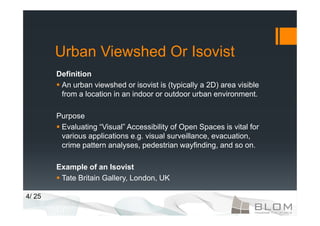
        Definition
         An urban viewshed or isovist is (typically a 2D) area visible
         from a location in an indoor or outdoor urban environment.

        Purpose
         Evaluating “Visual” Accessibility of Open Spaces is vital for
         various applications e.g. visual surveillance, evacuation,
         crime pattern analyses, pedestrian wayfinding, and so on.

        Example of an Isovist
         Tate Britain Gallery, London, UK

4/ 25
Urban Viewshed Or Isovist
        Brief History
         Proposed by Tandy (1967) and popularised by Benedikt
         (1979) for studies in architecture, urban design, urban
         planning, transport planning.

         Research on this theme now come under the field of “Space
         Syntax”.

         Relevant Wikipedia Entries: isovist space syntax visibility
         graph analysis space network analysis software


5/ 25
Urban Viewshed Or Isovist
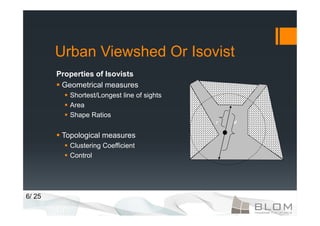
        Properties of Isovists
         Geometrical measures
           Shortest/Longest line of sights
           Area
           Shape Ratios
                                             r   d


         Topological measures
           Clustering Coefficient
           Control


6/ 25
Urban Viewshed Or Isovist
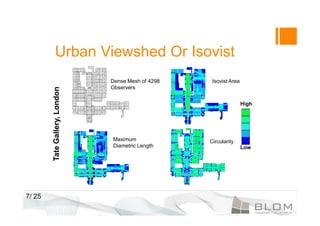
                               Dense Mesh of 4298    Isovist Area
                               Observers
        Tate Gallery, London


                                                                    High


                               Maximum              Circularity
                               Diametric Length                     Low


7/ 25
Urban Viewshed Or Isovist
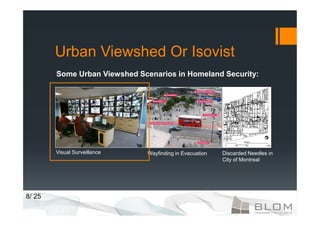
        Some Urban Viewshed Scenarios in Homeland Security:


        Visual Surveillance   Wayfinding in Evacuation   Discarded Needles in
                                                         City of Montreal


8/ 25
Visual Surveillance


9/ 25
Visual Surveillance
         Two types of visual surveillance
          Passive or Natural Visual Surveillance
              Design of urban open spaces so as to ensure that
              occupants can self-regulate themselves and reduce the
              fear of crime.
              Cheap, long lasting but involves a risk.

          Active or Artificial Visual Surveillance
              Direct and intrusive remote monitoring via devices such
              as CCTV or human observers.
              Potentially more effective but costly.

10/ 25
Passive Visual Surveillance


11/ 25
Passive Visual Surveillance
         Passive Visual Surveillance
            The aim is to create the perception of being observed or
            feeling safe by suitable architectural design of an open
            space:
                Occupants can see other occupants and entry/exist points in
                space, so that they can self-regulate themselves, e.g., in
                public spaces,
                Occupants always feel being watched by an invisible
                observer.


            Measures include removal of blind spots, dark alleys,
            installing one-way screens (Venetian blinds) etc.

12/ 25
Passive Visual Surveillance
         Passive Visual Surveillance
          Perception of safety and well-being in an open space can be
          correlated to the visibility properties of the open space for
          instance, poorly lit (e.g., by natural light) areas generate a
          fear of crime.

          People follow cues (e.g., long corridors) in the space while
          exploring open spaces.

          Isovist measures are correlated to empirical data on
          perception of crime and people behaviour to design new
          urban open spaces.


13/ 25
Passive Visual Surveillance
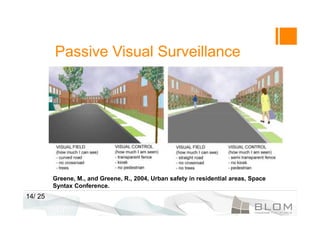
          Natural Visual Surveillance


         Greene, M., and Greene, R., 2004, Urban safety in residential areas, Space
         Syntax Conference.
14/ 25
Passive Visual Surveillance
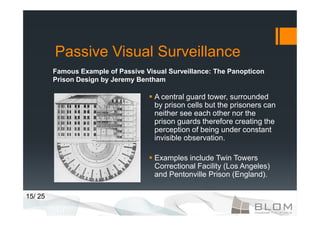
         Famous Example of Passive Visual Surveillance: The Panopticon
         Prison Design by Jeremy Bentham

                                      A central guard tower, surrounded
                                      by prison cells but the prisoners can
                                      neither see each other nor the
                                      prison guards therefore creating the
                                      perception of being under constant
                                      invisible observation.

                                      Examples include Twin Towers
                                      Correctional Facility (Los Angeles)
                                      and Pentonville Prison (England).

15/ 25
Active Visual Surveillance


16/ 25
Active Visual Surveillance
         Active Visual Surveillance
          The use of visual surveillance has dramatically increased in
          recent years, as demands arose for monitoring,
              Criminal behaviour in public space,
              Traffic,
              etc. etc.

          Several thousand millions of pounds are spent on sales and
          rental of CCTV and other types of visual surveillance.


17/ 25
Active Visual Surveillance


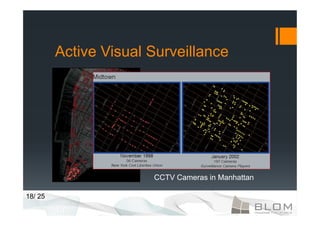
                       CCTV Cameras in Manhattan

18/ 25
Active Visual Surveillance
         Active Visual Surveillance
             The aim is to ensure complete/maximum visual coverage
             of an open space.

            It involves an iterative, manual and gut-feel process of
            trying various layouts until a satisfactory solution has been
            found.

            Traditionally done by architects, security consultants and
            urban planners using CAD software.


19/ 25
Active Visual Surveillance
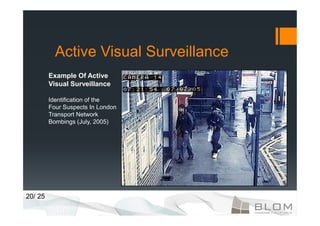
         Example Of Active
         Visual Surveillance

         Identification of the
         Four Suspects In London
         Transport Network
         Bombings (July, 2005)


20/ 25
Active Visual Surveillance
         Active Visual Surveillance
          Challenges:
            Costs of installation and maintenance, and coverage of CCTV
            cameras need to be addressed.

            The problem of ensuring maximum visual coverage with a
            minimum number of CCTV/observers is broadly similar to
            Location-Allocation, Chinese Postman/Travelling Salesman
            problems in GIS, and most importantly closely similar to the Art
            Gallery Problem in Computer Science.


21/ 25
Art Gallery Problem


22/ 25
Active Visual Surveillance
         Art Gallery Problem (AGP)
          Proposed by Victor Klee in 1973.
          What’s the minimum number of guards necessary to provide
          complete visual coverage of an art gallery?
          Solution of the AGP is going to be relevant for an affordable
          and effective CCTV network.
          However, there are no robust algorithms that guarantee a
          general purpose solution.
          Mathematically, the problem is NP-hard. Thus, it is
          analytically and computationally non-trivial and unsolvable at
          present therefore approximate solutions are used.

23/ 25
Active Visual Surveillance
         Art Gallery Problem
          Most existing algorithms assume a certain topology of the art
          gallery e.g., rectilinear, convex. A well known formula to solve
          the AGP is by Chv’atal (1975),

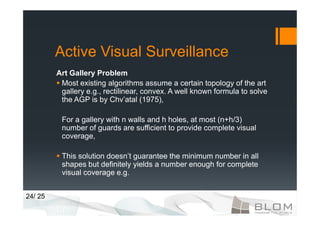
          For a gallery with n walls and h holes, at most (n+h/3)
          number of guards are sufficient to provide complete visual
          coverage,

          This solution doesn’t guarantee the minimum number in all
          shapes but definitely yields a number enough for complete
          visual coverage e.g.


24/ 25
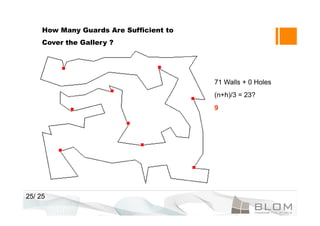
How Many Guards Are Sufficient to
     Cover the Gallery ?


                                         71 Walls + 0 Holes
                                         (n+h)/3 = 23?
                                         9


25/ 25
Rank and Overlap Elimination
                              (ROPE)


26/ 25
Active Visual Surveillance
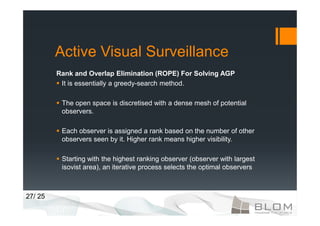
         Rank and Overlap Elimination (ROPE) For Solving AGP
          It is essentially a greedy-search method.

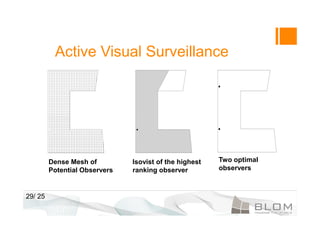
          The open space is discretised with a dense mesh of potential
          observers.

          Each observer is assigned a rank based on the number of other
          observers seen by it. Higher rank means higher visibility.

          Starting with the highest ranking observer (observer with largest
          isovist area), an iterative process selects the optimal observers


27/ 25
Active Visual Surveillance
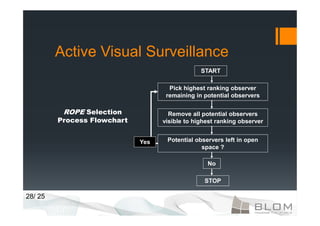
                                                START

                                     Pick highest ranking observer
                                    remaining in potential observers

          ROPE Selection             Remove all potential observers
         Process Flowchart         visible to highest ranking observer


                             Yes    Potential observers left in open
                                                space ?

                                                  No

                                                 STOP

28/ 25
Active Visual Surveillance


         Dense Mesh of         Isovist of the highest   Two optimal
         Potential Observers   ranking observer         observers


29/ 25
Active Visual Surveillance
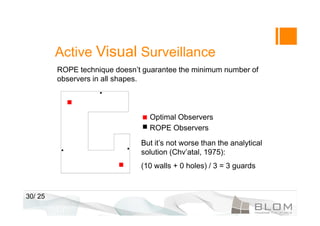
         ROPE technique doesn’t guarantee the minimum number of
         observers in all shapes.


                                 Optimal Observers
                                 ROPE Observers
                               But it’s not worse than the analytical
                               solution (Chv’atal, 1975):
                               (10 walls + 0 holes) / 3 = 3 guards


30/ 25
Isovist Analyst 2.0


31/ 25
Isovist Analyst 2.0
          ArcMap add-in for computing isovist and over 20 isovist
          properties.
          1.x versions released about a decade ago as extensions to
          ArcView 3.x (Screen shot):
            Still the only such application embedded inside ESRI suite of
            GIS. Used worldwide for research and teaching purposes.
            Voted Second Best User Software Application at 2007 ESRI
            International User Conference.
          Open space can be of arbitrary topology (i.e., with/out holes)
          and geometry (i.e., lines, polygons).
          Key achievement is the integration of urban visibility analyses
          in GIS.

32/ 25
Isovist Analyst 2.0
         How it works
          Technique of Ray Tracing is used to cast rays (line of sights)
          at a user-defined angular interval into the open space from a
          viewpoint.
          Nearest points of ray intersection with obstacles are
          connected together to form the isovist polygon.

         Requirements
          Point Feature Layers as Observers/Viewpoints.
          Polyline or Polygon Feature Layers as Obstacles.


33/ 25
Isovist Analyst 2.0
         Software Components:
             Combination of superior cartographic visualisation and
             data interactivity of ArcMap 10 with light-weight and easy
             to code Open Source geospatial libraries.
             ArcObjects
             NetTopologySuite, MapTools, GeoAPI


34/ 25
Isovist Analyst 2.0
            Demonstration


35/ 25
Isovist Analyst 2.0
         Demonstrations:
          Tate Gallery Isovist
             Data Used: Tate Gallery Outline. Tate Gallery Demo


          A (very) crude evaluation of CCTV Coverage of Norwich City
          Centre, UK.
             Data Used:
             Blom3D Level of Data 1 (LOD 1) Building Footprint polygons as
             Obstacles
             Blom WebViewer for visualising surveillance context e.g.
             Landuse


36/ 25
Planning and Evaluating Visual
         Surveillance using IA 2.0
         Disclaimer: Solely to demonstrate the application context and
         doesn’t in any way indicate any actual issue being studied.

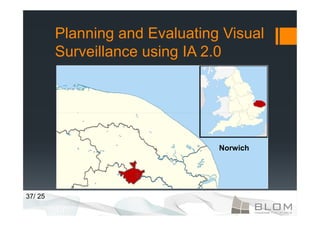
         Norwich is an important city in East of England.

         City was basically chosen because CCTV and Crime data
         was found on the internet, and BLOM contains good
         coverage of the city in aerial photographs and vector data
                                                        Norwich


37/ 25
Planning and Evaluating Visual
         Surveillance using IA 2.0
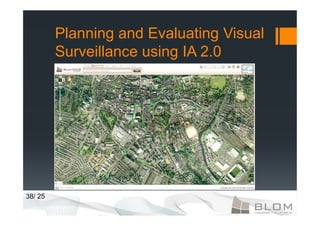
         Current distribution of CCTV in Norwich City Centre.
         Source: http://sites.google.com/site/norwichpolicecctv/, last
         accessed 23rd October 2011.


38/ 25
Planning and Evaluating Visual
           Surveillance using IA 2.0
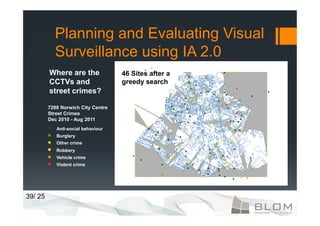
         Where are the                46 Sites after a
                                     6400
         CCTVs and                  717 for full
                                     Potentialsearch
                                      greedy
                                     66%
         street crimes?             coverage
                                     CCTV
                                     uncovered
                                     Locations
         7288 Norwich City Centre
         Street Crimes
         Dec 2010 - Aug 2011
            Anti-social behaviour
            Burglary
            Other crime
            Robbery
            Vehicle crime
            Violent crime


39/ 25
Conclusions
         Conclusions and Future Directions
         This work demonstrates
          Visual Surveillance has become a necessary aspect of
          modern society,
          Planning of Visual Surveillance is essentially a geospatial
          exercise.
          Most GISs do not provide in-built functions for planning visual
          surveillance.
          Automated algorithms for evaluating the structure of open
          spaces and planning visual coverage, in relation to planning
          visual surveillance can be easily developed in a GIS.

40/ 25
Disclaimer and Credits
         All views and work expressed are solely my own. Blom has
         no responsibility for any errors or opinions.
         Images:
           http://www.chelmsford.gov.uk/media/image/m/d/Monitor_wall_%2
           8o%29_large.jpg
           http://urbandesign.tfl.gov.uk/Design-Guidance/London-
           Rail/Crossrail/Underground-Rail-%281%29/Routes-
           %281%29.aspx
           BLOM for access to building footprints and Blom WebViewer data
           www. isee.com for the CCTV coverage of Manhattan image.
           Conroy and Dalton (1999) for the Tate Gallery outline.
           www.police.uk for crime data

41/ 25
Further Information
         Sanjay Rana
         sanjay.rana@blomasa.com


         Thank you!


42/ 25
43/ 25
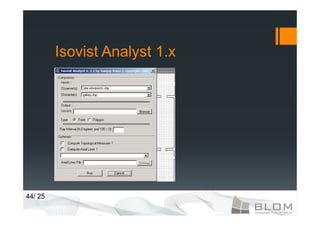
Isovist Analyst 1.x


44/ 25

Isovist Analyst 2.0

  • 1.
    Isovist Analyst 2.0 AnArcMap 10 Add-In for Urban Viewshed Analyses : Visual Surveillance Sanjay Rana Ideas and Improvement Group @ BLOM (UK)
  • 2.
    Topics Brief Overview of Urban Viewshed Analysis and its application in Visual Surveillance Isovist Analyst 2.0 Visual Surveillance Planning and Evaluation using Isovist Analyst 2.0 2/ 25
  • 3.
    Urban Viewshed orIsovist 3/ 25
  • 4.
    Urban Viewshed OrIsovist Definition An urban viewshed or isovist is (typically a 2D) area visible from a location in an indoor or outdoor urban environment. Purpose Evaluating “Visual” Accessibility of Open Spaces is vital for various applications e.g. visual surveillance, evacuation, crime pattern analyses, pedestrian wayfinding, and so on. Example of an Isovist Tate Britain Gallery, London, UK 4/ 25
  • 5.
    Urban Viewshed OrIsovist Brief History Proposed by Tandy (1967) and popularised by Benedikt (1979) for studies in architecture, urban design, urban planning, transport planning. Research on this theme now come under the field of “Space Syntax”. Relevant Wikipedia Entries: isovist space syntax visibility graph analysis space network analysis software 5/ 25
  • 6.
    Urban Viewshed OrIsovist Properties of Isovists Geometrical measures Shortest/Longest line of sights Area Shape Ratios r d Topological measures Clustering Coefficient Control 6/ 25
  • 7.
    Urban Viewshed OrIsovist Dense Mesh of 4298 Isovist Area Observers Tate Gallery, London High Maximum Circularity Diametric Length Low 7/ 25
  • 8.
    Urban Viewshed OrIsovist Some Urban Viewshed Scenarios in Homeland Security: Visual Surveillance Wayfinding in Evacuation Discarded Needles in City of Montreal 8/ 25
  • 9.
  • 10.
    Visual Surveillance Two types of visual surveillance Passive or Natural Visual Surveillance Design of urban open spaces so as to ensure that occupants can self-regulate themselves and reduce the fear of crime. Cheap, long lasting but involves a risk. Active or Artificial Visual Surveillance Direct and intrusive remote monitoring via devices such as CCTV or human observers. Potentially more effective but costly. 10/ 25
  • 11.
  • 12.
    Passive Visual Surveillance Passive Visual Surveillance The aim is to create the perception of being observed or feeling safe by suitable architectural design of an open space: Occupants can see other occupants and entry/exist points in space, so that they can self-regulate themselves, e.g., in public spaces, Occupants always feel being watched by an invisible observer. Measures include removal of blind spots, dark alleys, installing one-way screens (Venetian blinds) etc. 12/ 25
  • 13.
    Passive Visual Surveillance Passive Visual Surveillance Perception of safety and well-being in an open space can be correlated to the visibility properties of the open space for instance, poorly lit (e.g., by natural light) areas generate a fear of crime. People follow cues (e.g., long corridors) in the space while exploring open spaces. Isovist measures are correlated to empirical data on perception of crime and people behaviour to design new urban open spaces. 13/ 25
  • 14.
    Passive Visual Surveillance Natural Visual Surveillance Greene, M., and Greene, R., 2004, Urban safety in residential areas, Space Syntax Conference. 14/ 25
  • 15.
    Passive Visual Surveillance Famous Example of Passive Visual Surveillance: The Panopticon Prison Design by Jeremy Bentham A central guard tower, surrounded by prison cells but the prisoners can neither see each other nor the prison guards therefore creating the perception of being under constant invisible observation. Examples include Twin Towers Correctional Facility (Los Angeles) and Pentonville Prison (England). 15/ 25
  • 16.
  • 17.
    Active Visual Surveillance Active Visual Surveillance The use of visual surveillance has dramatically increased in recent years, as demands arose for monitoring, Criminal behaviour in public space, Traffic, etc. etc. Several thousand millions of pounds are spent on sales and rental of CCTV and other types of visual surveillance. 17/ 25
  • 18.
    Active Visual Surveillance CCTV Cameras in Manhattan 18/ 25
  • 19.
    Active Visual Surveillance Active Visual Surveillance The aim is to ensure complete/maximum visual coverage of an open space. It involves an iterative, manual and gut-feel process of trying various layouts until a satisfactory solution has been found. Traditionally done by architects, security consultants and urban planners using CAD software. 19/ 25
  • 20.
    Active Visual Surveillance Example Of Active Visual Surveillance Identification of the Four Suspects In London Transport Network Bombings (July, 2005) 20/ 25
  • 21.
    Active Visual Surveillance Active Visual Surveillance Challenges: Costs of installation and maintenance, and coverage of CCTV cameras need to be addressed. The problem of ensuring maximum visual coverage with a minimum number of CCTV/observers is broadly similar to Location-Allocation, Chinese Postman/Travelling Salesman problems in GIS, and most importantly closely similar to the Art Gallery Problem in Computer Science. 21/ 25
  • 22.
  • 23.
    Active Visual Surveillance Art Gallery Problem (AGP) Proposed by Victor Klee in 1973. What’s the minimum number of guards necessary to provide complete visual coverage of an art gallery? Solution of the AGP is going to be relevant for an affordable and effective CCTV network. However, there are no robust algorithms that guarantee a general purpose solution. Mathematically, the problem is NP-hard. Thus, it is analytically and computationally non-trivial and unsolvable at present therefore approximate solutions are used. 23/ 25
  • 24.
    Active Visual Surveillance Art Gallery Problem Most existing algorithms assume a certain topology of the art gallery e.g., rectilinear, convex. A well known formula to solve the AGP is by Chv’atal (1975), For a gallery with n walls and h holes, at most (n+h/3) number of guards are sufficient to provide complete visual coverage, This solution doesn’t guarantee the minimum number in all shapes but definitely yields a number enough for complete visual coverage e.g. 24/ 25
  • 25.
    How Many GuardsAre Sufficient to Cover the Gallery ? 71 Walls + 0 Holes (n+h)/3 = 23? 9 25/ 25
  • 26.
    Rank and OverlapElimination (ROPE) 26/ 25
  • 27.
    Active Visual Surveillance Rank and Overlap Elimination (ROPE) For Solving AGP It is essentially a greedy-search method. The open space is discretised with a dense mesh of potential observers. Each observer is assigned a rank based on the number of other observers seen by it. Higher rank means higher visibility. Starting with the highest ranking observer (observer with largest isovist area), an iterative process selects the optimal observers 27/ 25
  • 28.
    Active Visual Surveillance START Pick highest ranking observer remaining in potential observers ROPE Selection Remove all potential observers Process Flowchart visible to highest ranking observer Yes Potential observers left in open space ? No STOP 28/ 25
  • 29.
    Active Visual Surveillance Dense Mesh of Isovist of the highest Two optimal Potential Observers ranking observer observers 29/ 25
  • 30.
    Active Visual Surveillance ROPE technique doesn’t guarantee the minimum number of observers in all shapes. Optimal Observers ROPE Observers But it’s not worse than the analytical solution (Chv’atal, 1975): (10 walls + 0 holes) / 3 = 3 guards 30/ 25
  • 31.
  • 32.
    Isovist Analyst 2.0 ArcMap add-in for computing isovist and over 20 isovist properties. 1.x versions released about a decade ago as extensions to ArcView 3.x (Screen shot): Still the only such application embedded inside ESRI suite of GIS. Used worldwide for research and teaching purposes. Voted Second Best User Software Application at 2007 ESRI International User Conference. Open space can be of arbitrary topology (i.e., with/out holes) and geometry (i.e., lines, polygons). Key achievement is the integration of urban visibility analyses in GIS. 32/ 25
  • 33.
    Isovist Analyst 2.0 How it works Technique of Ray Tracing is used to cast rays (line of sights) at a user-defined angular interval into the open space from a viewpoint. Nearest points of ray intersection with obstacles are connected together to form the isovist polygon. Requirements Point Feature Layers as Observers/Viewpoints. Polyline or Polygon Feature Layers as Obstacles. 33/ 25
  • 34.
    Isovist Analyst 2.0 Software Components: Combination of superior cartographic visualisation and data interactivity of ArcMap 10 with light-weight and easy to code Open Source geospatial libraries. ArcObjects NetTopologySuite, MapTools, GeoAPI 34/ 25
  • 35.
    Isovist Analyst 2.0 Demonstration 35/ 25
  • 36.
    Isovist Analyst 2.0 Demonstrations: Tate Gallery Isovist Data Used: Tate Gallery Outline. Tate Gallery Demo A (very) crude evaluation of CCTV Coverage of Norwich City Centre, UK. Data Used: Blom3D Level of Data 1 (LOD 1) Building Footprint polygons as Obstacles Blom WebViewer for visualising surveillance context e.g. Landuse 36/ 25
  • 37.
    Planning and EvaluatingVisual Surveillance using IA 2.0 Disclaimer: Solely to demonstrate the application context and doesn’t in any way indicate any actual issue being studied. Norwich is an important city in East of England. City was basically chosen because CCTV and Crime data was found on the internet, and BLOM contains good coverage of the city in aerial photographs and vector data Norwich 37/ 25
  • 38.
    Planning and EvaluatingVisual Surveillance using IA 2.0 Current distribution of CCTV in Norwich City Centre. Source: http://sites.google.com/site/norwichpolicecctv/, last accessed 23rd October 2011. 38/ 25
  • 39.
    Planning and EvaluatingVisual Surveillance using IA 2.0 Where are the 46 Sites after a 6400 CCTVs and 717 for full Potentialsearch greedy 66% street crimes? coverage CCTV uncovered Locations 7288 Norwich City Centre Street Crimes Dec 2010 - Aug 2011 Anti-social behaviour Burglary Other crime Robbery Vehicle crime Violent crime 39/ 25
  • 40.
    Conclusions Conclusions and Future Directions This work demonstrates Visual Surveillance has become a necessary aspect of modern society, Planning of Visual Surveillance is essentially a geospatial exercise. Most GISs do not provide in-built functions for planning visual surveillance. Automated algorithms for evaluating the structure of open spaces and planning visual coverage, in relation to planning visual surveillance can be easily developed in a GIS. 40/ 25
  • 41.
    Disclaimer and Credits All views and work expressed are solely my own. Blom has no responsibility for any errors or opinions. Images: http://www.chelmsford.gov.uk/media/image/m/d/Monitor_wall_%2 8o%29_large.jpg http://urbandesign.tfl.gov.uk/Design-Guidance/London- Rail/Crossrail/Underground-Rail-%281%29/Routes- %281%29.aspx BLOM for access to building footprints and Blom WebViewer data www. isee.com for the CCTV coverage of Manhattan image. Conroy and Dalton (1999) for the Tate Gallery outline. www.police.uk for crime data 41/ 25
  • 42.
    Further Information Sanjay Rana sanjay.rana@blomasa.com Thank you! 42/ 25
  • 43.
  • 44.