Isomorphic Reactive
Programming
Giorgio Natili
@giorgionatili#MobileTea + @DroidconBos
About Me
• Engineering Manager at Akamai (NG2 on desktop
and mobile)
• Founder of Mobile Tea
• Organizer of the Hash Conf
• Organizer of DroidCon Boston
Mobile Tea
Hash Conf
http://hashconf.io/
Droidcon Boston
bitly.com/dcbos18
@giorgionatili#MobileTea + @DroidconBos
Agenda
• Fundamentals of Reactive Programming
• Fundamentals of Reactive Extensions
• Observables, Observers and Subjects
• Reactive Extensions Operators
• Parallel Programming
Reactive
Programming
@giorgionatili#MobileTea + @DroidconBos
Foundation
• Programming paradigm
• Computation is affected by signals
• No notion of event scope
• It favors function composition
@giorgionatili#MobileTea + @DroidconBos
Elasticity (in contrast to
Scalability)
• A system scales up or down automatically to meet
demand
• Elasticity builds upon scalability adding the notion
of automatic resource management
@giorgionatili#MobileTea + @DroidconBos
Failure (in contrast to Error)
• A failure is an unexpected event that prevents a
system from continuing to function normally
• This is in contrast with an error, which is an
expected and coded-for condition
@giorgionatili#MobileTea + @DroidconBos
Isolation (and Containment)
• Isolation can be defined in terms of decoupling in
time and space
• Decoupling in time means that the sender and
receiver can have independent life-cycles
• Decoupling in space means that the sender and
receiver do not have to run in the same process
@giorgionatili#MobileTea + @DroidconBos
Message-Driven (in contrast
to Event-Driven)
• A message is an item of data that is sent to a
specific destination
• Notification listeners are attached to event sources
such that get invoked when the event is emitted
@giorgionatili#MobileTea + @DroidconBos
Back-Pressure
• When one component is struggling to keep-up, the
system as a whole needs to respond in a sensible
way
• Back-pressure is an important feedback
mechanism that allows systems to gracefully
respond to load rather than collapse under it
@giorgionatili#MobileTea + @DroidconBos
Signals
• Functional programming ties signals together in a
dependency graph
• Each signal is either an external input or a derived
signal
• Signals feeds off of other signals that have already
been defined
@giorgionatili#MobileTea + @DroidconBos
Advantages
• Efficiency, by minimizing the amount of the
computation that must be rerun when inputs
change (e.g. history)
• Dynamism by reconfiguring the computation over
time, as the inputs to your system change
• Ease of reasoning due to a paradigm that has a
clean semantics
@giorgionatili#MobileTea + @DroidconBos
Streams
• Data
• I/O operations
• User interactions
@giorgionatili#MobileTea + @DroidconBos
Streams and Async Code
• Asynchronous code allows independent IO
operations to run concurrently
• Streams can be encapsulated in async code and
improve code efficiency and readability
@giorgionatili#MobileTea + @DroidconBos
Callback Hell
@giorgionatili#MobileTea + @DroidconBos
Get Out of the Callback Hell
• Abstractions that allow us to express the effect of
latency in asynchronous computations
• Encapsulate event-handling code, and use higher-
order functions such as map, reduce, and filter
• Compose clean and readable asynchronous code
@giorgionatili#MobileTea + @DroidconBos
Warning
• Reactive code composed with higher-order
functions is often not purely functional
• Functional reactive code typically involves side
effects through network or file system IO
@giorgionatili#MobileTea + @DroidconBos
Functions
@giorgionatili#MobileTea + @DroidconBos
Composition and Currying
• A mechanism to combine simple functions to build
more complicated ones
• Closely related to currying that instead translate a
function with multiple arguments into multiple
functions accepting one argument
@giorgionatili#MobileTea + @DroidconBos
Pure Functions
• In a pure functional language a function can only
read what is supplied to it in its arguments
• The only way it can have an effect on the world is
through the values it returns
@giorgionatili#MobileTea + @DroidconBos
Monads
“Monads are monoids in the category of
endofunctors”
@giorgionatili#MobileTea + @DroidconBos
Monoids
• Are the most basic way of combining values
together
• Don’t necessarily have to combine containers of
values
• Can combine any values with certain properties
• Support associativity and neutral elements (aka 0)
@giorgionatili#MobileTea + @DroidconBos
Monads
• Elegant abstractions for describing how state is
manipulated in a pure functional programming
language
• Monads apply a function that returns a wrapped
value to a wrapped value
@giorgionatili#MobileTea + @DroidconBos
Monads Operations
• The return operation that promotes regular values
of type A to monads M[A]
• The bind operation that takes a function A =>
M[B] that is used to transform underlying values
@giorgionatili#MobileTea + @DroidconBos
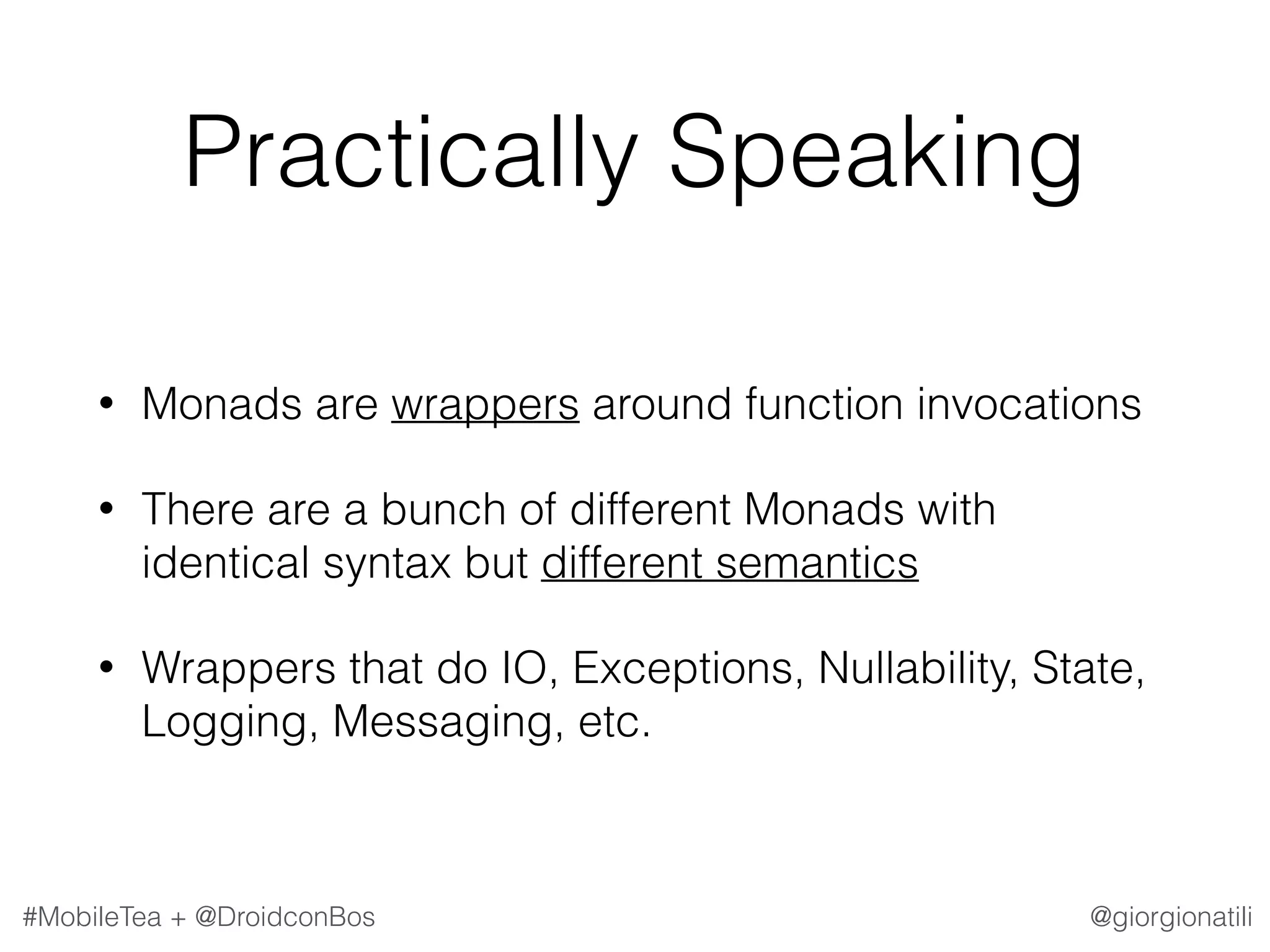
Practically Speaking
• Monads are wrappers around function invocations
• There are a bunch of different Monads with
identical syntax but different semantics
• Wrappers that do IO, Exceptions, Nullability, State,
Logging, Messaging, etc.
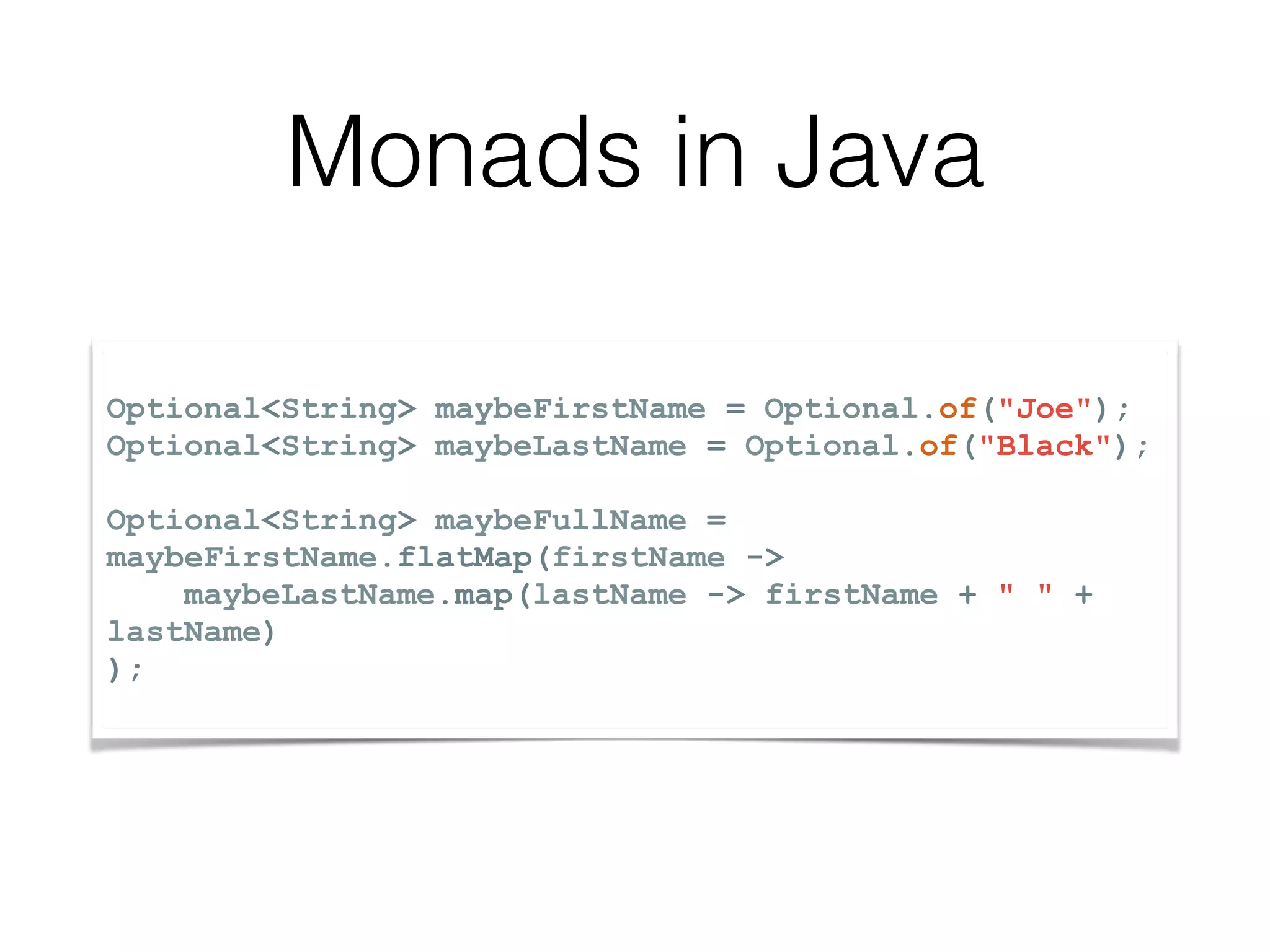
Optional<String> maybeFirstName = Optional.of("Joe");
Optional<String> maybeLastName = Optional.of("Black");
Optional<String> maybeFullName =
maybeFirstName.flatMap(firstName ->
maybeLastName.map(lastName -> firstName + " " +
lastName)
);
Monads in Java
@giorgionatili#MobileTea + @DroidconBos
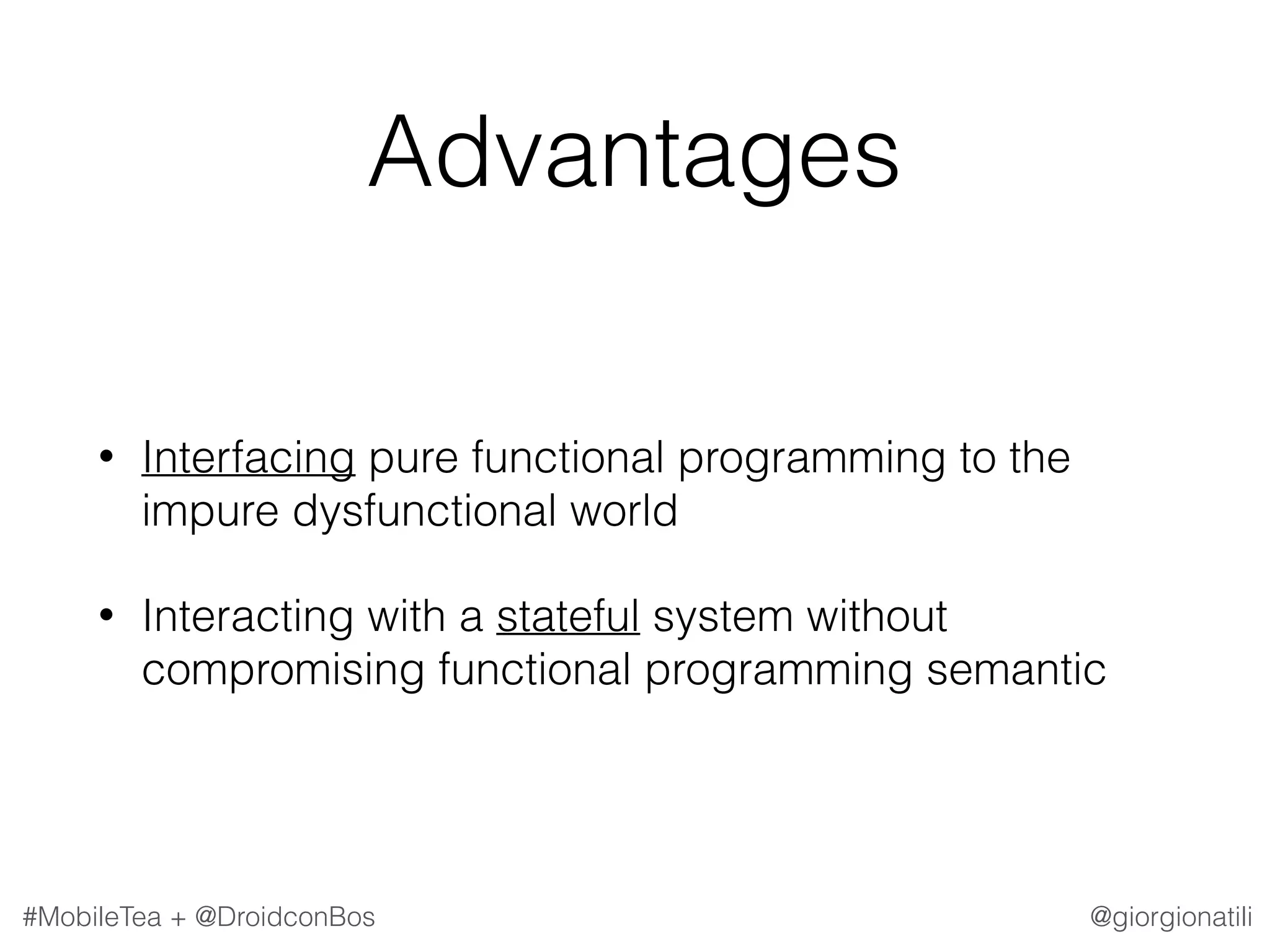
Advantages
• Interfacing pure functional programming to the
impure dysfunctional world
• Interacting with a stateful system without
compromising functional programming semantic
@giorgionatili#MobileTea + @DroidconBos
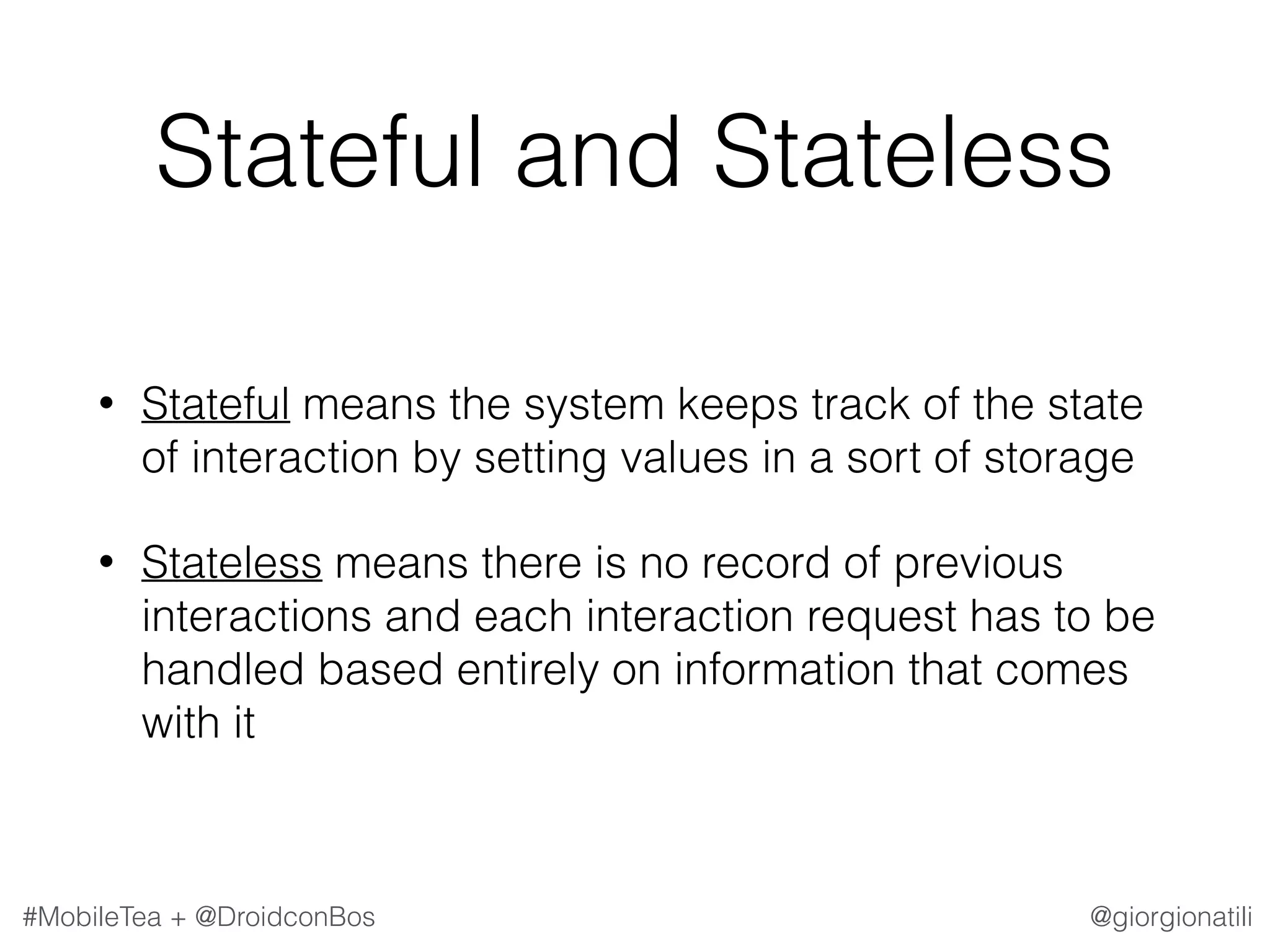
Stateful and Stateless
• Stateful means the system keeps track of the state
of interaction by setting values in a sort of storage
• Stateless means there is no record of previous
interactions and each interaction request has to be
handled based entirely on information that comes
with it
@giorgionatili#MobileTea + @DroidconBos
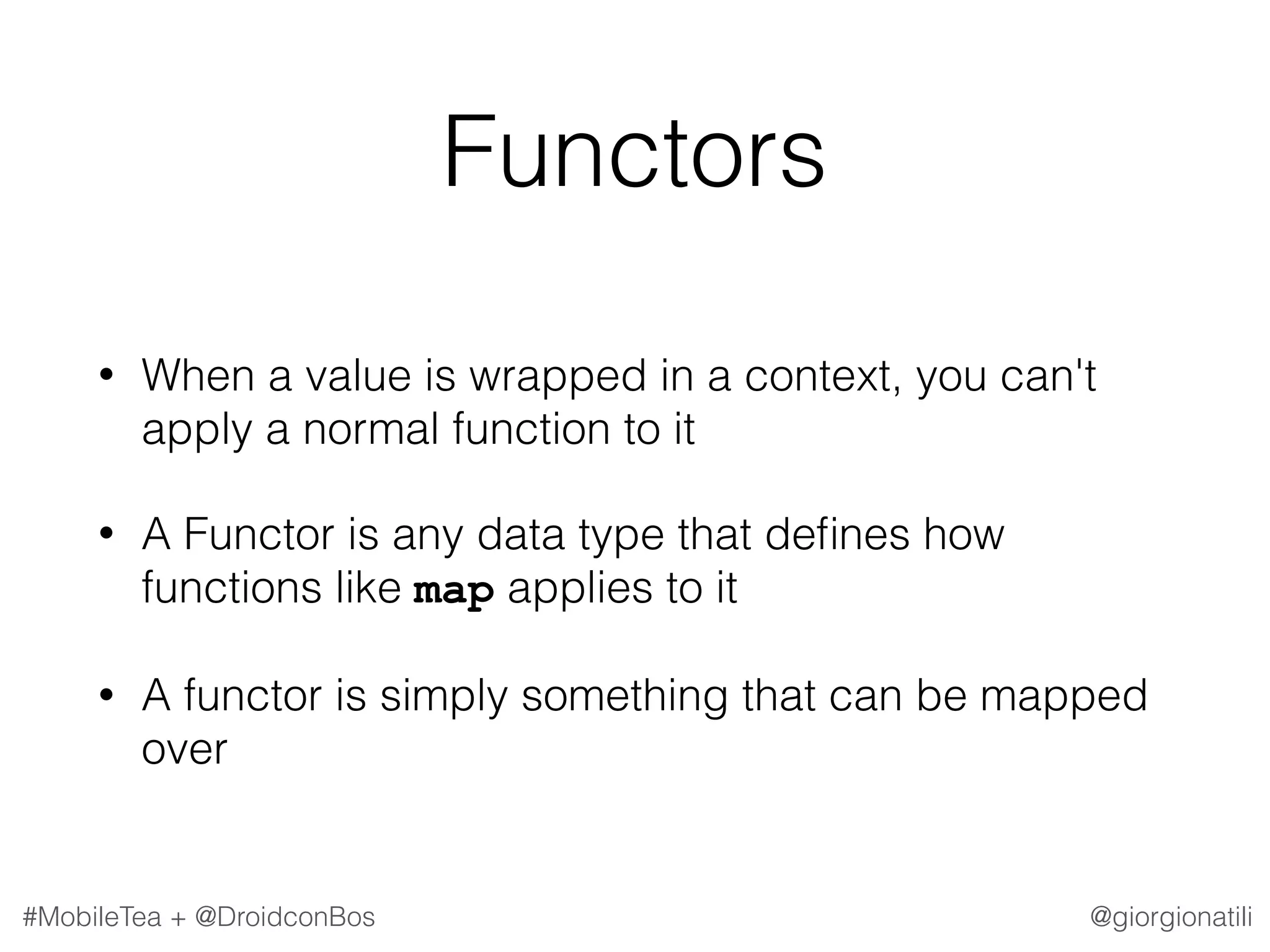
Functors
• When a value is wrapped in a context, you can't
apply a normal function to it
• A Functor is any data type that defines how
functions like map applies to it
• A functor is simply something that can be mapped
over
@giorgionatili#MobileTea + @DroidconBos
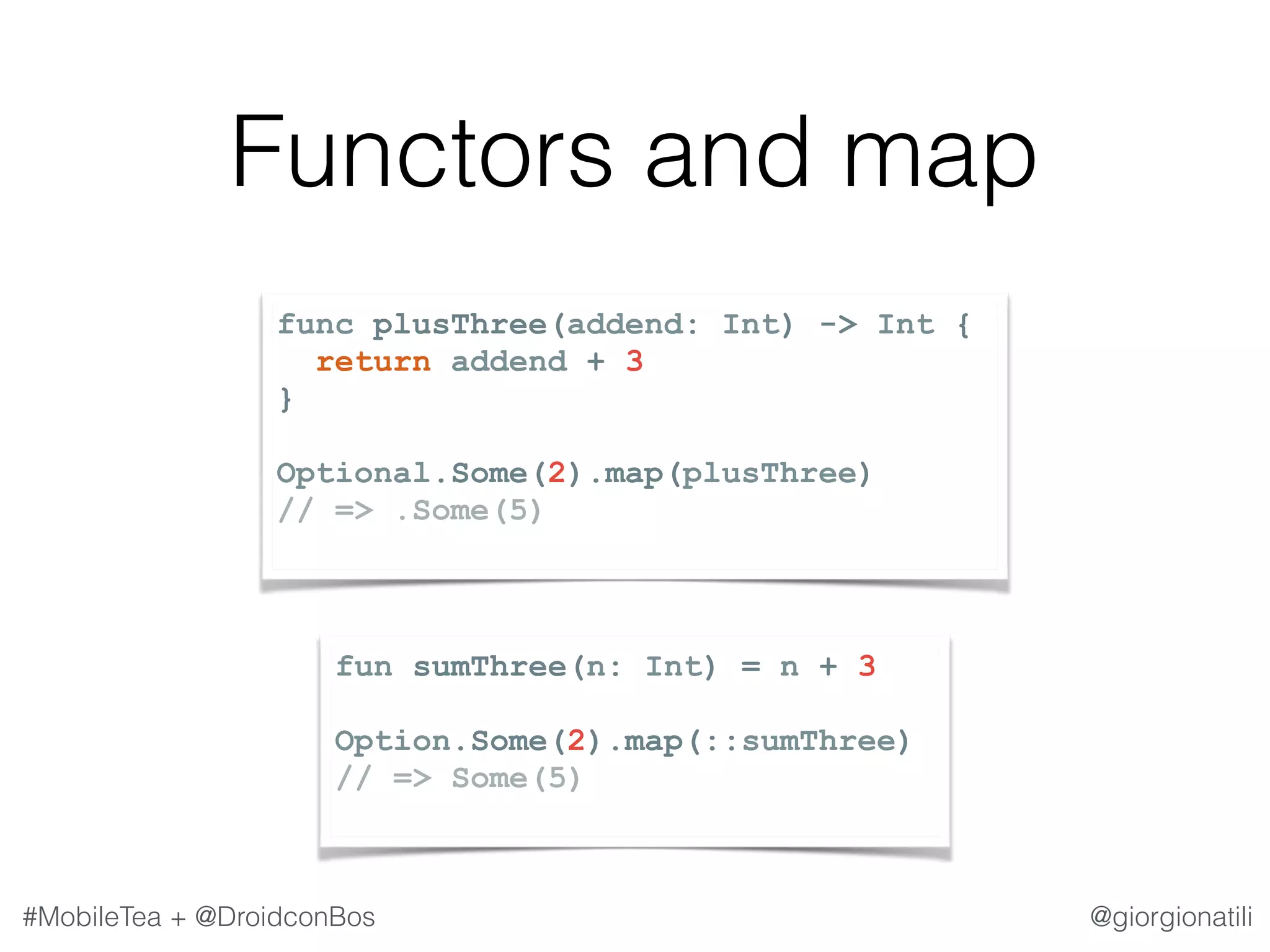
Functors and map
fun sumThree(n: Int) = n + 3
Option.Some(2).map(::sumThree)
// => Some(5)
func plusThree(addend: Int) -> Int {
return addend + 3
}
Optional.Some(2).map(plusThree)
// => .Some(5)
@giorgionatili#MobileTea + @DroidconBos
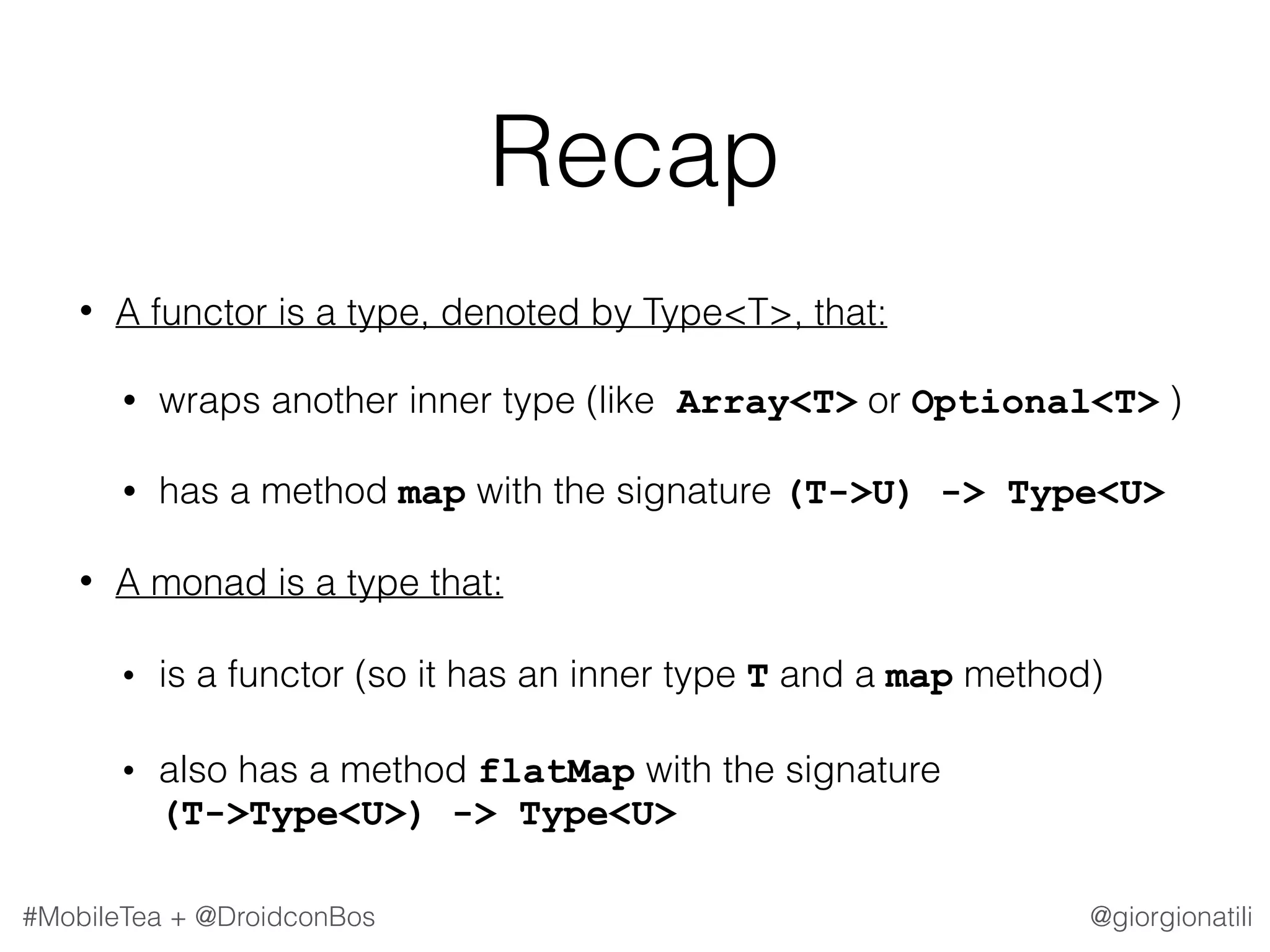
Recap
• A functor is a type, denoted by Type<T>, that:
• wraps another inner type (like Array<T> or Optional<T> )
• has a method map with the signature (T->U) -> Type<U>
• A monad is a type that:
• is a functor (so it has an inner type T and a map method)
• also has a method flatMap with the signature 

(T->Type<U>) -> Type<U>
Reactive Programming
and Reactive Extensions
@giorgionatili#MobileTea + @DroidconBos
Reactive Extensions
• It is a set of tools allowing imperative programming
languages to operate on sequences of data
• It provides a set of sequence operators that
operate on each item in the sequence
@giorgionatili#MobileTea + @DroidconBos
Functional Reactive
Programming (FRP)
• It’s just another a programming paradigm
• It focuses on reacting to streams of changes (data
and events)
• It favors function composition, avoidance of global
state and side effects
@giorgionatili#MobileTea + @DroidconBos
Observer Pattern and
Manipulation
• FRP is based on the Observer pattern
• FRP supports manipulating and transforming the
stream of data that Observables emit
@giorgionatili#MobileTea + @DroidconBos
Lambdas
• A lambda expression is an anonymous function
that you can use to create delegates or expression
tree types
• Lambda functions are often arguments being
passed to higher-order functions
@giorgionatili#MobileTea + @DroidconBos
Subject
• A Subject is a sort of bridge that is available in
most of the implementations of ReactiveX
• It acts both as an observer and as an Observable
• It can subscribe to one or more Observables,
• Because it is also an Observable, it can pass
through the items it observes by re-emitting them
@giorgionatili#MobileTea + @DroidconBos
Observables
• onNext, an Observable calls this method
whenever the Observable emits an item
• onError, an Observable calls this method to
indicate that it has failed to generate the expected
data
• onCompleted, an Observable calls this method
after it has called onNext for the final time
@giorgionatili#MobileTea + @DroidconBos
Push vs Pull
• Observable is push based, it decides when to
emit values
• Iterable is pull based, it sits until the some ask
for the next() value
@giorgionatili#MobileTea + @DroidconBos
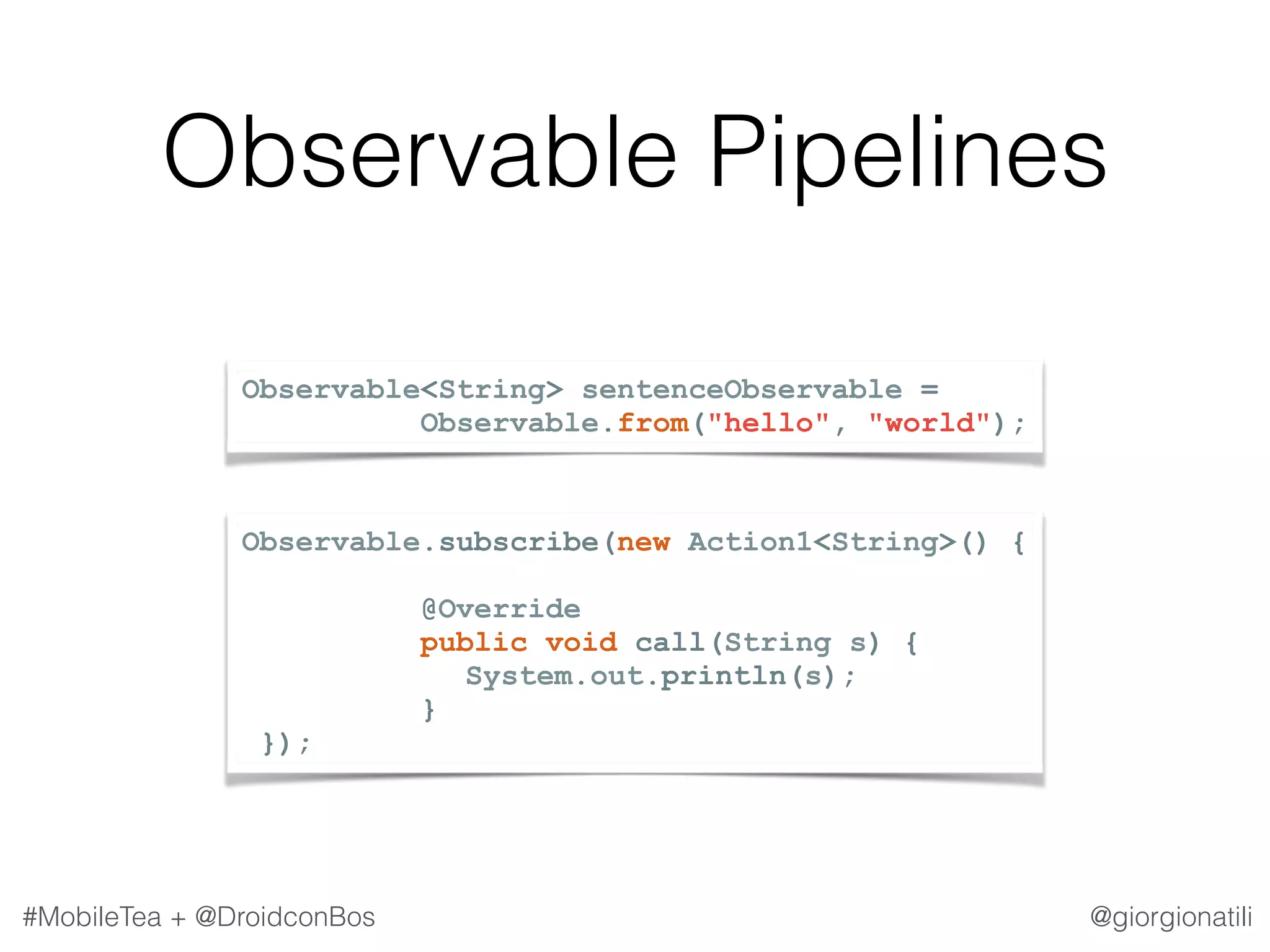
Observable Pipelines
Observable<String> sentenceObservable = 

Observable.from("hello", "world");
Observable.subscribe(new Action1<String>() {

@Override
public void call(String s) {
System.out.println(s);
}
});
@giorgionatili#MobileTea + @DroidconBos
Observing Subjects
• A professor is an observable
• A student is an observer
• A Subject emits all the subsequent items of the
source Observable at the time of subscription
@giorgionatili#MobileTea + @DroidconBos
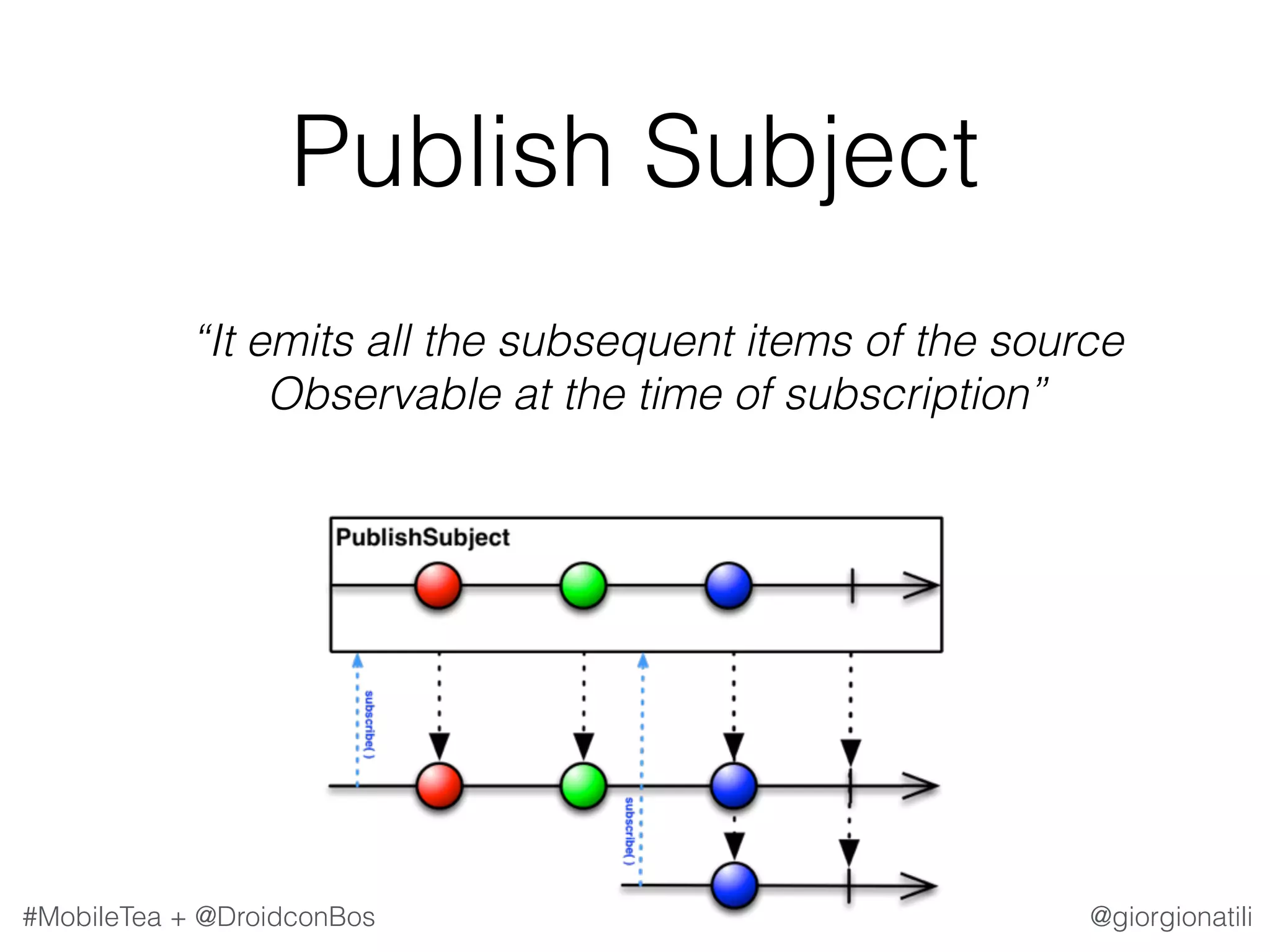
Publish Subject


“It emits all the subsequent items of the source
Observable at the time of subscription”
@giorgionatili#MobileTea + @DroidconBos


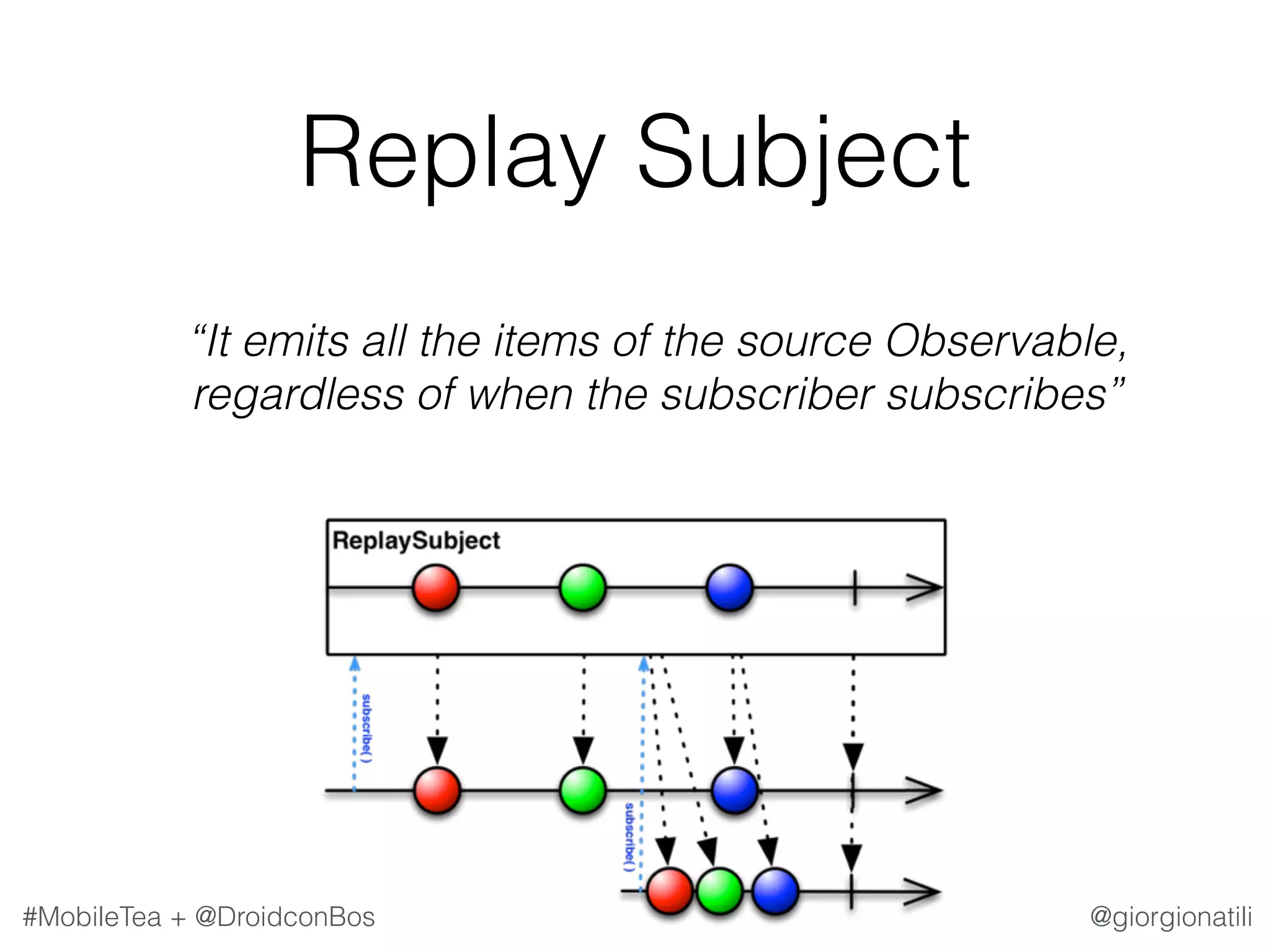
“It emits all the items of the source Observable,
regardless of when the subscriber subscribes”
Replay Subject
@giorgionatili#MobileTea + @DroidconBos
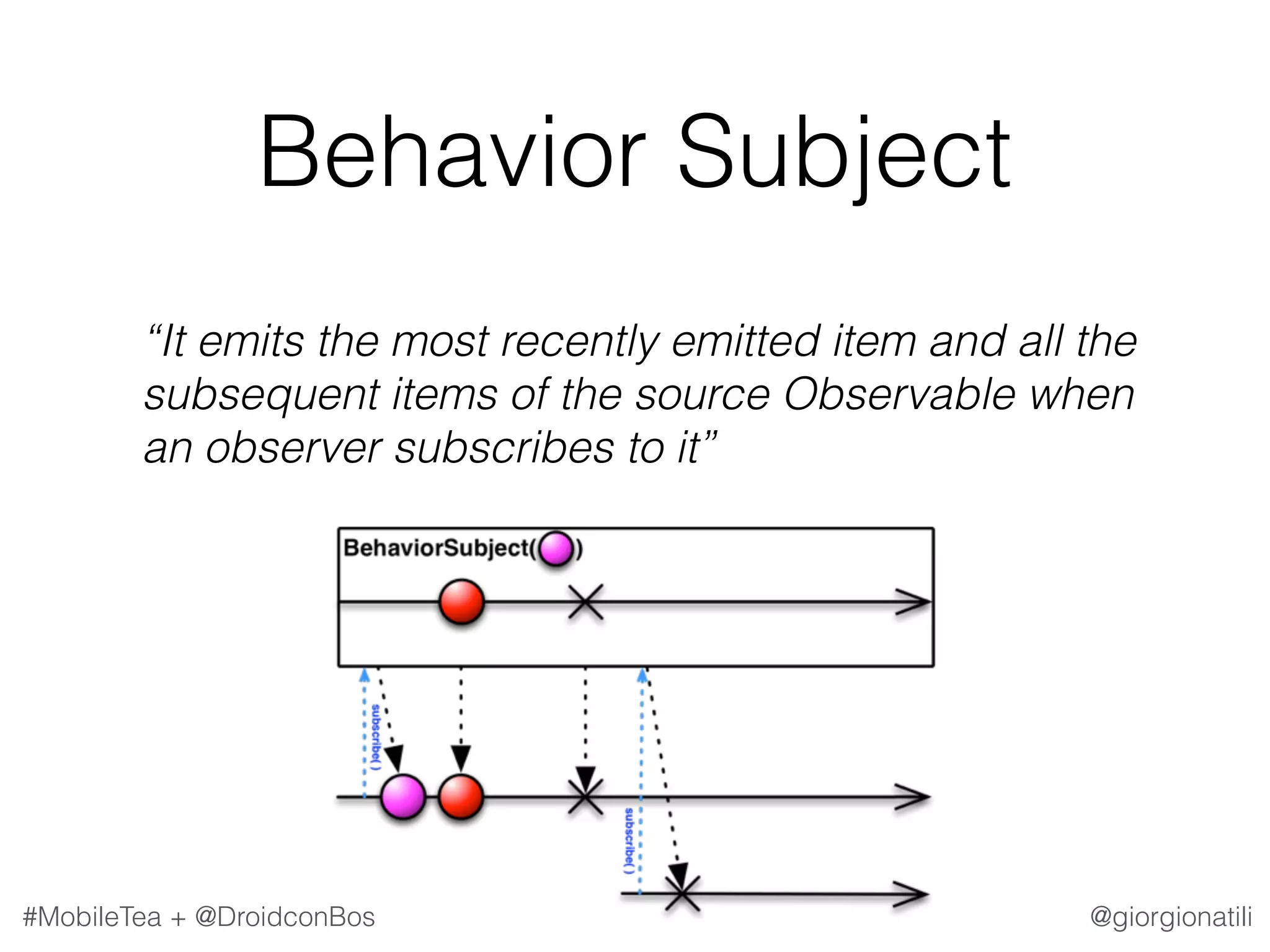
Behavior Subject


“It emits the most recently emitted item and all the
subsequent items of the source Observable when
an observer subscribes to it”
@giorgionatili#MobileTea + @DroidconBos
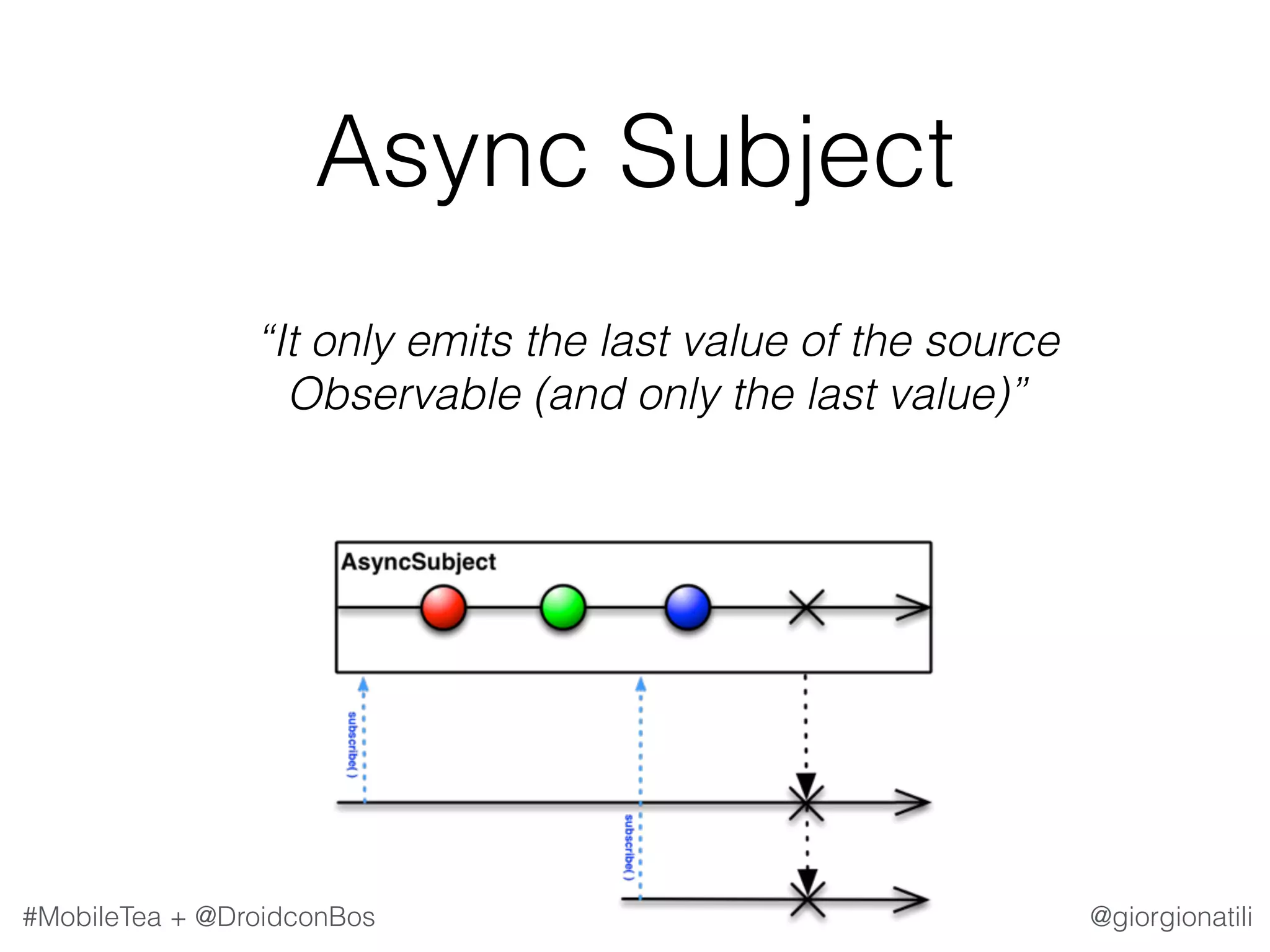
Async Subject


“It only emits the last value of the source
Observable (and only the last value)”
Creating Observables
@giorgionatili#MobileTea + @DroidconBos
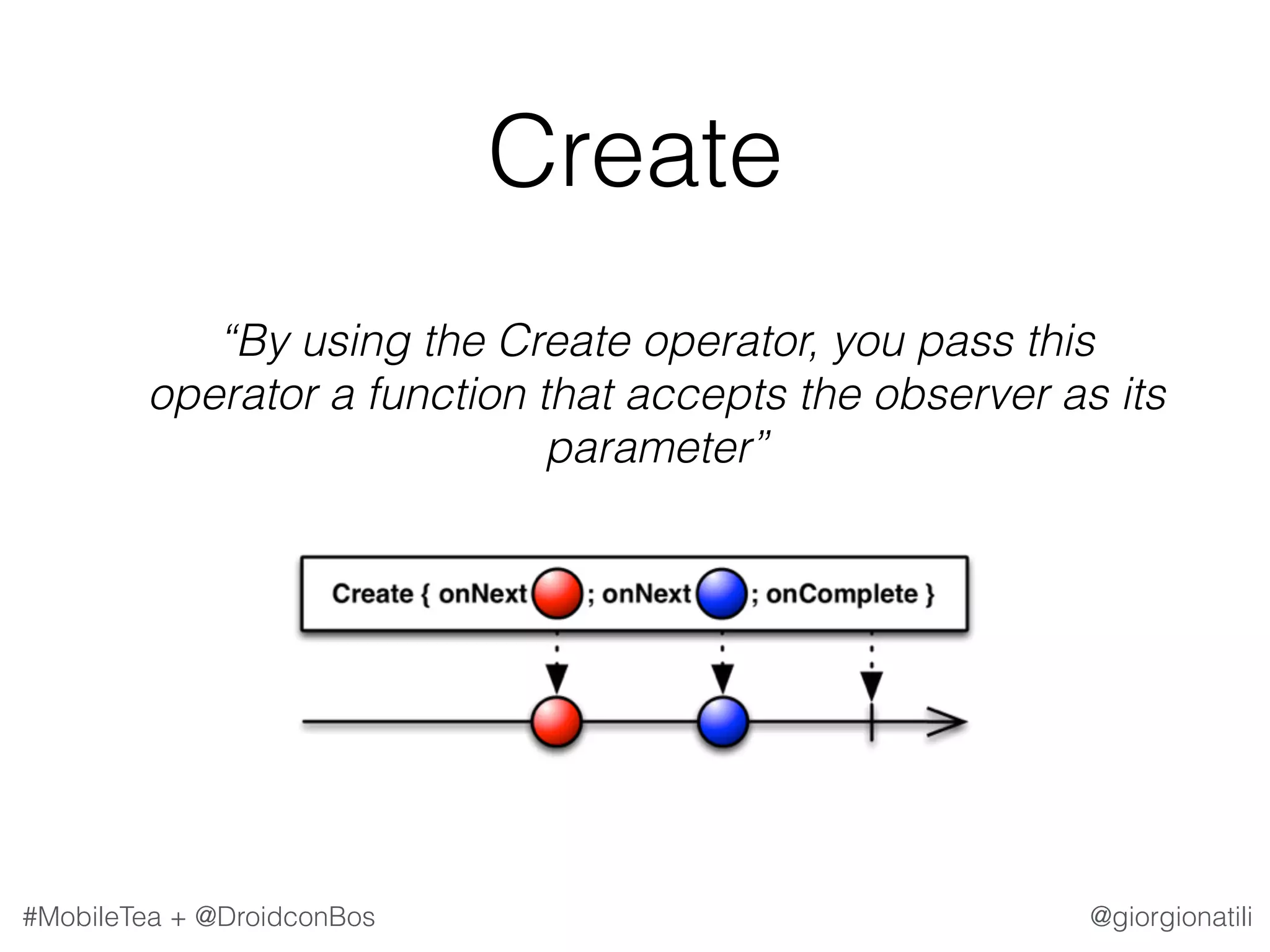
Create


“By using the Create operator, you pass this
operator a function that accepts the observer as its
parameter”
@giorgionatili#MobileTea + @DroidconBos
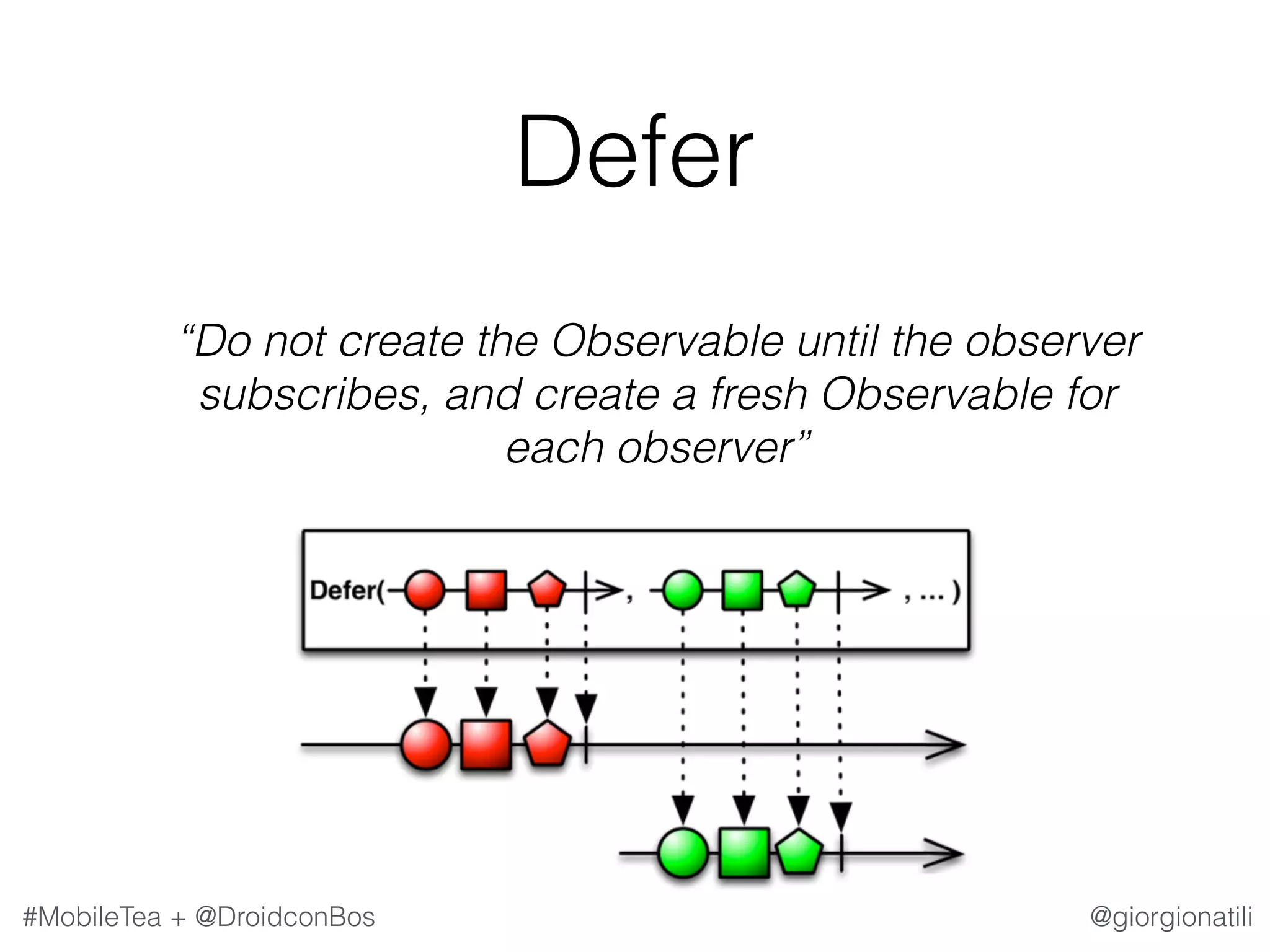
Defer


“Do not create the Observable until the observer
subscribes, and create a fresh Observable for
each observer”
@giorgionatili#MobileTea + @DroidconBos
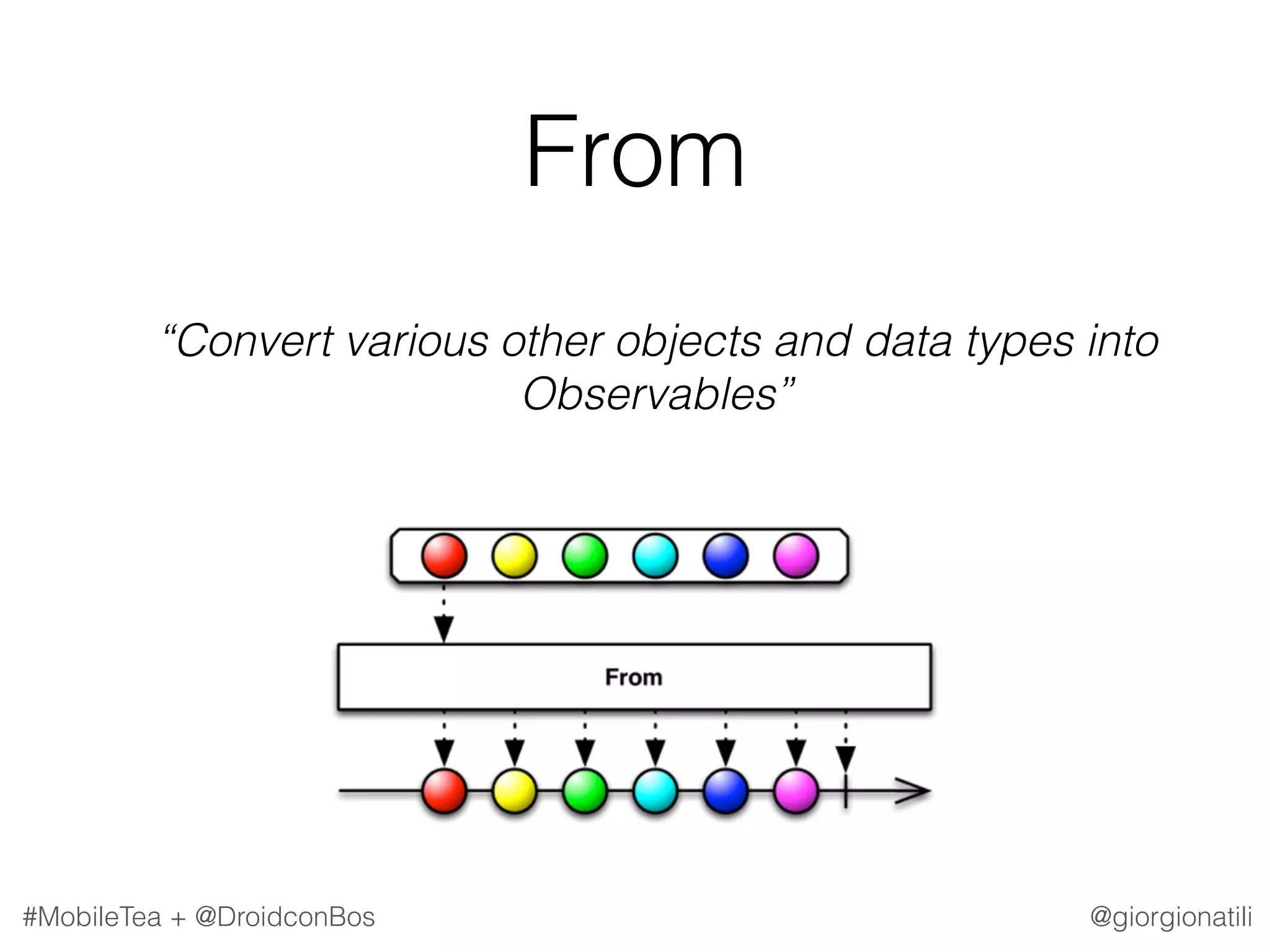
From


“Convert various other objects and data types into
Observables”
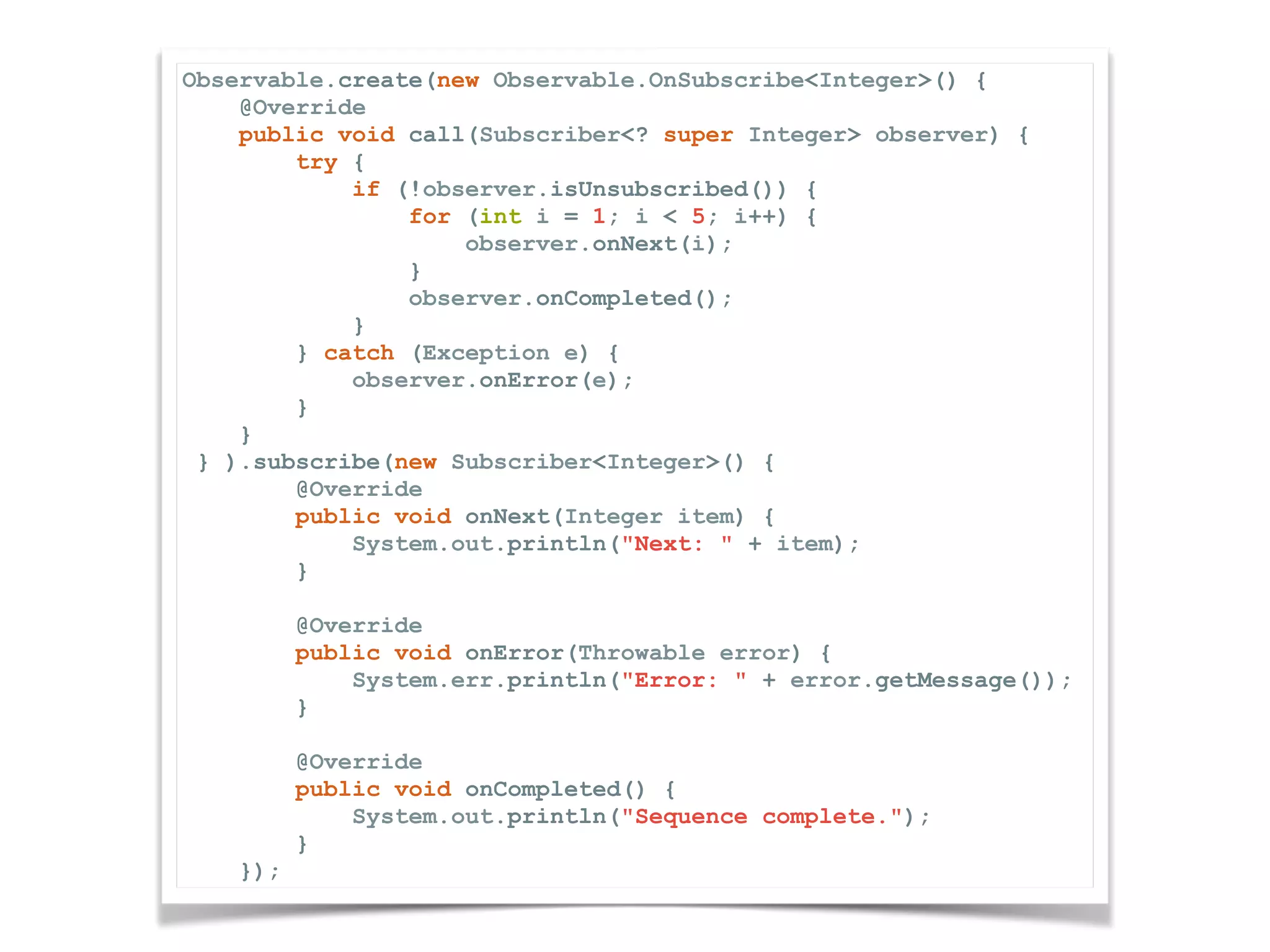
Observable.create(new Observable.OnSubscribe<Integer>() {
@Override
public void call(Subscriber<? super Integer> observer) {
try {
if (!observer.isUnsubscribed()) {
for (int i = 1; i < 5; i++) {
observer.onNext(i);
}
observer.onCompleted();
}
} catch (Exception e) {
observer.onError(e);
}
}
} ).subscribe(new Subscriber<Integer>() {
@Override
public void onNext(Integer item) {
System.out.println("Next: " + item);
}
@Override
public void onError(Throwable error) {
System.err.println("Error: " + error.getMessage());
}
@Override
public void onCompleted() {
System.out.println("Sequence complete.");
}
});
@giorgionatili#MobileTea + @DroidconBos
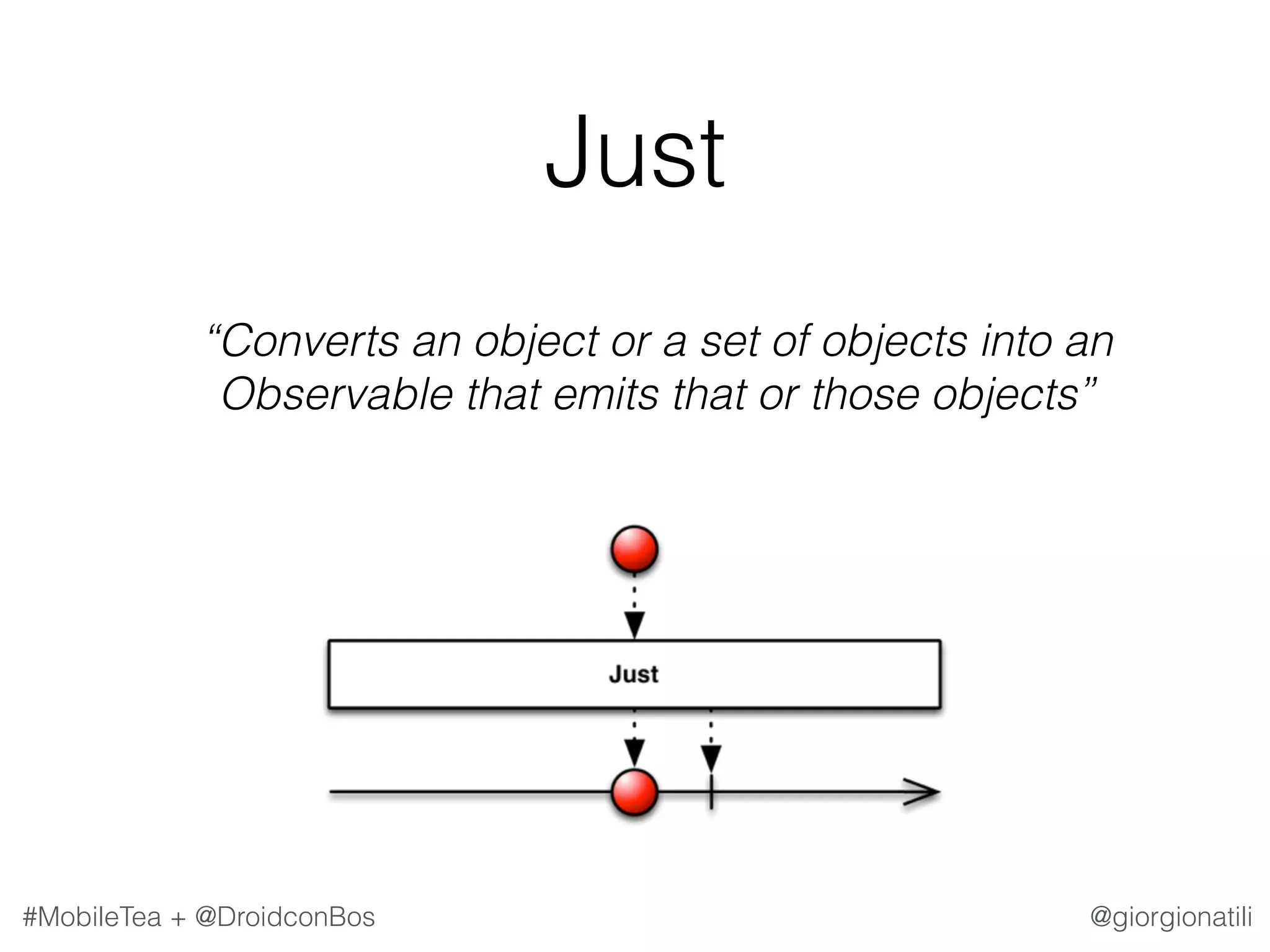
Just


“Converts an object or a set of objects into an
Observable that emits that or those objects”
@giorgionatili#MobileTea + @DroidconBos
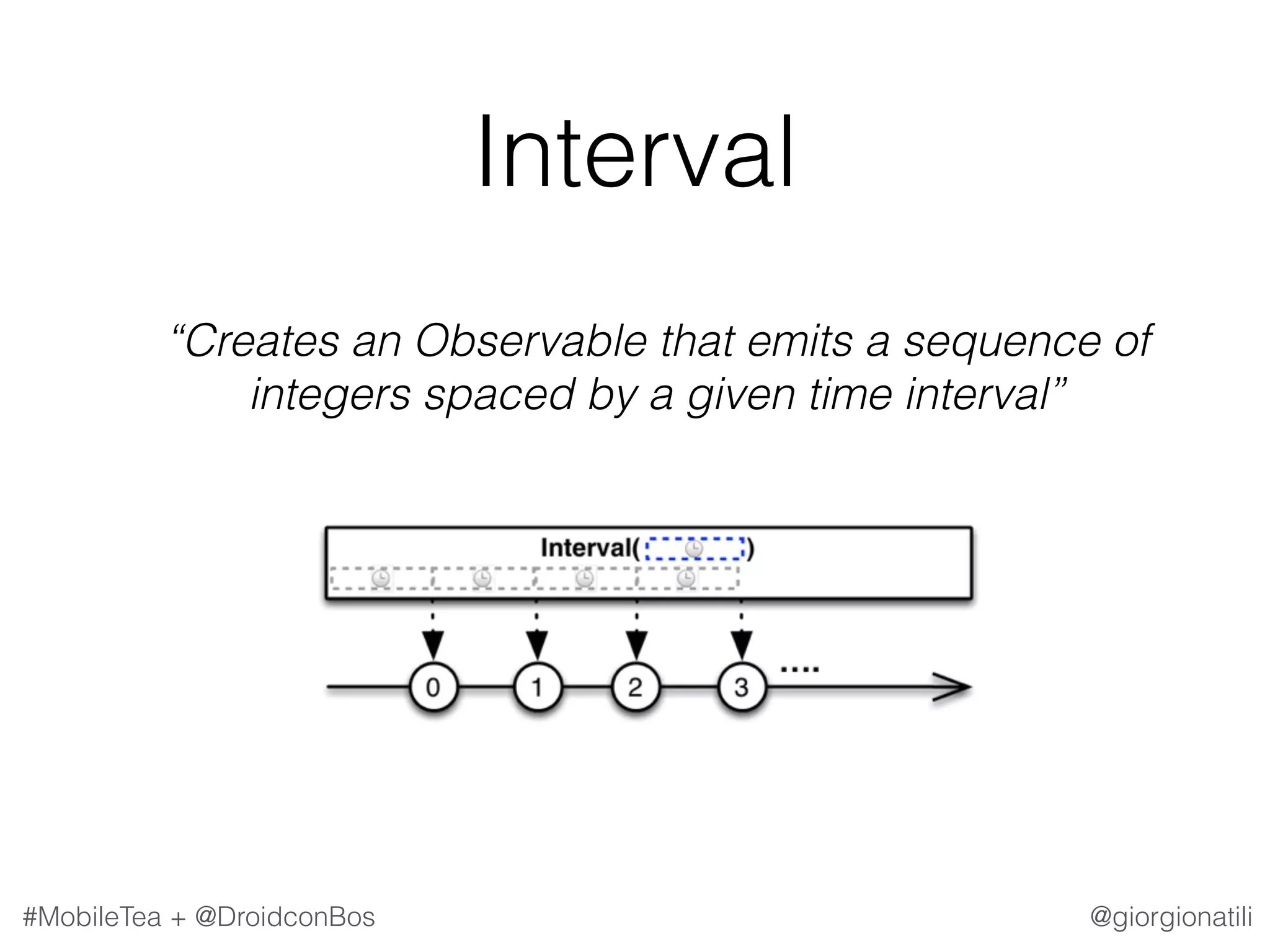
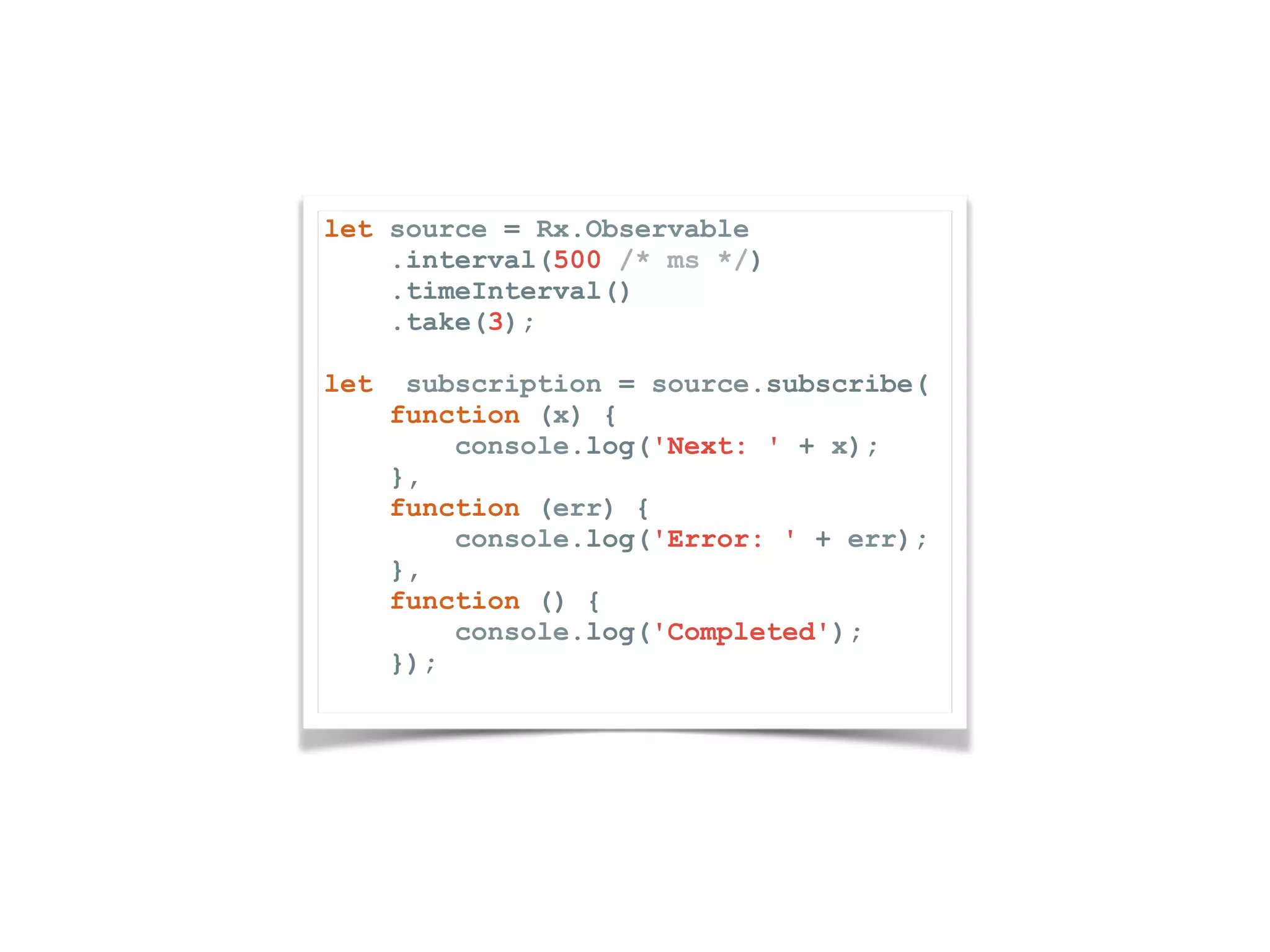
Interval


“Creates an Observable that emits a sequence of
integers spaced by a given time interval”
let source = Rx.Observable
.interval(500 /* ms */)
.timeInterval()
.take(3);
let subscription = source.subscribe(
function (x) {
console.log('Next: ' + x);
},
function (err) {
console.log('Error: ' + err);
},
function () {
console.log('Completed');
});
@giorgionatili#MobileTea + @DroidconBos
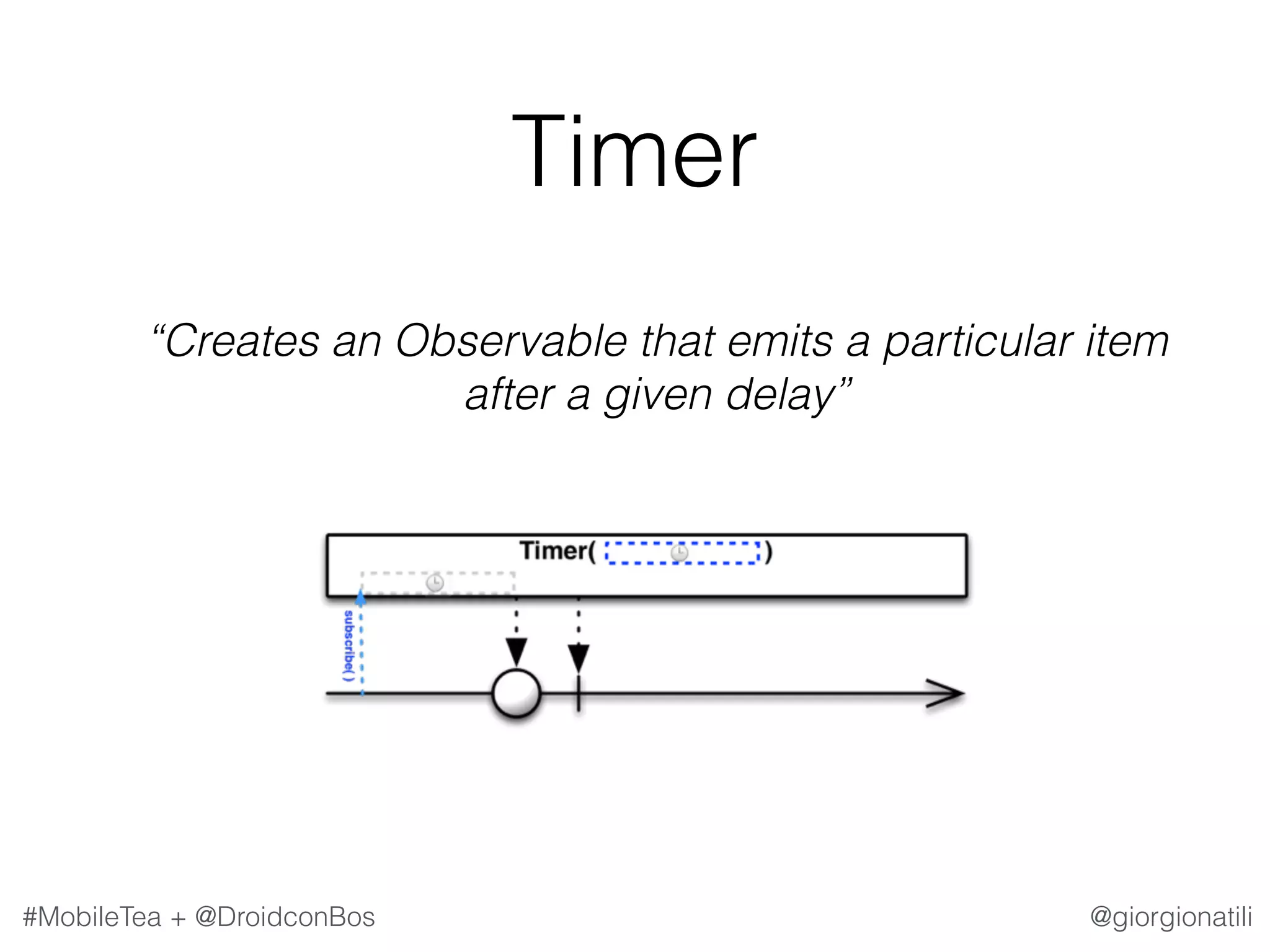
Timer


“Creates an Observable that emits a particular item
after a given delay”
Transforming
Operators
@giorgionatili#MobileTea + @DroidconBos
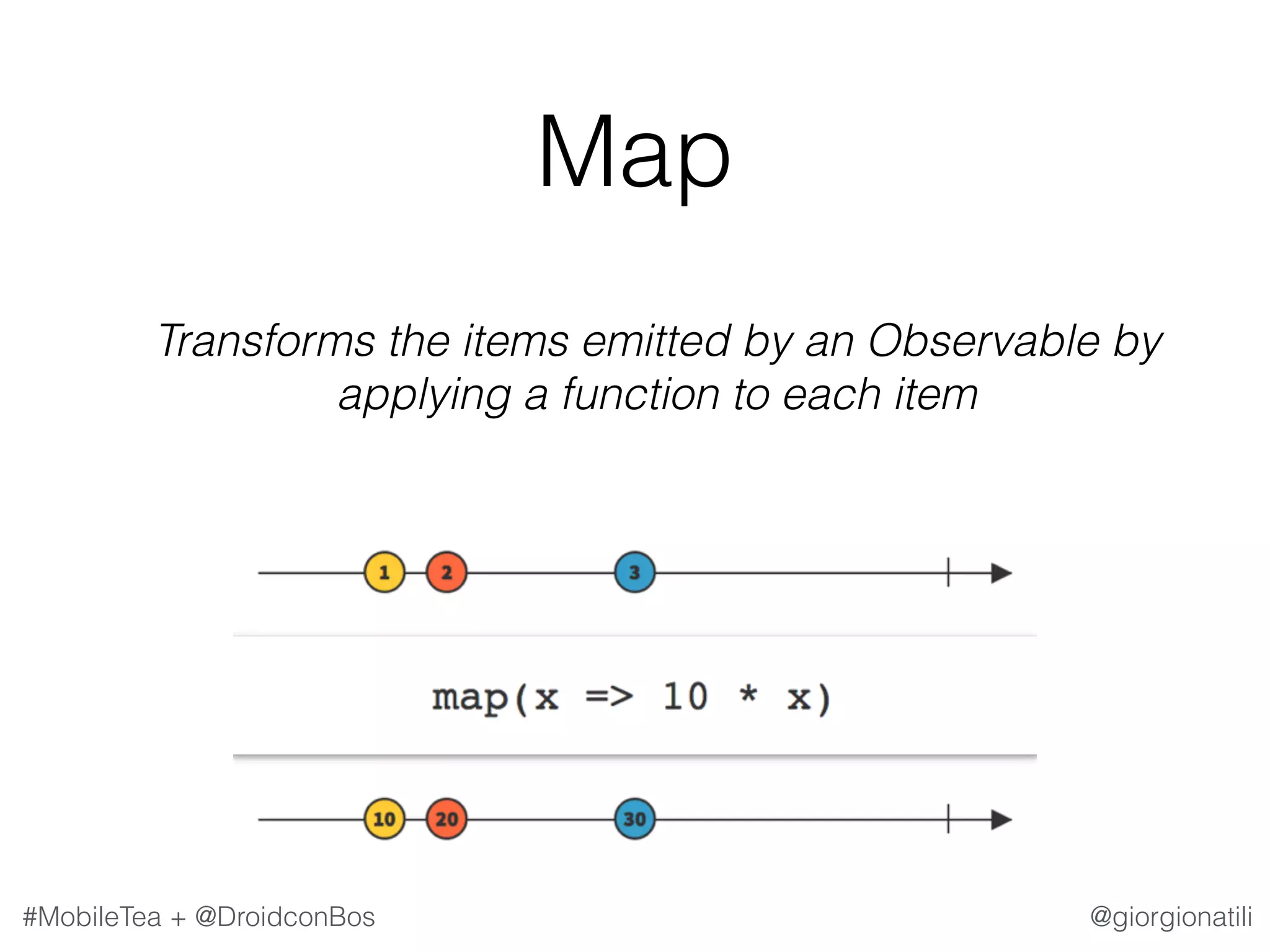
Map


Transforms the items emitted by an Observable by
applying a function to each item
@giorgionatili#MobileTea + @DroidconBos
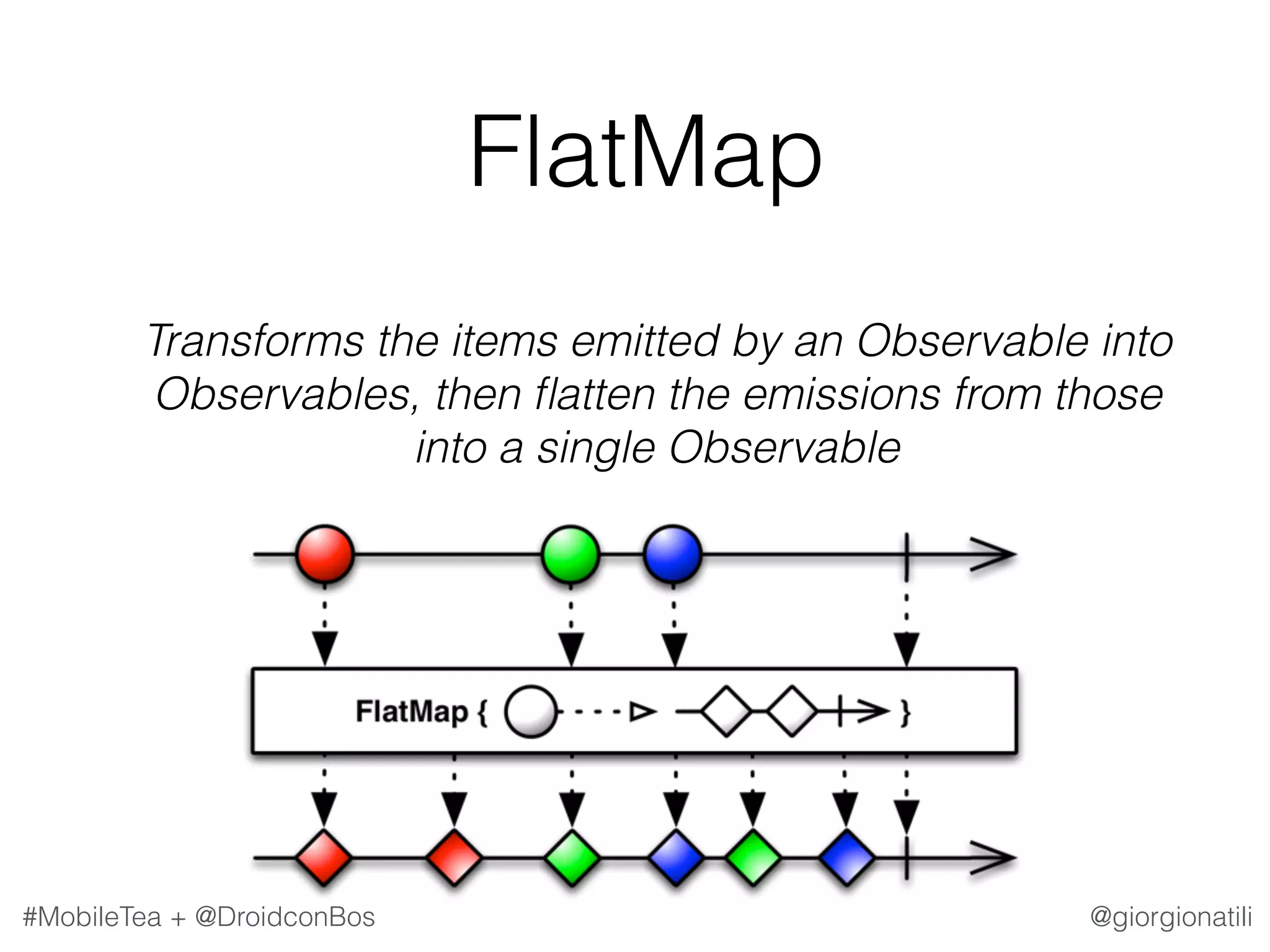
FlatMap


Transforms the items emitted by an Observable into
Observables, then flatten the emissions from those
into a single Observable
@giorgionatili#MobileTea + @DroidconBos
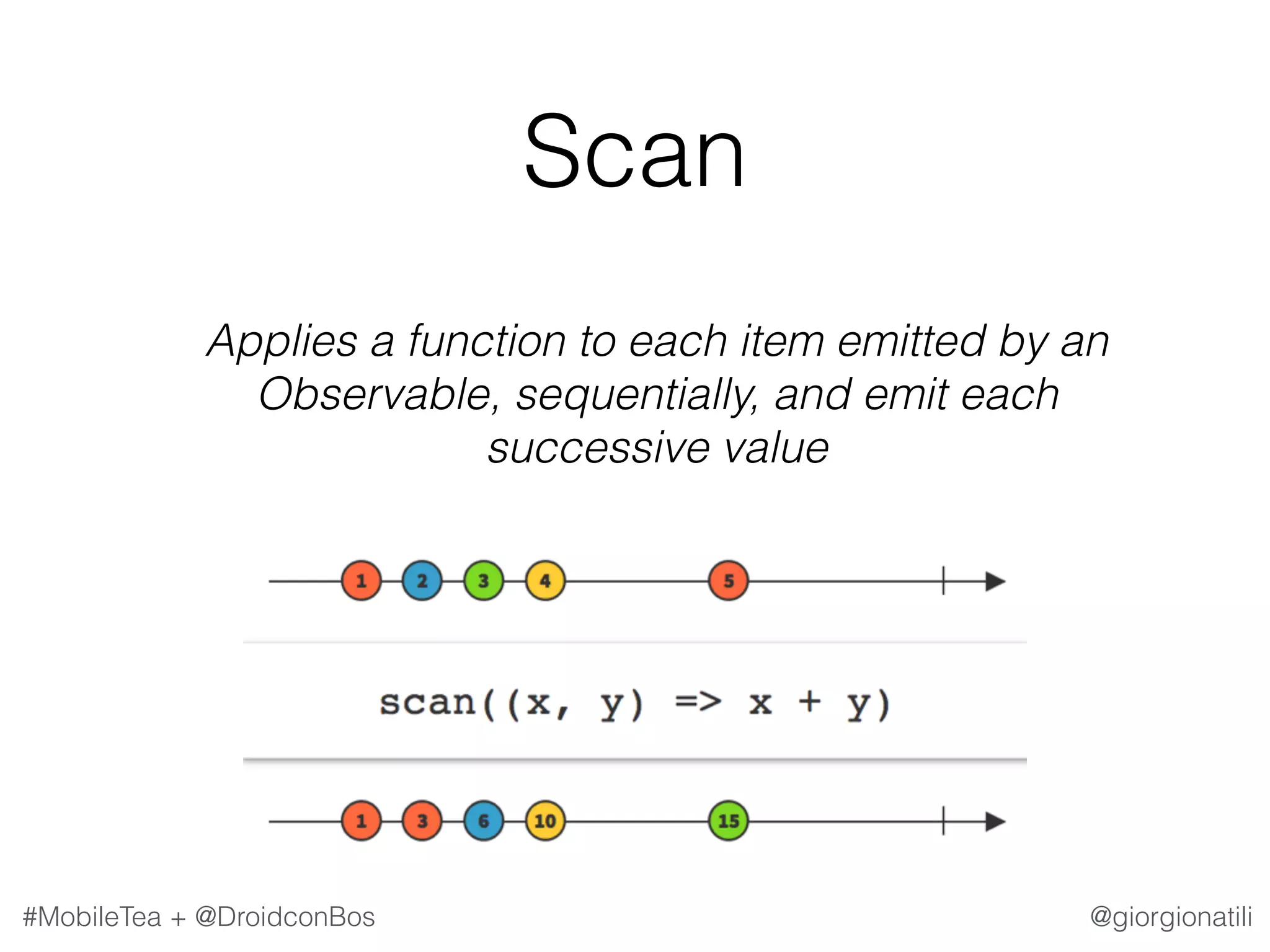
Scan


Applies a function to each item emitted by an
Observable, sequentially, and emit each
successive value
@giorgionatili#MobileTea + @DroidconBos
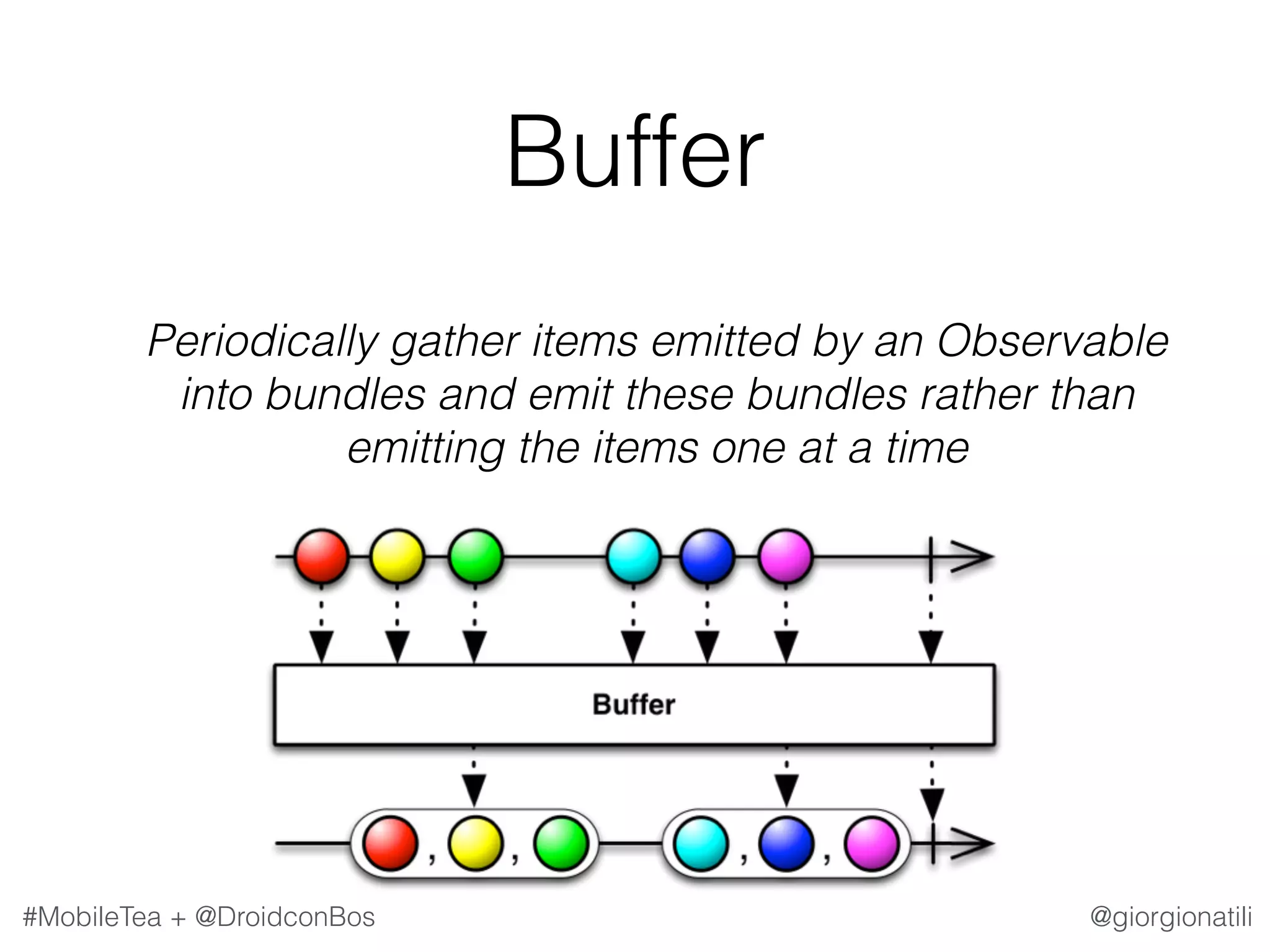
Buffer


Periodically gather items emitted by an Observable
into bundles and emit these bundles rather than
emitting the items one at a time
@giorgionatili#MobileTea + @DroidconBos
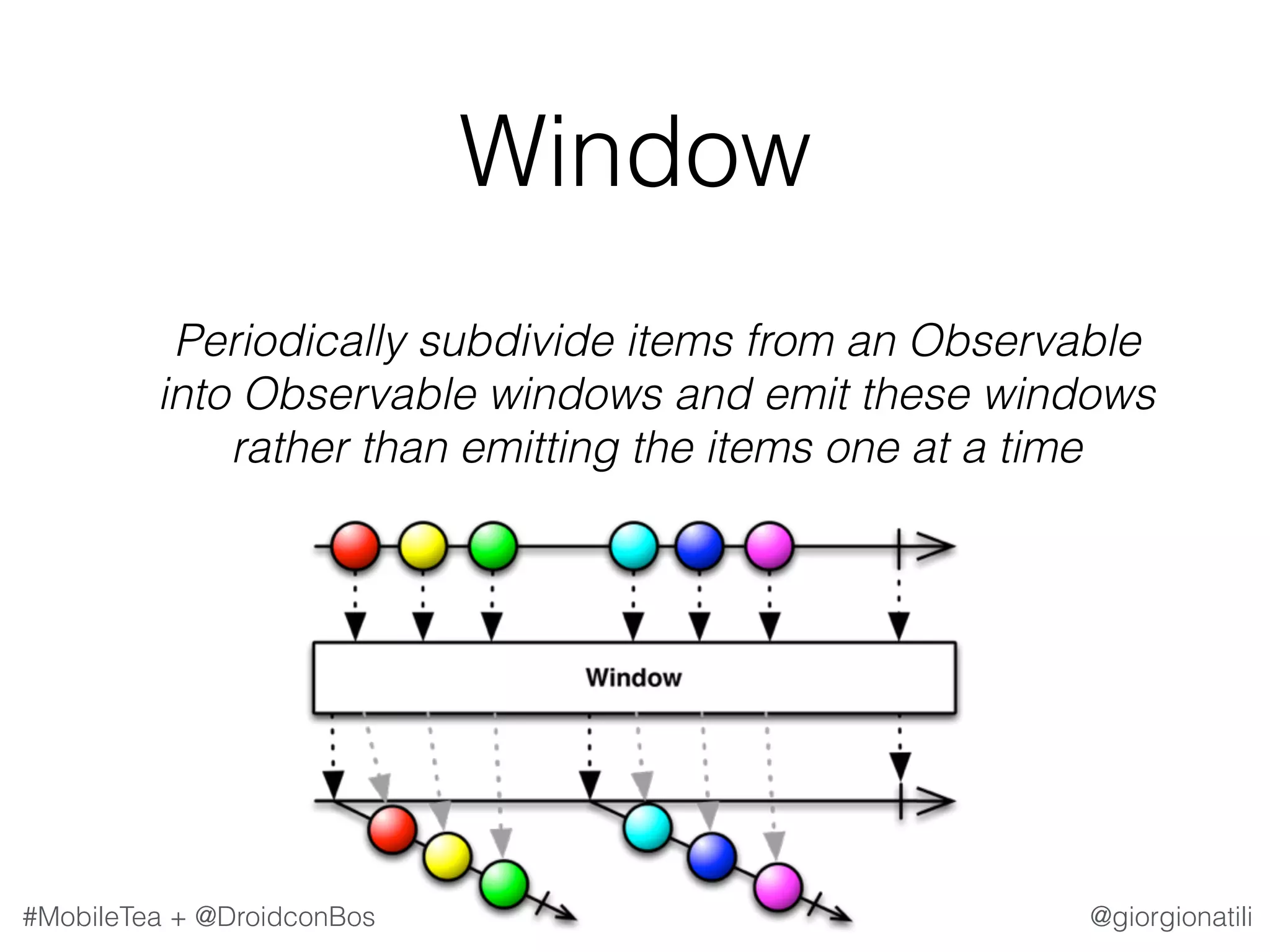
Window


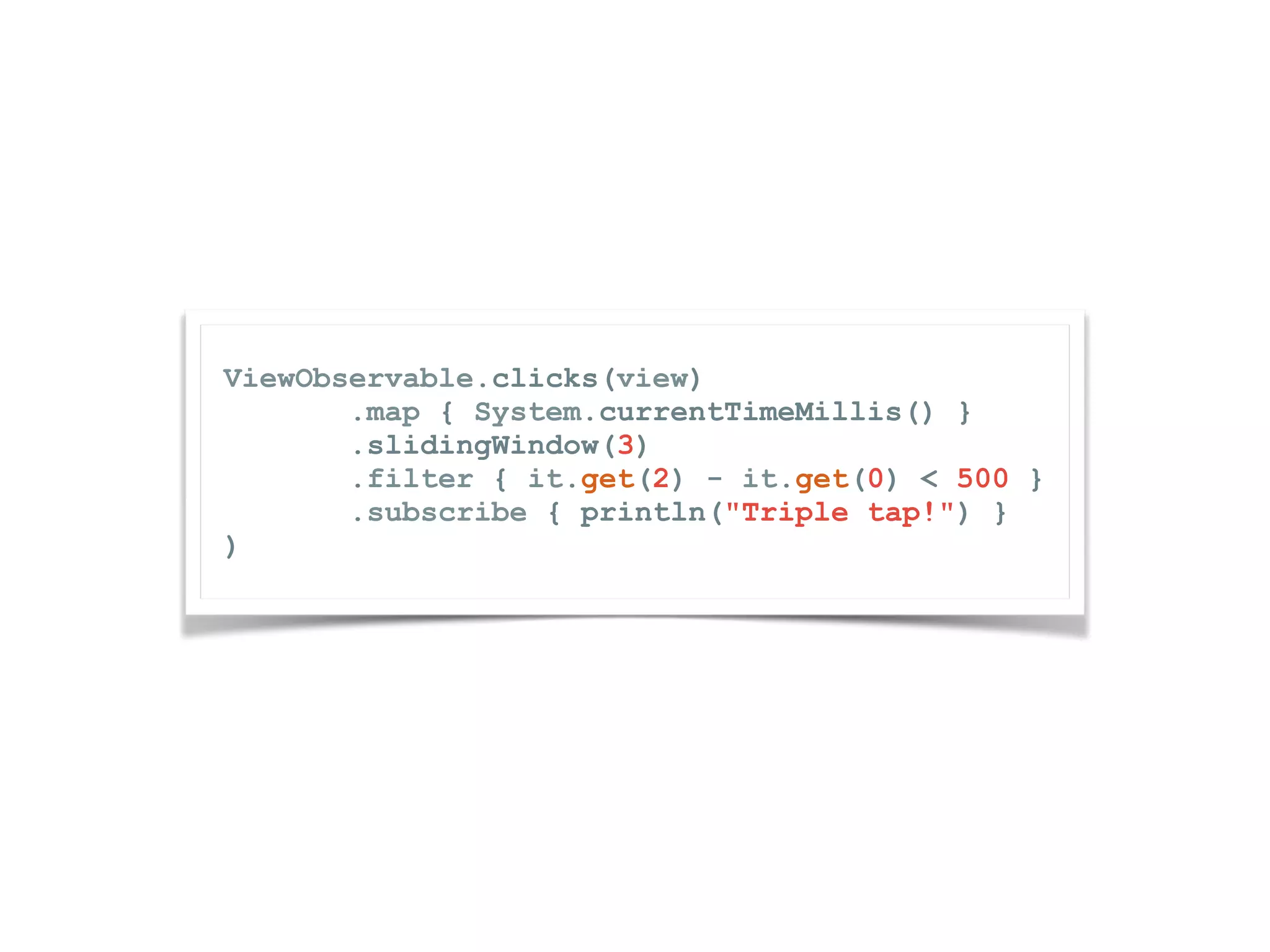
Periodically subdivide items from an Observable
into Observable windows and emit these windows
rather than emitting the items one at a time
ViewObservable.clicks(view)
.map { System.currentTimeMillis() }
.slidingWindow(3)
.filter { it.get(2) - it.get(0) < 500 }
.subscribe { println("Triple tap!") }
)
Filtering Operators
@giorgionatili#MobileTea + @DroidconBos
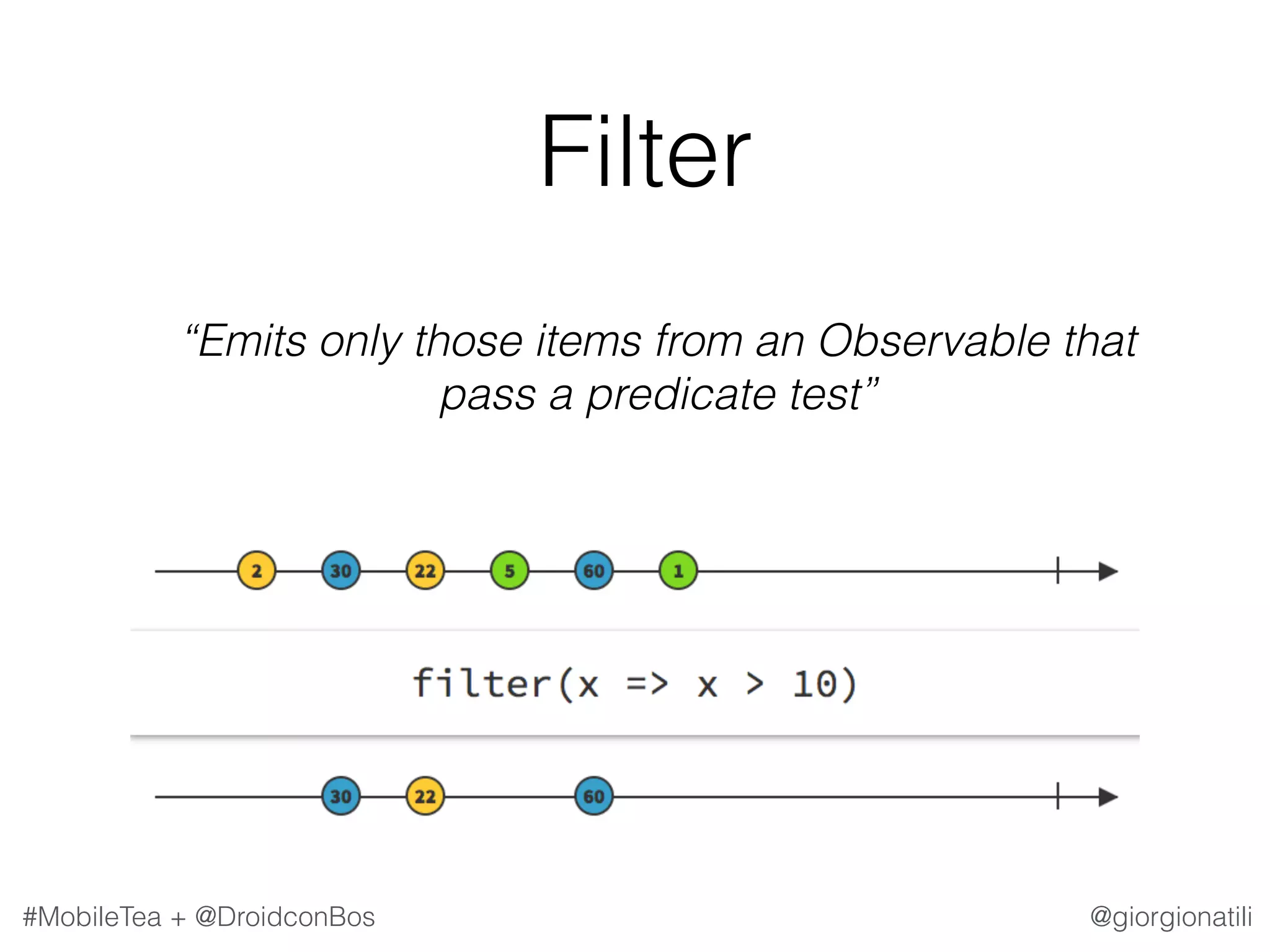
Filter


“Emits only those items from an Observable that
pass a predicate test”
@giorgionatili#MobileTea + @DroidconBos
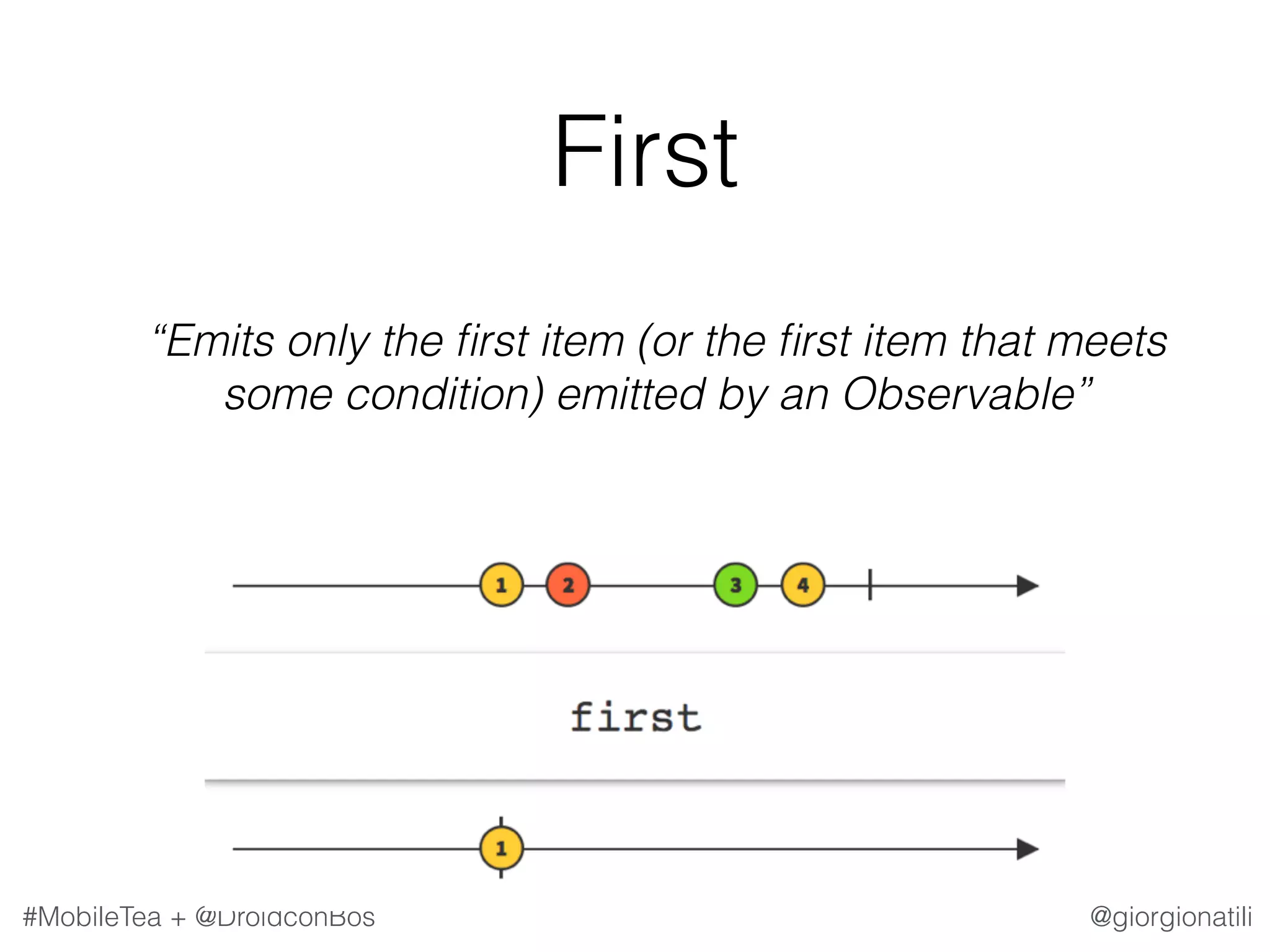
First


“Emits only the first item (or the first item that meets
some condition) emitted by an Observable”
@giorgionatili#MobileTea + @DroidconBos
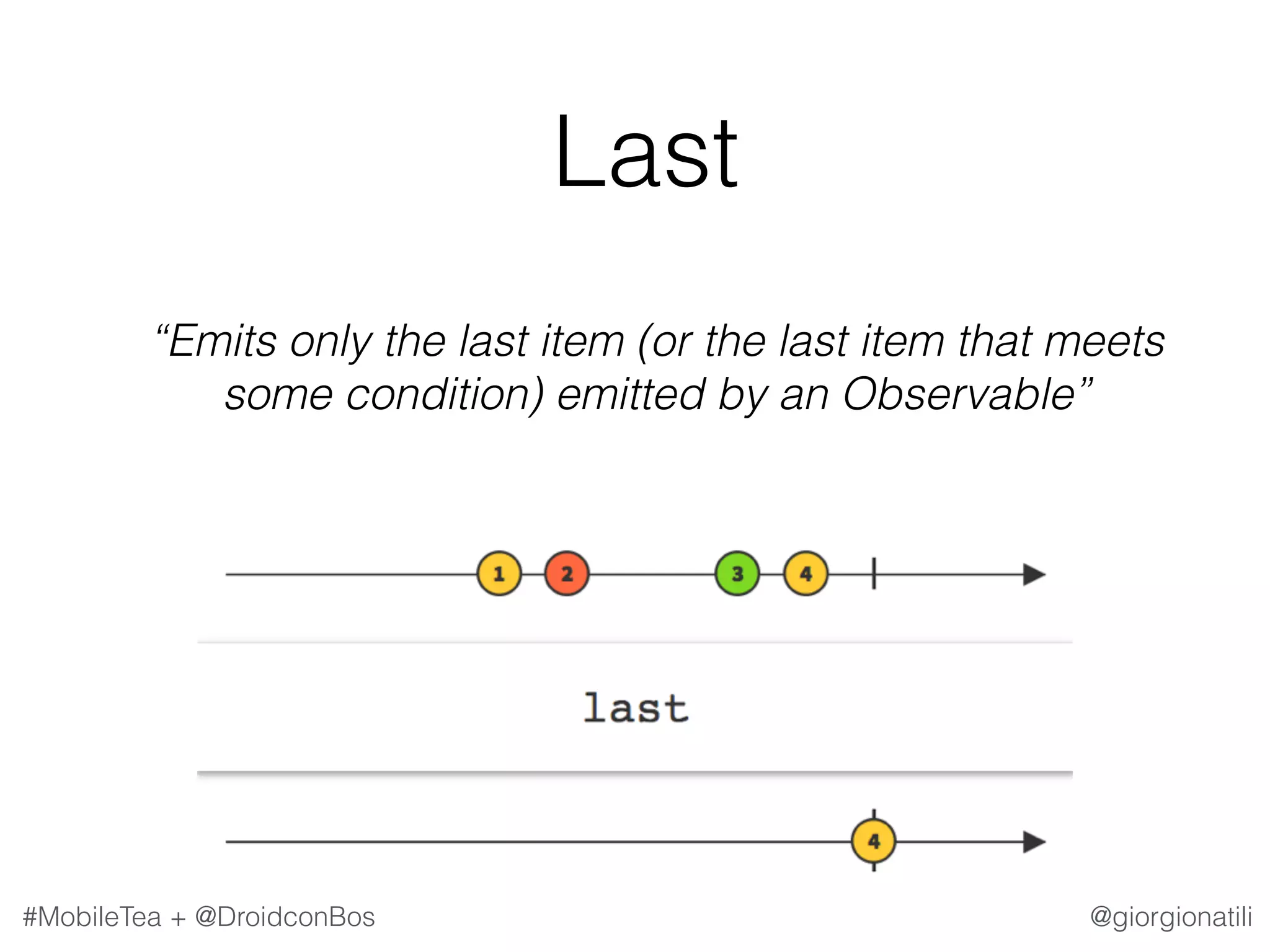
Last


“Emits only the last item (or the last item that meets
some condition) emitted by an Observable”
@giorgionatili#MobileTea + @DroidconBos
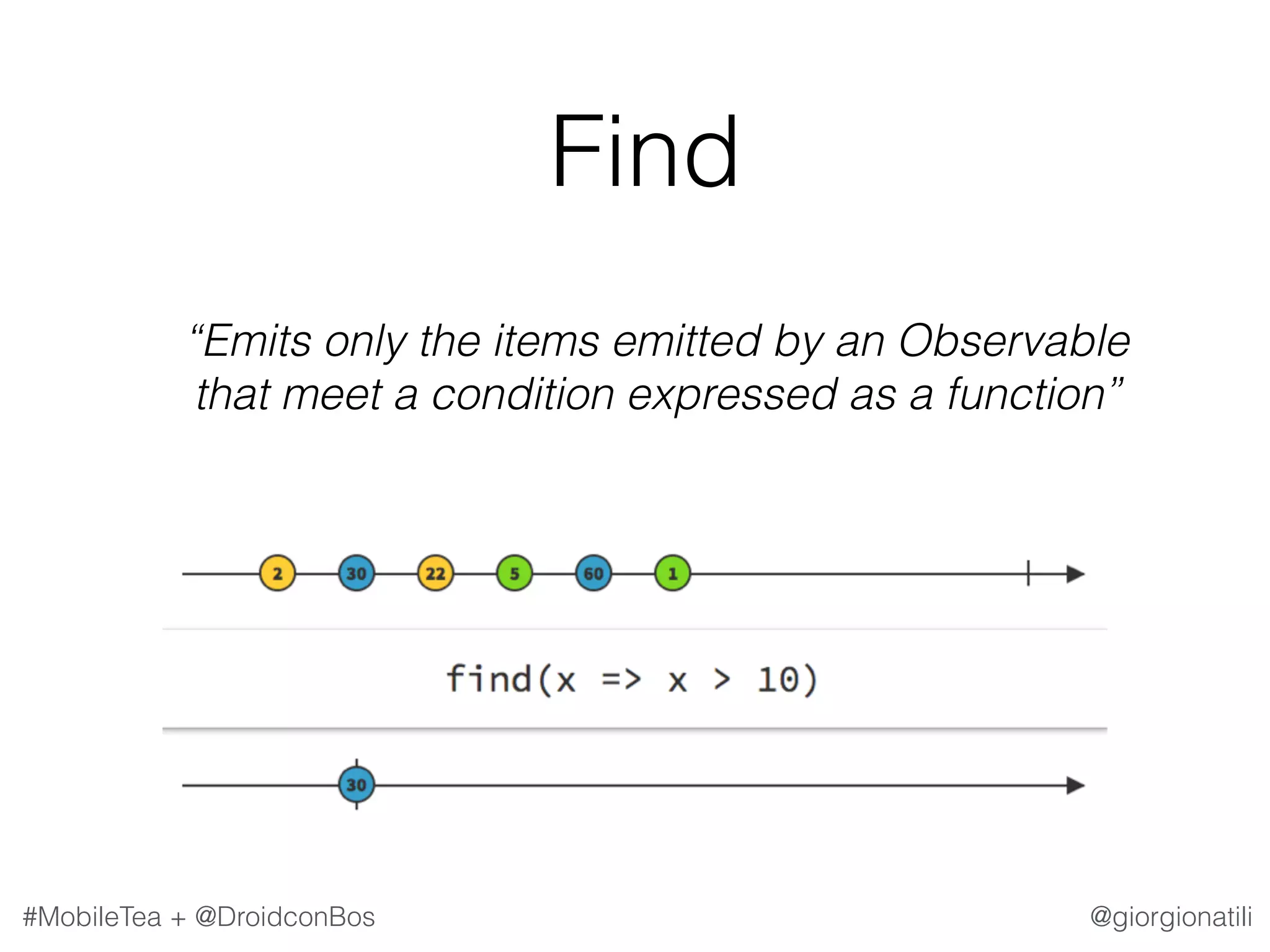
Find


“Emits only the items emitted by an Observable
that meet a condition expressed as a function”
@giorgionatili#MobileTea + @DroidconBos
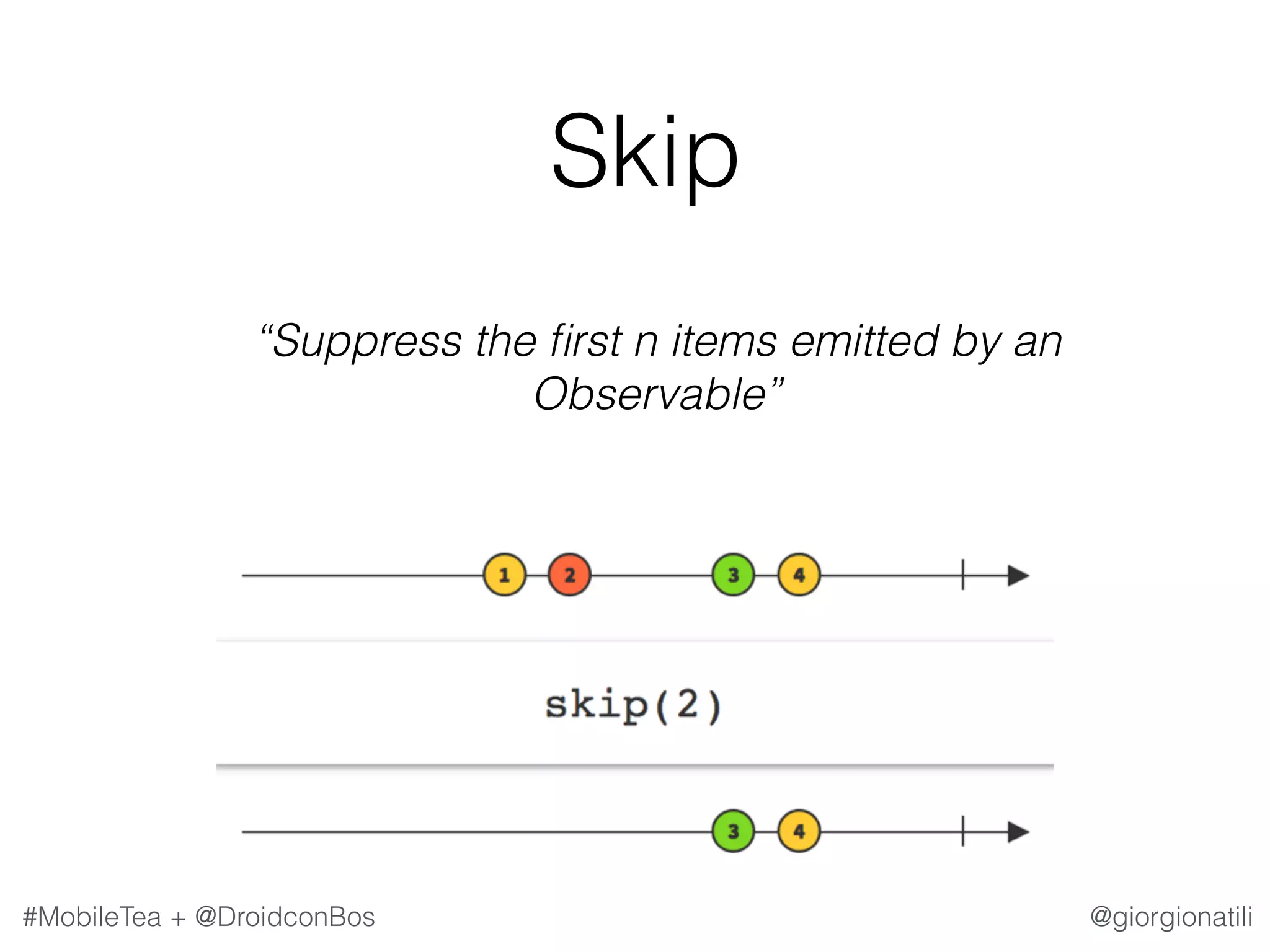
Skip


“Suppress the first n items emitted by an
Observable”
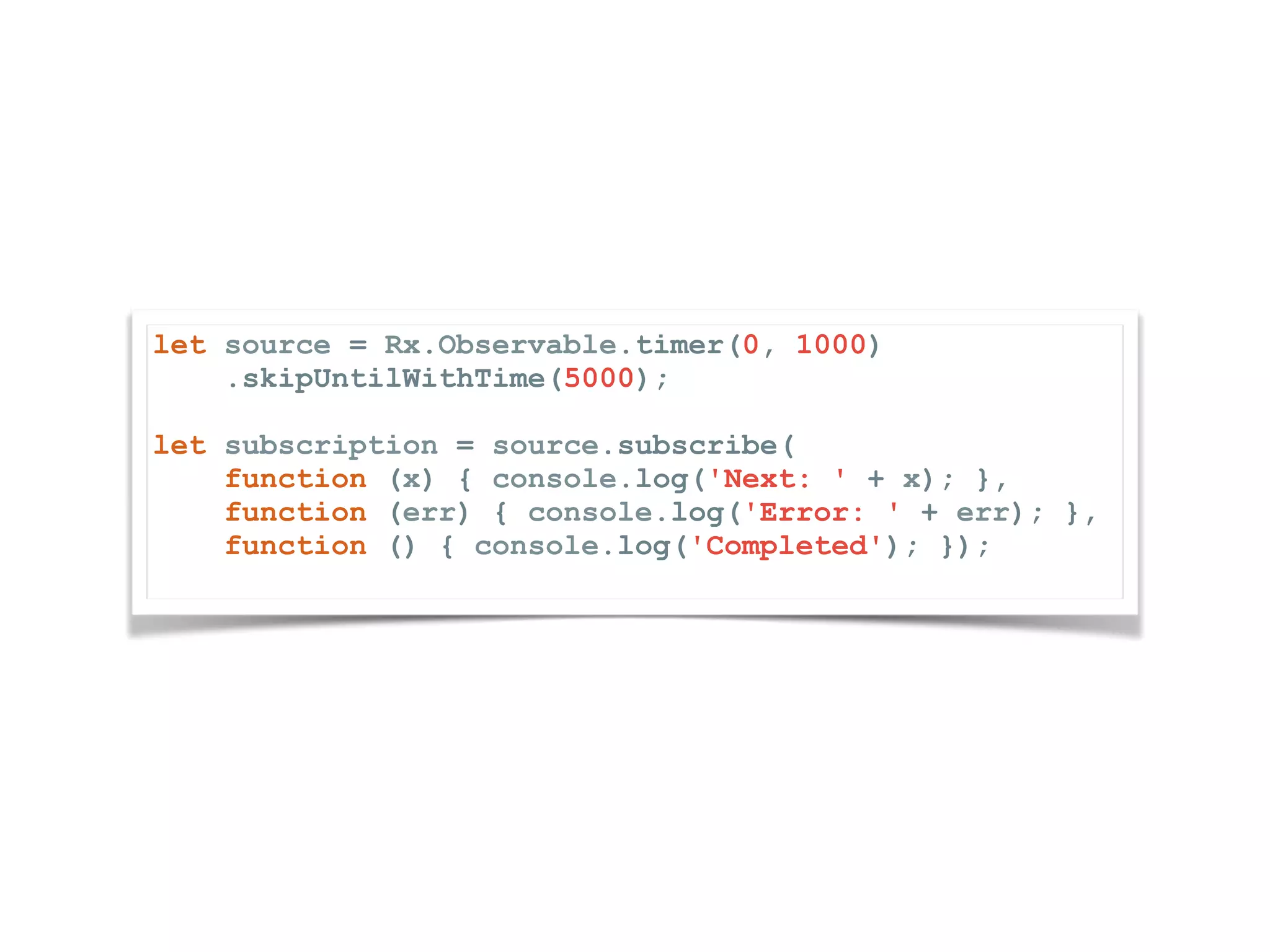
let source = Rx.Observable.timer(0, 1000)
.skipUntilWithTime(5000);
let subscription = source.subscribe(
function (x) { console.log('Next: ' + x); },
function (err) { console.log('Error: ' + err); },
function () { console.log('Completed'); });
@giorgionatili#MobileTea + @DroidconBos
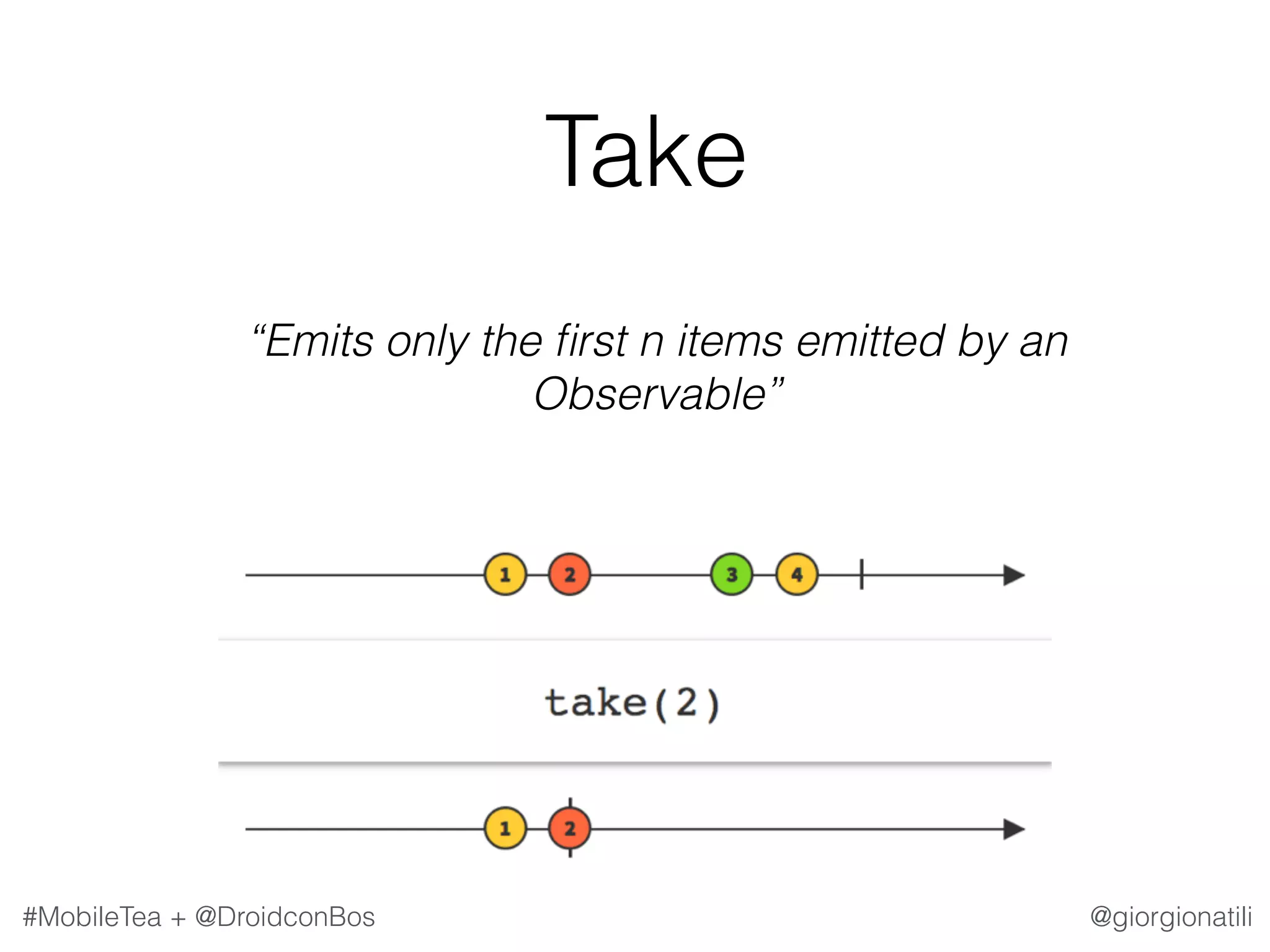
Take


“Emits only the first n items emitted by an
Observable”
@giorgionatili#MobileTea + @DroidconBos
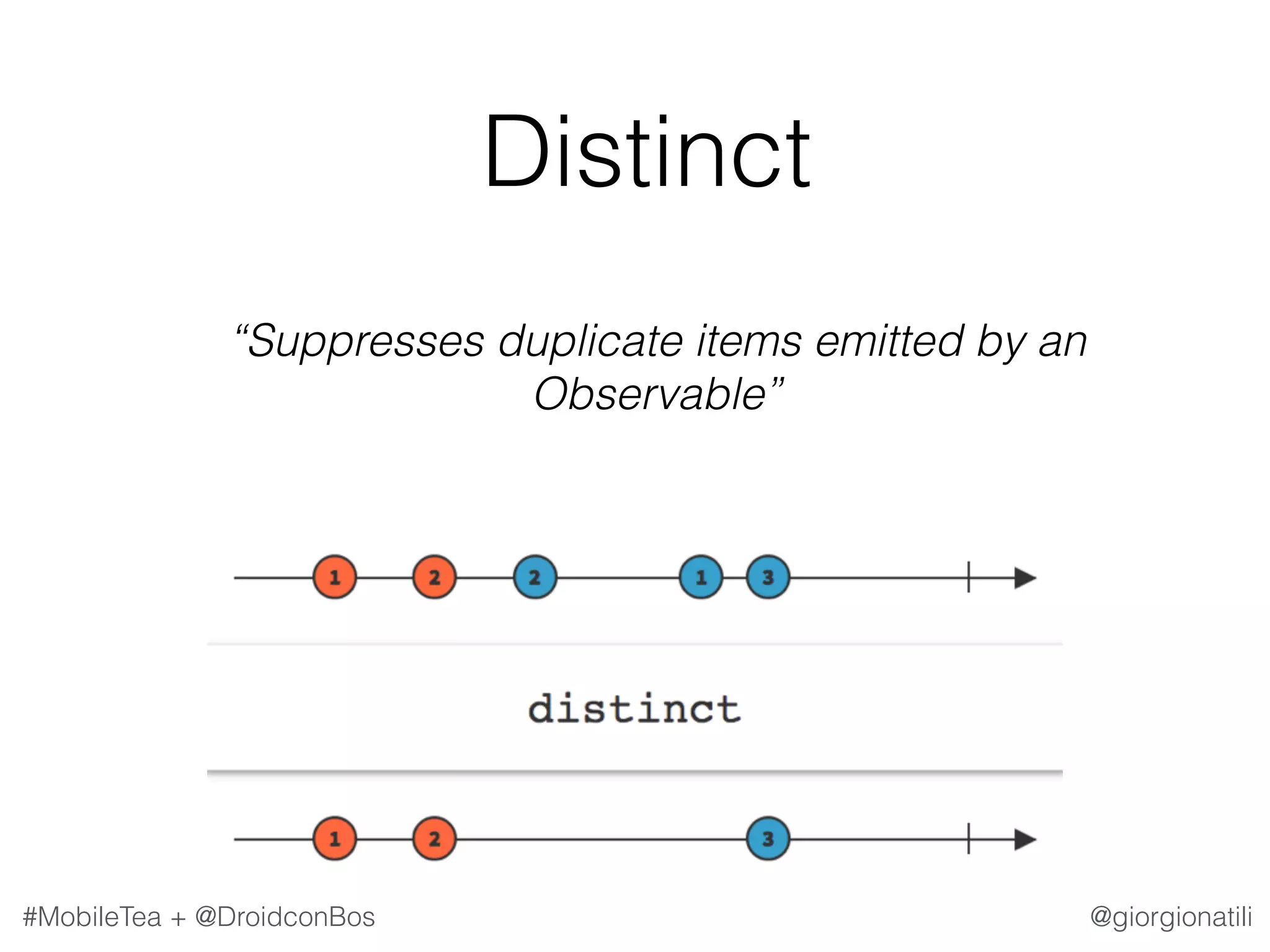
Distinct


“Suppresses duplicate items emitted by an
Observable”
Combining Operators
@giorgionatili#MobileTea + @DroidconBos
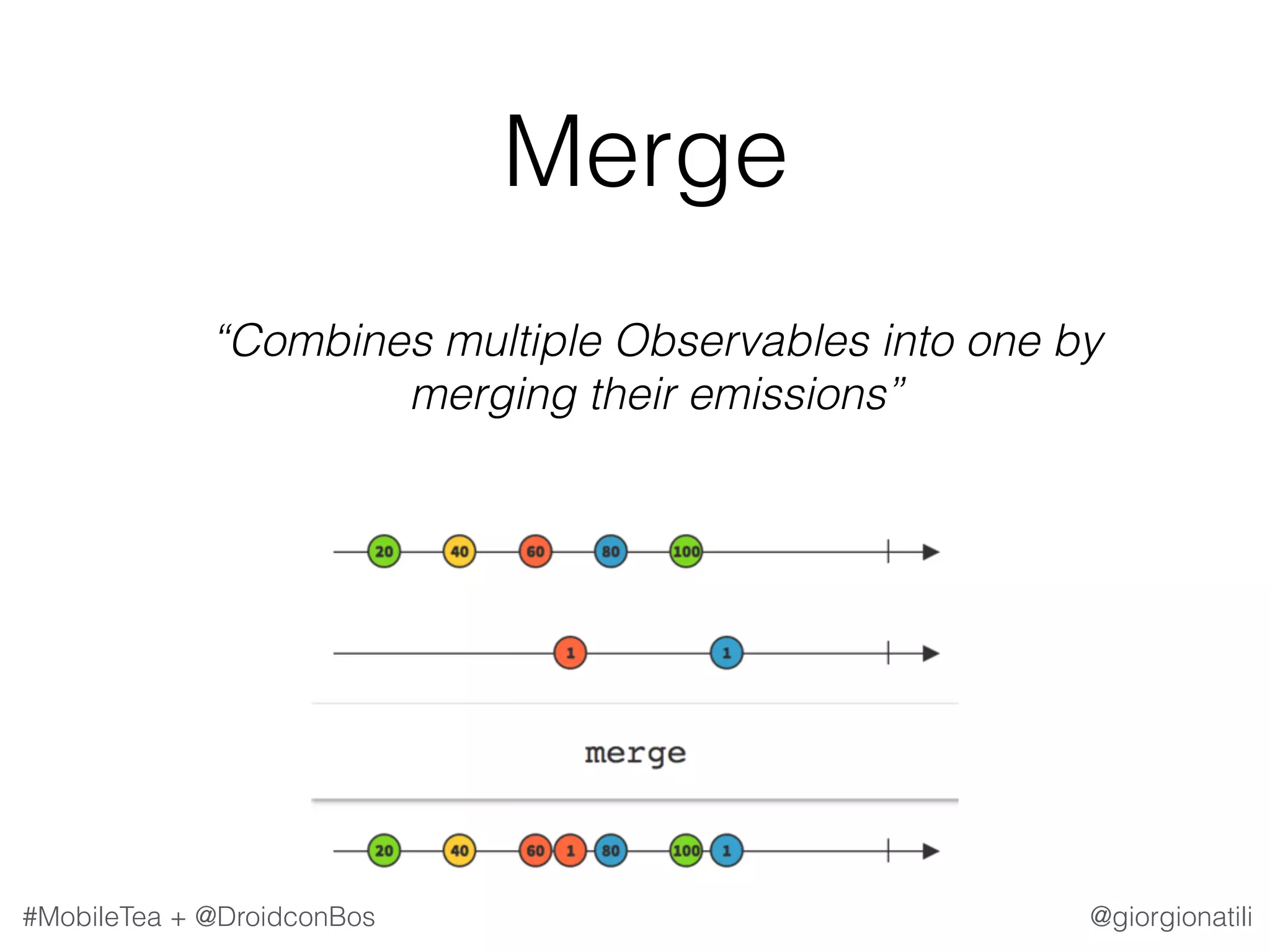
Merge


“Combines multiple Observables into one by
merging their emissions”
@giorgionatili#MobileTea + @DroidconBos
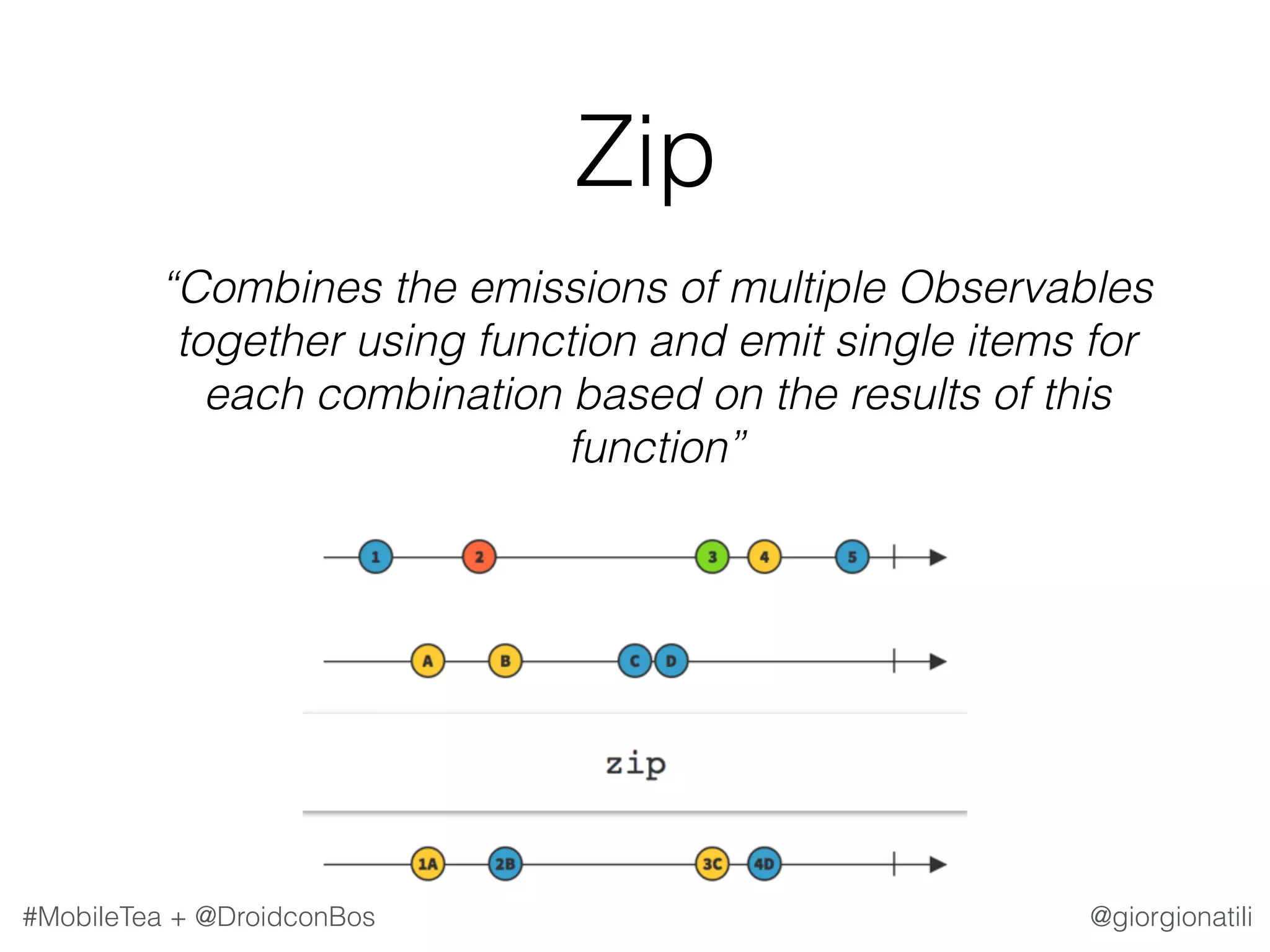
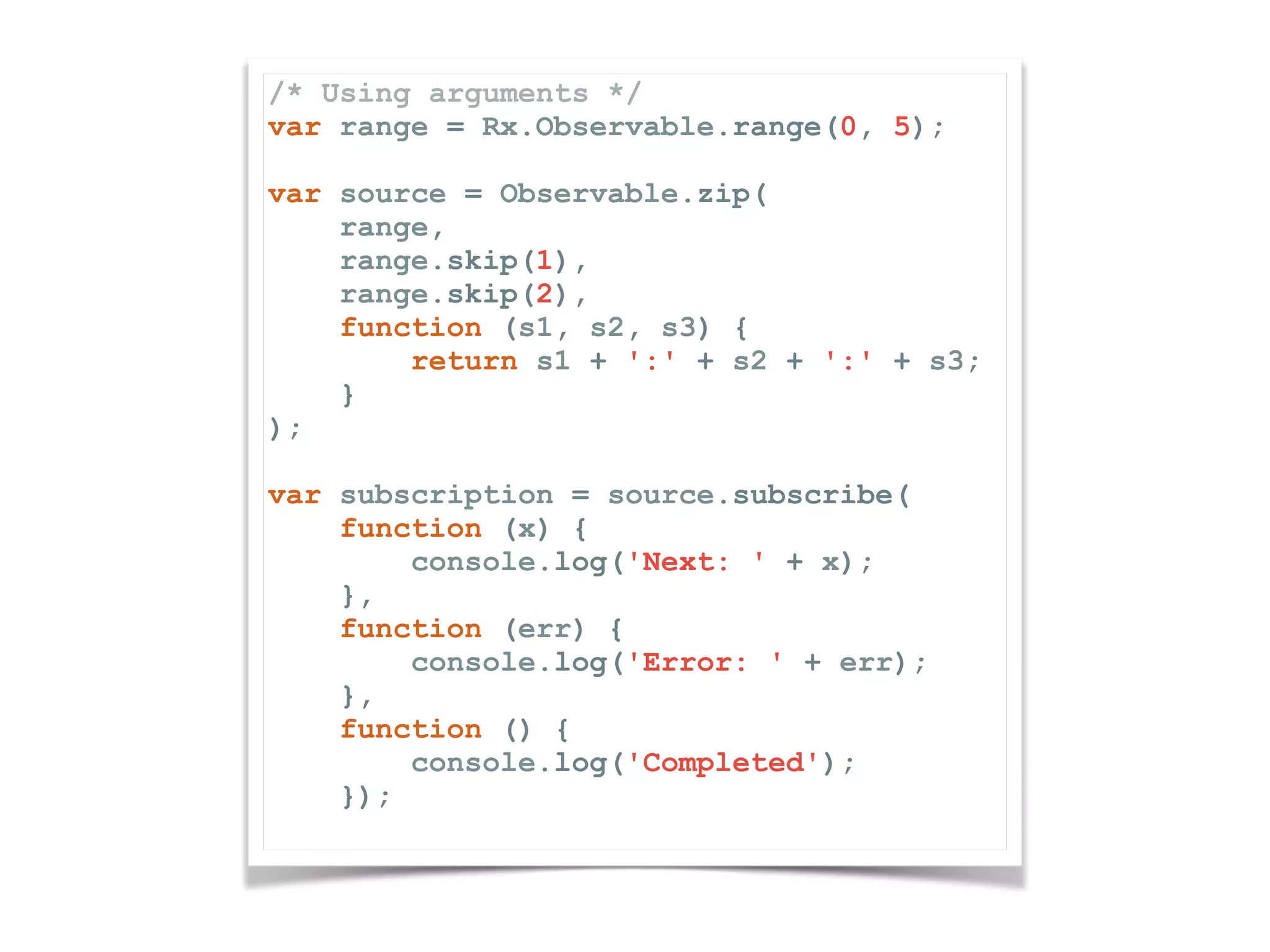
Zip
“Combines the emissions of multiple Observables
together using function and emit single items for
each combination based on the results of this
function”
/* Using arguments */
var range = Rx.Observable.range(0, 5);
var source = Observable.zip(
range,
range.skip(1),
range.skip(2),
function (s1, s2, s3) {
return s1 + ':' + s2 + ':' + s3;
}
);
var subscription = source.subscribe(
function (x) {
console.log('Next: ' + x);
},
function (err) {
console.log('Error: ' + err);
},
function () {
console.log('Completed');
});
@giorgionatili#MobileTea + @DroidconBos
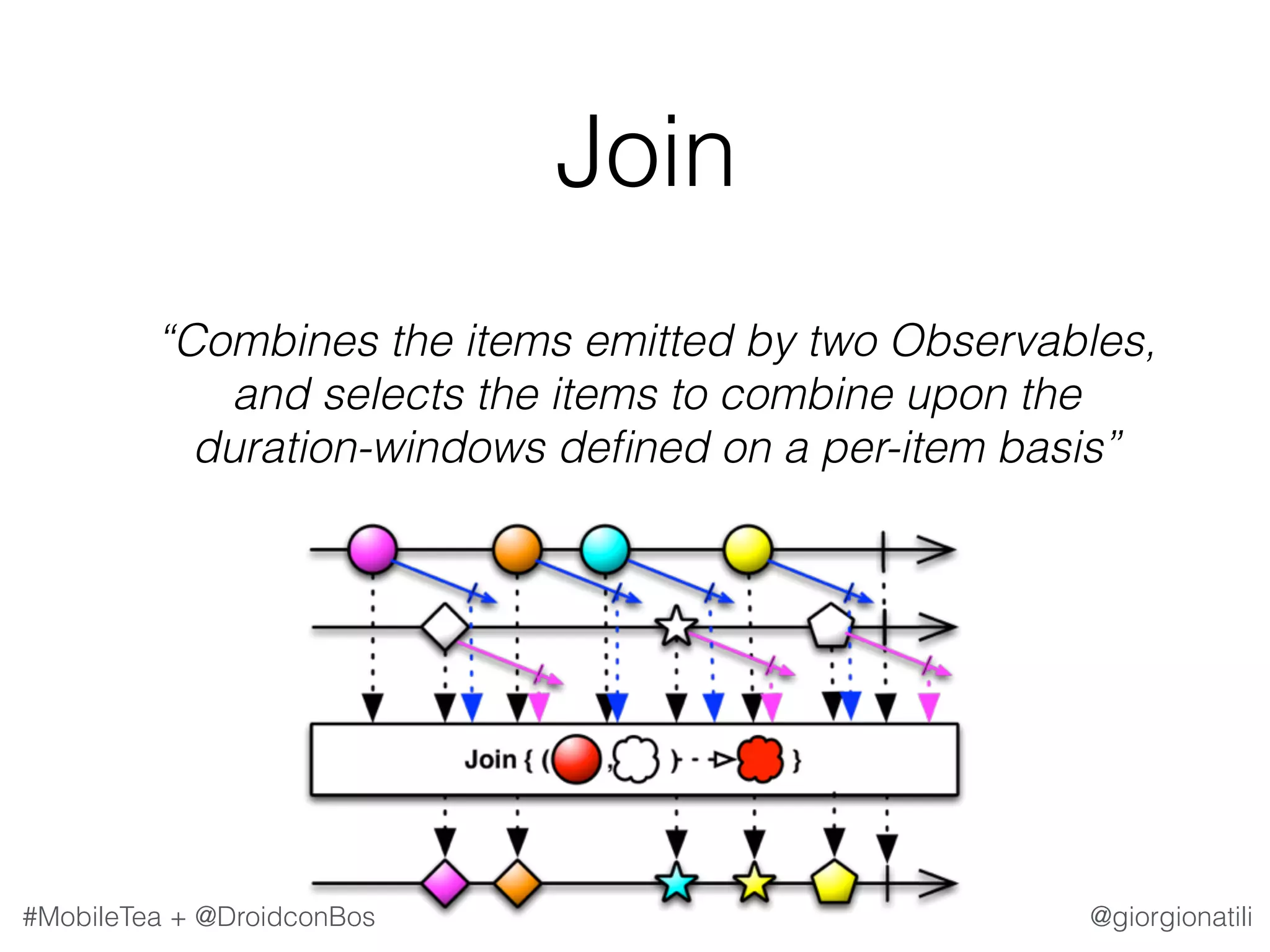
Join


“Combines the items emitted by two Observables,
and selects the items to combine upon the
duration-windows defined on a per-item basis”
@giorgionatili#MobileTea + @DroidconBos
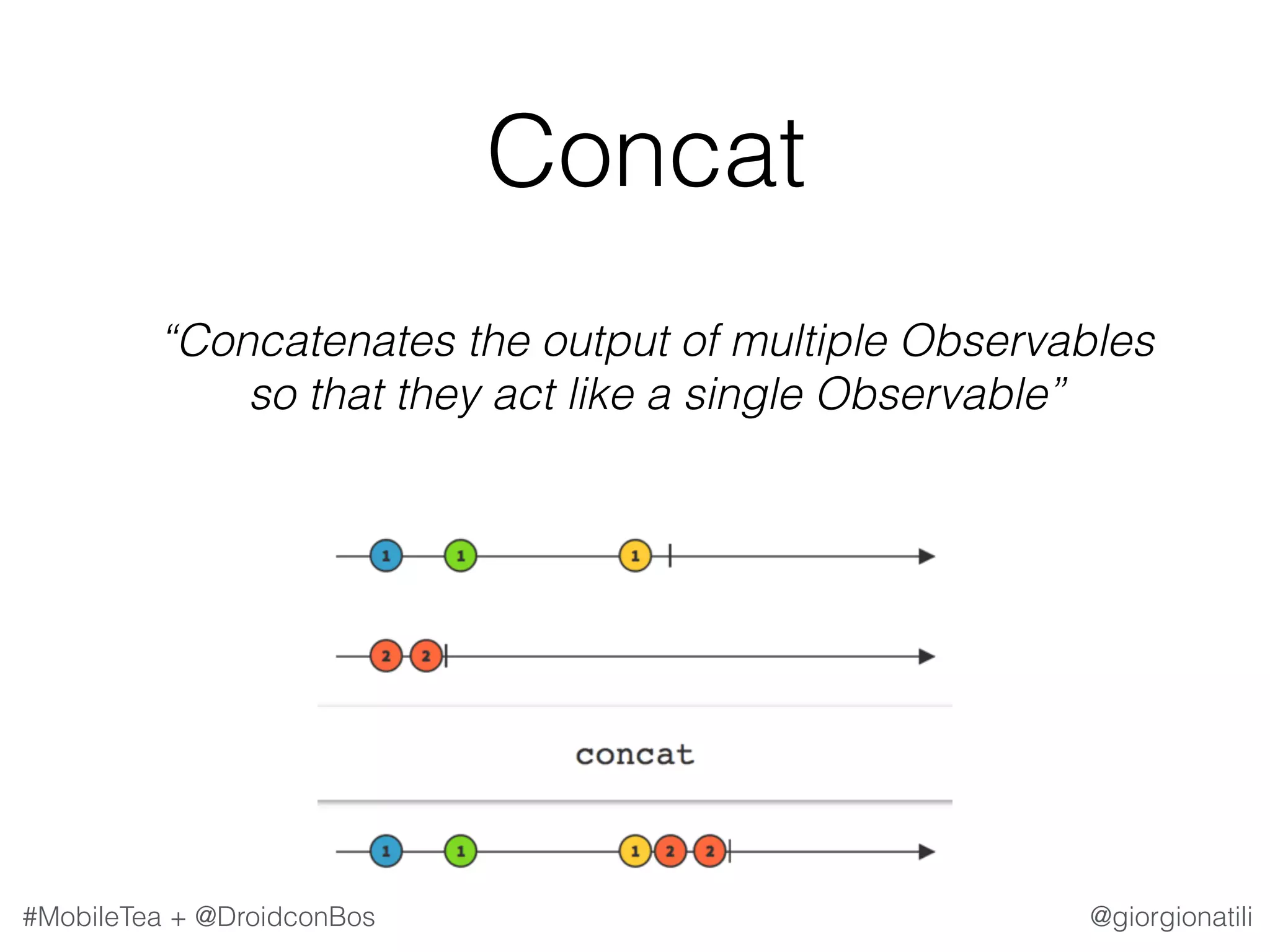
Concat


“Concatenates the output of multiple Observables
so that they act like a single Observable”
Parallelization
@giorgionatili#MobileTea + @DroidconBos
Achieving Parallelization
• A common question about Reactive Extensions is
how to achieve parallelization, or emitting multiple
items concurrently from an Observable
• You can achieve parallelization in RxJava without
breaking the Observable contract
@giorgionatili#MobileTea + @DroidconBos
Schedulers
• immediate(), creates and returns a Scheduler that executes work
immediately on the current thread
• trampoline(), creates and returns a Scheduler that queues work
on the current thread to be executed after the current work completes
• newThread(), creates and returns a Scheduler that creates a new
Thread for each unit of work
• computation(), creates and returns a Scheduler intended for
computational work
• io(),creates and returns a Scheduler intended for IO-bound work
(unbounded, multiple threads)
@giorgionatili#MobileTea + @DroidconBos
subscribeOn
The method subscribeOn() allows you to move
the execution of the Observable code into another
thread and with an specific behavior
@giorgionatili#MobileTea + @DroidconBos
flatMap
The flatMap() has to merge emissions from
multiple Observables happening on multiple
threads, but it cannot allow concurrent onNext()
calls to happen down the chain including the
Subscribe
Observable<Integer>vals = Observable.range(1,10);
vals.flatMap(val -> Observable.just(val)
.subscribeOn(Schedulers.computation())
.map(i -> intenseCalculation(i))
).toList()
.subscribe(val -> System.out.println("Subscriber received "
+ val + " on "
+ Thread.currentThread().getName()));
Calculating 4 on RxComputationThreadPool-2
Calculating 1 on RxComputationThreadPool-3
Calculating 2 on RxComputationThreadPool-4
Calculating 3 on RxComputationThreadPool-1
Calculating 7 on RxComputationThreadPool-1
Calculating 6 on RxComputationThreadPool-4
Calculating 5 on RxComputationThreadPool-3
Calculating 10 on RxComputationThreadPool-4
Calculating 8 on RxComputationThreadPool-2
Calculating 9 on RxComputationThreadPool-3
Subscriber received [3, 2, 1, 6, 4, 7, 10, 5, 8, 9] on RxComputationThreadPool-3
Parallelization with RxJava
What’s About Swift?
What’s About
JavaScript?
Questions?
–Giorgio Natili
“Keep calm and react gracefully to
asynchronous system events…”

Isomorphic Reactive Programming