Exploring the Invisible: Isolation
and Identification of Airborne
Microbes
Exploring the Invisible: Isolation
and Identification of Airborne
Microbes
Airborne microbes play a crucial role in our
environment, affecting health, climate,
and ecosystems. This presentation will
explore the methods for isolating and
identifying these invisible organisms,
highlighting their significance and impact
on our daily lives. Understanding them is
essential for improving public health and
environmental safety.
Airborne microbes play a crucial role in our
environment, affecting health, climate,
and ecosystems. This presentation will
explore the methods for isolating and
identifying these invisible organisms,
highlighting their significance and impact
on our daily lives. Understanding them is
essential for improving public health and
environmental safety.
Introduction to Airborne Microbes
Types of Airborne Microbes
Airborne microbes include bacteria, fungi,
and viruses. Each type has unique
characteristics and impacts on health and
the environment. Bacteria can cause
infections, while fungi can lead to allergies.
Understanding these differences is vital for
effective identification and management
strategies.
Airborne microbes include bacteria, fungi,
and viruses. Each type has unique
characteristics and impacts on health and
the environment. Bacteria can cause
infections, while fungi can lead to allergies.
Understanding these differences is vital for
effective identification and management
strategies.
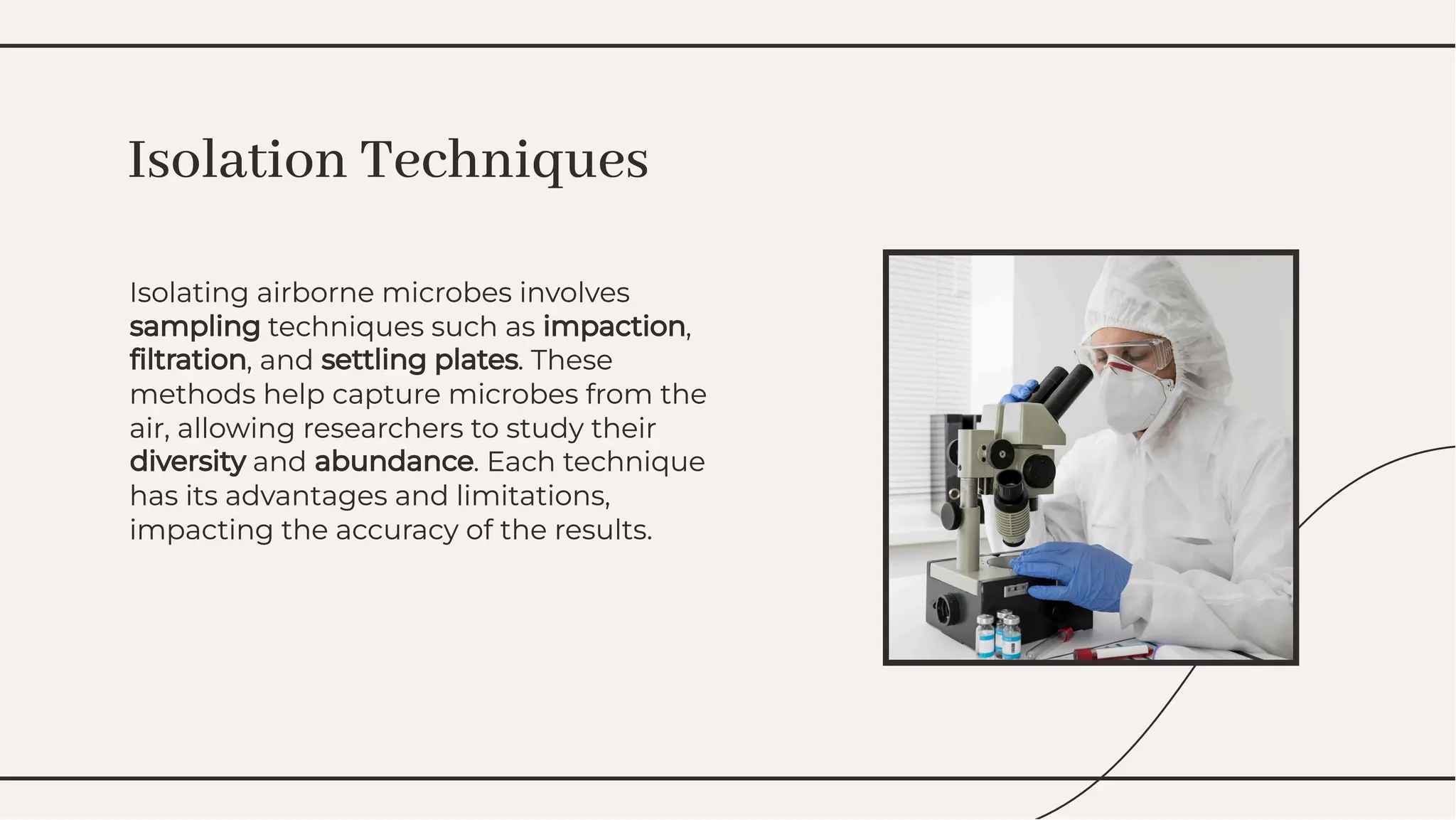
Isolating airborne microbes involves
sampling techniques such as impaction,
filtration, and settling plates. These
methods help capture microbes from the
air, allowing researchers to study their
diversity and abundance. Each technique
has its advantages and limitations,
impacting the accuracy of the results.
Isolating airborne microbes involves
sampling techniques such as impaction,
filtration, and settling plates. These
methods help capture microbes from the
air, allowing researchers to study their
diversity and abundance. Each technique
has its advantages and limitations,
impacting the accuracy of the results.
Isolation Techniques
Identifying isolated microbes can be
achieved through various methods,
including culture techniques, molecular
techniques, and genomic sequencing.
Each method provides different insights
into the species, genetic makeup, and
potential pathogenicity of the microbes,
facilitating a deeper understanding of
their roles in the environment.
Identifying isolated microbes can be
achieved through various methods,
including culture techniques, molecular
techniques, and genomic sequencing.
Each method provides different insights
into the species, genetic makeup, and
potential pathogenicity of the microbes,
facilitating a deeper understanding of
their roles in the environment.
Identification Methods
Airborne microbes significantly influence
public health, contributing to respiratory
diseases, allergies, and infections.
Understanding their presence and
behavior can lead to improved health
policies and preventive measures. It is
crucial to monitor and control these
microbes to protect community health
and well-being.
Airborne microbes significantly influence
public health, contributing to respiratory
diseases, allergies, and infections.
Understanding their presence and
behavior can lead to improved health
policies and preventive measures. It is
crucial to monitor and control these
microbes to protect community health
and well-being.
Impact on Public Health
Exploring airborne microbes is essential
for understanding their ecological roles
and impacts on human health. Ongoing
research will enhance our identification
techniques and inform strategies for
managing their effects. Continued
collaboration among scientists, healthcare
professionals, and policymakers is vital for
addressing the challenges posed by these
invisible organisms.
Exploring airborne microbes is essential
for understanding their ecological roles
and impacts on human health. Ongoing
research will enhance our identification
techniques and inform strategies for
managing their effects. Continued
collaboration among scientists, healthcare
professionals, and policymakers is vital for
addressing the challenges posed by these
invisible organisms.
Conclusion and Future Directions
Thanks!
Thanks!
Do you have any questions?
youremail@email.com
+91 620 421 838
www.yourwebsite.com
@yourusername
Do you have any questions?
youremail@email.com
+91 620 421 838
www.yourwebsite.com
@yourusername

isolation of microbes from air and method.pdf

  • 1.
    Exploring the Invisible:Isolation and Identification of Airborne Microbes Exploring the Invisible: Isolation and Identification of Airborne Microbes
  • 2.
    Airborne microbes playa crucial role in our environment, affecting health, climate, and ecosystems. This presentation will explore the methods for isolating and identifying these invisible organisms, highlighting their significance and impact on our daily lives. Understanding them is essential for improving public health and environmental safety. Airborne microbes play a crucial role in our environment, affecting health, climate, and ecosystems. This presentation will explore the methods for isolating and identifying these invisible organisms, highlighting their significance and impact on our daily lives. Understanding them is essential for improving public health and environmental safety. Introduction to Airborne Microbes Introduction to Airborne Microbes
  • 3.
    Types of AirborneMicrobes Types of Airborne Microbes Airborne microbes include bacteria, fungi, and viruses. Each type has unique characteristics and impacts on health and the environment. Bacteria can cause infections, while fungi can lead to allergies. Understanding these differences is vital for effective identification and management strategies. Airborne microbes include bacteria, fungi, and viruses. Each type has unique characteristics and impacts on health and the environment. Bacteria can cause infections, while fungi can lead to allergies. Understanding these differences is vital for effective identification and management strategies.
  • 4.
    Isolating airborne microbesinvolves sampling techniques such as impaction, filtration, and settling plates. These methods help capture microbes from the air, allowing researchers to study their diversity and abundance. Each technique has its advantages and limitations, impacting the accuracy of the results. Isolating airborne microbes involves sampling techniques such as impaction, filtration, and settling plates. These methods help capture microbes from the air, allowing researchers to study their diversity and abundance. Each technique has its advantages and limitations, impacting the accuracy of the results. Isolation Techniques Isolation Techniques
  • 5.
    Identifying isolated microbescan be achieved through various methods, including culture techniques, molecular techniques, and genomic sequencing. Each method provides different insights into the species, genetic makeup, and potential pathogenicity of the microbes, facilitating a deeper understanding of their roles in the environment. Identifying isolated microbes can be achieved through various methods, including culture techniques, molecular techniques, and genomic sequencing. Each method provides different insights into the species, genetic makeup, and potential pathogenicity of the microbes, facilitating a deeper understanding of their roles in the environment. Identification Methods Identification Methods
  • 6.
    Airborne microbes significantlyinfluence public health, contributing to respiratory diseases, allergies, and infections. Understanding their presence and behavior can lead to improved health policies and preventive measures. It is crucial to monitor and control these microbes to protect community health and well-being. Airborne microbes significantly influence public health, contributing to respiratory diseases, allergies, and infections. Understanding their presence and behavior can lead to improved health policies and preventive measures. It is crucial to monitor and control these microbes to protect community health and well-being. Impact on Public Health Impact on Public Health
  • 7.
    Exploring airborne microbesis essential for understanding their ecological roles and impacts on human health. Ongoing research will enhance our identification techniques and inform strategies for managing their effects. Continued collaboration among scientists, healthcare professionals, and policymakers is vital for addressing the challenges posed by these invisible organisms. Exploring airborne microbes is essential for understanding their ecological roles and impacts on human health. Ongoing research will enhance our identification techniques and inform strategies for managing their effects. Continued collaboration among scientists, healthcare professionals, and policymakers is vital for addressing the challenges posed by these invisible organisms. Conclusion and Future Directions Conclusion and Future Directions
  • 8.
    Thanks! Thanks! Do you haveany questions? youremail@email.com +91 620 421 838 www.yourwebsite.com @yourusername Do you have any questions? youremail@email.com +91 620 421 838 www.yourwebsite.com @yourusername