SHORT FILMS AND LITERACY
Mark Reid
BFI Education
Mark.reid@bfi.org.uk
www.bfi.org.uk
About BFI….
BFI Education…
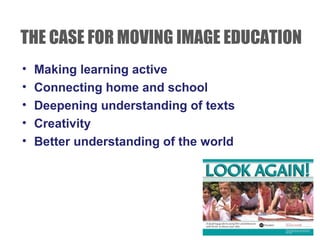
THE CASE FOR MOVING IMAGE EDUCATION
• Making learning active
• Connecting home and school
• Deepening understanding of texts
• Creativity
• Better understanding of the world
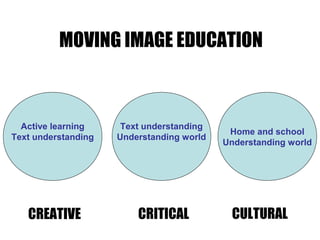
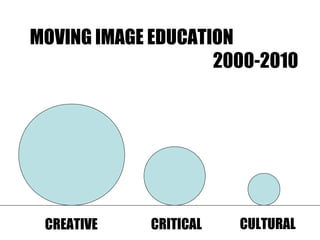
MOVING IMAGE EDUCATION
Text understanding
Understanding world
CREATIVE CRITICAL CULTURAL
Active learning
Text understanding
Home and school
Understanding world
MOVING IMAGE EDUCATION
2000-2010
CREATIVE CRITICAL CULTURAL
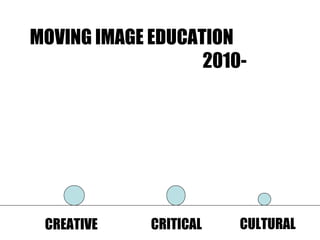
MOVING IMAGE EDUCATION
2010-
CREATIVE CRITICAL CULTURAL
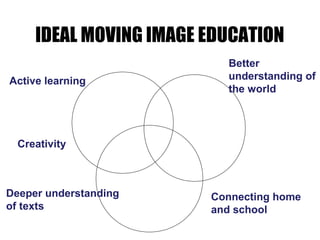
IDEAL MOVING IMAGE EDUCATION
Deeper understanding
of texts
Connecting home
and school
Better
understanding of
the world
Active learning
Creativity
To be literate is to participate fully in a culture
To participate fully in 21C culture, we
have to be literate in the moving image
It is vital and obvious that understanding,
manipulating, and appreciating the film sentence
should be an accepted part of the education
system
Anthony Minghella
Film, media, or literacy?
Film and media AS literacy
HOW TO BRIDGE FILM AND CORE LITERACY?
• How are film and print similar/ different
as storytelling media?
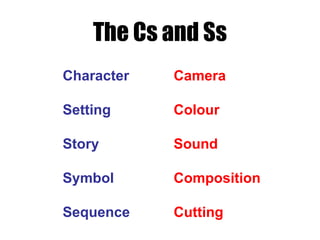
Character
Setting
Story
Symbol
Sequence
Camera
Colour
Sound
Composition
Cutting
The Cs and Ss
WHY SHORT FILMS?
• New to children
• Manageability
• Cinematic qualities
SHORT FILM PEDAGOGY
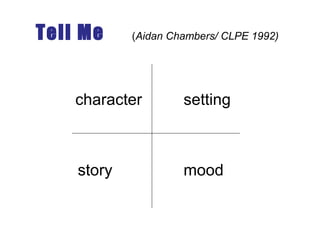
• ‘Tell Me’ grids
• Hiding and revealing
• Stopping and starting
character setting
story mood
Tell Me (Aidan Chambers/ CLPE 1992)
Hide Screen, Mark
♯bfiopeninglines
https://www.dailymotion.com/video/x24aul3
Le Pain et la rue
♯bfiopeninglines
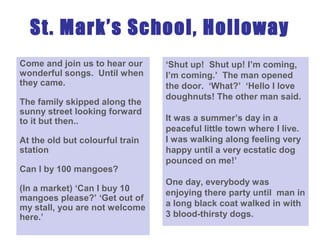
St. Mark’s School, Holloway
Come and join us to hear our
wonderful songs. Until when
they came.
The family skipped along the
sunny street looking forward
to it but then..
At the old but colourful train
station
Can I by 100 mangoes?
(In a market) ‘Can I buy 10
mangoes please?’ ‘Get out of
my stall, you are not welcome
here.’
‘Shut up! Shut up! I’m coming,
I’m coming.’ The man opened
the door. ‘What?’ ‘Hello I love
doughnuts! The other man said.
It was a summer’s day in a
peaceful little town where I live.
I was walking along feeling very
happy until a very ecstatic dog
pounced on me!’
One day, everybody was
enjoying there party until man in
a long black coat walked in with
3 blood-thirsty dogs.
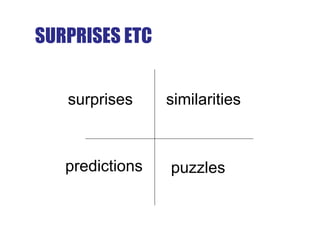
surprises similarities
predictions puzzles
SURPRISES ETC
PREDICTIONS
RETELLING
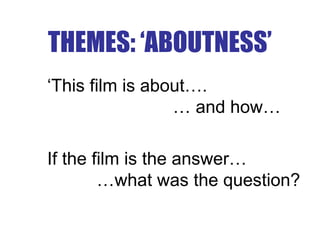
THEMES: ‘ABOUTNESS’
‘This film is about….
… and how…
If the film is the answer…
…what was the question?
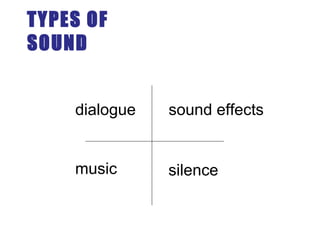
dialogue
music
sound effects
silence
TYPES OF
SOUND
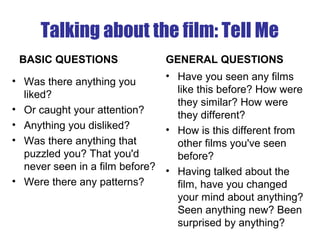
Talking about the film: Tell Me
BASIC QUESTIONS
• Was there anything you
liked?
• Or caught your attention?
• Anything you disliked?
• Was there anything that
puzzled you? That you'd
never seen in a film before?
• Were there any patterns?
GENERAL QUESTIONS
• Have you seen any films
like this before? How were
they similar? How were
they different?
• How is this different from
other films you've seen
before?
• Having talked about the
film, have you changed
your mind about anything?
Seen anything new? Been
surprised by anything?
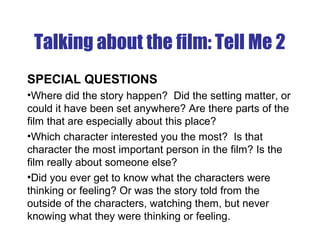
Talking about the film: Tell Me 2
SPECIAL QUESTIONS
•Where did the story happen? Did the setting matter, or
could it have been set anywhere? Are there parts of the
film that are especially about this place?
•Which character interested you the most? Is that
character the most important person in the film? Is the
film really about someone else?
•Did you ever get to know what the characters were
thinking or feeling? Or was the story told from the
outside of the characters, watching them, but never
knowing what they were thinking or feeling.
Talking about the film: Tell Me 3
SPECIAL QUESTIONS
•How much time did the story in the film cover?
•Are there parts of the story that took a long time to
happen but were shown quickly? And vice versa?
•Were there particular things in the film - shots, sounds,
images - that you liked or didn't like?
•How could you have made the film better?
•Has anything in the film ever happened to you?
•What would you tell other people about this film?
•How many different stories can you find in the film?
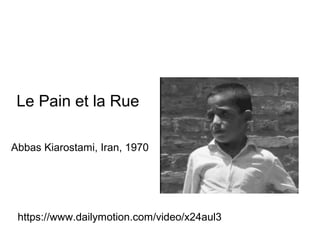
Le Pain et la Rue
Abbas Kiarostami, Iran, 1970
https://www.dailymotion.com/video/x24aul3
YEAR 3&4 READING AND WRITING
• Which objectives have we covered?
• Which others could we cover?
• Which other curriculum areas could we cover?
GATHERING EVIDENCE
• Pupil profile data incl baseline end of KS1
• Anonymised writing assessments taken at start,
middle, end
• Google form of teachers’ prior interest, confidence,
expertise
• Ongoing reflective blog
RESEARCH, RESOURCES
Digital Beginnings, Jackie Marsh
et al, Sheffield University
Reframing Literacy, BFI
https://www.bfi.org.uk/sites/bfi.org
.uk/files/downloads/bfi-education-
reframing-literacy-2013-04.pdf
Impacts of Moving Image
Education: A summary of
research for Scottish Screen
https://fashioningandflow.files.wor
dpress.com/2012/02/mie-
research-summary.pdf
UKLA: www.readingfilm.co.uk
Bradford Film Literacy
www.primaryfilmliteracy.com/

Islington 25 june 2019

  • 1.
    SHORT FILMS ANDLITERACY Mark Reid BFI Education Mark.reid@bfi.org.uk www.bfi.org.uk
  • 2.
  • 3.
  • 4.
    THE CASE FORMOVING IMAGE EDUCATION • Making learning active • Connecting home and school • Deepening understanding of texts • Creativity • Better understanding of the world
  • 5.
    MOVING IMAGE EDUCATION Textunderstanding Understanding world CREATIVE CRITICAL CULTURAL Active learning Text understanding Home and school Understanding world
  • 6.
  • 7.
  • 8.
    IDEAL MOVING IMAGEEDUCATION Deeper understanding of texts Connecting home and school Better understanding of the world Active learning Creativity
  • 9.
    To be literateis to participate fully in a culture To participate fully in 21C culture, we have to be literate in the moving image It is vital and obvious that understanding, manipulating, and appreciating the film sentence should be an accepted part of the education system Anthony Minghella Film, media, or literacy? Film and media AS literacy
  • 10.
    HOW TO BRIDGEFILM AND CORE LITERACY? • How are film and print similar/ different as storytelling media?
  • 11.
  • 12.
    WHY SHORT FILMS? •New to children • Manageability • Cinematic qualities
  • 13.
    SHORT FILM PEDAGOGY •‘Tell Me’ grids • Hiding and revealing • Stopping and starting
  • 14.
    character setting story mood TellMe (Aidan Chambers/ CLPE 1992)
  • 15.
  • 16.
  • 17.
  • 18.
    St. Mark’s School,Holloway Come and join us to hear our wonderful songs. Until when they came. The family skipped along the sunny street looking forward to it but then.. At the old but colourful train station Can I by 100 mangoes? (In a market) ‘Can I buy 10 mangoes please?’ ‘Get out of my stall, you are not welcome here.’ ‘Shut up! Shut up! I’m coming, I’m coming.’ The man opened the door. ‘What?’ ‘Hello I love doughnuts! The other man said. It was a summer’s day in a peaceful little town where I live. I was walking along feeling very happy until a very ecstatic dog pounced on me!’ One day, everybody was enjoying there party until man in a long black coat walked in with 3 blood-thirsty dogs.
  • 19.
  • 20.
  • 21.
  • 22.
    THEMES: ‘ABOUTNESS’ ‘This filmis about…. … and how… If the film is the answer… …what was the question?
  • 23.
  • 24.
    Talking about thefilm: Tell Me BASIC QUESTIONS • Was there anything you liked? • Or caught your attention? • Anything you disliked? • Was there anything that puzzled you? That you'd never seen in a film before? • Were there any patterns? GENERAL QUESTIONS • Have you seen any films like this before? How were they similar? How were they different? • How is this different from other films you've seen before? • Having talked about the film, have you changed your mind about anything? Seen anything new? Been surprised by anything?
  • 25.
    Talking about thefilm: Tell Me 2 SPECIAL QUESTIONS •Where did the story happen? Did the setting matter, or could it have been set anywhere? Are there parts of the film that are especially about this place? •Which character interested you the most? Is that character the most important person in the film? Is the film really about someone else? •Did you ever get to know what the characters were thinking or feeling? Or was the story told from the outside of the characters, watching them, but never knowing what they were thinking or feeling.
  • 26.
    Talking about thefilm: Tell Me 3 SPECIAL QUESTIONS •How much time did the story in the film cover? •Are there parts of the story that took a long time to happen but were shown quickly? And vice versa? •Were there particular things in the film - shots, sounds, images - that you liked or didn't like? •How could you have made the film better? •Has anything in the film ever happened to you? •What would you tell other people about this film? •How many different stories can you find in the film?
  • 27.
    Le Pain etla Rue Abbas Kiarostami, Iran, 1970 https://www.dailymotion.com/video/x24aul3
  • 28.
    YEAR 3&4 READINGAND WRITING • Which objectives have we covered? • Which others could we cover? • Which other curriculum areas could we cover?
  • 29.
    GATHERING EVIDENCE • Pupilprofile data incl baseline end of KS1 • Anonymised writing assessments taken at start, middle, end • Google form of teachers’ prior interest, confidence, expertise • Ongoing reflective blog
  • 30.
    RESEARCH, RESOURCES Digital Beginnings,Jackie Marsh et al, Sheffield University Reframing Literacy, BFI https://www.bfi.org.uk/sites/bfi.org .uk/files/downloads/bfi-education- reframing-literacy-2013-04.pdf Impacts of Moving Image Education: A summary of research for Scottish Screen https://fashioningandflow.files.wor dpress.com/2012/02/mie- research-summary.pdf UKLA: www.readingfilm.co.uk Bradford Film Literacy www.primaryfilmliteracy.com/