
Please sit with your TEAM ES  Faculty Meeting Mon, April 7, 2008 12:00-2:00
Meeting Goal For each area : Response Processing Time Concrete possibilities How? Build understanding of ES Vision by: •  responding to some questions and concerns  •  providing concrete implementation possibilities
“ How can we efficiently  deepen  student learning?” “ What is deep learning?” “ How do we know what deep is?” “ How deep do we go? “ When have we gone deep enough?”
What is “learning”? ISB Definition :  Learning is the primary focus of our school.   Our learners develop knowledge, skills, and attitudes by connecting prior learning to new experiences.   The most significant learning generates increased understanding and can be seen in our expanded capacities to analyze, synthesize, reflect, apply and communicate our new learnings in a variety of situations   --ISB Vision and Guiding Principles
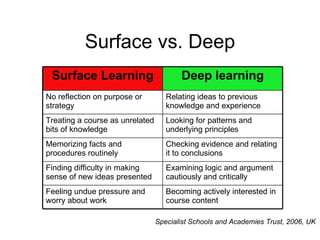
Surface vs. Deep Specialist Schools and Academies Trust, 2006, UK Becoming actively interested in course content Feeling undue pressure and worry about work Examining logic and argument cautiously and critically Finding difficulty in making sense of new ideas presented Checking evidence and relating it to conclusions Memorizing facts and procedures routinely Looking for patterns and underlying principles Treating a course as unrelated bits of knowledge Relating ideas to previous knowledge and experience No reflection on purpose or strategy Deep learning Surface Learning
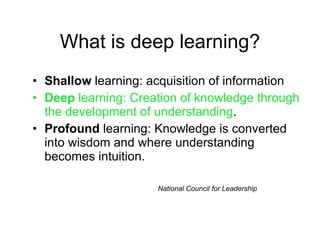
What is deep learning? Shallow  learning: acquisition of information Deep  learning: Creation of knowledge through the development of understanding . Profound  learning: Knowledge is converted into wisdom and where understanding becomes intuition. National Council for Leadership
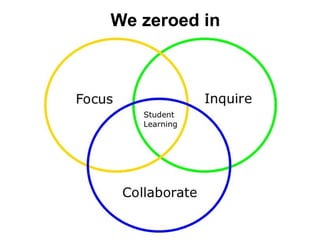
We zeroed in
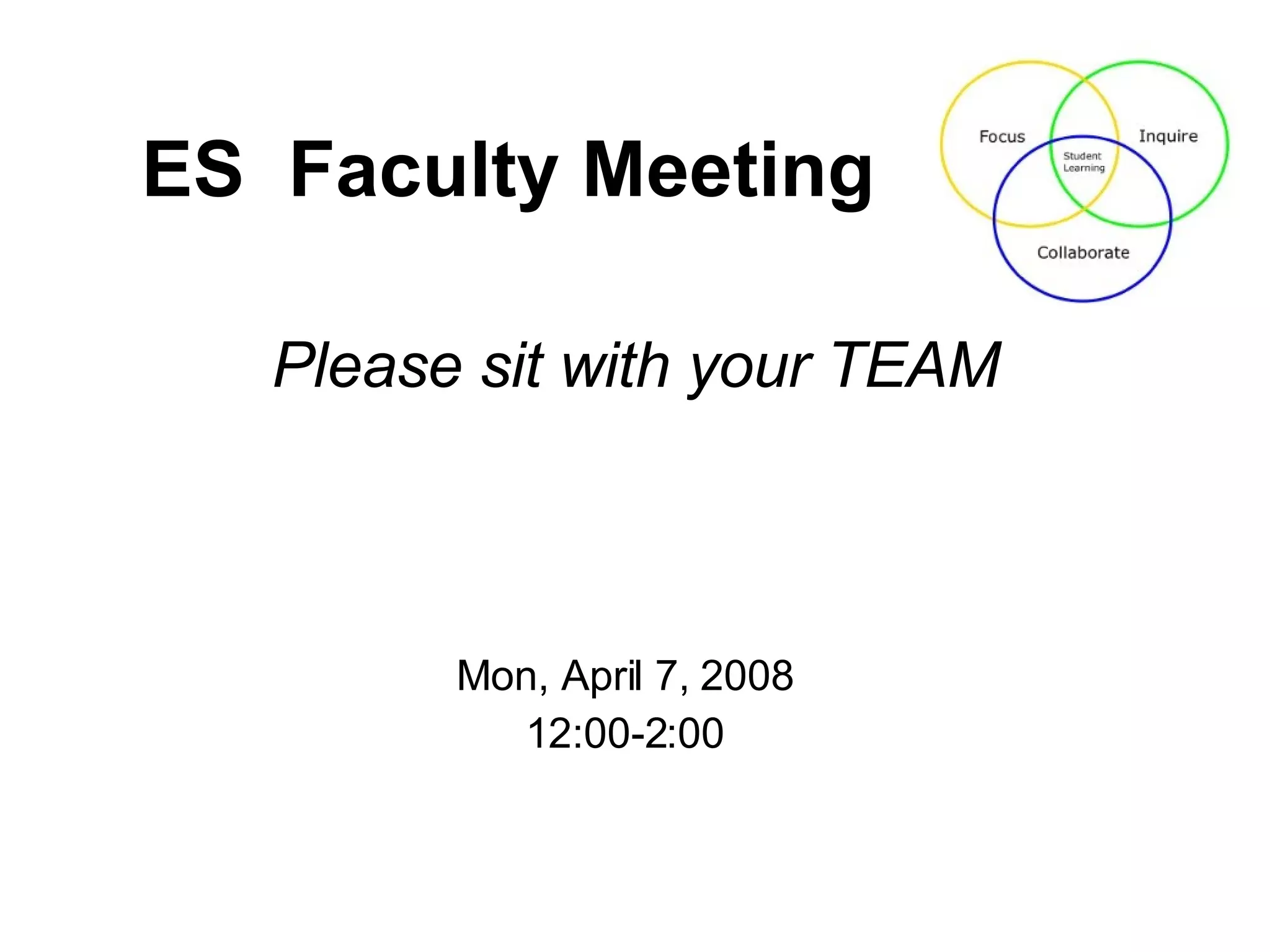
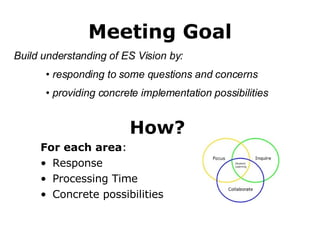
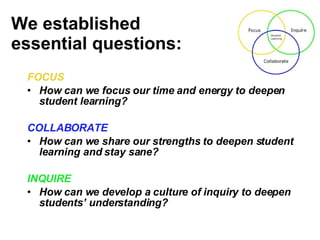
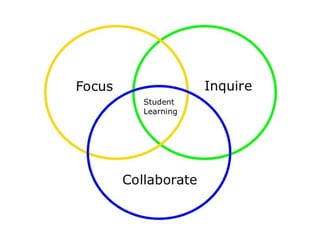
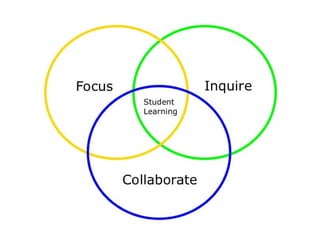
FOCUS How can we focus our time and energy to deepen student learning? COLLABORATE How can we share our strengths to deepen student learning and stay sane? INQUIRE How can we develop a culture of inquiry to deepen students’ understanding? We established  essential questions:
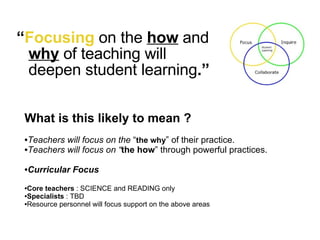
“ Focusing   on the  how  and  why   of teaching will deepen student learning .” What is this likely to mean ? Teachers will focus on the  “ the why ” of their practice. Teachers will focus on “ the how ” through powerful practices. Curricular Focus Core teachers  : SCIENCE and READING only Specialists  : TBD Resource personnel will focus support on the above areas
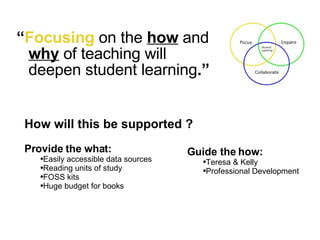
“ Focusing   on the  how  and  why   of teaching will deepen student learning .” How will this be supported ? Provide the what: Easily accessible data sources Reading units of study FOSS kits Huge budget for books Guide the how: Teresa & Kelly  Professional Development
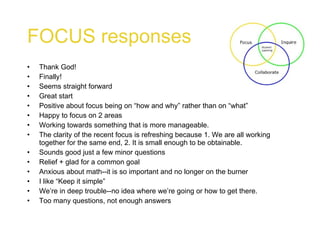
FOCUS   responses Thank God!  Finally! Seems straight forward Great start Positive about focus being on “how and why” rather than on “what” Happy to focus on 2 areas Working towards something that is more manageable. The clarity of the recent focus is refreshing because 1. We are all working together for the same end, 2. It is small enough to be obtainable. Sounds good just a few minor questions Relief + glad for a common goal Anxious about math--it is so important and no longer on the burner I like “Keep it simple” We’re in deep trouble--no idea where we’re going or how to get there. Too many questions, not enough answers
FOCUS   Questions Why reading?  Why science?  What about the rest of the curriculum?  How will we know when we’ve focused enough?  Is this part of the organizational and professional goal ?
Let’s Get Concrete Specialists Begin Process of selecting Organizational Goal Focus (Go to cafeteria with Struan) Grade Teachers How can Teresa and Kelly best support reading and science learning?
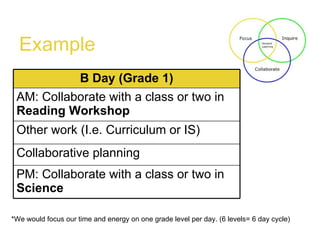
Example *We would focus our time and energy on one grade level per day. (6 levels= 6 day cycle)  PM: Collaborate with a class or two in  Science Collaborative planning Other work (I.e. Curriculum or IS) AM: Collaborate with a class or two in  Reading Workshop B Day (Grade 1)
 
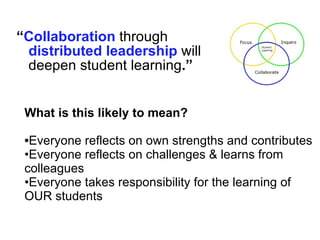
“ Collaboration  through   distributed leadership   will deepen student learning .” What is this likely to mean? Everyone reflects on own strengths and contributes Everyone reflects on challenges & learns from colleagues Everyone takes responsibility for the learning of OUR students
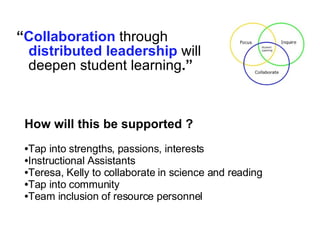
“ Collaboration  through   distributed leadership   will deepen student learning .” How will this be supported ? Tap into strengths, passions, interests Instructional Assistants  Teresa, Kelly to collaborate in science and reading Tap into community Team inclusion of resource personnel
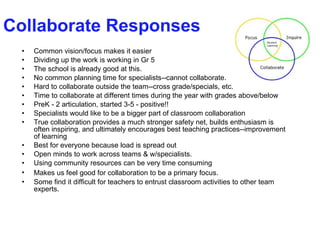
Common vision/focus makes it easier Dividing up the work is working in Gr 5 The school is already good at this. No common planning time for specialists--cannot collaborate.  Hard to collaborate outside the team--cross grade/specials, etc. Time to collaborate at different times during the year with grades above/below PreK - 2 articulation, started 3-5 - positive!! Specialists would like to be a bigger part of classroom collaboration True collaboration provides a much stronger safety net, builds enthusiasm is often inspiring, and ultimately encourages best teaching practices--improvement of learning Best for everyone because load is spread out Open minds to work across teams & w/specialists. Using community resources can be very time consuming Makes us feel good for collaboration to be a primary focus.   Some find it difficult for teachers to entrust classroom activities to other team experts. Collaborate Responses
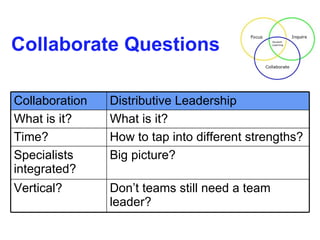
Collaborate Questions Don’t teams still need a team leader? Vertical? Big picture? Specialists integrated? How to tap into different strengths? Time? What is it? What is it? Distributive Leadership Collaboration
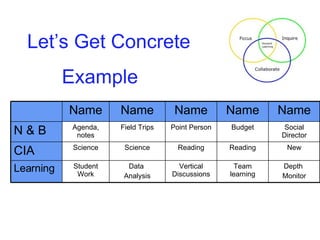
Let’s Get Concrete Example Depth  Monitor Team learning Vertical Discussions Data  Analysis Student Work Learning Reading Budget Name New Reading Science Science CIA Social Director Point Person Field Trips Agenda, notes N & B Name Name Name Name
 
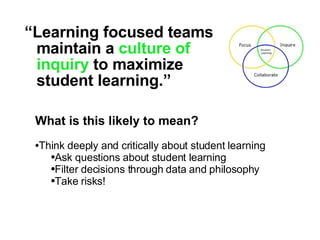
What is this likely to mean? Think deeply and critically about student learning  Ask questions about student learning Filter decisions through data and philosophy Take risks! “ Learning focused teams maintain a  culture of inquiry  to maximize student learning.”
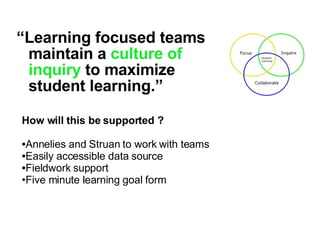
How will this be supported ? Annelies and Struan to work with teams Easily accessible data source Fieldwork support Five minute learning goal form “ Learning focused teams maintain a  culture of inquiry  to maximize student learning.”
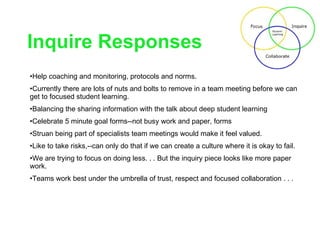
Inquire Responses Help coaching and monitoring, protocols and norms. Currently there are lots of nuts and bolts to remove in a team meeting before we can get to focused student learning.  Balancing the sharing information with the talk about deep student learning Celebrate 5 minute goal forms--not busy work and paper, forms Struan being part of specialists team meetings would make it feel valued. Like to take risks,--can only do that if we can create a culture where it is okay to fail. We are trying to focus on doing less. . . But the inquiry piece looks like more paper work. Teams work best under the umbrella of trust, respect and focused collaboration . . .
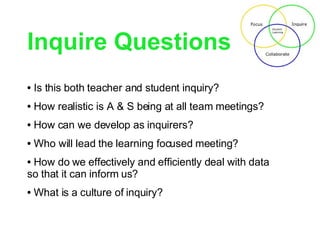
Inquire Questions Is this both teacher and student inquiry?  How realistic is A & S being at all team meetings? How can we develop as inquirers? Who will lead the learning focused meeting?  How do we effectively and efficiently deal with data so that it can inform us? What is a culture of inquiry?
What is a culture of inquiry? A culture of inquiry is a means to gain openness in asking questions, giving careful consideration to the answers, and considering change and a willingness to learn something new and unexpected. Sharon Bender  Quasitative Inquiry/Research/Approach: Leading a new Culture of Inquiry
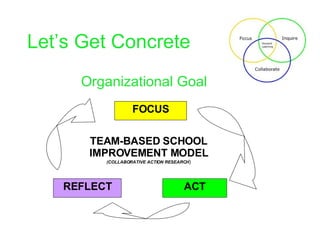
Let’s Get Concrete FOCUS ACT REFLECT TEAM-BASED SCHOOL IMPROVEMENT MODEL (COLLABORATIVE ACTION RESEARCH ) Organizational Goal
 

ISB ES Vision - The ROAD MAP

  • 1.
    Please sit withyour TEAM ES Faculty Meeting Mon, April 7, 2008 12:00-2:00
  • 2.
    Meeting Goal Foreach area : Response Processing Time Concrete possibilities How? Build understanding of ES Vision by: • responding to some questions and concerns • providing concrete implementation possibilities
  • 3.
    “ How canwe efficiently deepen student learning?” “ What is deep learning?” “ How do we know what deep is?” “ How deep do we go? “ When have we gone deep enough?”
  • 4.
    What is “learning”?ISB Definition : Learning is the primary focus of our school. Our learners develop knowledge, skills, and attitudes by connecting prior learning to new experiences. The most significant learning generates increased understanding and can be seen in our expanded capacities to analyze, synthesize, reflect, apply and communicate our new learnings in a variety of situations --ISB Vision and Guiding Principles
  • 5.
    Surface vs. DeepSpecialist Schools and Academies Trust, 2006, UK Becoming actively interested in course content Feeling undue pressure and worry about work Examining logic and argument cautiously and critically Finding difficulty in making sense of new ideas presented Checking evidence and relating it to conclusions Memorizing facts and procedures routinely Looking for patterns and underlying principles Treating a course as unrelated bits of knowledge Relating ideas to previous knowledge and experience No reflection on purpose or strategy Deep learning Surface Learning
  • 6.
    What is deeplearning? Shallow learning: acquisition of information Deep learning: Creation of knowledge through the development of understanding . Profound learning: Knowledge is converted into wisdom and where understanding becomes intuition. National Council for Leadership
  • 7.
  • 8.
    FOCUS How canwe focus our time and energy to deepen student learning? COLLABORATE How can we share our strengths to deepen student learning and stay sane? INQUIRE How can we develop a culture of inquiry to deepen students’ understanding? We established essential questions:
  • 9.
    “ Focusing on the how and why of teaching will deepen student learning .” What is this likely to mean ? Teachers will focus on the “ the why ” of their practice. Teachers will focus on “ the how ” through powerful practices. Curricular Focus Core teachers : SCIENCE and READING only Specialists : TBD Resource personnel will focus support on the above areas
  • 10.
    “ Focusing on the how and why of teaching will deepen student learning .” How will this be supported ? Provide the what: Easily accessible data sources Reading units of study FOSS kits Huge budget for books Guide the how: Teresa & Kelly Professional Development
  • 11.
    FOCUS responses Thank God! Finally! Seems straight forward Great start Positive about focus being on “how and why” rather than on “what” Happy to focus on 2 areas Working towards something that is more manageable. The clarity of the recent focus is refreshing because 1. We are all working together for the same end, 2. It is small enough to be obtainable. Sounds good just a few minor questions Relief + glad for a common goal Anxious about math--it is so important and no longer on the burner I like “Keep it simple” We’re in deep trouble--no idea where we’re going or how to get there. Too many questions, not enough answers
  • 12.
    FOCUS Questions Why reading? Why science? What about the rest of the curriculum? How will we know when we’ve focused enough? Is this part of the organizational and professional goal ?
  • 13.
    Let’s Get ConcreteSpecialists Begin Process of selecting Organizational Goal Focus (Go to cafeteria with Struan) Grade Teachers How can Teresa and Kelly best support reading and science learning?
  • 14.
    Example *We wouldfocus our time and energy on one grade level per day. (6 levels= 6 day cycle) PM: Collaborate with a class or two in Science Collaborative planning Other work (I.e. Curriculum or IS) AM: Collaborate with a class or two in Reading Workshop B Day (Grade 1)
  • 15.
  • 16.
    “ Collaboration through distributed leadership will deepen student learning .” What is this likely to mean? Everyone reflects on own strengths and contributes Everyone reflects on challenges & learns from colleagues Everyone takes responsibility for the learning of OUR students
  • 17.
    “ Collaboration through distributed leadership will deepen student learning .” How will this be supported ? Tap into strengths, passions, interests Instructional Assistants Teresa, Kelly to collaborate in science and reading Tap into community Team inclusion of resource personnel
  • 18.
    Common vision/focus makesit easier Dividing up the work is working in Gr 5 The school is already good at this. No common planning time for specialists--cannot collaborate. Hard to collaborate outside the team--cross grade/specials, etc. Time to collaborate at different times during the year with grades above/below PreK - 2 articulation, started 3-5 - positive!! Specialists would like to be a bigger part of classroom collaboration True collaboration provides a much stronger safety net, builds enthusiasm is often inspiring, and ultimately encourages best teaching practices--improvement of learning Best for everyone because load is spread out Open minds to work across teams & w/specialists. Using community resources can be very time consuming Makes us feel good for collaboration to be a primary focus. Some find it difficult for teachers to entrust classroom activities to other team experts. Collaborate Responses
  • 19.
    Collaborate Questions Don’tteams still need a team leader? Vertical? Big picture? Specialists integrated? How to tap into different strengths? Time? What is it? What is it? Distributive Leadership Collaboration
  • 20.
    Let’s Get ConcreteExample Depth Monitor Team learning Vertical Discussions Data Analysis Student Work Learning Reading Budget Name New Reading Science Science CIA Social Director Point Person Field Trips Agenda, notes N & B Name Name Name Name
  • 21.
  • 22.
    What is thislikely to mean? Think deeply and critically about student learning Ask questions about student learning Filter decisions through data and philosophy Take risks! “ Learning focused teams maintain a culture of inquiry to maximize student learning.”
  • 23.
    How will thisbe supported ? Annelies and Struan to work with teams Easily accessible data source Fieldwork support Five minute learning goal form “ Learning focused teams maintain a culture of inquiry to maximize student learning.”
  • 24.
    Inquire Responses Helpcoaching and monitoring, protocols and norms. Currently there are lots of nuts and bolts to remove in a team meeting before we can get to focused student learning. Balancing the sharing information with the talk about deep student learning Celebrate 5 minute goal forms--not busy work and paper, forms Struan being part of specialists team meetings would make it feel valued. Like to take risks,--can only do that if we can create a culture where it is okay to fail. We are trying to focus on doing less. . . But the inquiry piece looks like more paper work. Teams work best under the umbrella of trust, respect and focused collaboration . . .
  • 25.
    Inquire Questions Isthis both teacher and student inquiry? How realistic is A & S being at all team meetings? How can we develop as inquirers? Who will lead the learning focused meeting? How do we effectively and efficiently deal with data so that it can inform us? What is a culture of inquiry?
  • 26.
    What is aculture of inquiry? A culture of inquiry is a means to gain openness in asking questions, giving careful consideration to the answers, and considering change and a willingness to learn something new and unexpected. Sharon Bender Quasitative Inquiry/Research/Approach: Leading a new Culture of Inquiry
  • 27.
    Let’s Get ConcreteFOCUS ACT REFLECT TEAM-BASED SCHOOL IMPROVEMENT MODEL (COLLABORATIVE ACTION RESEARCH ) Organizational Goal
  • 28.