Information System
Analysis and Design
Lec 1
Dr. Omar Adel Al-Jubouri
AL-Khwarizmi College of Engineering
University of Baghdad
Department of Information and Communications Engineering
References
• essentials_of_systems_analysis_and_design_5th_by_valacich.
• System Analysis and Design Tutorial.
Objectives
• Define information systems analysis and design.
• Discuss the modern approach to systems analysis and design that combines
both process and data views of systems.
• Describe the role of the systems analyst in information systems development.
• Describe the information systems development life cycle (SDLC).
• List alternatives to the systems development life cycle, including a description
of the role of computer-aided software engineering (CASE) tools in systems
development.
Information systems analysis and
design
•Information System Analysis and Design
(ISAD) is the process of understanding,
designing, and implementing an information
system for an organization.
•The goal of ISAD is to improve the efficiency
and effectiveness of the organization by using
technology.
ISAD involves several steps, including:
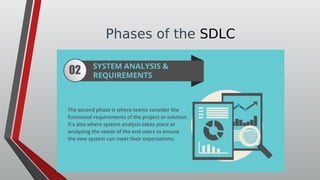
• System Analysis: In this phase, the current system
is analyzed to identify problems and opportunities for
improvement. The analysis includes gathering data
about the current system, identifying user needs,
and documenting the current processes.
• Requirements Gathering: In this phase, the
requirements of the new system are gathered from
stakeholders. This includes identifying the features
and functionality that the new system should have.
ISAD involves several steps, including:
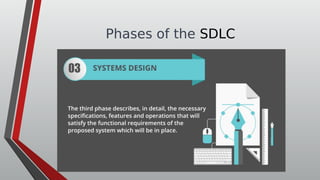
• System Design: In this phase, the new system is
designed based on the requirements gathered in the
previous phase. The design includes the architecture,
database design, interface design, and other
components necessary for the system.
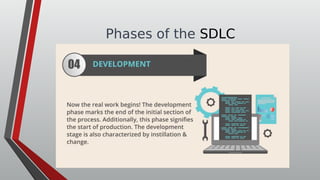
• Implementation: In this phase, the new system is
developed and installed. The implementation
includes coding, testing, and installation of the
system.
ISAD involves several steps, including:
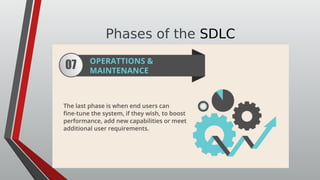
• Maintenance: In this phase, the system is
monitored, maintained, and updated as needed to
ensure that it continues to meet the needs of the
organization.
Systems Development Life Cycle
(SDLC)
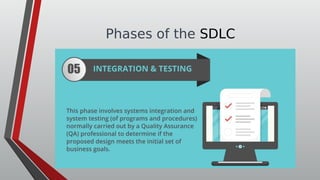
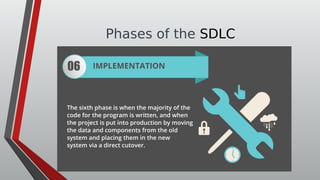
• The Information Systems Development Life Cycle (SDLC) is a
systematic approach to developing and implementing an
information system. The SDLC consists of a series of phases
that provide a framework for the development of information
systems.
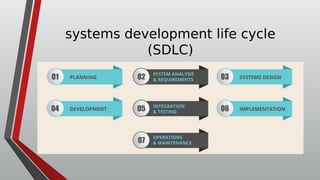
systems development life cycle
(SDLC)
Phases of the SDLC
Phases of the SDLC
Phases of the SDLC
Phases of the SDLC
Phases of the SDLC
Phases of the SDLC
Phases of the SDLC
Information System
Analysis and Design
Lec 2
Dr.Omar Adel Al-jibouri
AL-Khwarizmi College of Engineering
University of Baghdad
Department of Information and Communications Engineering
systems analysis and design: Core
Concepts
Methodologies: are a sequence of
step-by-step approaches that help
develop your final product.
Techniques: are processes that you, as an
analyst, will follow to help ensure that your
work is well thought-out, complete, and
comprehensible to others on your project
team.
Tools: are computer programs, such
as computer-aided software
engineering (CASE) tools, that make
it easy to use specific techniques.
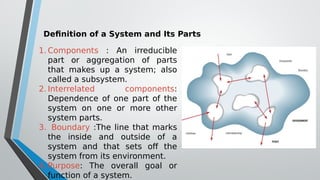
1. Components : An irreducible
part or aggregation of parts
that makes up a system; also
called a subsystem.
2. Interrelated components:
Dependence of one part of the
system on one or more other
system parts.
3. Boundary :The line that marks
the inside and outside of a
system and that sets off the
system from its environment.
4. Purpose: The overall goal or
function of a system.
Definition of a System and Its Parts
5. Environment: Everything external to a system that interacts
with the system.
6. Interfaces :Point of contact where a system meets its
environment or where subsystems meet each other
7.Constraints :A limit to what a system can accomplish.
8. Input
9. Output
systems development life cycle
(SDLC)
• Traditional methodology used to develop, maintain, and replace
information systems.
• Phases in SDLC:
• Planning
• Analysis
• Design
• Implementation
• Maintenance
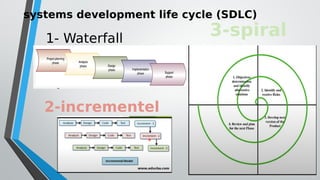
systems development life cycle (SDLC)
1- Waterfall
3-spiral
2-incrementel
systems development life cycle
(SDLC)
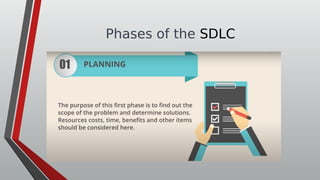
The first phase in the SDLC, systems planning and selection,
has two primary activities. First, someone identifies the need
for a new or enhanced system
The organization’s information system needs many result from:
 Requests to deal with problems in current procedures.
 The desire to perform additional tasks.
 The realization that information technology could be used to
capitalize on an existing opportunity.
1. Planning Phase
• The second task in the systems planning and selection phase
is to investigate the system and determine the proposed
system’s scope. The team of systems analysts then produces
a specific plan for the proposed project for the team to follow.
This baseline project plan customizes the standardized SDLC
and specifies the time and resources needed for its execution.

ISAD description and sdlc and its phases

  • 1.
    Information System Analysis andDesign Lec 1 Dr. Omar Adel Al-Jubouri AL-Khwarizmi College of Engineering University of Baghdad Department of Information and Communications Engineering
  • 2.
  • 3.
    Objectives • Define informationsystems analysis and design. • Discuss the modern approach to systems analysis and design that combines both process and data views of systems. • Describe the role of the systems analyst in information systems development. • Describe the information systems development life cycle (SDLC). • List alternatives to the systems development life cycle, including a description of the role of computer-aided software engineering (CASE) tools in systems development.
  • 4.
    Information systems analysisand design •Information System Analysis and Design (ISAD) is the process of understanding, designing, and implementing an information system for an organization. •The goal of ISAD is to improve the efficiency and effectiveness of the organization by using technology.
  • 5.
    ISAD involves severalsteps, including: • System Analysis: In this phase, the current system is analyzed to identify problems and opportunities for improvement. The analysis includes gathering data about the current system, identifying user needs, and documenting the current processes. • Requirements Gathering: In this phase, the requirements of the new system are gathered from stakeholders. This includes identifying the features and functionality that the new system should have.
  • 6.
    ISAD involves severalsteps, including: • System Design: In this phase, the new system is designed based on the requirements gathered in the previous phase. The design includes the architecture, database design, interface design, and other components necessary for the system. • Implementation: In this phase, the new system is developed and installed. The implementation includes coding, testing, and installation of the system.
  • 7.
    ISAD involves severalsteps, including: • Maintenance: In this phase, the system is monitored, maintained, and updated as needed to ensure that it continues to meet the needs of the organization.
  • 8.
    Systems Development LifeCycle (SDLC) • The Information Systems Development Life Cycle (SDLC) is a systematic approach to developing and implementing an information system. The SDLC consists of a series of phases that provide a framework for the development of information systems.
  • 9.
  • 10.
  • 11.
  • 12.
  • 13.
  • 14.
  • 15.
  • 16.
  • 17.
    Information System Analysis andDesign Lec 2 Dr.Omar Adel Al-jibouri AL-Khwarizmi College of Engineering University of Baghdad Department of Information and Communications Engineering
  • 18.
    systems analysis anddesign: Core Concepts Methodologies: are a sequence of step-by-step approaches that help develop your final product. Techniques: are processes that you, as an analyst, will follow to help ensure that your work is well thought-out, complete, and comprehensible to others on your project team. Tools: are computer programs, such as computer-aided software engineering (CASE) tools, that make it easy to use specific techniques.
  • 19.
    1. Components :An irreducible part or aggregation of parts that makes up a system; also called a subsystem. 2. Interrelated components: Dependence of one part of the system on one or more other system parts. 3. Boundary :The line that marks the inside and outside of a system and that sets off the system from its environment. 4. Purpose: The overall goal or function of a system. Definition of a System and Its Parts
  • 20.
    5. Environment: Everythingexternal to a system that interacts with the system. 6. Interfaces :Point of contact where a system meets its environment or where subsystems meet each other 7.Constraints :A limit to what a system can accomplish. 8. Input 9. Output
  • 21.
    systems development lifecycle (SDLC) • Traditional methodology used to develop, maintain, and replace information systems. • Phases in SDLC: • Planning • Analysis • Design • Implementation • Maintenance
  • 22.
    systems development lifecycle (SDLC) 1- Waterfall 3-spiral 2-incrementel
  • 23.
    systems development lifecycle (SDLC) The first phase in the SDLC, systems planning and selection, has two primary activities. First, someone identifies the need for a new or enhanced system The organization’s information system needs many result from:  Requests to deal with problems in current procedures.  The desire to perform additional tasks.  The realization that information technology could be used to capitalize on an existing opportunity. 1. Planning Phase
  • 24.
    • The secondtask in the systems planning and selection phase is to investigate the system and determine the proposed system’s scope. The team of systems analysts then produces a specific plan for the proposed project for the team to follow. This baseline project plan customizes the standardized SDLC and specifies the time and resources needed for its execution.