Presentation Outlines
- Introductionon ISAs
- Objective of ISAs
- Scope of this ISAs
- Importance of ISAs
- Audit Regulatory Environment
- ISAs Related to Phase I, Client Acceptance
- ISAs Related to Phase II, Planning the audit
- ISAs Related to Phase III, Testing and Evidence
- ISAs Related to Phase IV, Evaluation and Reporting
05/10/2025
CompiIed by Abdirahman M.
3.
05/10/2025
Introduction of ISAs
International Standards on Auditing (ISAs) are
professional guidelines issued by the International
Auditing and Assurance Standards Board (IAASB).
They provide a framework for the conduct of high-
quality audits of financial statements, ensuring
consistency, transparency, and reliability across global
audit practices.
CompiIed by Abdirahman M.
4.
05/10/2025
Cont…
• ISAs outlinethe responsibilities of auditors and establish
requirements for key areas such as audit planning, risk
assessment, evidence gathering, and reporting.
• They are widely adopted by audit professionals around
the world and serve to enhance investor confidence by
promoting uniformity and credibility in the audit
process.
CompiIed by Abdirahman M.
5.
05/10/2025
Objective of ISA
Themain goal of ISAs is to enhance the quality and
reliability of audits, promote transparency, and
ensure that audits are conducted with
professionalism and due diligence across different
countries and industries.
CompiIed by Abdirahman M.
6.
05/10/2025
The other Objectivesof ISAs
- To enhance the degree of confidence of intended users in
the financial statements.
- To give expression of an opinion by the auditor s on
whether the financial statements are presented fairly.
- As the basis for the auditor’s opinion, ISAs require the
auditor to obtain reasonable assurance about whether the
financial statements as a whole are free from material
misstatement, whether due to fraud or error.
CompiIed by Abdirahman M.
7.
05/10/2025
Scope of thisISA
- This International Standard on Auditing (ISA) deals with
the independent auditor’s overall responsibilities when
conducting an audit of financial statements in accordance
with ISAs.
- Specifically, it sets out the overall objectives of the
independent auditor, and explains the nature and scope of
an audit designed to enable the independent auditor to
meet those objectives. CompiIed by Abdirahman M.
8.
05/10/2025
Importance of ISAs
Enhancing Audit Quality
Promoting Global Consistency
Comparability
Increasing Investor Confidence
Supporting Regulatory Oversight
Facilitating International Trade and Investment
Aiding Auditor Training and Development
Strengthening Public Interest Protection
CompiIed by Abdirahman M.
9.
05/10/2025
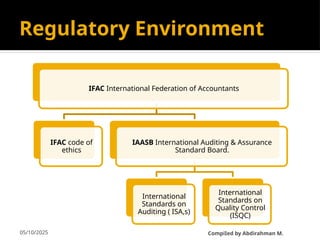
Regulatory Environment
IFAC InternationalFederation of Accountants
IFAC code of
ethics
IAASB International Auditing & Assurance
Standard Board.
International
Standards on
Auditing ( ISA,s)
International
Standards on
Quality Control
(ISQC)
CompiIed by Abdirahman M.
05/10/2025
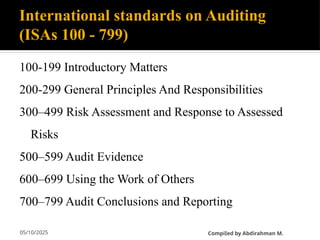
International standards onAuditing
(ISAs 100 - 799)
100-199 Introductory Matters
200-299 General Principles And Responsibilities
300–499 Risk Assessment and Response to Assessed
Risks
500–599 Audit Evidence
600–699 Using the Work of Others
700–799 Audit Conclusions and Reporting
CompiIed by Abdirahman M.
12.
05/10/2025
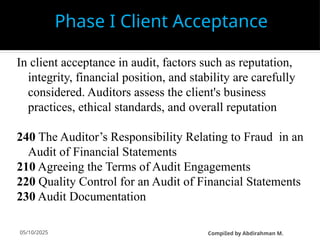
In client acceptancein audit, factors such as reputation,
integrity, financial position, and stability are carefully
considered. Auditors assess the client's business
practices, ethical standards, and overall reputation
240 The Auditor’s Responsibility Relating to Fraud in an
Audit of Financial Statements
210 Agreeing the Terms of Audit Engagements
220 Quality Control for an Audit of Financial Statements
230 Audit Documentation
Phase I Client Acceptance
CompiIed by Abdirahman M.
13.
05/10/2025
Cont…
250 Consideration ofLaws and Regulations in
an Audit of Financial Statements
260 Communication with Those Charged with
Governance
265 Communicating Deficiencies in Internal
Control to Those Charged with Governance
and Management
CompiIed by Abdirahman M.
14.
05/10/2025
Cont…
Requirements of AuditFinancial Statement
ISA 200 gives requirements relating to an audit
of financial statements.
The auditor is required to comply with relevant
ethical requirements, including those relating to
independence
The auditor shall plan and perform an audit with
professional skepticism recognizing that
circumstances may exist that cause the financial
statements to be materially misstated.
CompiIed by Abdirahman M.
15.
05/10/2025
Cont…
The auditorshall exercise professional
judgment in planning and performing an
audit of financial statements.
To obtain reasonable assurance, the auditor
must obtain sufficient appropriate audit
evidence to reduce audit risk to an
acceptably low level and thereby enable the
auditor to draw reasonable conclusions on
which to base the auditor’s opinion.
CompiIed by Abdirahman M.
16.
05/10/2025
Cont…
Key Definitions
Professionalskepticism—An attitude that includes a
questioning mind, being alert to conditions which
may indicate possible misstatement due to error or
fraud, and a critical assessment of evidence.
Material misstatement – A significant mistake in
financial information which would arise from errors
and fraud if it could influence the economic
decisions of users taken on the basis of the financial
statements.
CompiIed by Abdirahman M.
17.
05/10/2025
Cont…
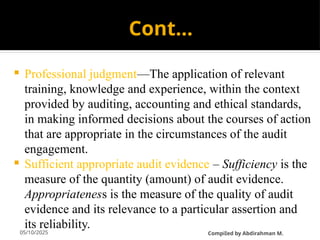
Professional judgment—Theapplication of relevant
training, knowledge and experience, within the context
provided by auditing, accounting and ethical standards,
in making informed decisions about the courses of action
that are appropriate in the circumstances of the audit
engagement.
Sufficient appropriate audit evidence – Sufficiency is the
measure of the quantity (amount) of audit evidence.
Appropriateness is the measure of the quality of audit
evidence and its relevance to a particular assertion and
its reliability.
CompiIed by Abdirahman M.
18.
05/10/2025
Cont…
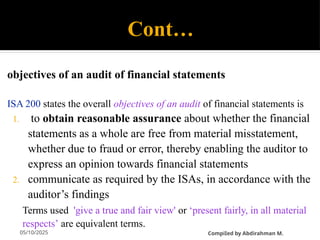
objectives of anaudit of financial statements
ISA 200 states the overall objectives of an audit of financial statements is
1. to obtain reasonable assurance about whether the financial
statements as a whole are free from material misstatement,
whether due to fraud or error, thereby enabling the auditor to
express an opinion towards financial statements
2. communicate as required by the ISAs, in accordance with the
auditor’s findings
Terms used 'give a true and fair view' or ‘present fairly, in all material
respects’ are equivalent terms.
CompiIed by Abdirahman M.
19.
05/10/2025
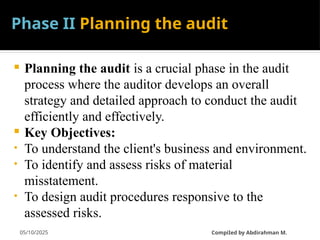
Phase II Planningthe audit
Planning the audit is a crucial phase in the audit
process where the auditor develops an overall
strategy and detailed approach to conduct the audit
efficiently and effectively.
Key Objectives:
• To understand the client's business and environment.
• To identify and assess risks of material
misstatement.
• To design audit procedures responsive to the
assessed risks.
CompiIed by Abdirahman M.
20.
05/10/2025
Cont…
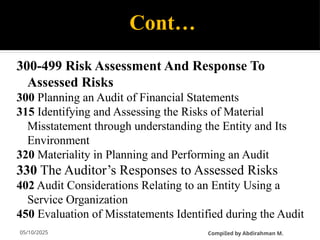
300-499 Risk AssessmentAnd Response To
Assessed Risks
300 Planning an Audit of Financial Statements
315 Identifying and Assessing the Risks of Material
Misstatement through understanding the Entity and Its
Environment
320 Materiality in Planning and Performing an Audit
330 The Auditor’s Responses to Assessed Risks
402 Audit Considerations Relating to an Entity Using a
Service Organization
450 Evaluation of Misstatements Identified during the Audit
CompiIed by Abdirahman M.
21.
05/10/2025
Cont…
Content of auditstrategy:
Scope of engagement (e.g. input of other
auditors).
Reporting objectives of assignment (e.g.
reporting timetable).
Nature/timing/extent of resources.
Content of audit plan:
Risk assessment procedures.
Detailed planned audit procedures.
CompiIed by Abdirahman M.
22.
05/10/2025
Phase II Planningthe audit
ISA 315 Identifying and assessing the risk of material
misstatement
Required understanding of entity and environment:
Industry/regulatory factors affecting FS.
Nature of entity:
Operations;
Ownership and governance; and
Financing.
CompiIed by Abdirahman M.
05/10/2025
Cont…
ISA 320 Materiality
Materiality: Misstatements, including omissions, are considered to be
material if they, individually or in the aggregate, could reasonably be
expected to influence the economic decisions of users taken on the
basis of the financial statements
Performance materiality: Performance materiality is set at a level
below overall materiality to reduce the probability that the aggregate of
uncorrected and undetected misstatements exceeds overall materiality..
CompiIed by Abdirahman M.
25.
05/10/2025
Cont…
Tolerable error:A monetary amount set by
the auditor in respect of which the auditor
seeks to obtain an appropriate level of
assurance that the monetary amount set by the
auditor is not exceeded by the actual
misstatement in the population.
CompiIed by Abdirahman M.
26.
05/10/2025
Phase III Testingand Evidence
500-599 Audit Evidence
500 Audit Evidence
501 Audit Evidence – Specific Considerations for Selected
Items
505 External Confirmations
510 Initial Audit Engagements—Opening Balances
520 Analytical Procedures
CompiIed by Abdirahman M.
27.
05/10/2025
Cont…
530 Audit Sampling
540Auditing Accounting Estimates and Related Disclosures
Including Fair Value Accounting Estimates, and Related
Disclosures
550 Related Parties
560 Subsequent Events
570 Going Concern
580 Written Representations
CompiIed by Abdirahman M.
28.
05/10/2025
Cont…
600-699 Using WorkOf Others
600 Special Considerations - Audits of Group
Financial Statements (including the work of a
competent auditor)
610 Using the Work of Internal Auditors
620 Using the Work of an Auditor’s Expert
CompiIed by Abdirahman M.
29.
05/10/2025
Cont…
ISA 500 AuditEvidence
Characteristics Audit Evidence :
Appropriateness: quality linked to relevance and reliability.
Sufficiency: quantity linked to quality and to risk of material
misstatement.
Relevance: linked to assertions.
Reliability:
Independent better than internal.
Auditor generated better than indirectly obtained.
Documentary better than oral.
Originals better than photocopies.
CompiIed by Abdirahman M.
30.
05/10/2025
Cont…
ISA 510 InitialAudit Engagement, Opening
balance
Objective: To obtain sufficient appropriate
evidence whether
Opening balances are misstated
Consistency accounting policies with current year
CompiIed by Abdirahman M.
31.
05/10/2025
Cont…
ISA 540 AuditingAccounting Estimates
Accounting estimates are approximations of
amounts in the financial statements that cannot be
precisely measured. These could include:
• Bad debt provisions/expenses
• Inventory obsolescence/wear out
• Fair value of financial instruments
• Depreciation and amortization
• Asset impairments (asset which has a current market value
that is less than the value listed on the balance sheet)
CompiIed by Abdirahman M.
32.
05/10/2025
Cont…
Why Estimates Matter
Estimates involve management judgment
and assumptions, which makes them
inherently risky and vulnerable to bias,
error, or even fraud. As a result, they are a
significant focus during an audit.
CompiIed by Abdirahman M.
33.
05/10/2025
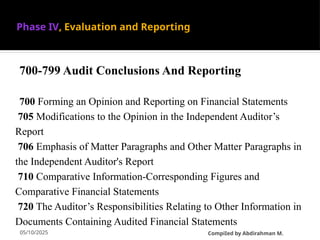
Phase IV, Evaluationand Reporting
700-799 Audit Conclusions And Reporting
700 Forming an Opinion and Reporting on Financial Statements
705 Modifications to the Opinion in the Independent Auditor’s
Report
706 Emphasis of Matter Paragraphs and Other Matter Paragraphs in
the Independent Auditor's Report
710 Comparative Information-Corresponding Figures and
Comparative Financial Statements
720 The Auditor’s Responsibilities Relating to Other Information in
Documents Containing Audited Financial Statements
CompiIed by Abdirahman M.
34.
05/10/2025
Cont…
ISA 700– Forming an Opinion and Reporting
on Financial Statements
ISA 700 provides guidance to auditors on how to
form an opinion on the financial statements and
how to communicate that opinion through the
auditor’s report.
CompiIed by Abdirahman M.
35.
05/10/2025
Cont…
The auditor must:
Form an opinion on whether the
financial statements:
1.Are prepared in accordance with the
applicable financial reporting framework
2.Give a true and fair view or are presented
fairly, in all material respects
Issue a written audit report that
clearly expresses that opinion.
CompiIed by Abdirahman M.
36.
05/10/2025
Cont…
ISA 705 Modificationof Audit Opinion
Sometimes, the auditor can't give a clean
(unmodified) opinion. ISA 705 guides auditors
on when and how to modify their opinion in
such cases.
CompiIed by Abdirahman M.
37.
05/10/2025
Cont…
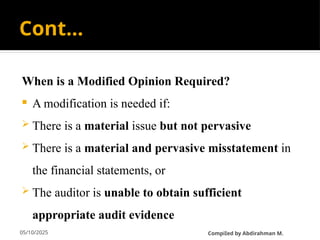
When is aModified Opinion Required?
A modification is needed if:
There is a material issue but not pervasive
There is a material and pervasive misstatement in
the financial statements, or
The auditor is unable to obtain sufficient
appropriate audit evidence
CompiIed by Abdirahman M.
38.
05/10/2025
Cont…
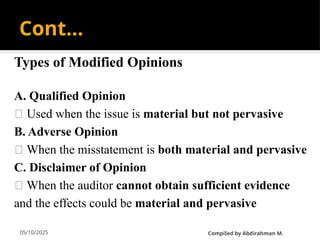
Types of ModifiedOpinions
A. Qualified Opinion
🔹 Used when the issue is material but not pervasive
B. Adverse Opinion
🔹 When the misstatement is both material and pervasive
C. Disclaimer of Opinion
🔹 When the auditor cannot obtain sufficient evidence
and the effects could be material and pervasive
CompiIed by Abdirahman M.
#11 Class Question: What is the process of auditing? Illustration 1.1 List of 2004 International Standards on Auditing pages 8-9;
Updated International Federation of Accountants. 2010. Handbook Of International Quality Control, Auditing, Review, Other Assurance, And Related Services Pronouncements 2010 Edition Part I
#12 Class Question: What is risk? Illustration 1.1 List of 2004 International Standards on Auditing pages 8-9
320 (Revised and Redrafted), Materiality in Planning and Performing an Audit
#14 ISA 200 sets out several requirements relating to an audit of financial statements. The auditor is required to comply with relevant ethical requirements, including those pertaining to independence, relating to financial statement audit engagements The auditor shall plan and perform an audit with professional skepticism recognizing that circumstances may exist that cause the financial statements to be materially misstated. The auditor shall exercise professional judgment in planning and performing an audit of financial statements. To obtain reasonable assurance, the auditor must obtain sufficient appropriate audit evidence to reduce audit risk to an acceptably low level and thereby enable the auditor to draw reasonable conclusions on which to base the auditor’s opinion.
Ibid. ISA 200. Paragraphs 14–17.
Professional skepticism—An attitude that includes a questioning mind, being alert to conditions which may indicate possible misstatement due to error or fraud, and a critical assessment of evidence. Discussed in more detail in Chapter 4.
Material misstatement – A significant mistake in financial information which would arise from errors and fraud if it could influence the economic decisions of users taken on the basis of the financial statements.
Professional judgment—The application of relevant training, knowledge and experience, within the context provided by auditing, accounting and ethical standards, in making informed decisions about the courses of action that are appropriate in the circumstances of the audit engagement. Discussed in more detail in Chapter 4.
Sufficient appropriate audit evidence – Sufficiency is the measure of the quantity (amount) of audit evidence. Appropriateness is the measure of the quality of audit evidence and its relevance to a particular assertion and its reliability. We will discuss evidence at some length in Chapters 9 and 10.
#16 Professional skepticism—An attitude that includes a questioning mind, being alert to conditions which may indicate possible misstatement due to error or fraud, and a critical assessment of evidence. Discussed in more detail in Chapter 4.
Material misstatement – A significant mistake in financial information which would arise from errors and fraud if it could influence the economic decisions of users taken on the basis of the financial statements.
Professional judgment—The application of relevant training, knowledge and experience, within the context provided by auditing, accounting and ethical standards, in making informed decisions about the courses of action that are appropriate in the circumstances of the audit engagement. Discussed in more detail in Chapter 4.
Sufficient appropriate audit evidence – Sufficiency is the measure of the quantity (amount) of audit evidence. Appropriateness is the measure of the quality of audit evidence and its relevance to a particular assertion and its reliability. We will discuss evidence at some length in Chapters 9 and 10.
#20 Class Question: What is audit evidence? Illustration 1.1 List of 2004 International Standards on Auditing pages 8-9
#26 Class Question: Why would an auditor need to use the assistance of someone else? Illustration 1.1 List of 2004 International Standards on Auditing pages 8-9
Class Question: What is an audit opinion?
#27 Class Question: Why would an auditor need to use the assistance of someone else? Illustration 1.1 List of 2004 International Standards on Auditing pages 8-9
Class Question: What is an audit opinion?
#33 Class Question: What kinds of audit opinions are there? Illustration 1.1 List of 2004 International Standards on Auditing pages 8-9