Is Internet getting old !!
❏ What (computer) network
architecture is
❏ What is the current one
❏ What are its main flaws
❏ How to construct a better
architecture
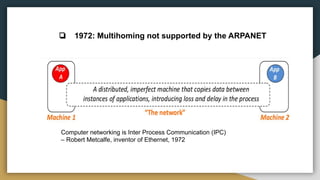
❏ 1972: Multihoming not supported by the ARPANET
Computer networking is Inter Process Communication (IPC)
– Robert Metcalfe, inventor of Ethernet, 1972
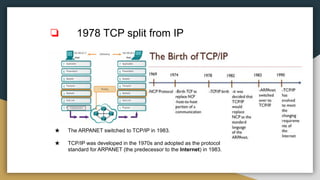
❏ 1978 TCP split from IP
★ The ARPANET switched to TCP/IP in 1983.
★ TCP/IP was developed in the 1970s and adopted as the protocol
standard for ARPANET (the predecessor to the Internet) in 1983.
❏ what are the “endpoints” of communication” today ??
★ Application
★ Network are just large data copying machines
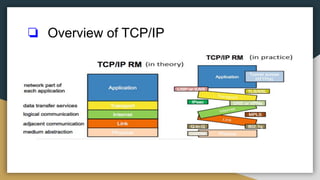
❏ Overview of TCP/IP
➔ Complexity makes all other
network problems worst
(security, management, etc),
makes networks hard (and
expensive!) to manage and
less reliable.
❏ Current network architecture has a flawed ...
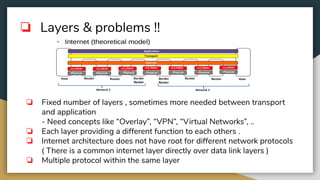
❏ Fixed number of layers , sometimes more needed between transport
and application
- Need concepts like “Overlay”, “VPN”, “Virtual Networks”, ..
❏ Each layer providing a different function to each others .
❏ Internet architecture does not have root for different network protocols
( There is a common internet layer directly over data link layers )
❏ Multiple protocol within the same layer
❏ Layers & problems !!
❏ Issues: mobility (II)
❏ HOW TO CONSTRUCT A BETTER
NETWORK ARCHITECTURE
❏ Let’s go to fixed ( what is new ?? )
❖ Meet RINA !
● The principles behind RINA were first
presented by John Day in his 2008 book
Patterns in Network Architecture
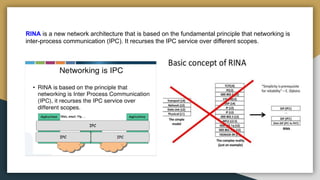
RINA is a new network architecture that is based on the fundamental principle that networking is
inter-process communication (IPC). It recurses the IPC service over different scopes.
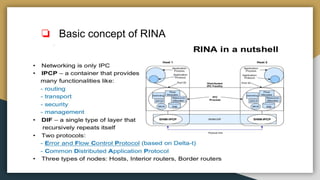
❏ Basic concept of RINA
❏ Overview
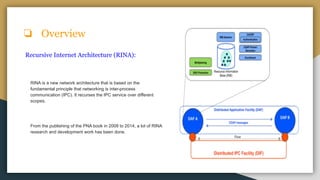
Recursive Internet Architecture (RINA):
RINA is a new network architecture that is based on the
fundamental principle that networking is inter-process
communication (IPC). It recurses the IPC service over different
scopes.
From the publishing of the PNA book in 2008 to 2014, a lot of RINA
research and development work has been done.
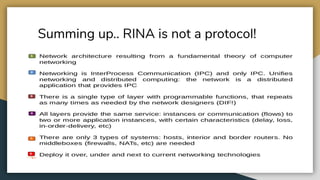
Summing up.. RINA is not a protocol!
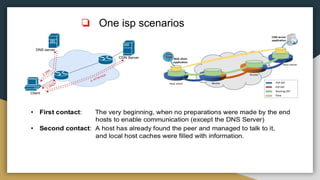
❏ One isp scenarios
❏ Let’s go to our to-do list
★ As a consequence of its structure, many capabilities supported
by RINA are accommodated without specific mechanisms. As
one would expect in a complete architecture, so-called
middleboxes are unnecessary, and so-called ``layer violations"
do not exist.
★ Network Structure Enhancements
★ Economic Efficiency
❏ Benefits of RINA ??
Reference:
http://csr.bu.edu/rina/documents2.html
https://www.icin-conference.org/rina-2020/
https://en.wikipedia.org/wiki/Recursive_Internetwork_Architecture

Is Internet getting old !!

  • 1.
    Is Internet gettingold !! ❏ What (computer) network architecture is ❏ What is the current one ❏ What are its main flaws ❏ How to construct a better architecture
  • 2.
    ❏ 1972: Multihomingnot supported by the ARPANET Computer networking is Inter Process Communication (IPC) – Robert Metcalfe, inventor of Ethernet, 1972
  • 3.
    ❏ 1978 TCPsplit from IP ★ The ARPANET switched to TCP/IP in 1983. ★ TCP/IP was developed in the 1970s and adopted as the protocol standard for ARPANET (the predecessor to the Internet) in 1983.
  • 4.
    ❏ what arethe “endpoints” of communication” today ?? ★ Application ★ Network are just large data copying machines
  • 5.
  • 6.
    ➔ Complexity makesall other network problems worst (security, management, etc), makes networks hard (and expensive!) to manage and less reliable.
  • 7.
    ❏ Current networkarchitecture has a flawed ...
  • 8.
    ❏ Fixed numberof layers , sometimes more needed between transport and application - Need concepts like “Overlay”, “VPN”, “Virtual Networks”, .. ❏ Each layer providing a different function to each others . ❏ Internet architecture does not have root for different network protocols ( There is a common internet layer directly over data link layers ) ❏ Multiple protocol within the same layer ❏ Layers & problems !!
  • 9.
  • 11.
    ❏ HOW TOCONSTRUCT A BETTER NETWORK ARCHITECTURE
  • 12.
    ❏ Let’s goto fixed ( what is new ?? ) ❖ Meet RINA ! ● The principles behind RINA were first presented by John Day in his 2008 book Patterns in Network Architecture
  • 13.
    RINA is anew network architecture that is based on the fundamental principle that networking is inter-process communication (IPC). It recurses the IPC service over different scopes.
  • 14.
  • 15.
    ❏ Overview Recursive InternetArchitecture (RINA): RINA is a new network architecture that is based on the fundamental principle that networking is inter-process communication (IPC). It recurses the IPC service over different scopes. From the publishing of the PNA book in 2008 to 2014, a lot of RINA research and development work has been done.
  • 16.
    Summing up.. RINAis not a protocol!
  • 17.
    ❏ One ispscenarios
  • 18.
    ❏ Let’s goto our to-do list
  • 19.
    ★ As aconsequence of its structure, many capabilities supported by RINA are accommodated without specific mechanisms. As one would expect in a complete architecture, so-called middleboxes are unnecessary, and so-called ``layer violations" do not exist. ★ Network Structure Enhancements ★ Economic Efficiency ❏ Benefits of RINA ??
  • 20.