Is experimentation
feasible at MOOCs?
Manuel Castro
Felix Garcia-Loro
Prof. Dr. Manuel Castro, http://www.slideshare.net/mmmcastro/
Electronics Technology Professor, UNED, Madrid, SPAIN
IEEE Fellow, Sr Past President, IEEE Education Society
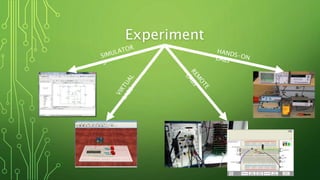
Experiment
What is a remote lab?
• A remote laboratory is a tool which combines
software and hardware to allow students to access to
real equipment, instruments and components
remotely through the Internet
• The main advantage of remote labs, when compared
with traditional laboratories, lies in its availability
that has neither temporal nor geographical
restrictions
• Main disadvantage are maintenance and 100%
availability
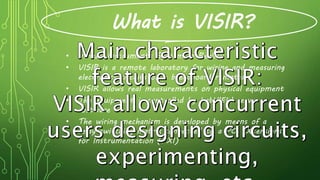
What is VISIR?
• Virtual Instruments System In Reality
• VISIR is a remote laboratory for wiring and measuring
electronics circuits on a breadboard remotely
• VISIR allows real measurements on physical equipment
• The equipment is controlled by LabVIEW server
software
• The wiring mechanism is developed by means of a
relay switching matrix connected to a PCI eXtensions
for Instrumentation (PXI)
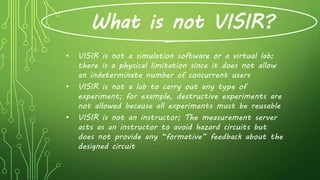
What is not VISIR?
• VISIR is not a simulation software or a virtual lab;
there is a physical limitation since it does not allow
an indeterminate number of concurrent users
• VISIR is not a lab to carry out any type of
experiment; for example, destructive experiments are
not allowed because all experiments must be reusable
• VISIR is not an instructor; The measurement server
acts as an instructor to avoid hazard circuits but
does not provide any “formative” feedback about the
designed circuit
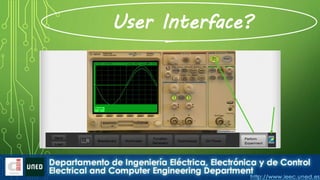
User Interface?
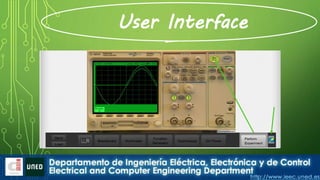
User Interface
UNED-COMA
• UNED-COMA platform is an Open-UNED initiative,
aimed at the deployment of MOOCs from different
Departments and Teaching Teams of UNED
• UNED-COMA platform explodes the rich experience in
distance education of UNED educational system
• Badge, Credential (paying) and Certificate (paying +
in-person exam)
• Curator (UNED-COMA) & Facilitator (teaching staff)
• Access is completely open and free
BCEP MOOC
• Circuits Fundamentals and Applied Electronics (“Bases
de Circuitos y Electrónica Práctica”, BCEP)
• The core of the MOOC is the remote laboratory
VISIR
• Critical analysis point: Scalability; VISIR into a
massive environment
• The acquisition of the competences in analyzing
circuits is not a goal, however it is necessary
BCEP goals
• To provide access to anyone interested
• To test VISIR remote laboratory performance under a
high demand scenario
• To analyze “consumers’” profile <<students interested
in this kind of courses and their needs to complete
satisfactorily the course>>
• To evaluate UNED-COMA platform and its
adaptability for electronics and practical-based courses
BCEP modules
• Module I: Simulation
• Module II: Remote laboratory (VISIR): equipment &
instruments
• Module III: Working with resistors
• Module IV: RLC circuits
• Module V: Working with diodes
• Module VI: Filters
• Module VII: Zener diode
• Module VIII: Operational amplifier
request muestra1
Gráfico de Dispersión
52 62 72 82 92 102
VISIR physical limitations
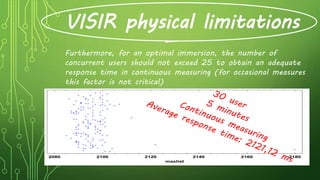
Furthermore, for an optimal immersion, the number of
concurrent users should not exceed 25 to obtain an adequate
response time in continuous measuring (for occasional measures
this factor is not critical)
maxlist
Gráfico de Dispersión
0 400 800 1200 1600 2000 2400
maxlist
Gráfico de Dispersión
2080 2100 2120 2140 2160 2180
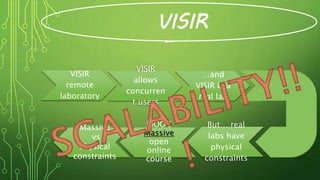
VISIR
VISIR
remote
laboratory
VISIR
allows
concurren
t users
…and
VISIR is a
real lab
But… real
labs have
physical
constraints
MOOC
Massive
open
online
course
Massive
vs
Physical
constraints
…but…
• It is very unlikely that all connected users perform
measurements simultaneously; The laboratory time is
necessary specially for the circuit assembly and for
configuring the equipment much more than for
measuring
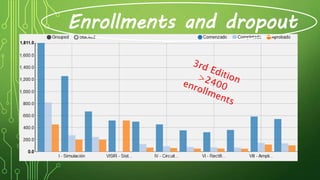
• In addition, MOOCs show a high dropout rate; So,
delaying VISIR onset, the number of accesses is
limited to those students who are really interested
and motivated
Booking system
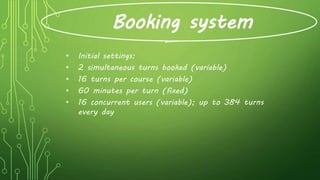
• Initial settings:
• 2 simultaneous turns booked (variable)
• 16 turns per course (variable)
• 60 minutes per turn (fixed)
• 16 concurrent users (variable); up to 384 turns
every day
Enrollments and dropout
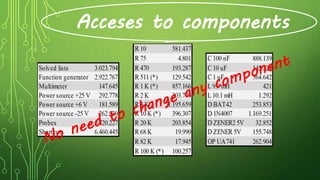
Acceses to components
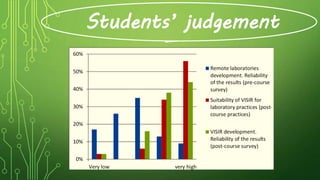
Students’ judgement
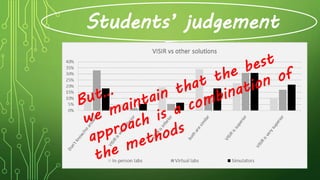
Students’ judgement
Platform conclusions
• New activities/tasks are required
• UNED-COMA platform allows access to any module
without any restriction, this feature destroys
scaffolding
• Users were anonymous for VISIR due to the way the
interaction between the remote lab and the MOOC
platform is carried out
• …A new MOOC platform is required
Course conclusions
• Practices designed were easy for those students who
had a previous training in electronics, but complex for
those who didn’t
• About the activities, students agreed that both, the
activities they have had to carry out in VISIR and
the activities derived from them, were long
• VISIR and practical contents have been inadequate to
help students to take advantage of VISIR;Theoretical
contents have been revealed necessary: BCEP-MOOC
requires a redesign
• Students are interested in practical courses
VISIR conclusions
• Remote laboratory VISIR has shown the ability to
perform its activity satisfactorily in massive
environments
• VISIR remote lab have been an attraction for
students’ enrollment
• Students’ opinion about VISIR reliability and
performance have been really positive
Is experimentation
feasible at MOOCs?
Manuel Castro
Felix Garcia-Loro
Prof. Dr. Manuel Castro, http://www.slideshare.net/mmmcastro/
Electronics Technology Professor, UNED, Madrid, SPAIN
IEEE Fellow, Sr Past President, IEEE Education Society
The
end
?

Is experimentation feasible at MOOCs?

  • 1.
    Is experimentation feasible atMOOCs? Manuel Castro Felix Garcia-Loro Prof. Dr. Manuel Castro, http://www.slideshare.net/mmmcastro/ Electronics Technology Professor, UNED, Madrid, SPAIN IEEE Fellow, Sr Past President, IEEE Education Society
  • 2.
  • 4.
    What is aremote lab? • A remote laboratory is a tool which combines software and hardware to allow students to access to real equipment, instruments and components remotely through the Internet • The main advantage of remote labs, when compared with traditional laboratories, lies in its availability that has neither temporal nor geographical restrictions • Main disadvantage are maintenance and 100% availability
  • 5.
    What is VISIR? •Virtual Instruments System In Reality • VISIR is a remote laboratory for wiring and measuring electronics circuits on a breadboard remotely • VISIR allows real measurements on physical equipment • The equipment is controlled by LabVIEW server software • The wiring mechanism is developed by means of a relay switching matrix connected to a PCI eXtensions for Instrumentation (PXI)
  • 6.
    What is notVISIR? • VISIR is not a simulation software or a virtual lab; there is a physical limitation since it does not allow an indeterminate number of concurrent users • VISIR is not a lab to carry out any type of experiment; for example, destructive experiments are not allowed because all experiments must be reusable • VISIR is not an instructor; The measurement server acts as an instructor to avoid hazard circuits but does not provide any “formative” feedback about the designed circuit
  • 7.
  • 8.
  • 9.
    UNED-COMA • UNED-COMA platformis an Open-UNED initiative, aimed at the deployment of MOOCs from different Departments and Teaching Teams of UNED • UNED-COMA platform explodes the rich experience in distance education of UNED educational system • Badge, Credential (paying) and Certificate (paying + in-person exam) • Curator (UNED-COMA) & Facilitator (teaching staff) • Access is completely open and free
  • 10.
    BCEP MOOC • CircuitsFundamentals and Applied Electronics (“Bases de Circuitos y Electrónica Práctica”, BCEP) • The core of the MOOC is the remote laboratory VISIR • Critical analysis point: Scalability; VISIR into a massive environment • The acquisition of the competences in analyzing circuits is not a goal, however it is necessary
  • 11.
    BCEP goals • Toprovide access to anyone interested • To test VISIR remote laboratory performance under a high demand scenario • To analyze “consumers’” profile <<students interested in this kind of courses and their needs to complete satisfactorily the course>> • To evaluate UNED-COMA platform and its adaptability for electronics and practical-based courses
  • 12.
    BCEP modules • ModuleI: Simulation • Module II: Remote laboratory (VISIR): equipment & instruments • Module III: Working with resistors • Module IV: RLC circuits • Module V: Working with diodes • Module VI: Filters • Module VII: Zener diode • Module VIII: Operational amplifier
  • 13.
    request muestra1 Gráfico deDispersión 52 62 72 82 92 102 VISIR physical limitations Furthermore, for an optimal immersion, the number of concurrent users should not exceed 25 to obtain an adequate response time in continuous measuring (for occasional measures this factor is not critical) maxlist Gráfico de Dispersión 0 400 800 1200 1600 2000 2400 maxlist Gráfico de Dispersión 2080 2100 2120 2140 2160 2180
  • 14.
    VISIR VISIR remote laboratory VISIR allows concurren t users …and VISIR isa real lab But… real labs have physical constraints MOOC Massive open online course Massive vs Physical constraints
  • 15.
    …but… • It isvery unlikely that all connected users perform measurements simultaneously; The laboratory time is necessary specially for the circuit assembly and for configuring the equipment much more than for measuring • In addition, MOOCs show a high dropout rate; So, delaying VISIR onset, the number of accesses is limited to those students who are really interested and motivated
  • 16.
    Booking system • Initialsettings: • 2 simultaneous turns booked (variable) • 16 turns per course (variable) • 60 minutes per turn (fixed) • 16 concurrent users (variable); up to 384 turns every day
  • 17.
  • 18.
  • 19.
  • 20.
  • 21.
    Platform conclusions • Newactivities/tasks are required • UNED-COMA platform allows access to any module without any restriction, this feature destroys scaffolding • Users were anonymous for VISIR due to the way the interaction between the remote lab and the MOOC platform is carried out • …A new MOOC platform is required
  • 22.
    Course conclusions • Practicesdesigned were easy for those students who had a previous training in electronics, but complex for those who didn’t • About the activities, students agreed that both, the activities they have had to carry out in VISIR and the activities derived from them, were long • VISIR and practical contents have been inadequate to help students to take advantage of VISIR;Theoretical contents have been revealed necessary: BCEP-MOOC requires a redesign • Students are interested in practical courses
  • 23.
    VISIR conclusions • Remotelaboratory VISIR has shown the ability to perform its activity satisfactorily in massive environments • VISIR remote lab have been an attraction for students’ enrollment • Students’ opinion about VISIR reliability and performance have been really positive
  • 24.
    Is experimentation feasible atMOOCs? Manuel Castro Felix Garcia-Loro Prof. Dr. Manuel Castro, http://www.slideshare.net/mmmcastro/ Electronics Technology Professor, UNED, Madrid, SPAIN IEEE Fellow, Sr Past President, IEEE Education Society The end ?

Editor's Notes

  • #18 Imagen: http://www.latercera.com/noticia/tendencias/2012/11/659-496134-9-fotografo-retrata-las-pizarras-que-explican-las-teorias-mas-complejas-de-la.shtml