International Research Journal of Engineering and Technology (IRJET) e-ISSN: 2395-0056
Volume: 06 Issue: 02 | Feb 2019 www.irjet.net p-ISSN: 2395-0072
© 2019, IRJET | Impact Factor value: 7.211 | ISO 9001:2008 Certified Journal | Page 482
Transmitting Audio through Li-Fi
Akash Sangle1, Hardik Shah2, Dheeraj Yadav3, Mahadev Varadkar4, Manish Salvi5
1,2,3,4Student, Dept. of Computer Engineering, Thakur Polytechnic, Maharashtra, India
5Manish Salvi:Lecturer, Dept. of Computer Engineering, Thakur Polytechnic, Maharashtra, India
---------------------------------------------------------------------***----------------------------------------------------------------------
Abstract - Li-Fi stands for light Fidelity. Li-Fi is a wireless
optical networking technology that uses light emitting diodes
(LEDs) for transmission of information. The term Li-Fi refers
to visible light communication(VLC)technologythatuseslight
as medium to deliver high-speed communication in a manner
the same as Wi-Fi. This paper focuses on Li-Fi, its applications,
features and comparison with existing technologies like Wi-Fi
etc. Wi-Fi is of major use for general wireless coverage among
building, whereas Li-Fi is right for high density wireless
information coverage in confined space and particularly
helpful for applications in areas where radio interference
problems are of concern, that the two technologies are often
thought-about complimentary. Li-Fi provides higher
bandwidth, efficiency, connectivity and security than Wi-Fi
and has already achieved high speeds larger than 1 Gbps
under the laboratory conditions. Li-Fi is the transfer of
information through light by taking fiber out of fiber optics
and sending data through LED light bulb
Key Words - Li-Fi, LED, VLC, speed 1Gbps
1. INTRODUCTION
Li-Fi is a new means of wireless communication that uses
diode lights to transmit information wirelessly.
Transmission of information is one of the most necessary
day to day activities in the quick growing world. This
wireless network that connect us to the internet are terribly
slow when multiple devices are connected. Li-Fi may be a
breakthrough technology within the lighting and
communications sectors enabling wireless transfer of data
by modulating light with benefits like high security, while
not sacrificing the liberty of wireless communication. It will
give lower latencies compared to Wi-Fi, particularly in
congested radio frequency (RF) environments,thatisvital in
facilitating higher product throughputs. By Communication
through visible light, Li-Fi technology has the chance toalter
how we access the net, stream videos, receive emails and
much more. Security wouldn't be a difficulty as information
can’t be accessed in the absence of light. As a result, it can be
utilized in high security military areas where RF
communication is susceptible to eavesdropping.
2. PROPOSED WORKING
Light Fidelity (Li-Fi) technologyisa wirelesscommunication
system based on the use of visible light between the violet
(800 THz) and red (400 THz). Unlike Wi-Fi that uses the
radio part of the spectrum, Li-Fi uses the optical spectrum
i.e. visible light part of the spectrum. The principle of Li-Fi
relies on sending information by amplitude modulation of
the light source in a very well-defined and standardized
manner. LEDs are often switched on and off quickerthanthe
human eyes can notice since theoperational speedofLEDsis
less than one microsecond. This invisible on-off activity
allows information transmission using binary codes. If the
LED is on, a digital ‘1’ is transmitted and if the LED is off, a
digital ‘0’ is transmitted. Also, these LEDs are often switched
on and off very quickly which provides us a really nice
opportunity for transmitting data through LED lights.
3. WORKING OF PROPOSED MODEL
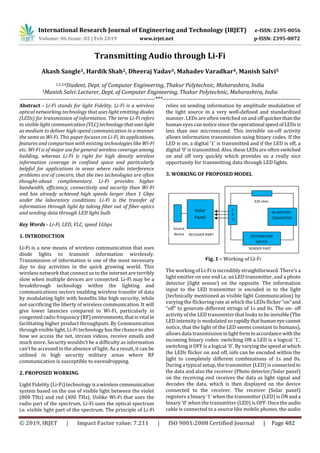
Fig. 1 – Working of LI-Fi
The working of Li-Fi is incredibly straightforward. There’s a
light emitter on one end i.e. an LED transmitter, and a photo
detector (light sensor) on the opposite. The information
input to the LED transmitter is encoded in to the light
(technically mentioned as visible light Communication) by
varying the flickering rate at which the LEDs flicker“on”and
“off” to generate different strings of 1s and 0s. The on- off
activity of the LED transmitter that looks to beinvisible(The
LED intensity is modulated sorapidlythathumaneyecannot
notice, that the light of the LED seems constant to humans),
allows data transmissioninlightforminaccordance withthe
incoming binary codes: switching ON a LED is a logical '1',
switching it OFF is a logical '0'. By varyingthespeedatwhich
the LEDs flicker on and off, info can be encoded within the
light to completely different combinations of 1s and 0s.
During a typical setup, the transmitter (LED) is connectedto
the data and also the receiver (Photo detector/Solar panel)
on the receiving end receives the data as light signal and
decodes the data, which is then displayed on the device
connected to the receiver. The receiver (Solar panel)
registers a binary ‘1’ when the transmitter (LED) is ON anda
binary ‘0’ when the transmitter (LED) is OFF. Once theaudio
cable is connected to a source like mobile phones, the audio
International Research Journal of Engineering and Technology (IRJET) e-ISSN: 2395-0056
Volume: 06 Issue: 02 | Feb 2019 www.irjet.net p-ISSN: 2395-0072
© 2019, IRJET | Impact Factor value: 7.211 | ISO 9001:2008 Certified Journal | Page 483
signals gets converted into LI-FI signals. Then from the LED
the LI-FI signals falls on the solar panel. The solar panel
receives the light signals from the LED. This signal is then
converted to audio signals then the audio is played on the
destination like a speaker.
4. COMPONENTS REQUIRED
[1] Solar Panels
[2] LEDs
[3] 3.5mm Audio Cable
[4] Speakers
[5] Battery
5. FEATURES
[1] Real time monitoring
[2] Improved maintenance identification
[3] Enhanced automation
[4] Informed decisions
[5] Increased security
[6] Wireless connectivity in RF hostile environments
[7] Larger information density
6. ADVANTAGES
[1] Efficiency - Energy consumption is often minimised
with the utilization of LED illumination that are already
out there within the home, offices and Mall etc. for
lighting purpose. Thus, the transmission of information
requiring negligible extra power, that makes it very
efficient in terms of costs as well as energy.
[2] High speed - Combination of low interference, high
bandwidths and high-intensity output, facilitate Li-Fi
provide high data rates i.e. 1 Gbps or even beyond.
Availability: Availability isn't a problem as light sources
are present all over. Where there's a light source, there
will be internet. Light bulbs are present everywhere in
homes, offices, shops, malls and even planes, which
might be used as a medium for the information
transmission.
[3] Cheaper - Li-Fi not only needs fewer componentsforits
operating, but also uses only a negligibleextra powerfor
the data transmission.
[4] Security - One main advantage of Li-Fi is security. Since
light cannot go through opaque structures, Li-Fi net is
available only to the users inside a confined space and
can't be interceptedandmisused,outsidethearea under
operation.
[5] Li-Fi technology - it has an excellent scope in future.
The in-depth growth in the use of LEDs for illumination
indeed provides the chance to integrate the technology
into a plethora of environments and applications.
7. LIMITATIONS
[1] Internet can't be accessed without a light source. This
might limit the locations and situations duringwhichLi-
Fi can be used.
[2] It needs a near or excellent line-of-sight to transmit
information.
[3] Opaque obstacles on pathways will have an effect on
information transmission.
[4] Natural light, sunlight, and traditional light bulb will
have an effect on the information transmission speed.
[5] Light waves don’t penetratethroughwallsandthenLi-Fi
contains a much shorter range than Wi-Fi.
[6] High initial installation cost, if used to set up a full-
fledged data network.
8. FUTURE SCOPE
As light is all over and free to use, there's an excellent scope
for the utilization and evolution of Li-Fi technology. If this
technology becomes mature, every Li-Fi bulb are often used
to transmit wireless information. As the Li-Fi technology
becomes widespread, it'll cause a cleaner, greener, safer
communications and have a bright future and environment.
The thought of Li-Fi is deriving many folks because it is free
(require no license) and quicker means of data transfer. If it
evolves quicker, individuals can use this technology more
and more.
9. CONCLUSION
Though there’s still an extended way to go to create this
technology a commercial success, it guarantees an excellent
potential within the field of wireless internet. A significant
number of researchers and corporations are presently
working on this idea, which guarantees to unravel the
problem of lack of radio spectrum, space and low internet
connection speed. By deployment of this technology,wewill
migrate to greener, cleaner, safer communication networks.
The very thought of Li-Fi guarantees to resolve problems
like, shortage of radio-frequency bandwidth and eliminates
the disadvantages of Radio communication technologies. Li-
Fi is the upcoming and growing technology actingascatalyst
for numerous different developing and new
inventions/technologies. Therefore, there's certainty of
development of future applications of the Li-Fi which might
International Research Journal of Engineering and Technology (IRJET) e-ISSN: 2395-0056
Volume: 06 Issue: 02 | Feb 2019 www.irjet.net p-ISSN: 2395-0072
© 2019, IRJET | Impact Factor value: 7.211 | ISO 9001:2008 Certified Journal | Page 484
be extended to completely different platforms and various
walks of human life.
10. REFERENCES
[1] https://www.prepostseo.com/compare/142647063ab6
e3887dab4a07209789a60caac096e559750278
[2] http://zuzfokst.cf/18wz.html
[3] https://myspybuddyblogs.wordpress.com/2018/07/28
/li-fi-technology-an-incredible-addition-to-wi-fifast-
high-speed-data-transmission/

IRJET- Transmitting Audio through Li-Fi

  • 1.
    International Research Journalof Engineering and Technology (IRJET) e-ISSN: 2395-0056 Volume: 06 Issue: 02 | Feb 2019 www.irjet.net p-ISSN: 2395-0072 © 2019, IRJET | Impact Factor value: 7.211 | ISO 9001:2008 Certified Journal | Page 482 Transmitting Audio through Li-Fi Akash Sangle1, Hardik Shah2, Dheeraj Yadav3, Mahadev Varadkar4, Manish Salvi5 1,2,3,4Student, Dept. of Computer Engineering, Thakur Polytechnic, Maharashtra, India 5Manish Salvi:Lecturer, Dept. of Computer Engineering, Thakur Polytechnic, Maharashtra, India ---------------------------------------------------------------------***---------------------------------------------------------------------- Abstract - Li-Fi stands for light Fidelity. Li-Fi is a wireless optical networking technology that uses light emitting diodes (LEDs) for transmission of information. The term Li-Fi refers to visible light communication(VLC)technologythatuseslight as medium to deliver high-speed communication in a manner the same as Wi-Fi. This paper focuses on Li-Fi, its applications, features and comparison with existing technologies like Wi-Fi etc. Wi-Fi is of major use for general wireless coverage among building, whereas Li-Fi is right for high density wireless information coverage in confined space and particularly helpful for applications in areas where radio interference problems are of concern, that the two technologies are often thought-about complimentary. Li-Fi provides higher bandwidth, efficiency, connectivity and security than Wi-Fi and has already achieved high speeds larger than 1 Gbps under the laboratory conditions. Li-Fi is the transfer of information through light by taking fiber out of fiber optics and sending data through LED light bulb Key Words - Li-Fi, LED, VLC, speed 1Gbps 1. INTRODUCTION Li-Fi is a new means of wireless communication that uses diode lights to transmit information wirelessly. Transmission of information is one of the most necessary day to day activities in the quick growing world. This wireless network that connect us to the internet are terribly slow when multiple devices are connected. Li-Fi may be a breakthrough technology within the lighting and communications sectors enabling wireless transfer of data by modulating light with benefits like high security, while not sacrificing the liberty of wireless communication. It will give lower latencies compared to Wi-Fi, particularly in congested radio frequency (RF) environments,thatisvital in facilitating higher product throughputs. By Communication through visible light, Li-Fi technology has the chance toalter how we access the net, stream videos, receive emails and much more. Security wouldn't be a difficulty as information can’t be accessed in the absence of light. As a result, it can be utilized in high security military areas where RF communication is susceptible to eavesdropping. 2. PROPOSED WORKING Light Fidelity (Li-Fi) technologyisa wirelesscommunication system based on the use of visible light between the violet (800 THz) and red (400 THz). Unlike Wi-Fi that uses the radio part of the spectrum, Li-Fi uses the optical spectrum i.e. visible light part of the spectrum. The principle of Li-Fi relies on sending information by amplitude modulation of the light source in a very well-defined and standardized manner. LEDs are often switched on and off quickerthanthe human eyes can notice since theoperational speedofLEDsis less than one microsecond. This invisible on-off activity allows information transmission using binary codes. If the LED is on, a digital ‘1’ is transmitted and if the LED is off, a digital ‘0’ is transmitted. Also, these LEDs are often switched on and off very quickly which provides us a really nice opportunity for transmitting data through LED lights. 3. WORKING OF PROPOSED MODEL Fig. 1 – Working of LI-Fi The working of Li-Fi is incredibly straightforward. There’s a light emitter on one end i.e. an LED transmitter, and a photo detector (light sensor) on the opposite. The information input to the LED transmitter is encoded in to the light (technically mentioned as visible light Communication) by varying the flickering rate at which the LEDs flicker“on”and “off” to generate different strings of 1s and 0s. The on- off activity of the LED transmitter that looks to beinvisible(The LED intensity is modulated sorapidlythathumaneyecannot notice, that the light of the LED seems constant to humans), allows data transmissioninlightforminaccordance withthe incoming binary codes: switching ON a LED is a logical '1', switching it OFF is a logical '0'. By varyingthespeedatwhich the LEDs flicker on and off, info can be encoded within the light to completely different combinations of 1s and 0s. During a typical setup, the transmitter (LED) is connectedto the data and also the receiver (Photo detector/Solar panel) on the receiving end receives the data as light signal and decodes the data, which is then displayed on the device connected to the receiver. The receiver (Solar panel) registers a binary ‘1’ when the transmitter (LED) is ON anda binary ‘0’ when the transmitter (LED) is OFF. Once theaudio cable is connected to a source like mobile phones, the audio
  • 2.
    International Research Journalof Engineering and Technology (IRJET) e-ISSN: 2395-0056 Volume: 06 Issue: 02 | Feb 2019 www.irjet.net p-ISSN: 2395-0072 © 2019, IRJET | Impact Factor value: 7.211 | ISO 9001:2008 Certified Journal | Page 483 signals gets converted into LI-FI signals. Then from the LED the LI-FI signals falls on the solar panel. The solar panel receives the light signals from the LED. This signal is then converted to audio signals then the audio is played on the destination like a speaker. 4. COMPONENTS REQUIRED [1] Solar Panels [2] LEDs [3] 3.5mm Audio Cable [4] Speakers [5] Battery 5. FEATURES [1] Real time monitoring [2] Improved maintenance identification [3] Enhanced automation [4] Informed decisions [5] Increased security [6] Wireless connectivity in RF hostile environments [7] Larger information density 6. ADVANTAGES [1] Efficiency - Energy consumption is often minimised with the utilization of LED illumination that are already out there within the home, offices and Mall etc. for lighting purpose. Thus, the transmission of information requiring negligible extra power, that makes it very efficient in terms of costs as well as energy. [2] High speed - Combination of low interference, high bandwidths and high-intensity output, facilitate Li-Fi provide high data rates i.e. 1 Gbps or even beyond. Availability: Availability isn't a problem as light sources are present all over. Where there's a light source, there will be internet. Light bulbs are present everywhere in homes, offices, shops, malls and even planes, which might be used as a medium for the information transmission. [3] Cheaper - Li-Fi not only needs fewer componentsforits operating, but also uses only a negligibleextra powerfor the data transmission. [4] Security - One main advantage of Li-Fi is security. Since light cannot go through opaque structures, Li-Fi net is available only to the users inside a confined space and can't be interceptedandmisused,outsidethearea under operation. [5] Li-Fi technology - it has an excellent scope in future. The in-depth growth in the use of LEDs for illumination indeed provides the chance to integrate the technology into a plethora of environments and applications. 7. LIMITATIONS [1] Internet can't be accessed without a light source. This might limit the locations and situations duringwhichLi- Fi can be used. [2] It needs a near or excellent line-of-sight to transmit information. [3] Opaque obstacles on pathways will have an effect on information transmission. [4] Natural light, sunlight, and traditional light bulb will have an effect on the information transmission speed. [5] Light waves don’t penetratethroughwallsandthenLi-Fi contains a much shorter range than Wi-Fi. [6] High initial installation cost, if used to set up a full- fledged data network. 8. FUTURE SCOPE As light is all over and free to use, there's an excellent scope for the utilization and evolution of Li-Fi technology. If this technology becomes mature, every Li-Fi bulb are often used to transmit wireless information. As the Li-Fi technology becomes widespread, it'll cause a cleaner, greener, safer communications and have a bright future and environment. The thought of Li-Fi is deriving many folks because it is free (require no license) and quicker means of data transfer. If it evolves quicker, individuals can use this technology more and more. 9. CONCLUSION Though there’s still an extended way to go to create this technology a commercial success, it guarantees an excellent potential within the field of wireless internet. A significant number of researchers and corporations are presently working on this idea, which guarantees to unravel the problem of lack of radio spectrum, space and low internet connection speed. By deployment of this technology,wewill migrate to greener, cleaner, safer communication networks. The very thought of Li-Fi guarantees to resolve problems like, shortage of radio-frequency bandwidth and eliminates the disadvantages of Radio communication technologies. Li- Fi is the upcoming and growing technology actingascatalyst for numerous different developing and new inventions/technologies. Therefore, there's certainty of development of future applications of the Li-Fi which might
  • 3.
    International Research Journalof Engineering and Technology (IRJET) e-ISSN: 2395-0056 Volume: 06 Issue: 02 | Feb 2019 www.irjet.net p-ISSN: 2395-0072 © 2019, IRJET | Impact Factor value: 7.211 | ISO 9001:2008 Certified Journal | Page 484 be extended to completely different platforms and various walks of human life. 10. REFERENCES [1] https://www.prepostseo.com/compare/142647063ab6 e3887dab4a07209789a60caac096e559750278 [2] http://zuzfokst.cf/18wz.html [3] https://myspybuddyblogs.wordpress.com/2018/07/28 /li-fi-technology-an-incredible-addition-to-wi-fifast- high-speed-data-transmission/