International Research Journal of Engineering and Technology (IRJET) e-ISSN: 2395-0056
Volume: 06 Issue: 07 | July 2019 www.irjet.net p-ISSN: 2395-0072
© 2019, IRJET | Impact Factor value: 7.211 | ISO 9001:2008 Certified Journal | Page 2941
Testing Improvement in Business Intelligence Area
Sani Kumar1, Dr. Hari Om Sharan2
1(Research Scholar), Department Computer Science & Engineering Rama University, Kanpur 209217, India
2(Associate Professor), Department Computer Science & Engineering Rama University, Kanpur 209217, India
-------------------------------------------------------------------------***------------------------------------------------------------------------
Abstract - In present, testing techniques have gradually
involved from the practice of single programmers or small
development teams into a systematic, managed engineering
discipline. Not only have there been numerous researches on
testing techniques, but also more and more considerable
industry practices. There are testing classes taught in
universities. There have been special testing teams, test
managers, and tester job positions open to professional
testers; there have been training programs and complete
procedures for testing in large enterprises; and there are
increasing number of companies and vendors doing testing
work for other companies.
However, despite the numerous research results (quite a lotof
them are really sound) testing remains an awkward, time -
consuming, cost-ineffective chunk of work that is always not
very satisfying in most industry practices. Onlyasmallnumber
of the research results have been utilized successfully in
industry practices so that the test process can be greatly
improved or automated. The mostcommon testingexercisesin
industry are static analysis including code inspections, peer
reviews, walkthroughs. Not enough testing tools can be
applied directly on industry projects and products without
being largely modified and even re-developed. Test plans are
still written by hand, while test environment remained simple
and crude. This inconsistency of testing research and practice
has been called the “testing gap.”
Fundamental researches in techniques need to:
 Demonstrate effectiveness of existing techniques
 Address the need in new areas
 Create new adaptive techniques
 Facilitate transferring technology to industry
General Terms: Data warehousing, data cleansing,
quality data, dirty data
Keywords: Data inconsistency, identification of errors,
organization growth, ETL, data quality
Introduction
Let’s takes the example of the Amazon retail store. The
offices of that store present in many country let’s say India,
USA, Australia and the data regarding all of these store can
be present in any of the formats, can be present with textfile
within the database within the CSV file, XML file or within
the database. It can be stored SQL server format within
oracle or within mysql. Now if the data we have for each and
every country. Now the things is we may ask the question
which of the country is having the maximum sales and what
is the total number of laptop that are being sold or many
more questions can be asked. This question when we will
answer such question is called as unanswered so the
unanswered one is going to do answer that collected data.
How we can do that because we have different different
variety of files the variety of source file so now for that we
need the ETL. Here comes to ETL in the picture lie we have
files, we have the DBMS, we have the OLAPS. Now from all of
these source files what we will do we will pass this data to
the target database or we call this as the target data ware
house. It comes under the process ETL. So first letter of ETL
is E that is for the extraction that is fetch data from different
different sources and the second process is the
transformation. Transformation means to make some
changes according to business requirements like if I take
some example in the month of January in the last year which
of the product is being sold maximum so we have the
transformation rule. We want the filter condition on the
basis of the month filter on the month of January so this is
one of the filter condition that cones under the
transformation and the third process comes under ETL
Loading so in the end we load our data to thetargetdatabase
and within ETL we call the target database as the Data ware
house.
In this paper, we focus on the technology maturation of
testing techniques, including these functional andstructural
techniques that have been influential in the academic world
and widely used in practice. We are going to examine the
growth and propagationofthemostestablishedstrategy and
methodology used to
Select test cases and analyses test results. Research in
software testing techniques can be roughly divided into two
branches: theoretical and methodological, andthe growth in
both branches pushes the growth of testing technology
together. Inhibitors of maturation, which explains why the
in-depth research hasn’t broughtrevolutionaryadvantagein
industry testing practice, are also within our scope of
interest. There are many other interesting areas in software
testing. We limit the scope of our study within the range of
testing techniques, although some of the areas maybe
inseparable from our study.
Specifically, we are not going to discuss:
1. How testing is involved in the software
development cycle?
International Research Journal of Engineering and Technology (IRJET) e-ISSN: 2395-0056
Volume: 06 Issue: 07 | July 2019 www.irjet.net p-ISSN: 2395-0072
© 2019, IRJET | Impact Factor value: 7.211 | ISO 9001:2008 Certified Journal | Page 2942
2. How different levels of testing are performed?
3. Testing process models
4. Testing policy and management responsibilities,
and Stop criteria of testing and software
testability
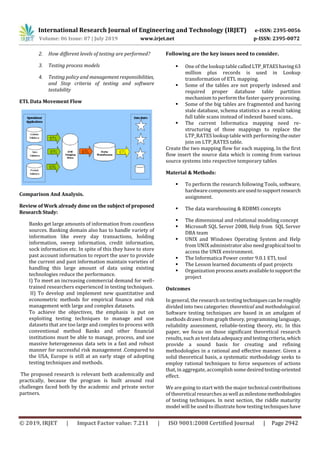
ETL Data Movement Flow
Comparison And Analysis.
Review of Work already done on the subject of proposed
Research Study:
Banks get large amounts of information from countless
sources. Banking domain also has to handle variety of
information like every day transactions, holding
information, sweep information, credit information,
sock information etc. In spite of this they have to store
past account information to report the user to provide
the current and past information maintain varieties of
handling this large amount of data using existing
technologies reduce the performance.
I) To meet an increasing commercial demand for well-
trained researchers experienced in testing techniques.
II) To develop and implement new quantitative and
econometric methods for empirical finance and risk
management with large and complex datasets.
To achieve the objectives, the emphasis is put on
exploiting testing techniques to manage and use
datasets that are too large and complex to process with
conventional method Banks and other financial
institutions must be able to manage, process, and use
massive heterogeneous data sets in a fast and robust
manner for successful risk management .Compared to
the USA, Europe is still at an early stage of adopting
testing techniques and methods.
The proposed research is relevant both academically and
practically, because the program is built around real
challenges faced both by the academic and private sector
partners.
Following are the key issues need to consider.
 One of the lookup table calledLTP_RTAEShaving63
million plus records is used in Lookup
transformation of ETL mapping.
 Some of the tables are not properly indexed and
required proper database table partition
mechanism to perform the faster query processing.
 Some of the big tables are fragmented and having
stale database, schema statistics as a result taking
full table scans instead of indexed based scans..
 The current Informatica mapping need re-
structuring of those mappings to replace the
LTP_RATES lookup table with performing theouter
join on LTP_RATES table.
Create the two mapping flow for each mapping, In the first
flow insert the source data which is coming from various
source systems into respective temporary tables
Material & Methods:
 To perform the research following Tools, software,
hardware components areusedtosupportresearch
assignment.
 The data warehousing & RDBMS concepts
 The dimensional and relational modeling concept
 Microsoft SQL Server 2008, Help from SQL Server
DBA team
 UNIX and Windows Operating System and Help
from UNIX administrator also needgraphical tool to
access the UNIX environment.
 The Informatica Power center 9.0.1 ETL tool
 The Lesson learned documents of past projects
 Organization process assetsavailableto supportthe
project
Outcomes
In general, the research on testing techniquescanberoughly
divided into two categories: theoretical and methodological.
Software testing techniques are based in an amalgam of
methods drawn from graph theory, programming language,
reliability assessment, reliable-testing theory, etc. In this
paper, we focus on those significant theoretical research
results, such as test data adequacyandtestingcriteria,which
provide a sound basis for creating and refining
methodologies in a rational and effective manner. Given a
solid theoretical basis, a systematic methodology seeks to
employ rational techniques to force sequences of actions
that, in aggregate, accomplish some desiredtesting-oriented
effect.
We are going to start with the major technical contributions
of theoretical researches as well asmilestonemethodologies
of testing techniques. In next section, the riddle maturity
model will be used to illustrate how testing techniques have
International Research Journal of Engineering and Technology (IRJET) e-ISSN: 2395-0056
Volume: 06 Issue: 07 | July 2019 www.irjet.net p-ISSN: 2395-0072
© 2019, IRJET | Impact Factor value: 7.211 | ISO 9001:2008 Certified Journal | Page 2943
matured from an intuitive, ad hoc collection of methods into
an Integrated, systematic discipline.
Conclusions
Testing has been widely used as a way to help engineers
develop high-quality systems, and the techniques fortesting
have evolved from ad hoc activities means of small group of
programmers to an organized discipline in software
engineering. However, the maturation of testing techniques
has been fruitful, but not adequate. Pressure to produce
higher-quality software at lower cost is increasing and
existing techniques used in practiceare notsufficientforthis
purpose. Fundamental research that addresses the
challenging problems, development of methods and tools,
and empirical studies should be carried out so that we can
expect significant improvement in the way we test software.
Researchers should demonstrate the effectiveness of many
existing techniques for large industrial software, thus
facilitating transfer of these techniques to practice. The
successful use of these techniques in industrial software
development will validate the results of the research and
drive future research. The pervasive use of software and the
increased cost of validating it will motivate the creation of
partnerships between industry and researchers to develop
new techniques and facilitate their transfer to practice.
Development of efficient testing techniques and tools that
will assist in the creation of high-quality software will
become one of the most important researchareasinthe near
future.
The ultimate goal of software testing is to help designers,
developers, and managers construct systems with high
quality. Thus research and development on testing aim at
efficiently performing effective testing – to find more errors
in requirement, design and implementation, and to increase
confidence that the software has various qualities.
References
[1] Chinta Someswara Rao, J Rajanikanth, V Chandra Sekhar,
Bhadri Raju MSVS (2012) “Data Cleaning Framework for
Robust Data Quality in Enterprise Data Warehouse”,IJCSTe-
ISSN: 0976-8491 p. ISSN: 2229-4333, Vol. 3, Issue 3, pp. 36-
41
[2] K. Srikanth, n.v.e.s Murthy, J. Anitha (2013) “Data
Warehousing Concept Using etl Process For scd Type-3”
International Journal of Emerging Trends & Technology in
Computer Science (ijettcs) Issn: 2276-6856, Vol. 2, Issue 5,
pp. 142-145.
[3] Kabiri A.; Chiadmi D. (2013) “Survey on ETL Processes”,
Journal of Theoretical and Applied Information Technology.
Vol. 54, No. 2
[4] P andey K.Rahul (2014). Data Quality in Data warehouse:
problems and solution.IOSR-Journal Of Computer
Engineering, Volume 16, Issue 1, pp. 18-24.
[5] Rahm, E., Do, H.H. (2000). Data Cleaning: Problems and
Current Approaches. IEEE Data Engineering Bull. Vol 23 No.
4, pp. 3-13
[6] Rodi´c J.; Baranovi´c M. (2009) “Generating Data Quality
Rules and Integration into ETL Process”, DOLAP’09 ACM
[7] Sakshi Agarwal ‘Reasons of Data Quality ProblemsinData
Warehousing’ International Journal of Computer,
Information Technology &Bioinformatics(ijcitb)issn:2278-
7593, Volume-1, Issue-4 ieee & ieee Computational
Intelligence Society, 2013.
[8] Saravanan p. (2014) “An Iterative Estimator for
Predicting the Heterogeneous Data Sets”, Weekly Science
Research Journal issn: 2321-7871, Volume 1, Issue27,pp. 1-
15.

IRJET- Testing Improvement in Business Intelligence Area

  • 1.
    International Research Journalof Engineering and Technology (IRJET) e-ISSN: 2395-0056 Volume: 06 Issue: 07 | July 2019 www.irjet.net p-ISSN: 2395-0072 © 2019, IRJET | Impact Factor value: 7.211 | ISO 9001:2008 Certified Journal | Page 2941 Testing Improvement in Business Intelligence Area Sani Kumar1, Dr. Hari Om Sharan2 1(Research Scholar), Department Computer Science & Engineering Rama University, Kanpur 209217, India 2(Associate Professor), Department Computer Science & Engineering Rama University, Kanpur 209217, India -------------------------------------------------------------------------***------------------------------------------------------------------------ Abstract - In present, testing techniques have gradually involved from the practice of single programmers or small development teams into a systematic, managed engineering discipline. Not only have there been numerous researches on testing techniques, but also more and more considerable industry practices. There are testing classes taught in universities. There have been special testing teams, test managers, and tester job positions open to professional testers; there have been training programs and complete procedures for testing in large enterprises; and there are increasing number of companies and vendors doing testing work for other companies. However, despite the numerous research results (quite a lotof them are really sound) testing remains an awkward, time - consuming, cost-ineffective chunk of work that is always not very satisfying in most industry practices. Onlyasmallnumber of the research results have been utilized successfully in industry practices so that the test process can be greatly improved or automated. The mostcommon testingexercisesin industry are static analysis including code inspections, peer reviews, walkthroughs. Not enough testing tools can be applied directly on industry projects and products without being largely modified and even re-developed. Test plans are still written by hand, while test environment remained simple and crude. This inconsistency of testing research and practice has been called the “testing gap.” Fundamental researches in techniques need to:  Demonstrate effectiveness of existing techniques  Address the need in new areas  Create new adaptive techniques  Facilitate transferring technology to industry General Terms: Data warehousing, data cleansing, quality data, dirty data Keywords: Data inconsistency, identification of errors, organization growth, ETL, data quality Introduction Let’s takes the example of the Amazon retail store. The offices of that store present in many country let’s say India, USA, Australia and the data regarding all of these store can be present in any of the formats, can be present with textfile within the database within the CSV file, XML file or within the database. It can be stored SQL server format within oracle or within mysql. Now if the data we have for each and every country. Now the things is we may ask the question which of the country is having the maximum sales and what is the total number of laptop that are being sold or many more questions can be asked. This question when we will answer such question is called as unanswered so the unanswered one is going to do answer that collected data. How we can do that because we have different different variety of files the variety of source file so now for that we need the ETL. Here comes to ETL in the picture lie we have files, we have the DBMS, we have the OLAPS. Now from all of these source files what we will do we will pass this data to the target database or we call this as the target data ware house. It comes under the process ETL. So first letter of ETL is E that is for the extraction that is fetch data from different different sources and the second process is the transformation. Transformation means to make some changes according to business requirements like if I take some example in the month of January in the last year which of the product is being sold maximum so we have the transformation rule. We want the filter condition on the basis of the month filter on the month of January so this is one of the filter condition that cones under the transformation and the third process comes under ETL Loading so in the end we load our data to thetargetdatabase and within ETL we call the target database as the Data ware house. In this paper, we focus on the technology maturation of testing techniques, including these functional andstructural techniques that have been influential in the academic world and widely used in practice. We are going to examine the growth and propagationofthemostestablishedstrategy and methodology used to Select test cases and analyses test results. Research in software testing techniques can be roughly divided into two branches: theoretical and methodological, andthe growth in both branches pushes the growth of testing technology together. Inhibitors of maturation, which explains why the in-depth research hasn’t broughtrevolutionaryadvantagein industry testing practice, are also within our scope of interest. There are many other interesting areas in software testing. We limit the scope of our study within the range of testing techniques, although some of the areas maybe inseparable from our study. Specifically, we are not going to discuss: 1. How testing is involved in the software development cycle?
  • 2.
    International Research Journalof Engineering and Technology (IRJET) e-ISSN: 2395-0056 Volume: 06 Issue: 07 | July 2019 www.irjet.net p-ISSN: 2395-0072 © 2019, IRJET | Impact Factor value: 7.211 | ISO 9001:2008 Certified Journal | Page 2942 2. How different levels of testing are performed? 3. Testing process models 4. Testing policy and management responsibilities, and Stop criteria of testing and software testability ETL Data Movement Flow Comparison And Analysis. Review of Work already done on the subject of proposed Research Study: Banks get large amounts of information from countless sources. Banking domain also has to handle variety of information like every day transactions, holding information, sweep information, credit information, sock information etc. In spite of this they have to store past account information to report the user to provide the current and past information maintain varieties of handling this large amount of data using existing technologies reduce the performance. I) To meet an increasing commercial demand for well- trained researchers experienced in testing techniques. II) To develop and implement new quantitative and econometric methods for empirical finance and risk management with large and complex datasets. To achieve the objectives, the emphasis is put on exploiting testing techniques to manage and use datasets that are too large and complex to process with conventional method Banks and other financial institutions must be able to manage, process, and use massive heterogeneous data sets in a fast and robust manner for successful risk management .Compared to the USA, Europe is still at an early stage of adopting testing techniques and methods. The proposed research is relevant both academically and practically, because the program is built around real challenges faced both by the academic and private sector partners. Following are the key issues need to consider.  One of the lookup table calledLTP_RTAEShaving63 million plus records is used in Lookup transformation of ETL mapping.  Some of the tables are not properly indexed and required proper database table partition mechanism to perform the faster query processing.  Some of the big tables are fragmented and having stale database, schema statistics as a result taking full table scans instead of indexed based scans..  The current Informatica mapping need re- structuring of those mappings to replace the LTP_RATES lookup table with performing theouter join on LTP_RATES table. Create the two mapping flow for each mapping, In the first flow insert the source data which is coming from various source systems into respective temporary tables Material & Methods:  To perform the research following Tools, software, hardware components areusedtosupportresearch assignment.  The data warehousing & RDBMS concepts  The dimensional and relational modeling concept  Microsoft SQL Server 2008, Help from SQL Server DBA team  UNIX and Windows Operating System and Help from UNIX administrator also needgraphical tool to access the UNIX environment.  The Informatica Power center 9.0.1 ETL tool  The Lesson learned documents of past projects  Organization process assetsavailableto supportthe project Outcomes In general, the research on testing techniquescanberoughly divided into two categories: theoretical and methodological. Software testing techniques are based in an amalgam of methods drawn from graph theory, programming language, reliability assessment, reliable-testing theory, etc. In this paper, we focus on those significant theoretical research results, such as test data adequacyandtestingcriteria,which provide a sound basis for creating and refining methodologies in a rational and effective manner. Given a solid theoretical basis, a systematic methodology seeks to employ rational techniques to force sequences of actions that, in aggregate, accomplish some desiredtesting-oriented effect. We are going to start with the major technical contributions of theoretical researches as well asmilestonemethodologies of testing techniques. In next section, the riddle maturity model will be used to illustrate how testing techniques have
  • 3.
    International Research Journalof Engineering and Technology (IRJET) e-ISSN: 2395-0056 Volume: 06 Issue: 07 | July 2019 www.irjet.net p-ISSN: 2395-0072 © 2019, IRJET | Impact Factor value: 7.211 | ISO 9001:2008 Certified Journal | Page 2943 matured from an intuitive, ad hoc collection of methods into an Integrated, systematic discipline. Conclusions Testing has been widely used as a way to help engineers develop high-quality systems, and the techniques fortesting have evolved from ad hoc activities means of small group of programmers to an organized discipline in software engineering. However, the maturation of testing techniques has been fruitful, but not adequate. Pressure to produce higher-quality software at lower cost is increasing and existing techniques used in practiceare notsufficientforthis purpose. Fundamental research that addresses the challenging problems, development of methods and tools, and empirical studies should be carried out so that we can expect significant improvement in the way we test software. Researchers should demonstrate the effectiveness of many existing techniques for large industrial software, thus facilitating transfer of these techniques to practice. The successful use of these techniques in industrial software development will validate the results of the research and drive future research. The pervasive use of software and the increased cost of validating it will motivate the creation of partnerships between industry and researchers to develop new techniques and facilitate their transfer to practice. Development of efficient testing techniques and tools that will assist in the creation of high-quality software will become one of the most important researchareasinthe near future. The ultimate goal of software testing is to help designers, developers, and managers construct systems with high quality. Thus research and development on testing aim at efficiently performing effective testing – to find more errors in requirement, design and implementation, and to increase confidence that the software has various qualities. References [1] Chinta Someswara Rao, J Rajanikanth, V Chandra Sekhar, Bhadri Raju MSVS (2012) “Data Cleaning Framework for Robust Data Quality in Enterprise Data Warehouse”,IJCSTe- ISSN: 0976-8491 p. ISSN: 2229-4333, Vol. 3, Issue 3, pp. 36- 41 [2] K. Srikanth, n.v.e.s Murthy, J. Anitha (2013) “Data Warehousing Concept Using etl Process For scd Type-3” International Journal of Emerging Trends & Technology in Computer Science (ijettcs) Issn: 2276-6856, Vol. 2, Issue 5, pp. 142-145. [3] Kabiri A.; Chiadmi D. (2013) “Survey on ETL Processes”, Journal of Theoretical and Applied Information Technology. Vol. 54, No. 2 [4] P andey K.Rahul (2014). Data Quality in Data warehouse: problems and solution.IOSR-Journal Of Computer Engineering, Volume 16, Issue 1, pp. 18-24. [5] Rahm, E., Do, H.H. (2000). Data Cleaning: Problems and Current Approaches. IEEE Data Engineering Bull. Vol 23 No. 4, pp. 3-13 [6] Rodi´c J.; Baranovi´c M. (2009) “Generating Data Quality Rules and Integration into ETL Process”, DOLAP’09 ACM [7] Sakshi Agarwal ‘Reasons of Data Quality ProblemsinData Warehousing’ International Journal of Computer, Information Technology &Bioinformatics(ijcitb)issn:2278- 7593, Volume-1, Issue-4 ieee & ieee Computational Intelligence Society, 2013. [8] Saravanan p. (2014) “An Iterative Estimator for Predicting the Heterogeneous Data Sets”, Weekly Science Research Journal issn: 2321-7871, Volume 1, Issue27,pp. 1- 15.