Towards a viable partnership for citizen-centred and driven rural development | Page 1
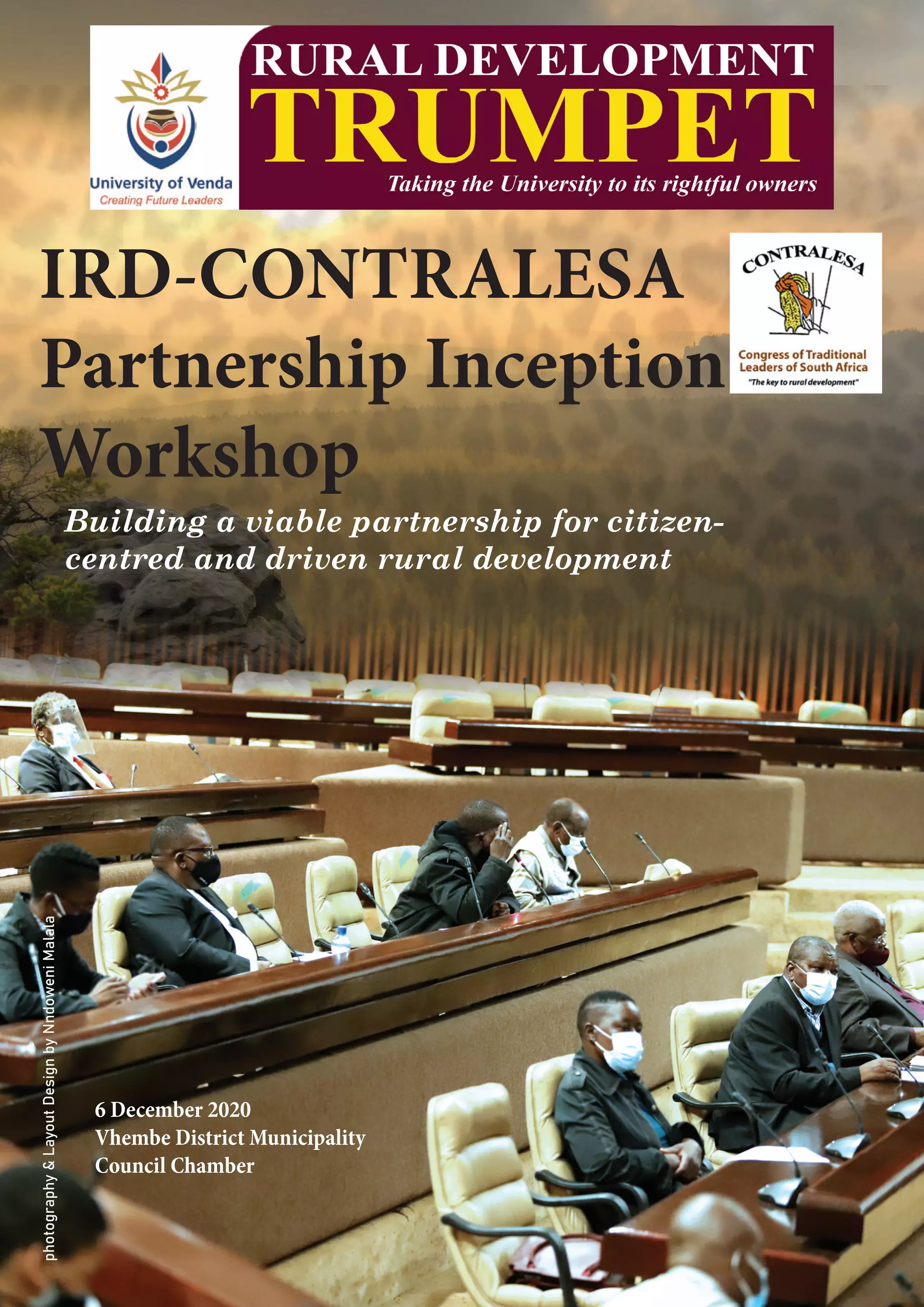
Building a viable partnership for citizen-
centred and driven rural development
IRD-CONTRALESA
Partnership Inception
Workshop
6 December 2020
Vhembe District Municipality
Council Chamber
photography&LayoutDesignbyNndoweniMalala
Towards a viable partnership for citizen-centred and driven rural development | Page 2
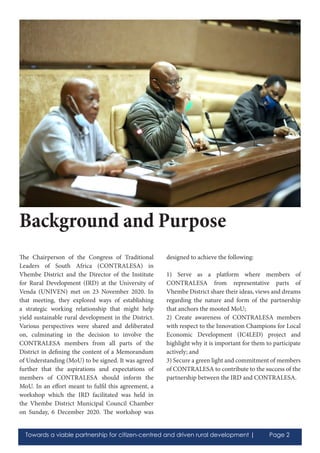
The Chairperson of the Congress of Traditional
Leaders of South Africa (CONTRALESA) in
Vhembe District and the Director of the Institute
for Rural Development (IRD) at the University of
Venda (UNIVEN) met on 23 November 2020. In
that meeting, they explored ways of establishing
a strategic working relationship that might help
yield sustainable rural development in the District.
Various perspectives were shared and deliberated
on, culminating in the decision to involve the
CONTRALESA members from all parts of the
District in defining the content of a Memorandum
of Understanding (MoU) to be signed. It was agreed
further that the aspirations and expectations of
members of CONTRALESA should inform the
MoU. In an effort meant to fulfil this agreement, a
workshop which the IRD facilitated was held in
the Vhembe District Municipal Council Chamber
on Sunday, 6 December 2020. The workshop was
designed to achieve the following:
1) Serve as a platform where members of
CONTRALESA from representative parts of
Vhembe District share their ideas, views and dreams
regarding the nature and form of the partnership
that anchors the mooted MoU;
2) Create awareness of CONTRALESA members
with respect to the Innovation Champions for Local
Economic Development (IC4LED) project and
highlight why it is important for them to participate
actively; and
3) Secure a green light and commitment of members
of CONTRALESA to contribute to the success of the
partnership between the IRD and CONTRALESA.
Background and Purpose
Towards a viable partnership for citizen-centred and driven rural development | Page 3
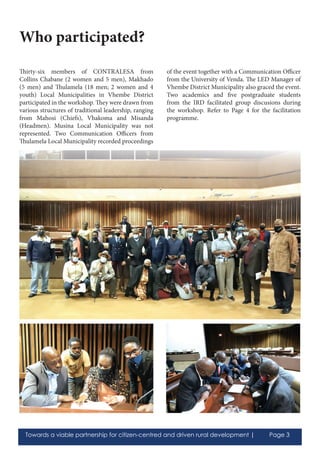
Thirty-six members of CONTRALESA from
Collins Chabane (2 women and 5 men), Makhado
(5 men) and Thulamela (18 men; 2 women and 4
youth) Local Municipalities in Vhembe District
participated in the workshop. They were drawn from
various structures of traditional leadership, ranging
from Mahosi (Chiefs), Vhakoma and Misanda
(Headmen). Musina Local Municipality was not
represented. Two Communication Officers from
Thulamela Local Municipality recorded proceedings
of the event together with a Communication Officer
from the University of Venda. The LED Manager of
Vhembe District Municipality also graced the event.
Two academics and five postgraduate students
from the IRD facilitated group discusions during
the workshop. Refer to Page 4 for the facilitation
programme.
Who participated?
Towards a viable partnership for citizen-centred and driven rural development | Page 4
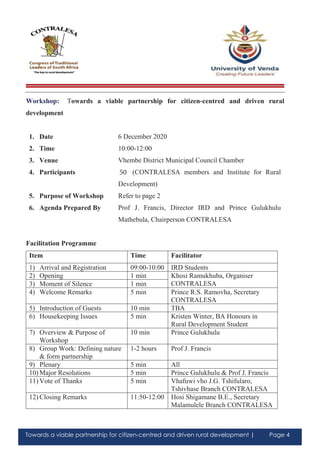
Workshop: Towards a viable partnership for citizen-centred and driven rural
development
1. Date 6 December 2020
2. Time 10:00-12:00
3. Venue Vhembe District Municipal Council Chamber
4. Participants 100 (CONTRALESA members and Institute for Rural
Development)
5. Purpose of Workshop Refer to page 2
6. Agenda Prepared By Prof J. Francis, Director IRD and Prince Gulukhulu
Mathebula, Chairperson CONTRALESA
Facilitation Programme
Item Time Facilitator
1) Arrival and Registration 09:00-10:00 IRD Students
2) Opening 1 min Khosi Ramukhuba, Organiser
CONTRALESA3) Moment of Silence 1 min
4) Welcome Remarks 5 min Prince R.S. Ramovha, Secretary
CONTRALESA
5) Introduction of Guests 10 min TBA
6) Housekeeping Issues 5 min Kristen Winter, BA Honours in
Rural Development Student
7) Overview & Purpose of
Workshop
10 min Prince Gulukhulu
8) Group Work: Defining nature
& form partnership
1-2 hours Prof J. Francis
9) Plenary 5 min All
10) Major Resolutions 5 min Prince Gulukhulu & Prof J. Francis
11) Vote of Thanks 5 min Vhafuwi vho J.G. Tshifularo,
Tshivhase Branch CONTRALESA
12) Closing Remarks 11:50-12:00 Hosi Shigamane B.E., Secretary
Malamulele Branch CONTRALESA
50
Towards a viable partnership for citizen-centred and driven rural development | Page 5
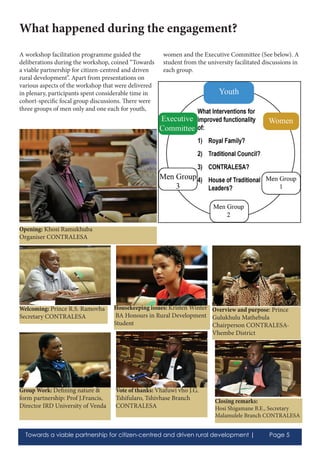
A workshop facilitation programme guided the
deliberations during the workshop, coined “Towards
a viable partnership for citizen-centred and driven
rural development”. Apart from presentations on
various aspects of the workshop that were delivered
in plenary, participants spent considerable time in
cohort-specific focal group discussions. There were
three groups of men only and one each for youth,
women and the Executive Committee (See below). A
student from the university facilitated discussions in
each group.
What happened during the engagement?
Opening: Khosi Ramukhuba
Organiser CONTRALESA
Welcoming: Prince R.S. Ramovha
Secretary CONTRALESA
Housekeeping issues: Kristen Winter
BA Honours in Rural Development
Student
Vote of thanks: Vhafuwi vho J.G.
Tshifularo, Tshivhase Branch
CONTRALESA
Closing remarks:
Hosi Shigamane B.E., Secretary
Malamulele Branch CONTRALESA
Overview and purpose: Prince
Gulukhulu Mathebula
Chairperson CONTRALESA-
Vhembe District
Group Work: Defining nature &
form partnership: Prof J.Francis,
Director IRD University of Venda
Towards a viable partnership for citizen-centred and driven rural development | Page 6
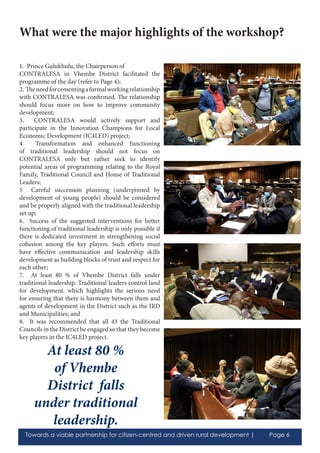
1. Prince Gulukhulu, the Chairperson of
CONTRALESA in Vhembe District facilitated the
programme of the day (refer to Page 4);
2. Theneedforcementingaformalworkingrelationship
with CONTRALESA was confirmed. The relationship
should focus more on how to improve community
development;
3. CONTRALESA would actively support and
participate in the Innovation Champions for Local
Economic Development (IC4LED) project;
4 Transformation and enhanced functioning
of traditional leadership should not focus on
CONTRALESA only but rather seek to identify
potential areas of programming relating to the Royal
Family, Traditional Council and House of Traditional
Leaders;
5 Careful succession planning (underpinned by
development of young people) should be considered
and be properly aligned with the traditional leadership
set up;
6. Success of the suggested interventions for better
functioning of traditional leadership is only possible if
there is dedicated investment in strengthening social
cohesion among the key players. Such efforts must
have effective communication and leadership skills
development as building blocks of trust and respect for
each other;
7. At least 80 % of Vhembe District falls under
traditional leadership. Traditional leaders control land
for development, which highlights the serious need
for ensuring that there is harmony between them and
agents of development in the District such as the IRD
and Municipalities; and
8. It was recommended that all 43 the Traditional
Councils in the District be engaged so that they become
key players in the IC4LED project.
What were the major highlights of the workshop?
At least 80 %
of Vhembe
District falls
under traditional
leadership.
Towards a viable partnership for citizen-centred and driven rural development | Page 7
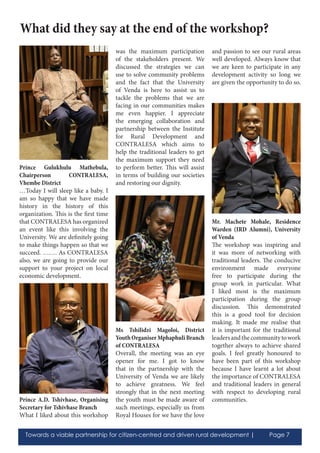
Prince Gulukhulu Mathebula,
Chairperson CONTRALESA,
Vhembe District
…Today I will sleep like a baby. I
am so happy that we have made
history in the history of this
organization. This is the first time
that CONTRALESA has organized
an event like this involving the
University. We are definitely going
to make things happen so that we
succeed. ……. As CONTRALESA
also, we are going to provide our
support to your project on local
economic development.
Prince A.D. Tshivhase, Organising
Secretary for Tshivhase Branch
What I liked about this workshop
was the maximum participation
of the stakeholders present. We
discussed the strategies we can
use to solve community problems
and the fact that the University
of Venda is here to assist us to
tackle the problems that we are
facing in our communities makes
me even happier. I appreciate
the emerging collaboration and
partnership between the Institute
for Rural Development and
CONTRALESA which aims to
help the traditional leaders to get
the maximum support they need
to perform better. This will assist
in terms of building our societies
and restoring our dignity.
Ms Tshilidzi Magoloi, District
Youth Organiser Mphaphuli Branch
of CONTRALESA
Overall, the meeting was an eye
opener for me. I got to know
that in the partnership with the
University of Venda we are likely
to achieve greatness. We feel
strongly that in the next meeting
the youth must be made aware of
such meetings, especially us from
Royal Houses for we have the love
and passion to see our rural areas
well developed. Always know that
we are keen to participate in any
development activity so long we
are given the opportunity to do so.
Mr. Machete Mohale, Residence
Warden (IRD Alumni), University
of Venda
The workshop was inspiring and
it was more of networking with
traditional leaders. The conducive
environment made everyone
free to participate during the
group work in particular. What
I liked most is the maximum
participation during the group
discussion. This demonstrated
this is a good tool for decision
making. It made me realise that
it is important for the traditional
leadersandthecommunitytowork
together always to achieve shared
goals. I feel greatly honoured to
have been part of this workshop
because I have learnt a lot about
the importance of CONTRALESA
and traditional leaders in general
with respect to developing rural
communities.
What did they say at the end of the workshop?
Towards a viable partnership for citizen-centred and driven rural development | Page 8
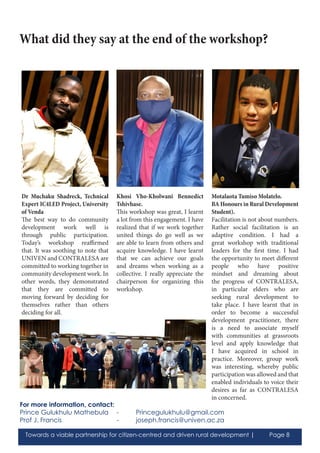
Dr Muchaku Shadreck, Technical
Expert IC4LED Project, University
of Venda
The best way to do community
development work well is
through public participation.
Today’s workshop reaffirmed
that. It was soothing to note that
UNIVEN and CONTRALESA are
committed to working together in
community development work. In
other words, they demonstrated
that they are committed to
moving forward by deciding for
themselves rather than others
deciding for all.
Khosi Vho-Kholwani Bennedict
Tshivhase.
This workshop was great, I learnt
a lot from this engagement. I have
realized that if we work together
united things do go well as we
are able to learn from others and
acquire knowledge. I have learnt
that we can achieve our goals
and dreams when working as a
collective. I really appreciate the
chairperson for organizing this
workshop.
Motalaota Tumiso Molatelo.
BA Honours in Rural Development
Student).
Facilitation is not about numbers.
Rather social facilitation is an
adaptive condition. I had a
great workshop with traditional
leaders for the first time. I had
the opportunity to meet different
people who have positive
mindset and dreaming about
the progress of CONTRALESA,
in particular elders who are
seeking rural development to
take place. I have learnt that in
order to become a successful
development practitioner, there
is a need to associate myself
with communities at grassroots
level and apply knowledge that
I have acquired in school in
practice. Moreover, group work
was interesting, whereby public
participation was allowed and that
enabled individuals to voice their
desires as far as CONTRALESA
in concerned.
What did they say at the end of the workshop?
For more information, contact:
Prince Gulukhulu Mathebula	 - 	 Princegulukhulu@gmail.com
Prof J. Francis			 - 	 joseph.francis@univen.ac.za

IRD-CONTRALESA Workshop Newsletter

  • 1.
    Towards a viablepartnership for citizen-centred and driven rural development | Page 1 Building a viable partnership for citizen- centred and driven rural development IRD-CONTRALESA Partnership Inception Workshop 6 December 2020 Vhembe District Municipality Council Chamber photography&LayoutDesignbyNndoweniMalala
  • 2.
    Towards a viablepartnership for citizen-centred and driven rural development | Page 2 The Chairperson of the Congress of Traditional Leaders of South Africa (CONTRALESA) in Vhembe District and the Director of the Institute for Rural Development (IRD) at the University of Venda (UNIVEN) met on 23 November 2020. In that meeting, they explored ways of establishing a strategic working relationship that might help yield sustainable rural development in the District. Various perspectives were shared and deliberated on, culminating in the decision to involve the CONTRALESA members from all parts of the District in defining the content of a Memorandum of Understanding (MoU) to be signed. It was agreed further that the aspirations and expectations of members of CONTRALESA should inform the MoU. In an effort meant to fulfil this agreement, a workshop which the IRD facilitated was held in the Vhembe District Municipal Council Chamber on Sunday, 6 December 2020. The workshop was designed to achieve the following: 1) Serve as a platform where members of CONTRALESA from representative parts of Vhembe District share their ideas, views and dreams regarding the nature and form of the partnership that anchors the mooted MoU; 2) Create awareness of CONTRALESA members with respect to the Innovation Champions for Local Economic Development (IC4LED) project and highlight why it is important for them to participate actively; and 3) Secure a green light and commitment of members of CONTRALESA to contribute to the success of the partnership between the IRD and CONTRALESA. Background and Purpose
  • 3.
    Towards a viablepartnership for citizen-centred and driven rural development | Page 3 Thirty-six members of CONTRALESA from Collins Chabane (2 women and 5 men), Makhado (5 men) and Thulamela (18 men; 2 women and 4 youth) Local Municipalities in Vhembe District participated in the workshop. They were drawn from various structures of traditional leadership, ranging from Mahosi (Chiefs), Vhakoma and Misanda (Headmen). Musina Local Municipality was not represented. Two Communication Officers from Thulamela Local Municipality recorded proceedings of the event together with a Communication Officer from the University of Venda. The LED Manager of Vhembe District Municipality also graced the event. Two academics and five postgraduate students from the IRD facilitated group discusions during the workshop. Refer to Page 4 for the facilitation programme. Who participated?
  • 4.
    Towards a viablepartnership for citizen-centred and driven rural development | Page 4 Workshop: Towards a viable partnership for citizen-centred and driven rural development 1. Date 6 December 2020 2. Time 10:00-12:00 3. Venue Vhembe District Municipal Council Chamber 4. Participants 100 (CONTRALESA members and Institute for Rural Development) 5. Purpose of Workshop Refer to page 2 6. Agenda Prepared By Prof J. Francis, Director IRD and Prince Gulukhulu Mathebula, Chairperson CONTRALESA Facilitation Programme Item Time Facilitator 1) Arrival and Registration 09:00-10:00 IRD Students 2) Opening 1 min Khosi Ramukhuba, Organiser CONTRALESA3) Moment of Silence 1 min 4) Welcome Remarks 5 min Prince R.S. Ramovha, Secretary CONTRALESA 5) Introduction of Guests 10 min TBA 6) Housekeeping Issues 5 min Kristen Winter, BA Honours in Rural Development Student 7) Overview & Purpose of Workshop 10 min Prince Gulukhulu 8) Group Work: Defining nature & form partnership 1-2 hours Prof J. Francis 9) Plenary 5 min All 10) Major Resolutions 5 min Prince Gulukhulu & Prof J. Francis 11) Vote of Thanks 5 min Vhafuwi vho J.G. Tshifularo, Tshivhase Branch CONTRALESA 12) Closing Remarks 11:50-12:00 Hosi Shigamane B.E., Secretary Malamulele Branch CONTRALESA 50
  • 5.
    Towards a viablepartnership for citizen-centred and driven rural development | Page 5 A workshop facilitation programme guided the deliberations during the workshop, coined “Towards a viable partnership for citizen-centred and driven rural development”. Apart from presentations on various aspects of the workshop that were delivered in plenary, participants spent considerable time in cohort-specific focal group discussions. There were three groups of men only and one each for youth, women and the Executive Committee (See below). A student from the university facilitated discussions in each group. What happened during the engagement? Opening: Khosi Ramukhuba Organiser CONTRALESA Welcoming: Prince R.S. Ramovha Secretary CONTRALESA Housekeeping issues: Kristen Winter BA Honours in Rural Development Student Vote of thanks: Vhafuwi vho J.G. Tshifularo, Tshivhase Branch CONTRALESA Closing remarks: Hosi Shigamane B.E., Secretary Malamulele Branch CONTRALESA Overview and purpose: Prince Gulukhulu Mathebula Chairperson CONTRALESA- Vhembe District Group Work: Defining nature & form partnership: Prof J.Francis, Director IRD University of Venda
  • 6.
    Towards a viablepartnership for citizen-centred and driven rural development | Page 6 1. Prince Gulukhulu, the Chairperson of CONTRALESA in Vhembe District facilitated the programme of the day (refer to Page 4); 2. Theneedforcementingaformalworkingrelationship with CONTRALESA was confirmed. The relationship should focus more on how to improve community development; 3. CONTRALESA would actively support and participate in the Innovation Champions for Local Economic Development (IC4LED) project; 4 Transformation and enhanced functioning of traditional leadership should not focus on CONTRALESA only but rather seek to identify potential areas of programming relating to the Royal Family, Traditional Council and House of Traditional Leaders; 5 Careful succession planning (underpinned by development of young people) should be considered and be properly aligned with the traditional leadership set up; 6. Success of the suggested interventions for better functioning of traditional leadership is only possible if there is dedicated investment in strengthening social cohesion among the key players. Such efforts must have effective communication and leadership skills development as building blocks of trust and respect for each other; 7. At least 80 % of Vhembe District falls under traditional leadership. Traditional leaders control land for development, which highlights the serious need for ensuring that there is harmony between them and agents of development in the District such as the IRD and Municipalities; and 8. It was recommended that all 43 the Traditional Councils in the District be engaged so that they become key players in the IC4LED project. What were the major highlights of the workshop? At least 80 % of Vhembe District falls under traditional leadership.
  • 7.
    Towards a viablepartnership for citizen-centred and driven rural development | Page 7 Prince Gulukhulu Mathebula, Chairperson CONTRALESA, Vhembe District …Today I will sleep like a baby. I am so happy that we have made history in the history of this organization. This is the first time that CONTRALESA has organized an event like this involving the University. We are definitely going to make things happen so that we succeed. ……. As CONTRALESA also, we are going to provide our support to your project on local economic development. Prince A.D. Tshivhase, Organising Secretary for Tshivhase Branch What I liked about this workshop was the maximum participation of the stakeholders present. We discussed the strategies we can use to solve community problems and the fact that the University of Venda is here to assist us to tackle the problems that we are facing in our communities makes me even happier. I appreciate the emerging collaboration and partnership between the Institute for Rural Development and CONTRALESA which aims to help the traditional leaders to get the maximum support they need to perform better. This will assist in terms of building our societies and restoring our dignity. Ms Tshilidzi Magoloi, District Youth Organiser Mphaphuli Branch of CONTRALESA Overall, the meeting was an eye opener for me. I got to know that in the partnership with the University of Venda we are likely to achieve greatness. We feel strongly that in the next meeting the youth must be made aware of such meetings, especially us from Royal Houses for we have the love and passion to see our rural areas well developed. Always know that we are keen to participate in any development activity so long we are given the opportunity to do so. Mr. Machete Mohale, Residence Warden (IRD Alumni), University of Venda The workshop was inspiring and it was more of networking with traditional leaders. The conducive environment made everyone free to participate during the group work in particular. What I liked most is the maximum participation during the group discussion. This demonstrated this is a good tool for decision making. It made me realise that it is important for the traditional leadersandthecommunitytowork together always to achieve shared goals. I feel greatly honoured to have been part of this workshop because I have learnt a lot about the importance of CONTRALESA and traditional leaders in general with respect to developing rural communities. What did they say at the end of the workshop?
  • 8.
    Towards a viablepartnership for citizen-centred and driven rural development | Page 8 Dr Muchaku Shadreck, Technical Expert IC4LED Project, University of Venda The best way to do community development work well is through public participation. Today’s workshop reaffirmed that. It was soothing to note that UNIVEN and CONTRALESA are committed to working together in community development work. In other words, they demonstrated that they are committed to moving forward by deciding for themselves rather than others deciding for all. Khosi Vho-Kholwani Bennedict Tshivhase. This workshop was great, I learnt a lot from this engagement. I have realized that if we work together united things do go well as we are able to learn from others and acquire knowledge. I have learnt that we can achieve our goals and dreams when working as a collective. I really appreciate the chairperson for organizing this workshop. Motalaota Tumiso Molatelo. BA Honours in Rural Development Student). Facilitation is not about numbers. Rather social facilitation is an adaptive condition. I had a great workshop with traditional leaders for the first time. I had the opportunity to meet different people who have positive mindset and dreaming about the progress of CONTRALESA, in particular elders who are seeking rural development to take place. I have learnt that in order to become a successful development practitioner, there is a need to associate myself with communities at grassroots level and apply knowledge that I have acquired in school in practice. Moreover, group work was interesting, whereby public participation was allowed and that enabled individuals to voice their desires as far as CONTRALESA in concerned. What did they say at the end of the workshop? For more information, contact: Prince Gulukhulu Mathebula - Princegulukhulu@gmail.com Prof J. Francis - joseph.francis@univen.ac.za