Industrial relations- Overview Concept of IR means-the relationship between employees & the mgmt in the day-to-day working of the industry.  IR is a set of functional interdependence involving historical ,economic social psychological, demographic, technological, occupational, political &legal variables. .  IR is a whole field relationship that exists because of the necessary collaboration of men & women in the employment process of an industry
Overview  contd IR are the relations mainly between employer & employees. IR are the outcome of the practice of HRM & employee relations. The relations emphasis on accommodating other party’s interest , values, needs. IR are governed by the system of rules & regulations concerning work, work place, &working community.
Overview contd. The main purpose of IR is to maintain harmonious relations between employer & employees by solving their problems through grievance procedure &collective bargaining. The govt., influences & shapes industrial relations policies, rules, agreements, mediation, awards, acts etc. Trade unions influence & shape the IRs through collective bargaining.
Characteristics of IR IRs are outcome of employment relationship in an industrial enterprise. IRs develop the skills & methods of adjusting to & cooperating with each other. IRS creates  complex set of rules 7 regulations to maintain harmonious relations. The govt., involves to shape IRS through laws, rules, agreements, awards, etc. The important factors of IRS are: employees & their organizations, employer & their associations & govt,.
Features of industrial work . The industry is the association of large number of workers, supervisors, managerial personnel , consultants, & other stake holders.  Large scale industrialization needs highly specialized HR with diversified skills & dynamic talent. The industrial work reduces workers dependence. The large scale & developed industries resort to tall organizations which reflects centralization of authority & responsibility The workers new to the industry find it difficult to follow rules & regulations therefore are more disciplined.
Features contd. The industrial jobs are insecure due to change in production process, technological changes & consequent downsizing’ Wage & salary are main factors to attract workers & skill & abilities are the main factors to get suitable job. Industrial employment is mostly based on economic considerations. Employers buy labour & workers sell it.
Factors of industrial relations. Institutional :  govt policy, labour legislations, voluntary courts collective agreement, employee courts, employers’ federation etc,. Economic  Technological Social & cultural. Political. Governmental.
Three actors of Industrial relations. According to John T Dunlop, ‘ Industrial societies necessarily create IRS defined as a complex of interrelations among workers , mgmt, & govt,. Workers & their organisations; Employers & their organisations; Government.
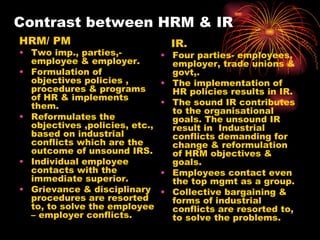
Contrast between HRM & IR HRM/ PM Two imp., parties,-employee & employer. Formulation of objectives policies , procedures & programs of HR & implements them. Reformulates the objectives ,policies, etc., based on industrial conflicts which are the outcome of unsound IRS. Individual employee contacts with the immediate superior. Grievance & disciplinary procedures are resorted to, to solve the employee – employer conflicts.  IR. Four parties- employees, employer, trade unions & govt,. The implementation of HR policies results in IR. The sound IR contributes to the organisational goals. The unsound IR result in  Industrial conflicts demanding for change & reformulation of HRM objectives & goals. Employees contact even the top mgmt as a group. Collective bargaining & forms of industrial conflicts are resorted to, to solve the problems.
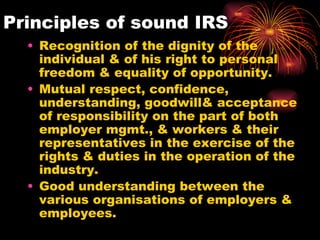
Principles of sound IRS Recognition of the dignity of the individual & of his right to personal freedom & equality of opportunity. Mutual respect, confidence, understanding, goodwill& acceptance of responsibility on the part of both employer mgmt., & workers & their representatives in the exercise of the rights & duties in the operation of the industry. Good understanding between the various organisations of employers & employees.
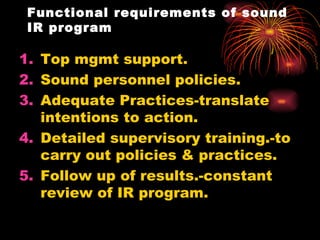
Functional requirements of sound IR program Top mgmt support. Sound personnel policies. Adequate Practices-translate intentions to action. Detailed supervisory training.-to carry out policies & practices. Follow up of results.-constant review of IR program.
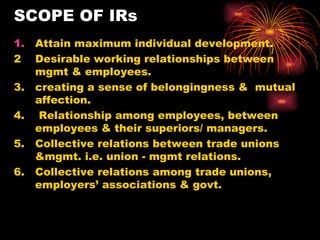
SCOPE OF IRs Attain maximum individual development. 2  Desirable working relationships between mgmt & employees.  3.  creating a sense of belongingness &  mutual affection. 4.  Relationship among employees, between employees & their superiors/ managers. 5.  Collective relations between trade unions &mgmt. i.e. union - mgmt relations. 6.  Collective relations among trade unions, employers’ associations & govt.
functions of IR Establish communications between workers &mgmt to bridge differences. Establishing rapport between managers & managed.  Ensure creative contribution of trade unions to avoid industrial conflicts. To safeguard the interests of workers & mgmt. to avoid unhealthy & unethical practices in the industry. To ensure better workers participation. To promote understanding, creativity &co-operative ness to raise industrial production.
Objectives of IR To promote & develop congenial labour mgmt relations. To enhance economic status of worker. To regulate production. To socialize industries. To provide workers participation in mgmt To improve workers’ strength. To encourage & develop trade unions. To avoid industrial conflict & their consequences. To extend & maintain industrial democracy
ILO  principles for healthy IRs Good labor-mgmt relations depend upon employers’ & trade unions capacity to deal with their mutual problems freely independently & responsibly. Trade unions & employers’ & their organizations should be interested in resolving their problems through collective bargaining process. Workers & employers orgns should take into consideration the general, social, public & economic measures affecting employers’ & workers relations & be willing to associate with govt agencies.
Labor  legislation in India--objectives Protect workers from exploitation. Strengthen IRs. Provide machinery for settling industrial disputes & welfare of workers.
Acts concerning social security & regulation of labour employment. Protective & employment /standards & norms legislation Factories act. Payment of wages act. Minimum wages act. Equal remuneration act. Payment of bonus act Apprentice act. Employment act( compulsory notification of vacancies act.
Social security/welfare & amenities legislation. ESI act-1948 EPF act 1952 Payment of gratuity act 1952 Maternity benefits act Workmen's compensation act.
Regulatory /disputes processing & rights of parties legislation Industrial disputes act1947.-provides for the investigation & settlement of industrial disputes. Industrial employment (standing orders) act 1946.-requiries mgmt to specify the terms & conditions of employment & communicate these to the workers. Trade unions act 1926- is for formation of trade unions.
Definition of collective bargaining   ‘ Collective bargaining’ is coined by Sydney & Beatrice Webb who defined it as a method by which trade unions protected & improved the conditions of their members’ working lives. It is a procedure by which employers & a group of employees agree upon the conditions of work.
Characteristics of collective bargaining It is a group or collective action as opposed to individual actions & is initiated through the representatives of employees. It is flexible& mobile,  & not fixed or static. it is a two party/ way process.-it can succeed only when both labour & mgmt want it to succeed. 4.  it is a continuous process , which provides a mechanism for continuing organized relationships between mgmts & trade unions.
Approaches to IRs Psychological-perceptions of mgmt, unions & workers. 2.  Sociological- problems of conflict & competition due to social factors. 3.  Human relations- freedom of speech ,thought expression, movement & control . 4.  Gandhi an –principles of truth & non-violence.
contd It is dynamic & not static. As this concept is growing ,expanding & changing in view of the attitudes ,opinions & perceptions of both the parties. It ensures democracy at work place. It is not a  competitive process but essentially a complimentary process. It is an art as it is an advanced form of understanding & maintaining human relations. It is voluntary process. The unique feature is that usually the parties concerned start negotiations with entirely divergent views ,interests & reach a middle path acceptable to both.
Importance of collective bargaining It establishes uniform conditions of employment. Secure a prompt & fair redressal of grievances. Avoids interruptions in work-strikes, go-slow tactics. Promotes the  stability of industry. Lays down fair rates of wages & norms of working conditions. Provides a method for regulation of the conditions of employment.
Importance-contd It provides a solution to the problem of industrial sickness. It provides a flexible means of adjusting wages & employment conditions to economic & technological changes. It is the most significant aspect of labour mgmt relations. It builds up a system of jurisprudence by introducing civil rights in industry.
Principles of CB For union & mgmt. CB should be made an educational as well as a bargaining process. The mgmt & trade union must look upon CB as a means of finding the best possible solution. Both parties to the dispute should command the respect of each other & should have enough bargaining power. There must be mutual confidence & good faith,& a desire to make CB an effective practice. There should be an honest, able & responsible leadership. Both parties should abide by both state & central laws. Both parties should ensure that the price of labour is properly adjusted to other prices.
For the mgmt The mgmt should develop & follow a realistic labour policy’ Mgmt should accept the recognize & accept trade union as a constructive force. The mgmt should not assume the good will of the employees. The mgmt should treat the trade union fairly & establish a meaningful relationship. The mgmt should be proactive in solving the grievances of the employees. The mgmt should deal with consequences only one trade union. The social considerations must be taken into account while weighing the economic.
For trade unions Trade unions should avoid racketeering & undemocratic practices. Trade unions should assist the mgmt in improving the quality & quantity of production. They should appreciate the economic implications of their demands in the CB process. They should resort to strikes as a last  method to settle disputes.
Forms of CB Single plant bargaining. Multiple plant bargaining. Multiple employer bargaining. IN India GB is classified into 4 categories. Settlements under Industrial disputes act. Agreements made without reference to board of conciliation. Consent awards. When disputes are sub judice. Agreements drawn after direct negotiations between labour & mgmt which are voluntary in character.
Collective bargaining process. The negotiation stage. Identification of the problem. Preparing for negotiations. Negotiation of agreement. Contract administration stage. Distribute the printed contract throught the organisation. Union takes steps to see that all workers understand the contract & implement it. From time to time both parties make mutually acceptable amendments
Content of collective agreement The purpose of the agreement, its scope & definition of important terms. The rights & responsibilities of the mgmt & trade unions. Wages, bonus, production norms, leave, retiring benefits & other benefits & terms & conditions of service. Grievance redressal procedure. Metnods to be adopted for settlement of future possible disputes. A termination clause.
Factors hindering CB Problems with unions problems from govt. Legal problems. Political interference. Attitude of mgmt.
Suggestions for effective CB A truly representative , enlightened & strong trade union should come into being. There should be a progressive & strong mgmt which is conscious of its obligations & responsibilities to the owners of business, to the employees. To consumers. Unanimity between labour & mgmt on basic objectives of the organisation. When there are several units there should be delegation of authority to local mgmt. a fact finding approach & willingness to use new tools.
Workers participation in management (WPM)- definition Davis-It is a mental & emotional involvement of a person  in a situation which encourages him to contribute to goals & share responsibilities in them. Mamoria- it is a system of communication & consultation either formal or informal by which employees of an organisation are kept informed about the affairs of the undertaking & through which they express their opinion & contribute to management decisions.
Scope of WPM It increases the scope for employee’s share of influence in decision-making at different tiers. It is at different levels. i. shop. ii. Department . & iii. Top level. It incorporates the willing acceptance of responsibilities by body of workers. It is conducted through a mechanism of forums & practices. its broad goal is to change basically the organisational aspect of production & transfer the mgmt function.
Objectives of WPM To promote increased productivity. To provide a better understanding to employees about their role & place in the process of attainment of orgnl goals To satisfy the workers social & esteem needs. To strengthen labour mgmt co-operation & thus maintaining industrial peace. to develop social education for effective solidarity among working community. An ideological point of view to develop self mgmt in industry. An instrument for improving efficiency. To build a dynamic HR. To build the nation through entrepreneurship & economic development.
WPM as a means of motivation It permits a more balanced interaction pattern & therefore results in less resistance to innovation. It permits members of the group to unfreeze their attitudes & engage in catharsis. It permits leaders to reinforce their position. they enhance their status. It enables the subordinate to feel that an exchange relationship is set up . It provides him an opportunity for achievement from work. It  subjects the individual to certain group pressures to implement the decision which the group participated in making.
Essential conditions for successful working of WPM The attitude & outlook of the parties should be enlightened & impartial so that free & frank exchange of thoughts & opinions is possible. Both parties should have genuine faith in the system & in each other & be willing to work together. The experiment of labour participation in mgmt should be given wide publicity.  Participation should be real at all stages & on all issues. Objectives to be achieved must be practical  & clear to all. Participation must work as complimentary body to help collective bargaining, which creates conditions of work & legal relations.
Contd There should be one single strong union .multiple unions should be discouraged. Authority should be centralized through democratic mgmt process. Progressive personnel polices should ensure  growth of individual workers. Mgmt should be prepared to full information connected with the working of the industry & worker should handle it responsibly. The follow up action on the decisions of the participating forums should be ensured. Effective two way communication is a must for the success of the program.
Forms of WPM Working committee.- under the industrial disputes act 1949. functions -- these work committees are consultative bodies. Discussion of conditions of work. Promote measures for securing & preserving amity & good relations between employers & workmen Structure   it has office bearers-president, vice president, secretary &jt. Secretary.
Joint mgmt councils Objectives- To increase the association of employers &employees for cordial IRs. To improve operational efficiency of the workers. To provide welfare facilities to them. To educate workers for better participation . To satisfy the psycological needs of employees.
WPM scheme of 1975 It is part of the 20 point economic program-30 th  oct 1975. Features of the scheme are: All decisions of a shop council & joint council shall be on the edifice of ‘consensus & not by a process of voting.’ It is non statutory like JMCs. ‘ consensus & time bound implementation’ are the tools for arriving at decisions. the scheme provides for workers participation at shop floor level. It provides for a two way communication. the scheme hits at 3 principle objectives-recovery of individual human rights at workplace ,consolidation of social & political freedom,& the framing of new industrial system.
Forms of wpm-contd Joint councils: these are for the whole unit & its membership remains confined to those who are actually engaged in the organisation. Tenure is for 2 years. Meet once in 4 months. Shop councils. Represents each dept., or a shop as aunit. Unit councils. These councils areto eliminate factors which hamper operations & to improve methods of operation.
Reasons for limited success of WPM The inherent conflicts between employees & mgmt. The general belief that workers are inferior to mgmt. The system is mgmt dominated. The view that managers sre averse to share responsibility.
Trade union--definition GDH COLE- an associationof workers in one or more professions-an association  formed on mainly for the purpose of advancing & protecting the members’ economic interests in with their daily work. S d punekar- a union is a continous association of persons in industry-wther employer or independent workers- formed primarily for the purpose of the pursuit of the interests of its members of the trsde they represent.
definition Indian trade union act 1926- any combination whether temporary or permanent formed primarily for the purpose of regulating the relations between workmen & employers or between workmen & workmen, between employers & employers or for imposing restrictive conditions on the conduct of any trade or business &include any federation of two or more trade unions.
Why do workers join trade unions. To attain economic security. To improve their bargaining power & balance it with that of mgmt. To ventilate the workers’ grievances to the mgmt. To inform workers’ views, aims, ideas & dissatisfaction/ frustrations to the mgmt. To secure protection from unexpected economic needs like illiness,accidents, injury etc,. To satisfy their social , psychological & belongingness needs. To secure power.
Characteristics of TU TU can be an association of the employees or employers or of independent workers. TUs are relatively permanent combination of workers. TUs is an association of workers who are engaged in securing economic benefits for their members. TUs origin & growth are influenced by a number of idealogies.
Functions of TUs .- national commission on labour. Tosecure for workers fair wages. To safeguard security of tenure & improve conditions of service. To enlarge opportunities for promotion & training. to improve working & living conditions. Tp provide for educational , cultural & recreational facilities. To cooperate in & facilitate technological advance by broadening the understanding of workers on its underlying issues.
Functions-contd To promote identity of interests of the the workers with their industry. To offer responsive cooperation in improving levels of production & productivity,discipline & high standard of quality. To promote individual & collective welfare. Promotion of national integration. Influencing the socio-economic policies of the community through active participationin their formulation at various levels instilling in their members a sense of responsibility towareds industry & the community.
Functions of TUs- categories. Militant or protective or intra –mural functions- hike inwages, providing benefits,job security etc., through CB & direct action. Fraternal or extra-mural-proving financial & non financial assistence to workers during strikes, lockouts. Medical, educational,recreational &housing facilities.
Categories contd. Social functions: social activities such as educating customers etc,. Political:- affiliating to political parties etc,. Ancillary:- communications , welfare activities, education & research.
Principles to regulate TUs The doctrine of vested interest.- wages & other conditions of employment hithertoenjoyed by any section of workmen ought under no circumstances be interfered with for the worse. The doctrine of supply & demand. Implies that because of collective action unions are able attain their objectives. The doctrine of living wage. The doctrine of partnership The doctrine of socialism. Right ot work, rest & equal pay for equal work.
Union security- national commission on labour. Closed shop is niether practicable nor desirable. Union shop may be feasible. Union security measures should be allowed to evolve as a natural process of trade union growth. An enabling provision to permit check-off facility on demand by a recognized union would be adequate.
Important trade unions. AITUC-all india trade union congress. INTUC- Indian national trade union congress. Hind mazdoor sabha. HMS BMS bharitya mazdoor sangh. CITU centre of indian trade unions.
Methods of achievement of objectives. Method of mutual insurance. Method of collective bargaining Method of legal enactment. Other methods- strikes, gheros, bandhs,etc,.
Advantages of industrial unions They provide a joint facility for collective bargaining. They introduce the measure of uniformity in the principle governing all aspects of service & working conditions, They coordinate sectional claims of different levels & different natures of employees within an industry
Industrial conflict Whenever there are Differences between the goals of separate groups or even several individuals in a group, conflict occurs. The three main groups in an organisation are: Owners  Managers Workers ( unions) These develop different orientations & perceptions of their interests & the pursuit of divergent objectives by each causes friction severe enough to lead to strikes/lockouts.
Occurrence of industrial conflicts Industrial conflicts occur due to the interactions  Within the work organisation-between union leaders & managers. Within the union organisation-between union leaders & workers. Between the work orgn & union orgn represented by the mgmt & union leaders.
Classification of industrial disputes Interest disputes-arise out of deadlocks in negotiations. Grievance disputes-arise out of day-to-day grievances. Unfair labour practices-arise out from interference with the exercise of right to organise, acts etc. Recognition disputes-arise due to recognition of trade union as a bargaining agent.
Manifestations of organised group conflict (union- mgmt)   Of unions Non-co-op Arguments Hostility Stress/tension Unwillingness to negotiate. Resentment Absenteeism/work to rule Demonstration Loss of production  strike Of mgmts Unwillingness to negotiate Termination Demotion Lay-offs lockouts
Manifestation of individual & unorganized conflict. Workers Un-organised with holding of efforts’ Intentional waste & efficiency Labour turnover Absenteeism & complaints. Breaking of rules strikes Management Autocratic supervision Over-strict discipline. Penalties Unnecessary firing Demotion Lay-offs lockouts
Causes of industrial conflicts Economic-wage , bonus, overtime, etc. Political- political instability, various parties, & their affiliations with unions Social- low morale in society, permissiveness, bankruptcy of social values & norms. Technological- unsuitable tech, difficulty in adaptation, resistance to change, fear of unemployment. Psychological-conflict in individual& orgnl objectives, motivational problems, personality & attitude. Market – rising prices & shortages. Legal-inadequacy of legal machinery, injustice etc
Dealing with industrial conflicts. Efforts to remove sources of conflict. Wage admn & proper  production standard. Working methods/conditions review & morale boosting Union –mgmt coop’tion Social security legislation Social control Pressure groups-labour ,mgmt,society. Grievance negotiation arbitration
Categorization of conflict resolution Statutory measures Non statutory measures Govt., sponsored guidelines.
Measures of conflict resolution Code of discipline Tripartite machinery workers participation in mgmt ( various schemes) Collective bargaining scheme.
Measures contd Govt machinery Labour administration machinery-state & central level
Statutory measures I D act 1947 Works committee Conciliation- board & offices Voluntary arbitration Adjudication - labour courts, industrial tribunals, national tribunals. .  State acts like BIFR act etc,.
Differences between arbitration & adjudication Arbitration It is a voluntary method of solving ID. The power to refer an ID to an arbitrator is derived from written agreement between employers &workmen Govt can issue notification concerned to present their case before arbitrator/s Decisions are quasi-judicial but amenable to high courts only Adjudication It is compulsory & is the ultimate remedy for resolving IDs The power to adjudicate is statutory as it is derived from ID act 1947& it is govt that refers to adjudicatory bodies.-labour courts, tribunals etc,. The presiding officers of the bodies are appointed by govt,. The awards are quasi judicial. After they are published in govt gazettes they are amenable to constitutional remedies only
The propensity to strike. The location of worker in society-nature of his work envirnm,his relations with society economic conditions & standard of living. The character of the job & the worker.- determines the kind of workers employed & their attitudes which in turn determines whether there will be an atmosphere of conflict or peace.
Factors leading variations in pattern of conflict propensity The organisation of unions. Technology Maturity of parties. Equality of partners.- strength & bargaining power. Wage rates-low or not consistent

Ir

  • 1.
    Industrial relations- OverviewConcept of IR means-the relationship between employees & the mgmt in the day-to-day working of the industry. IR is a set of functional interdependence involving historical ,economic social psychological, demographic, technological, occupational, political &legal variables. . IR is a whole field relationship that exists because of the necessary collaboration of men & women in the employment process of an industry
  • 2.
    Overview contdIR are the relations mainly between employer & employees. IR are the outcome of the practice of HRM & employee relations. The relations emphasis on accommodating other party’s interest , values, needs. IR are governed by the system of rules & regulations concerning work, work place, &working community.
  • 3.
    Overview contd. Themain purpose of IR is to maintain harmonious relations between employer & employees by solving their problems through grievance procedure &collective bargaining. The govt., influences & shapes industrial relations policies, rules, agreements, mediation, awards, acts etc. Trade unions influence & shape the IRs through collective bargaining.
  • 4.
    Characteristics of IRIRs are outcome of employment relationship in an industrial enterprise. IRs develop the skills & methods of adjusting to & cooperating with each other. IRS creates complex set of rules 7 regulations to maintain harmonious relations. The govt., involves to shape IRS through laws, rules, agreements, awards, etc. The important factors of IRS are: employees & their organizations, employer & their associations & govt,.
  • 5.
    Features of industrialwork . The industry is the association of large number of workers, supervisors, managerial personnel , consultants, & other stake holders. Large scale industrialization needs highly specialized HR with diversified skills & dynamic talent. The industrial work reduces workers dependence. The large scale & developed industries resort to tall organizations which reflects centralization of authority & responsibility The workers new to the industry find it difficult to follow rules & regulations therefore are more disciplined.
  • 6.
    Features contd. Theindustrial jobs are insecure due to change in production process, technological changes & consequent downsizing’ Wage & salary are main factors to attract workers & skill & abilities are the main factors to get suitable job. Industrial employment is mostly based on economic considerations. Employers buy labour & workers sell it.
  • 7.
    Factors of industrialrelations. Institutional : govt policy, labour legislations, voluntary courts collective agreement, employee courts, employers’ federation etc,. Economic Technological Social & cultural. Political. Governmental.
  • 8.
    Three actors ofIndustrial relations. According to John T Dunlop, ‘ Industrial societies necessarily create IRS defined as a complex of interrelations among workers , mgmt, & govt,. Workers & their organisations; Employers & their organisations; Government.
  • 9.
    Contrast between HRM& IR HRM/ PM Two imp., parties,-employee & employer. Formulation of objectives policies , procedures & programs of HR & implements them. Reformulates the objectives ,policies, etc., based on industrial conflicts which are the outcome of unsound IRS. Individual employee contacts with the immediate superior. Grievance & disciplinary procedures are resorted to, to solve the employee – employer conflicts. IR. Four parties- employees, employer, trade unions & govt,. The implementation of HR policies results in IR. The sound IR contributes to the organisational goals. The unsound IR result in Industrial conflicts demanding for change & reformulation of HRM objectives & goals. Employees contact even the top mgmt as a group. Collective bargaining & forms of industrial conflicts are resorted to, to solve the problems.
  • 10.
    Principles of soundIRS Recognition of the dignity of the individual & of his right to personal freedom & equality of opportunity. Mutual respect, confidence, understanding, goodwill& acceptance of responsibility on the part of both employer mgmt., & workers & their representatives in the exercise of the rights & duties in the operation of the industry. Good understanding between the various organisations of employers & employees.
  • 11.
    Functional requirements ofsound IR program Top mgmt support. Sound personnel policies. Adequate Practices-translate intentions to action. Detailed supervisory training.-to carry out policies & practices. Follow up of results.-constant review of IR program.
  • 12.
    SCOPE OF IRsAttain maximum individual development. 2 Desirable working relationships between mgmt & employees. 3. creating a sense of belongingness & mutual affection. 4. Relationship among employees, between employees & their superiors/ managers. 5. Collective relations between trade unions &mgmt. i.e. union - mgmt relations. 6. Collective relations among trade unions, employers’ associations & govt.
  • 13.
    functions of IREstablish communications between workers &mgmt to bridge differences. Establishing rapport between managers & managed. Ensure creative contribution of trade unions to avoid industrial conflicts. To safeguard the interests of workers & mgmt. to avoid unhealthy & unethical practices in the industry. To ensure better workers participation. To promote understanding, creativity &co-operative ness to raise industrial production.
  • 14.
    Objectives of IRTo promote & develop congenial labour mgmt relations. To enhance economic status of worker. To regulate production. To socialize industries. To provide workers participation in mgmt To improve workers’ strength. To encourage & develop trade unions. To avoid industrial conflict & their consequences. To extend & maintain industrial democracy
  • 15.
    ILO principlesfor healthy IRs Good labor-mgmt relations depend upon employers’ & trade unions capacity to deal with their mutual problems freely independently & responsibly. Trade unions & employers’ & their organizations should be interested in resolving their problems through collective bargaining process. Workers & employers orgns should take into consideration the general, social, public & economic measures affecting employers’ & workers relations & be willing to associate with govt agencies.
  • 16.
    Labor legislationin India--objectives Protect workers from exploitation. Strengthen IRs. Provide machinery for settling industrial disputes & welfare of workers.
  • 17.
    Acts concerning socialsecurity & regulation of labour employment. Protective & employment /standards & norms legislation Factories act. Payment of wages act. Minimum wages act. Equal remuneration act. Payment of bonus act Apprentice act. Employment act( compulsory notification of vacancies act.
  • 18.
    Social security/welfare &amenities legislation. ESI act-1948 EPF act 1952 Payment of gratuity act 1952 Maternity benefits act Workmen's compensation act.
  • 19.
    Regulatory /disputes processing& rights of parties legislation Industrial disputes act1947.-provides for the investigation & settlement of industrial disputes. Industrial employment (standing orders) act 1946.-requiries mgmt to specify the terms & conditions of employment & communicate these to the workers. Trade unions act 1926- is for formation of trade unions.
  • 20.
    Definition of collectivebargaining ‘ Collective bargaining’ is coined by Sydney & Beatrice Webb who defined it as a method by which trade unions protected & improved the conditions of their members’ working lives. It is a procedure by which employers & a group of employees agree upon the conditions of work.
  • 21.
    Characteristics of collectivebargaining It is a group or collective action as opposed to individual actions & is initiated through the representatives of employees. It is flexible& mobile, & not fixed or static. it is a two party/ way process.-it can succeed only when both labour & mgmt want it to succeed. 4. it is a continuous process , which provides a mechanism for continuing organized relationships between mgmts & trade unions.
  • 22.
    Approaches to IRsPsychological-perceptions of mgmt, unions & workers. 2. Sociological- problems of conflict & competition due to social factors. 3. Human relations- freedom of speech ,thought expression, movement & control . 4. Gandhi an –principles of truth & non-violence.
  • 23.
    contd It isdynamic & not static. As this concept is growing ,expanding & changing in view of the attitudes ,opinions & perceptions of both the parties. It ensures democracy at work place. It is not a competitive process but essentially a complimentary process. It is an art as it is an advanced form of understanding & maintaining human relations. It is voluntary process. The unique feature is that usually the parties concerned start negotiations with entirely divergent views ,interests & reach a middle path acceptable to both.
  • 24.
    Importance of collectivebargaining It establishes uniform conditions of employment. Secure a prompt & fair redressal of grievances. Avoids interruptions in work-strikes, go-slow tactics. Promotes the stability of industry. Lays down fair rates of wages & norms of working conditions. Provides a method for regulation of the conditions of employment.
  • 25.
    Importance-contd It providesa solution to the problem of industrial sickness. It provides a flexible means of adjusting wages & employment conditions to economic & technological changes. It is the most significant aspect of labour mgmt relations. It builds up a system of jurisprudence by introducing civil rights in industry.
  • 26.
    Principles of CBFor union & mgmt. CB should be made an educational as well as a bargaining process. The mgmt & trade union must look upon CB as a means of finding the best possible solution. Both parties to the dispute should command the respect of each other & should have enough bargaining power. There must be mutual confidence & good faith,& a desire to make CB an effective practice. There should be an honest, able & responsible leadership. Both parties should abide by both state & central laws. Both parties should ensure that the price of labour is properly adjusted to other prices.
  • 27.
    For the mgmtThe mgmt should develop & follow a realistic labour policy’ Mgmt should accept the recognize & accept trade union as a constructive force. The mgmt should not assume the good will of the employees. The mgmt should treat the trade union fairly & establish a meaningful relationship. The mgmt should be proactive in solving the grievances of the employees. The mgmt should deal with consequences only one trade union. The social considerations must be taken into account while weighing the economic.
  • 28.
    For trade unionsTrade unions should avoid racketeering & undemocratic practices. Trade unions should assist the mgmt in improving the quality & quantity of production. They should appreciate the economic implications of their demands in the CB process. They should resort to strikes as a last method to settle disputes.
  • 29.
    Forms of CBSingle plant bargaining. Multiple plant bargaining. Multiple employer bargaining. IN India GB is classified into 4 categories. Settlements under Industrial disputes act. Agreements made without reference to board of conciliation. Consent awards. When disputes are sub judice. Agreements drawn after direct negotiations between labour & mgmt which are voluntary in character.
  • 30.
    Collective bargaining process.The negotiation stage. Identification of the problem. Preparing for negotiations. Negotiation of agreement. Contract administration stage. Distribute the printed contract throught the organisation. Union takes steps to see that all workers understand the contract & implement it. From time to time both parties make mutually acceptable amendments
  • 31.
    Content of collectiveagreement The purpose of the agreement, its scope & definition of important terms. The rights & responsibilities of the mgmt & trade unions. Wages, bonus, production norms, leave, retiring benefits & other benefits & terms & conditions of service. Grievance redressal procedure. Metnods to be adopted for settlement of future possible disputes. A termination clause.
  • 32.
    Factors hindering CBProblems with unions problems from govt. Legal problems. Political interference. Attitude of mgmt.
  • 33.
    Suggestions for effectiveCB A truly representative , enlightened & strong trade union should come into being. There should be a progressive & strong mgmt which is conscious of its obligations & responsibilities to the owners of business, to the employees. To consumers. Unanimity between labour & mgmt on basic objectives of the organisation. When there are several units there should be delegation of authority to local mgmt. a fact finding approach & willingness to use new tools.
  • 34.
    Workers participation inmanagement (WPM)- definition Davis-It is a mental & emotional involvement of a person in a situation which encourages him to contribute to goals & share responsibilities in them. Mamoria- it is a system of communication & consultation either formal or informal by which employees of an organisation are kept informed about the affairs of the undertaking & through which they express their opinion & contribute to management decisions.
  • 35.
    Scope of WPMIt increases the scope for employee’s share of influence in decision-making at different tiers. It is at different levels. i. shop. ii. Department . & iii. Top level. It incorporates the willing acceptance of responsibilities by body of workers. It is conducted through a mechanism of forums & practices. its broad goal is to change basically the organisational aspect of production & transfer the mgmt function.
  • 36.
    Objectives of WPMTo promote increased productivity. To provide a better understanding to employees about their role & place in the process of attainment of orgnl goals To satisfy the workers social & esteem needs. To strengthen labour mgmt co-operation & thus maintaining industrial peace. to develop social education for effective solidarity among working community. An ideological point of view to develop self mgmt in industry. An instrument for improving efficiency. To build a dynamic HR. To build the nation through entrepreneurship & economic development.
  • 37.
    WPM as ameans of motivation It permits a more balanced interaction pattern & therefore results in less resistance to innovation. It permits members of the group to unfreeze their attitudes & engage in catharsis. It permits leaders to reinforce their position. they enhance their status. It enables the subordinate to feel that an exchange relationship is set up . It provides him an opportunity for achievement from work. It subjects the individual to certain group pressures to implement the decision which the group participated in making.
  • 38.
    Essential conditions forsuccessful working of WPM The attitude & outlook of the parties should be enlightened & impartial so that free & frank exchange of thoughts & opinions is possible. Both parties should have genuine faith in the system & in each other & be willing to work together. The experiment of labour participation in mgmt should be given wide publicity. Participation should be real at all stages & on all issues. Objectives to be achieved must be practical & clear to all. Participation must work as complimentary body to help collective bargaining, which creates conditions of work & legal relations.
  • 39.
    Contd There shouldbe one single strong union .multiple unions should be discouraged. Authority should be centralized through democratic mgmt process. Progressive personnel polices should ensure growth of individual workers. Mgmt should be prepared to full information connected with the working of the industry & worker should handle it responsibly. The follow up action on the decisions of the participating forums should be ensured. Effective two way communication is a must for the success of the program.
  • 40.
    Forms of WPMWorking committee.- under the industrial disputes act 1949. functions -- these work committees are consultative bodies. Discussion of conditions of work. Promote measures for securing & preserving amity & good relations between employers & workmen Structure it has office bearers-president, vice president, secretary &jt. Secretary.
  • 41.
    Joint mgmt councilsObjectives- To increase the association of employers &employees for cordial IRs. To improve operational efficiency of the workers. To provide welfare facilities to them. To educate workers for better participation . To satisfy the psycological needs of employees.
  • 42.
    WPM scheme of1975 It is part of the 20 point economic program-30 th oct 1975. Features of the scheme are: All decisions of a shop council & joint council shall be on the edifice of ‘consensus & not by a process of voting.’ It is non statutory like JMCs. ‘ consensus & time bound implementation’ are the tools for arriving at decisions. the scheme provides for workers participation at shop floor level. It provides for a two way communication. the scheme hits at 3 principle objectives-recovery of individual human rights at workplace ,consolidation of social & political freedom,& the framing of new industrial system.
  • 43.
    Forms of wpm-contdJoint councils: these are for the whole unit & its membership remains confined to those who are actually engaged in the organisation. Tenure is for 2 years. Meet once in 4 months. Shop councils. Represents each dept., or a shop as aunit. Unit councils. These councils areto eliminate factors which hamper operations & to improve methods of operation.
  • 44.
    Reasons for limitedsuccess of WPM The inherent conflicts between employees & mgmt. The general belief that workers are inferior to mgmt. The system is mgmt dominated. The view that managers sre averse to share responsibility.
  • 45.
    Trade union--definition GDHCOLE- an associationof workers in one or more professions-an association formed on mainly for the purpose of advancing & protecting the members’ economic interests in with their daily work. S d punekar- a union is a continous association of persons in industry-wther employer or independent workers- formed primarily for the purpose of the pursuit of the interests of its members of the trsde they represent.
  • 46.
    definition Indian tradeunion act 1926- any combination whether temporary or permanent formed primarily for the purpose of regulating the relations between workmen & employers or between workmen & workmen, between employers & employers or for imposing restrictive conditions on the conduct of any trade or business &include any federation of two or more trade unions.
  • 47.
    Why do workersjoin trade unions. To attain economic security. To improve their bargaining power & balance it with that of mgmt. To ventilate the workers’ grievances to the mgmt. To inform workers’ views, aims, ideas & dissatisfaction/ frustrations to the mgmt. To secure protection from unexpected economic needs like illiness,accidents, injury etc,. To satisfy their social , psychological & belongingness needs. To secure power.
  • 48.
    Characteristics of TUTU can be an association of the employees or employers or of independent workers. TUs are relatively permanent combination of workers. TUs is an association of workers who are engaged in securing economic benefits for their members. TUs origin & growth are influenced by a number of idealogies.
  • 49.
    Functions of TUs.- national commission on labour. Tosecure for workers fair wages. To safeguard security of tenure & improve conditions of service. To enlarge opportunities for promotion & training. to improve working & living conditions. Tp provide for educational , cultural & recreational facilities. To cooperate in & facilitate technological advance by broadening the understanding of workers on its underlying issues.
  • 50.
    Functions-contd To promoteidentity of interests of the the workers with their industry. To offer responsive cooperation in improving levels of production & productivity,discipline & high standard of quality. To promote individual & collective welfare. Promotion of national integration. Influencing the socio-economic policies of the community through active participationin their formulation at various levels instilling in their members a sense of responsibility towareds industry & the community.
  • 51.
    Functions of TUs-categories. Militant or protective or intra –mural functions- hike inwages, providing benefits,job security etc., through CB & direct action. Fraternal or extra-mural-proving financial & non financial assistence to workers during strikes, lockouts. Medical, educational,recreational &housing facilities.
  • 52.
    Categories contd. Socialfunctions: social activities such as educating customers etc,. Political:- affiliating to political parties etc,. Ancillary:- communications , welfare activities, education & research.
  • 53.
    Principles to regulateTUs The doctrine of vested interest.- wages & other conditions of employment hithertoenjoyed by any section of workmen ought under no circumstances be interfered with for the worse. The doctrine of supply & demand. Implies that because of collective action unions are able attain their objectives. The doctrine of living wage. The doctrine of partnership The doctrine of socialism. Right ot work, rest & equal pay for equal work.
  • 54.
    Union security- nationalcommission on labour. Closed shop is niether practicable nor desirable. Union shop may be feasible. Union security measures should be allowed to evolve as a natural process of trade union growth. An enabling provision to permit check-off facility on demand by a recognized union would be adequate.
  • 55.
    Important trade unions.AITUC-all india trade union congress. INTUC- Indian national trade union congress. Hind mazdoor sabha. HMS BMS bharitya mazdoor sangh. CITU centre of indian trade unions.
  • 56.
    Methods of achievementof objectives. Method of mutual insurance. Method of collective bargaining Method of legal enactment. Other methods- strikes, gheros, bandhs,etc,.
  • 57.
    Advantages of industrialunions They provide a joint facility for collective bargaining. They introduce the measure of uniformity in the principle governing all aspects of service & working conditions, They coordinate sectional claims of different levels & different natures of employees within an industry
  • 58.
    Industrial conflict Wheneverthere are Differences between the goals of separate groups or even several individuals in a group, conflict occurs. The three main groups in an organisation are: Owners Managers Workers ( unions) These develop different orientations & perceptions of their interests & the pursuit of divergent objectives by each causes friction severe enough to lead to strikes/lockouts.
  • 59.
    Occurrence of industrialconflicts Industrial conflicts occur due to the interactions Within the work organisation-between union leaders & managers. Within the union organisation-between union leaders & workers. Between the work orgn & union orgn represented by the mgmt & union leaders.
  • 60.
    Classification of industrialdisputes Interest disputes-arise out of deadlocks in negotiations. Grievance disputes-arise out of day-to-day grievances. Unfair labour practices-arise out from interference with the exercise of right to organise, acts etc. Recognition disputes-arise due to recognition of trade union as a bargaining agent.
  • 61.
    Manifestations of organisedgroup conflict (union- mgmt) Of unions Non-co-op Arguments Hostility Stress/tension Unwillingness to negotiate. Resentment Absenteeism/work to rule Demonstration Loss of production strike Of mgmts Unwillingness to negotiate Termination Demotion Lay-offs lockouts
  • 62.
    Manifestation of individual& unorganized conflict. Workers Un-organised with holding of efforts’ Intentional waste & efficiency Labour turnover Absenteeism & complaints. Breaking of rules strikes Management Autocratic supervision Over-strict discipline. Penalties Unnecessary firing Demotion Lay-offs lockouts
  • 63.
    Causes of industrialconflicts Economic-wage , bonus, overtime, etc. Political- political instability, various parties, & their affiliations with unions Social- low morale in society, permissiveness, bankruptcy of social values & norms. Technological- unsuitable tech, difficulty in adaptation, resistance to change, fear of unemployment. Psychological-conflict in individual& orgnl objectives, motivational problems, personality & attitude. Market – rising prices & shortages. Legal-inadequacy of legal machinery, injustice etc
  • 64.
    Dealing with industrialconflicts. Efforts to remove sources of conflict. Wage admn & proper production standard. Working methods/conditions review & morale boosting Union –mgmt coop’tion Social security legislation Social control Pressure groups-labour ,mgmt,society. Grievance negotiation arbitration
  • 65.
    Categorization of conflictresolution Statutory measures Non statutory measures Govt., sponsored guidelines.
  • 66.
    Measures of conflictresolution Code of discipline Tripartite machinery workers participation in mgmt ( various schemes) Collective bargaining scheme.
  • 67.
    Measures contd Govtmachinery Labour administration machinery-state & central level
  • 68.
    Statutory measures ID act 1947 Works committee Conciliation- board & offices Voluntary arbitration Adjudication - labour courts, industrial tribunals, national tribunals. . State acts like BIFR act etc,.
  • 69.
    Differences between arbitration& adjudication Arbitration It is a voluntary method of solving ID. The power to refer an ID to an arbitrator is derived from written agreement between employers &workmen Govt can issue notification concerned to present their case before arbitrator/s Decisions are quasi-judicial but amenable to high courts only Adjudication It is compulsory & is the ultimate remedy for resolving IDs The power to adjudicate is statutory as it is derived from ID act 1947& it is govt that refers to adjudicatory bodies.-labour courts, tribunals etc,. The presiding officers of the bodies are appointed by govt,. The awards are quasi judicial. After they are published in govt gazettes they are amenable to constitutional remedies only
  • 70.
    The propensity tostrike. The location of worker in society-nature of his work envirnm,his relations with society economic conditions & standard of living. The character of the job & the worker.- determines the kind of workers employed & their attitudes which in turn determines whether there will be an atmosphere of conflict or peace.
  • 71.
    Factors leading variationsin pattern of conflict propensity The organisation of unions. Technology Maturity of parties. Equality of partners.- strength & bargaining power. Wage rates-low or not consistent