Infection Prevention and Control
Program (IPC)
Dr. Hanan Fathy Abdelaziz
Health Quality specialist
Infection control and patient safety
▸ Patient safety is a global health care challenge.
▸ Present-day IPC experts regard healthcare-associated
infections (HAI) as a critical patient safety issue with
complications that are very often preventable.
2
How Big Is The HAI Problem???
▸ The US Center for Disease Control and Prevention
identifies that nearly 1.7 million Americans develop
hospital-acquired infections each year, and 99,000
die of HAIs annually.
3
Why is there a problem in infection prevention and
control?
▸ Even with the most careful application of IPC guidelines
HAIs may still occur from either:
Commission (doing something wrong that leads to
infection), e.g.,
 using the wrong antiseptic to prepare skin;
 keeping the urinary catheter bag above the patient’s
bladder;
 leaving the IV line longer than it should be
▸ OR
4
Why is there a problem in infection
prevention and control?
Omission (failure to do something right,) e.g.,
 Not performing hand hygiene after removing gloves;
 Not examining the catheter insertion site regularly;
 Not using aseptic technique when inspecting a
dressing over a central line insertion site.
5
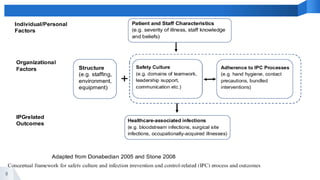
“These errors to be prevented
it needs Leadership
intervention by
IPC program
6
Corner stone of IPC program
Safety Culture
8
Infection Prevention &Control
(IPC) Program
According to WHO facility manual
WHO Facility Manual For IPC Programs
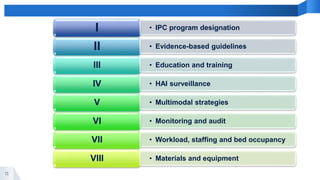
▸ To achieve effective implementation of IPC programs
World Health Organization (WHO) developed guidelines
that address eight (8) core components of IPC
programs.
10
11
• IPC program designation
I
• Evidence-based guidelines
II
• Education and training
III
• HAI surveillance
IV
• Multimodal strategies
V
• Monitoring and audit
VI
• Workload, staffing and bed occupancy
VII
• Materials and equipment
VIII
Core Component I
IPC program designation
What???
▸ Establishment of an IPC program
should be a high priority.
▸ There should be an annual work
plan based on local epidemiology.
▸ Plan should include clearly defined
objectives and measurable
outcome indicators .
▸ Strong and Effective IPC program
lead to more than 30% reduction in
HAI rates and prevent morbidity
and mortality.
13
Who ???
▸ IPC team that includes trained
medical and nursing staff trained
better with a certified IPC course.
▸ IPC committee should include:
facility leadership, senior clinical
staff, leads of other
complementary areas such as
biosafety ,waste management,
etc…
14
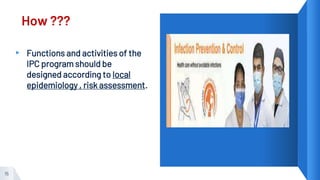
How ???
▸ Functions and activities of the
IPC program should be
designed according to local
epidemiology , risk assessment.
15
Core Component II
Evidence Based IPC Guidelines
What????
▸ The development and/or adaptation of IPC guidelines, is a
key function and pre requisite for an IPC program.
▸ It should be considered as a priority
▸ Guidelines should address key topics related to local
conditions (national guidelines).
17
Evidence Based IPC Guidelines
Who and How ???
▸ Relevant stakeholders (leading doctors, nurses , etc..) should be involved
in the development and adaptation of guidelines.
▸ The development and implementation of guidelines requires to ensure
that local guidelines refer to national evidence based guidelines and
standards.
18
Core Component III
IPC education and training
What ???
▸ IPC education and training is
essential to develop frontline
workforce with IPC basic
competencies. It should be
considered during the
establishment of IPC program
▸ IPC education should utilize
bedside , on job and simulation
training strategies.
20
Who (trainer and trainees)???
▸ Trainer should be IPC expertise
(one of team members)
▸ Three categories with three levels
of training are identified :
 Updates for IPC for specialists
and members of the IPC team.
21
Who (trainer and trainees)???
 Basic IPC for all health care
workers.
 Basic for other personnel that
support health service delivery
(patient family , administrative and
managerial staff, cleaners, etc.)
22
How ???
▸ Training should include written
and/or oral instructions , e-learning
and practical sessions.
▸ Tailored IPC education for patients
and family members e.g, immune
compromised or patients with
invasive devices.
23
Core Component IV
HAI Surveillance
What ???
▸ HAI surveillance should be
performed to identify most
frequent HAI and AMR.
▸ Timely feedback should be
provided to hospital staff and
managers to guide the IPC
interventions.
▸ It should be considered all though
the IPC program
25
Who ???
▸ Responsibility of surveillance is
usually of IPC committee through
the IPC team or those how have
access to medical records.
26
How ???
▸ Prioritization should be done to
determine which HAI (s) to target
for surveillance.
▸ Most common HAI include:
 Surgical site infections.
 Device associated infections.
 Infections in vulnerable
population e.g ICU patients
27
How ???
▸ Reliable case surveillance
definitions should be used with
defined numerator and
denominator
▸ Surveillance reports should be
delivered from IPC team in timely
manner to managerial and
administration level
28
Core Component V
Multimodal Strategies
What ???
▸ Multimodal strategy has critical role in long term IPC
implementation (a strong guideline recommendation).
▸ It should at the start of IPC program by the IPC team.
▸ The WHO multimodal strategy comprises five elements.
▸ Application of 3 or 4 elements of the strategy lead to
successful but short term program.
30
Multimodal Strategies
The WHO multimodal strategy comprises five elements
commonly referred to as:
▸ System change.
▸ Training and education.
▸ Monitoring and feedback.
▸ Communications.
▸ Developing safety culture.
31
Multimodal Strategies
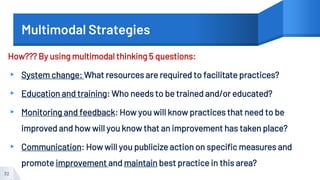
How??? By using multimodal thinking 5 questions:
▸ System change: What resources are required to facilitate practices?
▸ Education and training: Who needs to be trained and/or educated?
▸ Monitoring and feedback: How you will know practices that need to be
improved and how will you know that an improvement has taken place?
▸ Communication: How will you publicize action on specific measures and
promote improvement and maintain best practice in this area?
32
Core Component VI
Monitoring/audit
of IPC practices and feedback
What???
▸ IPC team should regularly audit of
IPC indicators.
▸ Timely feedback should be provided
to all audited personnel.
▸ It should be integrated all through
IPC program.
▸ It should be done in non blaming
manner.
34
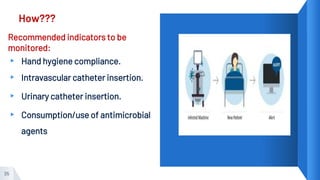
How???
Recommended indicators to be
monitored:
▸ Hand hygiene compliance.
▸ Intravascular catheter insertion.
▸ Urinary catheter insertion.
▸ Consumption/use of antimicrobial
agents
35
Core Component VII
Workload, staffing
and bed occupancy
Workload, Staffing and Bed Occupancy
What ???
▸ Consideration of workload, staffing and bed occupancy issues should be in
initial discussions of senior managers at the start of IPC program.
▸ Bed occupancy should not exceed one patient per bed with adequate spacing
of >1 meter between patient beds . If it exceeds this standard it will lead to
increased risk of HAI.
▸ Hospital staffing levels should be assigned according to patient workload.
37
Core Component VIII
Built environment, materials
and equipment for IPC
What???
▸ It is the responsibility of hospital
leadership that Patient care
activities should be undertaken in
hygienic environment.
▸ This includes all elements in
infrastructure and services, and the
availability of IPC materials and
(PPE).
39
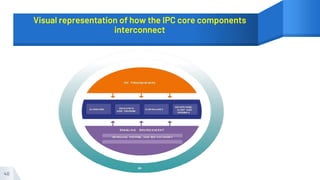
Visual representation of how the IPC core components
interconnect
40
Potential barriers for core
components action plans
Potential barriers for action plan of core component I
(IPC program)
Potential barriers:
▸ IPC program is not priority for
in your organization
Suggested solutions:
▸ Data play a critical role in
convincing leadership to act: “no
data, no problem”.
▸ Focus on structure and process
measures
42
Potential barriers for action plan of core component I
(IPC program)
Potential barriers:
▸ Lack of IPC expertise to
implement an IPC program
Suggested solutions:
▸ Start small – identify at least one person to
lead the IPC program and use on-the-job
training and development of a job description
as a first step. Then build the team step by
step
43
Potential barriers for action plan of core component II
(IPC Guidelines)
Potential barriers:
▸ Limited expertise in Guideline
development
Suggested solutions:
▸ Adopt national or international
guidelines/policies.
▸ Explore if other more advanced facilities
have produced evidence-based guidelines.
44
Potential barriers for action plan of core component II
(IPC Guidelines)
Potential barriers:
▸ Disseminating
and implementing
guidelines
Suggested solutions:
▸ Learn from other facilities or the literature
how to implement guideline.
▸ Involve relevant stake holders in adopting
guidelines and writing policies and
procedures.
45
Potential barriers for action plan of core component III
(IPC Training and Education)
Potential barriers:
▸ Lack of expertise to
train all relevant staff
Suggested solutions:
▸ Consider contracting specialist services to
support training and development
▸ Consider the use of train-the-trainer
approaches
46
Potential barriers for action plan of core component III
(IPC Training and Education)
Potential barriers:
▸ Engaging leaders and
managers in training and
education.
Suggested solutions:
▸ You should convince leadership and senior
managers through relevant statistics.
47
Potential barriers for action plan of core component III
(IPC Training and Education)
Potential barriers:
▸ Lack of time for training (not a
priority)
Suggested solutions:
▸ Consider on-the-job training.
▸ Build IPC into staff orientation.
▸ Include IPC competencies in staff evaluation
48
Potential barriers for action plan of core component IV
(IPC Surveillance )
Potential barriers:
▸ Unsure from where
we should start
Suggested solutions:
▸ Target high risk areas, for example, intensive care
units.
▸ Identify one IPC nurse to visit selected wards
on a daily basis and use surveillance results to build
support.
▸ Focus on more frequent procedures, or infections
that can be easily accessed
49
Potential barriers for action plan of core component IV
(IPC Surveillance )
Potential barriers:
▸ Reliability of
surveillance
Suggested solutions:
▸ Involve people under surveillance in the surveillance
process.
▸ Share with them results and data of surveillance.
▸ Try to implement early small corrective actions
according to surveillance results
50
Potential barriers for action plan of core component IV
(IPC Surveillance )
Potential barriers:
▸ Culture of doubt
Suggested solutions:
▸ Convince the leadership to support safety culture
▸ Give commitment that results of surveillance will not
be considered as part of official evaluation.
▸ Use educating rather than blame behavior
51
Potential barriers for action plan of core component V
(Multimodal Strategies )
Potential barriers:
▸ Lack of understanding
of multimodal
strategies
Suggested solutions:
▸ Describe to managers the critical role that a
multimodal approach has in supporting
implementation and behavior change.
▸ Provide workshops for hospital staff to explain
multimodal strategies and its importance.
▸ Use hand hygiene as an example of what a multimodal
approach means.
52
Potential barriers for action plan of core component VI
(Monitoring , Auditing and Feedback)
Potential barriers:
▸ Securing support
for audit
Suggested solutions:
▸ Explain that monitoring/audit and feedback are key
elements of multimodal improvement strategies and
continuous quality improvement.
▸ Advocate for monitoring and audit to take place as
part of learning culture.
▸ Inform all persons under auditing about monitoring
and auditing activities and publicize results.
53
Potential barriers for action plan of core component VI
(Monitoring , Auditing and Feedback)
Potential barriers:
▸ Audit checklist can be
considered as
routine practice
Suggested solutions:
▸ Consider using different approaches for example,
Focus group discussions; client satisfaction surveys
(patient and staff), patient complaint systems,
patient record reviews; clinical audits, review of
adverse events including accidents and needle stick
injuries.
54
Potential barriers for action plan of core component VII
(Workload , staffing and bed occupancy)
Potential barriers:
▸ Insufficient human
resources.
Suggested solutions:
▸ Consider task sharing.
▸ Convince leadership to hire enough staff according to
needs.
55
Potential barriers for action plan of core component VII
(Workload , staffing and bed occupancy)
Potential barriers:
▸ Demand for beds
exceeds current
capacity
Suggested solutions:
▸ Review of admission and discharge processes.
▸ Use smaller beds whenever possible.
56
Potential barriers for action plan of core component VIII
(Build environment , materials and equipment)
Potential barriers:
▸ Poor compliance (to hand
hygiene , waste disposal
etc…)
Suggested solutions:
▸ Use simple, small scale approach based on a
multimodal approach to enhance compliance.
▸ “(One) hospital has implemented a QIP to increase
waste management compliance. They started using
coloured bin markers to segregate waste at the point
of disposal. Nurses responded well that it makes less
work for them so it is easy to sustain and continue.
57
The Five-step Approach To IPC Improvement Program
How to implement the (8) core components ???
58
Step 1
preparing for
action
Step 2
Base line
assessment
Step 3
Developing
the plan
Step 4
Evaluating
impact
Step 5
Sustaining
the IPC over
long time
The Five-step Approach
To IPC Improvement Program
Step 1. Preparing for action:
▸ This step ensures that all
resources (human and financial)
and pre requisites are in place .
▸ Leadership play a critical role in
this step.
▸ A major part of step 1 will involve
talking to stakeholders.
59
The Five-step Approach
To IPC Improvement Program
Step 1. Preparing for action:
▸ During this step you should
understand all needed human
and financial resources.
▸ Depending on the current situation
in your facility, step 1 may take
months.
60
The Five-step Approach
To IPC Improvement Program
Step 2. Baseline assessment:
Conducting baseline assessment of
the current situation, (SWOT) including
the identification of strengths and
weaknesses, is critical for developing
a tailor-made action plan.
61
The Five-step Approach
To IPC Improvement Program
Step 2. Baseline assessment:
Needed tools:
▸ The IPCAF is a special tool for
measuring the situation of a health
care facility against each core
component recommendations
62
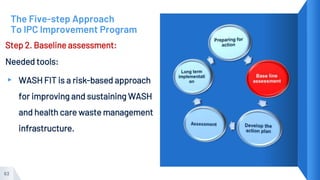
The Five-step Approach
To IPC Improvement Program
Step 2. Baseline assessment:
Needed tools:
▸ WASH FIT is a risk-based approach
for improving and sustaining WASH
and health care waste management
infrastructure.
63
The Five-step Approach
To IPC Improvement Program
Step 3. Developing and executing an
action plan:
▸ Based on baseline assessment
results develop a list of actions,
responsibilities, timelines,
budgets and expertise needed,
and review dates for each core
component to be implemented
64
The Five-step Approach
To IPC Improvement Program
Step 3. Developing an action plan:
▸ You may decide to focus on one
urgent component or more for
initial action.
▸ You can identify core components
that are partially implemented,
to improve its score.
65
The Five-step Approach
To IPC Improvement Program
Step 4. Assessing impact:
▸ Assessment is crucial to determine
the effectiveness of the plan.
▸ 2 Key considerations in this step:
 Analyzing the results.
 Presenting the results and
developing regular schedule of
evaluation.
66
The Five-step Approach
To IPC Improvement Program
Step 5. Sustaining The Program Over
The Long Term:
▸ Based on the information
obtained in step 4 you can now
see clearly where improvements
have been made and where gaps
remain.
67
The Five-step Approach
To IPC Improvement Program
Step 5. Sustaining The Program Over
The Long Term:
▸ Based on the information
obtained in step 4 , Step 5 is
concerned with regularly
reviewing and improving IPC and
ensure that IPC became a critical
part of your health facility.
68
Multimodal Strategy Guiding Questions
69
Priority List your priority
Multimodal
strategy element
Guiding questions Your response to
questions
List all required
actions
System changes
What resources
infrastructures or supplies
needed to improve
this priority area?
-------------------- ------------------
Education
and training
Who needs training?
Who will train?
What will be trained on?
-------------------- ------------------
Monitor and
feedback
How will you know that an
improvement
has taken place (indicators of
success)
-------------------- ------------------
Multimodal Strategy Guiding Questions
70
Priority List your priority
Multimodal
strategy element
Guiding questions Your response to
questions
List all required
actions
Communications
and reminders
How will you publicize action
on specific core components
and promote improvement
and best practice in this
area?
-------------------- ------------------
Safety climate
and culture
change
How will you maintain this as
a priority and engage
senior leaders/managers/
and opinion leaders over
time?
-------------------- ------------------
71
72

infection control program.pptx

  • 1.
    Infection Prevention andControl Program (IPC) Dr. Hanan Fathy Abdelaziz Health Quality specialist
  • 2.
    Infection control andpatient safety ▸ Patient safety is a global health care challenge. ▸ Present-day IPC experts regard healthcare-associated infections (HAI) as a critical patient safety issue with complications that are very often preventable. 2
  • 3.
    How Big IsThe HAI Problem??? ▸ The US Center for Disease Control and Prevention identifies that nearly 1.7 million Americans develop hospital-acquired infections each year, and 99,000 die of HAIs annually. 3
  • 4.
    Why is therea problem in infection prevention and control? ▸ Even with the most careful application of IPC guidelines HAIs may still occur from either: Commission (doing something wrong that leads to infection), e.g.,  using the wrong antiseptic to prepare skin;  keeping the urinary catheter bag above the patient’s bladder;  leaving the IV line longer than it should be ▸ OR 4
  • 5.
    Why is therea problem in infection prevention and control? Omission (failure to do something right,) e.g.,  Not performing hand hygiene after removing gloves;  Not examining the catheter insertion site regularly;  Not using aseptic technique when inspecting a dressing over a central line insertion site. 5
  • 6.
    “These errors tobe prevented it needs Leadership intervention by IPC program 6
  • 7.
    Corner stone ofIPC program Safety Culture
  • 8.
  • 9.
    Infection Prevention &Control (IPC)Program According to WHO facility manual
  • 10.
    WHO Facility ManualFor IPC Programs ▸ To achieve effective implementation of IPC programs World Health Organization (WHO) developed guidelines that address eight (8) core components of IPC programs. 10
  • 11.
    11 • IPC programdesignation I • Evidence-based guidelines II • Education and training III • HAI surveillance IV • Multimodal strategies V • Monitoring and audit VI • Workload, staffing and bed occupancy VII • Materials and equipment VIII
  • 12.
    Core Component I IPCprogram designation
  • 13.
    What??? ▸ Establishment ofan IPC program should be a high priority. ▸ There should be an annual work plan based on local epidemiology. ▸ Plan should include clearly defined objectives and measurable outcome indicators . ▸ Strong and Effective IPC program lead to more than 30% reduction in HAI rates and prevent morbidity and mortality. 13
  • 14.
    Who ??? ▸ IPCteam that includes trained medical and nursing staff trained better with a certified IPC course. ▸ IPC committee should include: facility leadership, senior clinical staff, leads of other complementary areas such as biosafety ,waste management, etc… 14
  • 15.
    How ??? ▸ Functionsand activities of the IPC program should be designed according to local epidemiology , risk assessment. 15
  • 16.
    Core Component II EvidenceBased IPC Guidelines
  • 17.
    Evidence Based IPCGuidelines What???? ▸ The development and/or adaptation of IPC guidelines, is a key function and pre requisite for an IPC program. ▸ It should be considered as a priority ▸ Guidelines should address key topics related to local conditions (national guidelines). 17
  • 18.
    Evidence Based IPCGuidelines Who and How ??? ▸ Relevant stakeholders (leading doctors, nurses , etc..) should be involved in the development and adaptation of guidelines. ▸ The development and implementation of guidelines requires to ensure that local guidelines refer to national evidence based guidelines and standards. 18
  • 19.
    Core Component III IPCeducation and training
  • 20.
    What ??? ▸ IPCeducation and training is essential to develop frontline workforce with IPC basic competencies. It should be considered during the establishment of IPC program ▸ IPC education should utilize bedside , on job and simulation training strategies. 20
  • 21.
    Who (trainer andtrainees)??? ▸ Trainer should be IPC expertise (one of team members) ▸ Three categories with three levels of training are identified :  Updates for IPC for specialists and members of the IPC team. 21
  • 22.
    Who (trainer andtrainees)???  Basic IPC for all health care workers.  Basic for other personnel that support health service delivery (patient family , administrative and managerial staff, cleaners, etc.) 22
  • 23.
    How ??? ▸ Trainingshould include written and/or oral instructions , e-learning and practical sessions. ▸ Tailored IPC education for patients and family members e.g, immune compromised or patients with invasive devices. 23
  • 24.
  • 25.
    What ??? ▸ HAIsurveillance should be performed to identify most frequent HAI and AMR. ▸ Timely feedback should be provided to hospital staff and managers to guide the IPC interventions. ▸ It should be considered all though the IPC program 25
  • 26.
    Who ??? ▸ Responsibilityof surveillance is usually of IPC committee through the IPC team or those how have access to medical records. 26
  • 27.
    How ??? ▸ Prioritizationshould be done to determine which HAI (s) to target for surveillance. ▸ Most common HAI include:  Surgical site infections.  Device associated infections.  Infections in vulnerable population e.g ICU patients 27
  • 28.
    How ??? ▸ Reliablecase surveillance definitions should be used with defined numerator and denominator ▸ Surveillance reports should be delivered from IPC team in timely manner to managerial and administration level 28
  • 29.
  • 30.
    Multimodal Strategies What ??? ▸Multimodal strategy has critical role in long term IPC implementation (a strong guideline recommendation). ▸ It should at the start of IPC program by the IPC team. ▸ The WHO multimodal strategy comprises five elements. ▸ Application of 3 or 4 elements of the strategy lead to successful but short term program. 30
  • 31.
    Multimodal Strategies The WHOmultimodal strategy comprises five elements commonly referred to as: ▸ System change. ▸ Training and education. ▸ Monitoring and feedback. ▸ Communications. ▸ Developing safety culture. 31
  • 32.
    Multimodal Strategies How??? Byusing multimodal thinking 5 questions: ▸ System change: What resources are required to facilitate practices? ▸ Education and training: Who needs to be trained and/or educated? ▸ Monitoring and feedback: How you will know practices that need to be improved and how will you know that an improvement has taken place? ▸ Communication: How will you publicize action on specific measures and promote improvement and maintain best practice in this area? 32
  • 33.
    Core Component VI Monitoring/audit ofIPC practices and feedback
  • 34.
    What??? ▸ IPC teamshould regularly audit of IPC indicators. ▸ Timely feedback should be provided to all audited personnel. ▸ It should be integrated all through IPC program. ▸ It should be done in non blaming manner. 34
  • 35.
    How??? Recommended indicators tobe monitored: ▸ Hand hygiene compliance. ▸ Intravascular catheter insertion. ▸ Urinary catheter insertion. ▸ Consumption/use of antimicrobial agents 35
  • 36.
    Core Component VII Workload,staffing and bed occupancy
  • 37.
    Workload, Staffing andBed Occupancy What ??? ▸ Consideration of workload, staffing and bed occupancy issues should be in initial discussions of senior managers at the start of IPC program. ▸ Bed occupancy should not exceed one patient per bed with adequate spacing of >1 meter between patient beds . If it exceeds this standard it will lead to increased risk of HAI. ▸ Hospital staffing levels should be assigned according to patient workload. 37
  • 38.
    Core Component VIII Builtenvironment, materials and equipment for IPC
  • 39.
    What??? ▸ It isthe responsibility of hospital leadership that Patient care activities should be undertaken in hygienic environment. ▸ This includes all elements in infrastructure and services, and the availability of IPC materials and (PPE). 39
  • 40.
    Visual representation ofhow the IPC core components interconnect 40
  • 41.
    Potential barriers forcore components action plans
  • 42.
    Potential barriers foraction plan of core component I (IPC program) Potential barriers: ▸ IPC program is not priority for in your organization Suggested solutions: ▸ Data play a critical role in convincing leadership to act: “no data, no problem”. ▸ Focus on structure and process measures 42
  • 43.
    Potential barriers foraction plan of core component I (IPC program) Potential barriers: ▸ Lack of IPC expertise to implement an IPC program Suggested solutions: ▸ Start small – identify at least one person to lead the IPC program and use on-the-job training and development of a job description as a first step. Then build the team step by step 43
  • 44.
    Potential barriers foraction plan of core component II (IPC Guidelines) Potential barriers: ▸ Limited expertise in Guideline development Suggested solutions: ▸ Adopt national or international guidelines/policies. ▸ Explore if other more advanced facilities have produced evidence-based guidelines. 44
  • 45.
    Potential barriers foraction plan of core component II (IPC Guidelines) Potential barriers: ▸ Disseminating and implementing guidelines Suggested solutions: ▸ Learn from other facilities or the literature how to implement guideline. ▸ Involve relevant stake holders in adopting guidelines and writing policies and procedures. 45
  • 46.
    Potential barriers foraction plan of core component III (IPC Training and Education) Potential barriers: ▸ Lack of expertise to train all relevant staff Suggested solutions: ▸ Consider contracting specialist services to support training and development ▸ Consider the use of train-the-trainer approaches 46
  • 47.
    Potential barriers foraction plan of core component III (IPC Training and Education) Potential barriers: ▸ Engaging leaders and managers in training and education. Suggested solutions: ▸ You should convince leadership and senior managers through relevant statistics. 47
  • 48.
    Potential barriers foraction plan of core component III (IPC Training and Education) Potential barriers: ▸ Lack of time for training (not a priority) Suggested solutions: ▸ Consider on-the-job training. ▸ Build IPC into staff orientation. ▸ Include IPC competencies in staff evaluation 48
  • 49.
    Potential barriers foraction plan of core component IV (IPC Surveillance ) Potential barriers: ▸ Unsure from where we should start Suggested solutions: ▸ Target high risk areas, for example, intensive care units. ▸ Identify one IPC nurse to visit selected wards on a daily basis and use surveillance results to build support. ▸ Focus on more frequent procedures, or infections that can be easily accessed 49
  • 50.
    Potential barriers foraction plan of core component IV (IPC Surveillance ) Potential barriers: ▸ Reliability of surveillance Suggested solutions: ▸ Involve people under surveillance in the surveillance process. ▸ Share with them results and data of surveillance. ▸ Try to implement early small corrective actions according to surveillance results 50
  • 51.
    Potential barriers foraction plan of core component IV (IPC Surveillance ) Potential barriers: ▸ Culture of doubt Suggested solutions: ▸ Convince the leadership to support safety culture ▸ Give commitment that results of surveillance will not be considered as part of official evaluation. ▸ Use educating rather than blame behavior 51
  • 52.
    Potential barriers foraction plan of core component V (Multimodal Strategies ) Potential barriers: ▸ Lack of understanding of multimodal strategies Suggested solutions: ▸ Describe to managers the critical role that a multimodal approach has in supporting implementation and behavior change. ▸ Provide workshops for hospital staff to explain multimodal strategies and its importance. ▸ Use hand hygiene as an example of what a multimodal approach means. 52
  • 53.
    Potential barriers foraction plan of core component VI (Monitoring , Auditing and Feedback) Potential barriers: ▸ Securing support for audit Suggested solutions: ▸ Explain that monitoring/audit and feedback are key elements of multimodal improvement strategies and continuous quality improvement. ▸ Advocate for monitoring and audit to take place as part of learning culture. ▸ Inform all persons under auditing about monitoring and auditing activities and publicize results. 53
  • 54.
    Potential barriers foraction plan of core component VI (Monitoring , Auditing and Feedback) Potential barriers: ▸ Audit checklist can be considered as routine practice Suggested solutions: ▸ Consider using different approaches for example, Focus group discussions; client satisfaction surveys (patient and staff), patient complaint systems, patient record reviews; clinical audits, review of adverse events including accidents and needle stick injuries. 54
  • 55.
    Potential barriers foraction plan of core component VII (Workload , staffing and bed occupancy) Potential barriers: ▸ Insufficient human resources. Suggested solutions: ▸ Consider task sharing. ▸ Convince leadership to hire enough staff according to needs. 55
  • 56.
    Potential barriers foraction plan of core component VII (Workload , staffing and bed occupancy) Potential barriers: ▸ Demand for beds exceeds current capacity Suggested solutions: ▸ Review of admission and discharge processes. ▸ Use smaller beds whenever possible. 56
  • 57.
    Potential barriers foraction plan of core component VIII (Build environment , materials and equipment) Potential barriers: ▸ Poor compliance (to hand hygiene , waste disposal etc…) Suggested solutions: ▸ Use simple, small scale approach based on a multimodal approach to enhance compliance. ▸ “(One) hospital has implemented a QIP to increase waste management compliance. They started using coloured bin markers to segregate waste at the point of disposal. Nurses responded well that it makes less work for them so it is easy to sustain and continue. 57
  • 58.
    The Five-step ApproachTo IPC Improvement Program How to implement the (8) core components ??? 58 Step 1 preparing for action Step 2 Base line assessment Step 3 Developing the plan Step 4 Evaluating impact Step 5 Sustaining the IPC over long time
  • 59.
    The Five-step Approach ToIPC Improvement Program Step 1. Preparing for action: ▸ This step ensures that all resources (human and financial) and pre requisites are in place . ▸ Leadership play a critical role in this step. ▸ A major part of step 1 will involve talking to stakeholders. 59
  • 60.
    The Five-step Approach ToIPC Improvement Program Step 1. Preparing for action: ▸ During this step you should understand all needed human and financial resources. ▸ Depending on the current situation in your facility, step 1 may take months. 60
  • 61.
    The Five-step Approach ToIPC Improvement Program Step 2. Baseline assessment: Conducting baseline assessment of the current situation, (SWOT) including the identification of strengths and weaknesses, is critical for developing a tailor-made action plan. 61
  • 62.
    The Five-step Approach ToIPC Improvement Program Step 2. Baseline assessment: Needed tools: ▸ The IPCAF is a special tool for measuring the situation of a health care facility against each core component recommendations 62
  • 63.
    The Five-step Approach ToIPC Improvement Program Step 2. Baseline assessment: Needed tools: ▸ WASH FIT is a risk-based approach for improving and sustaining WASH and health care waste management infrastructure. 63
  • 64.
    The Five-step Approach ToIPC Improvement Program Step 3. Developing and executing an action plan: ▸ Based on baseline assessment results develop a list of actions, responsibilities, timelines, budgets and expertise needed, and review dates for each core component to be implemented 64
  • 65.
    The Five-step Approach ToIPC Improvement Program Step 3. Developing an action plan: ▸ You may decide to focus on one urgent component or more for initial action. ▸ You can identify core components that are partially implemented, to improve its score. 65
  • 66.
    The Five-step Approach ToIPC Improvement Program Step 4. Assessing impact: ▸ Assessment is crucial to determine the effectiveness of the plan. ▸ 2 Key considerations in this step:  Analyzing the results.  Presenting the results and developing regular schedule of evaluation. 66
  • 67.
    The Five-step Approach ToIPC Improvement Program Step 5. Sustaining The Program Over The Long Term: ▸ Based on the information obtained in step 4 you can now see clearly where improvements have been made and where gaps remain. 67
  • 68.
    The Five-step Approach ToIPC Improvement Program Step 5. Sustaining The Program Over The Long Term: ▸ Based on the information obtained in step 4 , Step 5 is concerned with regularly reviewing and improving IPC and ensure that IPC became a critical part of your health facility. 68
  • 69.
    Multimodal Strategy GuidingQuestions 69 Priority List your priority Multimodal strategy element Guiding questions Your response to questions List all required actions System changes What resources infrastructures or supplies needed to improve this priority area? -------------------- ------------------ Education and training Who needs training? Who will train? What will be trained on? -------------------- ------------------ Monitor and feedback How will you know that an improvement has taken place (indicators of success) -------------------- ------------------
  • 70.
    Multimodal Strategy GuidingQuestions 70 Priority List your priority Multimodal strategy element Guiding questions Your response to questions List all required actions Communications and reminders How will you publicize action on specific core components and promote improvement and best practice in this area? -------------------- ------------------ Safety climate and culture change How will you maintain this as a priority and engage senior leaders/managers/ and opinion leaders over time? -------------------- ------------------
  • 71.
  • 72.