Intellectual Property: Valuation, Assessment and Audit Project Presentation Intellectual Property Management IIM Lucknow, Noida Campus
Agenda The 9 reasons for valuing IP The Basics Fundamental Principles The three approaches to value IP Specific IP Valuation Patents Trademarks and Brands IP Risk Assessment Damage Assessment IP Audit
Why Value IP? 1.  Exploitation, as any other asset.  A basis for negotiations involving sale, licensing or exchange of IP.
Why Value IP? 2.  For Taxation Transfer of IP from parent to subsidiary company. Donation of IP as a tax-free gift to some institution.
Why Value IP? 3.  For raising funds and securing Financing IP may serve as a collateral with banks IP value helps startups raise venture capital
Why Value IP? 4.  Profit sharing - when there are multiple IP owners As in a R&D consortium that involves multiple companies contributing - to determine the allocation of net income. Joint Ventures and Strategic Partnerships
Why Value IP? 5.  Assessing damage claims in a dispute, infringement or breach of contractual rights.
Why Value IP? 6.  Financial Reporting Indian Accounting Standard on Intangibles
Why Value IP? 7.  Transfer Pricing What price is right, for transfer of patents, licensing a trademark, within the firm?
Why Value IP? 8.  In any restructuring or liquidation procedure As in mergers, spin-offs or bankruptcy
Why Value IP? 9.  IP drives market Value of Stock Not only for smaller startups without significant real assets, but increasingly for larger companies such as IBM
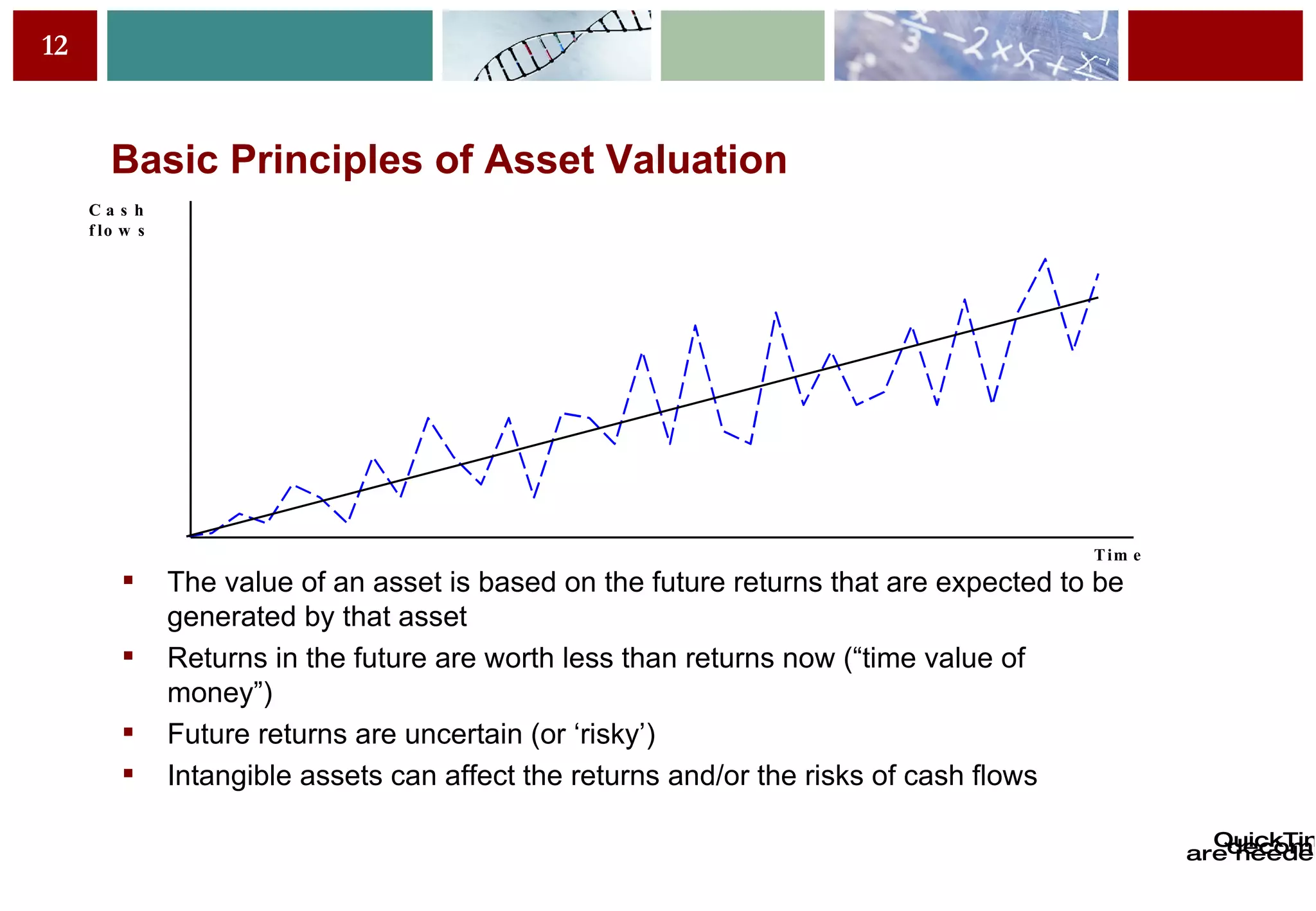
Basic Principles of Asset Valuation The value of an asset is based on the future returns that are expected to be generated by that asset Returns in the future are worth less than returns now (“time value of money”) Future returns are uncertain (or ‘risky’) Intangible assets can affect the returns and/or the risks of cash flows Cash flows Time
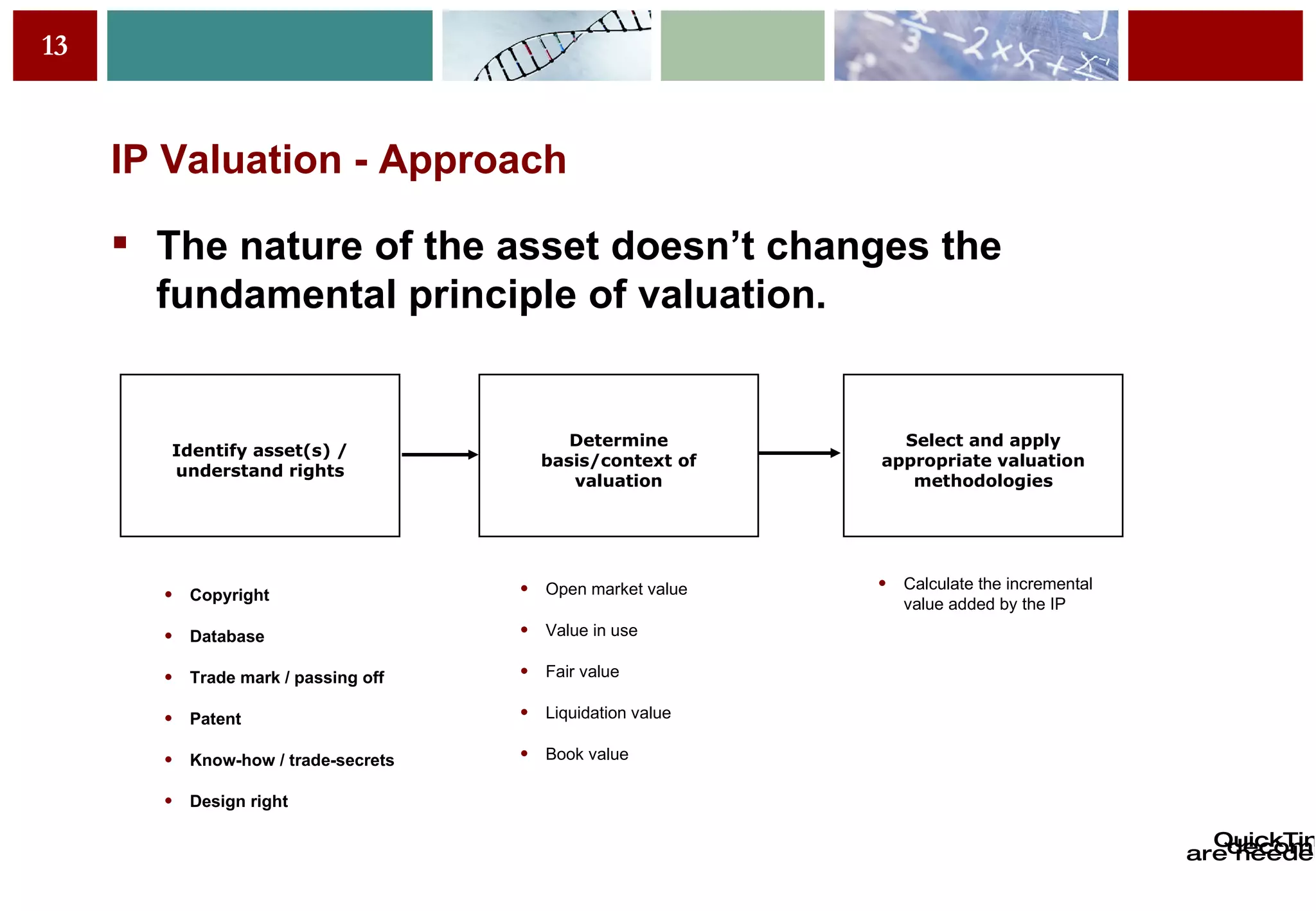
IP Valuation - Approach The nature of the asset doesn’t changes the fundamental principle of valuation. Open market value Value in use Fair value Liquidation value Book value Copyright Database Trade mark / passing off Patent Know-how / trade-secrets Design right Calculate the incremental value added by the IP Determine basis/context of valuation Select and apply appropriate valuation methodologies Identify asset(s) / understand rights
But Valuing IP is a bit harder … 1.  IP doesn’t comes alone Intangibles are often composite assets.  Value is realised in combination with other assets (tangible and intangible) e.g. brand – value in combination of trade marks (registered; rights in passing off) trade dress copyright logo get-up recipes/formulae n.b. trade mark licence v. brand v. branded business
Valuing IP is a bit harder 2.  Value may depend on form and scope of legal rights protecting the asset
The fuzzy nature of IP Rights Un clear how claims will be interpreted in practice   i nadvertent infringement can occur   U n clear boundaries  f o uls up workings of the Coase Theorem   D i sputes over value are not uncommon   I P   d i scounted in the marketplace as a consequence
Valuing IP is a bit harder 3.  Values can vary hugely depending on circumstances between uses between users over time
Valuing IP is a lot harder 4.  Availability of information/incomplete data Novelty and Secrecy in the IP market
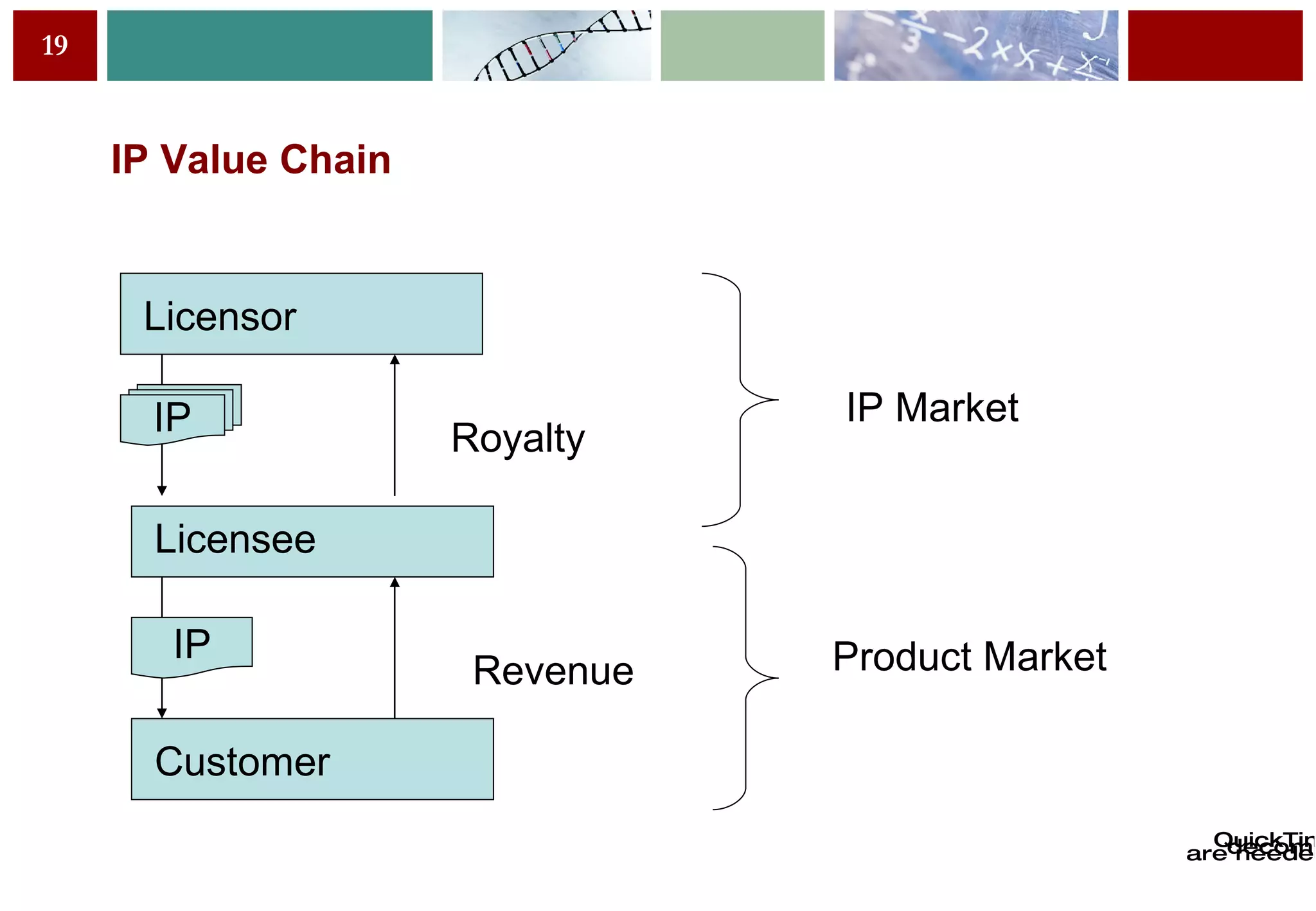
IP Value Chain Licensor Licensee Customer IP IP Royalty Revenue IP Market Product Market
Valuing IP is a lot harder 4.  Availability of information/incomplete data The market for IP is private and non- observable - Novelty and Secrecy Traditional deal structures use no commonly observed or rigorous economic valuation methods reflecting the private and non-observable nature of IP market  Deals a r e based on emotion and haggling
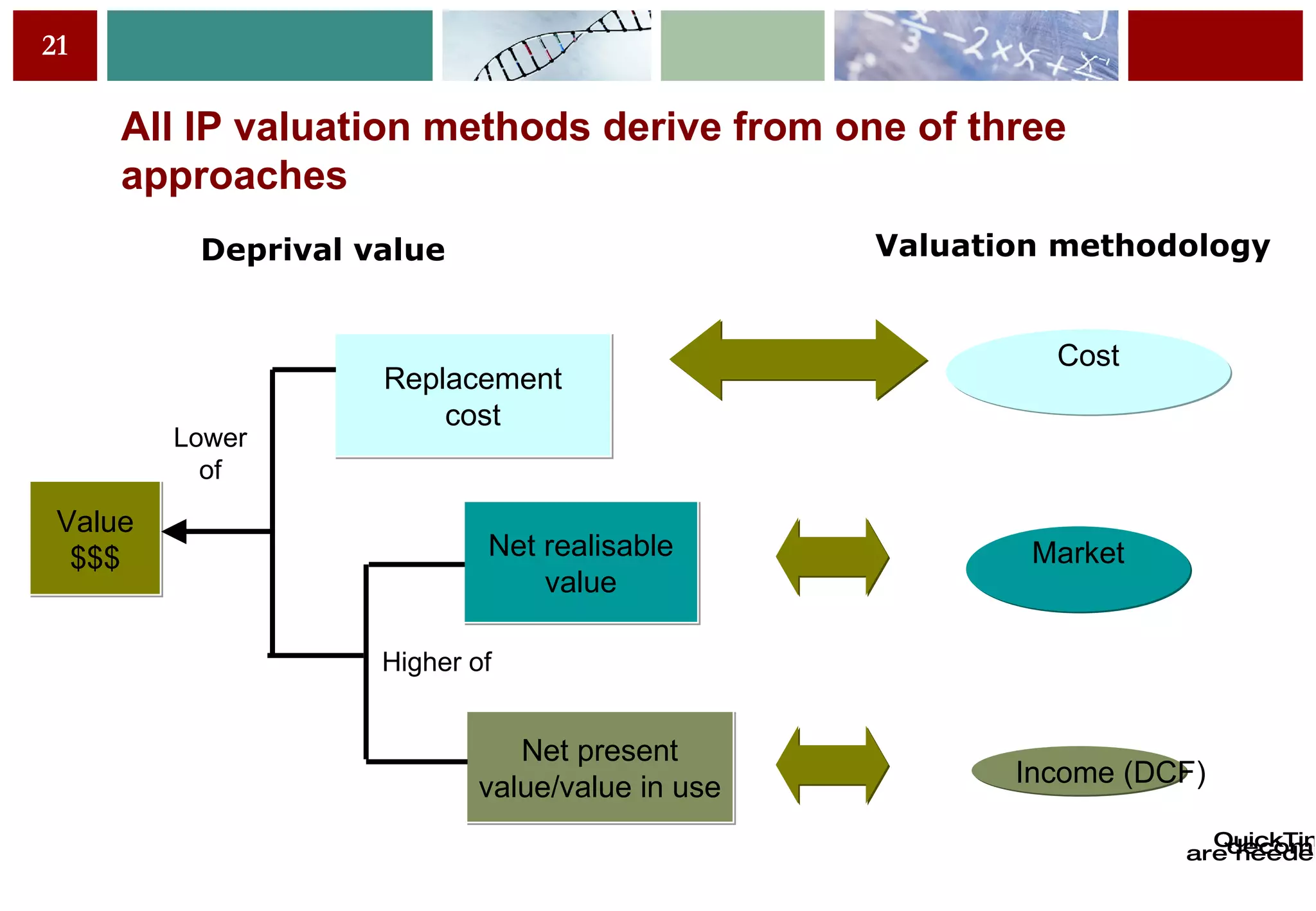
All IP valuation methods derive from one of three approaches Deprival value Value $$$ Replacement cost Net realisable value Net present value/value in use Lower of Higher of Valuation methodology Market Cost Income (DCF)
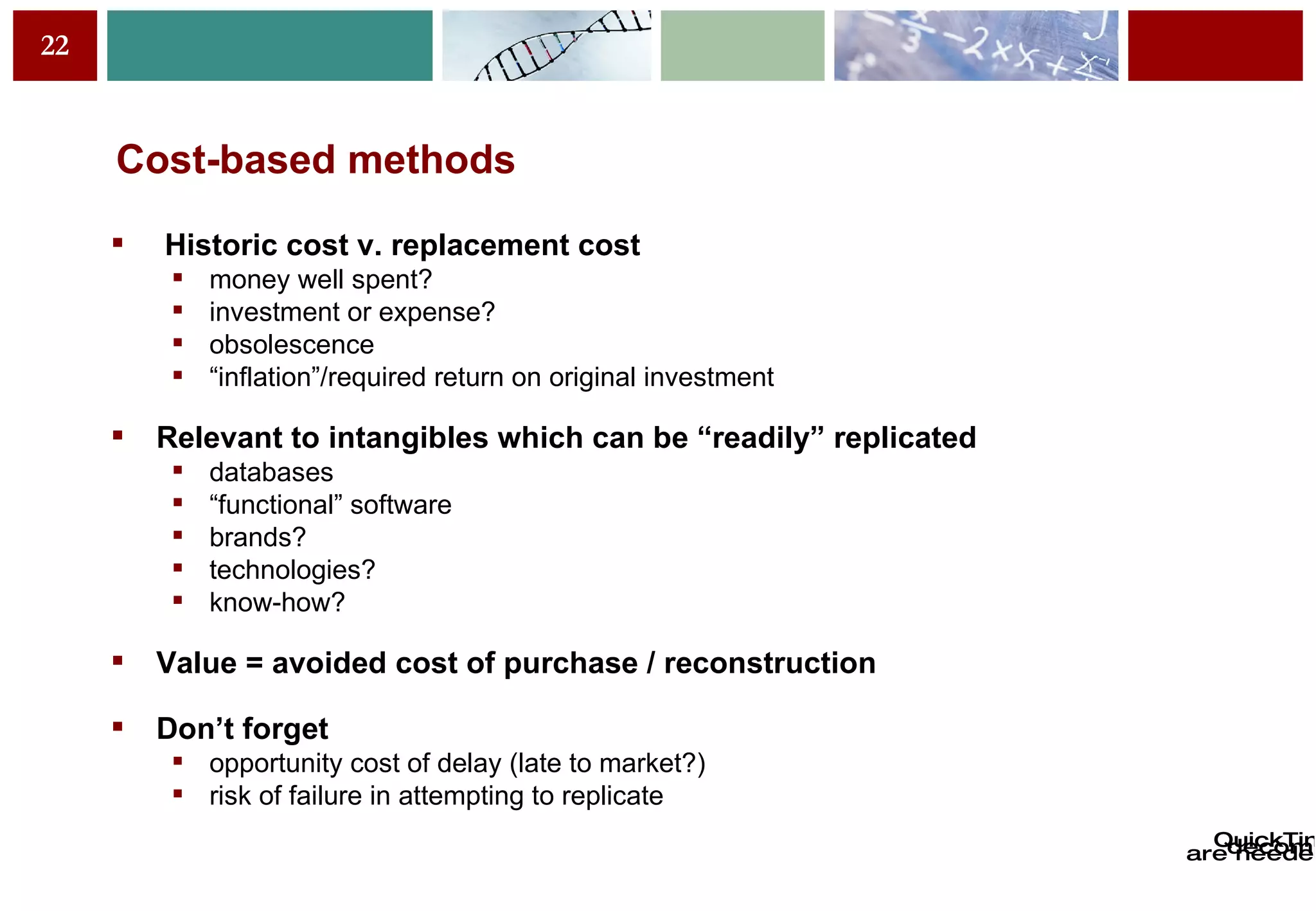
Cost-based methods Historic cost v. replacement cost money well spent? investment or expense? obsolescence “ inflation”/required return on original investment Relevant to intangibles which can be “readily” replicated databases “ functional” software brands? technologies? know-how? Value = avoided cost of purchase / reconstruction Don’t forget opportunity cost of delay (late to market?) risk of failure in attempting to replicate
Market-based methods Frequency of transactions evidence of an active market? Comparability of “market” transactions licences, more often than sale/assignment of IP rights transferred circumstances of transaction (e.g. cross-licence, licence agreed in settlement of litigation) Headline data only? summary royalty terms, but what about the rights and obligations under the licence? summary transaction terms, but what about manufacturing and distribution contracts? But still likely to provide some relevant data
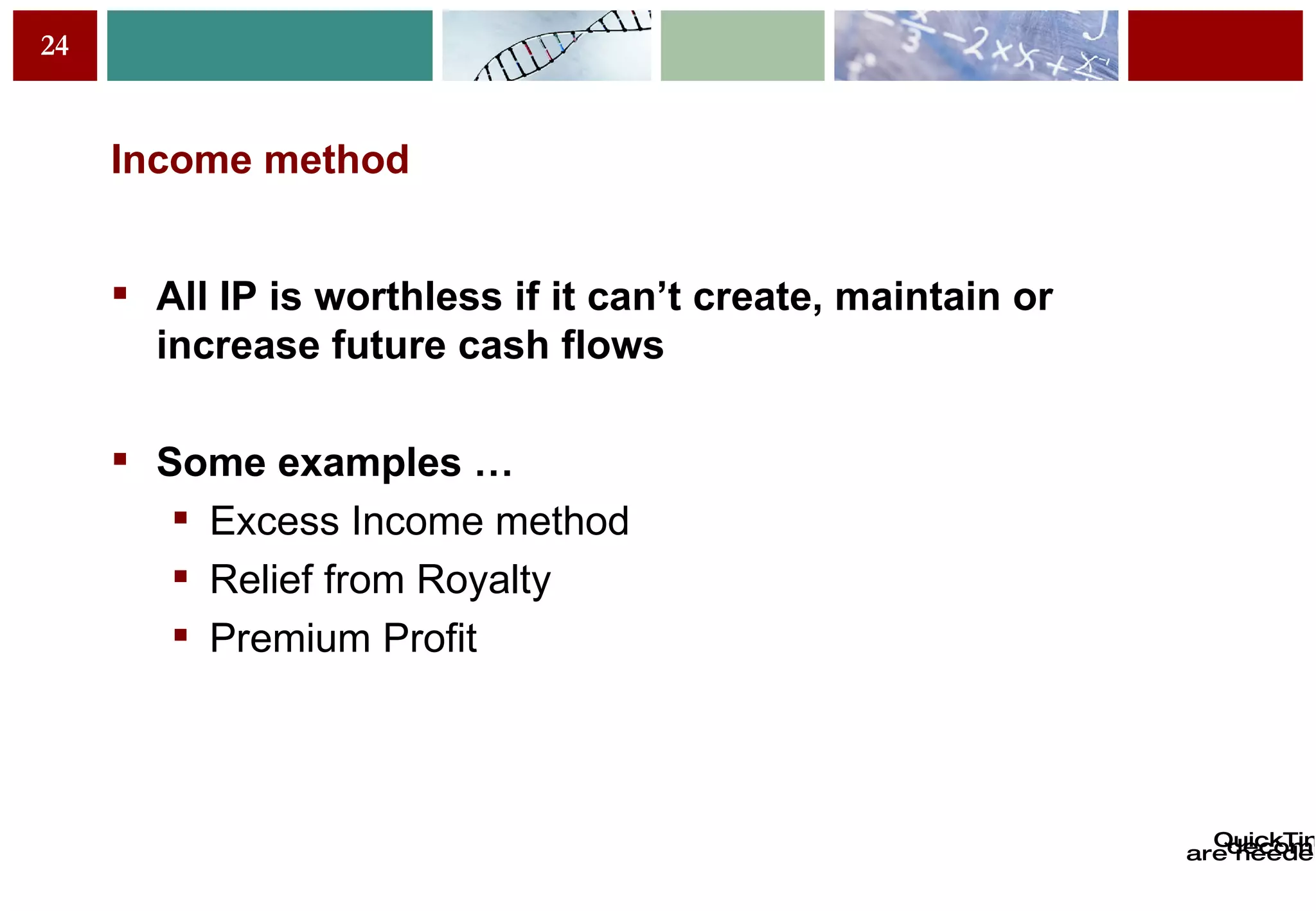
Income method All IP is worthless if it can’t create, maintain or increase future cash flows Some examples … Excess Income method Relief from Royalty Premium Profit
So far … The valuation of IP is, in principle, no different to a general business valuation understanding the dynamics of the business and how it creates value is critical the value derived from IP must come from increased prices or volumes, lower costs, lower risk or greater “optionality” Valuation methods designed to estimate this incremental value implicitly through royalty based or residual value calculations explicitly through economic benefits analysis Valuation is based on expectations of the future and therefore contains significant uncertainty using multiple methods improves the rigour of the valuation
Valuation of Patents Not  all patents are  equal What is the  Strength  of Patent Protection  ? Length :  how much time left to run?   Breadth :  range of products covered? Validity :  likelihood of being upheld if challenged?   Exclusionary  power:  can the owner refuse to license without raising antitrust or other issues (compulsory licensing)?   Available  remedies  if patent infringed
Real Options Valuation
Patents - Qualitative Valuation methods Citation Data Renewal Data Prism
Valuation of Trademarks Income Based Direct Assessment of Benefits DCF - Excess Returns Relief from Royalty Cost Based Residual Development Cost Recreation Cost
Income method – Trademark valuation Premium prices v.generic product adjust for quality/cost differences Premium profits (brand contribution) v.generic competitors/ utility provider of goods and services adjust for quality/cost differences Relief from royalty deprival value (value added/cost savings through ownership of asset) discounted cash flow (“DCF”) analysis based on after-tax royalty applied to projected revenues most commonly used approach by accountants/valuers/Courts and regulators Excess return on capital
Income method – Trademark valuation Consumer Business Premium services Mix   of services Brand  extension products / services channels sector / geography Brand loyalty certainty of demand Demand side factors Incremental cash flows Supply side factors Volumes  x Prices  x Margins –  Capex /  Working capital Risk and return Customer  acquisition /  retention Staff acquisition /  retention Brand support Brand extension  costs Supply terms Financial  Capital Economies of scale Growth Value
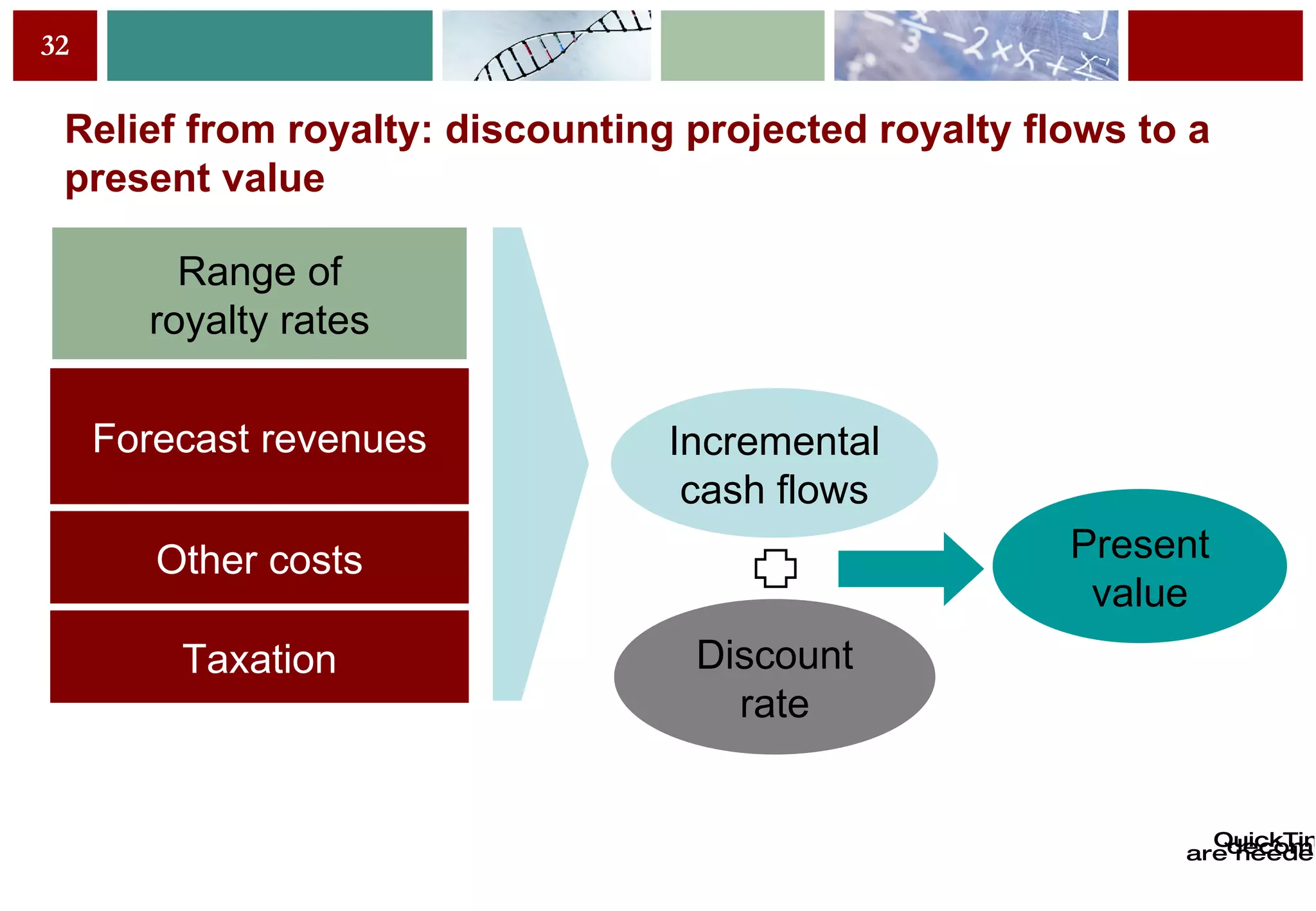
Relief from royalty: discounting projected royalty flows to a present value Range of royalty rates Taxation Incremental cash flows Discount rate Forecast revenues Other costs Present value
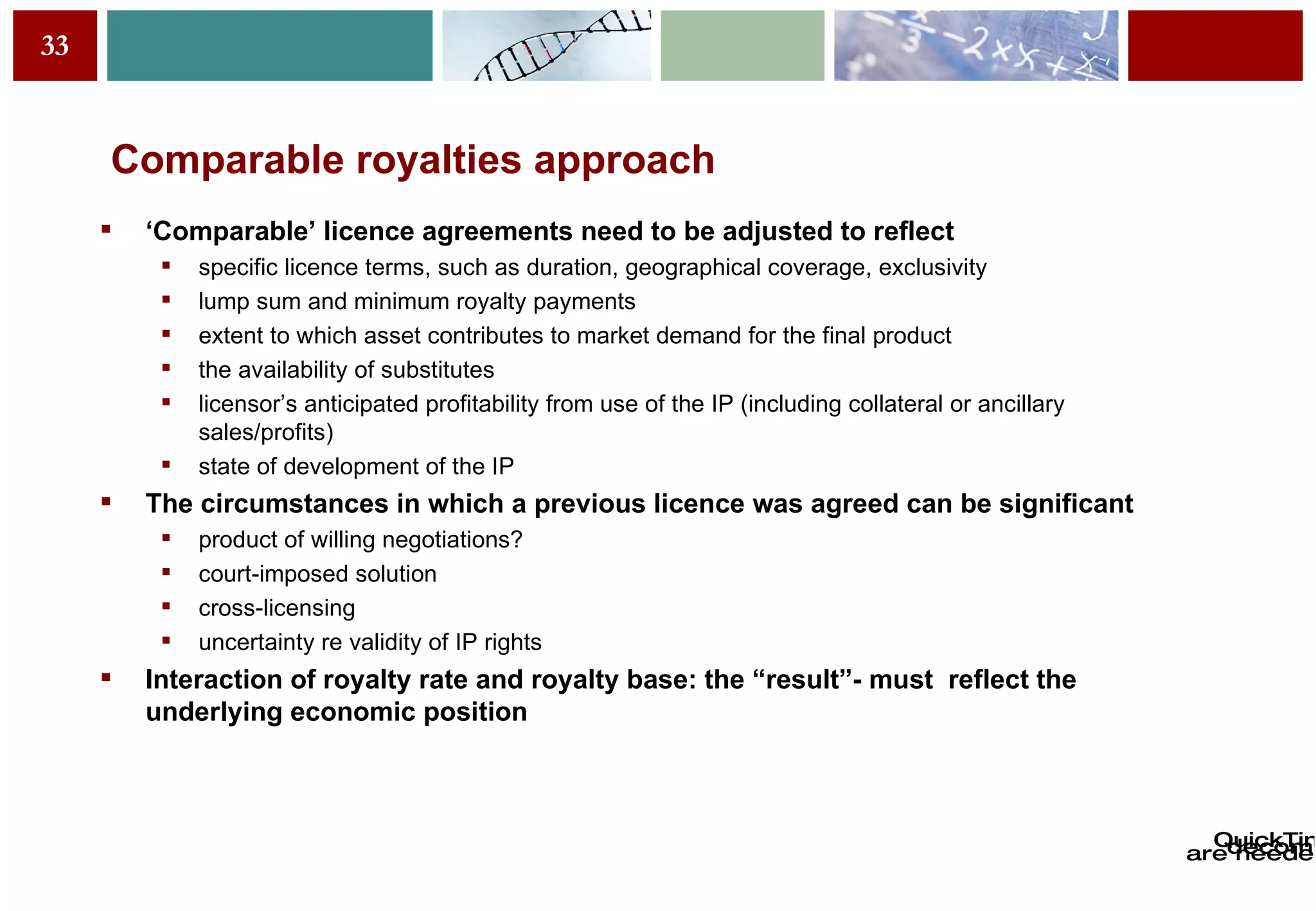
Comparable royalties approach ‘ Comparable’ licence agreements need to be adjusted to reflect specific licence terms, such as duration, geographical coverage, exclusivity lump sum and minimum royalty payments extent to which asset contributes to market demand for the final product the availability of substitutes licensor’s anticipated profitability from use of the IP (including collateral or ancillary sales/profits) state of development of the IP The circumstances in which a previous licence was agreed can be significant product of willing negotiations? court-imposed solution cross-licensing uncertainty re validity of IP rights Interaction of royalty rate and royalty base: the “result”- must  reflect the underlying economic position
Income approach and royalties – allocation of available profits Typically 25-33% of incremental profits are allocated to the licensor (in situations where licensor has no presence in the market to be licensed) as a royalty 50:50 split may be appropriate where licensee will compete directly with licensor Allocation reflects inter alia relative risks borne by parties   licensor: development of technology licensee: financial and marketing risks “ Rule of thumb” split of profits: beware different interpretations different measures of “profits” application different forms of IP rights
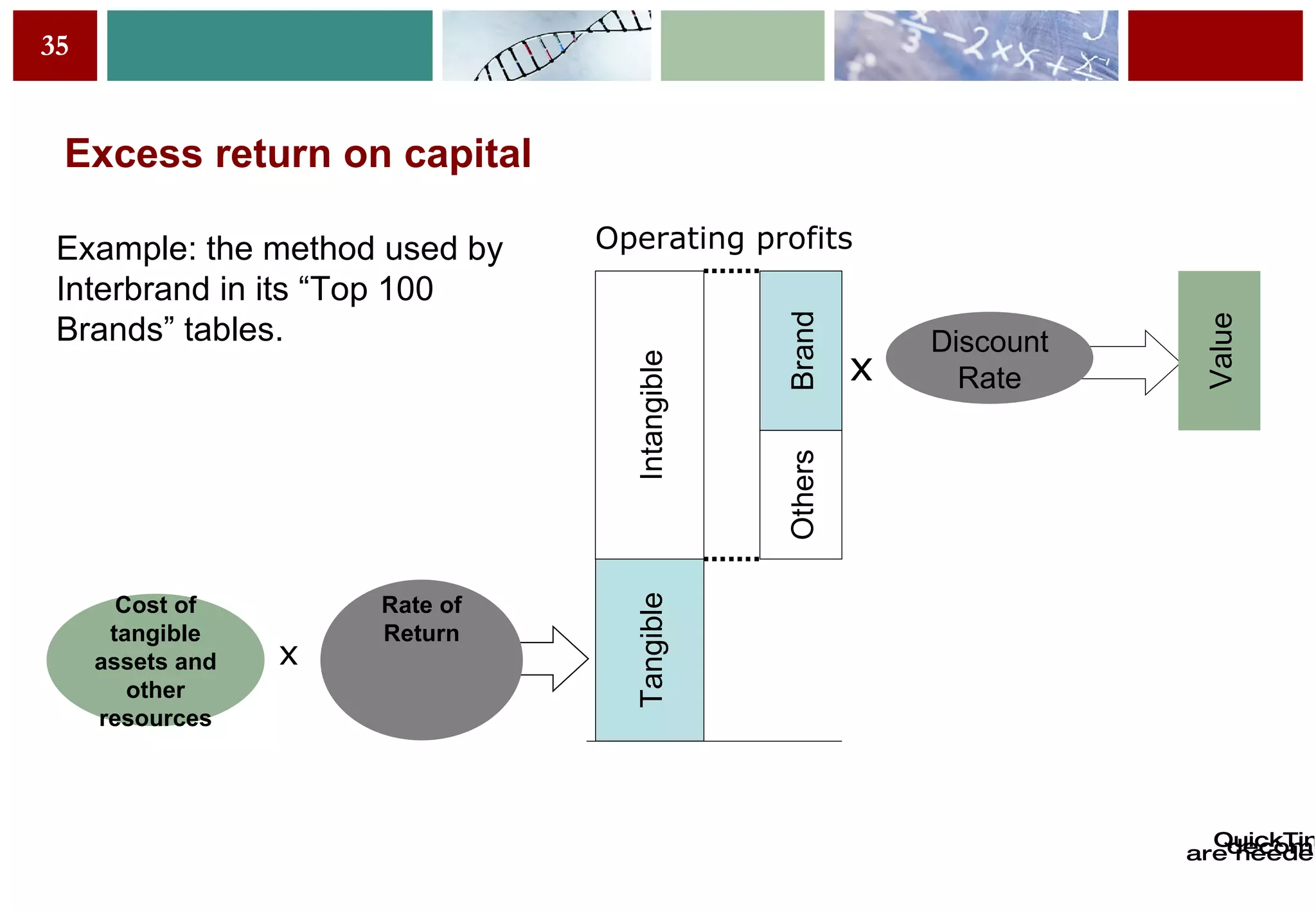
Excess return on capital Tangible Intangible Operating profits Cost of tangible assets and other resources Rate of Return x Brand Others Discount Rate Value x Example: the method used by Interbrand in its “Top 100 Brands” tables.
IP Risk and Damage Assessment
Risk Assessment Any financial valuation (rewards) must be weighted down by the risks. Ignoring the risks leads to overvaluation
Different assets face different types of Risk Patents Technological - Is it feasible/viable. Legal - Validity, the ability to stand when challenged in court of law Trademarks Priority Freedom to use Software/Copyrights Piracy Risks
Damages: The Cost of infringement Hewlett-Packard pays Pitney Bowes $400 million to settle patent dispute ASSOCIATED PRESS  Tuesday June 5th, 2001 STAMFORD, Conn. — Hewlett-Packard Co. agreed Monday to pay Pitney Bowes Inc. $400 million to settle a lawsuit over print technology patents…. The companies resolved all litigation without admitting wrongdoing. In CY2000 HP had net earnings of $3.7B on sales of $48.7B.  To earn  $400M  HP had to generate  $5.26B  in Sales.
The nature of infringement On August 31, 1993 a US jury found that Honeywell had infringed a Litton Ring Laser Gyroscope patent and should pay $1.2 billion in damages. This was somewhat less than the $1.96 billion Litton claimed but nevertheless perhaps the largest ever award of damages for patent infringement. However, on July 3rd, 1996 the CAFC whilst upholding the jury   verdict on infringement awarded a new trial concerning damages saying that the study by  Litton's damages expert  Dr. Phillips was predicated on  p eculation and unrealistic assertions and supported the trial court   conclusion that Dr. Phillips' study was " pure fantasy. "
The Theory of Infringement “ T h e basic theory of damages is to make the IP owner whole for losses caused by the infringers illicit activity. The IP owner is to be restored financially to the position he would have occupied but for the infringement.”
Wilful Infringement Treble damages The court may triple the damage award if it is proven wilful.
So far … Valuation may be triggered by an event, like M&A Financing - use of IP as collateral Joint Venture, Sale or Licensing of IP In case of infringement But the growing importance of IP makes IP assessment is an ongoing process
IP Audit Identification, organization and review of a client’s intellectual property  assets  and  potential   liabilities Ownership Recordation of transfers Perfection of security interests Compliance with statutory formalities Infringement on third party rights Client’s rights being infringed Could be  General Purpose IP Audit Event Driven Audit Narrow Focus Audit
Why do an IP audit? Other than quantifying the value  Identify, organize, and review existing IP portfolio Resolve current issues in IP management practices Establish procedures to ensure protection of assets in the future  Better guarding of trade secrets Docketing system for payment of fees and renewal filings Assignments of IP in employment and consulting agreements Better marking of products  Add value the company What IP assets are underutilized What are the potential value creators
Benefits of IP Audit Prevent asset losses Make effective economical use of IP assets Address gaps in licensing and agreement procedures  Minimize risk of third party infringements Determine position in relation to competitors
Issues unearthed in IP Defects in title to IP Assignments of ownership from consultants Quitclaim from alleged author or inventor Employee inventions within the scope of work License rights from third parties to make derivative works Third party joint ownership Defects in patents (copyrights or trademarks as well) Requests for reexamination or reissue of a patent Amendments to applications Certificates of correction
Thank You [email_address]

IP Valuation

  • 1.
    Intellectual Property: Valuation,Assessment and Audit Project Presentation Intellectual Property Management IIM Lucknow, Noida Campus
  • 2.
    Agenda The 9reasons for valuing IP The Basics Fundamental Principles The three approaches to value IP Specific IP Valuation Patents Trademarks and Brands IP Risk Assessment Damage Assessment IP Audit
  • 3.
    Why Value IP?1. Exploitation, as any other asset. A basis for negotiations involving sale, licensing or exchange of IP.
  • 4.
    Why Value IP?2. For Taxation Transfer of IP from parent to subsidiary company. Donation of IP as a tax-free gift to some institution.
  • 5.
    Why Value IP?3. For raising funds and securing Financing IP may serve as a collateral with banks IP value helps startups raise venture capital
  • 6.
    Why Value IP?4. Profit sharing - when there are multiple IP owners As in a R&D consortium that involves multiple companies contributing - to determine the allocation of net income. Joint Ventures and Strategic Partnerships
  • 7.
    Why Value IP?5. Assessing damage claims in a dispute, infringement or breach of contractual rights.
  • 8.
    Why Value IP?6. Financial Reporting Indian Accounting Standard on Intangibles
  • 9.
    Why Value IP?7. Transfer Pricing What price is right, for transfer of patents, licensing a trademark, within the firm?
  • 10.
    Why Value IP?8. In any restructuring or liquidation procedure As in mergers, spin-offs or bankruptcy
  • 11.
    Why Value IP?9. IP drives market Value of Stock Not only for smaller startups without significant real assets, but increasingly for larger companies such as IBM
  • 12.
    Basic Principles ofAsset Valuation The value of an asset is based on the future returns that are expected to be generated by that asset Returns in the future are worth less than returns now (“time value of money”) Future returns are uncertain (or ‘risky’) Intangible assets can affect the returns and/or the risks of cash flows Cash flows Time
  • 13.
    IP Valuation -Approach The nature of the asset doesn’t changes the fundamental principle of valuation. Open market value Value in use Fair value Liquidation value Book value Copyright Database Trade mark / passing off Patent Know-how / trade-secrets Design right Calculate the incremental value added by the IP Determine basis/context of valuation Select and apply appropriate valuation methodologies Identify asset(s) / understand rights
  • 14.
    But Valuing IPis a bit harder … 1. IP doesn’t comes alone Intangibles are often composite assets. Value is realised in combination with other assets (tangible and intangible) e.g. brand – value in combination of trade marks (registered; rights in passing off) trade dress copyright logo get-up recipes/formulae n.b. trade mark licence v. brand v. branded business
  • 15.
    Valuing IP isa bit harder 2. Value may depend on form and scope of legal rights protecting the asset
  • 16.
    The fuzzy natureof IP Rights Un clear how claims will be interpreted in practice i nadvertent infringement can occur U n clear boundaries f o uls up workings of the Coase Theorem D i sputes over value are not uncommon I P d i scounted in the marketplace as a consequence
  • 17.
    Valuing IP isa bit harder 3. Values can vary hugely depending on circumstances between uses between users over time
  • 18.
    Valuing IP isa lot harder 4. Availability of information/incomplete data Novelty and Secrecy in the IP market
  • 19.
    IP Value ChainLicensor Licensee Customer IP IP Royalty Revenue IP Market Product Market
  • 20.
    Valuing IP isa lot harder 4. Availability of information/incomplete data The market for IP is private and non- observable - Novelty and Secrecy Traditional deal structures use no commonly observed or rigorous economic valuation methods reflecting the private and non-observable nature of IP market Deals a r e based on emotion and haggling
  • 21.
    All IP valuationmethods derive from one of three approaches Deprival value Value $$$ Replacement cost Net realisable value Net present value/value in use Lower of Higher of Valuation methodology Market Cost Income (DCF)
  • 22.
    Cost-based methods Historiccost v. replacement cost money well spent? investment or expense? obsolescence “ inflation”/required return on original investment Relevant to intangibles which can be “readily” replicated databases “ functional” software brands? technologies? know-how? Value = avoided cost of purchase / reconstruction Don’t forget opportunity cost of delay (late to market?) risk of failure in attempting to replicate
  • 23.
    Market-based methods Frequencyof transactions evidence of an active market? Comparability of “market” transactions licences, more often than sale/assignment of IP rights transferred circumstances of transaction (e.g. cross-licence, licence agreed in settlement of litigation) Headline data only? summary royalty terms, but what about the rights and obligations under the licence? summary transaction terms, but what about manufacturing and distribution contracts? But still likely to provide some relevant data
  • 24.
    Income method AllIP is worthless if it can’t create, maintain or increase future cash flows Some examples … Excess Income method Relief from Royalty Premium Profit
  • 25.
    So far …The valuation of IP is, in principle, no different to a general business valuation understanding the dynamics of the business and how it creates value is critical the value derived from IP must come from increased prices or volumes, lower costs, lower risk or greater “optionality” Valuation methods designed to estimate this incremental value implicitly through royalty based or residual value calculations explicitly through economic benefits analysis Valuation is based on expectations of the future and therefore contains significant uncertainty using multiple methods improves the rigour of the valuation
  • 26.
    Valuation of PatentsNot all patents are equal What is the Strength of Patent Protection ? Length : how much time left to run? Breadth : range of products covered? Validity : likelihood of being upheld if challenged? Exclusionary power: can the owner refuse to license without raising antitrust or other issues (compulsory licensing)? Available remedies if patent infringed
  • 27.
  • 28.
    Patents - QualitativeValuation methods Citation Data Renewal Data Prism
  • 29.
    Valuation of TrademarksIncome Based Direct Assessment of Benefits DCF - Excess Returns Relief from Royalty Cost Based Residual Development Cost Recreation Cost
  • 30.
    Income method –Trademark valuation Premium prices v.generic product adjust for quality/cost differences Premium profits (brand contribution) v.generic competitors/ utility provider of goods and services adjust for quality/cost differences Relief from royalty deprival value (value added/cost savings through ownership of asset) discounted cash flow (“DCF”) analysis based on after-tax royalty applied to projected revenues most commonly used approach by accountants/valuers/Courts and regulators Excess return on capital
  • 31.
    Income method –Trademark valuation Consumer Business Premium services Mix of services Brand extension products / services channels sector / geography Brand loyalty certainty of demand Demand side factors Incremental cash flows Supply side factors Volumes x Prices x Margins – Capex / Working capital Risk and return Customer acquisition / retention Staff acquisition / retention Brand support Brand extension costs Supply terms Financial Capital Economies of scale Growth Value
  • 32.
    Relief from royalty:discounting projected royalty flows to a present value Range of royalty rates Taxation Incremental cash flows Discount rate Forecast revenues Other costs Present value
  • 33.
    Comparable royalties approach‘ Comparable’ licence agreements need to be adjusted to reflect specific licence terms, such as duration, geographical coverage, exclusivity lump sum and minimum royalty payments extent to which asset contributes to market demand for the final product the availability of substitutes licensor’s anticipated profitability from use of the IP (including collateral or ancillary sales/profits) state of development of the IP The circumstances in which a previous licence was agreed can be significant product of willing negotiations? court-imposed solution cross-licensing uncertainty re validity of IP rights Interaction of royalty rate and royalty base: the “result”- must reflect the underlying economic position
  • 34.
    Income approach androyalties – allocation of available profits Typically 25-33% of incremental profits are allocated to the licensor (in situations where licensor has no presence in the market to be licensed) as a royalty 50:50 split may be appropriate where licensee will compete directly with licensor Allocation reflects inter alia relative risks borne by parties licensor: development of technology licensee: financial and marketing risks “ Rule of thumb” split of profits: beware different interpretations different measures of “profits” application different forms of IP rights
  • 35.
    Excess return oncapital Tangible Intangible Operating profits Cost of tangible assets and other resources Rate of Return x Brand Others Discount Rate Value x Example: the method used by Interbrand in its “Top 100 Brands” tables.
  • 36.
    IP Risk andDamage Assessment
  • 37.
    Risk Assessment Anyfinancial valuation (rewards) must be weighted down by the risks. Ignoring the risks leads to overvaluation
  • 38.
    Different assets facedifferent types of Risk Patents Technological - Is it feasible/viable. Legal - Validity, the ability to stand when challenged in court of law Trademarks Priority Freedom to use Software/Copyrights Piracy Risks
  • 39.
    Damages: The Costof infringement Hewlett-Packard pays Pitney Bowes $400 million to settle patent dispute ASSOCIATED PRESS Tuesday June 5th, 2001 STAMFORD, Conn. — Hewlett-Packard Co. agreed Monday to pay Pitney Bowes Inc. $400 million to settle a lawsuit over print technology patents…. The companies resolved all litigation without admitting wrongdoing. In CY2000 HP had net earnings of $3.7B on sales of $48.7B. To earn $400M HP had to generate $5.26B in Sales.
  • 40.
    The nature ofinfringement On August 31, 1993 a US jury found that Honeywell had infringed a Litton Ring Laser Gyroscope patent and should pay $1.2 billion in damages. This was somewhat less than the $1.96 billion Litton claimed but nevertheless perhaps the largest ever award of damages for patent infringement. However, on July 3rd, 1996 the CAFC whilst upholding the jury verdict on infringement awarded a new trial concerning damages saying that the study by Litton's damages expert Dr. Phillips was predicated on p eculation and unrealistic assertions and supported the trial court conclusion that Dr. Phillips' study was " pure fantasy. "
  • 41.
    The Theory ofInfringement “ T h e basic theory of damages is to make the IP owner whole for losses caused by the infringers illicit activity. The IP owner is to be restored financially to the position he would have occupied but for the infringement.”
  • 42.
    Wilful Infringement Trebledamages The court may triple the damage award if it is proven wilful.
  • 43.
    So far …Valuation may be triggered by an event, like M&A Financing - use of IP as collateral Joint Venture, Sale or Licensing of IP In case of infringement But the growing importance of IP makes IP assessment is an ongoing process
  • 44.
    IP Audit Identification,organization and review of a client’s intellectual property assets and potential liabilities Ownership Recordation of transfers Perfection of security interests Compliance with statutory formalities Infringement on third party rights Client’s rights being infringed Could be General Purpose IP Audit Event Driven Audit Narrow Focus Audit
  • 45.
    Why do anIP audit? Other than quantifying the value Identify, organize, and review existing IP portfolio Resolve current issues in IP management practices Establish procedures to ensure protection of assets in the future Better guarding of trade secrets Docketing system for payment of fees and renewal filings Assignments of IP in employment and consulting agreements Better marking of products Add value the company What IP assets are underutilized What are the potential value creators
  • 46.
    Benefits of IPAudit Prevent asset losses Make effective economical use of IP assets Address gaps in licensing and agreement procedures Minimize risk of third party infringements Determine position in relation to competitors
  • 47.
    Issues unearthed inIP Defects in title to IP Assignments of ownership from consultants Quitclaim from alleged author or inventor Employee inventions within the scope of work License rights from third parties to make derivative works Third party joint ownership Defects in patents (copyrights or trademarks as well) Requests for reexamination or reissue of a patent Amendments to applications Certificates of correction
  • 48.