The Age of Multi-Layer
Networking

Ori Gerstel, Principal Engineer

ogerstel@cisco.com

© 2006 Cisco Systems, Inc. All rights reserved.

Cisco Confidential
Outline
 Challenges
• The shrinking gap between network cost and revenues
• Are we approaching the limit of fiber capacity?
• Cost of DWDM optics not dropping fast enough
• The reducing accuracy of traffic forecasts

 Solution components
• Agile and elastic optical networking
• Multi layer coordination (control plane)

• Multi layer optimization (SDN)

 Summary

© 2006 Cisco Systems, Inc. All rights reserved.

Cisco Confidential
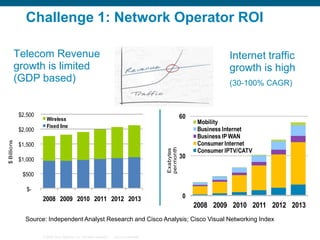
Challenge 1: Network Operator ROI
Telecom Revenue
growth is limited
(GDP based)

$2,500

(30-100% CAGR)

60

Wireless
Fixed line

$1,500

Exabytes
per month

$ Billions

$2,000

Internet traffic
growth is high

$1,000
$500

30

Mobility
Business Internet
Business IP WAN
Consumer Internet
Consumer IPTV/CATV

$-

2008 2009 2010 2011 2012 2013

0

2008 2009 2010 2011 2012 2013

Source: Independent Analyst Research and Cisco Analysis; Cisco Visual Networking Index
© 2006 Cisco Systems, Inc. All rights reserved.

Cisco Confidential
Challenge 2: how to achieve 10x capacity
in the next 10 years?

[Courtesy of David J. Richardson, adapted from “Filling the Light Pipe”, Science 15 October 2010]
© 2006 Cisco Systems, Inc. All rights reserved.

Cisco Confidential
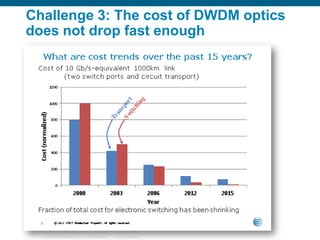
Challenge 3: The cost of DWDM optics
does not drop fast enough

© 2006 Cisco Systems, Inc. All rights reserved.

Cisco Confidential
Can SDM help?
Tx
Tx
Tx
Tx

Rx
Rx
Rx
Rx

Tx
Tx
Tx
Tx

Rx
Rx
Rx
Rx

Tx
Tx
Tx
Tx

Rx
Rx
Rx
Rx

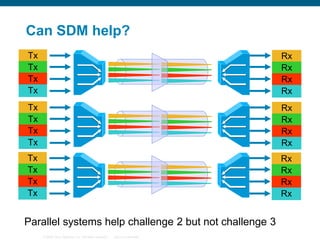
Parallel systems help challenge 2 but not challenge 3
© 2006 Cisco Systems, Inc. All rights reserved.

Cisco Confidential
Can SDM help?
Tx
Tx
Tx
Tx

Rx
Rx
Rx
Rx

Tx
Tx
Tx
Tx

Rx
Rx
Rx
Rx

Tx
Tx
Tx
Tx

Rx
Rx
Rx
Rx

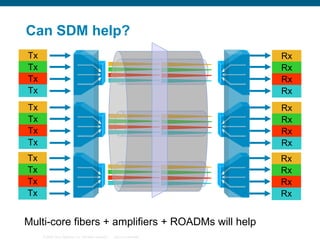
Multi-core fibers + amplifiers + ROADMs will help
© 2006 Cisco Systems, Inc. All rights reserved.

Cisco Confidential
Can SDM help?
Tx
Tx
Tx
Tx

Rx
Rx
Rx
Rx

Tx
Tx
Tx
Tx

Rx
Rx
Rx
Rx

Tx
Tx
Tx
Tx

Rx
Rx
Rx
Rx

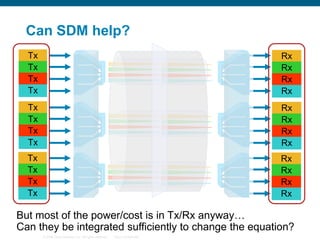
But most of the power/cost is in Tx/Rx anyway…
Can they be integrated sufficiently to change the equation?
© 2006 Cisco Systems, Inc. All rights reserved.

Cisco Confidential
Cisco Confidential

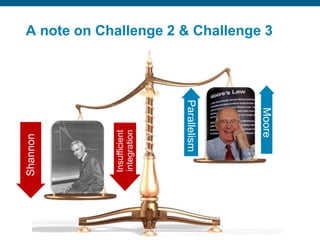
Shannon

Moore

© 2006 Cisco Systems, Inc. All rights reserved.

Parallelism

Insufficient
integration

A note on Challenge 2 & Challenge 3
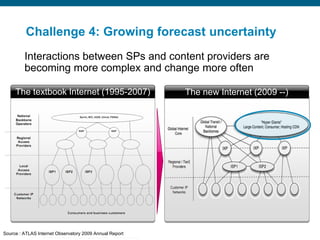
Challenge 4: Growing forecast uncertainty
Interactions between SPs and content providers are
becoming more complex and change more often
The textbook Internet (1995-2007)

Source : ATLAS Internet Observatory 2009 Annual Report
© 2006 Cisco Systems, Inc. All rights reserved.

Cisco Confidential

The new Internet (2009 --)
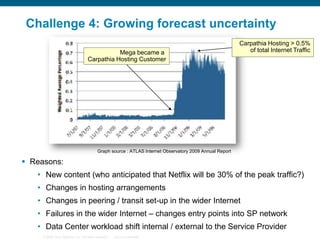
Challenge 4: Growing forecast uncertainty
Mega became a
Carpathia Hosting Customer

Carpathia Hosting > 0.5%
of total Internet Traffic

Graph source : ATLAS Internet Observatory 2009 Annual Report

 Reasons:

• New content (who anticipated that Netflix will be 30% of the peak traffic?)
• Changes in hosting arrangements
• Changes in peering / transit set-up in the wider Internet
• Failures in the wider Internet – changes entry points into SP network
• Data Center workload shift internal / external to the Service Provider
© 2006 Cisco Systems, Inc. All rights reserved.

Cisco Confidential
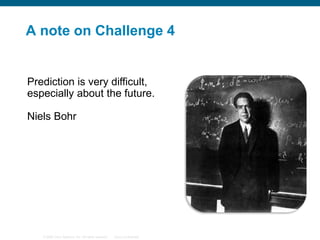
A note on Challenge 4

Prediction is very difficult,
especially about the future.
Niels Bohr

© 2006 Cisco Systems, Inc. All rights reserved.

Cisco Confidential
Outline
 Intro to SP core networks
 Challenges
• The shrinking gap between network cost and revenues
• Are we approaching the limit of fiber capacity?

• Cost of DWDM optics not dropping fast enough
• The reducing accuracy of traffic forecasts

 Solution components
• Agile and elastic optical networking
• Multi layer coordination (control plane)
• Multi layer optimization (SDN)

 Summary
© 2006 Cisco Systems, Inc. All rights reserved.

Cisco Confidential
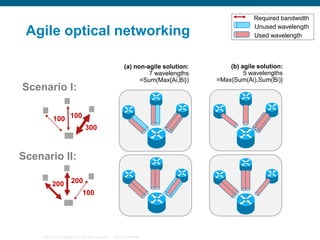
Agile optical networking
(a) non-agile solution:
7 wavelengths
=Sum(Max{Ai,Bi})

Scenario I:
100 100
300

Scenario II:
200

200
100

© 2006 Cisco Systems, Inc. All rights reserved.

Cisco Confidential

Required bandwidth
Unused wavelength
Used wavelength

(b) agile solution:
5 wavelengths
=Max{Sum(Ai),Sum(Bi)}
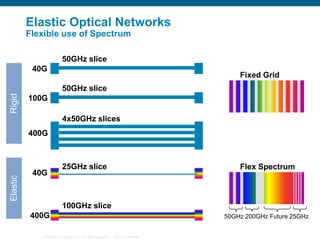
Elastic Optical Networks
Flexible use of Spectrum
50GHz slice
40G

Fixed Grid

Rigid

50GHz slice
100G
4x50GHz slices

Elastic

400G

40G

25GHz slice

Flex Spectrum

100GHz slice
400G
© 2006 Cisco Systems, Inc. All rights reserved.

50GHz 200GHz Future 25GHz

Cisco Confidential
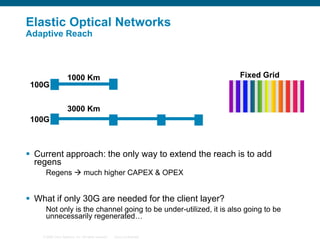
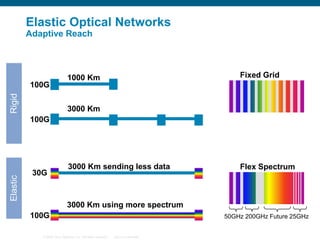
Elastic Optical Networks
Adaptive Reach

100G

Fixed Grid

1000 Km

3000 Km
100G

 Current approach: the only way to extend the reach is to add
regens
Regens  much higher CAPEX & OPEX

 What if only 30G are needed for the client layer?
Not only is the channel going to be under-utilized, it is also going to be
unnecessarily regenerated…
© 2006 Cisco Systems, Inc. All rights reserved.

Cisco Confidential
Elastic Optical Networks
Adaptive Reach

Rigid

100G

Fixed Grid

1000 Km

3000 Km

Elastic

100G

30G

3000 Km sending less data

Flex Spectrum

3000 Km using more spectrum
100G
© 2006 Cisco Systems, Inc. All rights reserved.

50GHz 200GHz Future 25GHz

Cisco Confidential
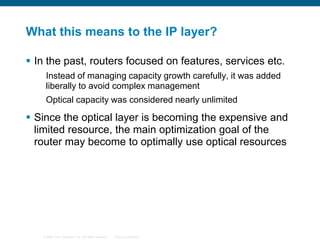
What this means to the IP layer?
 In the past, routers focused on features, services etc.
Instead of managing capacity growth carefully, it was added
liberally to avoid complex management
Optical capacity was considered nearly unlimited

 Since the optical layer is becoming the expensive and
limited resource, the main optimization goal of the
router may become to optimally use optical resources

© 2006 Cisco Systems, Inc. All rights reserved.

Cisco Confidential
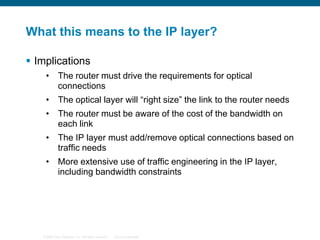
What this means to the IP layer?
 Implications
• The router must drive the requirements for optical
connections
• The optical layer will “right size” the link to the router needs
• The router must be aware of the cost of the bandwidth on
each link
• The IP layer must add/remove optical connections based on
traffic needs
• More extensive use of traffic engineering in the IP layer,
including bandwidth constraints

© 2006 Cisco Systems, Inc. All rights reserved.

Cisco Confidential
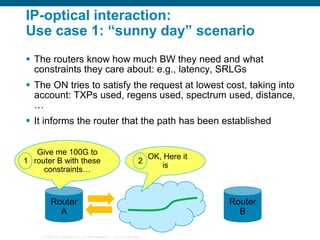
IP-optical interaction:
Use case 1: “sunny day” scenario
 The routers know how much BW they need and what
constraints they care about: e.g., latency, SRLGs
 The ON tries to satisfy the request at lowest cost, taking into
account: TXPs used, regens used, spectrum used, distance,
…
 It informs the router that the path has been established
Give me 100G to
1 router B with these
constraints…

2

Router
A
© 2006 Cisco Systems, Inc. All rights reserved.

OK, Here it
is

Router
B
Cisco Confidential
IP-optical interaction:
Use case 2
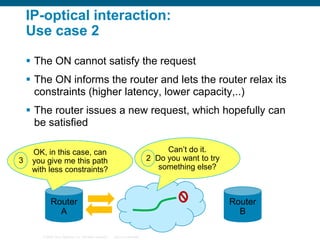
 The ON cannot satisfy the request
 The ON informs the router and lets the router relax its
constraints (higher latency, lower capacity,..)
 The router issues a new request, which hopefully can
be satisfied
Can’t do it.
2 Do you want to try
something else?

OK, inme 100G to
Give this case, can
3 1 you give me this path
router B with these
with less constraints?
constraints…

Router
A
© 2006 Cisco Systems, Inc. All rights reserved.

Router
B
Cisco Confidential
IP-optical interaction:
Use case 3
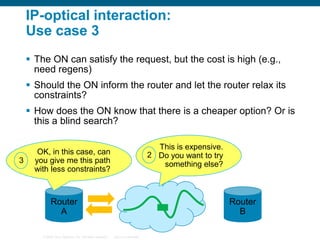
 The ON can satisfy the request, but the cost is high (e.g.,
need regens)
 Should the ON inform the router and let the router relax its
constraints?
 How does the ON know that there is a cheaper option? Or is
this a blind search?

3

This is expensive.
2 Do you want to try
something else?

OK, in this case, can
you give me this path
with less constraints?

Router
A
© 2006 Cisco Systems, Inc. All rights reserved.

Router
B
Cisco Confidential
IP-optical interaction:
Use case 4: restoration
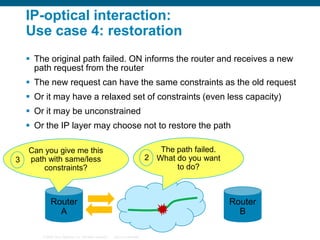
 The original path failed. ON informs the router and receives a new
path request from the router
 The new request can have the same constraints as the old request
 Or it may have a relaxed set of constraints (even less capacity)
 Or it may be unconstrained

 Or the IP layer may choose not to restore the path

3

The path failed.
2 What do you want
to do?

Can you give me this
path with same/less
constraints?

Router
A
© 2006 Cisco Systems, Inc. All rights reserved.

Router
B
Cisco Confidential
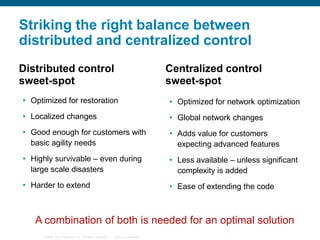
Striking the right balance between
distributed and centralized control

© 2006 Cisco Systems, Inc. All rights reserved.

Cisco Confidential
Striking the right balance between
distributed and centralized control
Distributed control
sweet-spot

Centralized control
sweet-spot

• Optimized for restoration

• Optimized for network optimization

• Localized changes

• Global network changes

• Good enough for customers with
basic agility needs

• Adds value for customers
expecting advanced features

• Highly survivable – even during
large scale disasters

• Less available – unless significant
complexity is added

• Harder to extend

• Ease of extending the code

A combination of both is needed for an optimal solution
© 2006 Cisco Systems, Inc. All rights reserved.

Cisco Confidential
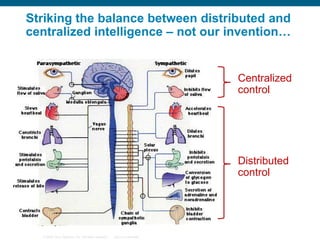
Striking the balance between distributed and
centralized intelligence – not our invention…

Centralized
control

Distributed
control

© 2006 Cisco Systems, Inc. All rights reserved.

Cisco Confidential
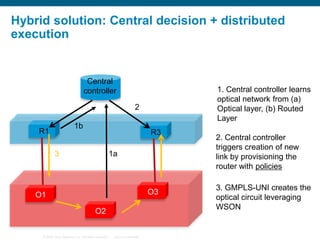
Hybrid solution: Central decision + distributed
execution

Central
controller

1. Central controller learns
optical network from (a)
Optical layer, (b) Routed
Layer

2
1b

R1

R3

3

1a

O3

O1
O2

© 2006 Cisco Systems, Inc. All rights reserved.

Cisco Confidential

2. Central controller
triggers creation of new
link by provisioning the
router with policies
3. GMPLS-UNI creates the
optical circuit leveraging
WSON
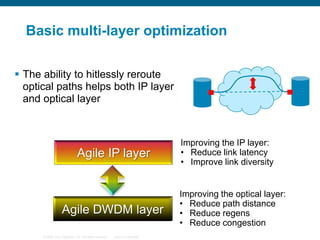
Basic multi-layer optimization
 The ability to hitlessly reroute
optical paths helps both IP layer
and optical layer

Agile IP layer

Static DWDM layer
Agile DWDM layer
© 2006 Cisco Systems, Inc. All rights reserved.

Cisco Confidential

Improving the IP layer:
• Reduce link latency
• Improve link diversity

Improving the optical layer:
• Reduce path distance
• Reduce regens
• Reduce congestion
What can be re-optimized in the optical
layer?
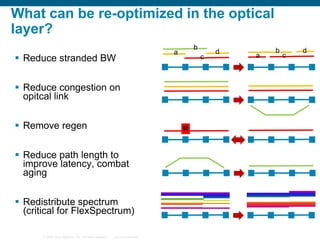
 Reduce stranded BW

b

a

c

 Reduce congestion on
opitcal link

 Remove regen

R

 Reduce path length to
improve latency, combat
aging
 Redistribute spectrum
(critical for FlexSpectrum)
© 2006 Cisco Systems, Inc. All rights reserved.

Cisco Confidential

d

a

b

c

d
How can the IP layer be reoptimized?
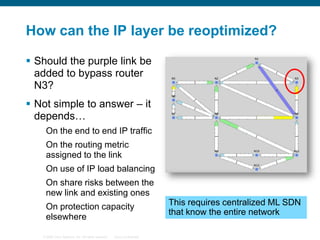
 Should the purple link be
added to bypass router
N3?
 Not simple to answer – it
depends…
On the end to end IP traffic
On the routing metric
assigned to the link
On use of IP load balancing
On share risks between the
new link and existing ones
On protection capacity
elsewhere
© 2006 Cisco Systems, Inc. All rights reserved.

Cisco Confidential

This requires centralized ML SDN
that know the entire network
Striking the right balance between
distributed and centralized control

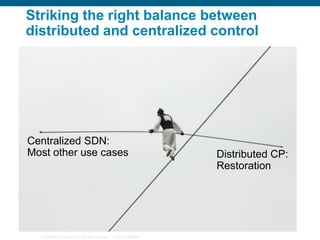
Centralized SDN:
Most other use cases

© 2006 Cisco Systems, Inc. All rights reserved.

Cisco Confidential

Distributed CP:
Restoration
Quantifying the savings

[To be published in IEEE Comm. Mag., 1-2/2014]
© 2006 Cisco Systems, Inc. All rights reserved.

Cisco Confidential
Outline
 Intro to SP core networks
 Challenges
• The shrinking gap between network cost and revenues
• Are we approaching the limit of fiber capacity?

• Cost of DWDM optics not dropping fast enough
• The reducing accuracy of traffic forecasts

 Solution components
• Agile and elastic optical networking
• Multi layer coordination (control plane)
• Multi layer optimization (SDN)

 Summary
© 2006 Cisco Systems, Inc. All rights reserved.

Cisco Confidential
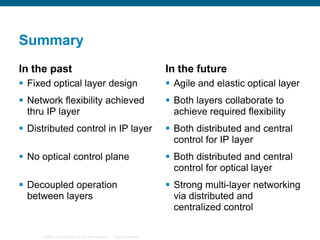
Summary
In the past

In the future

 Fixed optical layer design

 Agile and elastic optical layer

 Network flexibility achieved
thru IP layer

 Both layers collaborate to
achieve required flexibility

 Distributed control in IP layer

 Both distributed and central
control for IP layer

 No optical control plane

 Both distributed and central
control for optical layer

 Decoupled operation
between layers

 Strong multi-layer networking
via distributed and
centralized control

© 2006 Cisco Systems, Inc. All rights reserved.

Cisco Confidential
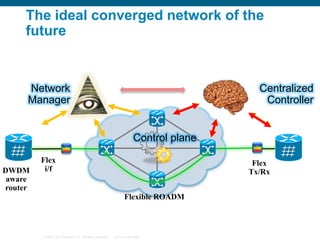
The ideal converged network of the
future

Network
Manager

Centralized
Controller

Control plane
DWDM
aware
router

Flex
i/f

Flex
Tx/Rx
Flexible ROADM

© 2006 Cisco Systems, Inc. All rights reserved.

Cisco Confidential
A final note on IP-optical collaboration
The whole is greater than
the sum of its parts
Aristotle

© 2006 Cisco Systems, Inc. All rights reserved.

Cisco Confidential
Thank You!

ogerstel@cisco.com

© 2006 Cisco Systems, Inc. All rights reserved.

Cisco Confidential

Plenary talk by Ori Gerstel at ACP13 on IP-optical collaboration

  • 1.
    The Age ofMulti-Layer Networking Ori Gerstel, Principal Engineer ogerstel@cisco.com © 2006 Cisco Systems, Inc. All rights reserved. Cisco Confidential
  • 2.
    Outline  Challenges • Theshrinking gap between network cost and revenues • Are we approaching the limit of fiber capacity? • Cost of DWDM optics not dropping fast enough • The reducing accuracy of traffic forecasts  Solution components • Agile and elastic optical networking • Multi layer coordination (control plane) • Multi layer optimization (SDN)  Summary © 2006 Cisco Systems, Inc. All rights reserved. Cisco Confidential
  • 3.
    Challenge 1: NetworkOperator ROI Telecom Revenue growth is limited (GDP based) $2,500 (30-100% CAGR) 60 Wireless Fixed line $1,500 Exabytes per month $ Billions $2,000 Internet traffic growth is high $1,000 $500 30 Mobility Business Internet Business IP WAN Consumer Internet Consumer IPTV/CATV $- 2008 2009 2010 2011 2012 2013 0 2008 2009 2010 2011 2012 2013 Source: Independent Analyst Research and Cisco Analysis; Cisco Visual Networking Index © 2006 Cisco Systems, Inc. All rights reserved. Cisco Confidential
  • 4.
    Challenge 2: howto achieve 10x capacity in the next 10 years? [Courtesy of David J. Richardson, adapted from “Filling the Light Pipe”, Science 15 October 2010] © 2006 Cisco Systems, Inc. All rights reserved. Cisco Confidential
  • 5.
    Challenge 3: Thecost of DWDM optics does not drop fast enough © 2006 Cisco Systems, Inc. All rights reserved. Cisco Confidential
  • 6.
    Can SDM help? Tx Tx Tx Tx Rx Rx Rx Rx Tx Tx Tx Tx Rx Rx Rx Rx Tx Tx Tx Tx Rx Rx Rx Rx Parallelsystems help challenge 2 but not challenge 3 © 2006 Cisco Systems, Inc. All rights reserved. Cisco Confidential
  • 7.
    Can SDM help? Tx Tx Tx Tx Rx Rx Rx Rx Tx Tx Tx Tx Rx Rx Rx Rx Tx Tx Tx Tx Rx Rx Rx Rx Multi-corefibers + amplifiers + ROADMs will help © 2006 Cisco Systems, Inc. All rights reserved. Cisco Confidential
  • 8.
    Can SDM help? Tx Tx Tx Tx Rx Rx Rx Rx Tx Tx Tx Tx Rx Rx Rx Rx Tx Tx Tx Tx Rx Rx Rx Rx Butmost of the power/cost is in Tx/Rx anyway… Can they be integrated sufficiently to change the equation? © 2006 Cisco Systems, Inc. All rights reserved. Cisco Confidential
  • 9.
    Cisco Confidential Shannon Moore © 2006Cisco Systems, Inc. All rights reserved. Parallelism Insufficient integration A note on Challenge 2 & Challenge 3
  • 10.
    Challenge 4: Growingforecast uncertainty Interactions between SPs and content providers are becoming more complex and change more often The textbook Internet (1995-2007) Source : ATLAS Internet Observatory 2009 Annual Report © 2006 Cisco Systems, Inc. All rights reserved. Cisco Confidential The new Internet (2009 --)
  • 11.
    Challenge 4: Growingforecast uncertainty Mega became a Carpathia Hosting Customer Carpathia Hosting > 0.5% of total Internet Traffic Graph source : ATLAS Internet Observatory 2009 Annual Report  Reasons: • New content (who anticipated that Netflix will be 30% of the peak traffic?) • Changes in hosting arrangements • Changes in peering / transit set-up in the wider Internet • Failures in the wider Internet – changes entry points into SP network • Data Center workload shift internal / external to the Service Provider © 2006 Cisco Systems, Inc. All rights reserved. Cisco Confidential
  • 12.
    A note onChallenge 4 Prediction is very difficult, especially about the future. Niels Bohr © 2006 Cisco Systems, Inc. All rights reserved. Cisco Confidential
  • 13.
    Outline  Intro toSP core networks  Challenges • The shrinking gap between network cost and revenues • Are we approaching the limit of fiber capacity? • Cost of DWDM optics not dropping fast enough • The reducing accuracy of traffic forecasts  Solution components • Agile and elastic optical networking • Multi layer coordination (control plane) • Multi layer optimization (SDN)  Summary © 2006 Cisco Systems, Inc. All rights reserved. Cisco Confidential
  • 14.
    Agile optical networking (a)non-agile solution: 7 wavelengths =Sum(Max{Ai,Bi}) Scenario I: 100 100 300 Scenario II: 200 200 100 © 2006 Cisco Systems, Inc. All rights reserved. Cisco Confidential Required bandwidth Unused wavelength Used wavelength (b) agile solution: 5 wavelengths =Max{Sum(Ai),Sum(Bi)}
  • 15.
    Elastic Optical Networks Flexibleuse of Spectrum 50GHz slice 40G Fixed Grid Rigid 50GHz slice 100G 4x50GHz slices Elastic 400G 40G 25GHz slice Flex Spectrum 100GHz slice 400G © 2006 Cisco Systems, Inc. All rights reserved. 50GHz 200GHz Future 25GHz Cisco Confidential
  • 16.
    Elastic Optical Networks AdaptiveReach 100G Fixed Grid 1000 Km 3000 Km 100G  Current approach: the only way to extend the reach is to add regens Regens  much higher CAPEX & OPEX  What if only 30G are needed for the client layer? Not only is the channel going to be under-utilized, it is also going to be unnecessarily regenerated… © 2006 Cisco Systems, Inc. All rights reserved. Cisco Confidential
  • 17.
    Elastic Optical Networks AdaptiveReach Rigid 100G Fixed Grid 1000 Km 3000 Km Elastic 100G 30G 3000 Km sending less data Flex Spectrum 3000 Km using more spectrum 100G © 2006 Cisco Systems, Inc. All rights reserved. 50GHz 200GHz Future 25GHz Cisco Confidential
  • 18.
    What this meansto the IP layer?  In the past, routers focused on features, services etc. Instead of managing capacity growth carefully, it was added liberally to avoid complex management Optical capacity was considered nearly unlimited  Since the optical layer is becoming the expensive and limited resource, the main optimization goal of the router may become to optimally use optical resources © 2006 Cisco Systems, Inc. All rights reserved. Cisco Confidential
  • 19.
    What this meansto the IP layer?  Implications • The router must drive the requirements for optical connections • The optical layer will “right size” the link to the router needs • The router must be aware of the cost of the bandwidth on each link • The IP layer must add/remove optical connections based on traffic needs • More extensive use of traffic engineering in the IP layer, including bandwidth constraints © 2006 Cisco Systems, Inc. All rights reserved. Cisco Confidential
  • 20.
    IP-optical interaction: Use case1: “sunny day” scenario  The routers know how much BW they need and what constraints they care about: e.g., latency, SRLGs  The ON tries to satisfy the request at lowest cost, taking into account: TXPs used, regens used, spectrum used, distance, …  It informs the router that the path has been established Give me 100G to 1 router B with these constraints… 2 Router A © 2006 Cisco Systems, Inc. All rights reserved. OK, Here it is Router B Cisco Confidential
  • 21.
    IP-optical interaction: Use case2  The ON cannot satisfy the request  The ON informs the router and lets the router relax its constraints (higher latency, lower capacity,..)  The router issues a new request, which hopefully can be satisfied Can’t do it. 2 Do you want to try something else? OK, inme 100G to Give this case, can 3 1 you give me this path router B with these with less constraints? constraints… Router A © 2006 Cisco Systems, Inc. All rights reserved. Router B Cisco Confidential
  • 22.
    IP-optical interaction: Use case3  The ON can satisfy the request, but the cost is high (e.g., need regens)  Should the ON inform the router and let the router relax its constraints?  How does the ON know that there is a cheaper option? Or is this a blind search? 3 This is expensive. 2 Do you want to try something else? OK, in this case, can you give me this path with less constraints? Router A © 2006 Cisco Systems, Inc. All rights reserved. Router B Cisco Confidential
  • 23.
    IP-optical interaction: Use case4: restoration  The original path failed. ON informs the router and receives a new path request from the router  The new request can have the same constraints as the old request  Or it may have a relaxed set of constraints (even less capacity)  Or it may be unconstrained  Or the IP layer may choose not to restore the path 3 The path failed. 2 What do you want to do? Can you give me this path with same/less constraints? Router A © 2006 Cisco Systems, Inc. All rights reserved. Router B Cisco Confidential
  • 24.
    Striking the rightbalance between distributed and centralized control © 2006 Cisco Systems, Inc. All rights reserved. Cisco Confidential
  • 25.
    Striking the rightbalance between distributed and centralized control Distributed control sweet-spot Centralized control sweet-spot • Optimized for restoration • Optimized for network optimization • Localized changes • Global network changes • Good enough for customers with basic agility needs • Adds value for customers expecting advanced features • Highly survivable – even during large scale disasters • Less available – unless significant complexity is added • Harder to extend • Ease of extending the code A combination of both is needed for an optimal solution © 2006 Cisco Systems, Inc. All rights reserved. Cisco Confidential
  • 26.
    Striking the balancebetween distributed and centralized intelligence – not our invention… Centralized control Distributed control © 2006 Cisco Systems, Inc. All rights reserved. Cisco Confidential
  • 27.
    Hybrid solution: Centraldecision + distributed execution Central controller 1. Central controller learns optical network from (a) Optical layer, (b) Routed Layer 2 1b R1 R3 3 1a O3 O1 O2 © 2006 Cisco Systems, Inc. All rights reserved. Cisco Confidential 2. Central controller triggers creation of new link by provisioning the router with policies 3. GMPLS-UNI creates the optical circuit leveraging WSON
  • 28.
    Basic multi-layer optimization The ability to hitlessly reroute optical paths helps both IP layer and optical layer Agile IP layer Static DWDM layer Agile DWDM layer © 2006 Cisco Systems, Inc. All rights reserved. Cisco Confidential Improving the IP layer: • Reduce link latency • Improve link diversity Improving the optical layer: • Reduce path distance • Reduce regens • Reduce congestion
  • 29.
    What can bere-optimized in the optical layer?  Reduce stranded BW b a c  Reduce congestion on opitcal link  Remove regen R  Reduce path length to improve latency, combat aging  Redistribute spectrum (critical for FlexSpectrum) © 2006 Cisco Systems, Inc. All rights reserved. Cisco Confidential d a b c d
  • 30.
    How can theIP layer be reoptimized?  Should the purple link be added to bypass router N3?  Not simple to answer – it depends… On the end to end IP traffic On the routing metric assigned to the link On use of IP load balancing On share risks between the new link and existing ones On protection capacity elsewhere © 2006 Cisco Systems, Inc. All rights reserved. Cisco Confidential This requires centralized ML SDN that know the entire network
  • 31.
    Striking the rightbalance between distributed and centralized control Centralized SDN: Most other use cases © 2006 Cisco Systems, Inc. All rights reserved. Cisco Confidential Distributed CP: Restoration
  • 32.
    Quantifying the savings [Tobe published in IEEE Comm. Mag., 1-2/2014] © 2006 Cisco Systems, Inc. All rights reserved. Cisco Confidential
  • 33.
    Outline  Intro toSP core networks  Challenges • The shrinking gap between network cost and revenues • Are we approaching the limit of fiber capacity? • Cost of DWDM optics not dropping fast enough • The reducing accuracy of traffic forecasts  Solution components • Agile and elastic optical networking • Multi layer coordination (control plane) • Multi layer optimization (SDN)  Summary © 2006 Cisco Systems, Inc. All rights reserved. Cisco Confidential
  • 34.
    Summary In the past Inthe future  Fixed optical layer design  Agile and elastic optical layer  Network flexibility achieved thru IP layer  Both layers collaborate to achieve required flexibility  Distributed control in IP layer  Both distributed and central control for IP layer  No optical control plane  Both distributed and central control for optical layer  Decoupled operation between layers  Strong multi-layer networking via distributed and centralized control © 2006 Cisco Systems, Inc. All rights reserved. Cisco Confidential
  • 35.
    The ideal convergednetwork of the future Network Manager Centralized Controller Control plane DWDM aware router Flex i/f Flex Tx/Rx Flexible ROADM © 2006 Cisco Systems, Inc. All rights reserved. Cisco Confidential
  • 36.
    A final noteon IP-optical collaboration The whole is greater than the sum of its parts Aristotle © 2006 Cisco Systems, Inc. All rights reserved. Cisco Confidential
  • 37.
    Thank You! ogerstel@cisco.com © 2006Cisco Systems, Inc. All rights reserved. Cisco Confidential

Editor's Notes

  • #5 65nm 28nm  22nm