INTERNET OF THINGS (IOT)
ENABLED DEVICES IN HEALTHCARE SECTOR
A Presentation
on
Presented by
Mr. Bapi Biswas
PhD Scholar
Department of Mechanical Engineering
Vishwavidyalaya Engineering College Ambikapur
Table of Content
 IoT Definition
 How IoT works?
 IoT in Health Care
 IoT Applications
 Opportunities of IoT in healthcare
 IoT-Medical Devices
 Implementation Strategies and Methodologies of IoT Healthcare
 Conclusions
 References
IoT Definition
• “The Internet of Things (IoT) is a system of interrelated computing
devices, mechanical and digital machines, objects, animals or
people that are provided with unique identifiers and the ability to
transfer data over a network without requiring human-to-human
or human-to-computer interaction.”
How IoT works?
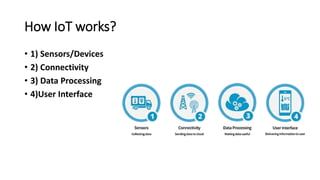
• 1) Sensors/Devices
• 2) Connectivity
• 3) Data Processing
• 4)User Interface
Example of an Internet of Things device
• Remote patient monitoring
• Glucose monitoring
• Heart-rate monitoring
• Hand hygiene monitoring
• Connected inhalers
• Robotic surgery
• Automated Remote Sensing Wheelchair for Covid Patients.
IoT in Health Care
There is lot of improvement in automation for betterment of
patient during pandemic or Emergency.
The healthcare services, such as medical rehabilitation, are
concerned, an IoT-based system makes it possible to provide ‘one
stop’ service to the residents conveniently even at remote
locations.
To integrate connected technology into mechanical devices to aid
remote patient monitoring
CONCLUSIONS
IoT brings significant changes to improve the facilities and information
system during Pandemic or critical situation.
It improves the digitalization of medical processes and proper
management in hospitals.
IoT opens new applications in medicine when the device/instruments
are being connected to the Internet.
For patients, internet-connected devices are being introduced in
different forms, to monitor patient health more effectively.
FUTURE SCOPE
In the future, IoT will monitor vital signs of the patient in a real-time
environment.
There will be a major enhancement in healthcare practice, using the latest
technologies.
IoT intelligent device would be performing autonomously.
There will be data storage with private and public cloud.
This disruptive innovation of the information system will facilitate
intelligent healthcare service in the Medical environment.
REFERENCES
1. J Oral Biol Craniofac Res. 2021 Apr-Jun; 11(2): 209–214. Published online 2021 Jan 30. doi: 10.1016/j
.jobcr. 2021.01.015
2. Nasajpour M., Pouriyeh S., Parizi R.M., Dorothy M., Valero M., Arabnia H.R. Internet of Things for
current COVID-19 and future pandemics: an exploratory study. J Healthc Inf Res. 2020 Nov 12:1–
40. [PMC free article] [PubMed] [Google Scholar]
3. Liu Y., Dong B., Guo B., Peng W. Combination of cloud computing and Internet of things (IoT) in medical
monitoring systems. Int J Hospit Inf Technol. 2015;8(12):367–376. [Google Scholar]
4. Shin D., Hwang Y. Integrated acceptance and sustainability evaluation of Internet of Medical Things: a
dual-level analysis. Internet Res. 2017;27(5):1227–1254. [Google Scholar]
5. Rahman M.S., Peeri N.C., Shrestha N., Zaki R., Haque U., Ab Hamid S.H. Defending against the novel
coronavirus (COVID-19) outbreak: how can the internet of things (IoT) help to save the world? Health Pol
Technol. 2020 Apr 22 [PMC free article] [PubMed] [Google Scholar]
Thank You

Iot-Internet-of-Things-ppt.pptx

  • 1.
    INTERNET OF THINGS(IOT) ENABLED DEVICES IN HEALTHCARE SECTOR A Presentation on Presented by Mr. Bapi Biswas PhD Scholar Department of Mechanical Engineering Vishwavidyalaya Engineering College Ambikapur
  • 2.
    Table of Content IoT Definition  How IoT works?  IoT in Health Care  IoT Applications  Opportunities of IoT in healthcare  IoT-Medical Devices  Implementation Strategies and Methodologies of IoT Healthcare  Conclusions  References
  • 3.
    IoT Definition • “TheInternet of Things (IoT) is a system of interrelated computing devices, mechanical and digital machines, objects, animals or people that are provided with unique identifiers and the ability to transfer data over a network without requiring human-to-human or human-to-computer interaction.”
  • 4.
    How IoT works? •1) Sensors/Devices • 2) Connectivity • 3) Data Processing • 4)User Interface
  • 5.
    Example of anInternet of Things device • Remote patient monitoring • Glucose monitoring • Heart-rate monitoring • Hand hygiene monitoring • Connected inhalers • Robotic surgery • Automated Remote Sensing Wheelchair for Covid Patients.
  • 6.
    IoT in HealthCare There is lot of improvement in automation for betterment of patient during pandemic or Emergency. The healthcare services, such as medical rehabilitation, are concerned, an IoT-based system makes it possible to provide ‘one stop’ service to the residents conveniently even at remote locations. To integrate connected technology into mechanical devices to aid remote patient monitoring
  • 8.
    CONCLUSIONS IoT brings significantchanges to improve the facilities and information system during Pandemic or critical situation. It improves the digitalization of medical processes and proper management in hospitals. IoT opens new applications in medicine when the device/instruments are being connected to the Internet. For patients, internet-connected devices are being introduced in different forms, to monitor patient health more effectively.
  • 9.
    FUTURE SCOPE In thefuture, IoT will monitor vital signs of the patient in a real-time environment. There will be a major enhancement in healthcare practice, using the latest technologies. IoT intelligent device would be performing autonomously. There will be data storage with private and public cloud. This disruptive innovation of the information system will facilitate intelligent healthcare service in the Medical environment.
  • 10.
    REFERENCES 1. J OralBiol Craniofac Res. 2021 Apr-Jun; 11(2): 209–214. Published online 2021 Jan 30. doi: 10.1016/j .jobcr. 2021.01.015 2. Nasajpour M., Pouriyeh S., Parizi R.M., Dorothy M., Valero M., Arabnia H.R. Internet of Things for current COVID-19 and future pandemics: an exploratory study. J Healthc Inf Res. 2020 Nov 12:1– 40. [PMC free article] [PubMed] [Google Scholar] 3. Liu Y., Dong B., Guo B., Peng W. Combination of cloud computing and Internet of things (IoT) in medical monitoring systems. Int J Hospit Inf Technol. 2015;8(12):367–376. [Google Scholar] 4. Shin D., Hwang Y. Integrated acceptance and sustainability evaluation of Internet of Medical Things: a dual-level analysis. Internet Res. 2017;27(5):1227–1254. [Google Scholar] 5. Rahman M.S., Peeri N.C., Shrestha N., Zaki R., Haque U., Ab Hamid S.H. Defending against the novel coronavirus (COVID-19) outbreak: how can the internet of things (IoT) help to save the world? Health Pol Technol. 2020 Apr 22 [PMC free article] [PubMed] [Google Scholar]
  • 11.

Editor's Notes

  • #3 For improve the healthcare sector and treatment outcome Internet of Things (IoT) is already being implemented. We realised that there is lot of improvement in automation for betterment of patient during pandemic in 2019 [1]. The healthcare services, such as medical rehabilitation, are concerned, an IoT-based system makes it possible to provide ‘one stop’ service to the residents conveniently even at remote locations. In contrast to conventional on-site rehabilitation service at local hospitals, all the related resources are shared within communities through smart rehabilitation to provide flexible and convenient treatment to patients. In this way, the utilization of rehabilitation resources can be maximized and it can be anticipated that the IoT-based intelligent technology would be- come an irreplaceable tool in modern healthcare systems [2]. The IoT is a system of interrelated computing devices, and machines (digital and mechanical), which are provided with unique identifiers. These have the ability to transfer data over a network without requiring human-to-human or human-to-computer interaction.[3]
  • #5 Sensors or devices are a key component that helps you to collect live data from the surrounding environment. All this data may have various levels of complexities. It could be a simple temperature monitoring sensor, or it may be in the form of the video feed. Conectivity All the collected data is sent to a cloud infrastructure. The sensors should be connected to the cloud using various mediums of communications. These communication mediums include mobile or satellite networks, Bluetooth, WI-FI, WAN, etc. Data Once that data is collected, and it gets to the cloud, the software performs processing on the gathered data. This process can be just checking the temperature, reading on devices like AC or heaters. However, it can sometimes also be very complex like identifying objects, using computer vision on video. User The information needs to be available to the end-user in some way which can be achieved by triggering alarms on their phones or sending them notification through email or text message. The user sometimes might need an interface which actively checks their IoT system. For example, the user has a camera installed in his home. He wants to access video recording and all the feeds with the help of a web server.
  • #7 For improve the healthcare sector and treatment outcome Internet of Things (IoT) is already being implemented. We realised that there is lot of improvement in automation for betterment of patient during pandemic in 2019 [1]. The healthcare services, such as medical rehabilitation, are concerned, an IoT-based system makes it possible to provide ‘one stop’ service to the residents conveniently even at remote locations. In contrast to conventional on-site rehabilitation service at local hospitals, all the related resources are shared within communities through smart rehabilitation to provide flexible and convenient treatment to patients. In this way, the utilization of rehabilitation resources can be maximized and it can be anticipated that the IoT-based intelligent technology would be- come an irreplaceable tool in modern healthcare systems [2]. The IoT is a system of interrelated computing devices, and machines (digital and mechanical), which are provided with unique identifiers. These have the ability to transfer data over a network without requiring human-to-human or human-to-computer interaction.[3]
  • #9 There has been a rise in the enthusiasm for wearable devices for nonstop finding. Movements to the stable hi-tech developments like Artificial Intelligence, Machine Learning, Virtual Reality (VR), Augmented Reality will have more than predicted influences in healthcare Industry. IoT would be the point of convergence for all developments, without which none of them would genuinely incorporate any regard. In medical, IoT brings significant changes to improve the facilities and information system during Pandemic or critical situation. It improves the digitisation of medical processes and proper management in hospitals. IoT opens new applications in medicine when the device/instruments are being connected to the Internet. For patients, internet-connected devices are being introduced in different forms, to monitor patient health more effectively. It alerts about public health problems by tracking climate change. This technology gives way for the proper management of the hospital during any Pandemic or medical emegency. It plays a significant role in monitoring the drug by providing validated information. This information can also help the proper distribution process of the right patient’s right equipment/device.