THE INTERNET OF THINGS (IOT) AS
A DEVELOPMENT TOOL
GSMA & open learning campus course
INTERNET OF THINGS
• « IoT defined as the use of intelligently connected devices and systems
to leverage data gathered by embedded sensors and actuators in
machines and other physical objects » -GSMA
• A large focus on how computers, sensors, and objects interact and
process data with one another – FTC
• « The interconnection of multiple M2M applications, often enabling the
exchange of data across multiple industry sectors. » Ofcom
COMMON ELEMENTS OF IOT
• Network – to provide connectivity
• Can be private or the internet
• Data – transmitted and received by IoT solution
• Can come from multiple sources or single source
• Device – integrated in a new or existing device
• Existing device where IoT integrate to enhance its feature or a new product where
viable
• Sensor -data is capture by sensors used to trigger reaction by actuators
(source GSMA)
• SENSOR AND ACTUATOR or a sensor
IOT IN DEVELOPING COUNTRIES
• Still a nascent tool that can be used to improve lives and livelihoods in
health and agriculture
• In health, it is being used to increase coverage of vaccinations in Haiti and Kenya
• In agriculture, it is being used to track soil quality for farmers to increase yield
• Can face many inhibitors however:
• Technology limitations
• Lack of network coverage
• Lack of investment
• Lack of infrastructure for growth of IoT
• Government not properly promoting IoT
IOT APPLICATION IN HAÏTI
• Need being addressed :
• Vaccines are one of the most effective
medical interventions and more than 3
million people die each year as a result
of vaccine-preventable diseases
• Unreliable electricity and inconsistent
infrastructure often make vaccines
unsafe
• According to WHO-UNICEF, 55% of
health facilities in rural areas have
fridges that don’t function at all,
destroying vaccines in the process
IOT SOLUTION: COLDTRACE
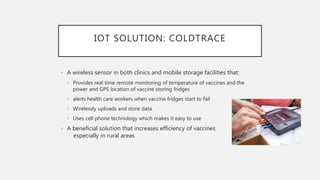
• A wireless sensor in both clinics and mobile storage facilities that:
• Provides real time remote monitoring of temperature of vaccines and the
power and GPS location of vaccine storing fridges
• alerts health care workers when vaccine fridges start to fail
• Wirelessly uploads and store data
• Uses cell phone technology which makes it easy to use
• A beneficial solution that increases efficiency of vaccines
especially in rural areas
TECHNOLOGY OF COLDTRACE
Feature Description Comment
Connectivity cost Medium The sensor sends an SMS to health staff if the fridge
reaches a critical temperature
Network area Wide area Health facilities in rural areas will need significant
signal coverage
Spectrum Dedicated Quality service of transmission is not crucial
Battery life Low High battery life is crucial for the sensors to be in
remote rural health facilities
Module cost Low Sensors are low cost allowing easy access for
developing countries
Bandwidth Low Only temperature data is being transmitted
Technology category 2G ColdTrace uploads data from the fridge’ temperature
via 2G network
BUSINESS MODELS FOR IOT SOLUTIONS
LIKELY BUSINESS MODEL OF
COLDTRACE
• Product – as -a- service where the ministry of health rent the sensors
from the IoT company, whom is then responsible for installation and
maintenance of the sensors
OPERATIONAL CONSIDERATIONS
• Network coverage – maybe some
health facilities aren’t within the 2G
network
• Interference – system failures are
possible
• Business model – costs could become
a problem in the future especially for
maintenance
• Legal framework for ColdTrace –
contract needs to be clear between
the government and the IoT company
• Liability – if the system fails and the
vaccines go bad, it needs to be clear
who is to blame
POLICY AREAS
OPERATIONAL ISSUES AND POLICY
TOPICS
CONCLUSION
• In conclusion, coldtrace has the potential to solve many of Haiti's
vaccination problems. Using 2g and cellular technology makes the
system more adaptable to the reality of a developing country, but at the
same time, it should ensure that all health facilities in remote areas can
use the network.
Image from Nexleaf
SOURCES
• World Health Organization. Immunization coverage. January 2018.
Accessed july 19, 2018
• Vaccines – Nexleaf Analytics. (n.d.). Retrieved August 3, 2018, from
https://nexleaf.org/vaccines/
• Internet of Things: GSMA & OLC Session 1. (n.d.). Retrieved August 3,
2018, from https://www.gsmatraining.com/courses/internet-of-things-a-
gsma-open-learning-campus-partnership/lessons/internet-of-things-
gsma-olc-session-1/

IoT Final Project

  • 1.
    THE INTERNET OFTHINGS (IOT) AS A DEVELOPMENT TOOL GSMA & open learning campus course
  • 2.
    INTERNET OF THINGS •« IoT defined as the use of intelligently connected devices and systems to leverage data gathered by embedded sensors and actuators in machines and other physical objects » -GSMA • A large focus on how computers, sensors, and objects interact and process data with one another – FTC • « The interconnection of multiple M2M applications, often enabling the exchange of data across multiple industry sectors. » Ofcom
  • 3.
    COMMON ELEMENTS OFIOT • Network – to provide connectivity • Can be private or the internet • Data – transmitted and received by IoT solution • Can come from multiple sources or single source • Device – integrated in a new or existing device • Existing device where IoT integrate to enhance its feature or a new product where viable • Sensor -data is capture by sensors used to trigger reaction by actuators (source GSMA) • SENSOR AND ACTUATOR or a sensor
  • 4.
    IOT IN DEVELOPINGCOUNTRIES • Still a nascent tool that can be used to improve lives and livelihoods in health and agriculture • In health, it is being used to increase coverage of vaccinations in Haiti and Kenya • In agriculture, it is being used to track soil quality for farmers to increase yield • Can face many inhibitors however: • Technology limitations • Lack of network coverage • Lack of investment • Lack of infrastructure for growth of IoT • Government not properly promoting IoT
  • 5.
    IOT APPLICATION INHAÏTI • Need being addressed : • Vaccines are one of the most effective medical interventions and more than 3 million people die each year as a result of vaccine-preventable diseases • Unreliable electricity and inconsistent infrastructure often make vaccines unsafe • According to WHO-UNICEF, 55% of health facilities in rural areas have fridges that don’t function at all, destroying vaccines in the process
  • 6.
    IOT SOLUTION: COLDTRACE •A wireless sensor in both clinics and mobile storage facilities that: • Provides real time remote monitoring of temperature of vaccines and the power and GPS location of vaccine storing fridges • alerts health care workers when vaccine fridges start to fail • Wirelessly uploads and store data • Uses cell phone technology which makes it easy to use • A beneficial solution that increases efficiency of vaccines especially in rural areas
  • 7.
    TECHNOLOGY OF COLDTRACE FeatureDescription Comment Connectivity cost Medium The sensor sends an SMS to health staff if the fridge reaches a critical temperature Network area Wide area Health facilities in rural areas will need significant signal coverage Spectrum Dedicated Quality service of transmission is not crucial Battery life Low High battery life is crucial for the sensors to be in remote rural health facilities Module cost Low Sensors are low cost allowing easy access for developing countries Bandwidth Low Only temperature data is being transmitted Technology category 2G ColdTrace uploads data from the fridge’ temperature via 2G network
  • 8.
    BUSINESS MODELS FORIOT SOLUTIONS
  • 9.
    LIKELY BUSINESS MODELOF COLDTRACE • Product – as -a- service where the ministry of health rent the sensors from the IoT company, whom is then responsible for installation and maintenance of the sensors
  • 10.
    OPERATIONAL CONSIDERATIONS • Networkcoverage – maybe some health facilities aren’t within the 2G network • Interference – system failures are possible • Business model – costs could become a problem in the future especially for maintenance • Legal framework for ColdTrace – contract needs to be clear between the government and the IoT company • Liability – if the system fails and the vaccines go bad, it needs to be clear who is to blame POLICY AREAS OPERATIONAL ISSUES AND POLICY TOPICS
  • 11.
    CONCLUSION • In conclusion,coldtrace has the potential to solve many of Haiti's vaccination problems. Using 2g and cellular technology makes the system more adaptable to the reality of a developing country, but at the same time, it should ensure that all health facilities in remote areas can use the network. Image from Nexleaf
  • 12.
    SOURCES • World HealthOrganization. Immunization coverage. January 2018. Accessed july 19, 2018 • Vaccines – Nexleaf Analytics. (n.d.). Retrieved August 3, 2018, from https://nexleaf.org/vaccines/ • Internet of Things: GSMA & OLC Session 1. (n.d.). Retrieved August 3, 2018, from https://www.gsmatraining.com/courses/internet-of-things-a- gsma-open-learning-campus-partnership/lessons/internet-of-things- gsma-olc-session-1/