Introduction to ElectricMotors and Their
Importance
Essential for Modern Life
Electric motors power countless devices, from household
appliances to industrial machinery, driving economic
growth and technological advancement.
Unveiling the Heart of Industry
Electric motors are vital to manufacturing, transportation,
and energy generation, playing a crucial role in modern
industrial processes.
3.
Abstract
At present, industriesare rapidly shifting towards automation. Today's industrial automations mostly based on
programmable controllers and robots. In order to do the tedious work and to serve the mankind, automation is developed in
industries. DC motor plays an important role in various industries hence we selected it. This project present a system to
provide protection, control and monitoring the condition of DC motor. Here Arduino Uno and various sensors like current,
voltage, speed and temperature sensors are used. Real time values of various parameters like current, voltage, temperature
and speed can be monitored in ThingSpeak mobile app. By continuous monitoring, the motor can be protected against fault
like short circuits, overloading, overheating etc. hence machine performance is improved.
4.
Methodology
1 Sensor Integration
Real-timemonitoring of
motor parameters
2 Data Transmission
Secure communication via
wireless networks
3 AI-Driven Analysis
Pattern recognition and
fault prediction
4 Alerting and
Diagnostics
Prompt notifications and
comprehensive diagnostics
5.
Block Diagram
1
Sensors
Temperature, vibration,current
2
Data Processing
Filtering, normalization
3
Communication
Wireless, wired
4
Cloud Platform
Fault detection algorithms
5
User Interface
Alerts, reports, analysis
6.
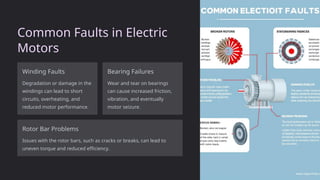
Common Faults inElectric
Motors
Winding Faults
Degradation or damage in the
windings can lead to short
circuits, overheating, and
reduced motor performance.
Bearing Failures
Wear and tear on bearings
can cause increased friction,
vibration, and eventually
motor seizure.
Rotor Bar Problems
Issues with the rotor bars, such as cracks or breaks, can lead to
uneven torque and reduced efficiency.
7.
IoT-Based Fault Detection
SystemArchitecture
Sensors
Sensors collect data from the motor,
including vibration, temperature, and
current readings.
Data Gateway
The gateway receives data from
sensors and transmits it to the cloud
platform for processing.
Cloud Platform
The cloud platform stores, analyzes,
and interprets data to identify
potential motor faults.
User Interface
A user interface provides real-time
insights and alerts to operators and
maintenance personnel.
9.
Real-World Implementation and
CaseStudies
50%
Downtime Reduction
Implementations have shown significant
reductions in downtime and maintenance
costs due to proactive fault detection.
20%
Increased Efficiency
Early detection of faults allows for
preventive maintenance, boosting overall
motor efficiency and performance.
95%
Accuracy
IoT-based systems offer high accuracy in
detecting motor faults, leading to
improved decision-making.
10.
Limitations of Traditional
FaultDetection Methods
1 Reactive Maintenance
Traditional methods often
rely on periodic inspections,
leading to reactive
maintenance and potential
costly downtime.
2 Limited Scope
Many methods lack the
ability to monitor critical
parameters continuously
and detect subtle changes in
motor performance.
Human Error
Manual inspections can be subjective and prone to human error,
potentially overlooking early signs of motor problems.
Conclusion
IoT-based fault detectionrevolutionizes motor maintenance, leading to
increased efficiency, reduced downtime, and improved safety for a wide
range of industries.