 The Internet of things (IOT) is the network of devices,
vehicles, and home appliances that contain electronics,
software and connectivity which allows these things to
connect, interact and exchange data.
 Devices can communicate and interact over the Internet,
and they can be remotely monitored and controlled.
What is IOT?
 The term Internet of Things is 16 years old. But the actual
idea of connected devices had been around longer, at least
since the 70s. Back then, the idea was often called “embedded
internet” or “pervasive computing”.
 But the actual term “Internet of Things” was coined by Kevin
Ashton in 1999 during his work at Procter & Gamble. Ashton
who was working in supply chain optimization, wanted to
attract senior management’s attention to a new exciting
technology called RFID. Because the internet was the hottest
new trend in 1999 and because it somehow made sense, he
called his presentation “Internet of Thing
History of IOT
 M2M (Machine to Machine)
 “Internet of Everything” (Cisco Systems)
 “World Size Web” (Bruce Schneier)
 “Skynet” (Terminator movie)
Various Name of IOT
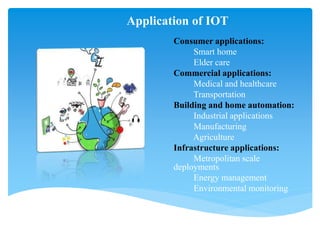
Application of IOT
Consumer applications:
Smart home
Elder care
Commercial applications:
Medical and healthcare
Transportation
Building and home automation:
Industrial applications
Manufacturing
Agriculture
Infrastructure applications:
Metropolitan scale
deployments
Energy management
Environmental monitoring
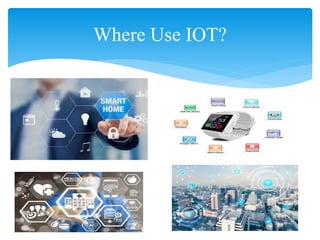
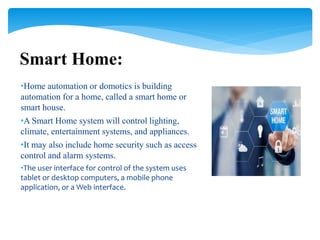
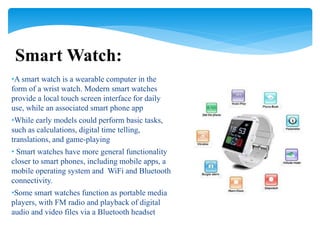
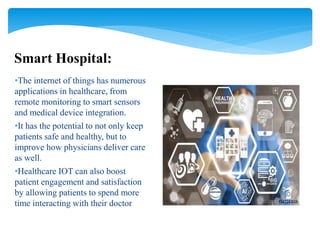
Where Use IOT?
•Home automation or domotics is building
automation for a home, called a smart home or
smart house.
•A Smart Home system will control lighting,
climate, entertainment systems, and appliances.
•It may also include home security such as access
control and alarm systems.
•The user interface for control of the system uses
tablet or desktop computers, a mobile phone
application, or a Web interface.
Smart Home:
•A smart watch is a wearable computer in the
form of a wrist watch. Modern smart watches
provide a local touch screen interface for daily
use, while an associated smart phone app
•While early models could perform basic tasks,
such as calculations, digital time telling,
translations, and game-playing
• Smart watches have more general functionality
closer to smart phones, including mobile apps, a
mobile operating system and WiFi and Bluetooth
connectivity.
•Some smart watches function as portable media
players, with FM radio and playback of digital
audio and video files via a Bluetooth headset
Smart Watch:
•The internet of things has numerous
applications in healthcare, from
remote monitoring to smart sensors
and medical device integration.
•It has the potential to not only keep
patients safe and healthy, but to
improve how physicians deliver care
as well.
•Healthcare IOT can also boost
patient engagement and satisfaction
by allowing patients to spend more
time interacting with their doctor
Smart Hospital:
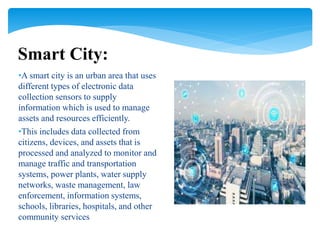
•A smart city is an urban area that uses
different types of electronic data
collection sensors to supply
information which is used to manage
assets and resources efficiently.
•This includes data collected from
citizens, devices, and assets that is
processed and analyzed to monitor and
manage traffic and transportation
systems, power plants, water supply
networks, waste management, law
enforcement, information systems,
schools, libraries, hospitals, and other
community services
Smart City:
 Automation of daily tasks leads to better monitoring of
devices
 Efficient and Saves Time
 Saves Money
 Better Quality of Life
 Automation and Control
 Monitor
 Tracking
Advantage Of IOT
 Compatibility
 Complexity
 Privacy/Security
 Safety
Disadvantage Of IOT

IOT

  • 1.
     The Internetof things (IOT) is the network of devices, vehicles, and home appliances that contain electronics, software and connectivity which allows these things to connect, interact and exchange data.  Devices can communicate and interact over the Internet, and they can be remotely monitored and controlled. What is IOT?
  • 2.
     The termInternet of Things is 16 years old. But the actual idea of connected devices had been around longer, at least since the 70s. Back then, the idea was often called “embedded internet” or “pervasive computing”.  But the actual term “Internet of Things” was coined by Kevin Ashton in 1999 during his work at Procter & Gamble. Ashton who was working in supply chain optimization, wanted to attract senior management’s attention to a new exciting technology called RFID. Because the internet was the hottest new trend in 1999 and because it somehow made sense, he called his presentation “Internet of Thing History of IOT
  • 3.
     M2M (Machineto Machine)  “Internet of Everything” (Cisco Systems)  “World Size Web” (Bruce Schneier)  “Skynet” (Terminator movie) Various Name of IOT
  • 4.
    Application of IOT Consumerapplications: Smart home Elder care Commercial applications: Medical and healthcare Transportation Building and home automation: Industrial applications Manufacturing Agriculture Infrastructure applications: Metropolitan scale deployments Energy management Environmental monitoring
  • 5.
  • 6.
    •Home automation ordomotics is building automation for a home, called a smart home or smart house. •A Smart Home system will control lighting, climate, entertainment systems, and appliances. •It may also include home security such as access control and alarm systems. •The user interface for control of the system uses tablet or desktop computers, a mobile phone application, or a Web interface. Smart Home:
  • 7.
    •A smart watchis a wearable computer in the form of a wrist watch. Modern smart watches provide a local touch screen interface for daily use, while an associated smart phone app •While early models could perform basic tasks, such as calculations, digital time telling, translations, and game-playing • Smart watches have more general functionality closer to smart phones, including mobile apps, a mobile operating system and WiFi and Bluetooth connectivity. •Some smart watches function as portable media players, with FM radio and playback of digital audio and video files via a Bluetooth headset Smart Watch:
  • 8.
    •The internet ofthings has numerous applications in healthcare, from remote monitoring to smart sensors and medical device integration. •It has the potential to not only keep patients safe and healthy, but to improve how physicians deliver care as well. •Healthcare IOT can also boost patient engagement and satisfaction by allowing patients to spend more time interacting with their doctor Smart Hospital:
  • 9.
    •A smart cityis an urban area that uses different types of electronic data collection sensors to supply information which is used to manage assets and resources efficiently. •This includes data collected from citizens, devices, and assets that is processed and analyzed to monitor and manage traffic and transportation systems, power plants, water supply networks, waste management, law enforcement, information systems, schools, libraries, hospitals, and other community services Smart City:
  • 10.
     Automation ofdaily tasks leads to better monitoring of devices  Efficient and Saves Time  Saves Money  Better Quality of Life  Automation and Control  Monitor  Tracking Advantage Of IOT
  • 11.
     Compatibility  Complexity Privacy/Security  Safety Disadvantage Of IOT