Ions
1 of 11 © Boardworks Ltd 2012
2 of 11 © Boardworks Ltd 2012
What are bonds?
3 of 11 © Boardworks Ltd 2012
Elements are made up of just one type of atom, sometimes
joined to other atoms of the same element by chemical
bonds. This forms molecules such as chlorine (Cl2).
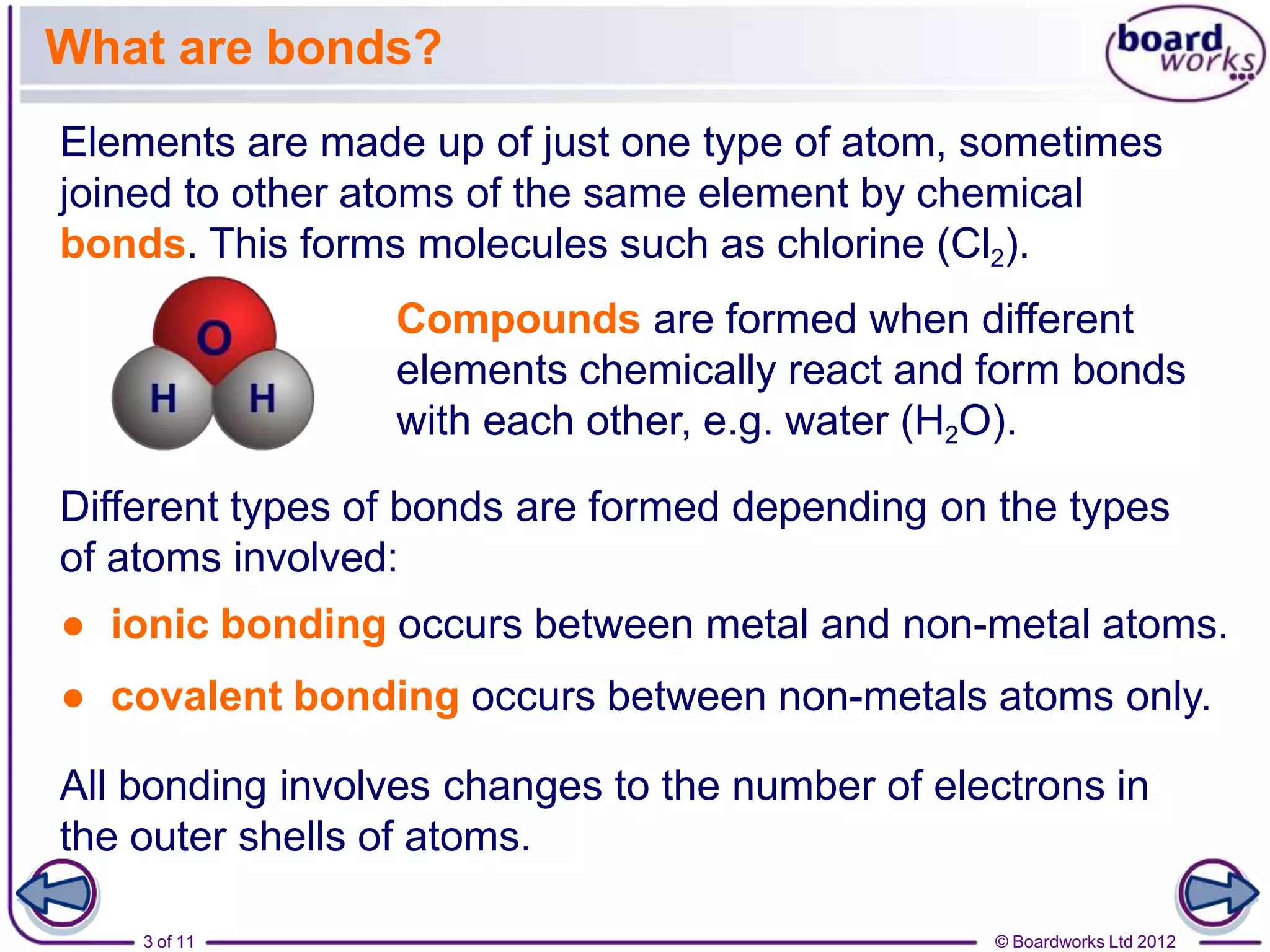
Compounds are formed when different
elements chemically react and form bonds
with each other, e.g. water (H2O).
Different types of bonds are formed depending on the types
of atoms involved:
● ionic bonding occurs between metal and non-metal atoms.
● covalent bonding occurs between non-metals atoms only.
All bonding involves changes to the number of electrons in
the outer shells of atoms.
Why do atoms form bonds?
4 of 11 © Boardworks Ltd 2012
An ion is an atom or group of atoms that has
an electrical charge, either positive or negative.
Atoms have an equal number of protons and electrons and
so do not have an overall charge.
Atoms with incomplete outer electron
shells are unstable. By either gaining or
losing electrons, atoms can obtain full
outer electron shells and become stable,
just like the noble gases.
When this happens, atoms have an unequal number of
protons and electrons and so have an overall charge.
This is how atoms become ions.
How do atoms form ions?
5 of 11 © Boardworks Ltd 2012
Positive and negative ions
6 of 11 © Boardworks Ltd 2012
Building an ion
7 of 11 © Boardworks Ltd 2012
Calculating ion charges
8 of 11 © Boardworks Ltd 2012
What is a compound ion?
Ion Formula Charge Atoms present
hydroxide OH-
-1 O H
sulfate SO4
2-
-2 S O O O O
nitrate NO3
- -1 N O O O
carbonate CO3
2-
-2 C O O O
ammonium NH4
+ +1 N H H H H
Ions can be made up of a single atom or a group of atoms. An
ion made up of a group of atoms is called a compound ion.
What atoms are present in the following compound ions?
9 of 11 © Boardworks Ltd 2012
Comparing positive and negative ions
10 of 11 © Boardworks Ltd 2012
Naming ions and compound ions
There are two common types of ions: –ide ions and –ate ions.
What is the difference?
Generally, –ide ions are negatively-charged ions of an
element, e.g. sulfide (S2-), fluoride (F-), oxide (O2-).
The exception to this rule is the hydroxide ion, which contains
both hydrogen and oxygen (OH-).
–ate ions are negatively-charged compound ions
that include oxygen, e.g. sulfate (SO4
2-), nitrate (NO3
-),
carbonate (CO3
2-).
11 of 11 © Boardworks Ltd 2012

ions-171030062231.pptx

  • 1.
    Ions 1 of 11© Boardworks Ltd 2012
  • 2.
    2 of 11© Boardworks Ltd 2012
  • 3.
    What are bonds? 3of 11 © Boardworks Ltd 2012 Elements are made up of just one type of atom, sometimes joined to other atoms of the same element by chemical bonds. This forms molecules such as chlorine (Cl2). Compounds are formed when different elements chemically react and form bonds with each other, e.g. water (H2O). Different types of bonds are formed depending on the types of atoms involved: ● ionic bonding occurs between metal and non-metal atoms. ● covalent bonding occurs between non-metals atoms only. All bonding involves changes to the number of electrons in the outer shells of atoms.
  • 4.
    Why do atomsform bonds? 4 of 11 © Boardworks Ltd 2012
  • 5.
    An ion isan atom or group of atoms that has an electrical charge, either positive or negative. Atoms have an equal number of protons and electrons and so do not have an overall charge. Atoms with incomplete outer electron shells are unstable. By either gaining or losing electrons, atoms can obtain full outer electron shells and become stable, just like the noble gases. When this happens, atoms have an unequal number of protons and electrons and so have an overall charge. This is how atoms become ions. How do atoms form ions? 5 of 11 © Boardworks Ltd 2012
  • 6.
    Positive and negativeions 6 of 11 © Boardworks Ltd 2012
  • 7.
    Building an ion 7of 11 © Boardworks Ltd 2012
  • 8.
    Calculating ion charges 8of 11 © Boardworks Ltd 2012
  • 9.
    What is acompound ion? Ion Formula Charge Atoms present hydroxide OH- -1 O H sulfate SO4 2- -2 S O O O O nitrate NO3 - -1 N O O O carbonate CO3 2- -2 C O O O ammonium NH4 + +1 N H H H H Ions can be made up of a single atom or a group of atoms. An ion made up of a group of atoms is called a compound ion. What atoms are present in the following compound ions? 9 of 11 © Boardworks Ltd 2012
  • 10.
    Comparing positive andnegative ions 10 of 11 © Boardworks Ltd 2012
  • 11.
    Naming ions andcompound ions There are two common types of ions: –ide ions and –ate ions. What is the difference? Generally, –ide ions are negatively-charged ions of an element, e.g. sulfide (S2-), fluoride (F-), oxide (O2-). The exception to this rule is the hydroxide ion, which contains both hydrogen and oxygen (OH-). –ate ions are negatively-charged compound ions that include oxygen, e.g. sulfate (SO4 2-), nitrate (NO3 -), carbonate (CO3 2-). 11 of 11 © Boardworks Ltd 2012