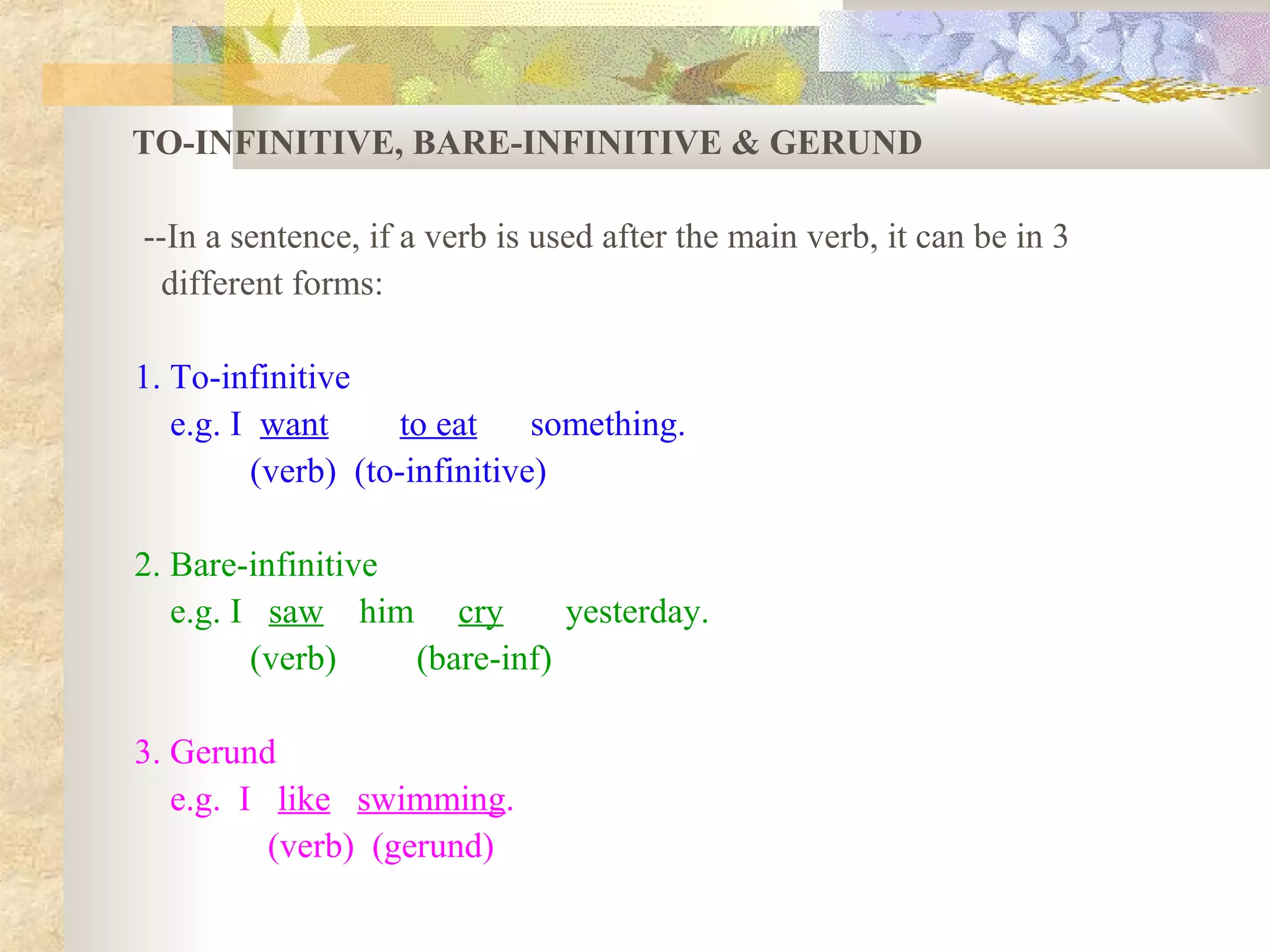
TO-INFINITIVE, BARE-INFINITIVE & GERUND
--In a sentence, if a verb is used after the main verb, it can be in 3
different forms:
1. To-infinitive
e.g. I want to eat something.
(verb) (to-infinitive)
2. Bare-infinitive
e.g. I saw him cry yesterday.
(verb) (bare-inf)
3. Gerund
e.g. I like swimming.
(verb) (gerund)
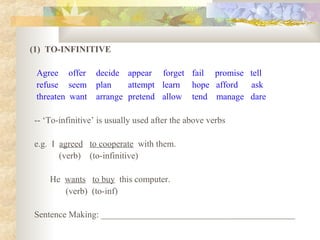
(1) TO-INFINITIVE
Agree offer decide appear forget fail promise tell
refuse seem plan attempt learn hope afford ask
threaten want arrange pretend allow tend manage dare
-- ‘To-infinitive’ is usually used after the above verbs
e.g. I agreed to cooperate with them.
(verb) (to-infinitive)
He wants to buy this computer.
(verb) (to-inf)
Sentence Making: _____________________________________________
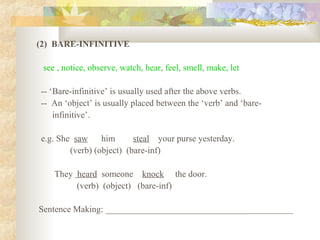
(2) BARE-INFINITIVE
see , notice, observe, watch, hear, feel, smell, make, let
-- ‘Bare-infinitive’ is usually used after the above verbs.
-- An ‘object’ is usually placed between the ‘verb’ and ‘bare-
infinitive’.
e.g. She saw him steal your purse yesterday.
(verb) (object) (bare-inf)
They heard someone knock the door.
(verb) (object) (bare-inf)
Sentence Making: ___________________________________________
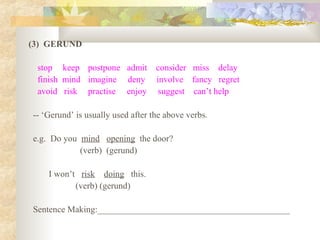
(3) GERUND
stop keep postpone admit consider miss delay
finish mind imagine deny involve fancy regret
avoid risk practise enjoy suggest can’t help
-- ‘Gerund’ is usually used after the above verbs.
e.g. Do you mind opening the door?
(verb) (gerund)
I won’t risk doing this.
(verb) (gerund)
Sentence Making:___________________________________________
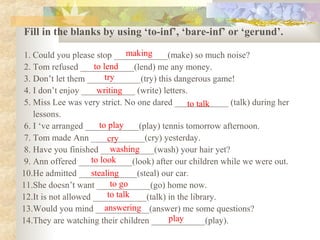
Fill in the blanks by using ‘to-inf’, ‘bare-inf’ or ‘gerund’.
1. Could you please stop ____________(make) so much noise?
2. Tom refused ____________(lend) me any money.
3. Don’t let them ____________(try) this dangerous game!
4. I don’t enjoy ____________ (write) letters.
5. Miss Lee was very strict. No one dared ____________ (talk) during her
lessons.
6. I ‘ve arranged ____________(play) tennis tomorrow afternoon.
7. Tom made Ann ____________(cry) yesterday.
8. Have you finished ____________(wash) your hair yet?
9. Ann offered ____________(look) after our children while we were out.
10.He admitted _____________(steal) our car.
11.She doesn’t want ____________(go) home now.
12.It is not allowed ____________(talk) in the library.
13.Would you mind ____________(answer) me some questions?
14.They are watching their children ____________(play).
making
to lend
try
writing
to talk
to play
cry
washing
to look
stealing
to go
to talk
answering
play
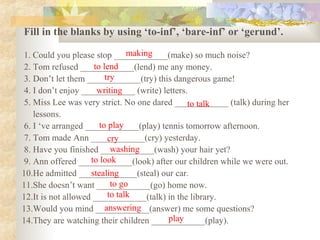
Fill in the blanks by using ‘to-inf’, ‘bare-inf’ or ‘gerund’.
1. Could you please stop ____________(make) so much noise?
2. Tom refused ____________(lend) me any money.
3. Don’t let them ____________(try) this dangerous game!
4. I don’t enjoy ____________ (write) letters.
5. Miss Lee was very strict. No one dared ____________ (talk) during her
lessons.
6. I ‘ve arranged ____________(play) tennis tomorrow afternoon.
7. Tom made Ann ____________(cry) yesterday.
8. Have you finished ____________(wash) your hair yet?
9. Ann offered ____________(look) after our children while we were out.
10.He admitted _____________(steal) our car.
11.She doesn’t want ____________(go) home now.
12.It is not allowed ____________(talk) in the library.
13.Would you mind ____________(answer) me some questions?
14.They are watching their children ____________(play).
making
to lend
try
writing
to talk
to play
cry
washing
to look
stealing
to go
to talk
answering
play

in_with_out

  • 1.
    TO-INFINITIVE, BARE-INFINITIVE &GERUND --In a sentence, if a verb is used after the main verb, it can be in 3 different forms: 1. To-infinitive e.g. I want to eat something. (verb) (to-infinitive) 2. Bare-infinitive e.g. I saw him cry yesterday. (verb) (bare-inf) 3. Gerund e.g. I like swimming. (verb) (gerund)
  • 2.
    (1) TO-INFINITIVE Agree offerdecide appear forget fail promise tell refuse seem plan attempt learn hope afford ask threaten want arrange pretend allow tend manage dare -- ‘To-infinitive’ is usually used after the above verbs e.g. I agreed to cooperate with them. (verb) (to-infinitive) He wants to buy this computer. (verb) (to-inf) Sentence Making: _____________________________________________
  • 3.
    (2) BARE-INFINITIVE see ,notice, observe, watch, hear, feel, smell, make, let -- ‘Bare-infinitive’ is usually used after the above verbs. -- An ‘object’ is usually placed between the ‘verb’ and ‘bare- infinitive’. e.g. She saw him steal your purse yesterday. (verb) (object) (bare-inf) They heard someone knock the door. (verb) (object) (bare-inf) Sentence Making: ___________________________________________
  • 4.
    (3) GERUND stop keeppostpone admit consider miss delay finish mind imagine deny involve fancy regret avoid risk practise enjoy suggest can’t help -- ‘Gerund’ is usually used after the above verbs. e.g. Do you mind opening the door? (verb) (gerund) I won’t risk doing this. (verb) (gerund) Sentence Making:___________________________________________
  • 5.
    Fill in theblanks by using ‘to-inf’, ‘bare-inf’ or ‘gerund’. 1. Could you please stop ____________(make) so much noise? 2. Tom refused ____________(lend) me any money. 3. Don’t let them ____________(try) this dangerous game! 4. I don’t enjoy ____________ (write) letters. 5. Miss Lee was very strict. No one dared ____________ (talk) during her lessons. 6. I ‘ve arranged ____________(play) tennis tomorrow afternoon. 7. Tom made Ann ____________(cry) yesterday. 8. Have you finished ____________(wash) your hair yet? 9. Ann offered ____________(look) after our children while we were out. 10.He admitted _____________(steal) our car. 11.She doesn’t want ____________(go) home now. 12.It is not allowed ____________(talk) in the library. 13.Would you mind ____________(answer) me some questions? 14.They are watching their children ____________(play). making to lend try writing to talk to play cry washing to look stealing to go to talk answering play
  • 6.
    Fill in theblanks by using ‘to-inf’, ‘bare-inf’ or ‘gerund’. 1. Could you please stop ____________(make) so much noise? 2. Tom refused ____________(lend) me any money. 3. Don’t let them ____________(try) this dangerous game! 4. I don’t enjoy ____________ (write) letters. 5. Miss Lee was very strict. No one dared ____________ (talk) during her lessons. 6. I ‘ve arranged ____________(play) tennis tomorrow afternoon. 7. Tom made Ann ____________(cry) yesterday. 8. Have you finished ____________(wash) your hair yet? 9. Ann offered ____________(look) after our children while we were out. 10.He admitted _____________(steal) our car. 11.She doesn’t want ____________(go) home now. 12.It is not allowed ____________(talk) in the library. 13.Would you mind ____________(answer) me some questions? 14.They are watching their children ____________(play). making to lend try writing to talk to play cry washing to look stealing to go to talk answering play