Case Study 2  The Harvard Management Company and Inflation Linked Bonds (2001)
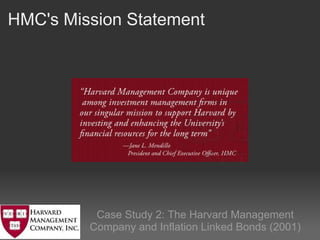
HMC's Mission Statement   Case Study 2: The Harvard Management Company and Inflation Linked Bonds (2001)
HMC Background The organisation that actively manages the assets of Harvard University. HMC manages 68% of endowment assets internally Employs 180 with 38 as investment professionals  Endowment, pension assets, working capital, other:  total $19 billion  Last 10 years HMC provided real return of 11.3%  Over same period U.S treasury bills: 2.2%, U.S equities: 15.8%  Case Study 2: The Harvard Management Company and Inflation Linked Bonds (2001)
Policy Portfolio (goals) Determined by board, but management allowed to make short run tactical adjustments Designed to fulfill growth goals of the endowment.  Estimated, to achieve these goals, they need an average real return on the endowment of between 6% & 7%  Case Study 2: The Harvard Management Company and Inflation Linked Bonds (2001)
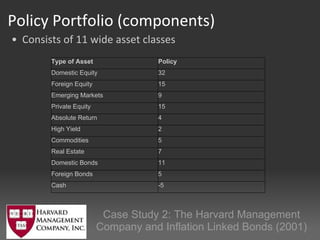
Policy Portfolio (components) Consists of 11 wide asset classes Case Study 2: The Harvard Management Company and Inflation Linked Bonds (2001) Type of Asset Policy Domestic Equity 32 Foreign Equity 15 Emerging Markets 9 Private Equity 15 Absolute Return 4 High Yield 2 Commodities 5 Real Estate 7 Domestic Bonds 11 Foreign Bonds 5 Cash -5
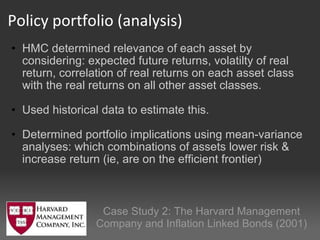
Policy portfolio (analysis) HMC determined relevance of each asset by considering: expected future returns, volatilty of real return, correlation of real returns on each asset class with the real returns on all other asset classes.   Used historical data to estimate this.   Determined portfolio implications using mean-variance analyses: which combinations of assets lower risk & increase return (ie, are on the efficient frontier) Case Study 2: The Harvard Management Company and Inflation Linked Bonds (2001)
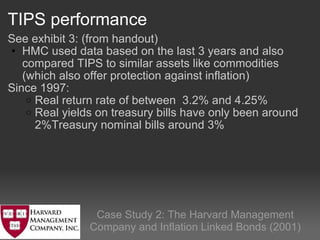
TIPS performance See exhibit 3: (from handout) HMC used data based on the last 3 years and also compared TIPS to similar assets like commodities (which also offer protection against inflation) Since 1997: Real return rate of between  3.2% and 4.25% Real yields on treasury bills have only been around 2%Treasury nominal bills around 3% Case Study 2: The Harvard Management Company and Inflation Linked Bonds (2001)
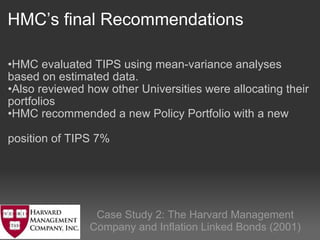
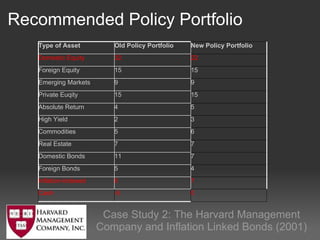
HMC’s final Recommendations • HMC evaluated TIPS using mean-variance analyses based on estimated data. • Also reviewed how other Universities were allocating their portfolios • HMC recommended a new Policy Portfolio with a new position of TIPS 7%   Case Study 2: The Harvard Management Company and Inflation Linked Bonds (2001)
Recommended Policy Portfolio Case Study 2: The Harvard Management Company and Inflation Linked Bonds (2001) Type of Asset Old Policy Portfolio New Policy Portfolio Domestic Equity 32 22 Foreign Equity 15 15 Emerging Markets 9 9 Private Euqity 15 15 Absolute Return 4 5 High Yield 2 3 Commodities 5 6 Real Estate 7 7 Domestic Bonds 11 7 Foreign Bonds 5 4 Inflation-Indexed 0 7 Cash -5 0
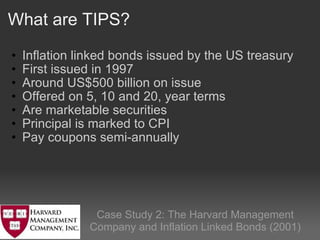
What are TIPS? Inflation linked bonds issued by the US treasury  First issued in 1997  Around US$500 billion on issue Offered on 5, 10 and 20, year terms   Are marketable securities Principal is marked to CPI Pay coupons semi-annually Case Study 2: The Harvard Management Company and Inflation Linked Bonds (2001)
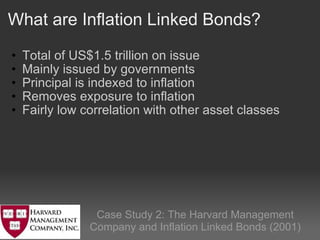
What are Inflation Linked Bonds? Total of US$1.5 trillion on issue   Mainly issued by governments Principal is indexed to inflation Removes exposure to inflation Fairly low correlation with other asset classes   Case Study 2: The Harvard Management Company and Inflation Linked Bonds (2001)
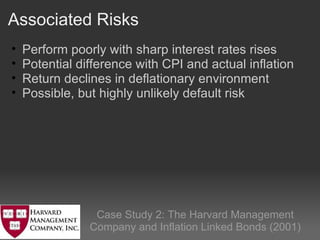
Associated Risks    Case Study 2: The Harvard Management Company and Inflation Linked Bonds (2001) Perform poorly with sharp interest rates rises  Potential difference with CPI and actual inflation Return declines in deflationary environment Possible, but highly unlikely default risk 
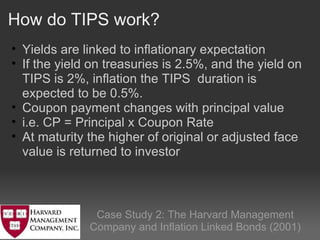
How do TIPS work?    Case Study 2: The Harvard Management Company and Inflation Linked Bonds (2001) Yields are linked to inflationary expectation  If the yield on treasuries is 2.5%, and the yield on TIPS is 2%, inflation the TIPS  duration is expected to be 0.5%. Coupon payment changes with principal value  i.e. CP = Principal x Coupon Rate At maturity the higher of original or adjusted face value is returned to investor
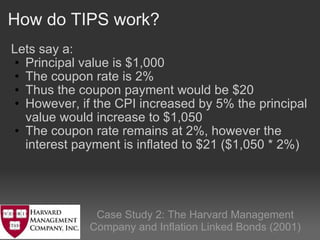
How do TIPS work? Lets say a: Principal value is $1,000 The coupon rate is 2%  Thus the coupon payment would be $20  However, if the CPI increased by 5% the principal value would increase to $1,050  The coupon rate remains at 2%, however the interest payment is inflated to $21 ($1,050 * 2%)  Case Study 2: The Harvard Management Company and Inflation Linked Bonds (2001)
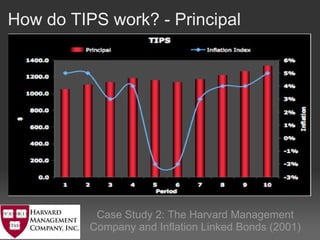
How do TIPS work? - Principal   Case Study 2: The Harvard Management Company and Inflation Linked Bonds (2001)
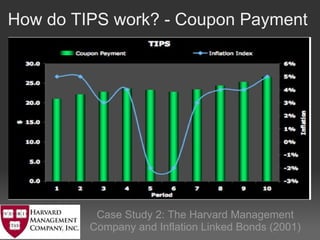
How do TIPS work? - Coupon Payment   Case Study 2: The Harvard Management Company and Inflation Linked Bonds (2001)
When would TIPS OUTperform/ UNDERperform regular Treasuries?
what is a regular US treasury security? Govt Debt Provides a Fixed interest payment until maturity  Carry different maturities based on T-Bills, T-Notes, T-Bonds    Very Liquid No Credit or Default risk- (backed by the Govt.) Subject to high Inflation and Interest Rate risk  Avoid long-term maturity unless you trust that the inflation rates and the interest in the market will be lower.
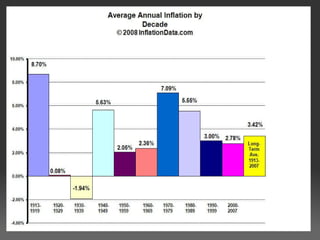
Regular Treasuries vs. TIPS If inflation is lower than expected, regular Treasuries will be a better investment than TIPS.  If inflation is higher than expected, TIPS will be better. Inflation can erode the value of regular Treasuries  if inflation remains low, TIPS holders receive lower returns than what they could receive with regular Treasury notes and bonds for the same maturity period.  TIPS principal is adjusted strictly-  with CPI changes, the value of the principal can go down from a peak it's already reached but never will go below original face value   
SO..What happens to TIPS if deflation occurs? The principal is adjusted downward, and your interest payments are less than they would be if inflation occurred or if the Consumer Price Index remained the same. You have this safeguard: at maturity, if the adjusted principal is less than the security's original principal, you are paid the original principal.   In a period of substantial inflation uncertainty (e.g., now), TIPS are an attractive bet. You get inflation protection if prices rise, but you get your full nominal principal back at maturity if prices fall.
 
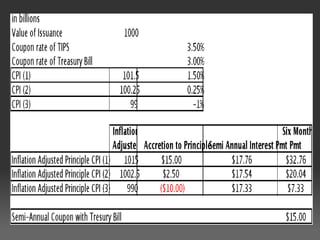
example You have a Billion Bucks (BB) and you are thinking about buying either regular treasuries or TIPS Today?  Treasury yields are  3% and TIPS is 3.5%?  where do you want to put your BB is you expect a expect CPI inflation at 3%, .5%, or -2%?
 
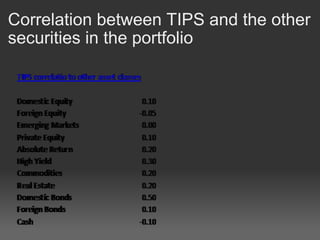
There are 4 criteria for determining an asset class: The asset class should be relatively independent of other asset classes already in the portfolio  An asset class should be comprised of homogeneous investments An asset class should have the capitalization capacity to absorb a meaningful fraction of the investor’s portfolio  An asset class should be expected to raise the utility of the investor's portfolio without selection skill on the part of the investor
Correlation between TIPS and the other securities in the portfolio
        But why doesn't TIPS satisfy the 4th criterion of asset class categorization?
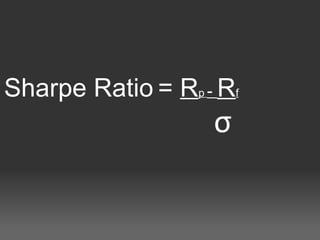
            Sharpe Ratio   =  R p   -  R f                                                                                  σ
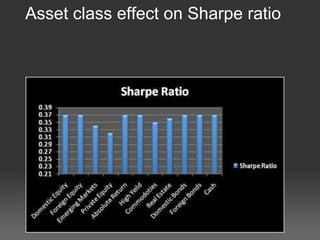
Asset class effect on Sharpe ratio
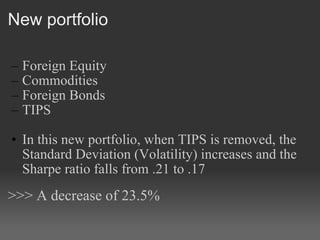
New portfolio Foreign Equity Commodities Foreign Bonds TIPS   In this new portfolio, when TIPS is removed, the Standard Deviation (Volatility) increases and the Sharpe ratio falls from .21 to .17      >>> A decrease of 23.5%

Harvard Management Company Investment Analysis

  • 1.
    Case Study 2 The Harvard Management Company and Inflation Linked Bonds (2001)
  • 2.
    HMC's Mission Statement  Case Study 2: The Harvard Management Company and Inflation Linked Bonds (2001)
  • 3.
    HMC Background Theorganisation that actively manages the assets of Harvard University. HMC manages 68% of endowment assets internally Employs 180 with 38 as investment professionals Endowment, pension assets, working capital, other:  total $19 billion Last 10 years HMC provided real return of 11.3% Over same period U.S treasury bills: 2.2%, U.S equities: 15.8%  Case Study 2: The Harvard Management Company and Inflation Linked Bonds (2001)
  • 4.
    Policy Portfolio (goals)Determined by board, but management allowed to make short run tactical adjustments Designed to fulfill growth goals of the endowment.  Estimated, to achieve these goals, they need an average real return on the endowment of between 6% & 7%  Case Study 2: The Harvard Management Company and Inflation Linked Bonds (2001)
  • 5.
    Policy Portfolio (components)Consists of 11 wide asset classes Case Study 2: The Harvard Management Company and Inflation Linked Bonds (2001) Type of Asset Policy Domestic Equity 32 Foreign Equity 15 Emerging Markets 9 Private Equity 15 Absolute Return 4 High Yield 2 Commodities 5 Real Estate 7 Domestic Bonds 11 Foreign Bonds 5 Cash -5
  • 6.
    Policy portfolio (analysis)HMC determined relevance of each asset by considering: expected future returns, volatilty of real return, correlation of real returns on each asset class with the real returns on all other asset classes.  Used historical data to estimate this.  Determined portfolio implications using mean-variance analyses: which combinations of assets lower risk & increase return (ie, are on the efficient frontier) Case Study 2: The Harvard Management Company and Inflation Linked Bonds (2001)
  • 7.
    TIPS performance Seeexhibit 3: (from handout) HMC used data based on the last 3 years and also compared TIPS to similar assets like commodities (which also offer protection against inflation) Since 1997: Real return rate of between  3.2% and 4.25% Real yields on treasury bills have only been around 2%Treasury nominal bills around 3% Case Study 2: The Harvard Management Company and Inflation Linked Bonds (2001)
  • 8.
    HMC’s final Recommendations• HMC evaluated TIPS using mean-variance analyses based on estimated data. • Also reviewed how other Universities were allocating their portfolios • HMC recommended a new Policy Portfolio with a new position of TIPS 7% Case Study 2: The Harvard Management Company and Inflation Linked Bonds (2001)
  • 9.
    Recommended Policy PortfolioCase Study 2: The Harvard Management Company and Inflation Linked Bonds (2001) Type of Asset Old Policy Portfolio New Policy Portfolio Domestic Equity 32 22 Foreign Equity 15 15 Emerging Markets 9 9 Private Euqity 15 15 Absolute Return 4 5 High Yield 2 3 Commodities 5 6 Real Estate 7 7 Domestic Bonds 11 7 Foreign Bonds 5 4 Inflation-Indexed 0 7 Cash -5 0
  • 10.
    What are TIPS?Inflation linked bonds issued by the US treasury First issued in 1997 Around US$500 billion on issue Offered on 5, 10 and 20, year terms  Are marketable securities Principal is marked to CPI Pay coupons semi-annually Case Study 2: The Harvard Management Company and Inflation Linked Bonds (2001)
  • 11.
    What are InflationLinked Bonds? Total of US$1.5 trillion on issue  Mainly issued by governments Principal is indexed to inflation Removes exposure to inflation Fairly low correlation with other asset classes  Case Study 2: The Harvard Management Company and Inflation Linked Bonds (2001)
  • 12.
    Associated Risks   Case Study 2: The Harvard Management Company and Inflation Linked Bonds (2001) Perform poorly with sharp interest rates rises Potential difference with CPI and actual inflation Return declines in deflationary environment Possible, but highly unlikely default risk 
  • 13.
    How do TIPSwork?   Case Study 2: The Harvard Management Company and Inflation Linked Bonds (2001) Yields are linked to inflationary expectation If the yield on treasuries is 2.5%, and the yield on TIPS is 2%, inflation the TIPS  duration is expected to be 0.5%. Coupon payment changes with principal value  i.e. CP = Principal x Coupon Rate At maturity the higher of original or adjusted face value is returned to investor
  • 14.
    How do TIPSwork? Lets say a: Principal value is $1,000 The coupon rate is 2% Thus the coupon payment would be $20 However, if the CPI increased by 5% the principal value would increase to $1,050 The coupon rate remains at 2%, however the interest payment is inflated to $21 ($1,050 * 2%) Case Study 2: The Harvard Management Company and Inflation Linked Bonds (2001)
  • 15.
    How do TIPSwork? - Principal   Case Study 2: The Harvard Management Company and Inflation Linked Bonds (2001)
  • 16.
    How do TIPSwork? - Coupon Payment   Case Study 2: The Harvard Management Company and Inflation Linked Bonds (2001)
  • 17.
    When would TIPSOUTperform/ UNDERperform regular Treasuries?
  • 18.
    what is aregular US treasury security? Govt Debt Provides a Fixed interest payment until maturity Carry different maturities based on T-Bills, T-Notes, T-Bonds   Very Liquid No Credit or Default risk- (backed by the Govt.) Subject to high Inflation and Interest Rate risk Avoid long-term maturity unless you trust that the inflation rates and the interest in the market will be lower.
  • 19.
    Regular Treasuries vs.TIPS If inflation is lower than expected, regular Treasuries will be a better investment than TIPS. If inflation is higher than expected, TIPS will be better. Inflation can erode the value of regular Treasuries  if inflation remains low, TIPS holders receive lower returns than what they could receive with regular Treasury notes and bonds for the same maturity period. TIPS principal is adjusted strictly-  with CPI changes, the value of the principal can go down from a peak it's already reached but never will go below original face value  
  • 20.
    SO..What happens toTIPS if deflation occurs? The principal is adjusted downward, and your interest payments are less than they would be if inflation occurred or if the Consumer Price Index remained the same. You have this safeguard: at maturity, if the adjusted principal is less than the security's original principal, you are paid the original principal.   In a period of substantial inflation uncertainty (e.g., now), TIPS are an attractive bet. You get inflation protection if prices rise, but you get your full nominal principal back at maturity if prices fall.
  • 21.
  • 22.
    example You havea Billion Bucks (BB) and you are thinking about buying either regular treasuries or TIPS Today?  Treasury yields are  3% and TIPS is 3.5%?  where do you want to put your BB is you expect a expect CPI inflation at 3%, .5%, or -2%?
  • 23.
  • 24.
    There are 4criteria for determining an asset class: The asset class should be relatively independent of other asset classes already in the portfolio  An asset class should be comprised of homogeneous investments An asset class should have the capitalization capacity to absorb a meaningful fraction of the investor’s portfolio An asset class should be expected to raise the utility of the investor's portfolio without selection skill on the part of the investor
  • 25.
    Correlation between TIPSand the other securities in the portfolio
  • 26.
           But why doesn't TIPS satisfy the 4th criterion of asset class categorization?
  • 27.
               Sharpe Ratio = R p - R f                                                                                σ
  • 28.
    Asset class effecton Sharpe ratio
  • 29.
    New portfolio ForeignEquity Commodities Foreign Bonds TIPS   In this new portfolio, when TIPS is removed, the Standard Deviation (Volatility) increases and the Sharpe ratio falls from .21 to .17      >>> A decrease of 23.5%