Download to read offline
![International Journal of Mechanical Engineering and Technology (IJMET), ISSN 0976 – 6340(Print),
ISSN 0976 – 6359(Online), Volume 5, Issue 7, July (2014), pp. 134-143 © IAEME
135
1. INTRODUCTION
In India machine tool industry made very great progress, but there main drawback is that they
not running the machine tools at their optimum operating conditions so that there is loss of man
power, material, time, quality along with productivity also. It has long been recognized that
conditions during cutting such as feed rate, depth of cut, cutting speed, nose radius should be
selected to optimize the economics of machining operations. In machine tool field turning hardened
steel is valuable process. Cutting hardened steel is an interesting topic of today’s industrial
production and scientific research. Turning process for hard steel is preferable thing compared to
grinding process & now days this process is alternative to many finishing processes such as grinding.
A major factor leading to the use of hard turning in place of grinding has been the development of
cubic boron nitride (CBN) cutting tool insert, which enable machining of high-strength materials
with a geometrically defined cutting edge. The main advantage of precision hard turning over
grinding include lower production costs, higher productivity, greater flexibility, elimination of
grinding fluids, and enhanced work piece quality.
In turning process, single-point cutting tool that is nothing but insert can complete the entire
machining process in a single fixture, thereby reduced setup times as well as lower costs. Also there
is many optionable things to improve the turning process rather than grinding process. In recent there
is big problem for all industrialist for achieving high quality products with more productivity within
less machining time which affects on surface roughness during turning of hardened steel. Even rough
surfaces wear more quickly & have high friction coefficient than smooth surfaces. As the surface
roughness increases then customer demand & quality of product goes on decreasing. So that there
should be bridge between quality and productivity. In short there should be such optimum condition
on which tool wear rate is minimum, maximum productivity with maximum quality within less time.
Generally hard turning requires large quantities of coolants and lubricants. The cost associated with
storage and disposal of coolants and lubricants increases the total cost of production considerably.
Conventional cutting fluid application fails to penetrate the chip-tool interface and thus cannot
remove heat effectively due to which there is loss of surface finish and also loss of tool life. To
overcome this problem there are some solutions. Some of these alternatives are dry machining and
machining with minimal fluid application. Dry machining is now of great interest and actually, they
meet with success in the field of environmentally friendly manufacturing. However, they are
sometimes less effective when higher machining efficiently, better surface finish quality and serve
cutting conditions are required. Minimal fluid application refers to the use of cutting fluids of only a
minute amount typically of flow rate of 50 to 500 ml/hour. The concept of minimal fluid application
sometimes referred to as near dry lubrication or micro lubrication.
So, to reduce the surface roughness, machining time, and to increase the MRR in finished
hard turning process I used minimum quantity lubrication system which also affect on chip handling
process and tool wear.
2. LITERATURE REVIEW
D.V. Lohar have evaluated the performance of MQL system during turning on hard AISI
4340 material by using Taguchi method. They have used the feed rate, cutting speed, depth of cut as
process parameter for analysis of cutting forces, surface roughness, cutting temperature & tool wear.
They have found that cutting force & temperature is less in MQL system Compared to the dry & wet
lubrication system. The surface finish is also high in case of MQL system. [1]
Y.B. Kumbhar investigated tool life and surface roughness optimization of PVD TiAlN/TiN
coated carbide inserts in semi hard turning of hardened EN31 alloy steel under dry cutting conditions](https://image.slidesharecdn.com/30120140507013-160218082052/75/INVESTIGATION-AND-OPTIMIZATION-OF-TURNING-PROCESS-PARAMETER-IN-WET-AND-MQL-SYSTEM-ON-EN31-2-2048.jpg)
![International Journal of Mechanical Engineering and Technology (IJMET), ISSN 0976 – 6340(Print),
ISSN 0976 – 6359(Online), Volume 5, Issue 7, July (2014), pp. 134-143 © IAEME
136
using Taguchi method. They have concluded that the feed rate was the most influential factor on the
surface roughness and tool life. [2]
Ravinder Tonk, have investigated the effects of the parametric variations in turning process
of En31 alloy steel. Taguchi's robust design methodology has been used for statistical planning of the
experiments. Experiments were conducted on conventional lathe machine in a completely random
manner to minimize the effect of noise factors present while turning EN31 under different
experimental conditions. The analysis of results shows that input parameter setting of cutting tool as
carbide, cutting condition as dry, spindle speed at 230 rpm, feed at 0.25mm/rev and depth of cut at
0.3 mm has given the optimum results for the thrust force and input parameter setting of cutting tool
as HSS, cutting fluid as soluble oil, spindle speed at 230 rpm, feed at 0.25 mm/rev and depth of cut at
0.3 mm have been given the optimum results for the feed force when EN31 was turned on lathe. [3]
M. A. H. Mithu et al have evaluated the effect of minimum quantity lubrication on turning AISI 9310
alloy steel using vegetable oil based cutting fluid. They have found that chip-tool interface
temperature as well as tool wear gets reduced. [4]
Nikhil Ranjan Dhar evaluated the performance of MQL system on tool wear, surface
roughness and dimensional deviation in turning AISI-4340 steel by using cutting speed, feed rate,
depth of cut as controllable variables. They improved the tool life in MQL system.[5]
C. R. Barik studied the parametric effect & optimization of surface roughness of EN 31
material in dry turning. They concluded that feed rate has more effect on surface roughness. [6]
L. B. Abhang investigated the effect of MQL during turning of EN 31 alloy steel for analysis of
cutting temperature, cutting force, surface roughness. They found that quality of product as well as
tool life get improved.[7]
C. Ramudu have analyzed and optimized the turning process parameters using design of
experiments & response surface methodology on EN 24 steel. [8]
L. B. Abhang have created model and analyzed it for surface roughness in machining EN 31
steel using response surface methodology. They have found that surface roughness increases with
increase in feed rate and decreases with increase in cutting velocity. [9]
A. Del Prete studied & optimized the turning process parameter by using the genetic
algorithm & simulated annealing on super-nickel alloy for maximizing the MRR & analysis of thrust
force.[10]
Ashish Bhateja conducted there project work for Optimization of Different Performance
Parameters i.e. Surface Roughness, Tool Wear Rate & Material Removal Rate with the Selection of
Various Process Parameters Such as Speed Rate, Feed Rate, Specimen Wear , Depth Of Cut in CNC
Turning of EN24 Alloy Steel.[11]
R. Venkata Rao have optimized the multipass turning process parameter for surface
roughness by using Teaching–learning based optimization algorithm. [12]
Miroslav Neslusan et al have evaluated analysis of chip formation during hard turning
through acoustic emission. The results show that AE signals and accelerometers can be used to
monitor the dynamic character of plastic deformation in the cutting zone in hard turning. [13]
2.1 Literature Outcome
From the literature review, it is observed that less research work has been seen for En31
Alloy Steel in CNC turning by the use of MQL system. Also very less work has been reported for
optimization of surface roughness, material removal rate & machining time on En 31 material. Also
optimization of turning process parameter in MQL system & comparison it with wet turning is to be
reported to much less. Chip chart is also new concept that has reported for EN 31 material in MQL
system and wet system is too much less from which one can easily predict tool life, surface finish.
Again no one can do an experiment by varying all controllable parameter in single experiment. I](https://image.slidesharecdn.com/30120140507013-160218082052/75/INVESTIGATION-AND-OPTIMIZATION-OF-TURNING-PROCESS-PARAMETER-IN-WET-AND-MQL-SYSTEM-ON-EN31-3-2048.jpg)
![International Journal of Mechanical Engineering and Technology (IJMET), ISSN 0976 – 6340(Print),
ISSN 0976 – 6359(Online), Volume 5, Issue 7, July (2014), pp. 134-143 © IAEME
142
F.R
D.O.C.
0.50.40.30.20.1
1.2
1.0
0.8
0.6
0.4
0.2
N.R. 0.8
C.S 190
Hold Values
>
–
–
–
–
< 0
0 20000
20000 40000
40000 60000
60000 80000
80000
MRR
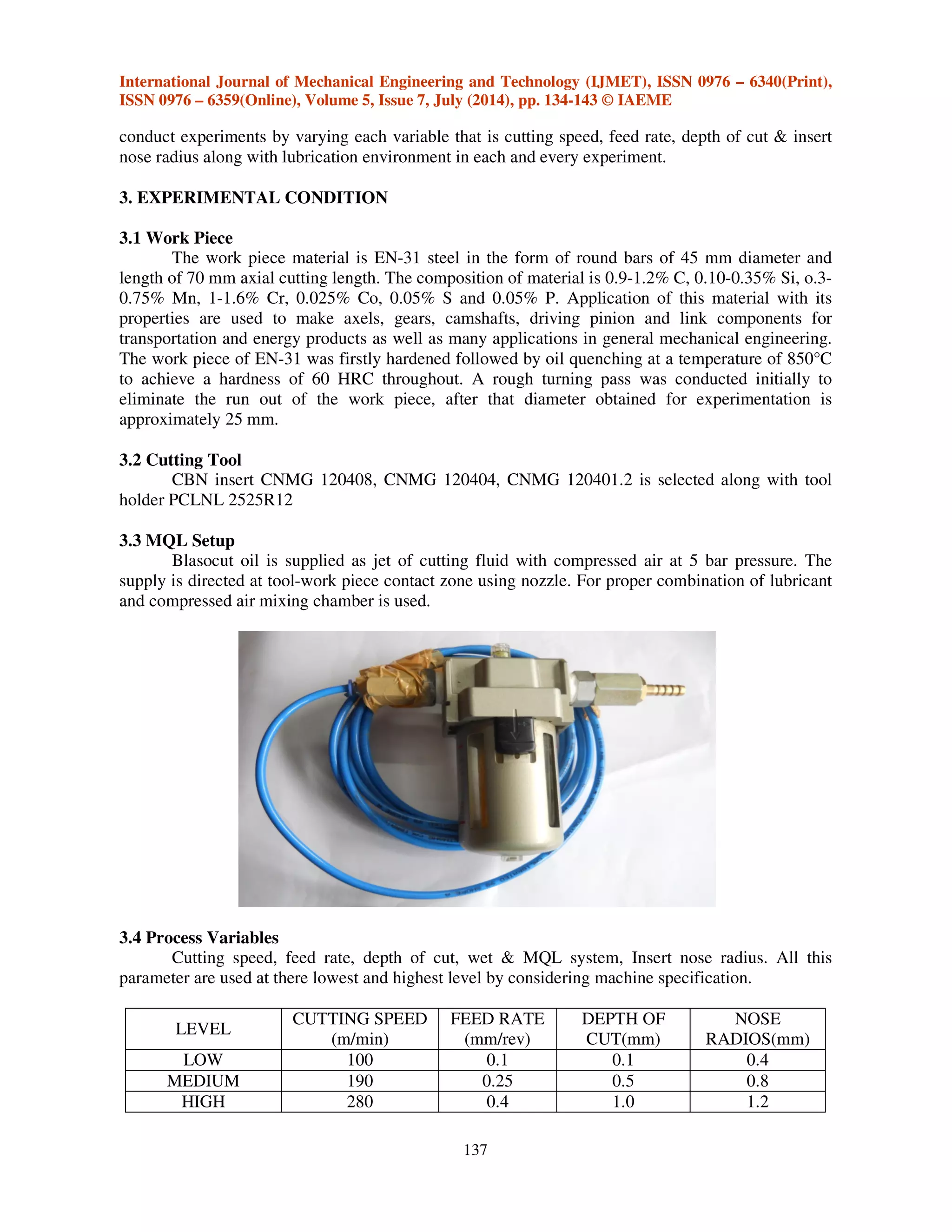
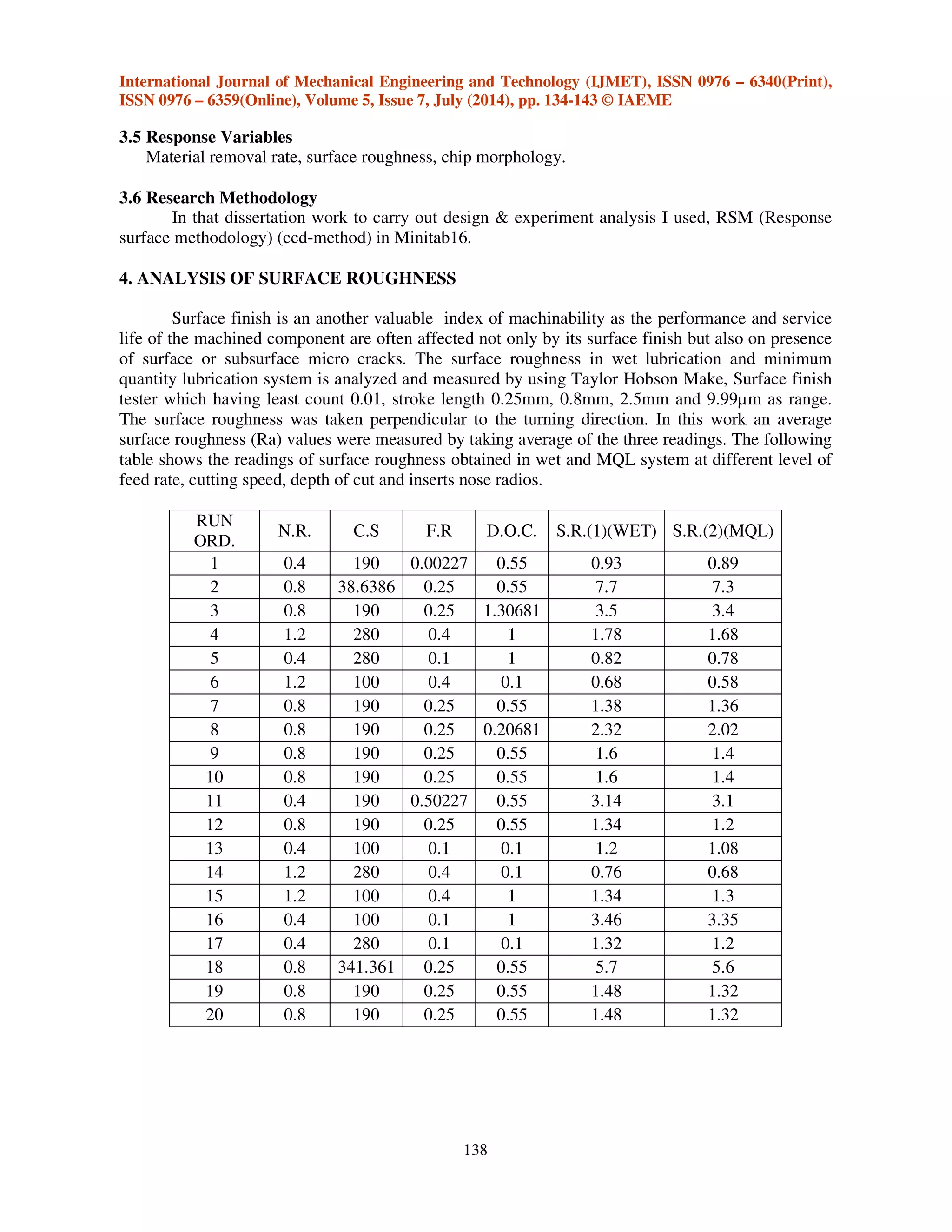
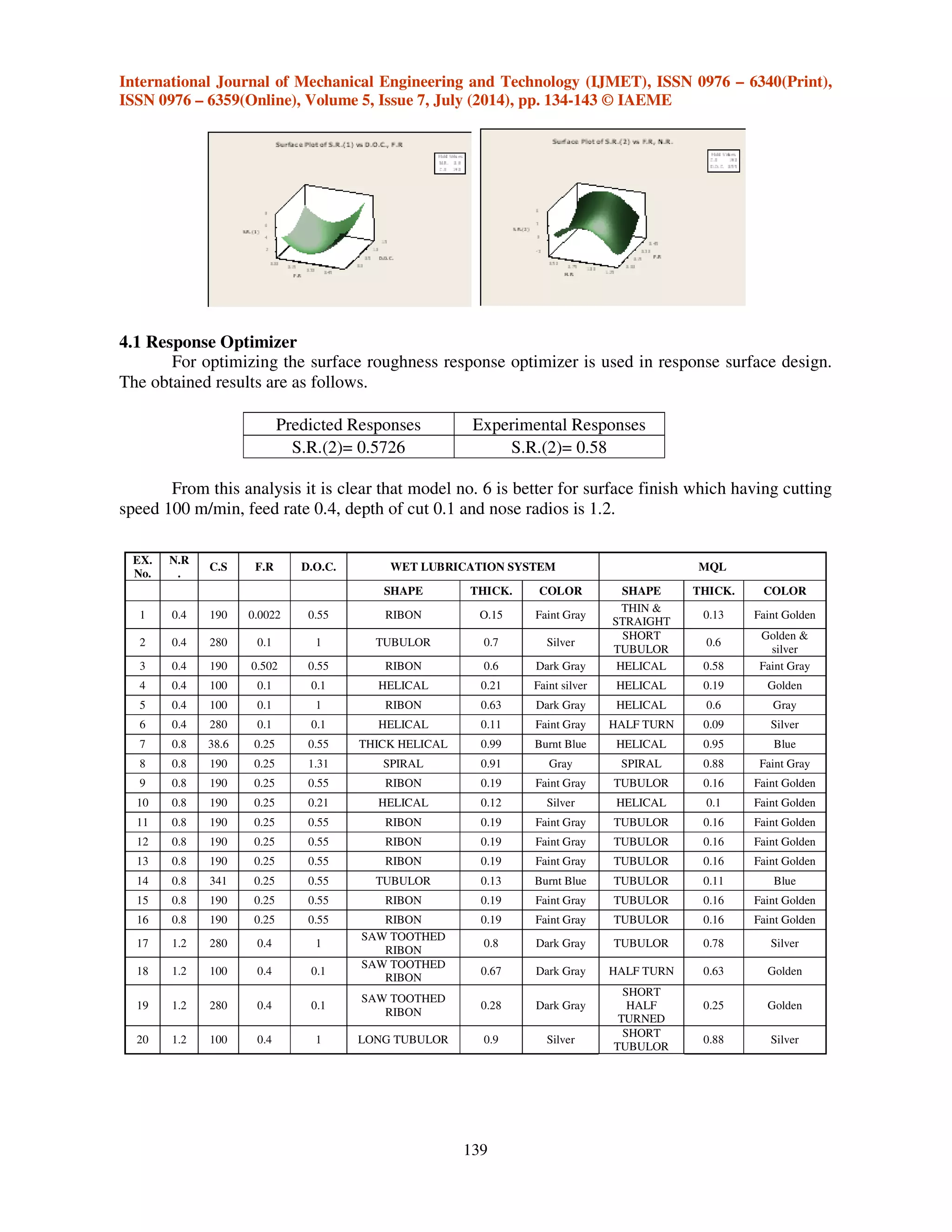
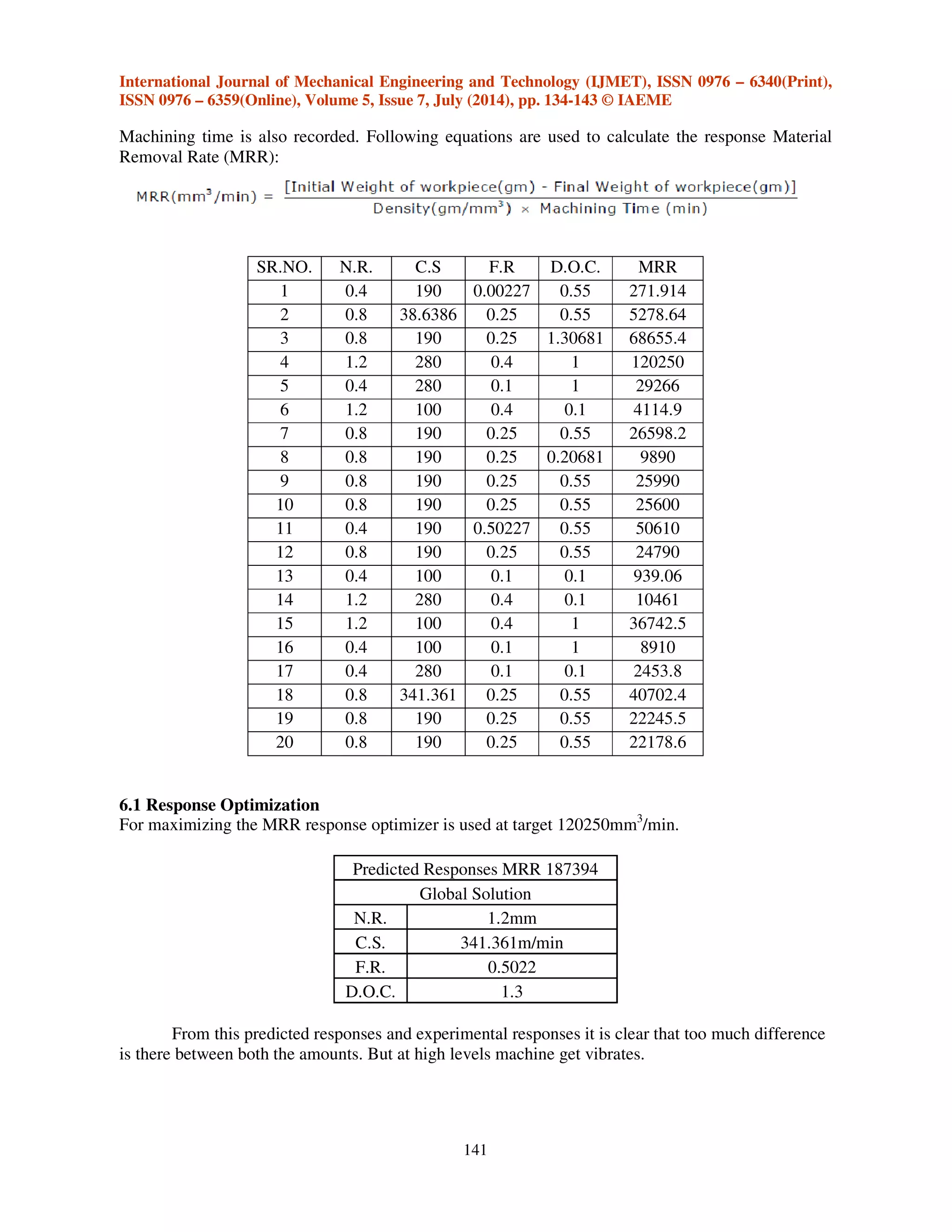
Contour Plot of MRR vs D.O.C., F.R
7. CONCLUSION
From the analysis of surface roughness, material removal rate and chip morphology in wet
and MQL system it is clear that MQL system is better than wet system as follows.
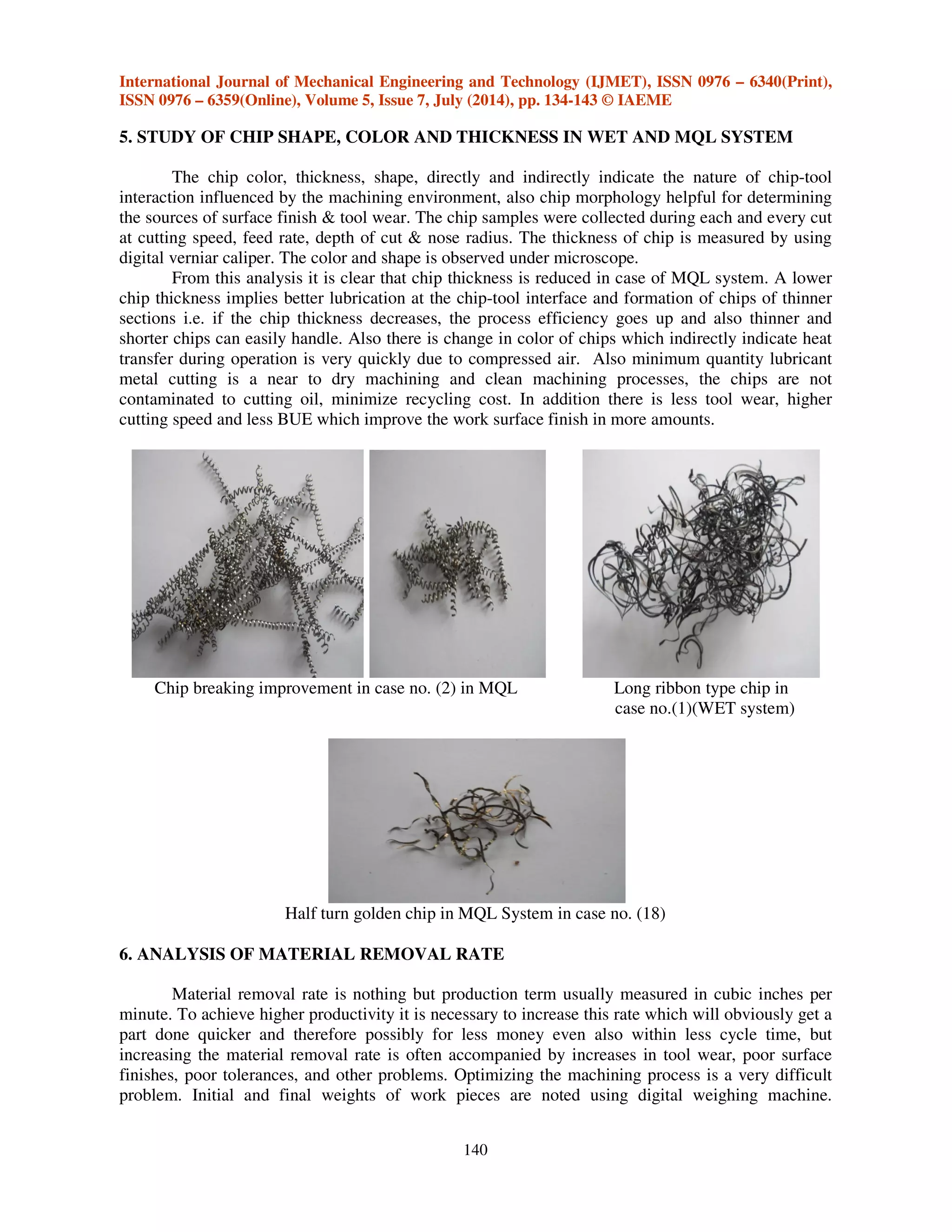
1) By using MQL system near about maximum 18.18% chip thickness is reduced which is helpful
for reducing the surface roughness and also for reducing the tool wear.
2) MQL system improve the surface finish by maximum 14.70% with better dimensionability.
3) From the investigation it is clear that increase in feed rate increases the surface roughness,
increase in cutting speed decreases the surface roughness this is because due to higher cutting
temperature made the material ahead of tool softer and plastic. Also increase in insert nose
radios there is decrease in surface roughness.
4) As MQL system required less coolant due to which cutting tools and the work-piece will
remain clean which also save the recycling cost of lubricant oil.
5) MQL system enable improvement in MRR (Productivity) by allowing higher feed rate and
higher cutting speed.
8. REFERENCES
[1] D.V.Lohar, “Performance Evaluation of Minimum Quantity Lubrication (MQL) using CBN
Tool during Hard Turning of AISI 4340 and its Comparison with Dry and Wet Turning”
Bonfring International Journal of Industrial Engineering and Management Science, Vol. 3,
No. 3, September 2013.
[2] Y.B. Kumbhar, “Tool Life And Surface Roughness Optimization Of PVD TiAlN/TiN
Multilayer Coated Carbide Inserts In Semi Hard Turning Of Hardened EN31 Alloy Steel
Under Dry Cutting Conditions”, International Journal of Advanced Engineering Research and
Studies E-ISSN 2249–8974.
[3] Ravinder Tonk, “Investigation of the Effects of the Parametric Variations in Turning Process
of En31 Alloy”, International Journal on Emerging Technologies 3(1): 160-164(2012) ISSN
No. 0975-8364.
[4] M.A.H. Mithu, “Effects of minimum quantity lubrication on turning AISI 9310 alloy steel
using vegetable oil based cutting fluid, Journal of Materials Processing Technology 209
(2009) 5573–5583.
[5] Nikhil Ranjan Dhar, “Effect of Minimum Quantity Lubrication (MQL) on Tool Wear,
Surface Roughness and Dimensional Deviation in Turning AISI-4340 Steel, G.U. Journal of
Science 20(2): 23-32(2007).
[6] C.R. Barik, “Parametric Effect and Optimization of Surface Roughness of EN 31 In CNC
Dry Turning”, International Journal of Lean Thinking Volume 3, Issue 2 (December 2012).](https://image.slidesharecdn.com/30120140507013-160218082052/75/INVESTIGATION-AND-OPTIMIZATION-OF-TURNING-PROCESS-PARAMETER-IN-WET-AND-MQL-SYSTEM-ON-EN31-9-2048.jpg)
![International Journal of Mechanical Engineering and Technology (IJMET), ISSN 0976 – 6340(Print),
ISSN 0976 – 6359(Online), Volume 5, Issue 7, July (2014), pp. 134-143 © IAEME
143
[7] L B Abhang, “Experimental Investigation of Minimum Quantity Lubricants in Alloy Steel
Turning”, International Journal of Engineering Science and Technology, Vol. 2(7), 2010,
3045-3053.
[8] C. Ramudu, “Analysis and Optimization of Turning Process Parameters using Design of
Experiments”, International Journal of Engineering Research and Applications (IJERA)
ISSN: 2248-9622, Vol. 2, Issue 6, November- December 2012.
[9] L.B. Abhang, “Modeling and Analysis for Surface roughness in Machining EN-31 steel using
Response Surface Methodology” International Journal of Applied Research in Mechanical
Engineering, Volume-1, Issue-1, 2011.
[10] A. Del Prete, “Super-Nickel Orthogonal Turning Operations Optimization”, 14th CIRP
Conference on Modeling of Machining Operations (CIRP CMMO).
[11] Ashish Bhateja, “Optimization of Different Performance Parameters i.e. Surface Roughness,
Tool Wear Rate & Material Removal Rate with the Selection of Various Process Parameters
Such as Speed Rate, Feed Rate, Specimen Wear , Depth Of Cut in CNC Turning of EN24
Alloy Steel – An Empirical Approach”, The International Journal of Engineering And
Science (IJES) ISSN: 2319 – 1813.
[12] R. Venkata Rao, “Multi-pass turning process parameter optimization using teaching–
learning-based optimization algorithm” Scientia Iranica E (2013) 20 (3), 967–974.
[13] Miroslav Neslusan, “Analysis of Chip Formation During Hard Turning Through Acoustic
Emission”, Journal of Material Engineering, ISSN 1335-0803.
[14] Sreekala P and Visweswararao K, “A Methodology for Chip Breaker Design at Low Feed
Turning of Alloy Steel using Finite Element Modeling Methods”, International Journal of
Mechanical Engineering & Technology (IJMET), Volume 3, Issue 2, 2012, pp. 263 - 273,
ISSN Print: 0976 – 6340, ISSN Online: 0976 – 6359.
[15] Rahul Davis, “A Parameteric Design Study of Surface Roughness in Dry Turning Operation
of EN24 Steel”, International Journal of Mechanical Engineering & Technology (IJMET),
Volume 3, Issue 2, 2012, pp. 410 - 415, ISSN Print: 0976 – 6340, ISSN Online: 0976 – 6359.
[16] Sumedh. S. Pathak and Dr. M. S. Kadam, “Development of RSM Based Model for
Machining of T105cr EN31 Steel by TiAlN Coated Twist Drill”, International Journal of
Mechanical Engineering & Technology (IJMET), Volume 3, Issue 1, 2012, pp. 311 - 320,
ISSN Print: 0976 - 6340, ISSN Online: 0976 - 6359.
[17] Vishal Francis, Ravi.S.Singh, Nikita Singh, Ali.R.Rizvi and Santosh Kumar, “Application of
Taguchi Method and Anova in Optimization of Cutting Parameters for Material Removal
Rate and Surface Roughness in Turning Operation”, International Journal of Mechanical
Engineering & Technology (IJMET), Volume 4, Issue 3, 2013, pp. 47 - 53, ISSN Print:
0976 – 6340, ISSN Online: 0976 – 6359.
[18] Prabhat Kumar Sinha, Manas Tiwari, Piyush Pandey and Vijay Kumar, “Optimization of
Input Parameters of CNC Turning Operation for the Given Component using Taguchi
Approach”, International Journal of Mechanical Engineering & Technology (IJMET),
Volume 4, Issue 4, 2013, pp. 188 - 196, ISSN Print: 0976 - 6340, ISSN Online: 0976 - 6359.](https://image.slidesharecdn.com/30120140507013-160218082052/75/INVESTIGATION-AND-OPTIMIZATION-OF-TURNING-PROCESS-PARAMETER-IN-WET-AND-MQL-SYSTEM-ON-EN31-10-2048.jpg)

The document summarizes an investigation into optimizing turning process parameters for EN31 steel in wet and minimum quantity lubrication (MQL) systems. Key findings from experiments varying cutting speed, feed rate, depth of cut, and insert nose radius include: - Surface roughness values were generally lower in MQL than wet turning. Cutting temperature and tool wear were also reduced with MQL. - An analysis of variance showed feed rate had the greatest influence on surface roughness, while higher cutting speed and lower depth of cut reduced roughness. - Material removal rate was higher with MQL compared to wet turning, demonstrating MQL can improve productivity while maintaining surface finish quality.


