1
Inverted Files for
TextSearch Engines
Alireza Abbasi
abbasi@snu.ac.kr
406.534 Industrial Information Technology
Survey Paper Presentation
Information Technology Policy Program
Seoul National University
2.
2
Bibliographic Details
Title:Inverted Files for Text Search Engines
Authors: Justin Zobel (RMIT University, Australia) and
Alistair Moffat (The University of Melbourne, Australia)
Journal: ACM Computing Surveys
Vol.: 38
No.: 2
Article: 6
Month: July
Year: 2006
3.
3
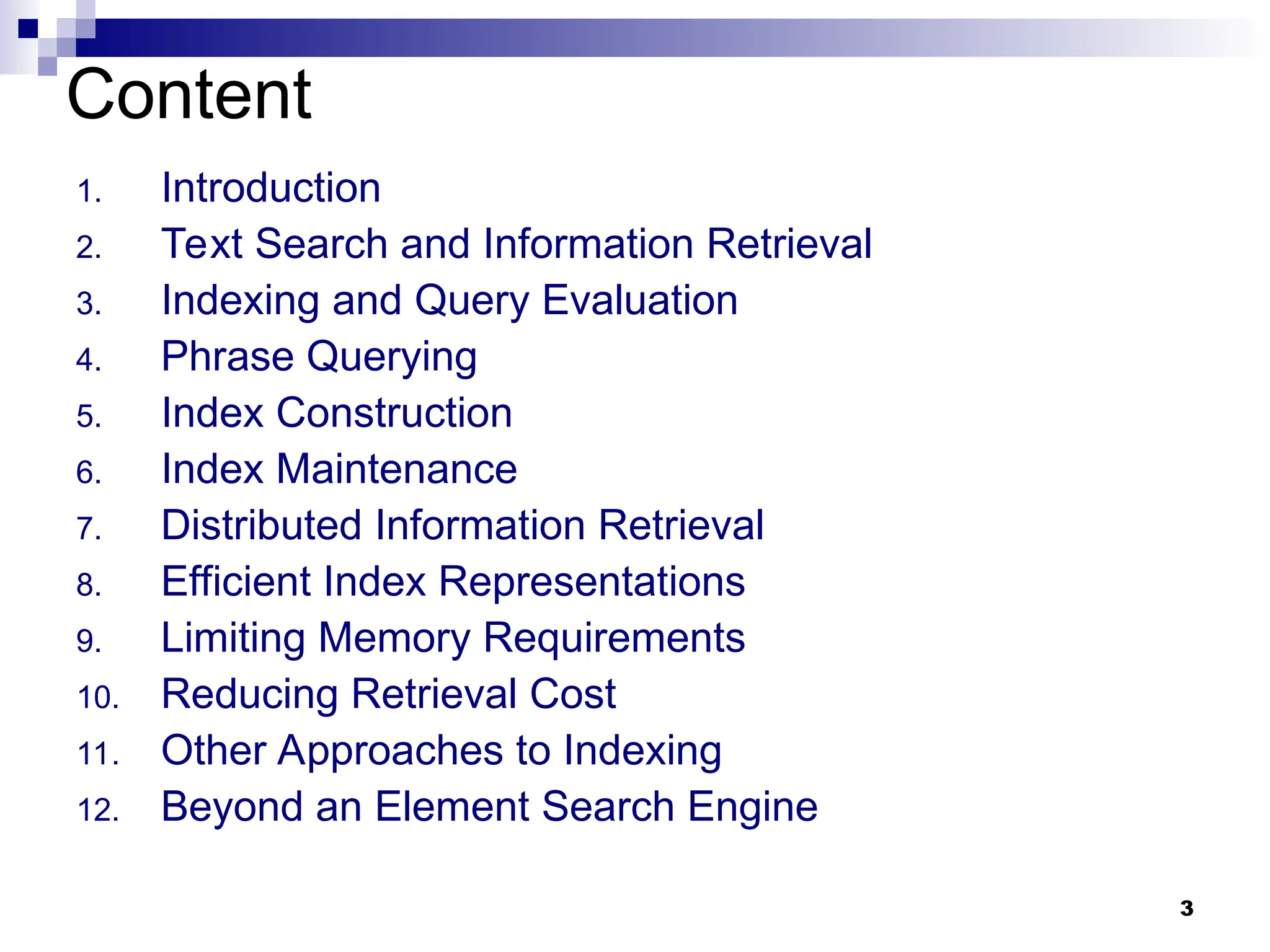
Content
1. Introduction
2. TextSearch and Information Retrieval
3. Indexing and Query Evaluation
4. Phrase Querying
5. Index Construction
6. Index Maintenance
7. Distributed Information Retrieval
8. Efficient Index Representations
9. Limiting Memory Requirements
10. Reducing Retrieval Cost
11. Other Approaches to Indexing
12. Beyond an Element Search Engine
4.
4
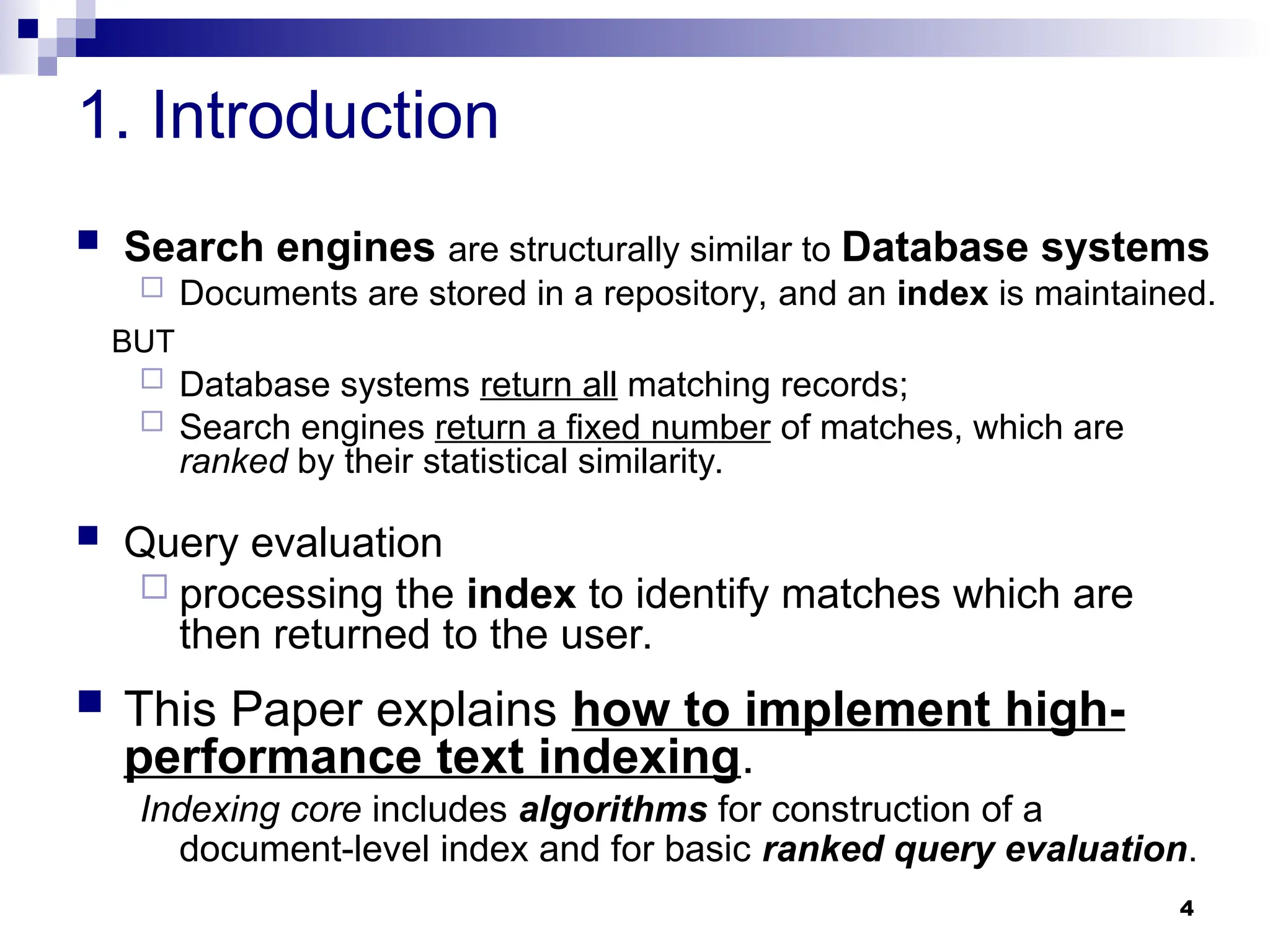
1. Introduction
Searchengines are structurally similar to Database systems
Documents are stored in a repository, and an index is maintained.
BUT
Database systems return all matching records;
Search engines return a fixed number of matches, which are
ranked by their statistical similarity.
Query evaluation
processing the index to identify matches which are
then returned to the user.
This Paper explains how to implement high-
performance text indexing.
Indexing core includes algorithms for construction of a
document-level index and for basic ranked query evaluation.
5.
5
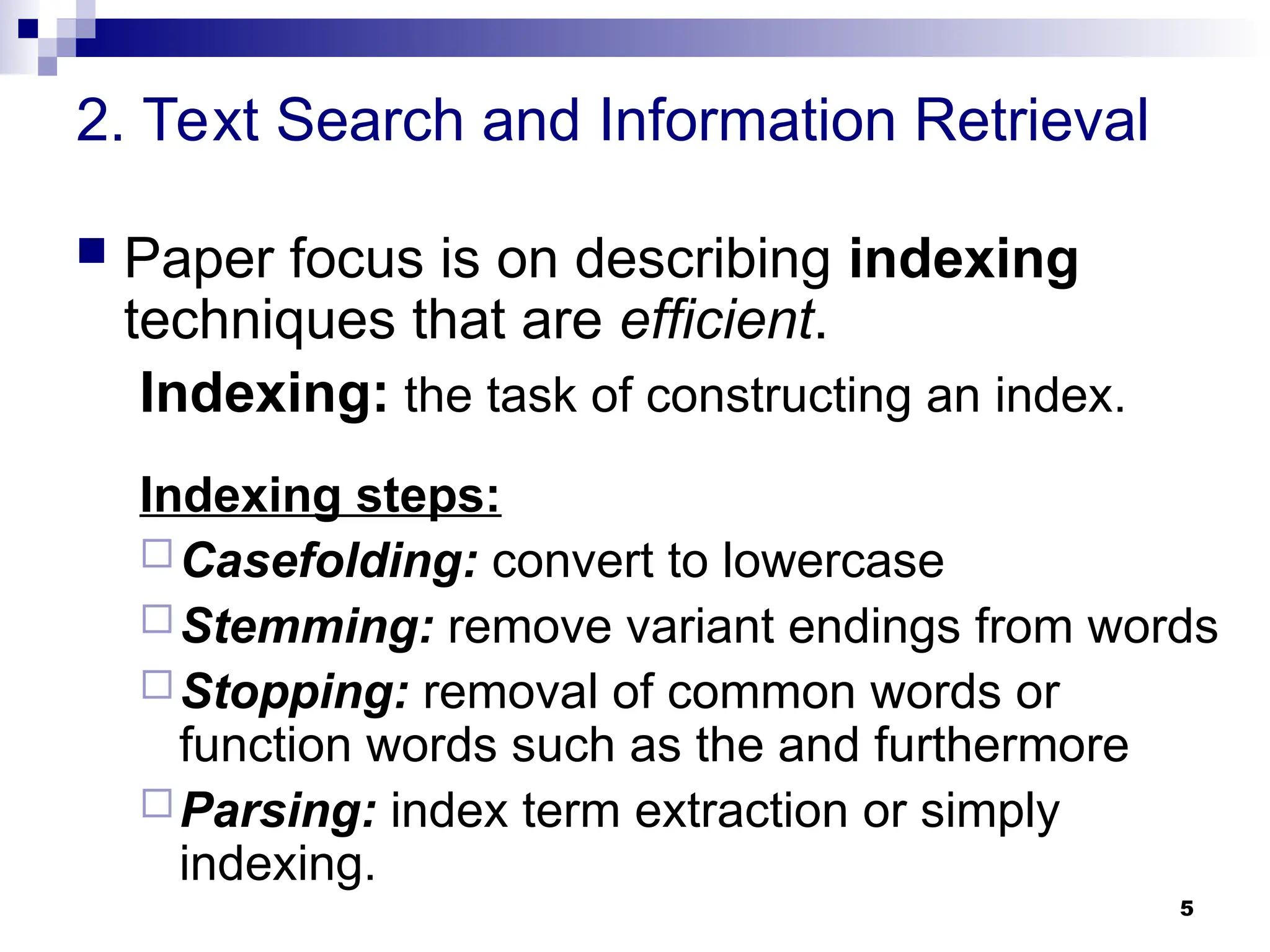
2. Text Searchand Information Retrieval
Paper focus is on describing indexing
techniques that are efficient.
Indexing: the task of constructing an index.
Indexing steps:
Casefolding: convert to lowercase
Stemming: remove variant endings from words
Stopping: removal of common words or
function words such as the and furthermore
Parsing: index term extraction or simply
indexing.
6.
6
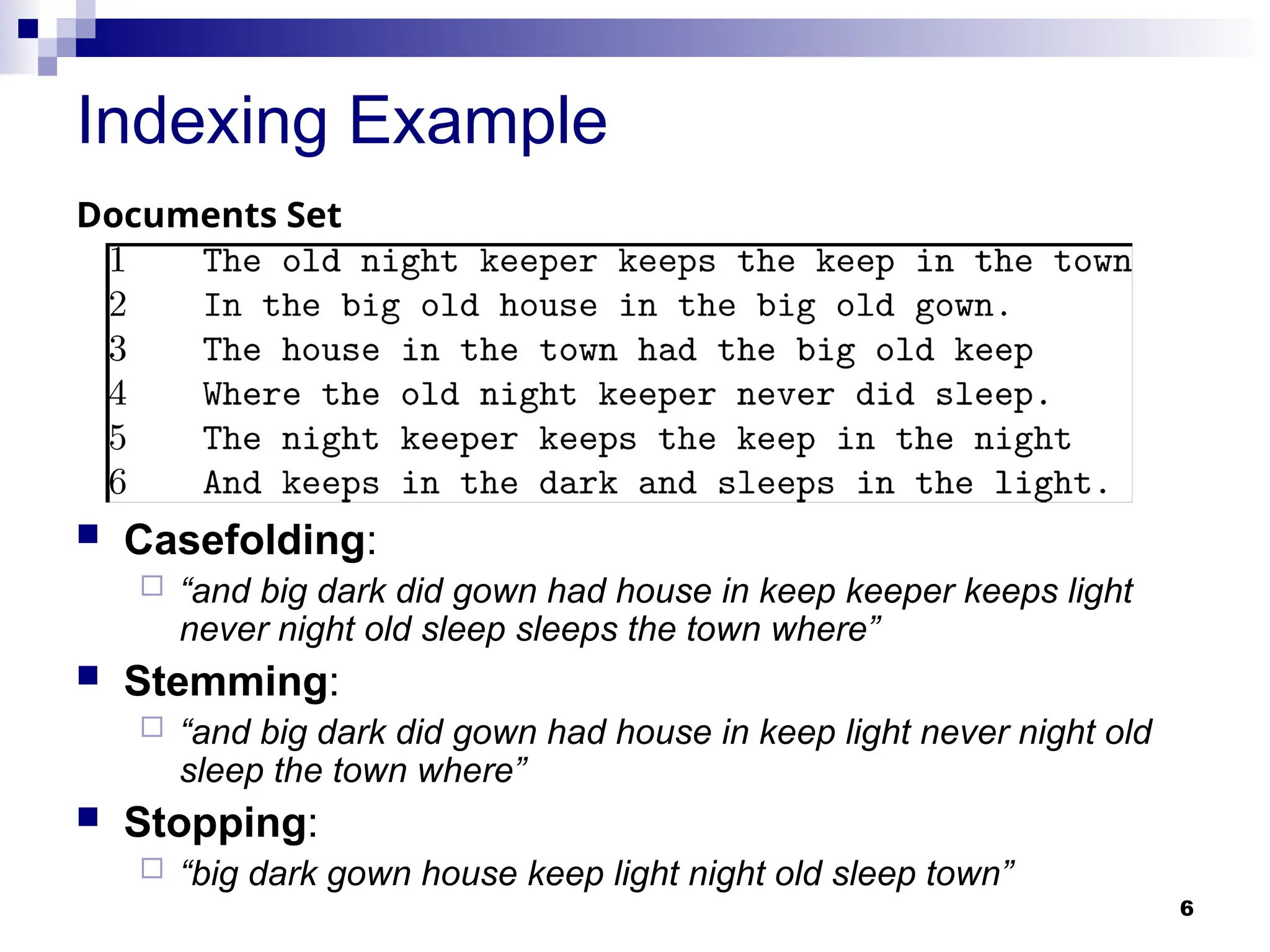
Indexing Example
Documents Set
Casefolding:
“and big dark did gown had house in keep keeper keeps light
never night old sleep sleeps the town where”
Stemming:
“and big dark did gown had house in keep light never night old
sleep the town where”
Stopping:
“big dark gown house keep light night old sleep town”
7.
7
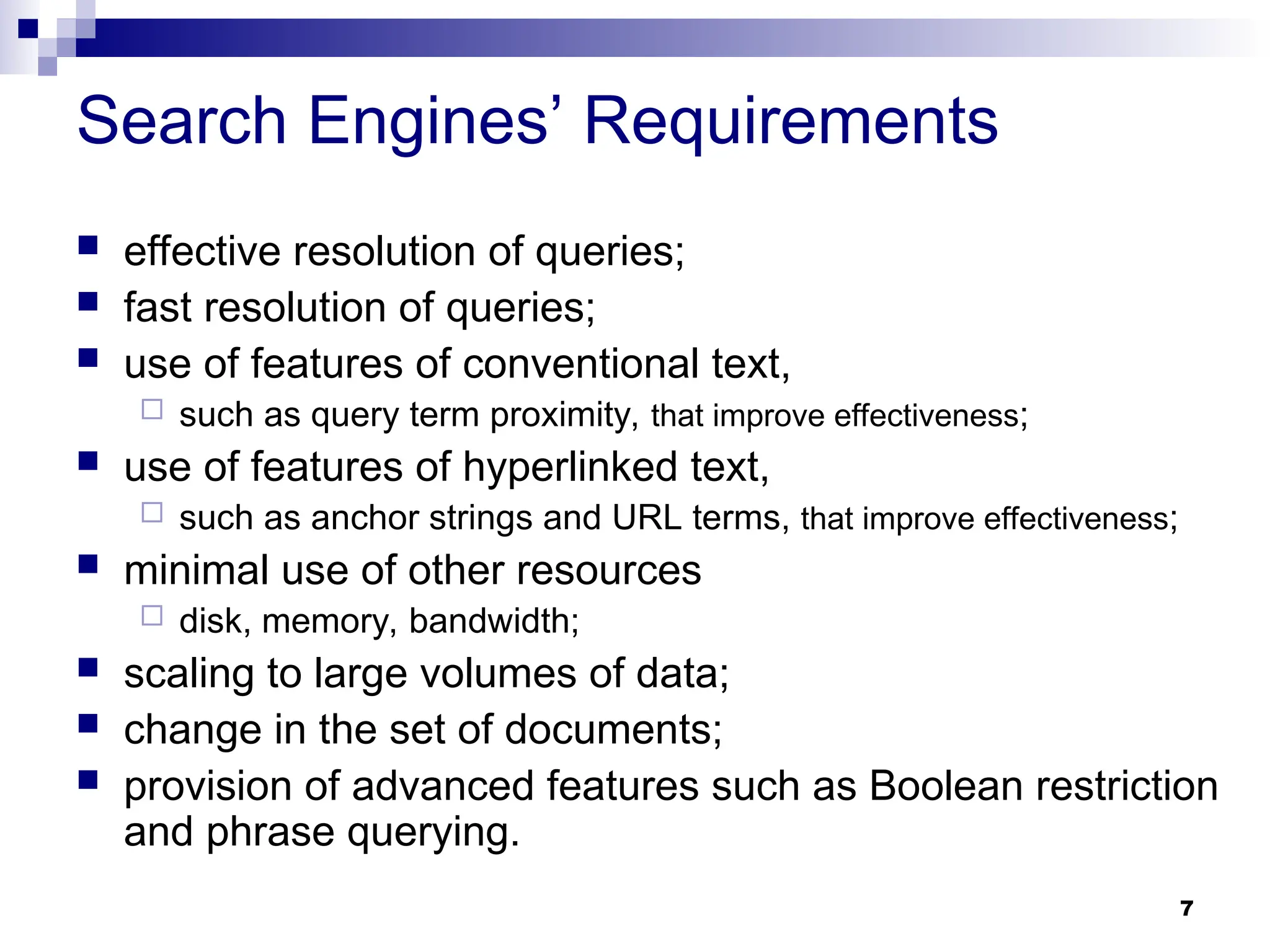
Search Engines’ Requirements
effective resolution of queries;
fast resolution of queries;
use of features of conventional text,
such as query term proximity, that improve effectiveness;
use of features of hyperlinked text,
such as anchor strings and URL terms, that improve effectiveness;
minimal use of other resources
disk, memory, bandwidth;
scaling to large volumes of data;
change in the set of documents;
provision of advanced features such as Boolean restriction
and phrase querying.
8.
8
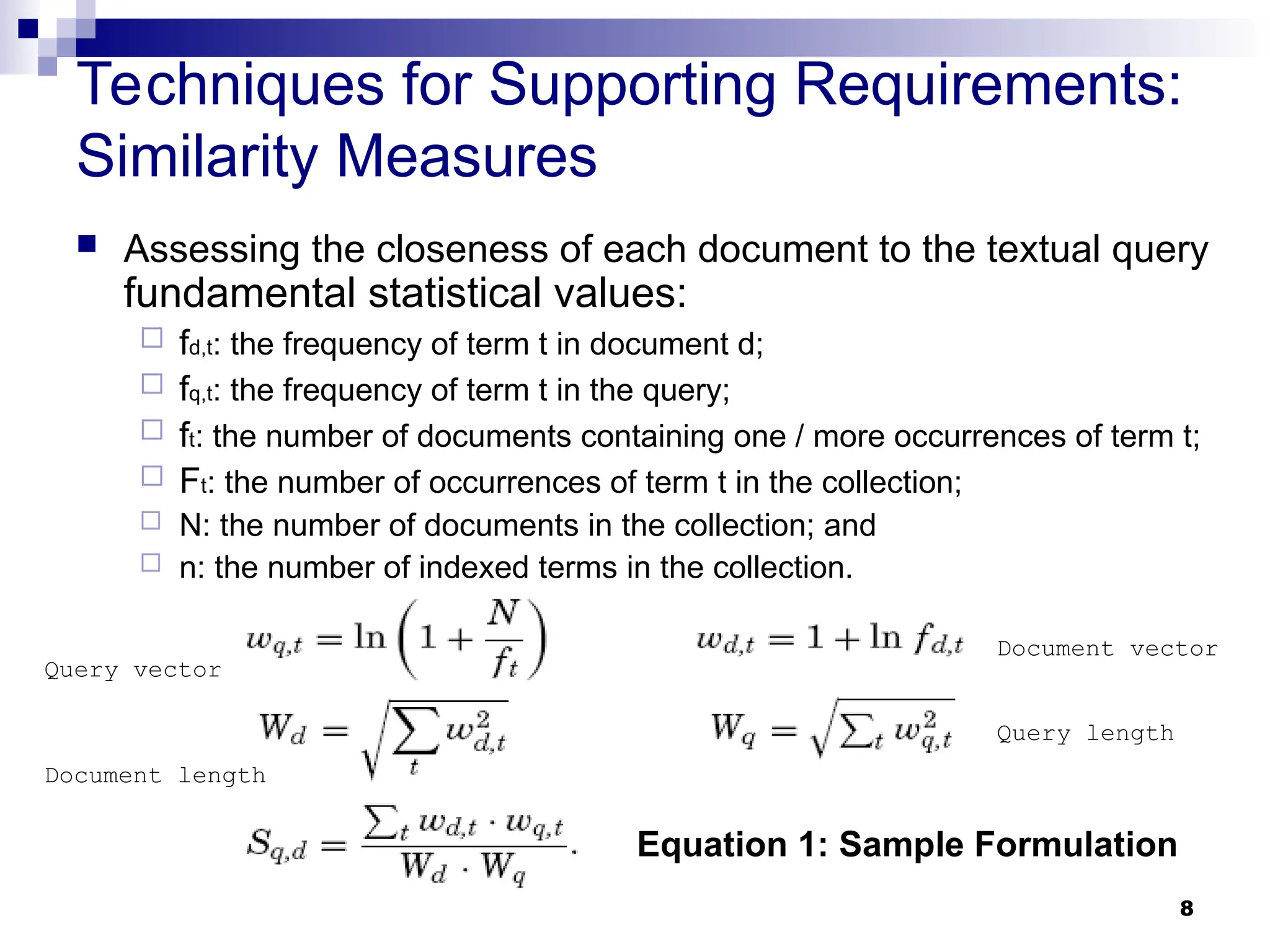
Techniques for SupportingRequirements:
Similarity Measures
Assessing the closeness of each document to the textual query
fundamental statistical values:
fd,t: the frequency of term t in document d;
fq,t: the frequency of term t in the query;
ft: the number of documents containing one / more occurrences of term t;
Ft: the number of occurrences of term t in the collection;
N: the number of documents in the collection; and
n: the number of indexed terms in the collection.
Equation 1: Sample Formulation
Query length
Document length
Query vector
Document vector
9.
9
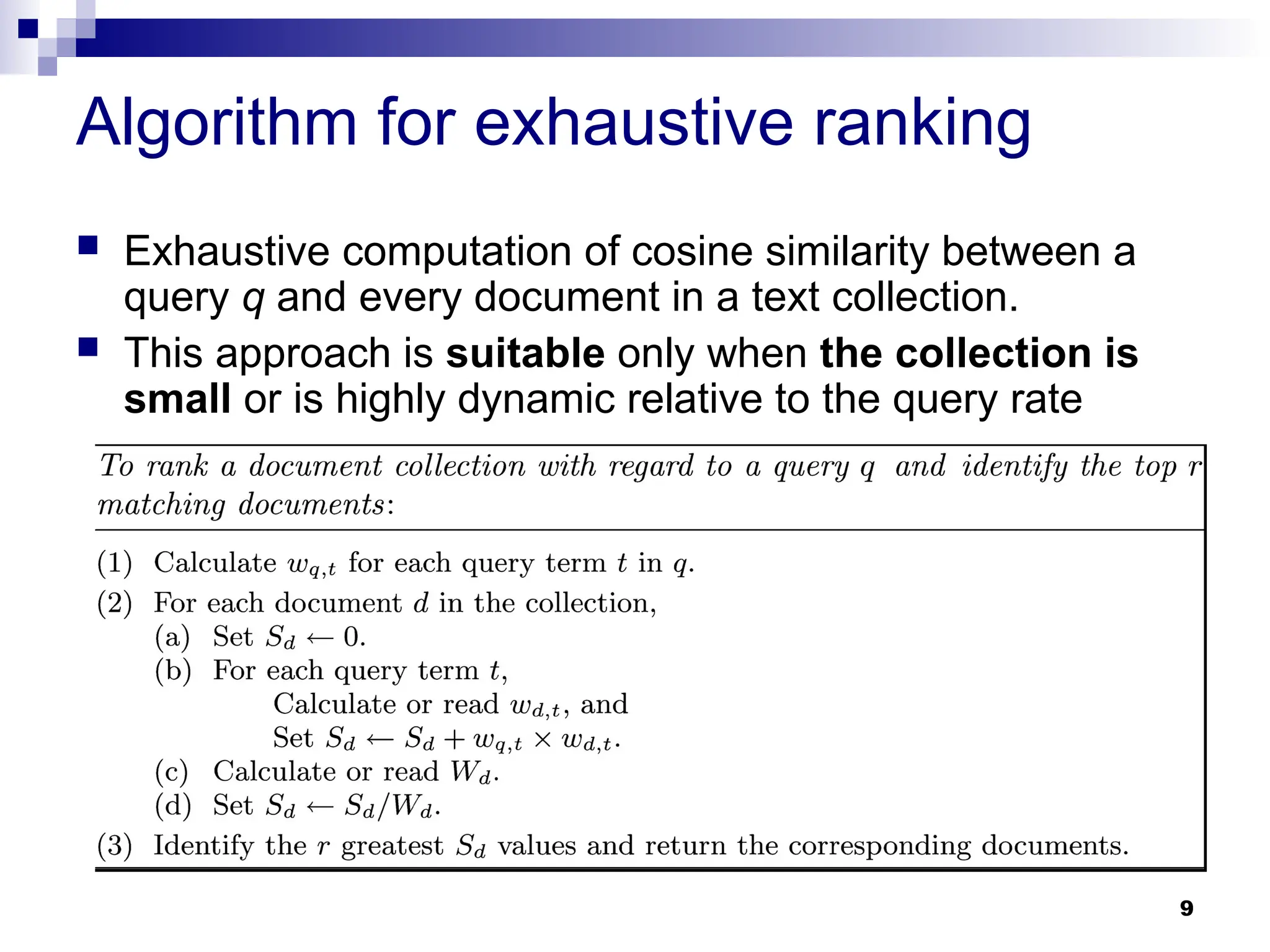
Algorithm for exhaustiveranking
Exhaustive computation of cosine similarity between a
query q and every document in a text collection.
This approach is suitable only when the collection is
small or is highly dynamic relative to the query rate
10.
10
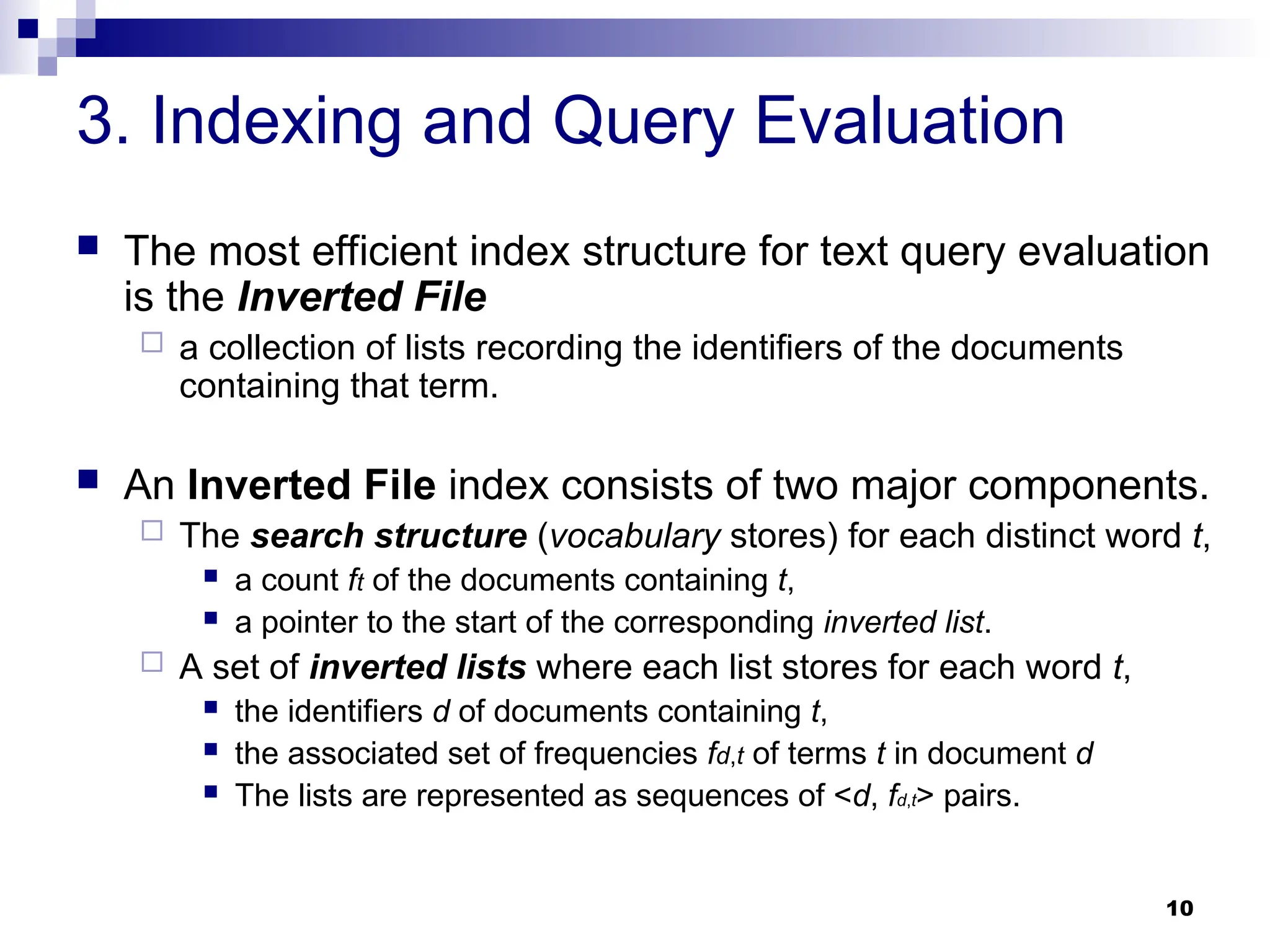
3. Indexing andQuery Evaluation
The most efficient index structure for text query evaluation
is the Inverted File
a collection of lists recording the identifiers of the documents
containing that term.
An Inverted File index consists of two major components.
The search structure (vocabulary stores) for each distinct word t,
a count ft of the documents containing t,
a pointer to the start of the corresponding inverted list.
A set of inverted lists where each list stores for each word t,
the identifiers d of documents containing t,
the associated set of frequencies fd,t of terms t in document d
The lists are represented as sequences of <d, fd,t> pairs.
11.
11
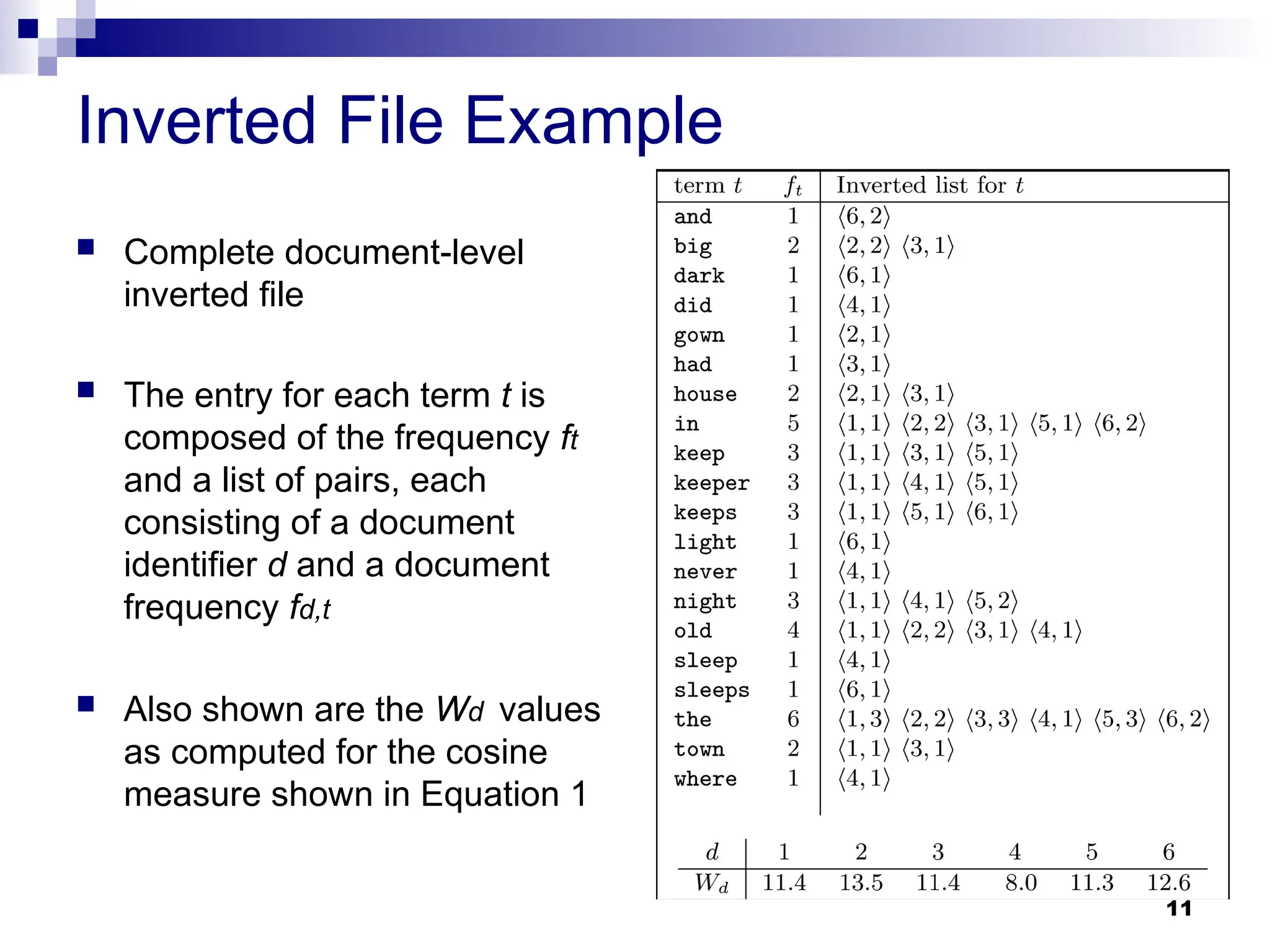
Inverted File Example
Complete document-level
inverted file
The entry for each term t is
composed of the frequency ft
and a list of pairs, each
consisting of a document
identifier d and a document
frequency fd,t
Also shown are the Wd values
as computed for the cosine
measure shown in Equation 1
12.
12
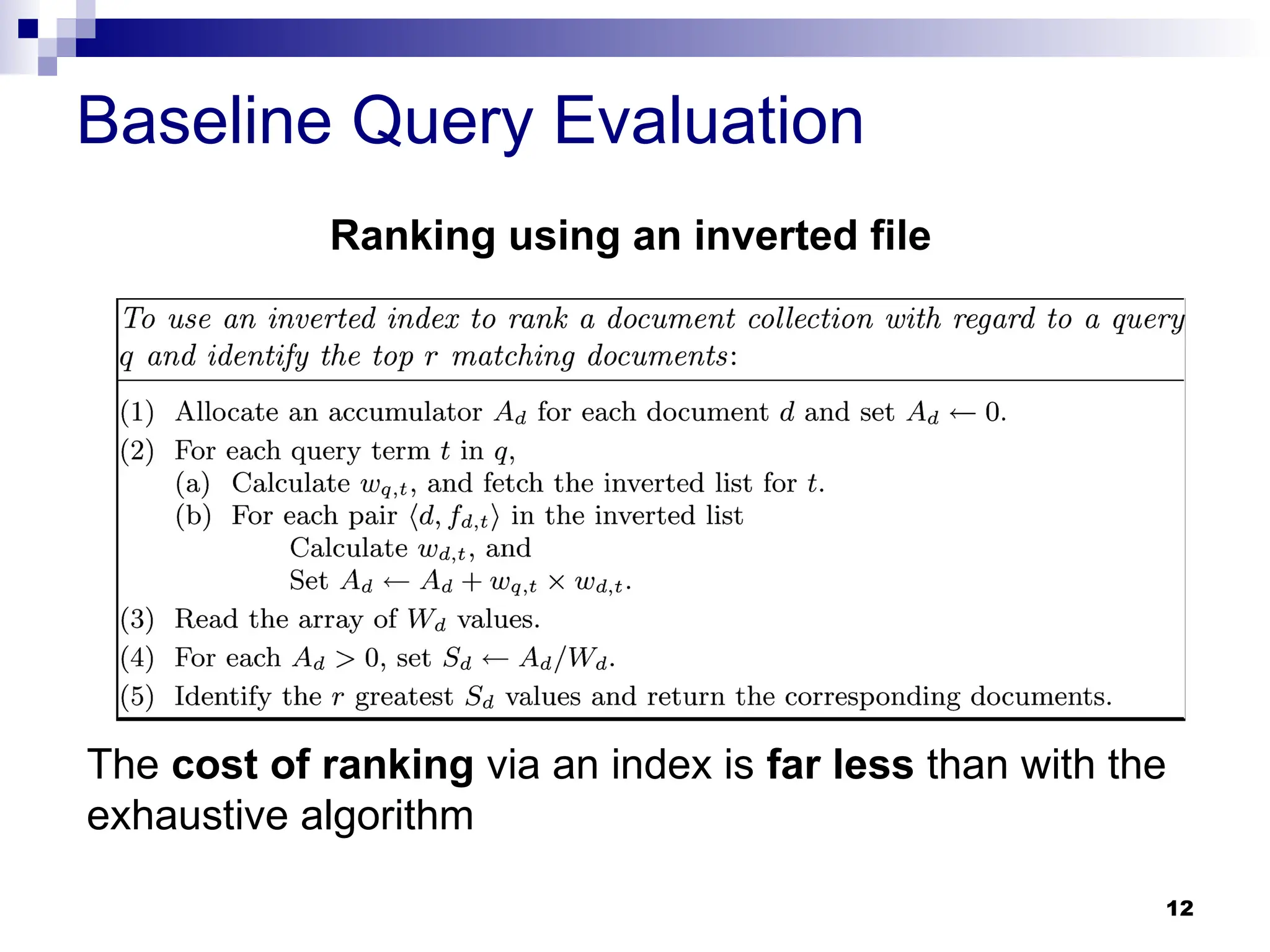
Baseline Query Evaluation
Thecost of ranking via an index is far less than with the
exhaustive algorithm
Ranking using an inverted file
14
4. Phrase Querying
Explicit Phrase like ["the great flydini“] or [San Francisco hotel],
it is appealing to give high scores to pages in which terms appear
in the same order and pattern as they appear in the query,
and low scores to pages in which the terms are separated.
Boolean queries like [old "night keeper“],
it contains two query terms, one of which is a phrase, and both terms
would be required for a document to match.
Three main strategies for Boolean phrase query evaluation
Process phrase queries as Boolean bags-of-words so that the terms can
occur anywhere in matching document, then post-process the retrieved
documents to eliminate false matches.
Add word positions to some or all of the index entries so that the
locations of terms in documents can be checked during query evaluation.
Use some form of partial phrase index or word-pair index so that phrase
appearances can be directly identified.
15.
15
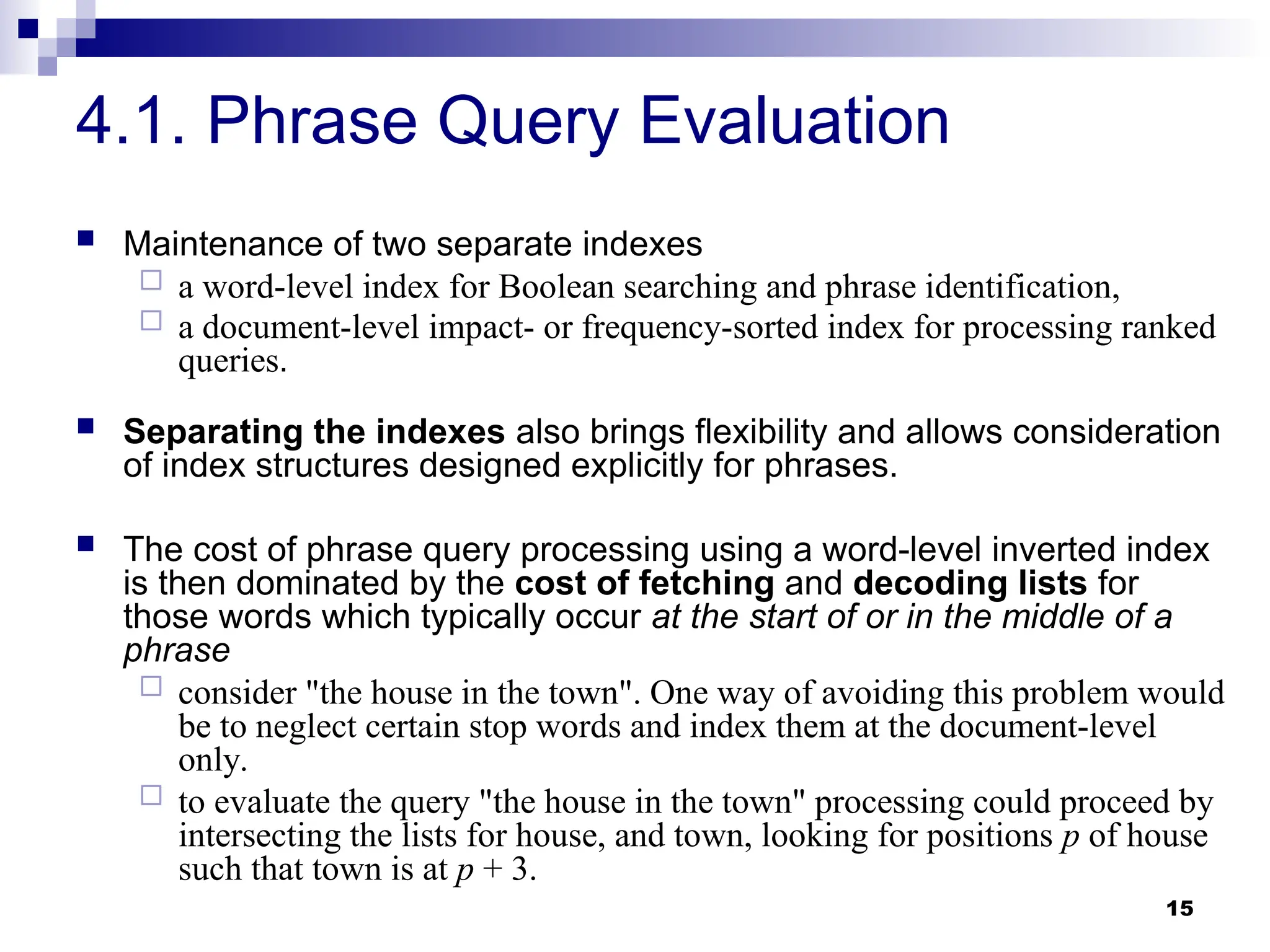
4.1. Phrase QueryEvaluation
Maintenance of two separate indexes
a word-level index for Boolean searching and phrase identification,
a document-level impact- or frequency-sorted index for processing ranked
queries.
Separating the indexes also brings flexibility and allows consideration
of index structures designed explicitly for phrases.
The cost of phrase query processing using a word-level inverted index
is then dominated by the cost of fetching and decoding lists for
those words which typically occur at the start of or in the middle of a
phrase
consider "the house in the town". One way of avoiding this problem would
be to neglect certain stop words and index them at the document-level
only.
to evaluate the query "the house in the town" processing could proceed by
intersecting the lists for house, and town, looking for positions p of house
such that town is at p + 3.
16.
16
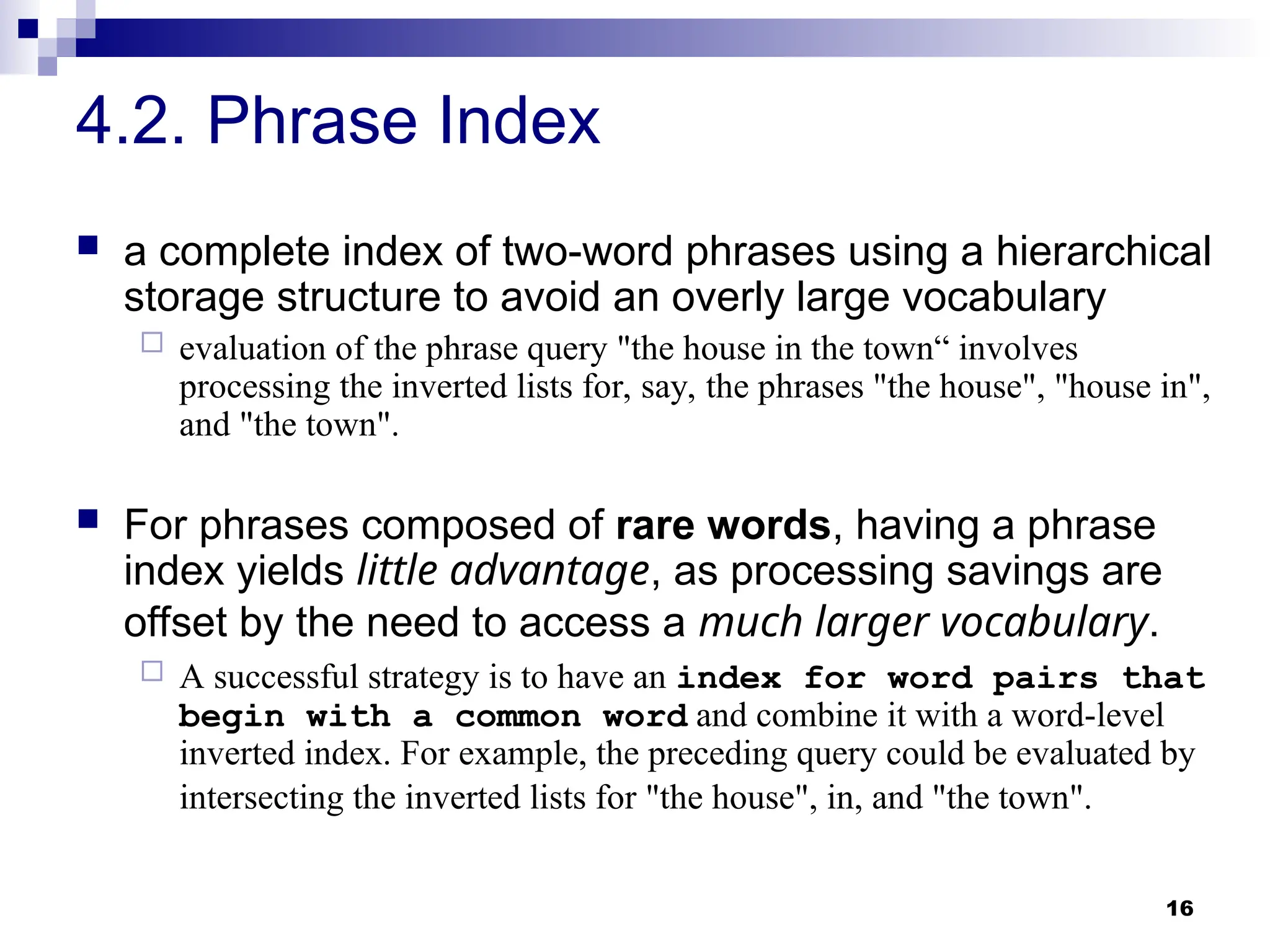
4.2. Phrase Index
a complete index of two-word phrases using a hierarchical
storage structure to avoid an overly large vocabulary
evaluation of the phrase query "the house in the town“ involves
processing the inverted lists for, say, the phrases "the house", "house in",
and "the town".
For phrases composed of rare words, having a phrase
index yields little advantage, as processing savings are
offset by the need to access a much larger vocabulary.
A successful strategy is to have an index for word pairs that
begin with a common word and combine it with a word-level
inverted index. For example, the preceding query could be evaluated by
intersecting the inverted lists for "the house", in, and "the town".
17.
17
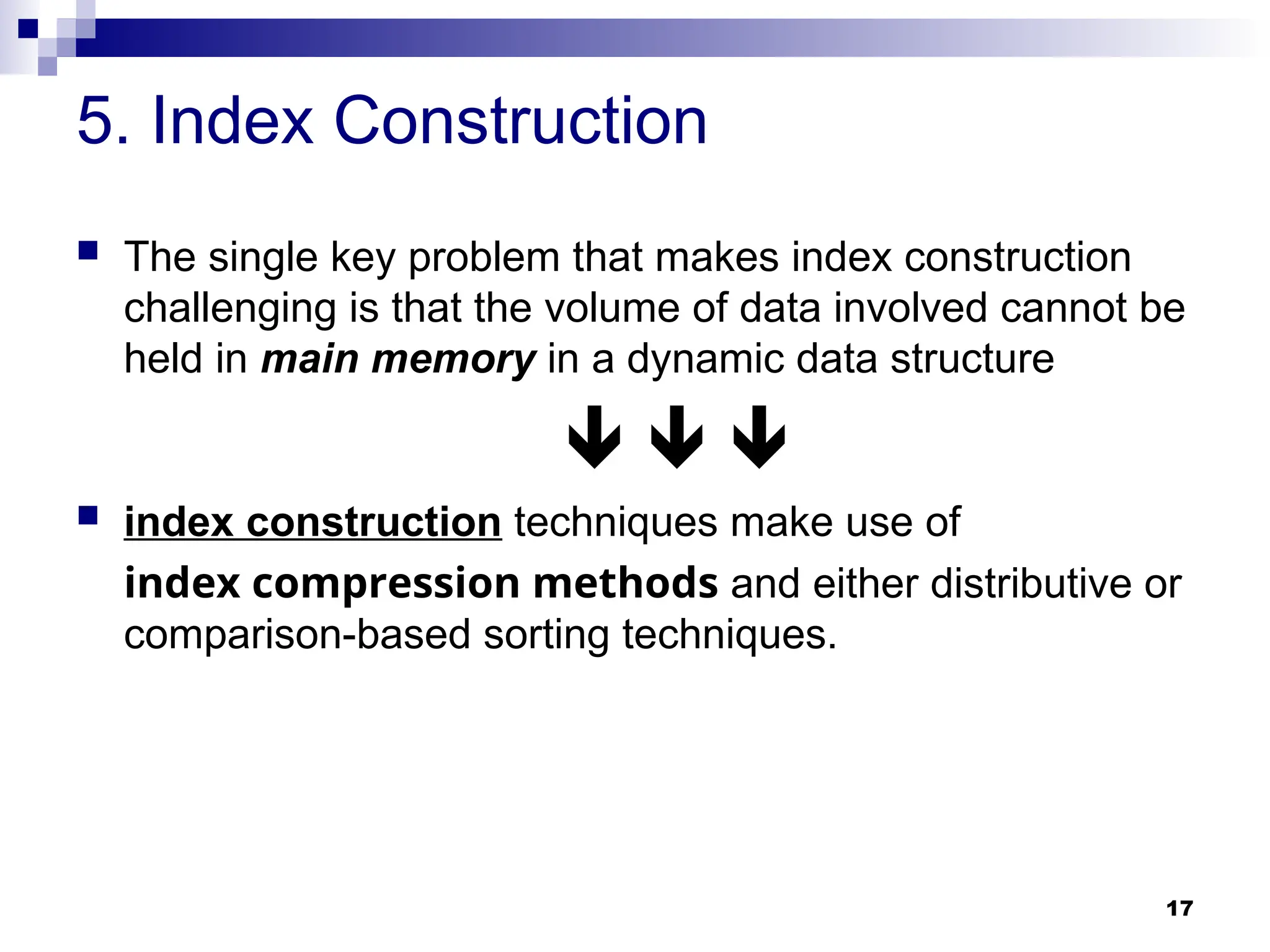
5. Index Construction
The single key problem that makes index construction
challenging is that the volume of data involved cannot be
held in main memory in a dynamic data structure
index construction techniques make use of
index compression methods and either distributive or
comparison-based sorting techniques.
18.
18
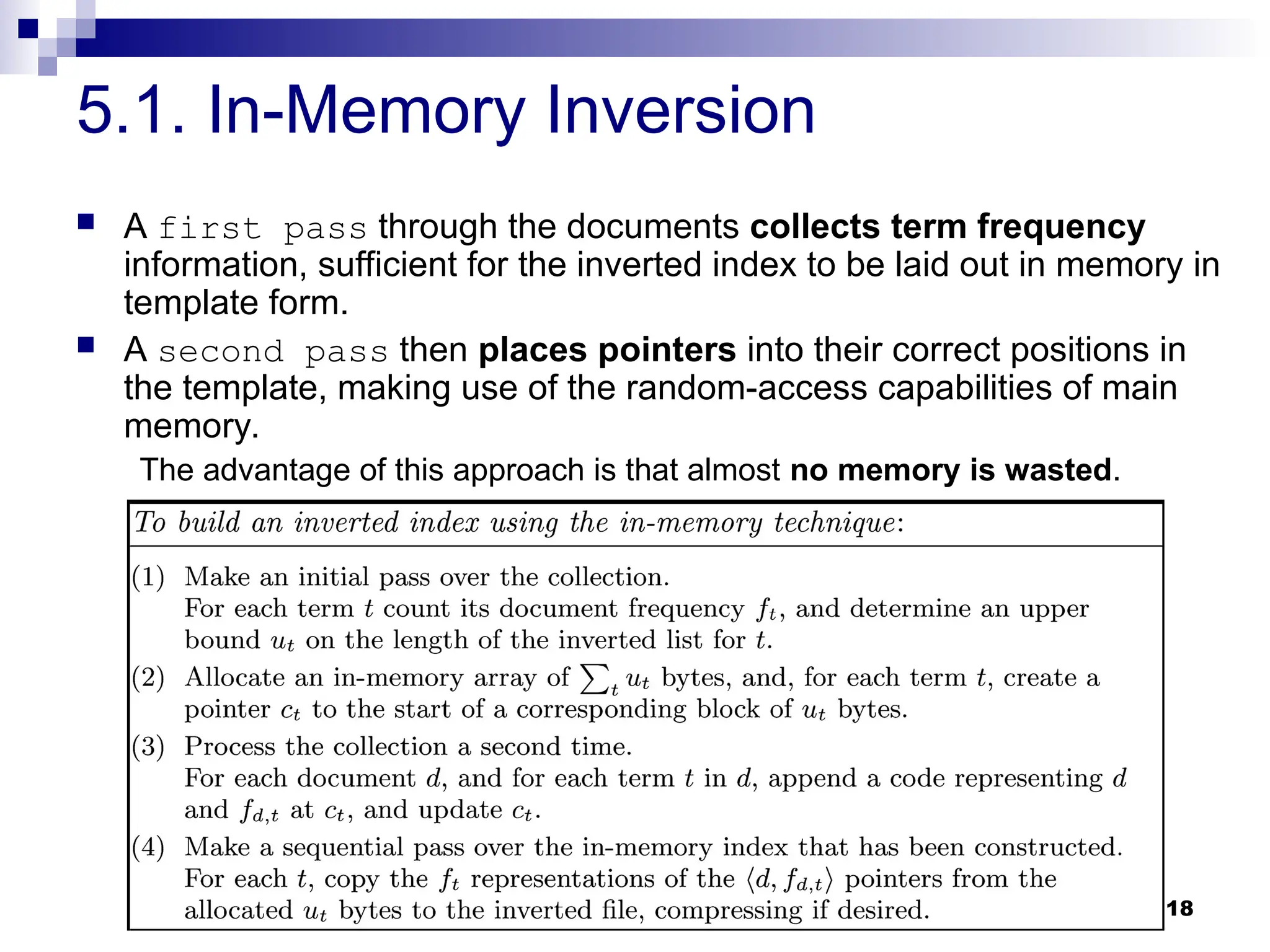
5.1. In-Memory Inversion
A first pass through the documents collects term frequency
information, sufficient for the inverted index to be laid out in memory in
template form.
A second pass then places pointers into their correct positions in
the template, making use of the random-access capabilities of main
memory.
The advantage of this approach is that almost no memory is wasted.
19.
19
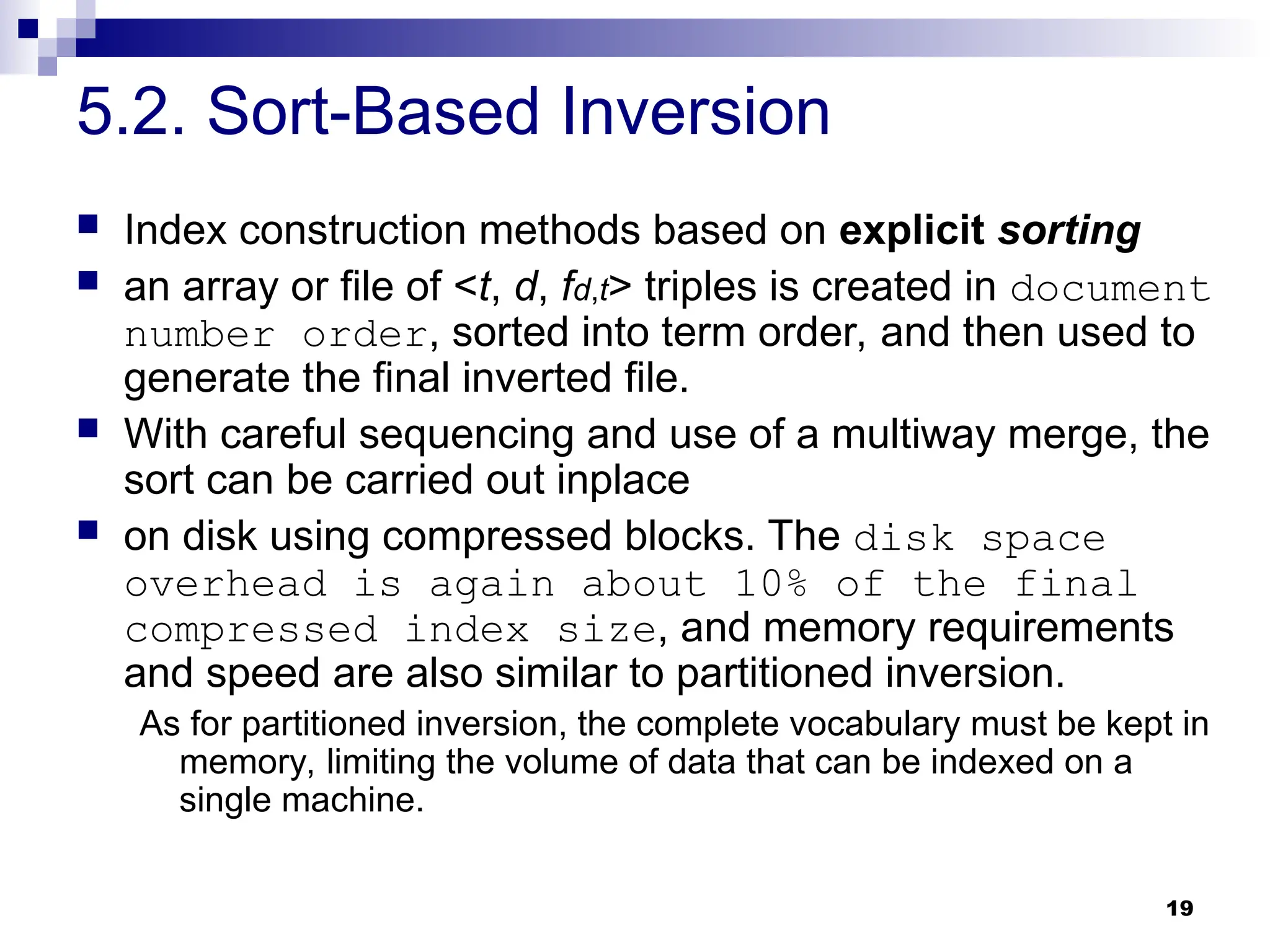
5.2. Sort-Based Inversion
Index construction methods based on explicit sorting
an array or file of <t, d, fd,t> triples is created in document
number order, sorted into term order, and then used to
generate the final inverted file.
With careful sequencing and use of a multiway merge, the
sort can be carried out inplace
on disk using compressed blocks. The disk space
overhead is again about 10% of the final
compressed index size, and memory requirements
and speed are also similar to partitioned inversion.
As for partitioned inversion, the complete vocabulary must be kept in
memory, limiting the volume of data that can be indexed on a
single machine.
20.
20
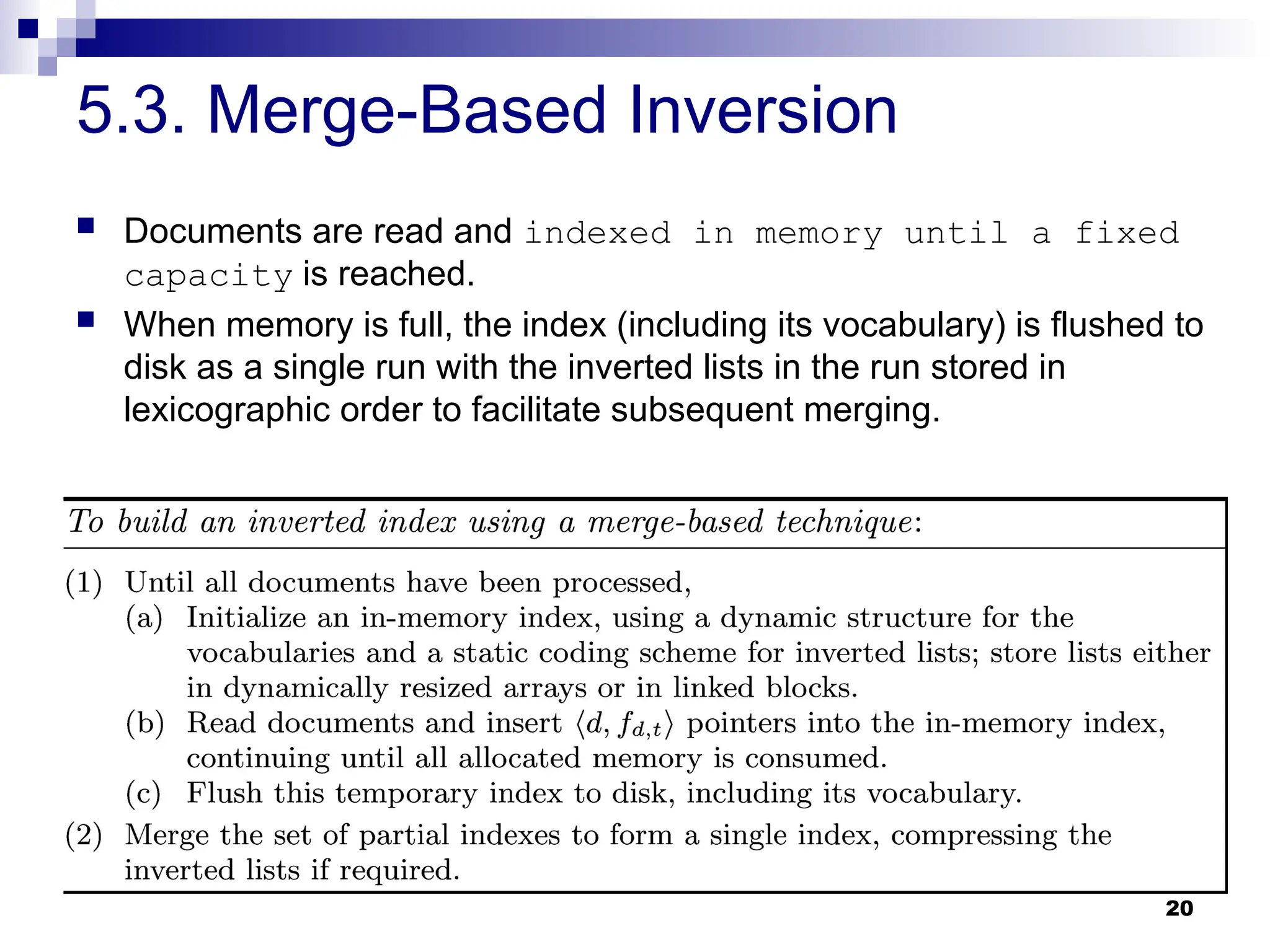
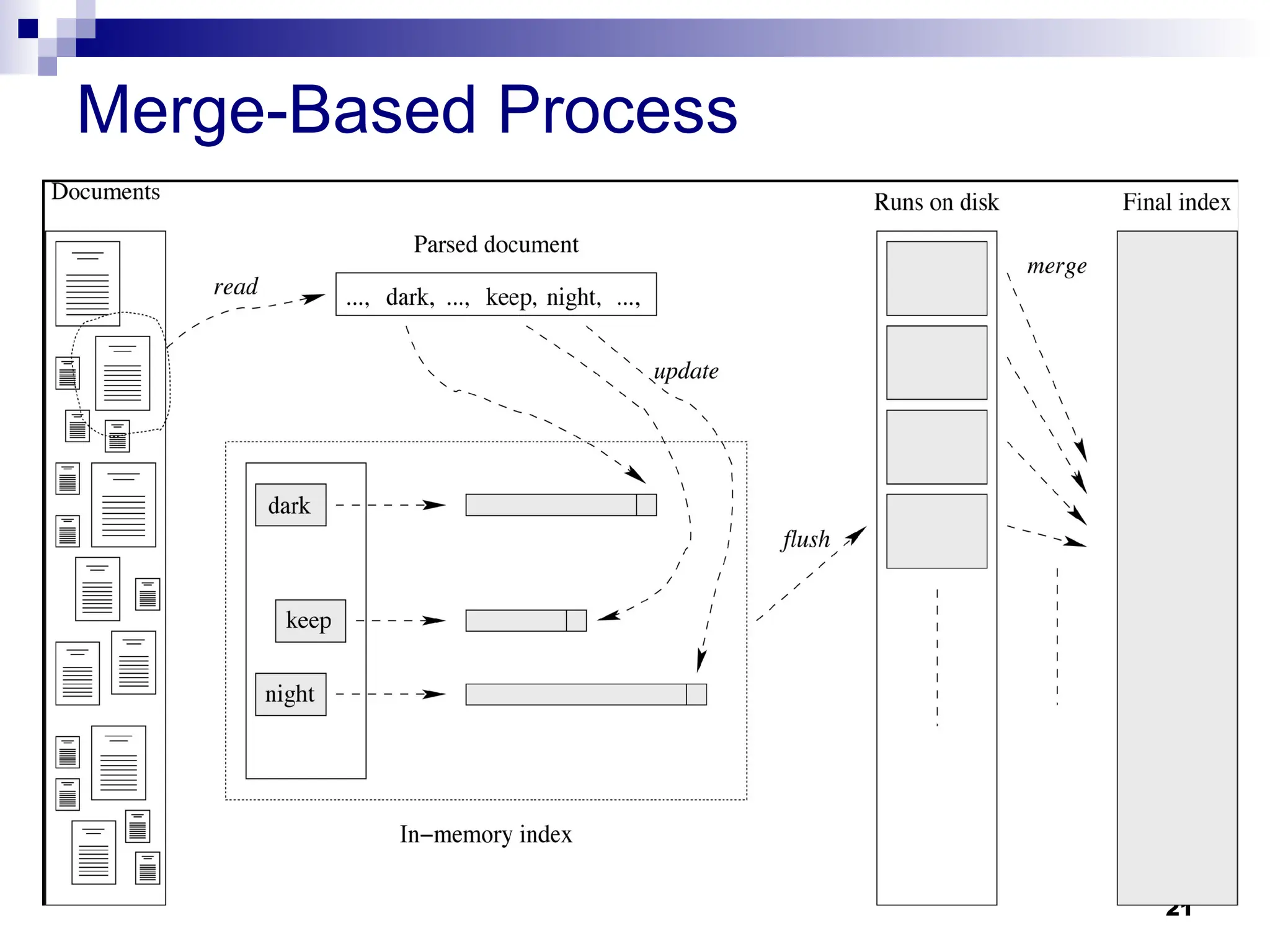
5.3. Merge-Based Inversion
Documents are read and indexed in memory until a fixed
capacity is reached.
When memory is full, the index (including its vocabulary) is flushed to
disk as a single run with the inverted lists in the run stored in
lexicographic order to facilitate subsequent merging.
22
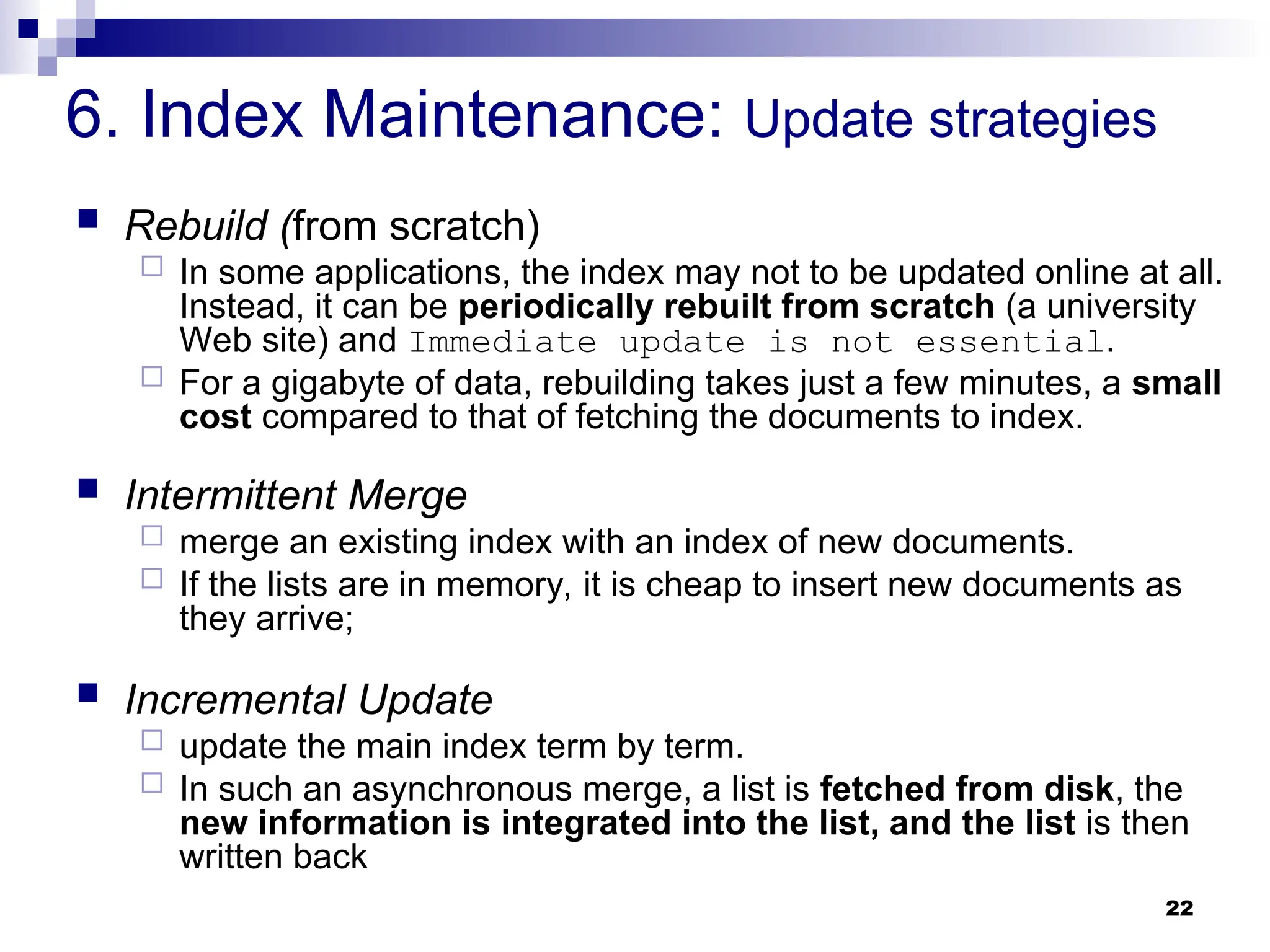
6. Index Maintenance:Update strategies
Rebuild (from scratch)
In some applications, the index may not to be updated online at all.
Instead, it can be periodically rebuilt from scratch (a university
Web site) and Immediate update is not essential.
For a gigabyte of data, rebuilding takes just a few minutes, a small
cost compared to that of fetching the documents to index.
Intermittent Merge
merge an existing index with an index of new documents.
If the lists are in memory, it is cheap to insert new documents as
they arrive;
Incremental Update
update the main index term by term.
In such an asynchronous merge, a list is fetched from disk, the
new information is integrated into the list, and the list is then
written back
23.
23
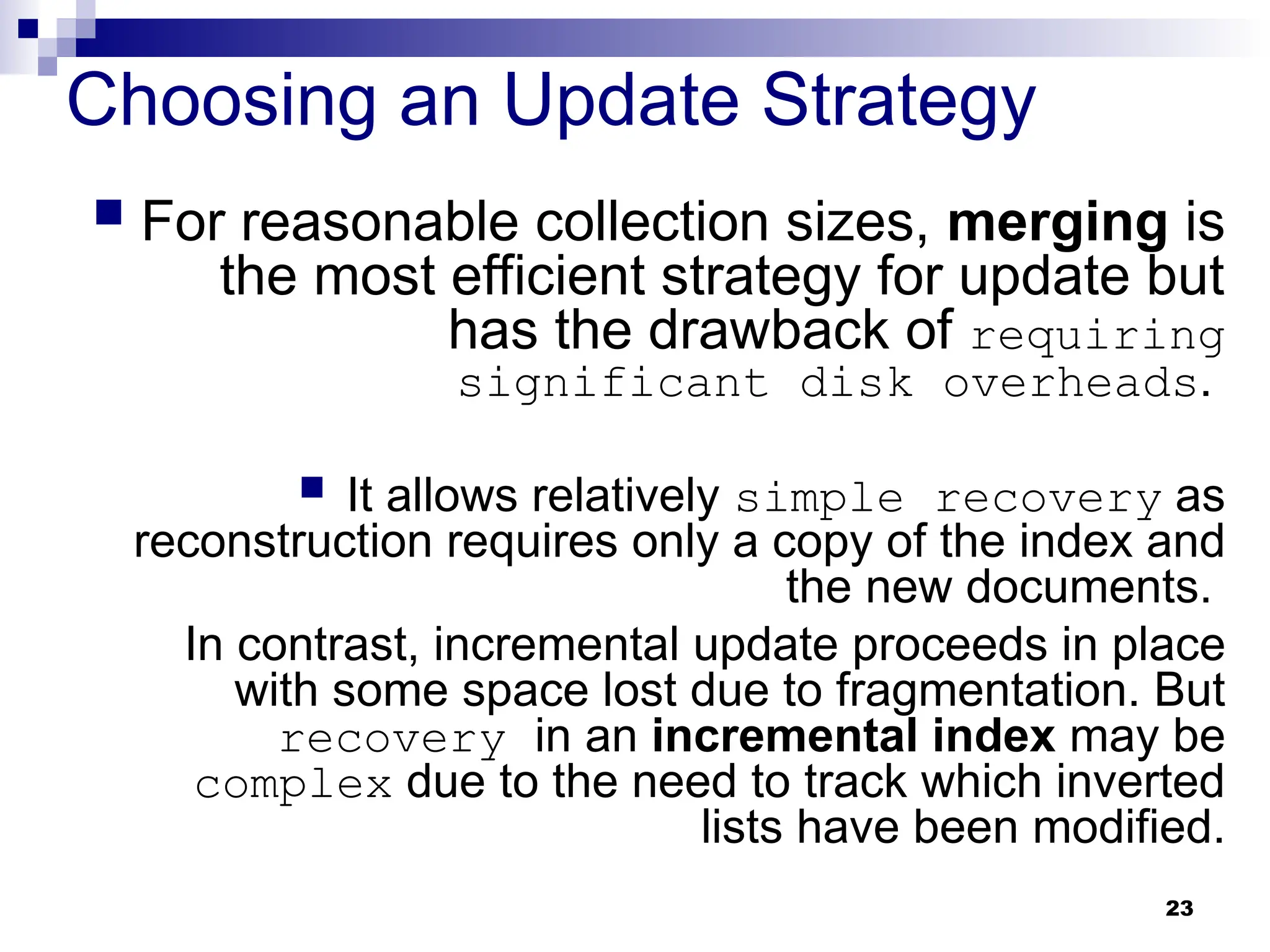
Choosing an UpdateStrategy
For reasonable collection sizes, merging is
the most efficient strategy for update but
has the drawback of requiring
significant disk overheads.
It allows relatively simple recovery as
reconstruction requires only a copy of the index and
the new documents.
In contrast, incremental update proceeds in place
with some space lost due to fragmentation. But
recovery in an incremental index may be
complex due to the need to track which inverted
lists have been modified.
24.
24
7. Distributed InformationRetrieval
Distribution
the document collection and its index are split across
multiple machines and that answers to the query as a
whole must be synthesized from the various collection
components.
Replication (or mirroring)
involves making enough identical copies of the system so
that the required query load can be handled.
25.
25
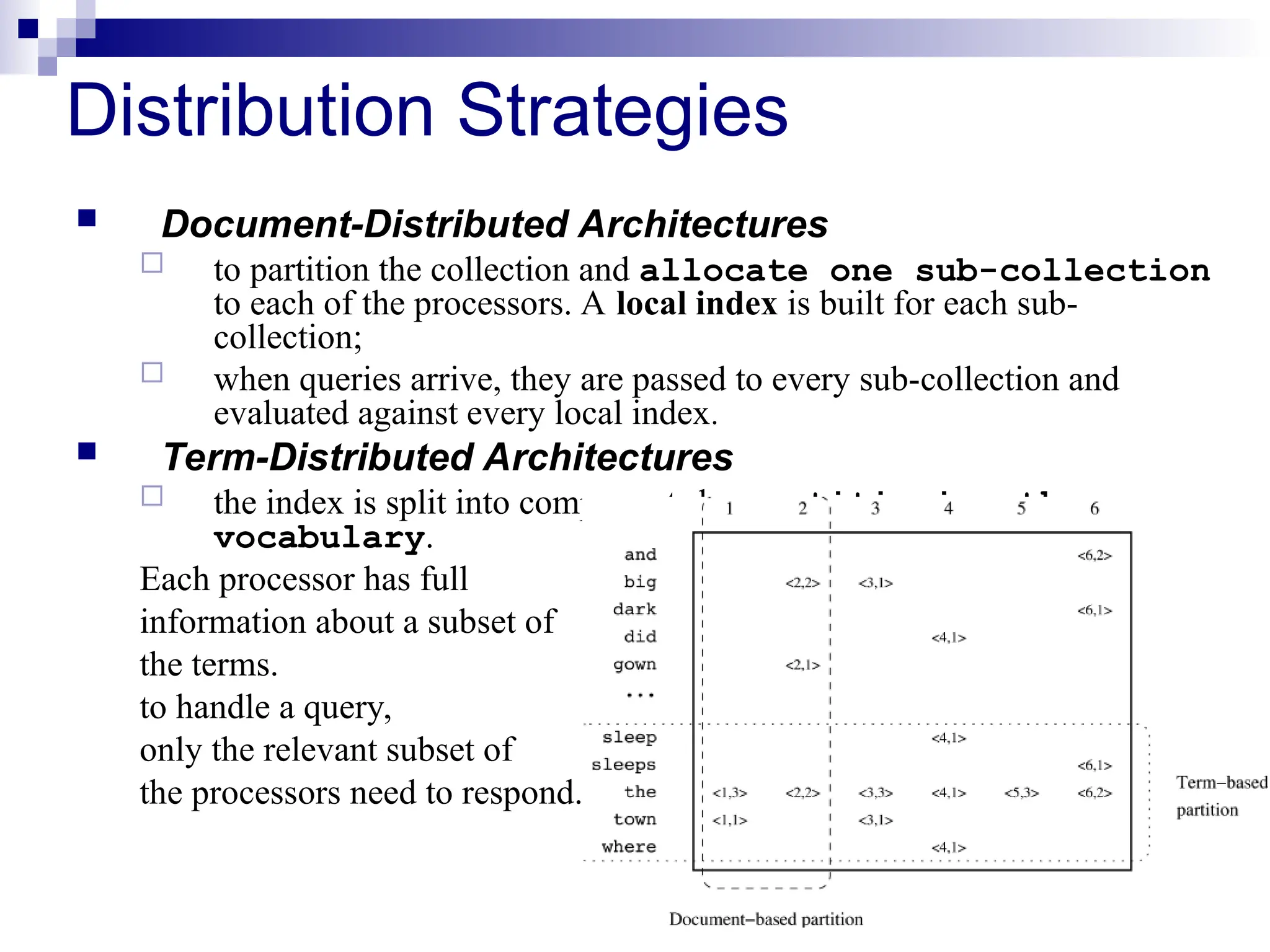
Distribution Strategies
Document-DistributedArchitectures
to partition the collection and allocate one sub-collection
to each of the processors. A local index is built for each sub-
collection;
when queries arrive, they are passed to every sub-collection and
evaluated against every local index.
Term-Distributed Architectures
the index is split into components by partitioning the
vocabulary.
Each processor has full
information about a subset of
the terms.
to handle a query,
only the relevant subset of
the processors need to respond.
26.
26
Choosing a DistributionStrategy
Document distribution typically results in a better
balance of workload
allows more naturally for index construction and for
document insertion.
allows a search service to be provided even when one of
the hosts is offline for some reason.
The Google implementation uses a document-partitioned index with
massive replication and redundancy at all levels: the machine,
the processor cluster, and the site.
27.
27
8. Efficient IndexRepresentations
With appropriate compression techniques, it is possible to
simultaneously reduce both space consumption and disk
traffic and also overall query evaluation time.
1. Compact Storage of Integers
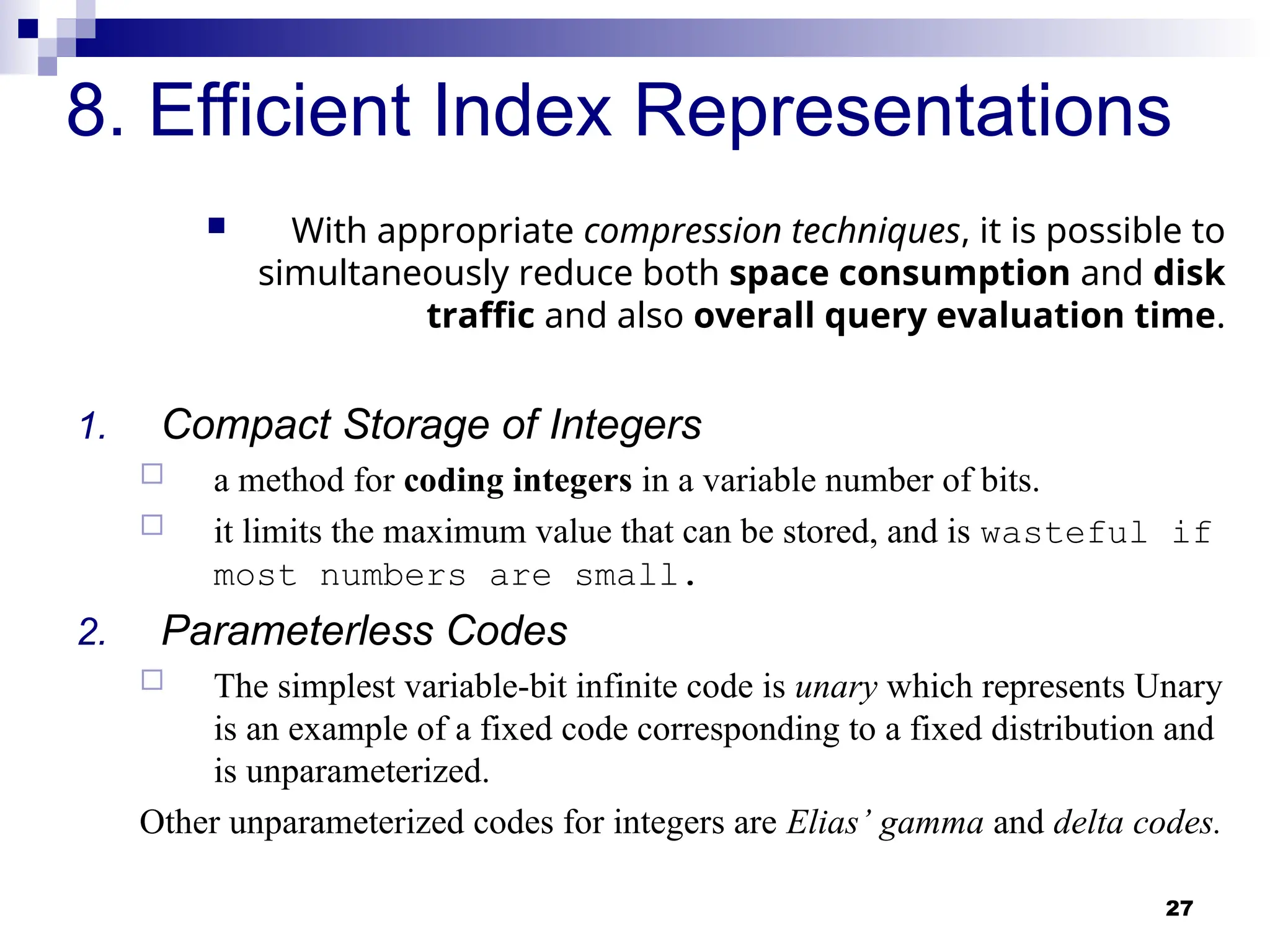
a method for coding integers in a variable number of bits.
it limits the maximum value that can be stored, and is wasteful if
most numbers are small.
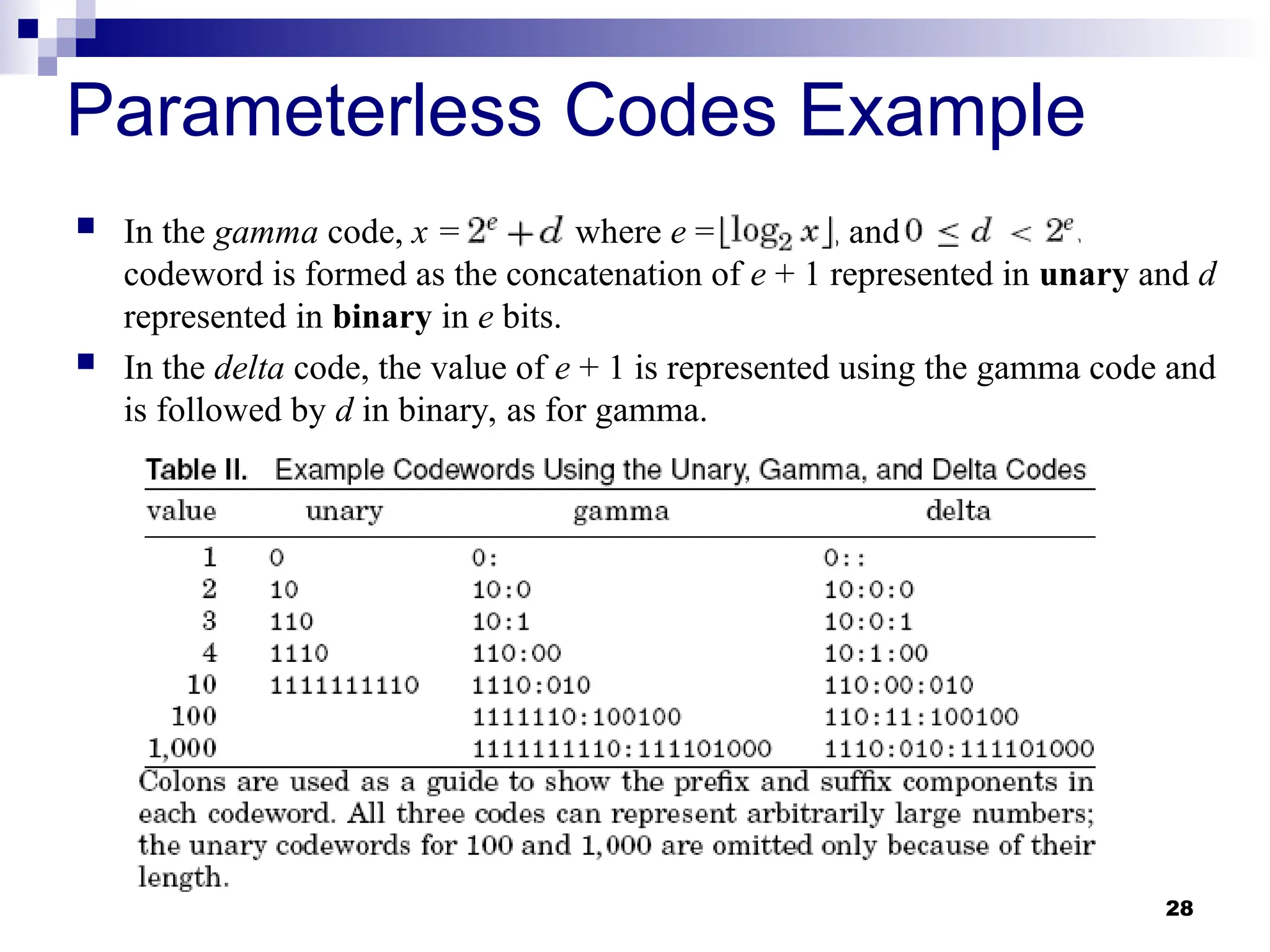
2. Parameterless Codes
The simplest variable-bit infinite code is unary which represents Unary
is an example of a fixed code corresponding to a fixed distribution and
is unparameterized.
Other unparameterized codes for integers are Elias’ gamma and delta codes.
28.
28
In thegamma code, x = 2^e +d where e = logx2 , and 0 ≤ d < 2^e.
codeword is formed as the concatenation of e + 1 represented in unary and d
represented in binary in e bits.
In the delta code, the value of e + 1 is represented using the gamma code and
is followed by d in binary, as for gamma.
Parameterless Codes Example
29.
29
Efficient Index Representations(Cont’)
3. Binary Codes
for locally homogeneous data. they can provide decoding speeds as
good as bytewise codes.
To allow decoding, each word of packed codes is prefixed by a short
binary selector that indicates how that word should be interpreted.
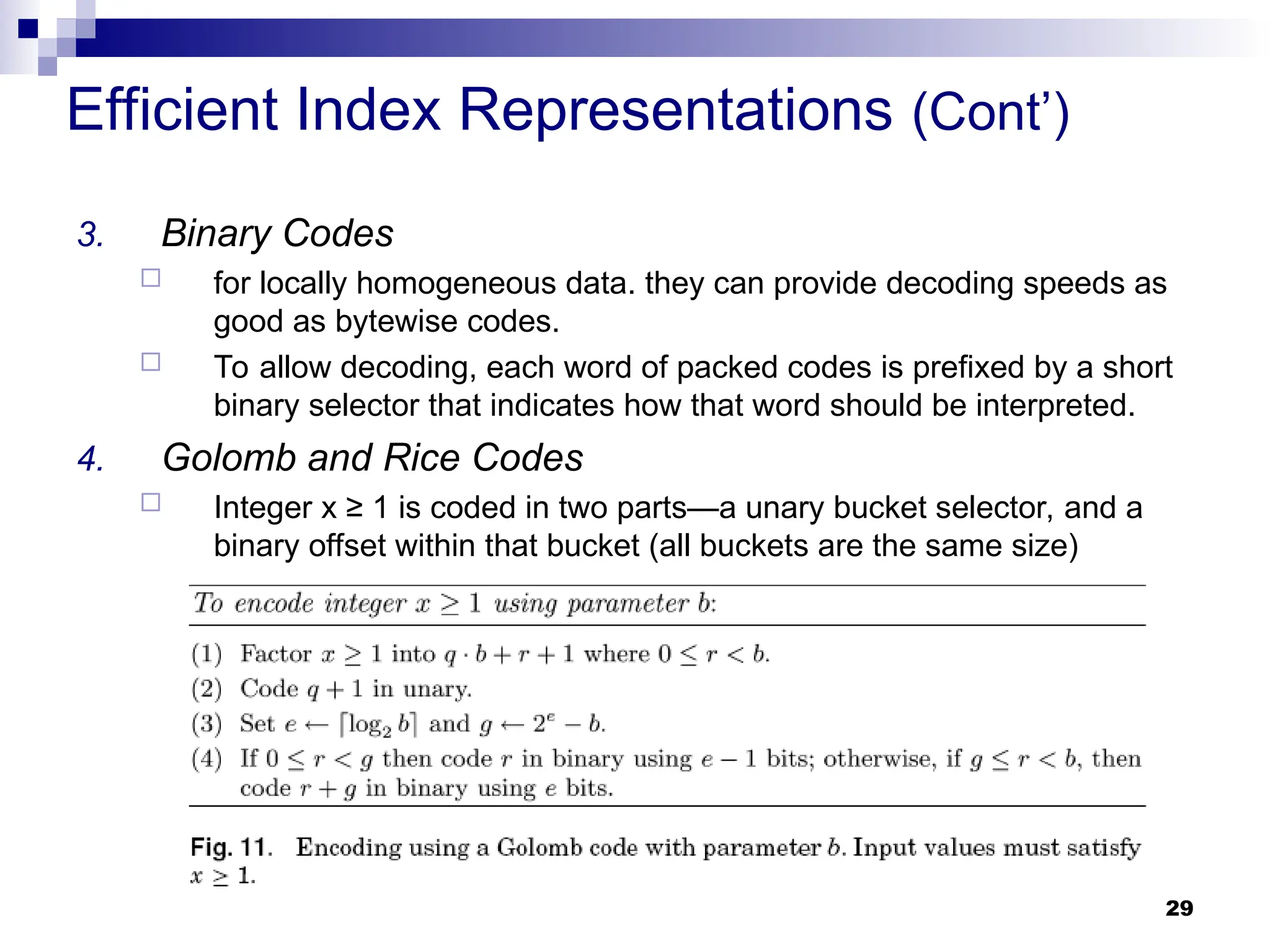
4. Golomb and Rice Codes
Integer x ≥ 1 is coded in two parts—a unary bucket selector, and a
binary offset within that bucket (all buckets are the same size)
30.
30
Pros and Consof Compression
Pros:
Compression reduces the disk space needed to store the index;
during query evaluation, it reduces transfer costs (the lists are
shorter) and seek times (the index is smaller);
reduces the costs of index construction and maintenance.
Cons:
inverted lists must be decoded before they are used.
If the index is larger than the available main memory or
cannot be buffered for some other reason, there is no disadvantage to
compression.
Use of appropriate index compression techniques is an important facet of the
design of an efficient retrieval system.
31.
31
9. Limiting MemoryRequirements
Accumulator Limiting
If only documents with rare query terms (low ft) are allowed to have an
accumulator, the number of accumulators can be greatly reduced during
ranked query evaluation. This method gives precise control over
memory usage.
Accumulator Thresholding
Accumulators are created if it seems likely that the document will
ultimately have a sufficiently high similarity, with a test wq,t× wd,t > S,
for some value S. The threshold S is initially small but is increased
during query processing so that it becomes harder for documents to
create an accumulator as the computation proceeds.
Data Structures
An obvious solution is to store the accumulators as a list ordered by
document number and successively merge it with each term’s inverted
list.
32.
32
10. Reducing RetrievalCost
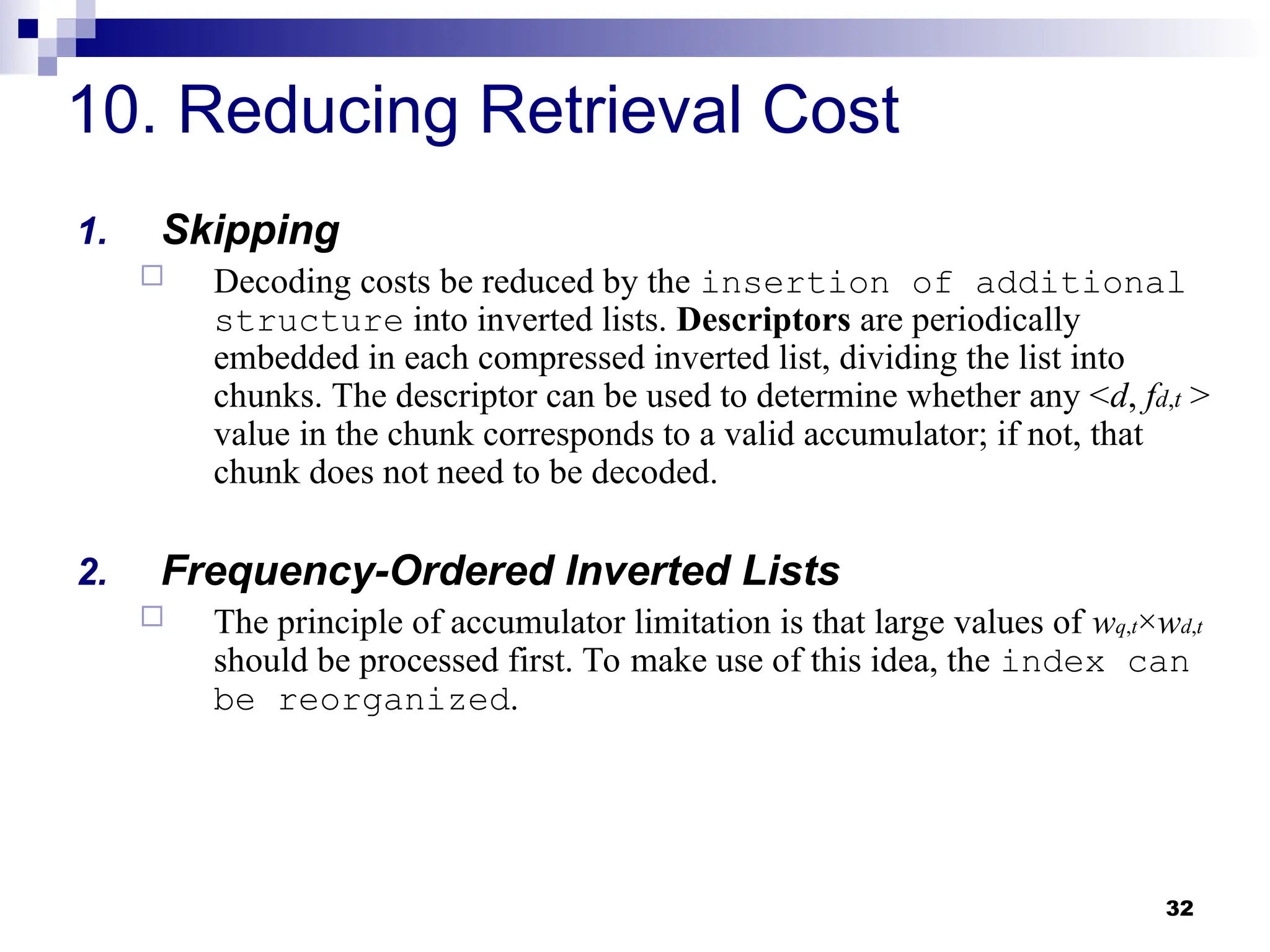
1. Skipping
Decoding costs be reduced by the insertion of additional
structure into inverted lists. Descriptors are periodically
embedded in each compressed inverted list, dividing the list into
chunks. The descriptor can be used to determine whether any <d, fd,t >
value in the chunk corresponds to a valid accumulator; if not, that
chunk does not need to be decoded.
2. Frequency-Ordered Inverted Lists
The principle of accumulator limitation is that large values of wq,t×wd,t
should be processed first. To make use of this idea, the index can
be reorganized.
33.
33
Reducing Retrieval Cost(Cont’)
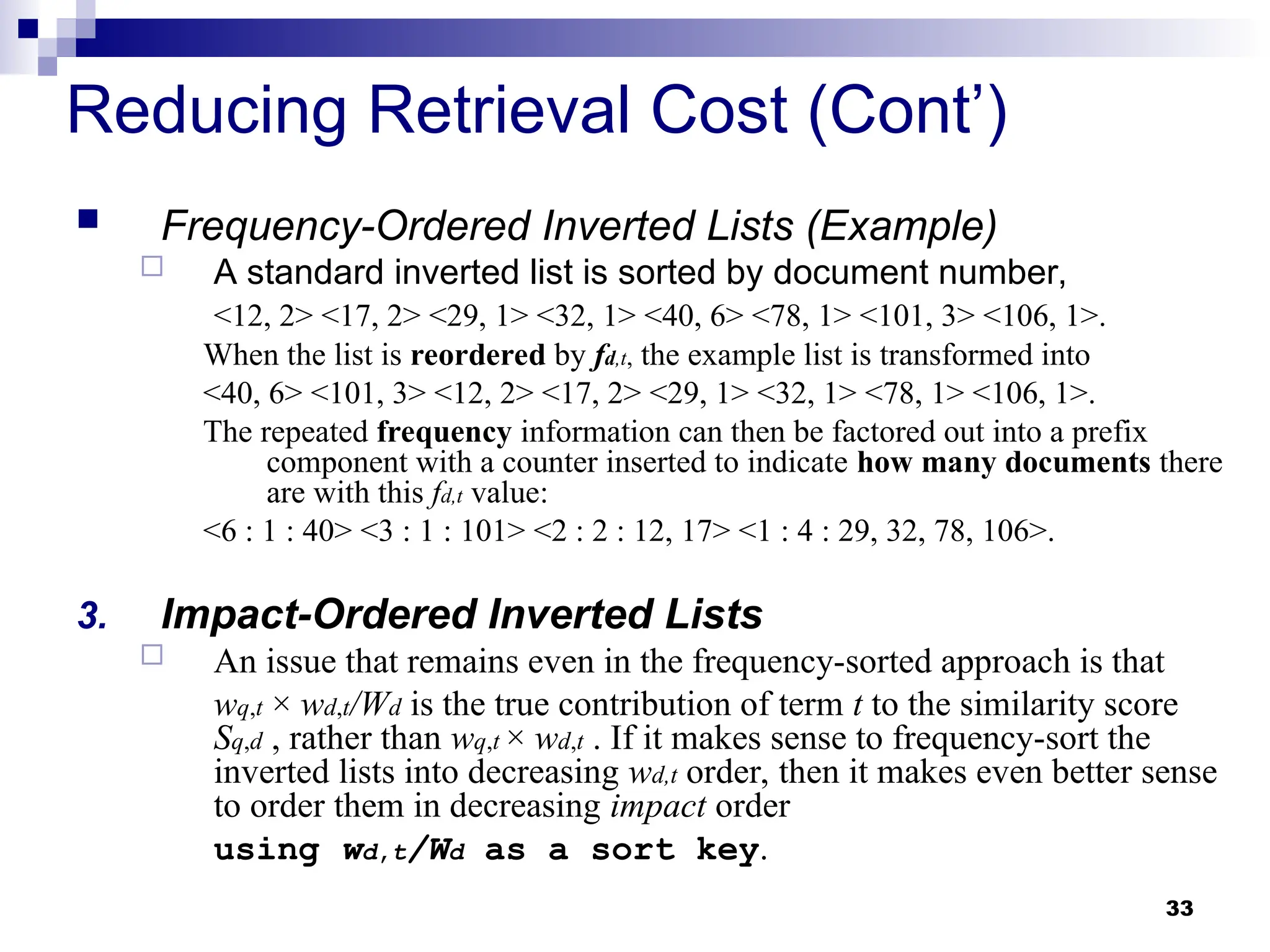
Frequency-Ordered Inverted Lists (Example)
A standard inverted list is sorted by document number,
<12, 2> <17, 2> <29, 1> <32, 1> <40, 6> <78, 1> <101, 3> <106, 1>.
When the list is reordered by fd,t, the example list is transformed into
<40, 6> <101, 3> <12, 2> <17, 2> <29, 1> <32, 1> <78, 1> <106, 1>.
The repeated frequency information can then be factored out into a prefix
component with a counter inserted to indicate how many documents there
are with this fd,t value:
<6 : 1 : 40> <3 : 1 : 101> <2 : 2 : 12, 17> <1 : 4 : 29, 32, 78, 106>.
3. Impact-Ordered Inverted Lists
An issue that remains even in the frequency-sorted approach is that
wq,t × wd,t/Wd is the true contribution of term t to the similarity score
Sq,d , rather than wq,t × wd,t . If it makes sense to frequency-sort the
inverted lists into decreasing wd,t order, then it makes even better sense
to order them in decreasing impact order
using wd,t/Wd as a sort key.
34.
34
Reducing Retrieval Cost(Other Considerations)
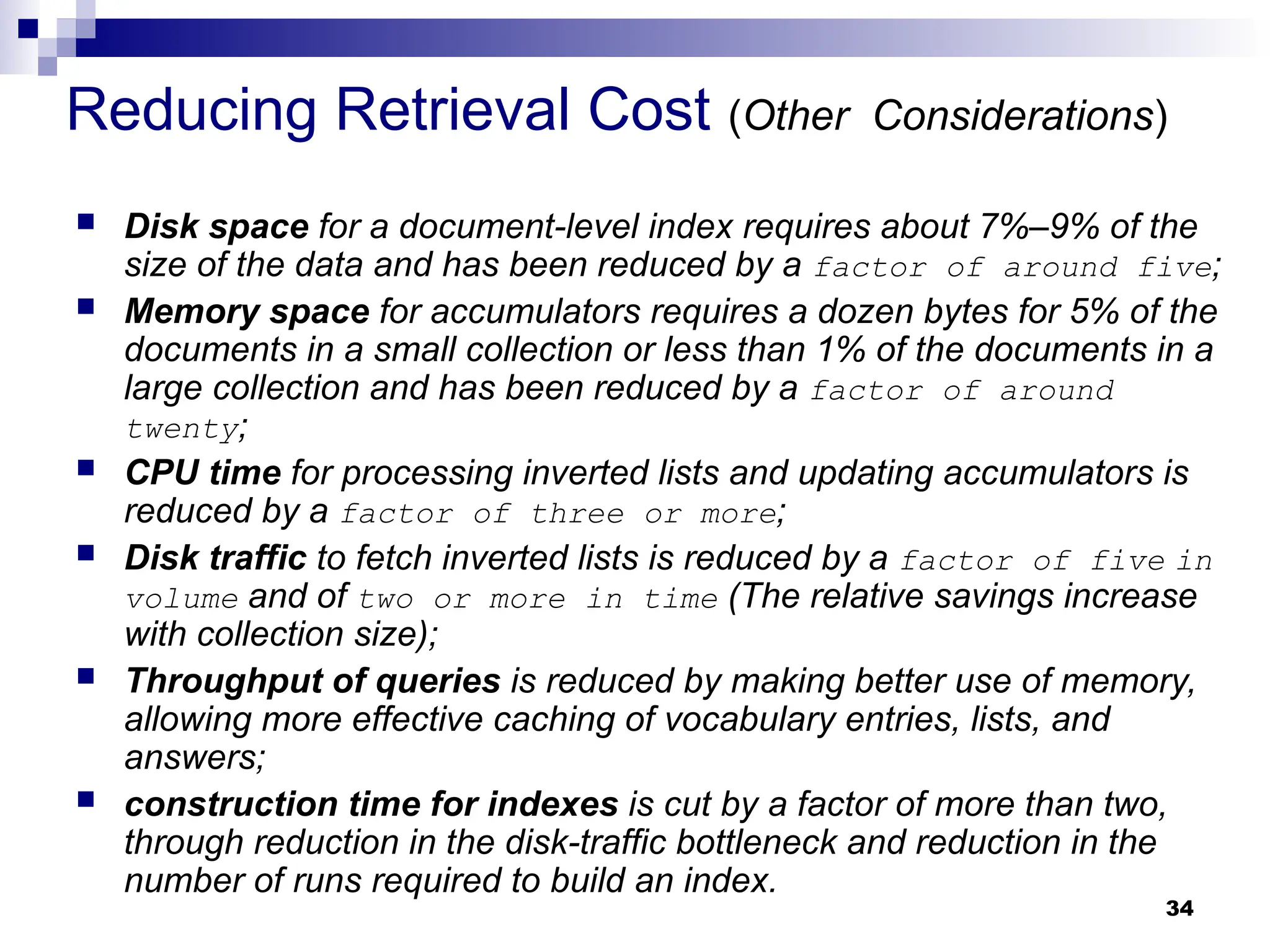
Disk space for a document-level index requires about 7%–9% of the
size of the data and has been reduced by a factor of around five;
Memory space for accumulators requires a dozen bytes for 5% of the
documents in a small collection or less than 1% of the documents in a
large collection and has been reduced by a factor of around
twenty;
CPU time for processing inverted lists and updating accumulators is
reduced by a factor of three or more;
Disk traffic to fetch inverted lists is reduced by a factor of five in
volume and of two or more in time (The relative savings increase
with collection size);
Throughput of queries is reduced by making better use of memory,
allowing more effective caching of vocabulary entries, lists, and
answers;
construction time for indexes is cut by a factor of more than two,
through reduction in the disk-traffic bottleneck and reduction in the
number of runs required to build an index.
35.
35
11. Other Approachesto Indexing
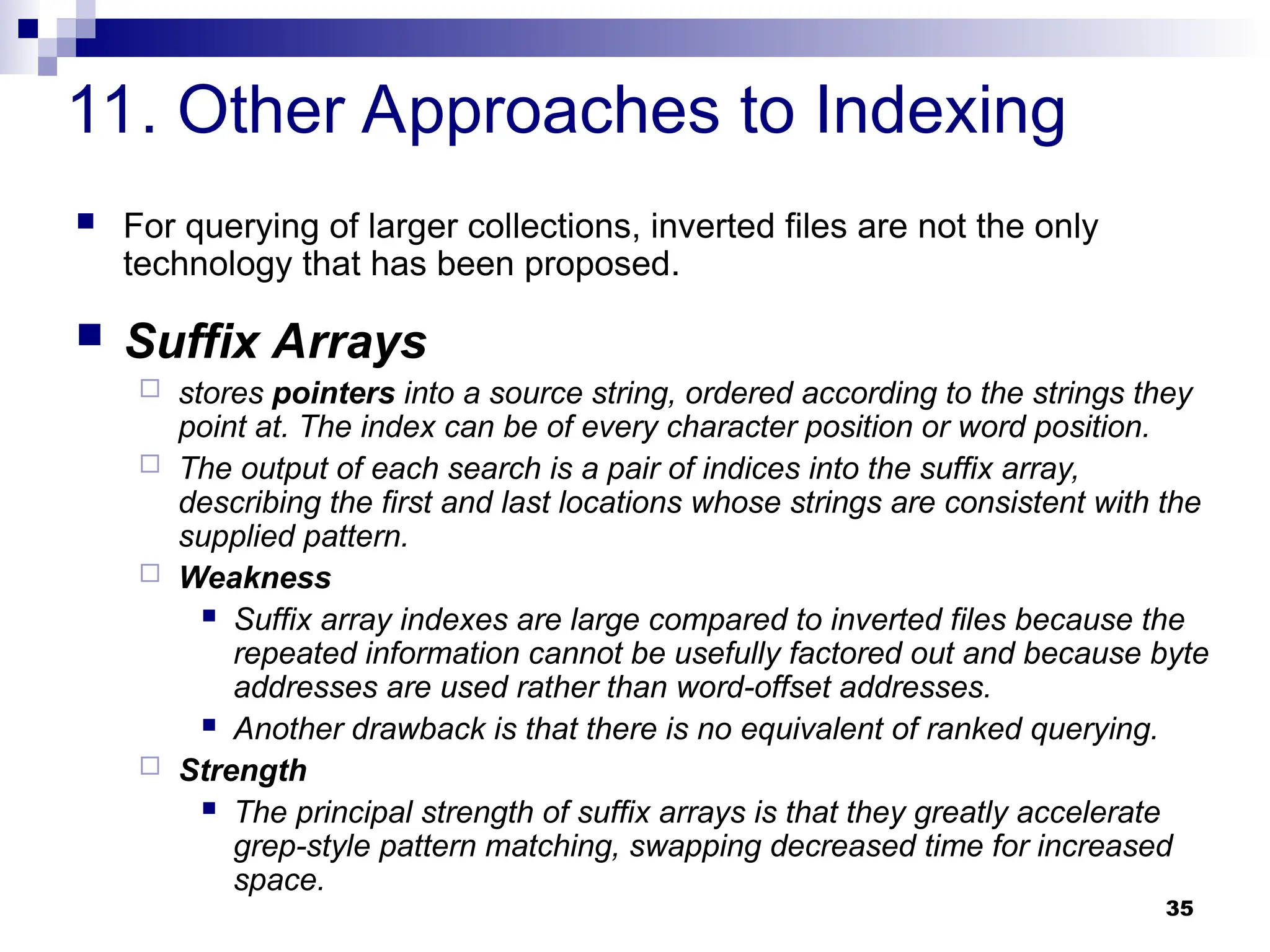
For querying of larger collections, inverted files are not the only
technology that has been proposed.
Suffix Arrays
stores pointers into a source string, ordered according to the strings they
point at. The index can be of every character position or word position.
The output of each search is a pair of indices into the suffix array,
describing the first and last locations whose strings are consistent with the
supplied pattern.
Weakness
Suffix array indexes are large compared to inverted files because the
repeated information cannot be usefully factored out and because byte
addresses are used rather than word-offset addresses.
Another drawback is that there is no equivalent of ranked querying.
Strength
The principal strength of suffix arrays is that they greatly accelerate
grep-style pattern matching, swapping decreased time for increased
space.
36.
36
Other Approaches toIndexing (Cont’)
Signature Files
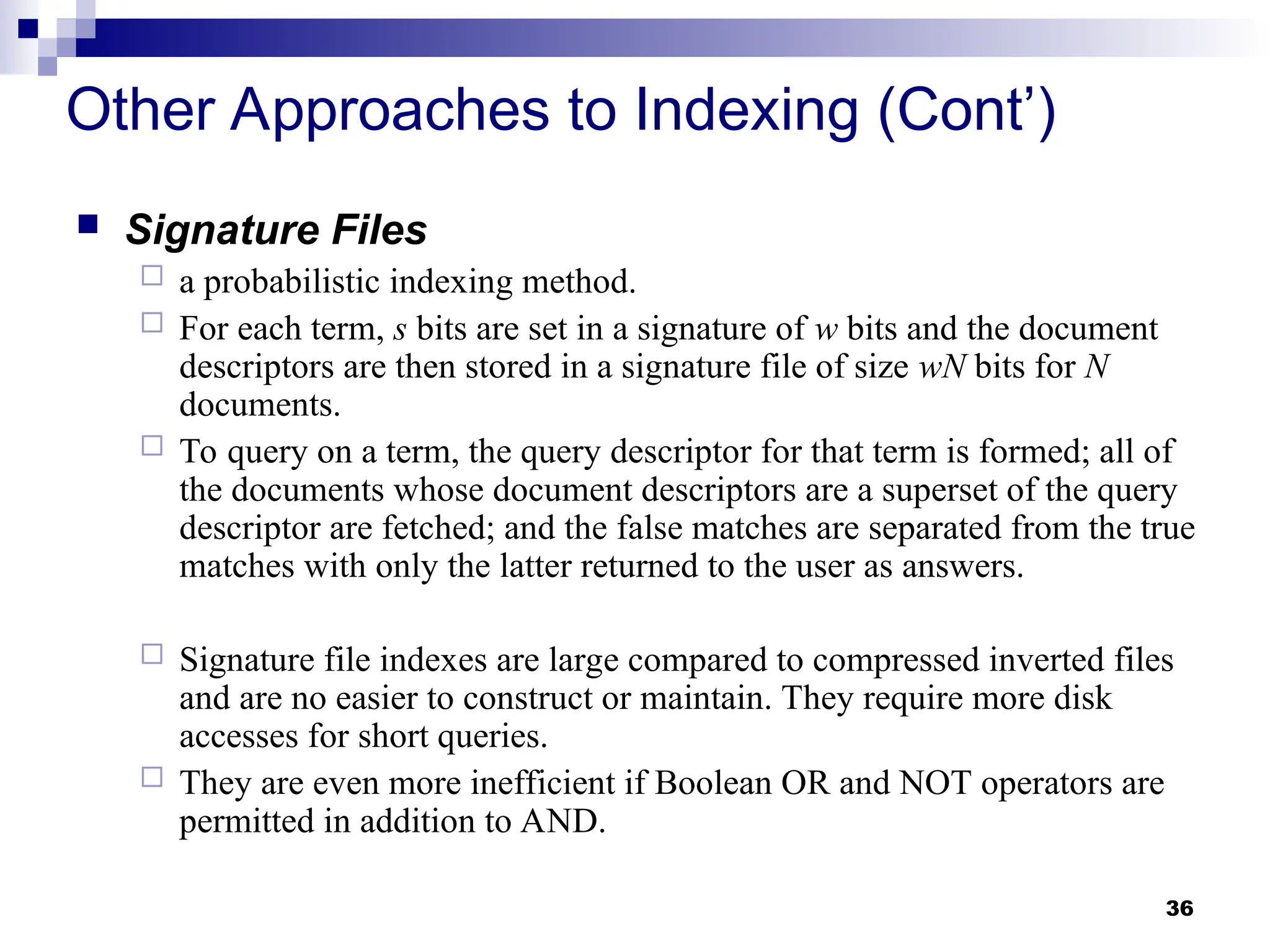
a probabilistic indexing method.
For each term, s bits are set in a signature of w bits and the document
descriptors are then stored in a signature file of size wN bits for N
documents.
To query on a term, the query descriptor for that term is formed; all of
the documents whose document descriptors are a superset of the query
descriptor are fetched; and the false matches are separated from the true
matches with only the latter returned to the user as answers.
Signature file indexes are large compared to compressed inverted files
and are no easier to construct or maintain. They require more disk
accesses for short queries.
They are even more inefficient if Boolean OR and NOT operators are
permitted in addition to AND.
37.
37
12. Beyond anElement Search Engine
Crawling
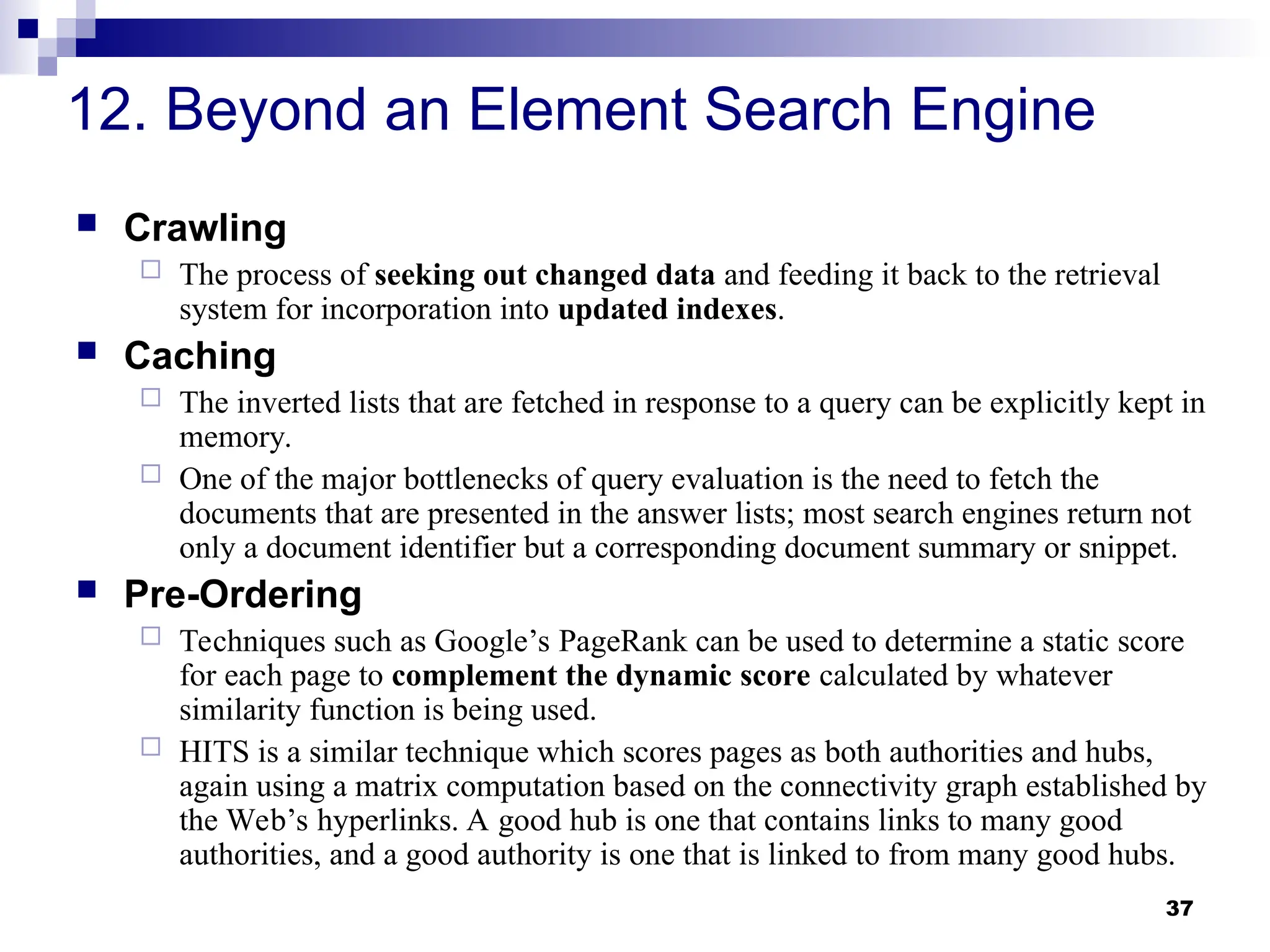
The process of seeking out changed data and feeding it back to the retrieval
system for incorporation into updated indexes.
Caching
The inverted lists that are fetched in response to a query can be explicitly kept in
memory.
One of the major bottlenecks of query evaluation is the need to fetch the
documents that are presented in the answer lists; most search engines return not
only a document identifier but a corresponding document summary or snippet.
Pre-Ordering
Techniques such as Google’s PageRank can be used to determine a static score
for each page to complement the dynamic score calculated by whatever
similarity function is being used.
HITS is a similar technique which scores pages as both authorities and hubs,
again using a matrix computation based on the connectivity graph established by
the Web’s hyperlinks. A good hub is one that contains links to many good
authorities, and a good authority is one that is linked to from many good hubs.
38.
38
Beyond an ElementSearch Engine (Cont’)
User Feedback
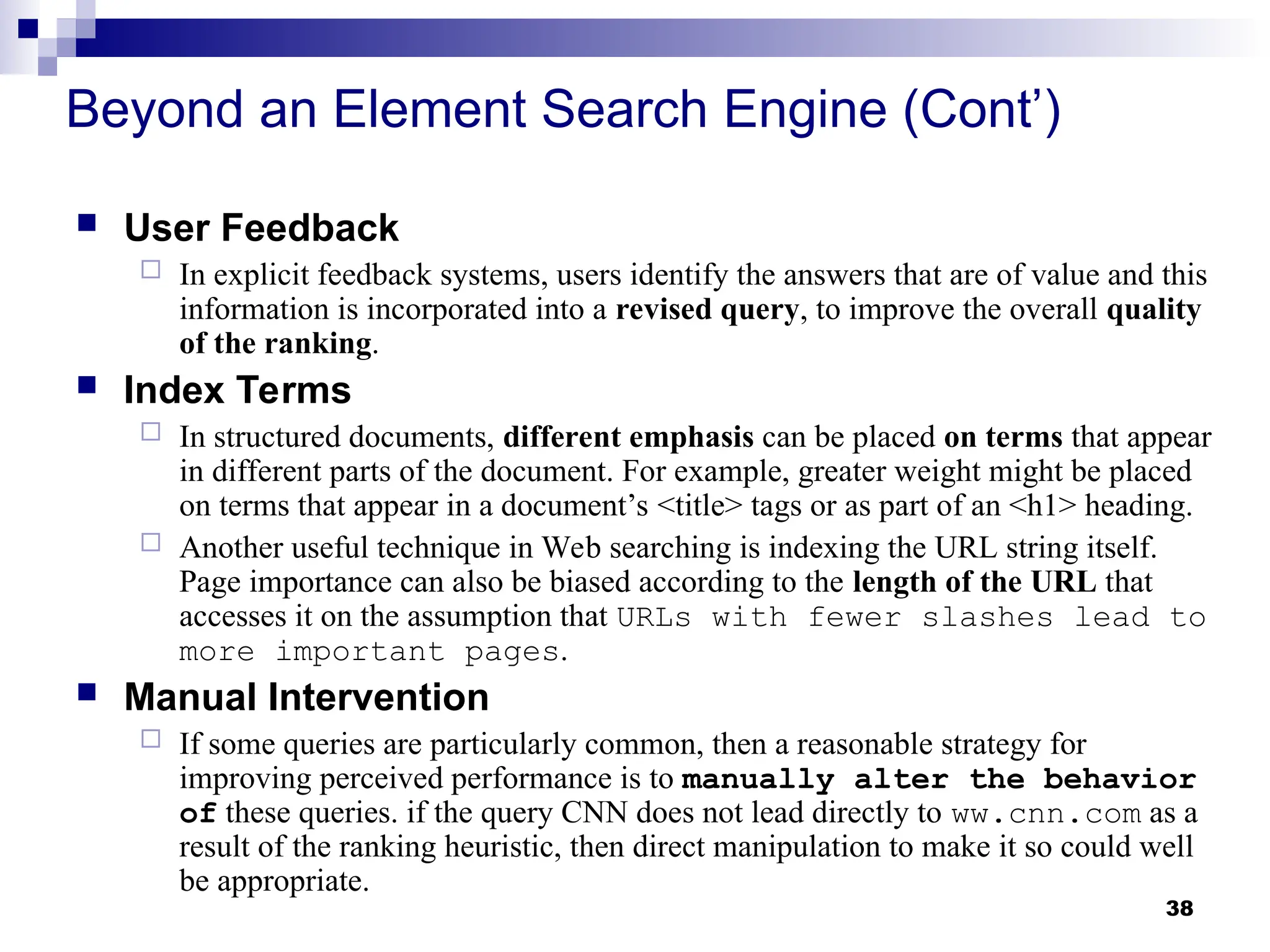
In explicit feedback systems, users identify the answers that are of value and this
information is incorporated into a revised query, to improve the overall quality
of the ranking.
Index Terms
In structured documents, different emphasis can be placed on terms that appear
in different parts of the document. For example, greater weight might be placed
on terms that appear in a document’s <title> tags or as part of an <h1> heading.
Another useful technique in Web searching is indexing the URL string itself.
Page importance can also be biased according to the length of the URL that
accesses it on the assumption that URLs with fewer slashes lead to
more important pages.
Manual Intervention
If some queries are particularly common, then a reasonable strategy for
improving perceived performance is to manually alter the behavior
of these queries. if the query CNN does not lead directly to ww.cnn.com as a
result of the ranking heuristic, then direct manipulation to make it so could well
be appropriate.


![14
4. Phrase Querying
Explicit Phrase like ["the great flydini“] or [San Francisco hotel],
it is appealing to give high scores to pages in which terms appear
in the same order and pattern as they appear in the query,
and low scores to pages in which the terms are separated.
Boolean queries like [old "night keeper“],
it contains two query terms, one of which is a phrase, and both terms
would be required for a document to match.
Three main strategies for Boolean phrase query evaluation
Process phrase queries as Boolean bags-of-words so that the terms can
occur anywhere in matching document, then post-process the retrieved
documents to eliminate false matches.
Add word positions to some or all of the index entries so that the
locations of terms in documents can be checked during query evaluation.
Use some form of partial phrase index or word-pair index so that phrase
appearances can be directly identified.](https://image.slidesharecdn.com/1197-250410120525-71bc5363/75/Inverted-Files-for-Text-Search-Engin-ppt-14-2048.jpg)



![[DSC Europe 25] Dusan Jovicic - AI Story: From on-prem to cloud and back agai...](https://cdn.slidesharecdn.com/ss_thumbnails/8kp49m6uq22ifnbwhfnk-2-251205085715-964d11a6-thumbnail.jpg?width=640&height=640&fit=bounds)
![[DSC Europe 25] Nikola Rajovic - Hardware Technologies Under the Hood: RISC-V...](https://cdn.slidesharecdn.com/ss_thumbnails/o2gptrmtoyqndgoshwgq-dsc2025-tenstorrent-rajovic-251205090438-814685f5-thumbnail.jpg?width=640&height=640&fit=bounds)
![[DSC Europe 25] Vid Stimac - Policy Parsimony: Between Oversimplifying and Ov...](https://cdn.slidesharecdn.com/ss_thumbnails/eqlepagzqp2rhg3gbluh-dsc-stimac-251120-251205090438-059e7f54-thumbnail.jpg?width=640&height=640&fit=bounds)


![[DSC Europe 25] Marija Vlajkovic & Andrea Radonjanin - Integration of AI tool...](https://cdn.slidesharecdn.com/ss_thumbnails/qf1jrglttoc3bm8s3aop-final-integration-of-ai-tools-251208151905-394f3a6a-thumbnail.jpg?width=640&height=640&fit=bounds)

![[DSC Europe 25] Max Talanov - Non digital NNs.pptx](https://cdn.slidesharecdn.com/ss_thumbnails/wif8tr3gtua74qvtopke-non-digital-nns-251205090438-26b0eea6-thumbnail.jpg?width=640&height=640&fit=bounds)

![[DSC Europe 25] Bogdan Daniel Maruneac - AI - It starts with you.pptx](https://cdn.slidesharecdn.com/ss_thumbnails/odov3snhrcqs9hx5ny2n-4-251205085715-f1daacfe-thumbnail.jpg?width=640&height=640&fit=bounds)

