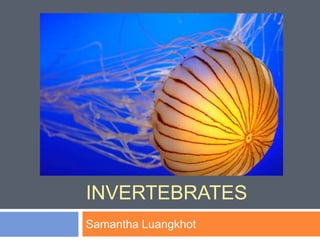
INVERTEBRATES
Samantha Luangkhot
Invertebrates
   An invertebrate is an animal without a backbone.
       Invertebrates make 95% of all animal species.
   Types of invertebrates:
     Porifera
     Cnidaria
     Platyhelminthes
     Mollusca
     Annelids
     Echinodermata
     Arthropoda
   Vertebrates usually reproduce sexually or
    asexually.
Continued…
   Invertebrates
    are
    heterotrophs:
    feeding off
    other
    organisms for
    nutrition.
   Their cells
    lacks rigid cell
    walls.
   Invertebrates
    are
Examples…
   Porifera: lacks tissues, sponges;
   Cnidaria: “stinging creatures” jellyfishes,
    hydroids,
   Platyhelminthes: no body cavity, parasites;
    worms.
   Mollusca: soft body protected by a hard shell
    of calcium carbonate; octopus.
   Arthropoda: hard exoskeleton, open circulatory
    system; lobster, spiders.
Examples
Citations
   https://sites.google.com/a/mrswan.net/wiki/stu
    dent-pages/nanci-rivera/ch-33-invertebrates
   http://en.wikipedia.org/wiki/Invertebrate
   http://www.oum.ox.ac.uk/thezone/fossils/invert
    s/index.htm

Invertebrates slideshow wiki

  • 1.
  • 2.
    Invertebrates  An invertebrate is an animal without a backbone.  Invertebrates make 95% of all animal species.  Types of invertebrates:  Porifera  Cnidaria  Platyhelminthes  Mollusca  Annelids  Echinodermata  Arthropoda  Vertebrates usually reproduce sexually or asexually.
  • 3.
    Continued…  Invertebrates are heterotrophs: feeding off other organisms for nutrition.  Their cells lacks rigid cell walls.  Invertebrates are
  • 4.
    Examples…  Porifera: lacks tissues, sponges;  Cnidaria: “stinging creatures” jellyfishes, hydroids,  Platyhelminthes: no body cavity, parasites; worms.  Mollusca: soft body protected by a hard shell of calcium carbonate; octopus.  Arthropoda: hard exoskeleton, open circulatory system; lobster, spiders.
  • 5.
  • 6.
    Citations  https://sites.google.com/a/mrswan.net/wiki/stu dent-pages/nanci-rivera/ch-33-invertebrates  http://en.wikipedia.org/wiki/Invertebrate  http://www.oum.ox.ac.uk/thezone/fossils/invert s/index.htm