INVERTEBRATES
Mrs. Olivia Wilson's Class
LEARNING
OBJECTIVES
At the end of the lesson,
pupils should be able to:
• classify invertebrates into
its group
• give examples of
invertebrate animals
• describe invertebrate
animals
INVERTEBRATES
Invertebrates are animals
that do not have a backbone.
These animals include
mollusks, arthropods,
annelids, cnidarians,
echinoderms and sponges.
MOLLUSKS
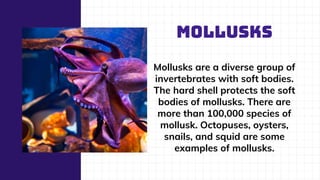
Mollusks are a diverse group of
invertebrates with soft bodies.
The hard shell protects the soft
bodies of mollusks. There are
more than 100,000 species of
mollusk. Octopuses, oysters,
snails, and squid are some
examples of mollusks.
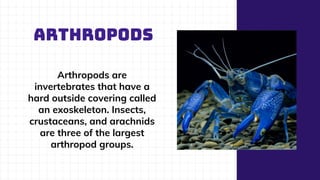
ARTHROPODS
Arthropods are
invertebrates that have a
hard outside covering called
an exoskeleton. Insects,
crustaceans, and arachnids
are three of the largest
arthropod groups.
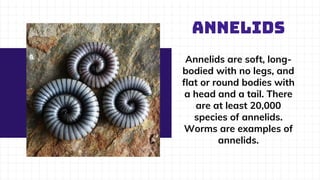
ANNELIDS
Annelids are soft, long-
bodied with no legs, and
flat or round bodies with
a head and a tail. There
are at least 20,000
species of annelids.
Worms are examples of
annelids.
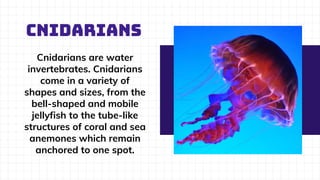
CNIDARIANS
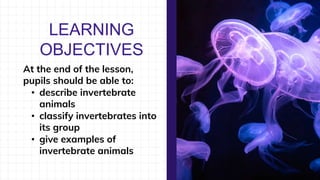
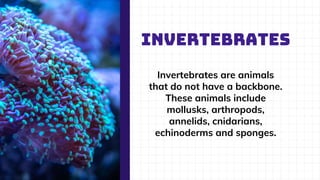
Cnidarians are water
invertebrates. Cnidarians
come in a variety of
shapes and sizes, from the
bell-shaped and mobile
jellyfish to the tube-like
structures of coral and sea
anemones which remain
anchored to one spot.
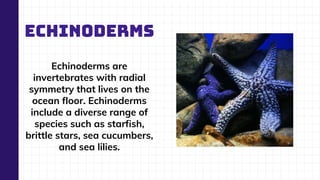
ECHINODERMS
Echinoderms are
invertebrates with radial
symmetry that lives on the
ocean floor. Echinoderms
include a diverse range of
species such as starfish,
brittle stars, sea cucumbers,
and sea lilies.
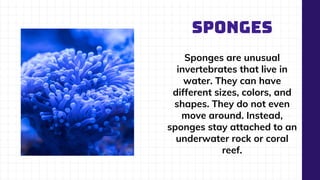
SPONGES
Sponges are unusual
invertebrates that live in
water. They can have
different sizes, colors, and
shapes. They do not even
move around. Instead,
sponges stay attached to an
underwater rock or coral
reef.
THANK YOU!
I hope you learn something new today!

Science Lesson about Invertebrates Lesson