Inventory to
Insight
Understanding Content Inventories, Audits, and Analysis
Paula Land
Content Insight
2
Founder and Principal Consultant at
Strategic Content, a content strategy
consultancy based in Seattle WA
Author of the forthcoming book The
Content Inventory and Audit Handbook
(XML Press, September 2014)
Co-founder and CEO of Content
Insight, developer of the Content
Analysis Tool (CAT)
3
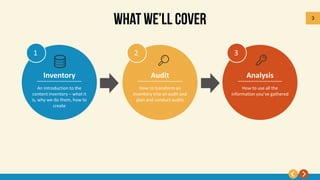
Inventory
An introduction to the
content inventory – what it
is, why we do them, how to
create
1
Audit
How to transform an
inventory into an audit and
plan and conduct audits
2
Analysis
How to use all the
information you’ve gathered
3
5
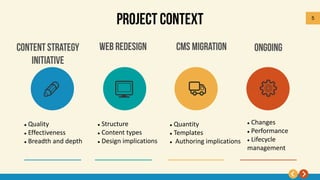
 Quality
 Effectiveness
 Breadth and depth
 Structure
 Content types
 Design implications
 Quantity
 Templates
 Authoring implications
 Changes
 Performance
 Lifecycle
management
6
PLAN
DOCUMENT VISION
AND GOALS
INVOLVE THE
RIGHT PEOPLE
COMMUNICATE
SHOW ROI
DELIVER ACTIONABLE
INSIGHTS
7
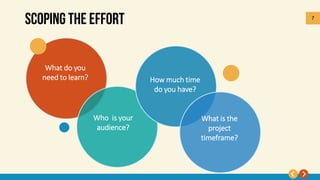
What do you
need to learn?
Who is your
audience?
What is the
project
timeframe?
How much time
do you have?
8
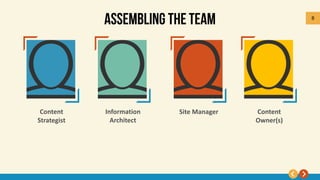
Content
Strategist
Content
Owner(s)
Site ManagerInformation
Architect
Data gathering
Collaboration
Documentation and
presentation
11
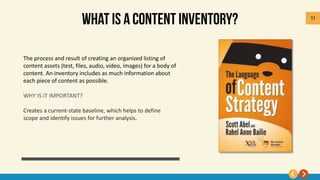
The process and result of creating an organized listing of
content assets (test, files, audio, video, images) for a body of
content. An inventory includes as much information about
each piece of content as possible.
WHY IS IT IMPORTANT?
Creates a current-state baseline, which helps to define
scope and identify issues for further analysis.
12
 Assess as-is landscape of a site or content set
 Prepare for a content audit
 Scope a project for resource estimation
 Identify patterns in content structure
 Set a baseline to measure to-be site against
 Establish a basis for migration tracking
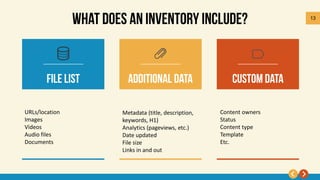
13
URLs/location
Images
Videos
Audio files
Documents
Content owners
Status
Content type
Template
Etc.
Metadata (title, description,
keywords, H1)
Analytics (pageviews, etc.)
Date updated
File size
Links in and out
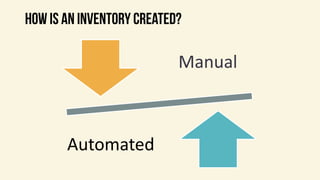
Manual
Automated
15
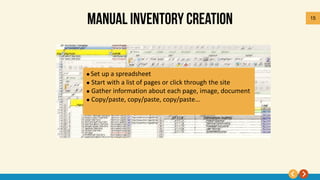
 Set up a spreadsheet
 Start with a list of pages or click through the site
 Gather information about each page, image, document
 Copy/paste, copy/paste, copy/paste…
16
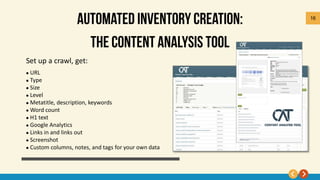
 URL
 Type
 Size
 Level
 Metatitle, description, keywords
 Word count
 H1 text
 Google Analytics
 Links in and links out
 Screenshot
 Custom columns, notes, and tags for your own data
Set up a crawl, get:
17
18
 Scope
 Site structure
 Content distribution by type and audience
 Content performance
 Cross-linking strategy
 Metadata for SEO
20
Qualitative assessment of content
against business and user goals
21
What you want What you have
22
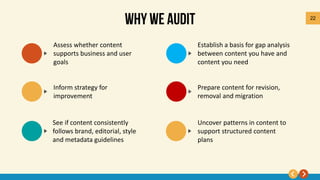
Assess whether content
supports business and user
goals
Inform strategy for
improvement
See if content consistently
follows brand, editorial, style
and metadata guidelines
Establish a basis for gap analysis
between content you have and
content you need
Prepare content for revision,
removal and migration
Uncover patterns in content to
support structured content
plans
23
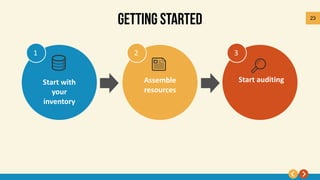
Start with
your
inventory
1
Assemble
resources
2
Start auditing
3
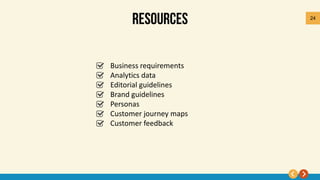
24
Business requirements
Analytics data
Editorial guidelines
Brand guidelines
Personas
Customer journey maps
Customer feedback
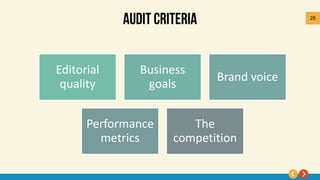
25
Editorial
quality
Business
goals
Brand voice
Performance
metrics
The
competition
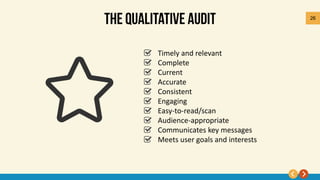
26
Timely and relevant
Complete
Current
Accurate
Consistent
Engaging
Easy-to-read/scan
Audience-appropriate
Communicates key messages
Meets user goals and interests
27
Terminology
Tone and voice
Imagery
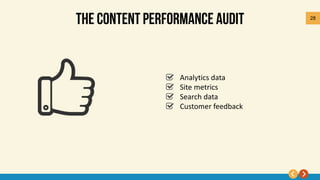
28
Analytics data
Site metrics
Search data
Customer feedback
29
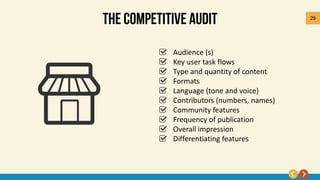
Audience (s)
Key user task flows
Type and quantity of content
Formats
Language (tone and voice)
Contributors (numbers, names)
Community features
Frequency of publication
Overall impression
Differentiating features
30
Language support
Breadth of translation
Cultural relevance
Navigational model
Imagery
Design consistency
Regional and local content
Localized metadata
32
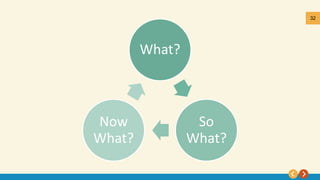
What?
So
What?
Now
What?
33
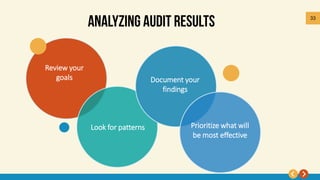
Review your
goals
Look for patterns Prioritize what will
be most effective
Document your
findings
34
35
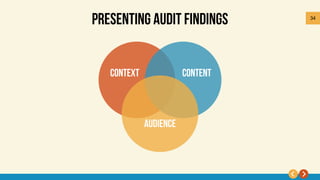
What decisions need to
be made?
What change are you
trying to drive?
36
What are the most
compelling data points?
What is the call to
action?
37
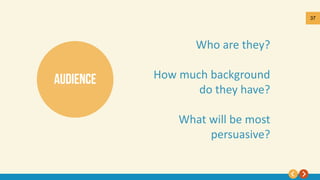
Who are they?
How much background
do they have?
What will be most
persuasive?
38
39
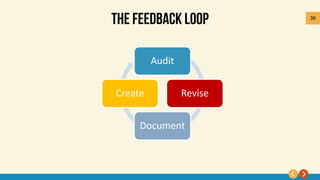
Audit
Revise
Document
Create
40
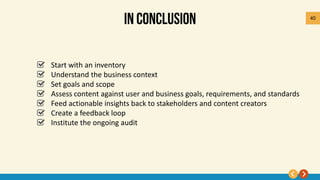
Start with an inventory
Understand the business context
Set goals and scope
Assess content against user and business goals, requirements, and standards
Feed actionable insights back to stakeholders and content creators
Create a feedback loop
Institute the ongoing audit
41
Free Trial Available
Sign up at www.content-insight.com
pland@content-insight.com @content_insightwww.content-insight.com Content Analysis Tool
(CAT)

Inventory to insight: Understanding Content Inventories, Audits, and Analysis