INTRODUCTION
The management ofcurrent assets involves making strategic
decisions to optimize the balance and flow of these assets to ensure
liquidity, minimize cost, and enhance profitability. Since current assets
are directly linked to the firm’s day-to-day operations, their efficient
handling determines the firm’s ability to meet short-term obligations
and continue operations without interruption.
Meaning
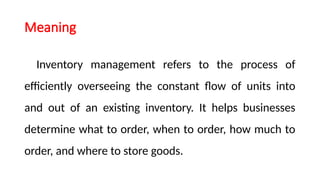
Inventory management refersto the process of
efficiently overseeing the constant flow of units into
and out of an existing inventory. It helps businesses
determine what to order, when to order, how much to
order, and where to store goods.
6.
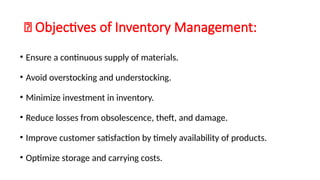
🔹 Objectives ofInventory Management:
• Ensure a continuous supply of materials.
• Avoid overstocking and understocking.
• Minimize investment in inventory.
• Reduce losses from obsolescence, theft, and damage.
• Improve customer satisfaction by timely availability of products.
• Optimize storage and carrying costs.
7.
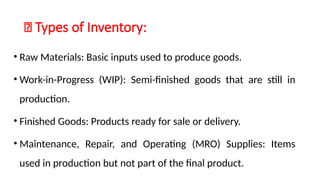
🔹 Types ofInventory:
• Raw Materials: Basic inputs used to produce goods.
• Work-in-Progress (WIP): Semi-finished goods that are still in
production.
• Finished Goods: Products ready for sale or delivery.
• Maintenance, Repair, and Operating (MRO) Supplies: Items
used in production but not part of the final product.
8.
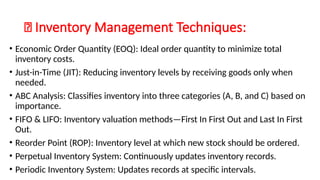
🔹 Inventory ManagementTechniques:
• Economic Order Quantity (EOQ): Ideal order quantity to minimize total
inventory costs.
• Just-in-Time (JIT): Reducing inventory levels by receiving goods only when
needed.
• ABC Analysis: Classifies inventory into three categories (A, B, and C) based on
importance.
• FIFO & LIFO: Inventory valuation methods—First In First Out and Last In First
Out.
• Reorder Point (ROP): Inventory level at which new stock should be ordered.
• Perpetual Inventory System: Continuously updates inventory records.
• Periodic Inventory System: Updates records at specific intervals.
9.
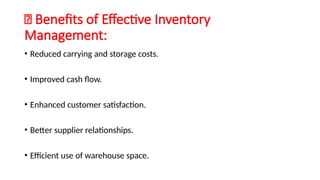
🔹 Benefits ofEffective Inventory
Management:
• Reduced carrying and storage costs.
• Improved cash flow.
• Enhanced customer satisfaction.
• Better supplier relationships.
• Efficient use of warehouse space.
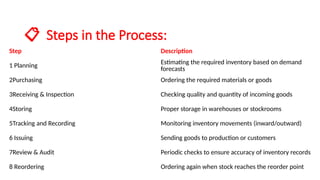
📋 Steps inthe Process:
Step Description
1️Planning Estimating the required inventory based on demand
forecasts
2️
Purchasing Ordering the required materials or goods
3️
Receiving & Inspection Checking quality and quantity of incoming goods
4️
Storing Proper storage in warehouses or stockrooms
5️
Tracking and Recording Monitoring inventory movements (inward/outward)
6️Issuing Sending goods to production or customers
7️
Review & Audit Periodic checks to ensure accuracy of inventory records
8️Reordering Ordering again when stock reaches the reorder point
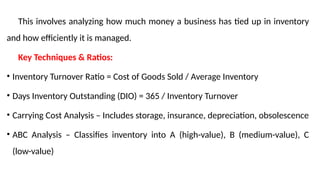
This involves analyzinghow much money a business has tied up in inventory
and how efficiently it is managed.
Key Techniques & Ratios:
• Inventory Turnover Ratio = Cost of Goods Sold / Average Inventory
• Days Inventory Outstanding (DIO) = 365 / Inventory Turnover
• Carrying Cost Analysis – Includes storage, insurance, depreciation, obsolescence
• ABC Analysis – Classifies inventory into A (high-value), B (medium-value), C
(low-value)
14.
📌 Conclusion:
Efficient inventorymanagement minimizes costs,
improves cash flow, and ensures uninterrupted
operations. By analyzing investments in inventory,
businesses can enhance profitability and operational
efficiency.