
By: Yra Marie Celocia,Gr.6,St.NicholasTHOMAS ALVA EDISON(project in science)
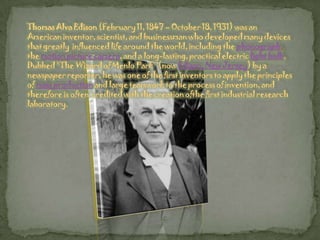
Thomas Alva Edison (February 11, 1847 – October 18, 1931) was an American inventor, scientist, and businessman who developed many devices that greatly  influenced life around the world, including the phonograph, the motion picture camera, and a long-lasting, practical electric light bulb. Dubbed "The Wizard of Menlo Park" (now Edison, New Jersey) by a newspaper reporter, he was one of the first inventors to apply the principles of mass production and large teamwork to the process of invention, and therefore is often  credited with the creation ofthe first industrial research laboratory.
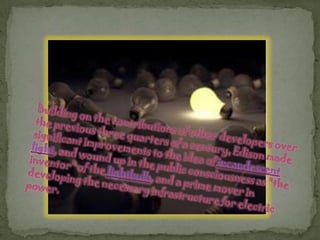
Building on the contributions of other developers over the previous three quarters of a century, Edison made significant improvements to the idea of incandescent light, and wound up in the public consciousness as "the inventor" of the lightbulb, and a prime mover in developing the necessary infrastructure for electric power.
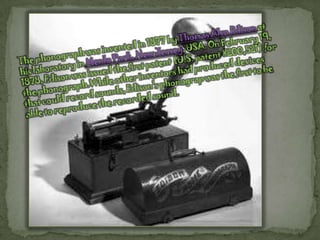
The phonograph was invented in 1877 by Thomas Alva Edison at his laboratory in Menlo Park, New Jersey, USA. On February 19, 1878, Edison was issued the first patent (U.S. patent #200,521) for the phonograph.While other inventors had produced devices that could record sounds, Edison's phonograp was the first to be able to reproduce the recorded sound.
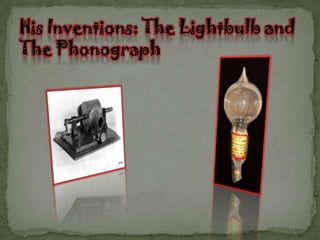
His Inventions: The Lightbulb and The Phonograph
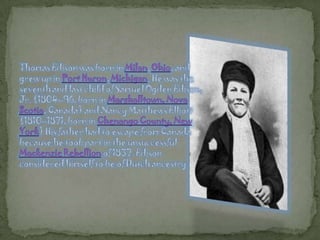
Thomas Edison was born in Milan, Ohio, and grew up in Port Huron, Michigan. He was the seventh and last child of Samuel Ogden Edison, Jr. (1804–96, born in Marshalltown, Nova Scotia, Canada) and Nancy Matthews Elliott (1810–1871, born in Chenango County, New York) His father had to escape from Canada because he took part in the unsuccessful Mackenzie Rebellion of 1837. Edison considered himself to be of Dutch ancestry.
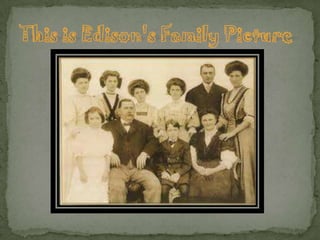
This is Edison's Family Picture
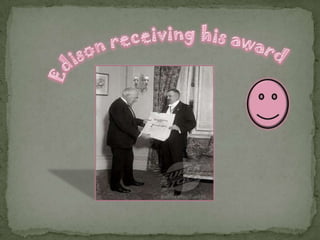
These are some of his Awards:
Edison receiving his award
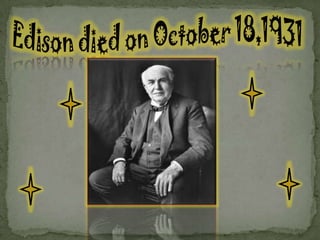
Edison died on October 18,1931

Thomas alva edison

  • 1.
    By: Yra MarieCelocia,Gr.6,St.NicholasTHOMAS ALVA EDISON(project in science)
  • 2.
    Thomas Alva Edison(February 11, 1847 – October 18, 1931) was an American inventor, scientist, and businessman who developed many devices that greatly influenced life around the world, including the phonograph, the motion picture camera, and a long-lasting, practical electric light bulb. Dubbed "The Wizard of Menlo Park" (now Edison, New Jersey) by a newspaper reporter, he was one of the first inventors to apply the principles of mass production and large teamwork to the process of invention, and therefore is often credited with the creation ofthe first industrial research laboratory.
  • 3.
    Building on thecontributions of other developers over the previous three quarters of a century, Edison made significant improvements to the idea of incandescent light, and wound up in the public consciousness as "the inventor" of the lightbulb, and a prime mover in developing the necessary infrastructure for electric power.
  • 4.
    The phonograph wasinvented in 1877 by Thomas Alva Edison at his laboratory in Menlo Park, New Jersey, USA. On February 19, 1878, Edison was issued the first patent (U.S. patent #200,521) for the phonograph.While other inventors had produced devices that could record sounds, Edison's phonograp was the first to be able to reproduce the recorded sound.
  • 5.
    His Inventions: TheLightbulb and The Phonograph
  • 6.
    Thomas Edison wasborn in Milan, Ohio, and grew up in Port Huron, Michigan. He was the seventh and last child of Samuel Ogden Edison, Jr. (1804–96, born in Marshalltown, Nova Scotia, Canada) and Nancy Matthews Elliott (1810–1871, born in Chenango County, New York) His father had to escape from Canada because he took part in the unsuccessful Mackenzie Rebellion of 1837. Edison considered himself to be of Dutch ancestry.
  • 7.
    This is Edison'sFamily Picture
  • 8.
    These are someof his Awards:
  • 9.
  • 10.
    Edison died onOctober 18,1931