E-Business Development Issues
         in UK SME’s
Introduction
• This chapter traces some of the current e-
  business development issues in selected
  regions of the UK and looks at the extent to
  which take-up of e-business has been
  facilitated by government initiatives.
Research Purpose
• The aim of the research is to present a pilot
  study for situational analysis of e-business/e-
  commerce development .
Conditions
• 3.7 million SMEs in the UK at the start of 2000
  (UK online for Business)
• 99% of the business had less than 50
  employees and they provided 45% of the UK
  non-government employment and 38% of
  turnover
• This gives an indication of the relative
  importance of SMEs to the success of present
  UK government e-commerce initiatives
Conditions (2)
• In 2000, only 1.7 million smaller firms were
  connected to the Internet, and still less,
  450,000 of them, were trading online.
• A later survey by the UK Office of National
  Statistics revealed significant variations in e-
  commerce implementation across the UK
• London and the southeast region
  "considerably" outpacing Internet sales in
  other regions (Saliba, 2001).
Conditions (3)
• The UK bought $28.6 billion in goods and
  services
• London-based companies accounting for $7
  billion
• the northeast and east Midlands spending less
  than $1.5 billion
 "significant variations" that were of interest
  to the researchers in this case
Conditions (4)
• The research undertaken has focused on the
  lower spending regions to try to ascertain
  what are the limiting factors for companies in
  these regions
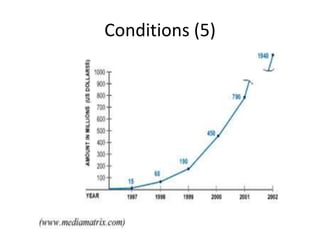
Conditions (5)
Conditions (6)
• The period 1997-1999 saw exceptional e-
  commerce growth within the UK through
  many new "get rich quick" ventures supported
  by significant venture capital input.
• At the same time, established businesses
  looked to Internet technologies to support or
  revolutionize their existing business processes.
Conditions (7)
• After a series of dot.com collapses, 2000-2001 venture
  capital has largely dried up, but the market has
  continued to grow steadily with many mergers and
  acquisitions between new and old economy firms each
  supporting the other by exploiting their experiences
  and core competencies.
• In September 1999, the Performance and Innovation
  Unit (PIU) published a report, "e-commerce@its best,"
  which found that the UK was the leader in e-commerce
  developments within Europe, but still behind the USA,
  Canada, Australia, and Scandinavia on key measures of
  business e-commerce use.

Introduction_SME

  • 1.
  • 2.
    Introduction • This chaptertraces some of the current e- business development issues in selected regions of the UK and looks at the extent to which take-up of e-business has been facilitated by government initiatives.
  • 3.
    Research Purpose • Theaim of the research is to present a pilot study for situational analysis of e-business/e- commerce development .
  • 4.
    Conditions • 3.7 millionSMEs in the UK at the start of 2000 (UK online for Business) • 99% of the business had less than 50 employees and they provided 45% of the UK non-government employment and 38% of turnover • This gives an indication of the relative importance of SMEs to the success of present UK government e-commerce initiatives
  • 5.
    Conditions (2) • In2000, only 1.7 million smaller firms were connected to the Internet, and still less, 450,000 of them, were trading online. • A later survey by the UK Office of National Statistics revealed significant variations in e- commerce implementation across the UK • London and the southeast region "considerably" outpacing Internet sales in other regions (Saliba, 2001).
  • 6.
    Conditions (3) • TheUK bought $28.6 billion in goods and services • London-based companies accounting for $7 billion • the northeast and east Midlands spending less than $1.5 billion  "significant variations" that were of interest to the researchers in this case
  • 7.
    Conditions (4) • Theresearch undertaken has focused on the lower spending regions to try to ascertain what are the limiting factors for companies in these regions
  • 8.
  • 9.
    Conditions (6) • Theperiod 1997-1999 saw exceptional e- commerce growth within the UK through many new "get rich quick" ventures supported by significant venture capital input. • At the same time, established businesses looked to Internet technologies to support or revolutionize their existing business processes.
  • 10.
    Conditions (7) • Aftera series of dot.com collapses, 2000-2001 venture capital has largely dried up, but the market has continued to grow steadily with many mergers and acquisitions between new and old economy firms each supporting the other by exploiting their experiences and core competencies. • In September 1999, the Performance and Innovation Unit (PIU) published a report, "e-commerce@its best," which found that the UK was the leader in e-commerce developments within Europe, but still behind the USA, Canada, Australia, and Scandinavia on key measures of business e-commerce use.