Copyright © The McGraw-Hill Companies, Inc. Permission required for reproduction or display.
Enger & Smith
Environmental Science
A Study of Interrelationships
Twelfth Edition
Chapter 9
Energy Sources
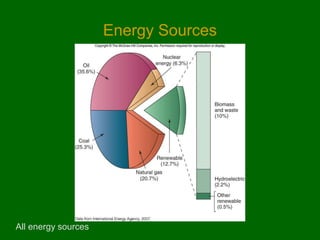
Energy Sources
Outline
 Energy Sources
 Resources and Reserves
 Fossil-Fuel Formation
 Issues Related to the Use of Fossil Fuels
 Renewable Sources of Energy
 Energy Conservation
 Are Fuel Cells in the Future?
Energy Sources
 Nonrenewable energy sources are those whose
resources are being used faster than can be
replenished.
– Coal, oil, and natural gas
 Renewable energy sources replenish themselves
or are continuously present as a feature of the
environment.
– Solar, geothermal, tidal, etc.
– Some forms are referred to as perpetual energy.
Energy Sources
All energy sources
Resources and Reserves
 A resource is a naturally occurring substance of
use to humans that can potentially be extracted
using current technology.
 A reserve is a known deposit that can be
economically extracted using current technology,
under certain economic conditions.
 Reserves are smaller than resources.
 Reserve levels change as technology advances,
new discoveries are made, and economic
conditions vary.
Resources and Reserves
Fossil Fuel Formation
 Coal
• 300 million years ago, plant material began collecting
underwater, initiating decay, forming a spongy mass
of organic material.
• Due to geological changes, some of these deposits
were covered by seas, and covered with sediment.
• Pressure and heat over time transformed the organic
matter into coal.
Fossil Fuel Formation
Recoverable coal reserves of the world 2004
Fossil Fuel Formation
 Oil and natural gas probably originated from
microscopic marine organisms that accumulated on
the ocean floor and were covered by sediments.
• Muddy rock gradually formed shale containing dispersed
oil.
• Natural gas often forms on top of oil.
Fossil Fuel Formation
Crude oil and natural gas pool
Issues Related to the Use of Fossil Fuels
 Fossil fuels supply 80% of world’s commercial
energy.
• Oil 36%
• Coal 25%
• Natural Gas 19%
Issues Related to the Use of Fossil Fuels
 Coal is most abundant fossil fuel.
• Primarily used for generating electricity.
 There are four categories of coal: Lignite, Sub-
bituminous, Bituminous, and Anthracite.
• Lignite
– High moisture, low energy, crumbly, least desirable form.
• Sub-bituminous
– Lower moisture, higher carbon than lignite.
– Used as fuel for power plants.
• Bituminous
– Low moisture, high carbon content
– Used in power plants and other industry such as steel
making.
– Most widely used because it is easiest to mine and the
most abundant, supplying 20% of the world’s energy
requirements.
• Anthracite
– Has the highest carbon content, and is relatively rare.
– It is used primarily in heating buildings and for
specialty uses.
Issues Related to the Use of Fossil Fuels
 There are two extraction methods:
• Surface mining (strip mining), which is the process of
removing material on top of a vein, is efficient but
destructive.
• Underground mining minimizes surface disturbance,
but is costly and dangerous.
– Many miners suffer from black lung disease, a respiratory
condition that results from the accumulation of fine coal-
dust particles in the miners’ lungs.
Issues Related to the Use of Fossil Fuels
 Coal is bulky and causes some transport problems.
 Mining creates dust pollution.
 Burning coal releases pollutants (carbon and
sulfur).
• Millions of tons of material are released into atmosphere
annually.
• Sulfur leads to acid mine drainage and acid deposition.
• Increased amounts of atmospheric carbon dioxide are
implicated in global warming.
Issues Related to the Use of Fossil Fuels
Underground mining
Issues Related to the Use of Fossil Fuels
Surface-mine reclamation
Issues Related to the Use of Fossil Fuels
Acid mine drainage
Issues Related to the Use of Fossil Fuels
 Oil is more concentrated than coal, burns cleaner,
and is easily transported through pipelines.
• These qualities make it ideal for automobile use.
• It is difficult to find.
• It causes less environmental damage than coal mining.
Issues Related to the Use of Fossil Fuels
 Once a source of oil has been located, it must be
extracted and transported to the surface.
 Primary Recovery methods
• If water or gas pressure associated with the oil is great
enough, the oil is forced to the surface when a well is
drilled.
• If water and gas pressure is low, the oil is pumped to
the surface.
• 5–30% of the oil is extracted depending on viscosity
and geological characteristics.
Issues Related to the Use of Fossil Fuels
 Secondary Recovery
• Water or gas is pumped into a well to drive the oil out
of the pores in the rock.
• This technique allows up to 40% of the oil to be
extracted.
 Tertiary Recovery
• Steam is pumped into a well to lower the viscosity of
the oil.
• Aggressive pumping of gas or chemicals can be
pumped into a well.
• These methods are expensive and only used with
high oil prices.
Issues Related to the Use of Fossil Fuels
Offshore drilling
Issues Related to the Use of Fossil Fuels
 Processing
• As it comes from the ground, oil is not in a form suitable
for use, and must be refined.
• Multiple products can be produced from a single barrel of
crude oil.
 Oil Spills
• Accidental spills only account for about 1/3 of oil pollution
resulting from shipping.
• 60% comes from routine shipping operations.
Issues Related to the Use of Fossil Fuels
Processing crude oil
Issues Related to the Use of Fossil Fuels
 The drilling operations to obtain natural gas are
similar to those used for oil.
 It is hard to transport and in many places is burned
off at oil fields, but new transportation methods are
being developed.
• Liquefaction at -126o F (1/600 volume of gas)
• The public is concerned about the safety of LNG loading
facilities so they are located off shore.
 It is the least environmentally damaging fossil fuel.
• It causes almost no air pollution.
Renewable Sources of Energy
 Currently, alternative energy sources supply almost
13.5% of the world’s total energy.
• Some studies suggest these sources could provide half
of the world’s energy needs by 2050.
• Renewable sources will become much more important as
fossil fuel supplies become more expensive.
– Biomass conversion
– Hydroelectric power
– Solar energy
– Wind energy
– Geothermal energy
– Tidal power
Renewable Sources of Energy
Renewable energy as a share of total energy consumption (World 2006)
Renewable Sources of Energy
 Biomass Conversion
• All biomass is produced by green plants that convert
sunlight into plant material through photosynthesis.
• Biomass is still the predominant form of energy used by
people in less-developed countries.
• It accounts for 10% of world energy use.
Renewable Sources of Energy
 There are several sources of biomass energy:
• Fuel wood
• Municipal and industrial wastes
• Agricultural crop residues and animal wastes
• Energy plantations
Renewable Sources of Energy
 In less-developed countries, fuel wood has been a
major energy source for centuries.
 Fuel wood is the primary energy source for nearly
half the world’s population.
 Due to intense population growth, an estimated 1.3
billion people cannot get enough fuel wood, or are
using it faster than rate of regeneration.
 It is a source of air pollution and particulate matter.
Renewable Sources of Energy
 Solid waste is a major source of biomass and other
burnable materials produced by society.
 The burning of solid waste only makes economic
sense when the cost of waste disposal is taken into
account.
 Using municipal waste as a source of energy:
• Reduces landfill volume.
• Requires large volume and dependable supply, and must
be sorted.
• Produces air pollution, including pollutants not found in
other forms of biomass.
Renewable Sources of Energy
 Crop residues and animal wastes:
• Materials left over following the harvest of a crop
(e.g., straw and stalks) can be used as biomass fuel.
• Animal dung is dried and burned or processed in
anaerobic digesters to provide a burnable gas.
Renewable Sources of Energy
 Energy plantations:
• Many crops, including sugar beets, sugar cane, corn,
grains, kelp, and palm oil can be grown for the
express purpose of energy production.
• Two factors determine whether a crop is suitable for
energy use:
– Good energy crops have a very high yield of dry
material per unit of land.
– The amount of energy that can be produced from a
biomass crop must be more than the amount of energy
required to grow a crop.
Renewable Sources of Energy
 There are several technologies capable of converting
biomass into energy.
• Direct combustion
– Burning biomass in fires to cook food or heat homes.
• Biofuels production
– Fermentation converts plant sugars to ethanol, which is used as
an energy source.
• Anaerobic digestion
– Green, wet biomass and animal waste is broken down by
anaerobic bacteria, producing methane and CO2.
• Pyrolysis
– A thermo chemical process that converts biomass to a more
useful fuel such as charcoal.
Renewable Sources of Energy
 Environmental impact of biomass
 Habitat and biodiversity loss
• 1.3 billion people cannot obtain wood, or harvest it
faster than it grows.
• Much forest has been destroyed in Asia and Africa.
• Desertification has increased in these regions.
 Air pollution
• Burning wood produces air pollution.
• Smoke, particulates, carbon monoxide, and
hydrocarbons contribute to ill health.
Renewable Sources of Energy
Methane digester
Renewable Sources of Energy
 Hydroelectric power is created when flowing
water is captured and turned into electricity.
• Damming a river and storing water in a reservoir is the
most common method.
• Pumped storage plants use two reservoirs separated by
a significant elevation difference.
• The potential for developing hydroelectric power is best
in mountainous regions and large river valleys.
• The World Energy Council estimates that it would be
technically possible to triple the electricity produced by
hydropower with current technology.
Renewable Sources of Energy
 Hydroelectric power currently supplies 16% of
world’s electricity.
• In South and Central America, 65% of electricity used
comes from hydroelectric power.
• Norway gets 99% of its electricity and 65% of all its
energy from hydroelectric power.
• Construction of “mini hydro” (less than 10 megawatts)
and “micro hydro” (less than 1 megawatt) plants is
increasing; these plants can be built in remote places
and supply electricity to small areas.
Renewable Sources of Energy
 Reservoir construction causes significant
environmental and social damage.
• Loss of farmland or forest land due to flooding
• Community relocation
• Prevention of fish migrations
• Trapping of silt fills in reservoir and stops flow of
nutrients downstream
• Mercury accumulation
Renewable Sources of Energy
Hydroelectric power plant.
Renewable Sources of Energy
 Daily energy from the sun is 600 times greater
than energy produced each day by all other
energy sources combined.
• The major problems with solar energy are its
intermittent and diffuse nature.
 Solar energy is utilized in three ways:
• In passive heating, the sun’s energy is converted
directly to heat and used at collection site.
• In an active heating system, the sun’s energy is
converted into heat, but transported elsewhere to be
used.
• Solar energy is also transformed into electrical energy.
Renewable Sources of Energy
Passive solar heating
Renewable Sources of Energy
Solar heating designs
Renewable Sources of Energy
 In a passive solar system, light energy is
transformed to heat energy when it is absorbed
by a surface.
 Buildings designed for passive solar heating in
the Northern Hemisphere usually have large,
south-facing windows.
 Floors and walls, made of materials that absorb
and store the sun’s heat during the day, slowly
release heat at night when it is needed most.
This feature is called direct gain.
Renewable Sources of Energy
 Solar energy can generate electricity in two
different ways.
• Steam can be created to drive a turbine.
• Photovoltaic cells can generate electricity directly.
• Currently the most successful design is the parabolic
trough which heats oil in pipes. The heat is
transferred to water to make steam and run a turbine.
• The Nevada Solar One plant which opened in 2007 is
currently the world’s largest solar generation facility in
the world.
• Several plants are under construction in Spain.
Renewable Sources of Energy
 A photovoltaic cell (PV) is a solid-state
semiconductor that converts sunlight directly into
electricity.
 The amount of PV power installed worldwide has
increased from 314 megawatts in 1997 to 5700
megawatts in 2006.
 Thin-film technology has made it possible to build
solar cells into roof shingles and tiles, building
facades, and the glazing for skylights and atria.
Renewable Sources of Energy
 Improving solar cell efficiency while holding
down the cost per cell is an important goal of the
growing PV industry.
• Solar electricity is 20 cents per kilowatt-hour, more
than electricity from the power plant.
 Photovoltaics are probably the most benign
method of power generation known.
 They are silent, produce no emissions, and use
no fuel other than sunlight, but thermal systems
use large amounts of land to position the
mirrors.
Renewable Sources of Energy
Solar generation of electricity
Renewable Sources of Energy
Photovoltaic shingles
Renewable Sources of Energy
 Tidal Power
• The gravitational forces of the moon and sun cause
ocean water to bulge out. Tides form as the Earth rotates
through this bulge.
• As water flows from a higher level to a lower level, it can
be used to spin an electricity-generating turbine.
• Since tidal changes of roughly 16 feet are needed to
produce practical amounts of power, suitable sites are
limited.
• A new style, submerged turbine tidal generator is being
developed in the Philippines.
Renewable Sources of Energy
 Geothermal Power
• In geologically active areas hot magma moves to the
surface and heats water.
– The hot water can heat buildings or generate electricity
through a steam turbine.
• Wells are drilled to obtain steam trapped underground,
and the steam powers electrical generators.
• The U.S. produces 30% of world’s geothermal electricity,
with the world’s largest plant in San Francisco.
• However, this accounts for less than 1% of U.S. electrical
consumption.
Renewable Sources of Energy
 Heat pumps can be used in areas that are not
geologically active.
 The pump extracts heat from the Earth, and
deposits it in a building.
 Environmental Issues
• Steam contains hydrogen sulfide gas.
– It smells like rotten eggs.
– Minerals in the steam corrode pipes and equipment.
– The minerals are toxic to fish.
Renewable Sources of Energy
Geothermal power plant
Renewable Sources of Energy
 Wind Power
• As warm air becomes less dense and rises, cooler,
denser, air flows in to take its place. This flow of air is
wind.
• Wind has ground grain and pumped water. Now is it
used to generate electricity.
• Some areas are better suited than others, and winds
are variable. Wind energy must be coupled with other
sources of energy.
• Only 0.5% of total worldwide electrical production is
from wind.
• Only 1% of U.S. electricity is from wind. 20% could be
generated by 2030.
Renewable Sources of Energy
 There are some negative effects from wind
generators:
• The moving blades produce noise and some consider
the windmills visual pollution.
• Moving blades are hazardous to birds, although newer
windmills have slower-moving rotors that many birds
find easier to avoid.
• Vibrations from generators can cause structural
damage.
Energy Conservation
 Conservation is not a way of generating electricity,
but a way of reducing need for additional energy
production/consumption and saving money for the
consumer.
 Much of the energy we consume is wasted.
• The amount of energy wasted through poorly insulated
windows and doors alone is about as much energy as
the U.S. receives from the Alaskan pipeline each year.
 Electrical utilities have recently become part of the
energy conservation picture.
Energy Conservation
 Many conservation techniques are relatively simple
and highly cost-effective.
• Highly efficient fluorescent light bulbs give the same
amount of light as incandescent bulbs for 25% of the
energy, and produce less heat.
• Lighting and air conditioning (removing the heat from
inefficient incandescent lighting) account for 25% of U.S.
electricity consumption.
• Automatic dimming or light-shutoff devices are being used
in new construction.
Are Fuel Cells in the Future?
 Hydrogen is abundant and generates heat and
pure water when it reacts with air.
 Hydrogen fuel cells are beginning to rise in
popularity due to their high efficiency and low
emissions.
• They do not need to be recharged, unlike batteries.
• They run continuously if provided with adequate fuel
input—anything from which hydrogen can be
extracted.
Are Fuel Cells in the Future?
 The most common form is the proton exchange
membrane (PEM) fuel cell.
• Pressurized hydrogen gas enters the fuel cell and
contacts a catalyst that causes the hydrogen molecules
to split into hydrogen ions and electrons.
• A proton exchange membrane allows the hydrogen
ions, but not electrons, to flow through it.
• The electrons flow through an electric circuit to do work,
such as powering motors or generating lights.
• The hydrogen ions flow through the membrane and
recombine with electrons that have passed through the
circuit and with oxygen to form water.
Are Fuel Cells in the Future?
 Obstacles delaying the development of fuel cells
include:
• Hydrogen used to power the cell is difficult to obtain in
a pure state.
• Hydrogen gas is highly flammable, difficult to store,
and not available to consumers as readily as oil-
derived fuels.
• Fuel reformation results in impure hydrogen,
decreasing fuel cell efficiency; it also releases carbon
dioxide, nitrous oxide, and particulate matter.
Are Fuel Cells in the Future?
 Advantages of fuel cells include:
• Low operating temperature and minimal noise
generation make them safe to install in semi-exposed
areas.
• Cells are self-sustaining, making them ideal for
remote locations.
• They operate separately from power lines associated
with electrical distribution systems, so weather-related
power outages are diminished.
• They are nonpolluting.
Are Fuel Cells in the Future?
Experimental fuel cell bus
Summary
 Resources are naturally occurring substances of
use to humans.
 Reserves are known deposits from which
materials can be extracted profitably with
existing technology under present economic
conditions.
 Coal is the world’s most abundant fossil fuel.
 The supply of oil is limited.
 Natural gas is another major source of fossil-fuel
energy, but transport of natural gas to
consumers is problematic.
Summary
 Fossil fuels are nonrenewable.
 Fuel wood is the major source of energy in less-
developed countries.
 Biomass can be burned to provide heat or
electricity, or can be converted to alcohol or
used to generate methane.
 Hydroelectric power can be increased
significantly but may displace people.
 Solar energy can be collected and used in either
passive or active systems and can also generate
electricity.
Summary
 Geothermal and tidal applications are limited by
geographic locations.
 Wind power may be used to generate electricity
but requires wide, open areas and a large
number of wind generators.
 Energy conservation can reduce energy
demands without noticeably changing standards
of living.

Chapter 9 Energy Source Environmental Science

  • 1.
    Copyright © TheMcGraw-Hill Companies, Inc. Permission required for reproduction or display. Enger & Smith Environmental Science A Study of Interrelationships Twelfth Edition Chapter 9 Energy Sources
  • 2.
  • 3.
    Outline  Energy Sources Resources and Reserves  Fossil-Fuel Formation  Issues Related to the Use of Fossil Fuels  Renewable Sources of Energy  Energy Conservation  Are Fuel Cells in the Future?
  • 4.
    Energy Sources  Nonrenewableenergy sources are those whose resources are being used faster than can be replenished. – Coal, oil, and natural gas  Renewable energy sources replenish themselves or are continuously present as a feature of the environment. – Solar, geothermal, tidal, etc. – Some forms are referred to as perpetual energy.
  • 5.
  • 6.
    Resources and Reserves A resource is a naturally occurring substance of use to humans that can potentially be extracted using current technology.  A reserve is a known deposit that can be economically extracted using current technology, under certain economic conditions.  Reserves are smaller than resources.  Reserve levels change as technology advances, new discoveries are made, and economic conditions vary.
  • 7.
  • 8.
    Fossil Fuel Formation Coal • 300 million years ago, plant material began collecting underwater, initiating decay, forming a spongy mass of organic material. • Due to geological changes, some of these deposits were covered by seas, and covered with sediment. • Pressure and heat over time transformed the organic matter into coal.
  • 9.
    Fossil Fuel Formation Recoverablecoal reserves of the world 2004
  • 10.
    Fossil Fuel Formation Oil and natural gas probably originated from microscopic marine organisms that accumulated on the ocean floor and were covered by sediments. • Muddy rock gradually formed shale containing dispersed oil. • Natural gas often forms on top of oil.
  • 11.
    Fossil Fuel Formation Crudeoil and natural gas pool
  • 12.
    Issues Related tothe Use of Fossil Fuels  Fossil fuels supply 80% of world’s commercial energy. • Oil 36% • Coal 25% • Natural Gas 19%
  • 13.
    Issues Related tothe Use of Fossil Fuels  Coal is most abundant fossil fuel. • Primarily used for generating electricity.  There are four categories of coal: Lignite, Sub- bituminous, Bituminous, and Anthracite. • Lignite – High moisture, low energy, crumbly, least desirable form. • Sub-bituminous – Lower moisture, higher carbon than lignite. – Used as fuel for power plants.
  • 14.
    • Bituminous – Lowmoisture, high carbon content – Used in power plants and other industry such as steel making. – Most widely used because it is easiest to mine and the most abundant, supplying 20% of the world’s energy requirements. • Anthracite – Has the highest carbon content, and is relatively rare. – It is used primarily in heating buildings and for specialty uses. Issues Related to the Use of Fossil Fuels
  • 15.
    Issues Related tothe Use of Fossil Fuels  There are two extraction methods: • Surface mining (strip mining), which is the process of removing material on top of a vein, is efficient but destructive. • Underground mining minimizes surface disturbance, but is costly and dangerous. – Many miners suffer from black lung disease, a respiratory condition that results from the accumulation of fine coal- dust particles in the miners’ lungs.
  • 16.
    Issues Related tothe Use of Fossil Fuels  Coal is bulky and causes some transport problems.  Mining creates dust pollution.  Burning coal releases pollutants (carbon and sulfur). • Millions of tons of material are released into atmosphere annually. • Sulfur leads to acid mine drainage and acid deposition. • Increased amounts of atmospheric carbon dioxide are implicated in global warming.
  • 17.
    Issues Related tothe Use of Fossil Fuels Underground mining
  • 18.
    Issues Related tothe Use of Fossil Fuels Surface-mine reclamation
  • 19.
    Issues Related tothe Use of Fossil Fuels Acid mine drainage
  • 20.
    Issues Related tothe Use of Fossil Fuels  Oil is more concentrated than coal, burns cleaner, and is easily transported through pipelines. • These qualities make it ideal for automobile use. • It is difficult to find. • It causes less environmental damage than coal mining.
  • 21.
    Issues Related tothe Use of Fossil Fuels  Once a source of oil has been located, it must be extracted and transported to the surface.  Primary Recovery methods • If water or gas pressure associated with the oil is great enough, the oil is forced to the surface when a well is drilled. • If water and gas pressure is low, the oil is pumped to the surface. • 5–30% of the oil is extracted depending on viscosity and geological characteristics.
  • 22.
    Issues Related tothe Use of Fossil Fuels  Secondary Recovery • Water or gas is pumped into a well to drive the oil out of the pores in the rock. • This technique allows up to 40% of the oil to be extracted.  Tertiary Recovery • Steam is pumped into a well to lower the viscosity of the oil. • Aggressive pumping of gas or chemicals can be pumped into a well. • These methods are expensive and only used with high oil prices.
  • 23.
    Issues Related tothe Use of Fossil Fuels Offshore drilling
  • 24.
    Issues Related tothe Use of Fossil Fuels  Processing • As it comes from the ground, oil is not in a form suitable for use, and must be refined. • Multiple products can be produced from a single barrel of crude oil.  Oil Spills • Accidental spills only account for about 1/3 of oil pollution resulting from shipping. • 60% comes from routine shipping operations.
  • 25.
    Issues Related tothe Use of Fossil Fuels Processing crude oil
  • 26.
    Issues Related tothe Use of Fossil Fuels  The drilling operations to obtain natural gas are similar to those used for oil.  It is hard to transport and in many places is burned off at oil fields, but new transportation methods are being developed. • Liquefaction at -126o F (1/600 volume of gas) • The public is concerned about the safety of LNG loading facilities so they are located off shore.  It is the least environmentally damaging fossil fuel. • It causes almost no air pollution.
  • 27.
    Renewable Sources ofEnergy  Currently, alternative energy sources supply almost 13.5% of the world’s total energy. • Some studies suggest these sources could provide half of the world’s energy needs by 2050. • Renewable sources will become much more important as fossil fuel supplies become more expensive. – Biomass conversion – Hydroelectric power – Solar energy – Wind energy – Geothermal energy – Tidal power
  • 28.
    Renewable Sources ofEnergy Renewable energy as a share of total energy consumption (World 2006)
  • 29.
    Renewable Sources ofEnergy  Biomass Conversion • All biomass is produced by green plants that convert sunlight into plant material through photosynthesis. • Biomass is still the predominant form of energy used by people in less-developed countries. • It accounts for 10% of world energy use.
  • 30.
    Renewable Sources ofEnergy  There are several sources of biomass energy: • Fuel wood • Municipal and industrial wastes • Agricultural crop residues and animal wastes • Energy plantations
  • 31.
    Renewable Sources ofEnergy  In less-developed countries, fuel wood has been a major energy source for centuries.  Fuel wood is the primary energy source for nearly half the world’s population.  Due to intense population growth, an estimated 1.3 billion people cannot get enough fuel wood, or are using it faster than rate of regeneration.  It is a source of air pollution and particulate matter.
  • 32.
    Renewable Sources ofEnergy  Solid waste is a major source of biomass and other burnable materials produced by society.  The burning of solid waste only makes economic sense when the cost of waste disposal is taken into account.  Using municipal waste as a source of energy: • Reduces landfill volume. • Requires large volume and dependable supply, and must be sorted. • Produces air pollution, including pollutants not found in other forms of biomass.
  • 33.
    Renewable Sources ofEnergy  Crop residues and animal wastes: • Materials left over following the harvest of a crop (e.g., straw and stalks) can be used as biomass fuel. • Animal dung is dried and burned or processed in anaerobic digesters to provide a burnable gas.
  • 34.
    Renewable Sources ofEnergy  Energy plantations: • Many crops, including sugar beets, sugar cane, corn, grains, kelp, and palm oil can be grown for the express purpose of energy production. • Two factors determine whether a crop is suitable for energy use: – Good energy crops have a very high yield of dry material per unit of land. – The amount of energy that can be produced from a biomass crop must be more than the amount of energy required to grow a crop.
  • 35.
    Renewable Sources ofEnergy  There are several technologies capable of converting biomass into energy. • Direct combustion – Burning biomass in fires to cook food or heat homes. • Biofuels production – Fermentation converts plant sugars to ethanol, which is used as an energy source. • Anaerobic digestion – Green, wet biomass and animal waste is broken down by anaerobic bacteria, producing methane and CO2. • Pyrolysis – A thermo chemical process that converts biomass to a more useful fuel such as charcoal.
  • 36.
    Renewable Sources ofEnergy  Environmental impact of biomass  Habitat and biodiversity loss • 1.3 billion people cannot obtain wood, or harvest it faster than it grows. • Much forest has been destroyed in Asia and Africa. • Desertification has increased in these regions.  Air pollution • Burning wood produces air pollution. • Smoke, particulates, carbon monoxide, and hydrocarbons contribute to ill health.
  • 37.
    Renewable Sources ofEnergy Methane digester
  • 38.
    Renewable Sources ofEnergy  Hydroelectric power is created when flowing water is captured and turned into electricity. • Damming a river and storing water in a reservoir is the most common method. • Pumped storage plants use two reservoirs separated by a significant elevation difference. • The potential for developing hydroelectric power is best in mountainous regions and large river valleys. • The World Energy Council estimates that it would be technically possible to triple the electricity produced by hydropower with current technology.
  • 39.
    Renewable Sources ofEnergy  Hydroelectric power currently supplies 16% of world’s electricity. • In South and Central America, 65% of electricity used comes from hydroelectric power. • Norway gets 99% of its electricity and 65% of all its energy from hydroelectric power. • Construction of “mini hydro” (less than 10 megawatts) and “micro hydro” (less than 1 megawatt) plants is increasing; these plants can be built in remote places and supply electricity to small areas.
  • 40.
    Renewable Sources ofEnergy  Reservoir construction causes significant environmental and social damage. • Loss of farmland or forest land due to flooding • Community relocation • Prevention of fish migrations • Trapping of silt fills in reservoir and stops flow of nutrients downstream • Mercury accumulation
  • 41.
    Renewable Sources ofEnergy Hydroelectric power plant.
  • 42.
    Renewable Sources ofEnergy  Daily energy from the sun is 600 times greater than energy produced each day by all other energy sources combined. • The major problems with solar energy are its intermittent and diffuse nature.  Solar energy is utilized in three ways: • In passive heating, the sun’s energy is converted directly to heat and used at collection site. • In an active heating system, the sun’s energy is converted into heat, but transported elsewhere to be used. • Solar energy is also transformed into electrical energy.
  • 43.
    Renewable Sources ofEnergy Passive solar heating
  • 44.
    Renewable Sources ofEnergy Solar heating designs
  • 45.
    Renewable Sources ofEnergy  In a passive solar system, light energy is transformed to heat energy when it is absorbed by a surface.  Buildings designed for passive solar heating in the Northern Hemisphere usually have large, south-facing windows.  Floors and walls, made of materials that absorb and store the sun’s heat during the day, slowly release heat at night when it is needed most. This feature is called direct gain.
  • 46.
    Renewable Sources ofEnergy  Solar energy can generate electricity in two different ways. • Steam can be created to drive a turbine. • Photovoltaic cells can generate electricity directly. • Currently the most successful design is the parabolic trough which heats oil in pipes. The heat is transferred to water to make steam and run a turbine. • The Nevada Solar One plant which opened in 2007 is currently the world’s largest solar generation facility in the world. • Several plants are under construction in Spain.
  • 47.
    Renewable Sources ofEnergy  A photovoltaic cell (PV) is a solid-state semiconductor that converts sunlight directly into electricity.  The amount of PV power installed worldwide has increased from 314 megawatts in 1997 to 5700 megawatts in 2006.  Thin-film technology has made it possible to build solar cells into roof shingles and tiles, building facades, and the glazing for skylights and atria.
  • 48.
    Renewable Sources ofEnergy  Improving solar cell efficiency while holding down the cost per cell is an important goal of the growing PV industry. • Solar electricity is 20 cents per kilowatt-hour, more than electricity from the power plant.  Photovoltaics are probably the most benign method of power generation known.  They are silent, produce no emissions, and use no fuel other than sunlight, but thermal systems use large amounts of land to position the mirrors.
  • 49.
    Renewable Sources ofEnergy Solar generation of electricity
  • 50.
    Renewable Sources ofEnergy Photovoltaic shingles
  • 51.
    Renewable Sources ofEnergy  Tidal Power • The gravitational forces of the moon and sun cause ocean water to bulge out. Tides form as the Earth rotates through this bulge. • As water flows from a higher level to a lower level, it can be used to spin an electricity-generating turbine. • Since tidal changes of roughly 16 feet are needed to produce practical amounts of power, suitable sites are limited. • A new style, submerged turbine tidal generator is being developed in the Philippines.
  • 52.
    Renewable Sources ofEnergy  Geothermal Power • In geologically active areas hot magma moves to the surface and heats water. – The hot water can heat buildings or generate electricity through a steam turbine. • Wells are drilled to obtain steam trapped underground, and the steam powers electrical generators. • The U.S. produces 30% of world’s geothermal electricity, with the world’s largest plant in San Francisco. • However, this accounts for less than 1% of U.S. electrical consumption.
  • 53.
    Renewable Sources ofEnergy  Heat pumps can be used in areas that are not geologically active.  The pump extracts heat from the Earth, and deposits it in a building.  Environmental Issues • Steam contains hydrogen sulfide gas. – It smells like rotten eggs. – Minerals in the steam corrode pipes and equipment. – The minerals are toxic to fish.
  • 54.
    Renewable Sources ofEnergy Geothermal power plant
  • 55.
    Renewable Sources ofEnergy  Wind Power • As warm air becomes less dense and rises, cooler, denser, air flows in to take its place. This flow of air is wind. • Wind has ground grain and pumped water. Now is it used to generate electricity. • Some areas are better suited than others, and winds are variable. Wind energy must be coupled with other sources of energy. • Only 0.5% of total worldwide electrical production is from wind. • Only 1% of U.S. electricity is from wind. 20% could be generated by 2030.
  • 56.
    Renewable Sources ofEnergy  There are some negative effects from wind generators: • The moving blades produce noise and some consider the windmills visual pollution. • Moving blades are hazardous to birds, although newer windmills have slower-moving rotors that many birds find easier to avoid. • Vibrations from generators can cause structural damage.
  • 57.
    Energy Conservation  Conservationis not a way of generating electricity, but a way of reducing need for additional energy production/consumption and saving money for the consumer.  Much of the energy we consume is wasted. • The amount of energy wasted through poorly insulated windows and doors alone is about as much energy as the U.S. receives from the Alaskan pipeline each year.  Electrical utilities have recently become part of the energy conservation picture.
  • 58.
    Energy Conservation  Manyconservation techniques are relatively simple and highly cost-effective. • Highly efficient fluorescent light bulbs give the same amount of light as incandescent bulbs for 25% of the energy, and produce less heat. • Lighting and air conditioning (removing the heat from inefficient incandescent lighting) account for 25% of U.S. electricity consumption. • Automatic dimming or light-shutoff devices are being used in new construction.
  • 59.
    Are Fuel Cellsin the Future?  Hydrogen is abundant and generates heat and pure water when it reacts with air.  Hydrogen fuel cells are beginning to rise in popularity due to their high efficiency and low emissions. • They do not need to be recharged, unlike batteries. • They run continuously if provided with adequate fuel input—anything from which hydrogen can be extracted.
  • 60.
    Are Fuel Cellsin the Future?  The most common form is the proton exchange membrane (PEM) fuel cell. • Pressurized hydrogen gas enters the fuel cell and contacts a catalyst that causes the hydrogen molecules to split into hydrogen ions and electrons. • A proton exchange membrane allows the hydrogen ions, but not electrons, to flow through it. • The electrons flow through an electric circuit to do work, such as powering motors or generating lights. • The hydrogen ions flow through the membrane and recombine with electrons that have passed through the circuit and with oxygen to form water.
  • 61.
    Are Fuel Cellsin the Future?  Obstacles delaying the development of fuel cells include: • Hydrogen used to power the cell is difficult to obtain in a pure state. • Hydrogen gas is highly flammable, difficult to store, and not available to consumers as readily as oil- derived fuels. • Fuel reformation results in impure hydrogen, decreasing fuel cell efficiency; it also releases carbon dioxide, nitrous oxide, and particulate matter.
  • 62.
    Are Fuel Cellsin the Future?  Advantages of fuel cells include: • Low operating temperature and minimal noise generation make them safe to install in semi-exposed areas. • Cells are self-sustaining, making them ideal for remote locations. • They operate separately from power lines associated with electrical distribution systems, so weather-related power outages are diminished. • They are nonpolluting.
  • 63.
    Are Fuel Cellsin the Future? Experimental fuel cell bus
  • 64.
    Summary  Resources arenaturally occurring substances of use to humans.  Reserves are known deposits from which materials can be extracted profitably with existing technology under present economic conditions.  Coal is the world’s most abundant fossil fuel.  The supply of oil is limited.  Natural gas is another major source of fossil-fuel energy, but transport of natural gas to consumers is problematic.
  • 65.
    Summary  Fossil fuelsare nonrenewable.  Fuel wood is the major source of energy in less- developed countries.  Biomass can be burned to provide heat or electricity, or can be converted to alcohol or used to generate methane.  Hydroelectric power can be increased significantly but may displace people.  Solar energy can be collected and used in either passive or active systems and can also generate electricity.
  • 66.
    Summary  Geothermal andtidal applications are limited by geographic locations.  Wind power may be used to generate electricity but requires wide, open areas and a large number of wind generators.  Energy conservation can reduce energy demands without noticeably changing standards of living.