An Introduction to Artificial
Intelligence
A Comprehensive Overview
Introduction: Philosophy of AI,
Definitions
• Philosophy of AI:
- Examines the nature and function of AI
- Key questions: Can machines think? What is
intelligence?
Definitions:
- AI is the simulation of human intelligence by
machines
- Key areas: Machine Learning, Natural Language
Processing, Robotics, etc.
Modeling a Problem as Search
Problem, Uninformed Search
• Modeling a Problem as a Search Problem:
- Define states, actions, goal, and cost
- Example: Pathfinding in a maze
Uninformed Search:
- Algorithms: Breadth-First Search, Depth-First
Search
- Characteristics: Do not use problem-specific
knowledge
Heuristic Search, Domain
Relaxations
• Heuristic Search:
- Use heuristics to improve search efficiency
- Algorithms: A*, Greedy Best-First Search
Domain Relaxations:
- Simplifying the problem to make it more tractable
- Example: Ignoring obstacles in pathfinding
Local Search, Genetic Algorithms
• Local Search:
- Search for solutions in the local neighborhood
- Algorithms: Hill Climbing, Simulated Annealing
Genetic Algorithms:
- Inspired by natural evolution
- Use crossover, mutation, and selection operators
Adversarial Search
• Adversarial Search:
- Used in games and competitive environments
- Algorithms: Minimax, Alpha-Beta Pruning
- Example: Chess, Go
Constraint Satisfaction
• Constraint Satisfaction Problems (CSP):
- Define variables, domains, and constraints
- Algorithms: Backtracking, Constraint Propagation
- Applications: Scheduling, Sudoku
Propositional Logic & Satisfiability
• Propositional Logic:
- Formal system for reasoning about propositions
- Connectives: AND, OR, NOT, IMPLIES
Satisfiability (SAT):
- Determine if there exists an assignment that
satisfies a given formula
- Algorithms: DPLL, SAT Solvers
Uncertainty in AI, Bayesian
Networks
• Uncertainty in AI:
- Handling incomplete or uncertain information
- Techniques: Probability Theory, Fuzzy Logic
Bayesian Networks:
- Graphical models representing probabilistic
relationships
- Nodes represent variables, edges represent
dependencies
Bayesian Networks Learning &
Inference, Decision Theory
• Bayesian Networks Learning:
- Methods: Maximum Likelihood, Bayesian
Estimation
Inference in Bayesian Networks:
- Techniques: Variable Elimination, Belief
Propagation
Decision Theory:
- Framework for making rational decisions under
uncertainty
- Concepts: Utility, Expected Value
Markov Decision Processes
• Markov Decision Processes (MDP):
- Framework for modeling decision making in
stochastic environments
- Components: States, Actions, Transition Model,
Reward Function
- Solution: Policy, Value Function
Reinforcement Learning
• Reinforcement Learning (RL):
- Learning by interacting with an environment
- Key concepts: Reward, Policy, Value Function
- Algorithms: Q-Learning, SARSA, Deep Q-Networks
(DQN)
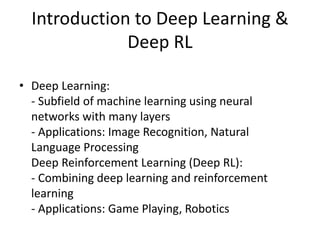
Introduction to Deep Learning &
Deep RL
• Deep Learning:
- Subfield of machine learning using neural
networks with many layers
- Applications: Image Recognition, Natural
Language Processing
Deep Reinforcement Learning (Deep RL):
- Combining deep learning and reinforcement
learning
- Applications: Game Playing, Robotics

Introduction_to_Artificial_Intelligence (1).pptx

  • 1.
    An Introduction toArtificial Intelligence A Comprehensive Overview
  • 2.
    Introduction: Philosophy ofAI, Definitions • Philosophy of AI: - Examines the nature and function of AI - Key questions: Can machines think? What is intelligence? Definitions: - AI is the simulation of human intelligence by machines - Key areas: Machine Learning, Natural Language Processing, Robotics, etc.
  • 3.
    Modeling a Problemas Search Problem, Uninformed Search • Modeling a Problem as a Search Problem: - Define states, actions, goal, and cost - Example: Pathfinding in a maze Uninformed Search: - Algorithms: Breadth-First Search, Depth-First Search - Characteristics: Do not use problem-specific knowledge
  • 4.
    Heuristic Search, Domain Relaxations •Heuristic Search: - Use heuristics to improve search efficiency - Algorithms: A*, Greedy Best-First Search Domain Relaxations: - Simplifying the problem to make it more tractable - Example: Ignoring obstacles in pathfinding
  • 5.
    Local Search, GeneticAlgorithms • Local Search: - Search for solutions in the local neighborhood - Algorithms: Hill Climbing, Simulated Annealing Genetic Algorithms: - Inspired by natural evolution - Use crossover, mutation, and selection operators
  • 6.
    Adversarial Search • AdversarialSearch: - Used in games and competitive environments - Algorithms: Minimax, Alpha-Beta Pruning - Example: Chess, Go
  • 7.
    Constraint Satisfaction • ConstraintSatisfaction Problems (CSP): - Define variables, domains, and constraints - Algorithms: Backtracking, Constraint Propagation - Applications: Scheduling, Sudoku
  • 8.
    Propositional Logic &Satisfiability • Propositional Logic: - Formal system for reasoning about propositions - Connectives: AND, OR, NOT, IMPLIES Satisfiability (SAT): - Determine if there exists an assignment that satisfies a given formula - Algorithms: DPLL, SAT Solvers
  • 9.
    Uncertainty in AI,Bayesian Networks • Uncertainty in AI: - Handling incomplete or uncertain information - Techniques: Probability Theory, Fuzzy Logic Bayesian Networks: - Graphical models representing probabilistic relationships - Nodes represent variables, edges represent dependencies
  • 10.
    Bayesian Networks Learning& Inference, Decision Theory • Bayesian Networks Learning: - Methods: Maximum Likelihood, Bayesian Estimation Inference in Bayesian Networks: - Techniques: Variable Elimination, Belief Propagation Decision Theory: - Framework for making rational decisions under uncertainty - Concepts: Utility, Expected Value
  • 11.
    Markov Decision Processes •Markov Decision Processes (MDP): - Framework for modeling decision making in stochastic environments - Components: States, Actions, Transition Model, Reward Function - Solution: Policy, Value Function
  • 12.
    Reinforcement Learning • ReinforcementLearning (RL): - Learning by interacting with an environment - Key concepts: Reward, Policy, Value Function - Algorithms: Q-Learning, SARSA, Deep Q-Networks (DQN)
  • 13.
    Introduction to DeepLearning & Deep RL • Deep Learning: - Subfield of machine learning using neural networks with many layers - Applications: Image Recognition, Natural Language Processing Deep Reinforcement Learning (Deep RL): - Combining deep learning and reinforcement learning - Applications: Game Playing, Robotics