Artificial Intelligence- An
Introduction
Tentative Outline
 Introductory Lecture- AI, Learning (Intro)
 Logic, Bayesian reasoning
 Statistical Models, Reinforcement Learning
 Special Topics
Obvious question
 What is AI?
 Programs that behave externally like humans?
 Programs that operate internally as humans
do?
 Computational systems that behave
intelligently?
 Rational behaviour?
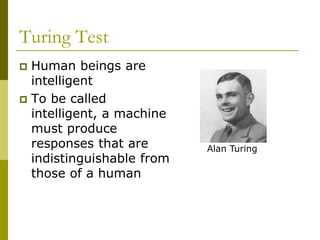
Turing Test
 Human beings are
intelligent
 To be called
intelligent, a machine
must produce
responses that are
indistinguishable from
those of a human
Alan Turing
Does AI have applications?
 Autonomous planning and scheduling of
tasks aboard a spacecraft
 Beating Gary Kasparov in a chess match
 Steering a driver-less car
 Understanding language
 Robotic assistants in surgery
 Monitoring trade in the stock market to
see if insider trading is going on
A rich history
 Philosophy
 Mathematics
 Economics
 Neuroscience
 Psychology
 Control Theory
 John McCarthy- coined the term- 1950’s
Philosophy
 Dealt with questions like:
 Can formal rules be used to draw valid conclusions?
 Where does knowledge come from? How does it lead to
action?
 David Hume proposed the principle of induction
(later)
 Aristotle-
 Given the end to achieve
 Consider by what means to achieve it
 Consider how the above will be achieved …till you reach
the first cause
 Last in the order of analysis = First in the order of action
 If you reach an impossibility, abandon search
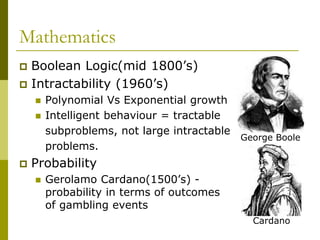
Mathematics
 Boolean Logic(mid 1800’s)
 Intractability (1960’s)
 Polynomial Vs Exponential growth
 Intelligent behaviour = tractable
subproblems, not large intractable
problems.
 Probability
 Gerolamo Cardano(1500’s) -
probability in terms of outcomes
of gambling events
George Boole
Cardano
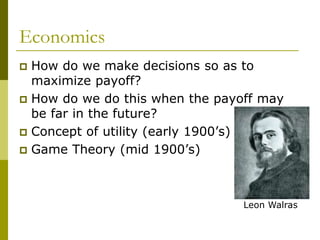
Economics
 How do we make decisions so as to
maximize payoff?
 How do we do this when the payoff may
be far in the future?
 Concept of utility (early 1900’s)
 Game Theory (mid 1900’s)
Leon Walras
Neuroscience
 Study of the nervous system, esp. brain
 A collection of simple cells can lead to
thought and action
 Cycle time: Human brain- microseconds
Computers- nanoseconds
 The brain is still 100,000 times faster
Psychology
 Behaviourism- stimulus leads to response
 Cognitive science
 Computer models can be used to understand
the psychology of memory, language and
thinking
 The brain is now thought of in terms of
computer science constructs like I/O units, and
processing center
Control Theory
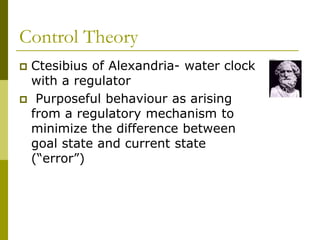
 Ctesibius of Alexandria- water clock
with a regulator
 Purposeful behaviour as arising
from a regulatory mechanism to
minimize the difference between
goal state and current state
(“error”)
Does AI meet EE?
 Robotics- the science
and technology of
robots, their design,
manufacture, and
application.
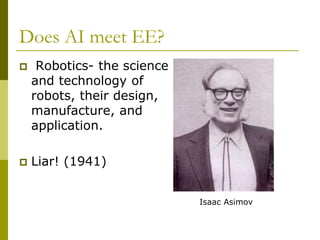
 Liar! (1941)
Isaac Asimov
 Mechatronics- mechanics, electronics and
computing which, combined, make
possible the generation of simpler, more
economical, reliable and versatile systems.
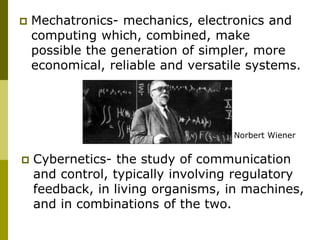
 Cybernetics- the study of communication
and control, typically involving regulatory
feedback, in living organisms, in machines,
and in combinations of the two.
Norbert Wiener
An Agent
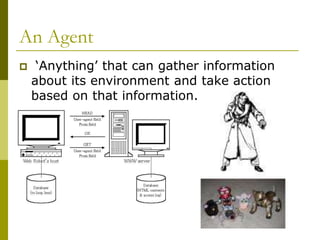
 ‘Anything’ that can gather information
about its environment and take action
based on that information.
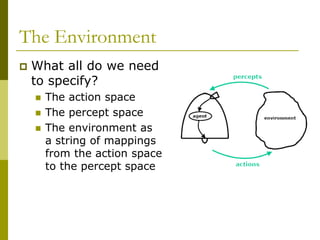
The Environment
 What all do we need
to specify?
 The action space
 The percept space
 The environment as
a string of mappings
from the action space
to the percept space
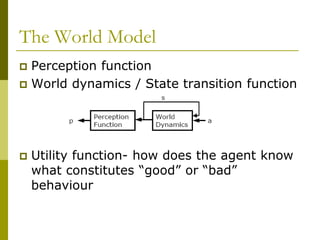
The World Model
 Perception function
 World dynamics / State transition function
 Utility function- how does the agent know
what constitutes “good” or “bad”
behaviour
What is Rationality?
 Goal
 Information / Knowledge
 The purpose of action is to reach the goal,
given the information/knowledge
possessed by the agent
 Is not omniscience
 The notion of rationality does not
necessarily include success of the actions
chosen
Environments
 Accessible/Inaccessible
 Deterministic/Non-deterministic
 Static/Dynamic
 Discrete/Continuous
 E.g. Driving a car, a game of Chinese-
checkers
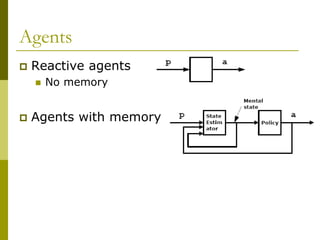
Agents
 Reactive agents
 No memory
 Agents with memory
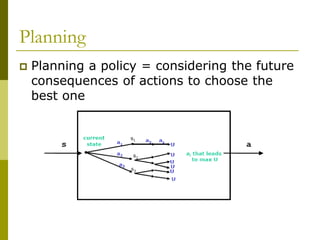
Planning
 Planning a policy = considering the future
consequences of actions to choose the
best one
Seems okay so far?
 Computational constraints
 Can we possibly specify EXACTLY the
domain the agent will work in?
 A look-up table of reactions to percepts is
far to big
 Most things that could happen, don’t
Learning
 Incomplete information about the
environment
 A changing environment
 Use the sequence of percepts to estimate
the missing details
 Hard for us to articulate the knowledge
needed to build AI systems – e.g. try
writing a program to recognize visual
input like various types of flowers
What is Learning?
 Herb Simon-
“Learning denotes changes in the system that are
adaptive in the sense that they enable the system to do the
tasks drawn from the same population more efficiently and
more effectively the next time.”
 But why do we believe we have the license
to predict the future?
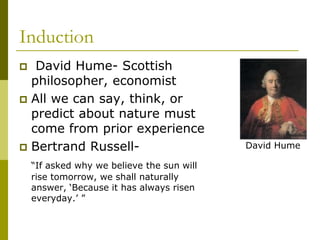
Induction
 David Hume- Scottish
philosopher, economist
 All we can say, think, or
predict about nature must
come from prior experience
 Bertrand Russell-
“If asked why we believe the sun will
rise tomorrow, we shall naturally
answer, ‘Because it has always risen
everyday.’ ”
David Hume
Classifying Learning Problems
 Supervised learning- Given a set of
input/output pairs, learn to predict the
output if faced with a new input.
 Unsupervised Learning- Learning patterns
in the input when no specific output values
are supplied.
 Reinforcement Learning- Learn to interact
with the world from the reinforcement you
get.
Functions
 Given a sample set of inputs and
corresponding outputs, find a function to
express this relationship
 Pronunciation= Function from letters to sound
 Bowling= Function from target location (or
trajectory?) to joint torques
 Diagnosis= Function from lab results to
disease categories
Aspects of Function Learning
 Memory
 Averaging
 Generalization

Artificial intelligence introduction

  • 1.
  • 2.
    Tentative Outline  IntroductoryLecture- AI, Learning (Intro)  Logic, Bayesian reasoning  Statistical Models, Reinforcement Learning  Special Topics
  • 3.
    Obvious question  Whatis AI?  Programs that behave externally like humans?  Programs that operate internally as humans do?  Computational systems that behave intelligently?  Rational behaviour?
  • 4.
    Turing Test  Humanbeings are intelligent  To be called intelligent, a machine must produce responses that are indistinguishable from those of a human Alan Turing
  • 5.
    Does AI haveapplications?  Autonomous planning and scheduling of tasks aboard a spacecraft  Beating Gary Kasparov in a chess match  Steering a driver-less car  Understanding language  Robotic assistants in surgery  Monitoring trade in the stock market to see if insider trading is going on
  • 6.
    A rich history Philosophy  Mathematics  Economics  Neuroscience  Psychology  Control Theory  John McCarthy- coined the term- 1950’s
  • 7.
    Philosophy  Dealt withquestions like:  Can formal rules be used to draw valid conclusions?  Where does knowledge come from? How does it lead to action?  David Hume proposed the principle of induction (later)  Aristotle-  Given the end to achieve  Consider by what means to achieve it  Consider how the above will be achieved …till you reach the first cause  Last in the order of analysis = First in the order of action  If you reach an impossibility, abandon search
  • 8.
    Mathematics  Boolean Logic(mid1800’s)  Intractability (1960’s)  Polynomial Vs Exponential growth  Intelligent behaviour = tractable subproblems, not large intractable problems.  Probability  Gerolamo Cardano(1500’s) - probability in terms of outcomes of gambling events George Boole Cardano
  • 9.
    Economics  How dowe make decisions so as to maximize payoff?  How do we do this when the payoff may be far in the future?  Concept of utility (early 1900’s)  Game Theory (mid 1900’s) Leon Walras
  • 10.
    Neuroscience  Study ofthe nervous system, esp. brain  A collection of simple cells can lead to thought and action  Cycle time: Human brain- microseconds Computers- nanoseconds  The brain is still 100,000 times faster
  • 11.
    Psychology  Behaviourism- stimulusleads to response  Cognitive science  Computer models can be used to understand the psychology of memory, language and thinking  The brain is now thought of in terms of computer science constructs like I/O units, and processing center
  • 12.
    Control Theory  Ctesibiusof Alexandria- water clock with a regulator  Purposeful behaviour as arising from a regulatory mechanism to minimize the difference between goal state and current state (“error”)
  • 13.
    Does AI meetEE?  Robotics- the science and technology of robots, their design, manufacture, and application.  Liar! (1941) Isaac Asimov
  • 14.
     Mechatronics- mechanics,electronics and computing which, combined, make possible the generation of simpler, more economical, reliable and versatile systems.  Cybernetics- the study of communication and control, typically involving regulatory feedback, in living organisms, in machines, and in combinations of the two. Norbert Wiener
  • 15.
    An Agent  ‘Anything’that can gather information about its environment and take action based on that information.
  • 16.
    The Environment  Whatall do we need to specify?  The action space  The percept space  The environment as a string of mappings from the action space to the percept space
  • 17.
    The World Model Perception function  World dynamics / State transition function  Utility function- how does the agent know what constitutes “good” or “bad” behaviour
  • 18.
    What is Rationality? Goal  Information / Knowledge  The purpose of action is to reach the goal, given the information/knowledge possessed by the agent  Is not omniscience  The notion of rationality does not necessarily include success of the actions chosen
  • 19.
    Environments  Accessible/Inaccessible  Deterministic/Non-deterministic Static/Dynamic  Discrete/Continuous  E.g. Driving a car, a game of Chinese- checkers
  • 20.
    Agents  Reactive agents No memory  Agents with memory
  • 21.
    Planning  Planning apolicy = considering the future consequences of actions to choose the best one
  • 22.
    Seems okay sofar?  Computational constraints  Can we possibly specify EXACTLY the domain the agent will work in?  A look-up table of reactions to percepts is far to big  Most things that could happen, don’t
  • 23.
    Learning  Incomplete informationabout the environment  A changing environment  Use the sequence of percepts to estimate the missing details  Hard for us to articulate the knowledge needed to build AI systems – e.g. try writing a program to recognize visual input like various types of flowers
  • 24.
    What is Learning? Herb Simon- “Learning denotes changes in the system that are adaptive in the sense that they enable the system to do the tasks drawn from the same population more efficiently and more effectively the next time.”  But why do we believe we have the license to predict the future?
  • 25.
    Induction  David Hume-Scottish philosopher, economist  All we can say, think, or predict about nature must come from prior experience  Bertrand Russell- “If asked why we believe the sun will rise tomorrow, we shall naturally answer, ‘Because it has always risen everyday.’ ” David Hume
  • 26.
    Classifying Learning Problems Supervised learning- Given a set of input/output pairs, learn to predict the output if faced with a new input.  Unsupervised Learning- Learning patterns in the input when no specific output values are supplied.  Reinforcement Learning- Learn to interact with the world from the reinforcement you get.
  • 27.
    Functions  Given asample set of inputs and corresponding outputs, find a function to express this relationship  Pronunciation= Function from letters to sound  Bowling= Function from target location (or trajectory?) to joint torques  Diagnosis= Function from lab results to disease categories
  • 28.
    Aspects of FunctionLearning  Memory  Averaging  Generalization