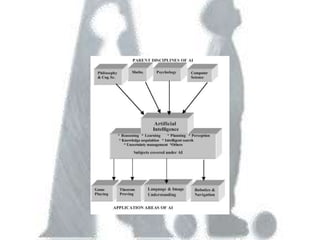

ARTIFICIAL INTELLIGENCE
        AUTHORS:
       Amit Dovtya
      IIMET (Jaipur)
Origin
• Human wanted to see themselves.
• They started constructing their statues.
• The desire to make model intelligent originated.
• Babbage’s analytical engine .
• Thermo ionic valves ,transistors ,IC’s and VLSI
  engines gave way to first to fourth generations
  computes.
• Fifth generation – intelligence.
Introduction
• No formal definition to date.
• Compared with human intelligence.
• Intelligence            Immeasurable.
• Intelligence helps to identify right knowledge
  at right time.
• The system capable of doing this is called
  rational.
Problem solving approaches AI
•   State is solution at a given step .
•   State space approach.
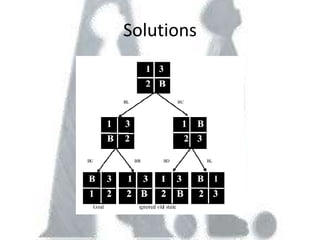
•   To solve :one state             next state
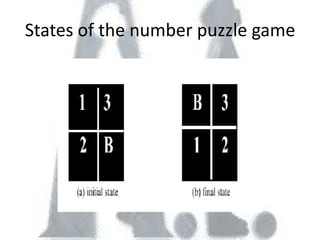
•   Example: four puzzle problem
•   3 blocks       digits
•   1 block        blank
•   AIM : To reach from given state to goal state.
States of the number puzzle game
Solutions
• Thus AI problem            no straightforward
   mathematical or logical algorithm available .
• Solved by intuitive approach.
• Some of these well known algorithm to solve
   AI are
I. Generate and test
II. Hill climbing
III. Heuristic search
IV. Means and ends analysis
Subject of AI
• Started with game playing and theorem
   proving
• Topics significant to under currently :
I. Learning system
II. Knowledge representation and reasoning
III. Planning
IV. Knowledge acquisition
V. Fuzzy logic
VI. ANN
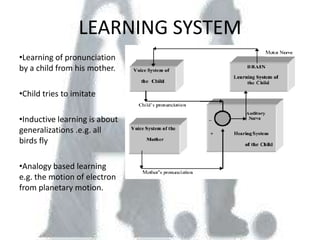
LEARNING SYSTEM
•Learning of pronunciation
by a child from his mother.

•Child tries to imitate

•Inductive learning is about
generalizations .e.g. all
birds fly

•Analogy based learning
e.g. the motion of electron
from planetary motion.
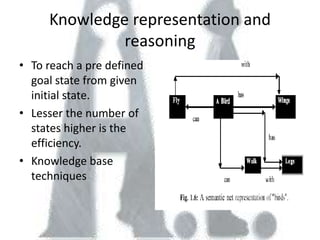
Knowledge representation and
              reasoning
• To reach a pre defined
  goal state from given
  initial state.
• Lesser the number of
  states higher is the
  efficiency.
• Knowledge base
  techniques
Knowledge acquisition

• Generation of knowledge from given
  knowledge base.
• Automated acquisition is active field .
• Soft computing            remarkable ability of
  human mind to reason and learn in an
  environment of uncertainty and imprecision.
• Collection of fuzzy logic ,artificial neural nets
  ,genetic algorithms ,belief calculus etc.
Fuzzy logic & ANN
• fuzzy sets and logical connectives.
• Members have value 1 and other elements of
  universal set 0.
• Common operators AND ,OR and negation.
• ANN are electrical analogues of biological neural
  nets.
• ANN is collection of artificial neurons .
• The unsupervised learning algorithm have been
  applied in AI techniques.
Queries

Artificial intelligence

  • 1.
    ARTIFICIAL INTELLIGENCE AUTHORS: Amit Dovtya IIMET (Jaipur)
  • 2.
    Origin • Human wantedto see themselves. • They started constructing their statues. • The desire to make model intelligent originated. • Babbage’s analytical engine . • Thermo ionic valves ,transistors ,IC’s and VLSI engines gave way to first to fourth generations computes. • Fifth generation – intelligence.
  • 3.
    Introduction • No formaldefinition to date. • Compared with human intelligence. • Intelligence Immeasurable. • Intelligence helps to identify right knowledge at right time. • The system capable of doing this is called rational.
  • 4.
    Problem solving approachesAI • State is solution at a given step . • State space approach. • To solve :one state next state • Example: four puzzle problem • 3 blocks digits • 1 block blank • AIM : To reach from given state to goal state.
  • 5.
    States of thenumber puzzle game
  • 6.
  • 7.
    • Thus AIproblem no straightforward mathematical or logical algorithm available . • Solved by intuitive approach. • Some of these well known algorithm to solve AI are I. Generate and test II. Hill climbing III. Heuristic search IV. Means and ends analysis
  • 9.
    Subject of AI •Started with game playing and theorem proving • Topics significant to under currently : I. Learning system II. Knowledge representation and reasoning III. Planning IV. Knowledge acquisition V. Fuzzy logic VI. ANN
  • 10.
    LEARNING SYSTEM •Learning ofpronunciation by a child from his mother. •Child tries to imitate •Inductive learning is about generalizations .e.g. all birds fly •Analogy based learning e.g. the motion of electron from planetary motion.
  • 11.
    Knowledge representation and reasoning • To reach a pre defined goal state from given initial state. • Lesser the number of states higher is the efficiency. • Knowledge base techniques
  • 12.
    Knowledge acquisition • Generationof knowledge from given knowledge base. • Automated acquisition is active field . • Soft computing remarkable ability of human mind to reason and learn in an environment of uncertainty and imprecision. • Collection of fuzzy logic ,artificial neural nets ,genetic algorithms ,belief calculus etc.
  • 13.
    Fuzzy logic &ANN • fuzzy sets and logical connectives. • Members have value 1 and other elements of universal set 0. • Common operators AND ,OR and negation. • ANN are electrical analogues of biological neural nets. • ANN is collection of artificial neurons . • The unsupervised learning algorithm have been applied in AI techniques.
  • 15.