EPIDEMIOLOGY
METASTASIS
CA- breast 45-85%
CA- lung 35-60%
CA-kidney 35-40%
CA- prostate 35-85%
CA- thyroid
The most common location for
skeletal metastasis:
Thoracolumbar region ~ 70%
Lumbar and sacral spine ~ 20%
Cervical spine ~ 10%
Vertebral metastases are the first sign of
malignant disease in 12% to 20% of the
cases.
Clinical symptoms of spinal
metastasis;
Pain
Neurologic deficit
The spinal pain may be due:
In destruction of the anatomic
vertebral elements as a result of
metastases
Resulting spinal instability
The pain is possible to occur as a
result of:
Compression or
infiltration of the spinal cord – nerves
from neoplasmatic masses.
Pathologic spinal fracture
Instability
Compression
of the neural
tissues
Neurologic
deficit
Spinal pain
Diagnosis of spinal metastases
M.R.I. Kidney’s metastasis
SCANNING Tc 99 MDP
P.E.T.
Biopsy of the spine
•C.T. – guided percutaneous
needle - trocar
•Graig’s trocar
BREAST ADENOCARCINOMA : SPINAL METASTASIS
TREATMENT
Medical treatment
•Chemotherapy
•Hormone therapy
•Immunotherapy
Radiotherapy
Operative
Chemotherapy
•Anti-tumor medication
•Steroids
•Bi-phosphonates
MEDICAL TREATMENT
CHEMOTHERAPY
Highly sensitive
Childhood cancers like
•Acute lymphocytic leukemia
•Wilms tumor
•Ewing’s tumor
•Retinoblastoma
•Rhabdomyosarcoma
Hodgkin’s lymphoma.
Carcinoma of the testis.
Choriocarcinoma.
Burkitts tumor.
Acute promyelocytic leukemia.
Moderately sensitive
•Adenocarcinoma of breast.
•Non-Hodgkin’s lymphoma.
•Lung cancer.
•Osteosarcoma.
•Adult myeloid and lymphocytic leukemia.
•Carcinoma of the prostate.
•Colorectal carcinoma.
•Female cancers of the ovary, endometrium, and cervix.
CHEMOTHERAPY
Minimally sensitive
•Endocrine gland cancers.
•Malignant melanoma.
•Hepatocellular carcinoma.
•Renal carcinoma.
•Pancreatic carcinoma.
CHEMOTHERAPY
BI-PHOSPHONATES
•Tend to inhibit osteoclast re-absortion of bone matrix and decrease bone
turnover.
•There are three generations of bi-phosphonate currently available.
RADIOTHERAPY
Relevant contraindication : Neurologic
deficit
Absolute contraindication : Vertebral
collapse
ARTERIAL EMBOLISM IN SPINAL
METASTASIS
CERVICAL SPINE
INDICATIONS FOR OPERATIVE TREATMENT
1. Spinal instability
2. Pain resistible to conservative treatment (radiotherapy
chemotherapy)
3. Incomplete neurologic deficit resistible to any type of conservative
treatment
4. Rapid deterioration of the neurologic deficit
5. Recurrence of tumor in an area that has been already submitted in
radiotherapy (at the maximum permitted levels)
6. Ambiguous histological diagnosis
FACTORS FOR EVALUATION
•The biology of the tumor
•The location
•The pain
•The neurologic deficit
•The spinal instability
•Life expectancy
•Overall condition of the patient
METHODS OF EVALUATION
•Tokuhashi scoring system
•Tomita surgical staging
•Karnofsky performance status scale
definitions rating (%) criteria
Tokuhashi’s criteria allow the definition of a pre
operative strategy and therefore considerable
variability in the choice of treatment ranging:
•Excisional operation should be performed on those who
scored above 9 points.
•A palliative operation should be performed on those who
scored under 5 points.
Simpler system of preoperative evaluation based on only
three
parameters:
•the degree of malignacy.
•the presence of visceral metastases.
•the presence of bony metastases.
TOMITA’S CLASSIFICATION SYSTEM
TYPES OF OPERATIVE TREATMENT
•Decompression
•Decompression– spondylodesia
•Debulking
•Piecemeal excision
ANTERIOR PROCEDURE
Up to three
vertebral
metastases
BREAST’S METASTASIS
•Vertebrectomy
•Vertebral substitution by cylinder
and
•Stabilization
POSTERIOR PROCEDURE
1. Vertebrae
2. Posterior vertebral elements
involvement
3. Poor general condition
Bilateral Mastectomy 35years ago
POSTERIOR DECOMPRESSION
±
OCCIPUT-CERVICAL
STABILIZATION
Combined procedures
(anterior – posterior
PNEUMON METASTASIS
N(+)
TOTAL VERTEBRECTOMY
ACCORDING TO TOMITA
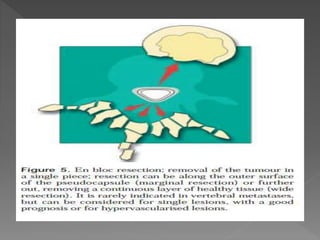
TOTAL EN BLOC SPONDYLECTOMY (TES)
Harmful
Not useful
Useful

tumors.pptx