The Global Financial Crisis: 
The View From German 
Ordnungspolitik (秩序政策) 
Prof. Dr. Carsten Herrmann-Pillath / 何梦笔 
Fall 2008
2 
2 
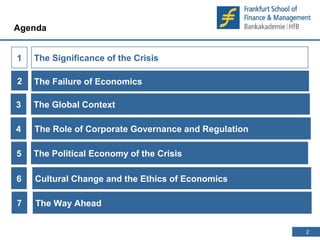
Agenda 
1 
2 The Failure of Economics 
5 
The Significance of the Crisis 
3 
The Global Context 
The Role of Corporate Governance and Regulation 
The Political Economy of the Crisis 
4 
6 Cultural Change and the Ethics of Economics 
7 The Way Ahead
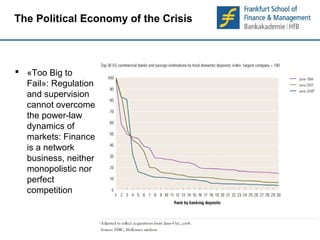
3 
3 
The Significance of the Crisis 
 After two decades of transition, we now face a transition of capitalism: 
– From Washington consensus to Beijing consensus? 
– Reinstating the diversity of capitalisms (French, German etc.) 
 Current situation: Difficult for forecasting 
– Fact: We enter a global recession 
– Unknown: Whether we face a global depression 
– Unknown: How far the financial system is really affected: 
• Reason: The status of the financial system is endogenous to the 
economy 
• Examples of unknown variables: hedge funds, credit card companies 
(see American Express), banks of car companies (leasing), corporate 
finance in general
4 
4 
The Significance of the Crisis 
 But the biggest unknown: The Lucas problem in forecasting! 
– We observe far-reaching institutional changes, hence structural 
changes of the largest economies of the world 
• Specific example: downsizing and restructuring of financial asset supply 
• And certainly: A new role of government in the economy 
– Hence, our attention should focus on these: This is the perspective 
of Ordnungstheorie und –politik / Institutional, evolutionary and 
constitutional economics 
 What is the institutional framework for finance in the future? 
– Institutions of financial markets 
– Embeddedness of financial markets (Interdependenz der 
Ordnungen)
5 
5 
The Significance of the Crisis 
 Conclusion: 
– The crisis changes fundamental premises of 
global institutional change and policies in the 
past two decades. We failed to forecast the 
extent of the crisis, and we will fail to forecast its 
consequences. Thus, adapting our institutions to 
our ignorance is the crucial challenge.
6 
6 
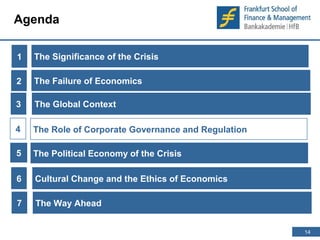
Agenda 
1 
The Significance of the Crisis 
The Failure of Economics 
3 
The Global Context 
The Role of Corporate Governance and Regulation 
2 
4 
The Political 5 Economy of the Crisis 
6 Cultural Change and the Ethics of Economics 
7 The Way Ahead
7 
7 
The Failure of Economics 
 Economic theory is endogenous to capital market evolution 
– Modern theory of finance major driving force in the production of new types 
of financial assets (options, securitization etc.) 
 Neglect of the institutional dimension of capital markets 
– No substantial role in theorizing about the role of continuous innovation in 
financial markets 
– Innovation continuously recreates patterns of asymmetric information 
(increasing complexity of assets does not manage risk, but increases 
information asymmetries, which exploded in the total loss of trust) 
 Tension between behavioral economics and mathematical modeling in risk 
analysis and risk management 
– Mainstream finance modelling assumes efficient markets and rationality: 
Perfect arbitrage and the market portfolio 
– The issue of probability distributions: Levy distributions and others, «rare 
events», instead of normal distributions 
– Neglect of the lemons problem in market dynamics, which interacts with 
behavioral determinants («irrationality»)
8 
8 
The Failure of Economics 
 A systematic neglect of asset prices and wealth effects in simple applied 
macroeconomics 
– Asset price inflation versus CPI inflation: An unresolved issue in 
central banking (which adopted inflation targeting) 
– Stiglitz on Asia 1997: No role for bankruptcy in modeling crises 
 The failure is endemic: 
– In the crisis, we observe a sudden revival of vulgar-Keynesian ideas 
about fiscal policies 
– Central banks continue to be entangled in the flow-perspective on 
macroeconomics: interest rate is the lever 
 The real issue - choosing the right models: 
– Hayekian model of credit cycles with very low real interest rates? 
– Stiglitz‘ revival of loanable funds theory? 
– General: Eschewing the pure macro-approach in favour of an 
Austrian/evolutionary approach
9 
9 
The Failure of Economics 
 Conclusion: 
– Economics played a major role in the genesis of 
the crisis. It guided regulation and 
institutionalization by wrong models of the 
market and monetary policy. We need to rethink 
economics as well.
10 
10 
Agenda 
1 
The Significance of the Crisis 
The Failure of Economics 
The Global Context 
2 
The Role of Corporate Governance and Regulation 
3 
4 
5 The Failure of Economics 
6 Cultural Change and the Ethics of Economics 
7 The Way Ahead
11 
11 
The Global Context 
 Bretton Woods II: The US as global lead economy and issuer of the global 
reserve currency could maintain a very low savings rate by capital inflows from 
China, in particular: 
– China swaps safe interest returns from treasury bonds etc. for FDI inflows 
which transfer technology under risk 
– FDI profits from stable exchange rates and from the resulting Chinese 
competitiveness 
– China funds the American deficit and sustains the market for her exports 
 Chinese reserves serve different objectives (non-macro): 
– a cushion for domestic banking system reforms and external shocks 
– channeled into a Sovereign Wealth Fund, they help to reduce transaction 
costs in Chinese FDI 
– they are a pawn for Western FDI in China, and they are a commitment 
device for Chinese cooperation in international policy coordination (because 
of dollar denomination)
12 
12 
The Global Context 
 One of the main causes of the crisis: 
– Expansion of US money supply creates reserve accumulation / 
inflationary pressures worldwide 
– Financial innovation major incentive for capital inflows to the US, 
simultanously providing the stuff for asset price inflation 
– However, asset price inflation and CPI inflation have been 
decoupled because of deflationary pressures from China 
 Will Bretton Woods II survive? 
– If Chinese price competitiveness remains strong, a global recession 
will not translate into a low demand for Chinese exports, rather the 
other way round (e.g. automobile industry) 
– Global investors will continue to be interested in investing in China, 
given the dearth of alternative investments
13 
13 
The Global Context 
 Conclusion: 
– A reinterpretation of the macroeconomic 
imbalances of the past decade follows an 
Austrian line of thinking: Macroeconomics serves 
the optimal allocation of real capital in terms of 
growth potentials, overcoming institutional 
barriers and reducing uncertainty for 
entrepreneurs. The major fault line was the Fed‘s 
monetary policy.
14 
14 
Agenda 
1 
The Significance of the Crisis 
The Failure of Economics 
The Role of Corporate Governance and Regulation 
2 
The Global Context 
3 
4 
The Political 5 Economy of the Crisis 
6 Cultural Change and the Ethics of Economics 
7 The Way Ahead
15 
15 
The Role of Corporate Governance and 
Regulation 
 Both the Anglo-saxon and the Continental system failed because of a 
lack of personal liability: 
– In Germany, the Landesbanken were the main protagonists in the 
crisis (public sector management) 
– In the US, the supervisory system and the rating agencies failed to 
curb overexpansion by ambitious managers 
– In both cases, managers‘ incentives are distorted 
 Leveraging and shareholder value: The false assumption that 
shareholders will control excessive risk-taking by management 
– As leveraging implies a high profit rate on equity, shareholders will 
always support high leverage ratios, especially because they know 
that they can sell the shares at any point of time 
– Competition in financial markets is status competition, not „efficient 
markets“, because status is a central signaling mechanism 
(Podolny), hence no reason to curb managers‘ gains
16 
16 
The Role of Corporate Governance and 
Regulation 
 Procyclical regulation supports risk-taking 
– Rating agencies will improve ratings in boom times, and vice versa 
– Regulation may also cause moral hazard (the higher the level of 
regulation, the more responsibility can be shifted to the government) 
 Regulation can never keep up with financial sector innovation 
– There will be always scope for regulatory arbitrage, such that profits 
will be made precisely because of regulation (securitization and risk 
transformation), and by avoiding regulation (hedge funds) 
 Regulation of single banks and regulation of the system differ – another 
case of the fallacy of composition 
– The government can only follow industry benchmarks and has no 
external beacon to determine structure and level of regulation 
(example: risk control under Basel II) 
– On the systemic level, government is captured easily by the finance 
industry (example: Bush‘s support of soft mortgaging schemes)
17 
17 
The Role of Corporate Governance and 
Regulation 
 Conclusion: 
– The most important single determinant of the 
crisis was the lack of personal liability in the 
financial system. Government regulation cannot 
make up for this fault, unless it usurps financial 
management, hence establishes state ownership 
in the financial industry.
18 
18 
Agenda 
1 
The Significance of the Crisis 
2 The Global Context 
The Political Economy of the Crisis 
2 
The Role of Corporate Governance and Regulation 
5 
The Failure of Economics 
4 
6 Cultural Change and the Ethics of Economics 
7 The Way Ahead
19 
19 
The Political Economy of the Crisis 
 «Too Big to 
Fail»: Regulation 
and supervision 
cannot overcome 
the power-law 
dynamics of 
markets: Finance 
is a network 
business, neither 
monopolistic nor 
perfect 
competition
20 
20 
The Political Economy of the Crisis 
 How can governments solve the problem of information asymmetry 
between them and the financial institutions? 
– The Lehman Brothers case: Trying to be tough, but weakness 
afterwards, see AIG 
– The deeper the crisis, the larger the asymmetries: Demand for 
government support grows indiscriminately 
 Special case US: The two goals of the Fed 
– In-built tendency to over-expand the money supply and to adopt 
activist monetary policy 
 Politicians like to expand their influence 
– Standard case of bureaucratic growth 
– Politicians have to show off crisis management capability (see 
Gordon Brown) 
– Strong public resentment against increasing inequality of income
21 
21 
The Political Economy of the Crisis 
 Conclusion: 
– The nature of financial markets leads to complex 
patterns of collusion, co-optation and capture 
between government and finance industry. 
Facing elections, governments are also prone to 
short-termism and to claim competences which 
are in fact limited.
22 
22 
Agenda 
1 
The Significance of the Crisis 
2 The Global Context 
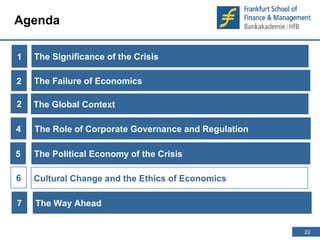
Cultural Change and the Ethics of Economics 
2 
The Role of Corporate Governance and Regulation 
6 
The Failure of Economics 
4 
5 The Political Economy of the Crisis 
7 The Way Ahead
23 
23 
Cultural change 
and the ethics of economics 
 Are Bankers greedy? It‘s the system, as Karl Marx already recognized 
– Status competition plus short-termism of unfettered financial markets 
– Lack of personal liability 
 The past three decades saw a cultural competition between different 
models 
– The Anglo-Saxon system of capital-market based finance 
– The relational / credit-based banking model of Germany and Japan, 
in particular 
– The transitional banking systems of emergent economies (e.g. 
Russia, China) 
– Emergence of explicitly culture-based finance: Islamic finance 
 Culture: Different mental models of risk and entrepreneurship, historical 
roots of government-business relations etc.
24 
24 
Cultural change 
and the ethics of economics 
 The relative advantages of the models are at least partly context-dependent: 
– Finance is not independent from the structure of other markets, 
especially labor (Aoki) 
– Structural characteristics of markets determine the structure of 
uncertainty (e.g. the relative role of generic / singular knowledge as 
compared to semi-structured / meso – knowledge) 
– Theoretical paradigm : complementarities and super-modularity, 
both on the level of the real economy and the institutions 
 Result: Finance is global, but banking is national! 
 Is there a need for enhanced consumer protection? 
– Again, the question of modeling arises: Hyperbolic time preferences 
and commitment devices for savings 
– What is the profession of bankers? A custodian, not a businessman?
25 
25 
Cultural change 
and the ethics of economics 
 Conclusion: 
– The competition among financial systems is also 
a battle among different economic cultures. The 
crisis will trigger cultural change supporting the 
institutional diversity of the global economy. 
Global regulation cannot substitute for national 
regulation of national banking systems.
26 
26 
Agenda 
1 
The Significance of the Crisis 
2 The Global Context 
The Way Ahead 
2 
The Role of Corporate Governance and Regulation 
7 
The Failure of Economics 
4 
5 The Political Economy of the Crisis 
6 Cultural Change and the Ethics of Economics
27 
27 
The Way Ahead 
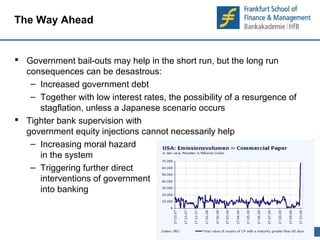
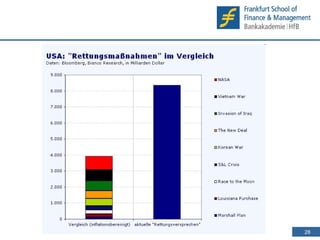
 Government bail-outs may help in the short run, but the long run 
consequences can be desastrous: 
– Increased government debt 
– Together with low interest rates, the possibility of a resurgence of 
stagflation, unless a Japanese scenario occurs 
 Tighter bank supervision with 
government equity injections cannot necessarily help 
– Increasing moral hazard 
in the system 
– Triggering further direct 
interventions of government 
into banking
28 
28
29 
29 
The Way Ahead 
 Solution: Less emphasis on business models of banks, but on 
safeguarding product quality 
– Stiglitz: Financial product safety commission 
– Containing the role of rating agencies 
 The root of the problem: How can the possible negative externalities of 
finance business be contained? 
– There are only two choices: 
• Either curbing status competition, i.e. turning CEOs into quasi-officials 
(following Bruno Frey) 
• Or increasing personal liability, hence strengthening private banks 
– Major challenge: Defining long-term success indicators for banks 
which internalize externalities 
• Caveat: There are also positive externalities of risk taking in finance, 
supporting innovation in business!
30 
30 
The Way Ahead 
 There is no way to avoid crises in capitalism 
– Failure is the king‘s way of learning: creative destruction 
 But we can try to minimize externalities and collateral damages 
– Central concern: The social security system must be entirely 
independent from the financial markets, especially the pension 
system 
– Second concern: Maintaining the capacity of the financial system to 
lend credit to companies, especially SME, thus maintaining the real 
economy 
– Third concern: Nurturing a diversified structure of the economy, 
including finance, by means of competition policy
31 
31 
The Way Ahead 
 Conclusions: 
– Central assumptions of Ordnungspolitik are 
vindicated, again: 
• Personal liability 
• Containing big business, nurturing diversity 
• Primacy of monetary order and monetary policies 
• Strong, but autonomous government, against «crisis 
management»

Financial crisis

  • 1.
    The Global FinancialCrisis: The View From German Ordnungspolitik (秩序政策) Prof. Dr. Carsten Herrmann-Pillath / 何梦笔 Fall 2008
  • 2.
    2 2 Agenda 1 2 The Failure of Economics 5 The Significance of the Crisis 3 The Global Context The Role of Corporate Governance and Regulation The Political Economy of the Crisis 4 6 Cultural Change and the Ethics of Economics 7 The Way Ahead
  • 3.
    3 3 TheSignificance of the Crisis  After two decades of transition, we now face a transition of capitalism: – From Washington consensus to Beijing consensus? – Reinstating the diversity of capitalisms (French, German etc.)  Current situation: Difficult for forecasting – Fact: We enter a global recession – Unknown: Whether we face a global depression – Unknown: How far the financial system is really affected: • Reason: The status of the financial system is endogenous to the economy • Examples of unknown variables: hedge funds, credit card companies (see American Express), banks of car companies (leasing), corporate finance in general
  • 4.
    4 4 TheSignificance of the Crisis  But the biggest unknown: The Lucas problem in forecasting! – We observe far-reaching institutional changes, hence structural changes of the largest economies of the world • Specific example: downsizing and restructuring of financial asset supply • And certainly: A new role of government in the economy – Hence, our attention should focus on these: This is the perspective of Ordnungstheorie und –politik / Institutional, evolutionary and constitutional economics  What is the institutional framework for finance in the future? – Institutions of financial markets – Embeddedness of financial markets (Interdependenz der Ordnungen)
  • 5.
    5 5 TheSignificance of the Crisis  Conclusion: – The crisis changes fundamental premises of global institutional change and policies in the past two decades. We failed to forecast the extent of the crisis, and we will fail to forecast its consequences. Thus, adapting our institutions to our ignorance is the crucial challenge.
  • 6.
    6 6 Agenda 1 The Significance of the Crisis The Failure of Economics 3 The Global Context The Role of Corporate Governance and Regulation 2 4 The Political 5 Economy of the Crisis 6 Cultural Change and the Ethics of Economics 7 The Way Ahead
  • 7.
    7 7 TheFailure of Economics  Economic theory is endogenous to capital market evolution – Modern theory of finance major driving force in the production of new types of financial assets (options, securitization etc.)  Neglect of the institutional dimension of capital markets – No substantial role in theorizing about the role of continuous innovation in financial markets – Innovation continuously recreates patterns of asymmetric information (increasing complexity of assets does not manage risk, but increases information asymmetries, which exploded in the total loss of trust)  Tension between behavioral economics and mathematical modeling in risk analysis and risk management – Mainstream finance modelling assumes efficient markets and rationality: Perfect arbitrage and the market portfolio – The issue of probability distributions: Levy distributions and others, «rare events», instead of normal distributions – Neglect of the lemons problem in market dynamics, which interacts with behavioral determinants («irrationality»)
  • 8.
    8 8 TheFailure of Economics  A systematic neglect of asset prices and wealth effects in simple applied macroeconomics – Asset price inflation versus CPI inflation: An unresolved issue in central banking (which adopted inflation targeting) – Stiglitz on Asia 1997: No role for bankruptcy in modeling crises  The failure is endemic: – In the crisis, we observe a sudden revival of vulgar-Keynesian ideas about fiscal policies – Central banks continue to be entangled in the flow-perspective on macroeconomics: interest rate is the lever  The real issue - choosing the right models: – Hayekian model of credit cycles with very low real interest rates? – Stiglitz‘ revival of loanable funds theory? – General: Eschewing the pure macro-approach in favour of an Austrian/evolutionary approach
  • 9.
    9 9 TheFailure of Economics  Conclusion: – Economics played a major role in the genesis of the crisis. It guided regulation and institutionalization by wrong models of the market and monetary policy. We need to rethink economics as well.
  • 10.
    10 10 Agenda 1 The Significance of the Crisis The Failure of Economics The Global Context 2 The Role of Corporate Governance and Regulation 3 4 5 The Failure of Economics 6 Cultural Change and the Ethics of Economics 7 The Way Ahead
  • 11.
    11 11 TheGlobal Context  Bretton Woods II: The US as global lead economy and issuer of the global reserve currency could maintain a very low savings rate by capital inflows from China, in particular: – China swaps safe interest returns from treasury bonds etc. for FDI inflows which transfer technology under risk – FDI profits from stable exchange rates and from the resulting Chinese competitiveness – China funds the American deficit and sustains the market for her exports  Chinese reserves serve different objectives (non-macro): – a cushion for domestic banking system reforms and external shocks – channeled into a Sovereign Wealth Fund, they help to reduce transaction costs in Chinese FDI – they are a pawn for Western FDI in China, and they are a commitment device for Chinese cooperation in international policy coordination (because of dollar denomination)
  • 12.
    12 12 TheGlobal Context  One of the main causes of the crisis: – Expansion of US money supply creates reserve accumulation / inflationary pressures worldwide – Financial innovation major incentive for capital inflows to the US, simultanously providing the stuff for asset price inflation – However, asset price inflation and CPI inflation have been decoupled because of deflationary pressures from China  Will Bretton Woods II survive? – If Chinese price competitiveness remains strong, a global recession will not translate into a low demand for Chinese exports, rather the other way round (e.g. automobile industry) – Global investors will continue to be interested in investing in China, given the dearth of alternative investments
  • 13.
    13 13 TheGlobal Context  Conclusion: – A reinterpretation of the macroeconomic imbalances of the past decade follows an Austrian line of thinking: Macroeconomics serves the optimal allocation of real capital in terms of growth potentials, overcoming institutional barriers and reducing uncertainty for entrepreneurs. The major fault line was the Fed‘s monetary policy.
  • 14.
    14 14 Agenda 1 The Significance of the Crisis The Failure of Economics The Role of Corporate Governance and Regulation 2 The Global Context 3 4 The Political 5 Economy of the Crisis 6 Cultural Change and the Ethics of Economics 7 The Way Ahead
  • 15.
    15 15 TheRole of Corporate Governance and Regulation  Both the Anglo-saxon and the Continental system failed because of a lack of personal liability: – In Germany, the Landesbanken were the main protagonists in the crisis (public sector management) – In the US, the supervisory system and the rating agencies failed to curb overexpansion by ambitious managers – In both cases, managers‘ incentives are distorted  Leveraging and shareholder value: The false assumption that shareholders will control excessive risk-taking by management – As leveraging implies a high profit rate on equity, shareholders will always support high leverage ratios, especially because they know that they can sell the shares at any point of time – Competition in financial markets is status competition, not „efficient markets“, because status is a central signaling mechanism (Podolny), hence no reason to curb managers‘ gains
  • 16.
    16 16 TheRole of Corporate Governance and Regulation  Procyclical regulation supports risk-taking – Rating agencies will improve ratings in boom times, and vice versa – Regulation may also cause moral hazard (the higher the level of regulation, the more responsibility can be shifted to the government)  Regulation can never keep up with financial sector innovation – There will be always scope for regulatory arbitrage, such that profits will be made precisely because of regulation (securitization and risk transformation), and by avoiding regulation (hedge funds)  Regulation of single banks and regulation of the system differ – another case of the fallacy of composition – The government can only follow industry benchmarks and has no external beacon to determine structure and level of regulation (example: risk control under Basel II) – On the systemic level, government is captured easily by the finance industry (example: Bush‘s support of soft mortgaging schemes)
  • 17.
    17 17 TheRole of Corporate Governance and Regulation  Conclusion: – The most important single determinant of the crisis was the lack of personal liability in the financial system. Government regulation cannot make up for this fault, unless it usurps financial management, hence establishes state ownership in the financial industry.
  • 18.
    18 18 Agenda 1 The Significance of the Crisis 2 The Global Context The Political Economy of the Crisis 2 The Role of Corporate Governance and Regulation 5 The Failure of Economics 4 6 Cultural Change and the Ethics of Economics 7 The Way Ahead
  • 19.
    19 19 ThePolitical Economy of the Crisis  «Too Big to Fail»: Regulation and supervision cannot overcome the power-law dynamics of markets: Finance is a network business, neither monopolistic nor perfect competition
  • 20.
    20 20 ThePolitical Economy of the Crisis  How can governments solve the problem of information asymmetry between them and the financial institutions? – The Lehman Brothers case: Trying to be tough, but weakness afterwards, see AIG – The deeper the crisis, the larger the asymmetries: Demand for government support grows indiscriminately  Special case US: The two goals of the Fed – In-built tendency to over-expand the money supply and to adopt activist monetary policy  Politicians like to expand their influence – Standard case of bureaucratic growth – Politicians have to show off crisis management capability (see Gordon Brown) – Strong public resentment against increasing inequality of income
  • 21.
    21 21 ThePolitical Economy of the Crisis  Conclusion: – The nature of financial markets leads to complex patterns of collusion, co-optation and capture between government and finance industry. Facing elections, governments are also prone to short-termism and to claim competences which are in fact limited.
  • 22.
    22 22 Agenda 1 The Significance of the Crisis 2 The Global Context Cultural Change and the Ethics of Economics 2 The Role of Corporate Governance and Regulation 6 The Failure of Economics 4 5 The Political Economy of the Crisis 7 The Way Ahead
  • 23.
    23 23 Culturalchange and the ethics of economics  Are Bankers greedy? It‘s the system, as Karl Marx already recognized – Status competition plus short-termism of unfettered financial markets – Lack of personal liability  The past three decades saw a cultural competition between different models – The Anglo-Saxon system of capital-market based finance – The relational / credit-based banking model of Germany and Japan, in particular – The transitional banking systems of emergent economies (e.g. Russia, China) – Emergence of explicitly culture-based finance: Islamic finance  Culture: Different mental models of risk and entrepreneurship, historical roots of government-business relations etc.
  • 24.
    24 24 Culturalchange and the ethics of economics  The relative advantages of the models are at least partly context-dependent: – Finance is not independent from the structure of other markets, especially labor (Aoki) – Structural characteristics of markets determine the structure of uncertainty (e.g. the relative role of generic / singular knowledge as compared to semi-structured / meso – knowledge) – Theoretical paradigm : complementarities and super-modularity, both on the level of the real economy and the institutions  Result: Finance is global, but banking is national!  Is there a need for enhanced consumer protection? – Again, the question of modeling arises: Hyperbolic time preferences and commitment devices for savings – What is the profession of bankers? A custodian, not a businessman?
  • 25.
    25 25 Culturalchange and the ethics of economics  Conclusion: – The competition among financial systems is also a battle among different economic cultures. The crisis will trigger cultural change supporting the institutional diversity of the global economy. Global regulation cannot substitute for national regulation of national banking systems.
  • 26.
    26 26 Agenda 1 The Significance of the Crisis 2 The Global Context The Way Ahead 2 The Role of Corporate Governance and Regulation 7 The Failure of Economics 4 5 The Political Economy of the Crisis 6 Cultural Change and the Ethics of Economics
  • 27.
    27 27 TheWay Ahead  Government bail-outs may help in the short run, but the long run consequences can be desastrous: – Increased government debt – Together with low interest rates, the possibility of a resurgence of stagflation, unless a Japanese scenario occurs  Tighter bank supervision with government equity injections cannot necessarily help – Increasing moral hazard in the system – Triggering further direct interventions of government into banking
  • 28.
  • 29.
    29 29 TheWay Ahead  Solution: Less emphasis on business models of banks, but on safeguarding product quality – Stiglitz: Financial product safety commission – Containing the role of rating agencies  The root of the problem: How can the possible negative externalities of finance business be contained? – There are only two choices: • Either curbing status competition, i.e. turning CEOs into quasi-officials (following Bruno Frey) • Or increasing personal liability, hence strengthening private banks – Major challenge: Defining long-term success indicators for banks which internalize externalities • Caveat: There are also positive externalities of risk taking in finance, supporting innovation in business!
  • 30.
    30 30 TheWay Ahead  There is no way to avoid crises in capitalism – Failure is the king‘s way of learning: creative destruction  But we can try to minimize externalities and collateral damages – Central concern: The social security system must be entirely independent from the financial markets, especially the pension system – Second concern: Maintaining the capacity of the financial system to lend credit to companies, especially SME, thus maintaining the real economy – Third concern: Nurturing a diversified structure of the economy, including finance, by means of competition policy
  • 31.
    31 31 TheWay Ahead  Conclusions: – Central assumptions of Ordnungspolitik are vindicated, again: • Personal liability • Containing big business, nurturing diversity • Primacy of monetary order and monetary policies • Strong, but autonomous government, against «crisis management»