What is Network Administration ??
Network administration can be defined as: “branch of engineering that
concerns the operational management of human-computer systems
A network administrator has different roles
Controlling corporate strategic assets
•Controlling complexity
•Improving service
•Balancing various needs
•Reducing downtime
•Controlling costs
“F C A P S”
• Fault Management
• Configuration & Name
Management
• Account Management
• Performance Management
• Security Management
The core management areas
Fault
management
The facilities that enable the
 detection,
 isolation, and
 correction
of abnormal operation of the
OSI environment.
Configuration and Name
Management
The services and facilities that
• control
• identify
• collect and provide data
to clients and managed objects,
so assisting in continuous
operation of interconnection
services.
OSI - Account Management
The facilities that enable
charges to be established for the use of manage
objects and
costs to be identified for the use of those
managed objects.
OSI - Performance Management
The Facilities needed to evaluate
 Behaviour of managed objects
 Effectiveness of communication
activities
OSI - Security Management
Address those aspects of OSI
security essential to:
 operate OSI network
management correctly and
 to protect managed objects
Definitions??
How does Network
Administration work in
Practice?
Let’s look at how Network
Management is
Organised…
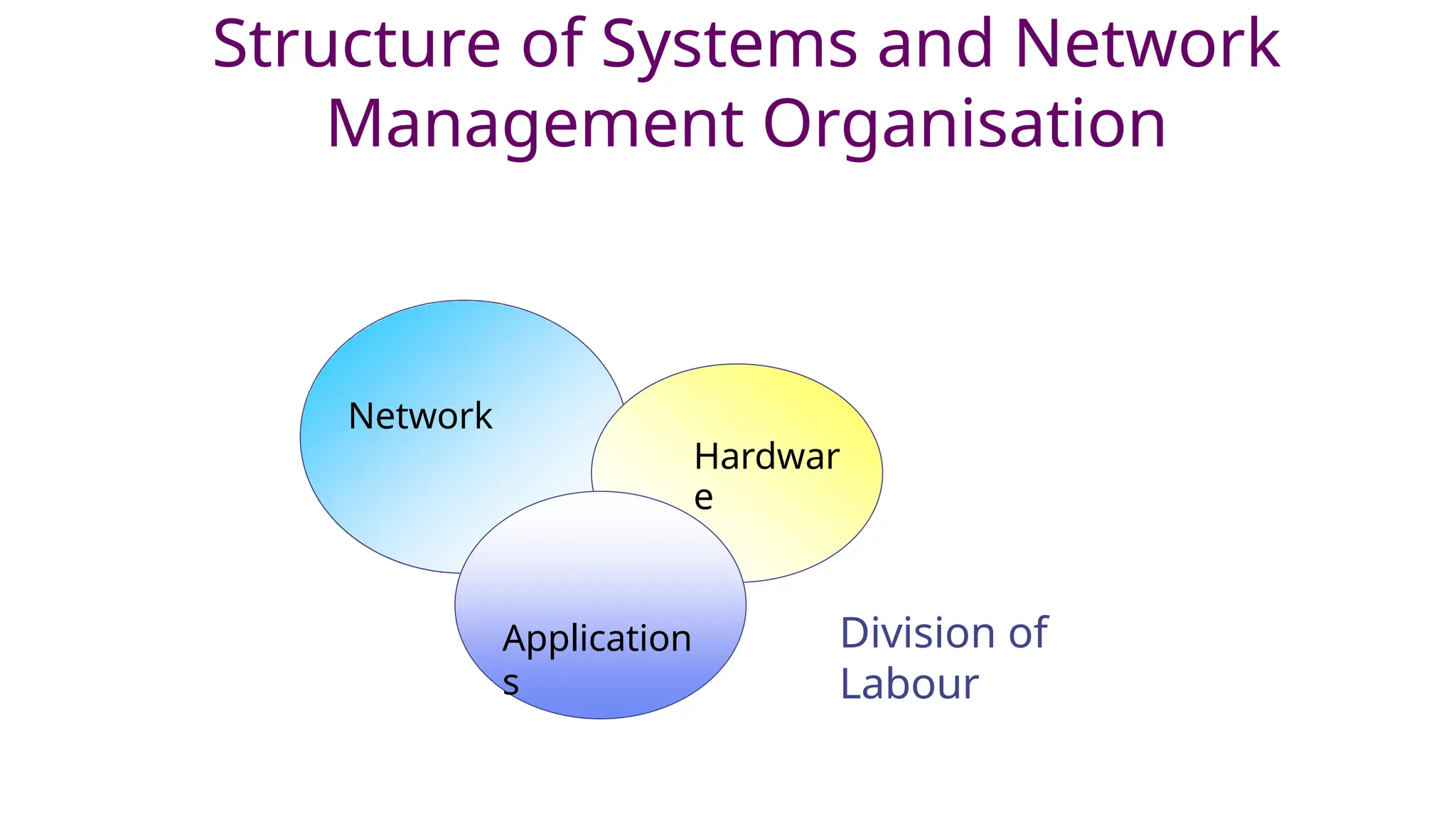
Network
Hardwar
e
Application
s
Division of
Labour
Structure of Systems and Network
Management Organisation
Corporate Networked Environments
Have team(s) of specialists in various areas Well
defined tasks
 job descriptions
In small networks usually one person
 multi-skilled and multi-tasked
In reality – often somewhere in between….
Network Administrators Tasks
Tasks of a Network Administrator
Security Management
Performance
Management Planning
for Growth
Fault Management and
Recovery Account/User
Management Networked
Application Support
Security Management
Firewalls
Usernames
Password
control
Resource
Access Control
Performance Management
Availability
Response
Time Accuracy
Planning for Growth
A Network (or any organisation) is
not static
Growth means increased load on a
network. This must be planned
for….
Systems eventually need
replacement. This must be planned
for – in advance…
Fault Management and Recovery
Monitoring
 Reporting status
Testing
 Fixes and Patches
 Updates
 Repairs
 Change
Management
Account / User
Management
Communication Facilities
 Connection - Rental - Charges
Hardware Usage
 Lease - Rent - Hire
Consumables Usage
 Power, Paper, Media (Diskettes,
CDs…)
Software Usage
 Licensing,
 Tolls,
 Application usage
Account / User Management
Accounts are Managed for:
 Intrusion detection / prevention
 Charging for Services
 Legal protection of the
Organisation
Networked Application Support
Client / Server systems
support Internet support
Server support
 Applications and Hardware
Helpdesk
 Trouble report / Bug fixes
 Printing
 eMail
How to be a Sys/Net
Admin
(yet another Job Description…)
Learn Operating System basics eg Unix
Learn shell utilities and script
programming Learn how to Install and
Configure OS Learn DNS and Bind
Learn TCP/IP networking
Learn NFS and NIS (or equivalent…)
Learn about system tuning and
accounting Learn Compile and Link (eg
C and make)
Goals of
System/Network
Administration
Put together a network of
computers Get them running
Keep them running (despite
Users….) Provide a Service to Users
Requires skills of
 Mechanic
 Sociologist
 Researcher
Challenges
of
System/Network Administration
Systems or Network Administration is
more than just installing computers or
networks.
It is about planning and designing
an efficient community of
computers that allow users to get
their jobs done.
Challenges of
Administration
Design Logical, Efficient networks
Easily deploy & update many
machines Decide what services are
needed
 know the business tasks & customers
Plan and implement adequate
security Provide comfortable User
environment Be able to fix errors
and problems
Comparison of System/Network Management
Styles
Fire-Fighting
 Managing by responding to situations when
they happen (Reactive)
Preventative management
 Monitor network and make repairs and
changes before problems appear (Proactive)
These are two opposite
extremes. Most real managers
combine both.
Fire-Fighting
Investigate the Fault or Problem
 Isolate the problem and
identify/define it
 Use tests and tools to diagnose
the problem
 Solve the problem and document
the solution
Prioritize multiple problems
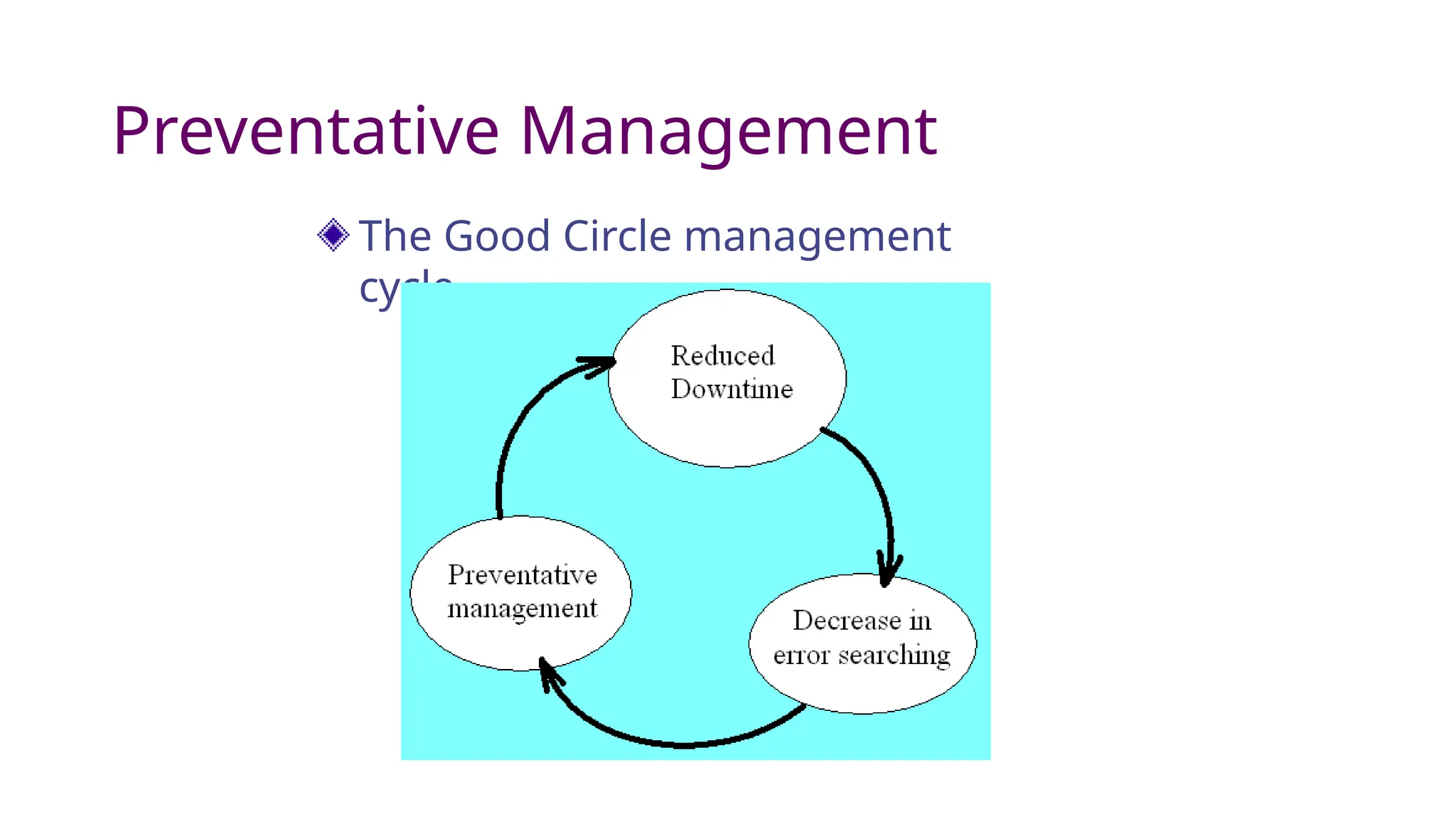
Preventative Management
The Good Circle management
cycle
Preventative Management Technique
Capacity Planning
Simulation and
Testing
 load generators
 Benchmarks
Performance
Monitors and System
Tuning
 Network analysis and
modelling
 Load balancing

SYSTEM AND NETWORK ADMINISTRATION ppt-1.pdf_084326.pptx

  • 1.
    What is NetworkAdministration ?? Network administration can be defined as: “branch of engineering that concerns the operational management of human-computer systems A network administrator has different roles Controlling corporate strategic assets •Controlling complexity •Improving service •Balancing various needs •Reducing downtime •Controlling costs
  • 2.
    “F C AP S” • Fault Management • Configuration & Name Management • Account Management • Performance Management • Security Management The core management areas
  • 3.
    Fault management The facilities thatenable the  detection,  isolation, and  correction of abnormal operation of the OSI environment.
  • 4.
    Configuration and Name Management Theservices and facilities that • control • identify • collect and provide data to clients and managed objects, so assisting in continuous operation of interconnection services.
  • 5.
    OSI - AccountManagement The facilities that enable charges to be established for the use of manage objects and costs to be identified for the use of those managed objects.
  • 6.
    OSI - PerformanceManagement The Facilities needed to evaluate  Behaviour of managed objects  Effectiveness of communication activities
  • 7.
    OSI - SecurityManagement Address those aspects of OSI security essential to:  operate OSI network management correctly and  to protect managed objects
  • 8.
    Definitions?? How does Network Administrationwork in Practice? Let’s look at how Network Management is Organised…
  • 9.
    Network Hardwar e Application s Division of Labour Structure ofSystems and Network Management Organisation
  • 10.
    Corporate Networked Environments Haveteam(s) of specialists in various areas Well defined tasks  job descriptions In small networks usually one person  multi-skilled and multi-tasked In reality – often somewhere in between….
  • 11.
  • 12.
    Tasks of aNetwork Administrator Security Management Performance Management Planning for Growth Fault Management and Recovery Account/User Management Networked Application Support
  • 13.
  • 14.
  • 15.
    Planning for Growth ANetwork (or any organisation) is not static Growth means increased load on a network. This must be planned for…. Systems eventually need replacement. This must be planned for – in advance…
  • 16.
    Fault Management andRecovery Monitoring  Reporting status Testing  Fixes and Patches  Updates  Repairs  Change Management
  • 17.
    Account / User Management CommunicationFacilities  Connection - Rental - Charges Hardware Usage  Lease - Rent - Hire Consumables Usage  Power, Paper, Media (Diskettes, CDs…) Software Usage  Licensing,  Tolls,  Application usage
  • 18.
    Account / UserManagement Accounts are Managed for:  Intrusion detection / prevention  Charging for Services  Legal protection of the Organisation
  • 19.
    Networked Application Support Client/ Server systems support Internet support Server support  Applications and Hardware Helpdesk  Trouble report / Bug fixes  Printing  eMail
  • 20.
    How to bea Sys/Net Admin (yet another Job Description…) Learn Operating System basics eg Unix Learn shell utilities and script programming Learn how to Install and Configure OS Learn DNS and Bind Learn TCP/IP networking Learn NFS and NIS (or equivalent…) Learn about system tuning and accounting Learn Compile and Link (eg C and make)
  • 21.
    Goals of System/Network Administration Put togethera network of computers Get them running Keep them running (despite Users….) Provide a Service to Users Requires skills of  Mechanic  Sociologist  Researcher
  • 22.
    Challenges of System/Network Administration Systems orNetwork Administration is more than just installing computers or networks. It is about planning and designing an efficient community of computers that allow users to get their jobs done.
  • 23.
    Challenges of Administration Design Logical,Efficient networks Easily deploy & update many machines Decide what services are needed  know the business tasks & customers Plan and implement adequate security Provide comfortable User environment Be able to fix errors and problems
  • 24.
    Comparison of System/NetworkManagement Styles Fire-Fighting  Managing by responding to situations when they happen (Reactive) Preventative management  Monitor network and make repairs and changes before problems appear (Proactive) These are two opposite extremes. Most real managers combine both.
  • 25.
    Fire-Fighting Investigate the Faultor Problem  Isolate the problem and identify/define it  Use tests and tools to diagnose the problem  Solve the problem and document the solution Prioritize multiple problems
  • 26.
    Preventative Management The GoodCircle management cycle
  • 27.
    Preventative Management Technique CapacityPlanning Simulation and Testing  load generators  Benchmarks Performance Monitors and System Tuning  Network analysis and modelling  Load balancing