Introduction to statistics
Rakshita .I.Padesur
Introduction to statistics
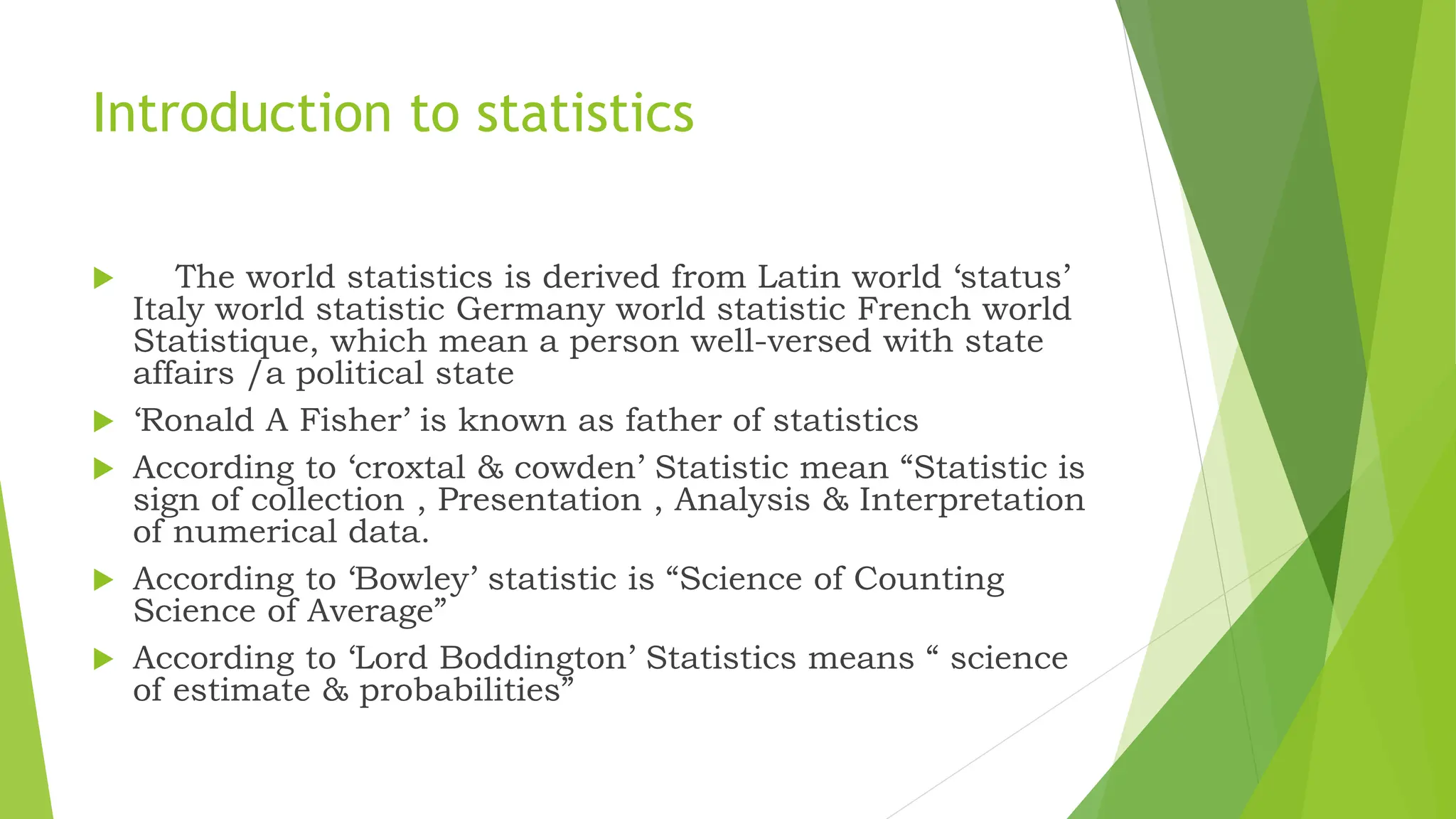
 The world statistics is derived from Latin world ‘status’
Italy world statistic Germany world statistic French world
Statistique, which mean a person well-versed with state
affairs /a political state
 ‘Ronald A Fisher’ is known as father of statistics
 According to ‘croxtal & cowden’ Statistic mean “Statistic is
sign of collection , Presentation , Analysis & Interpretation
of numerical data.
 According to ‘Bowley’ statistic is “Science of Counting
Science of Average”
 According to ‘Lord Boddington’ Statistics means “ science
of estimate & probabilities”
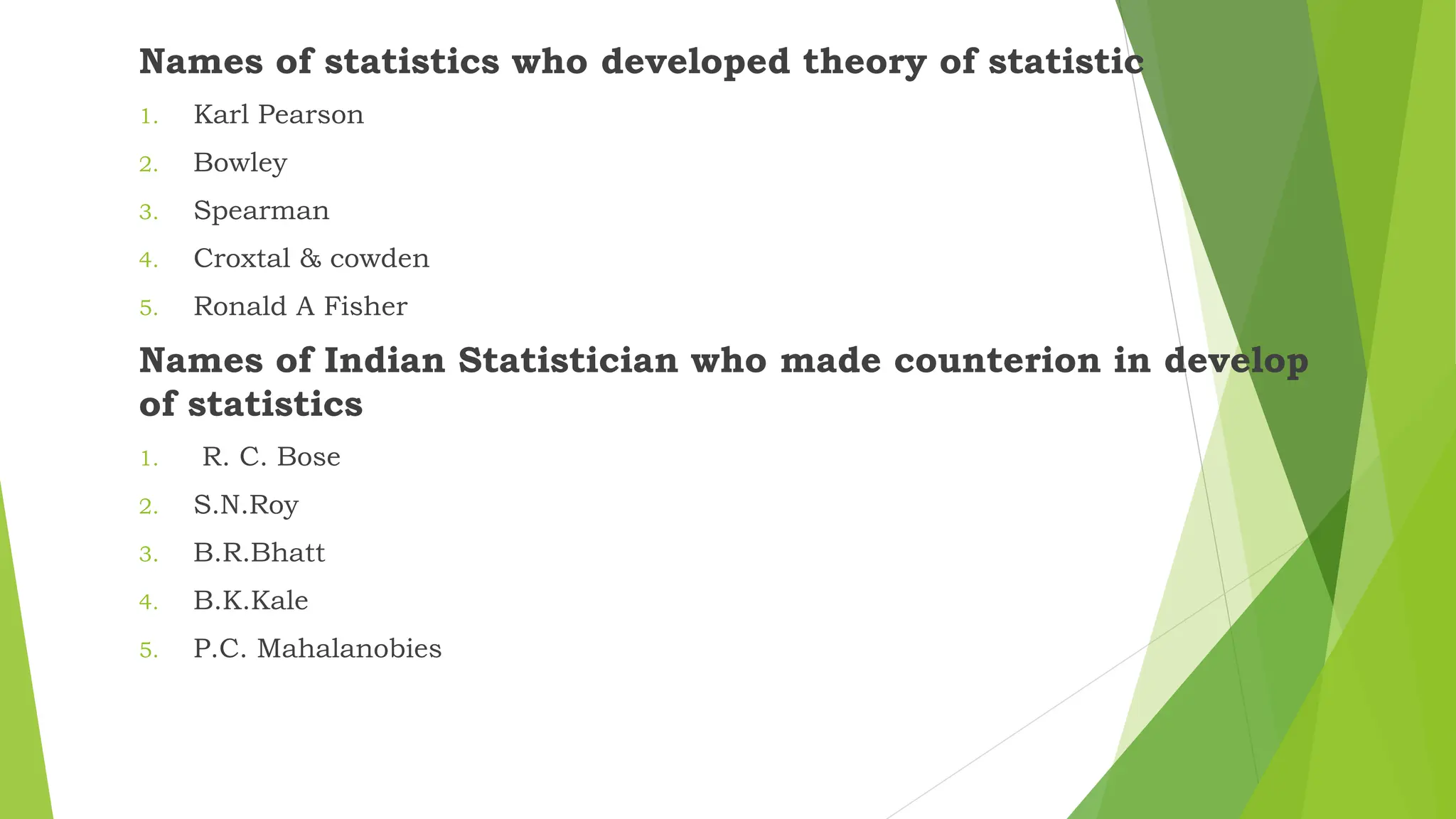
Names of statistics who developed theory of statistic
1. Karl Pearson
2. Bowley
3. Spearman
4. Croxtal & cowden
5. Ronald A Fisher
Names of Indian Statistician who made counterion in develop
of statistics
1. R. C. Bose
2. S.N.Roy
3. B.R.Bhatt
4. B.K.Kale
5. P.C. Mahalanobies
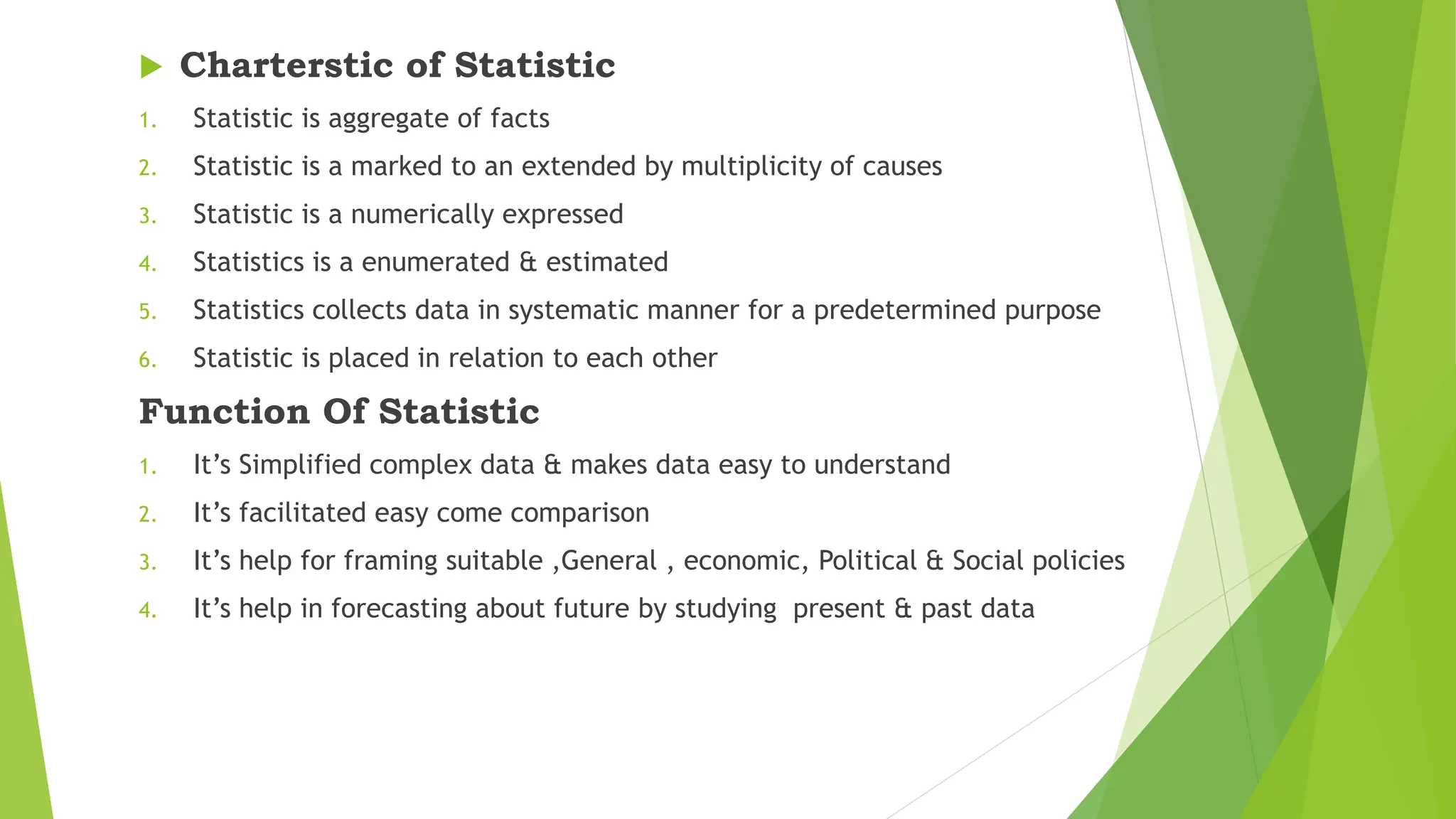
 Charterstic of Statistic
1. Statistic is aggregate of facts
2. Statistic is a marked to an extended by multiplicity of causes
3. Statistic is a numerically expressed
4. Statistics is a enumerated & estimated
5. Statistics collects data in systematic manner for a predetermined purpose
6. Statistic is placed in relation to each other
Function Of Statistic
1. It’s Simplified complex data & makes data easy to understand
2. It’s facilitated easy come comparison
3. It’s help for framing suitable ,General , economic, Political & Social policies
4. It’s help in forecasting about future by studying present & past data
 Techniques of data collection
1. Census techniques
2. Sample techniques
A.Census Techniques :
these census techniques is complete enumeration of each & every unit of
population
B. Sample Techniques :
sample technique is collection of data from the part of population
 Sources of data
1. Primary data
2. Secondary data
A. Primary data :
` The data which are collected originally for they purpose investigation by
investigator himself for the first time is called primary data
B. Secondary data :
the data which are not collected originally by they investigator but it’s collected by
someone else.
 Classification & tabulation
INTRODUCTION :
we have discuss different method of data collection in statistical investigation
the data so collected are usually were large quantity & as search there are not fit for
presentation, Analysis & interpretation of data analysis it’s arrange & presented in
simplified form. The data are therefore sorted out according to similar charterstic &
than presented in the form of table.
Definition:
Classification means grouping of related items into classes .
or
Classification is a process of sorting of similar & dissimilar characteristic which are
presented in the data
Objectives of classification :
1. To reduce quantity of data & simplifies the collected facts
2. To facilities comparison
3. To highlights significant factor
 Types of classification
1. Geographical {Spacial}
2. Chronological { Temporal}
3. Qualitative
4. Quanlitative
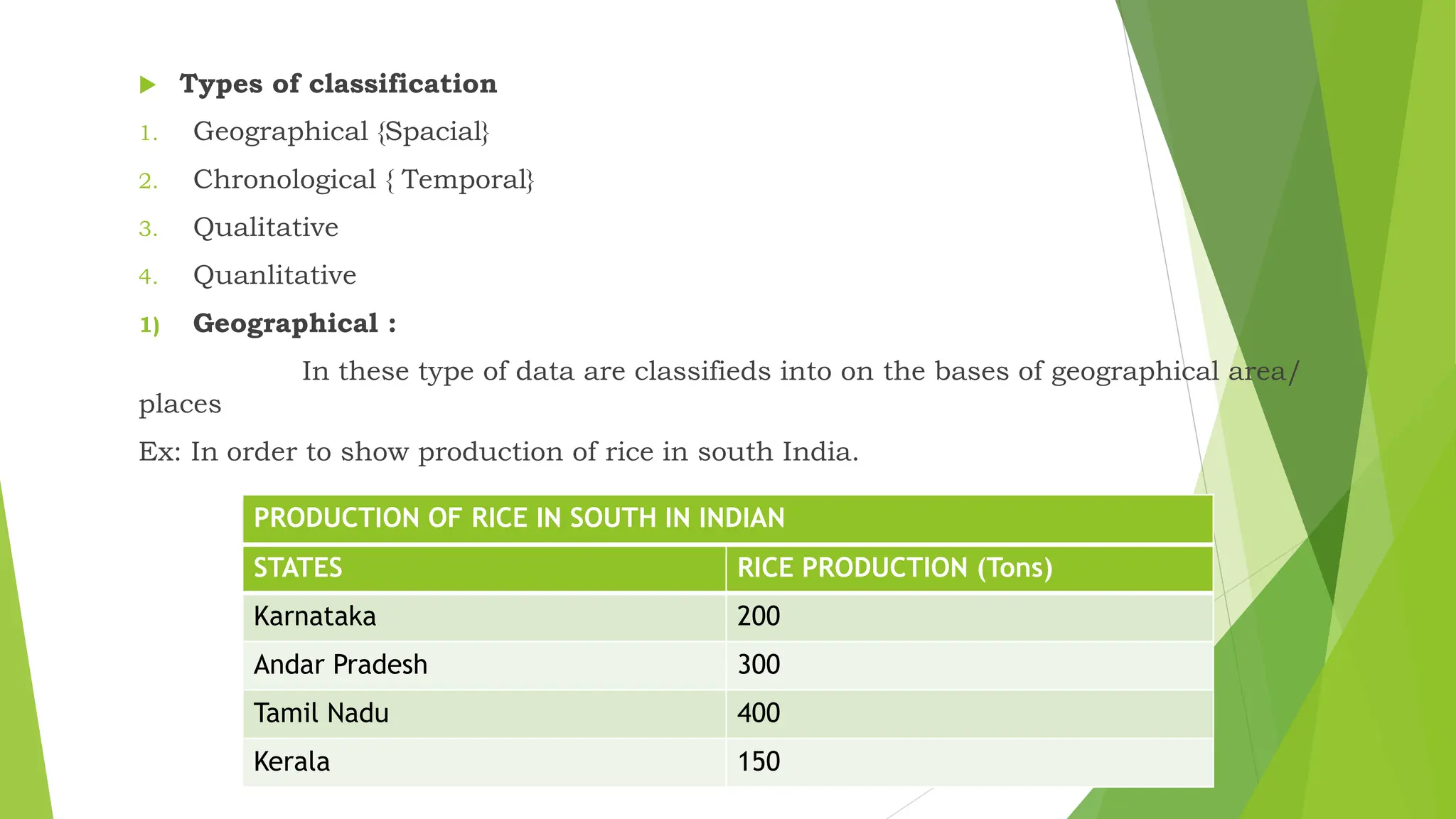
1) Geographical :
In these type of data are classifieds into on the bases of geographical area/
places
Ex: In order to show production of rice in south India.
STATES RICE PRODUCTION (Tons)
Karnataka 200
Andar Pradesh 300
Tamil Nadu 400
Kerala 150
PRODUCTION OF RICE IN SOUTH IN INDIAN
 Chronological classification:
Chrono means time in these type of classification of data are
classified on the bases different point of time
Ex: If a company wants to known trend of sales over number of year is
has follow
YEAR SALES IN TURNOVER
2022 200
2021 100
2020 70
SALES OF COMPANY
 Qualitative classification :
In these type data are classified on the base of quality or attributes like such as
gender, literacy , employ, marital status , knowledge etc.…. Here data classified into two
groups namely the group processing quality & other group not processive quality
Ex: Classification of population is has follow.
Population
male female
Literate
employee
unemployee
Illitrate
empolyee
unemployee
literate
employee
unemployee
illitrate
employee
unemployee
 Quanlitative :
It’s type of classification data are classified according to some quanlitative
such as height, weight , marks ,age , sales, salary etc.,..
Ex:
NUMBER OF MARKS OBTAINED BY STUDENTS
MARKS TOTAL NUMBER OF STUDENT
0-30 2
30-40 5
40-50 6
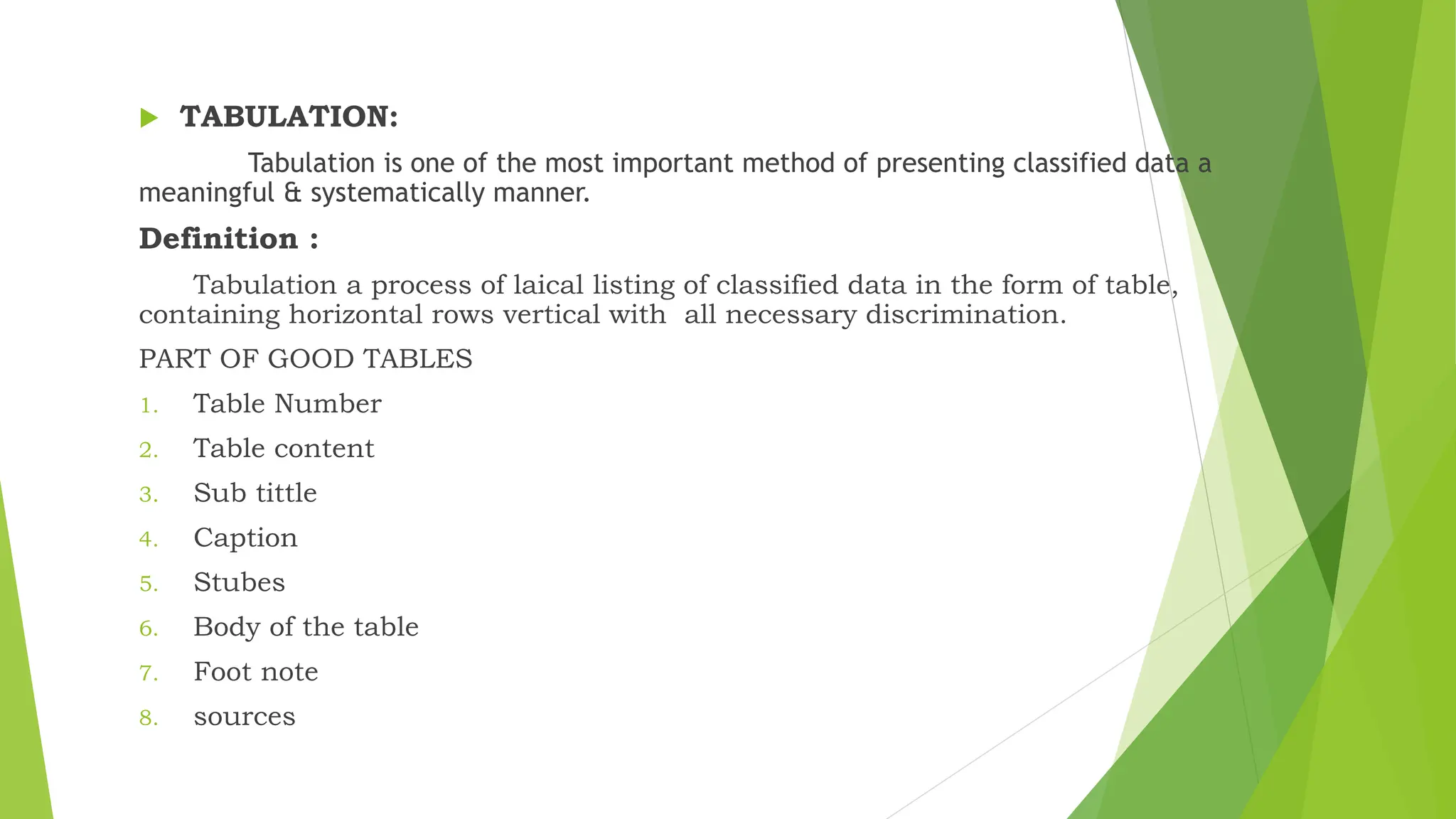
 TABULATION:
Tabulation is one of the most important method of presenting classified data a
meaningful & systematically manner.
Definition :
Tabulation a process of laical listing of classified data in the form of table,
containing horizontal rows vertical with all necessary discrimination.
PART OF GOOD TABLES
1. Table Number
2. Table content
3. Sub tittle
4. Caption
5. Stubes
6. Body of the table
7. Foot note
8. sources
 FORMAT OF GOOD TABLE :
Table no: 1234
TITTLE : POPULATION OF TOWN
Sub tittle: {Accordng to religion &gender}
*_________________(Foot Note)
Sources :According to 2021 Census.
R religon Hindu Muslim Christian Total
Male 50 50 50 150
female 50* 50 50 150
total 100 100 100 300
gender
Thank You

Introduction to statistics.pptx basic of introduction to statistics

  • 1.
  • 2.
    Introduction to statistics The world statistics is derived from Latin world ‘status’ Italy world statistic Germany world statistic French world Statistique, which mean a person well-versed with state affairs /a political state  ‘Ronald A Fisher’ is known as father of statistics  According to ‘croxtal & cowden’ Statistic mean “Statistic is sign of collection , Presentation , Analysis & Interpretation of numerical data.  According to ‘Bowley’ statistic is “Science of Counting Science of Average”  According to ‘Lord Boddington’ Statistics means “ science of estimate & probabilities”
  • 3.
    Names of statisticswho developed theory of statistic 1. Karl Pearson 2. Bowley 3. Spearman 4. Croxtal & cowden 5. Ronald A Fisher Names of Indian Statistician who made counterion in develop of statistics 1. R. C. Bose 2. S.N.Roy 3. B.R.Bhatt 4. B.K.Kale 5. P.C. Mahalanobies
  • 4.
     Charterstic ofStatistic 1. Statistic is aggregate of facts 2. Statistic is a marked to an extended by multiplicity of causes 3. Statistic is a numerically expressed 4. Statistics is a enumerated & estimated 5. Statistics collects data in systematic manner for a predetermined purpose 6. Statistic is placed in relation to each other Function Of Statistic 1. It’s Simplified complex data & makes data easy to understand 2. It’s facilitated easy come comparison 3. It’s help for framing suitable ,General , economic, Political & Social policies 4. It’s help in forecasting about future by studying present & past data
  • 5.
     Techniques ofdata collection 1. Census techniques 2. Sample techniques A.Census Techniques : these census techniques is complete enumeration of each & every unit of population B. Sample Techniques : sample technique is collection of data from the part of population
  • 6.
     Sources ofdata 1. Primary data 2. Secondary data A. Primary data : ` The data which are collected originally for they purpose investigation by investigator himself for the first time is called primary data B. Secondary data : the data which are not collected originally by they investigator but it’s collected by someone else.
  • 7.
     Classification &tabulation INTRODUCTION : we have discuss different method of data collection in statistical investigation the data so collected are usually were large quantity & as search there are not fit for presentation, Analysis & interpretation of data analysis it’s arrange & presented in simplified form. The data are therefore sorted out according to similar charterstic & than presented in the form of table. Definition: Classification means grouping of related items into classes . or Classification is a process of sorting of similar & dissimilar characteristic which are presented in the data Objectives of classification : 1. To reduce quantity of data & simplifies the collected facts 2. To facilities comparison 3. To highlights significant factor
  • 8.
     Types ofclassification 1. Geographical {Spacial} 2. Chronological { Temporal} 3. Qualitative 4. Quanlitative 1) Geographical : In these type of data are classifieds into on the bases of geographical area/ places Ex: In order to show production of rice in south India. STATES RICE PRODUCTION (Tons) Karnataka 200 Andar Pradesh 300 Tamil Nadu 400 Kerala 150 PRODUCTION OF RICE IN SOUTH IN INDIAN
  • 9.
     Chronological classification: Chronomeans time in these type of classification of data are classified on the bases different point of time Ex: If a company wants to known trend of sales over number of year is has follow YEAR SALES IN TURNOVER 2022 200 2021 100 2020 70 SALES OF COMPANY
  • 10.
     Qualitative classification: In these type data are classified on the base of quality or attributes like such as gender, literacy , employ, marital status , knowledge etc.…. Here data classified into two groups namely the group processing quality & other group not processive quality Ex: Classification of population is has follow. Population male female Literate employee unemployee Illitrate empolyee unemployee literate employee unemployee illitrate employee unemployee
  • 11.
     Quanlitative : It’stype of classification data are classified according to some quanlitative such as height, weight , marks ,age , sales, salary etc.,.. Ex: NUMBER OF MARKS OBTAINED BY STUDENTS MARKS TOTAL NUMBER OF STUDENT 0-30 2 30-40 5 40-50 6
  • 12.
     TABULATION: Tabulation isone of the most important method of presenting classified data a meaningful & systematically manner. Definition : Tabulation a process of laical listing of classified data in the form of table, containing horizontal rows vertical with all necessary discrimination. PART OF GOOD TABLES 1. Table Number 2. Table content 3. Sub tittle 4. Caption 5. Stubes 6. Body of the table 7. Foot note 8. sources
  • 13.
     FORMAT OFGOOD TABLE : Table no: 1234 TITTLE : POPULATION OF TOWN Sub tittle: {Accordng to religion &gender} *_________________(Foot Note) Sources :According to 2021 Census. R religon Hindu Muslim Christian Total Male 50 50 50 150 female 50* 50 50 150 total 100 100 100 300 gender
  • 14.