Introduction to
Statistics
Introduction
Statistics play a vital role in enriching a specific domain by collecting data in that
field, analysing the data by applying various statistical techniques and finally making
statistical inferences about the domain.
History of Statistics
The origins of statistics can be traced back to ancient civilizations such as Babylon, Egypt,
and Rome, where people used basic statistical methods to keep records of population sizes,
trade, and taxes. However, the development of modern statistics can be attributed to the
European Renaissance, where the scientific method, critical thinking, and empirical
observations became the norm. It is originated from Latin word 'status' which means
political state. Italian word 'statista' means statesman. German word 'statistik' and French
word 'statistique' was made as statistics with the passage of time.
Definition of Statistics
According to Croxton and Cowden, “Statistics may be defined as the
collection, presentation, analysis, and interpretation of numerical data.”
A.L. Bowley defines, “Statistics are numerical statements of facts in any
department of inquiry placed in relation to each other.”
Meaning of Statistics
It is a branch of mathematics that deals with collection of numerical
data, analysis, interpretation and presentation of same in a systematic
manner
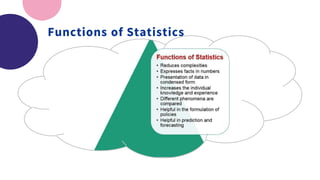
Functions of Statistics
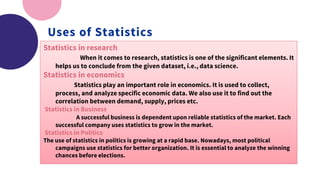
Uses of Statistics
Statistics in research
When it comes to research, statistics is one of the significant elements. It
helps us to conclude from the given dataset, i.e., data science.
Statistics in economics
Statistics play an important role in economics. It is used to collect,
process, and analyze specific economic data. We also use it to find out the
correlation between demand, supply, prices etc.
Statistics in Business
A successful business is dependent upon reliable statistics of the market. Each
successful company uses statistics to grow in the market.
Statistics in Politics
The use of statistics in politics is growing at a rapid base. Nowadays, most political
campaigns use statistics for better organization. It is essential to analyze the winning
chances before elections.
Limitations of Statistics
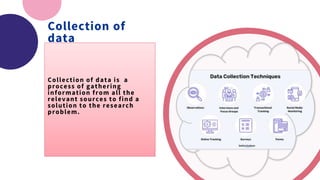
Collection of
data
Collection of data is a
process of gathering
information from all the
relevant sources to find a
solution to the research
problem.
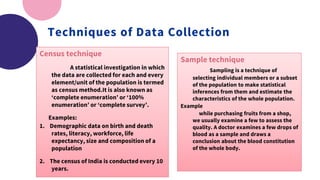
Techniques of Data Collection
Census technique
A statistical investigation in which
the data are collected for each and every
element/unit of the population is termed
as census method.It is also known as
‘complete enumeration’ or ‘100%
enumeration’ or ‘complete survey’.
Examples:
1. Demographic data on birth and death
rates, literacy, workforce, life
expectancy, size and composition of a
population
2. The census of India is conducted every 10
years.
Sample technique
Sampling is a technique of
selecting individual members or a subset
of the population to make statistical
inferences from them and estimate the
characteristics of the whole population.
Example
while purchasing fruits from a shop,
we usually examine a few to assess the
quality. A doctor examines a few drops of
blood as a sample and draws a
conclusion about the blood constitution
of the whole body.
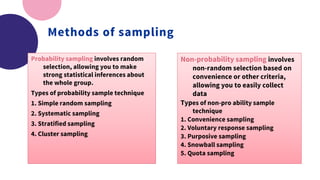
Methods of sampling
Probability sampling involves random
selection, allowing you to make
strong statistical inferences about
the whole group.
Types of probability sample technique
1. Simple random sampling
2. Systematic sampling
3. Stratified sampling
4. Cluster sampling
Non-probability sampling involves
non-random selection based on
convenience or other criteria,
allowing you to easily collect
data
Types of non-pro ability sample
technique
1. Convenience sampling
2. Voluntary response sampling
3. Purposive sampling
4. Snowball sampling
5. Quota sampling
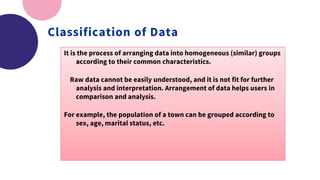
Classification of Data
It is the process of arranging data into homogeneous (similar) groups
according to their common characteristics.
Raw data cannot be easily understood, and it is not fit for further
analysis and interpretation. Arrangement of data helps users in
comparison and analysis.
For example, the population of a town can be grouped according to
sex, age, marital status, etc.
Methods of classification of Data
Geographical
classification
When data are classified
with reference to geographical
locations such as countries,
states, cities, districts, etc., it is
known as geographical
classification.
It is also known as ‘spatial
classification’.
Chronological
classification
A classification where data
are grouped according to time
is known as a chronological
classification.It is also known
as temporal classification’.
Qualitative
classification
Under this
classification, data are
classified on the basis of
some attributes or
qualities like honesty,
beauty, intelligence,
literacy, marital status,
Quantitative
classification
This type of classification
is made on the basis of
some measurable
characteristics like
height, weight, age,
income, marks of
students, etc.
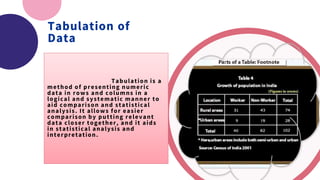
Tabulation of
Data
Tabulation is a
method of presenting numeric
data in rows and columns in a
logical and systematic manner to
aid comparison and statistical
analysis. It allows for easier
comparison by putting relevant
data closer together, and it aids
in statistical analysis and
interpretation.
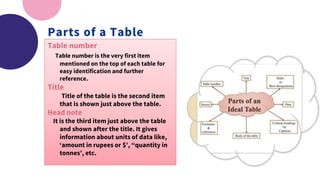
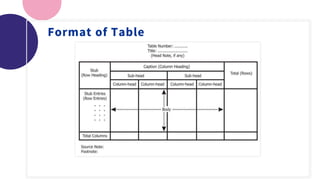
Parts of a Table
Table number
Table number is the very first item
mentioned on the top of each table for
easy identification and further
reference.
Title
Title of the table is the second item
that is shown just above the table.
Head note
It is the third item just above the table
and shown after the title. It gives
information about units of data like,
‘amount in rupees or $’, “quantity in
tonnes’, etc.
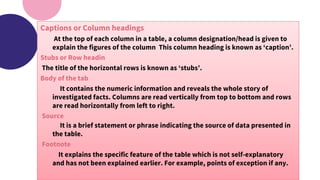
Captions or Column headings
At the top of each column in a table, a column designation/head is given to
explain the figures of the column This column heading is known as ‘caption’.
Stubs or Row headin
The title of the horizontal rows is known as ‘stubs’.
Body of the tab
It contains the numeric information and reveals the whole story of
investigated facts. Columns are read vertically from top to bottom and rows
are read horizontally from left to right.
Source
It is a brief statement or phrase indicating the source of data presented in
the table.
Footnote
It explains the specific feature of the table which is not self-explanatory
and has not been explained earlier. For example, points of exception if any.
Format of Table
Diagrammatic
Presentation
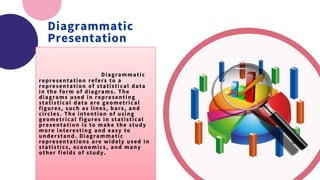
Diagrammatic
representation refers to a
representation of statistical data
in the form of diagrams. The
diagrams used in representing
statistical data are geometrical
figures, such as lines, bars, and
circles. The intention of using
geometrical figures in statistical
presentation is to make the study
more interesting and easy to
understand. Diagrammatic
representations are widely used in
statistics, economics, and many
other fields of study.
Types of Diagrammatic presentation of
data
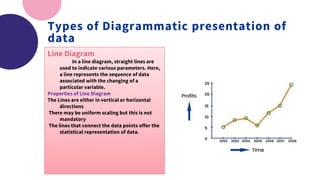
Line Diagram
In a line diagram, straight lines are
used to indicate various parameters. Here,
a line represents the sequence of data
associated with the changing of a
particular variable.
Properties of Line Diagram
The Lines are either in vertical or horizontal
directions
There may be uniform scaling but this is not
mandatory
The lines that connect the data points offer the
statistical representation of data.
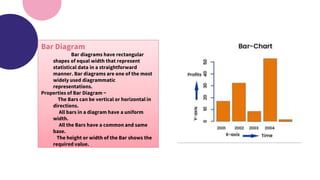
Bar Diagram
Bar diagrams have rectangular
shapes of equal width that represent
statistical data in a straightforward
manner. Bar diagrams are one of the most
widely used diagrammatic
representations.
Properties of Bar Diagram −
The Bars can be vertical or horizontal in
directions.
All bars in a diagram have a uniform
width.
All the Bars have a common and same
base.
The height or width of the Bar shows the
required value.
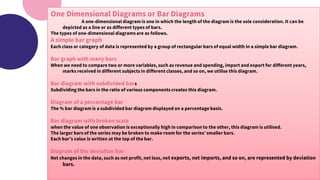
One Dimensional Diagrams or Bar Diagrams
A one-dimensional diagram is one in which the length of the diagram is the sole consideration. It can be
depicted as a line or as different types of bars.
The types of one-dimensional diagrams are as follows.
A simple bar graph
Each class or category of data is represented by a group of rectangular bars of equal width in a simple bar diagram.
Bar graph with many bars
When we need to compare two or more variables, such as revenue and spending, import and export for different years,
marks received in different subjects in different classes, and so on, we utilise this diagram.
Bar diagram with subdivided bars
Subdividing the bars in the ratio of various components creates this diagram.
Diagram of a percentage bar
The % bar diagram is a subdivided bar diagram displayed on a percentage basis.
Bar diagram with broken scale
when the value of one observation is exceptionally high in comparison to the other, this diagram is utilised.
The larger bars of the series may be broken to make room for the series’ smaller bars.
Each bar’s value is written at the top of the bar.
Diagram of the deviation bar
Net changes in the data, such as net profit, net loss, net exports, net imports, and so on, are represented by deviation
bars.
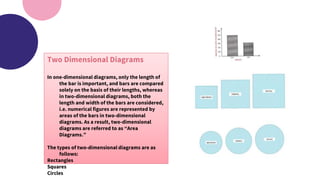
Two Dimensional Diagrams
In one-dimensional diagrams, only the length of
the bar is important, and bars are compared
solely on the basis of their lengths, whereas
in two-dimensional diagrams, both the
length and width of the bars are considered,
i.e. numerical figures are represented by
areas of the bars in two-dimensional
diagrams. As a result, two-dimensional
diagrams are referred to as “Area
Diagrams.”
The types of two-dimensional diagrams are as
follows:
Rectangles
Squares
Circles
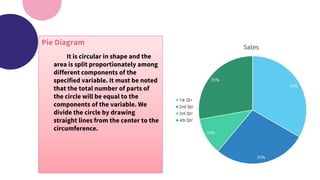
Pie Diagram
It is circular in shape and the
area is split proportionately among
different components of the
specified variable. It must be noted
that the total number of parts of
the circle will be equal to the
components of the variable. We
divide the circle by drawing
straight lines from the center to the
circumference.
Conclusion
In conclusion, statistics is a powerful tool for analyzing and
interpreting data, providing valuable insights into various
phenomena. It plays a crucial role in research, decision-making,
and understanding patterns in diverse fields, ranging from science
to business. Through the systematic collection, analysis, and
interpretation of data, statistics helps uncover meaningful
information, making it an essential discipline in our data-driven
world.

Introduction to Statistics information.pptx

  • 1.
  • 2.
    Introduction Statistics play avital role in enriching a specific domain by collecting data in that field, analysing the data by applying various statistical techniques and finally making statistical inferences about the domain. History of Statistics The origins of statistics can be traced back to ancient civilizations such as Babylon, Egypt, and Rome, where people used basic statistical methods to keep records of population sizes, trade, and taxes. However, the development of modern statistics can be attributed to the European Renaissance, where the scientific method, critical thinking, and empirical observations became the norm. It is originated from Latin word 'status' which means political state. Italian word 'statista' means statesman. German word 'statistik' and French word 'statistique' was made as statistics with the passage of time.
  • 3.
    Definition of Statistics Accordingto Croxton and Cowden, “Statistics may be defined as the collection, presentation, analysis, and interpretation of numerical data.” A.L. Bowley defines, “Statistics are numerical statements of facts in any department of inquiry placed in relation to each other.” Meaning of Statistics It is a branch of mathematics that deals with collection of numerical data, analysis, interpretation and presentation of same in a systematic manner
  • 4.
  • 5.
    Uses of Statistics Statisticsin research When it comes to research, statistics is one of the significant elements. It helps us to conclude from the given dataset, i.e., data science. Statistics in economics Statistics play an important role in economics. It is used to collect, process, and analyze specific economic data. We also use it to find out the correlation between demand, supply, prices etc. Statistics in Business A successful business is dependent upon reliable statistics of the market. Each successful company uses statistics to grow in the market. Statistics in Politics The use of statistics in politics is growing at a rapid base. Nowadays, most political campaigns use statistics for better organization. It is essential to analyze the winning chances before elections.
  • 6.
  • 7.
    Collection of data Collection ofdata is a process of gathering information from all the relevant sources to find a solution to the research problem.
  • 8.
    Techniques of DataCollection Census technique A statistical investigation in which the data are collected for each and every element/unit of the population is termed as census method.It is also known as ‘complete enumeration’ or ‘100% enumeration’ or ‘complete survey’. Examples: 1. Demographic data on birth and death rates, literacy, workforce, life expectancy, size and composition of a population 2. The census of India is conducted every 10 years. Sample technique Sampling is a technique of selecting individual members or a subset of the population to make statistical inferences from them and estimate the characteristics of the whole population. Example while purchasing fruits from a shop, we usually examine a few to assess the quality. A doctor examines a few drops of blood as a sample and draws a conclusion about the blood constitution of the whole body.
  • 9.
    Methods of sampling Probabilitysampling involves random selection, allowing you to make strong statistical inferences about the whole group. Types of probability sample technique 1. Simple random sampling 2. Systematic sampling 3. Stratified sampling 4. Cluster sampling Non-probability sampling involves non-random selection based on convenience or other criteria, allowing you to easily collect data Types of non-pro ability sample technique 1. Convenience sampling 2. Voluntary response sampling 3. Purposive sampling 4. Snowball sampling 5. Quota sampling
  • 10.
    Classification of Data Itis the process of arranging data into homogeneous (similar) groups according to their common characteristics. Raw data cannot be easily understood, and it is not fit for further analysis and interpretation. Arrangement of data helps users in comparison and analysis. For example, the population of a town can be grouped according to sex, age, marital status, etc.
  • 11.
    Methods of classificationof Data Geographical classification When data are classified with reference to geographical locations such as countries, states, cities, districts, etc., it is known as geographical classification. It is also known as ‘spatial classification’. Chronological classification A classification where data are grouped according to time is known as a chronological classification.It is also known as temporal classification’. Qualitative classification Under this classification, data are classified on the basis of some attributes or qualities like honesty, beauty, intelligence, literacy, marital status, Quantitative classification This type of classification is made on the basis of some measurable characteristics like height, weight, age, income, marks of students, etc.
  • 12.
    Tabulation of Data Tabulation isa method of presenting numeric data in rows and columns in a logical and systematic manner to aid comparison and statistical analysis. It allows for easier comparison by putting relevant data closer together, and it aids in statistical analysis and interpretation.
  • 13.
    Parts of aTable Table number Table number is the very first item mentioned on the top of each table for easy identification and further reference. Title Title of the table is the second item that is shown just above the table. Head note It is the third item just above the table and shown after the title. It gives information about units of data like, ‘amount in rupees or $’, “quantity in tonnes’, etc.
  • 14.
    Captions or Columnheadings At the top of each column in a table, a column designation/head is given to explain the figures of the column This column heading is known as ‘caption’. Stubs or Row headin The title of the horizontal rows is known as ‘stubs’. Body of the tab It contains the numeric information and reveals the whole story of investigated facts. Columns are read vertically from top to bottom and rows are read horizontally from left to right. Source It is a brief statement or phrase indicating the source of data presented in the table. Footnote It explains the specific feature of the table which is not self-explanatory and has not been explained earlier. For example, points of exception if any.
  • 15.
  • 16.
    Diagrammatic Presentation Diagrammatic representation refers toa representation of statistical data in the form of diagrams. The diagrams used in representing statistical data are geometrical figures, such as lines, bars, and circles. The intention of using geometrical figures in statistical presentation is to make the study more interesting and easy to understand. Diagrammatic representations are widely used in statistics, economics, and many other fields of study.
  • 17.
    Types of Diagrammaticpresentation of data Line Diagram In a line diagram, straight lines are used to indicate various parameters. Here, a line represents the sequence of data associated with the changing of a particular variable. Properties of Line Diagram The Lines are either in vertical or horizontal directions There may be uniform scaling but this is not mandatory The lines that connect the data points offer the statistical representation of data.
  • 18.
    Bar Diagram Bar diagramshave rectangular shapes of equal width that represent statistical data in a straightforward manner. Bar diagrams are one of the most widely used diagrammatic representations. Properties of Bar Diagram − The Bars can be vertical or horizontal in directions. All bars in a diagram have a uniform width. All the Bars have a common and same base. The height or width of the Bar shows the required value.
  • 19.
    One Dimensional Diagramsor Bar Diagrams A one-dimensional diagram is one in which the length of the diagram is the sole consideration. It can be depicted as a line or as different types of bars. The types of one-dimensional diagrams are as follows. A simple bar graph Each class or category of data is represented by a group of rectangular bars of equal width in a simple bar diagram. Bar graph with many bars When we need to compare two or more variables, such as revenue and spending, import and export for different years, marks received in different subjects in different classes, and so on, we utilise this diagram. Bar diagram with subdivided bars Subdividing the bars in the ratio of various components creates this diagram. Diagram of a percentage bar The % bar diagram is a subdivided bar diagram displayed on a percentage basis. Bar diagram with broken scale when the value of one observation is exceptionally high in comparison to the other, this diagram is utilised. The larger bars of the series may be broken to make room for the series’ smaller bars. Each bar’s value is written at the top of the bar. Diagram of the deviation bar Net changes in the data, such as net profit, net loss, net exports, net imports, and so on, are represented by deviation bars.
  • 20.
    Two Dimensional Diagrams Inone-dimensional diagrams, only the length of the bar is important, and bars are compared solely on the basis of their lengths, whereas in two-dimensional diagrams, both the length and width of the bars are considered, i.e. numerical figures are represented by areas of the bars in two-dimensional diagrams. As a result, two-dimensional diagrams are referred to as “Area Diagrams.” The types of two-dimensional diagrams are as follows: Rectangles Squares Circles
  • 21.
    Pie Diagram It iscircular in shape and the area is split proportionately among different components of the specified variable. It must be noted that the total number of parts of the circle will be equal to the components of the variable. We divide the circle by drawing straight lines from the center to the circumference.
  • 22.
    Conclusion In conclusion, statisticsis a powerful tool for analyzing and interpreting data, providing valuable insights into various phenomena. It plays a crucial role in research, decision-making, and understanding patterns in diverse fields, ranging from science to business. Through the systematic collection, analysis, and interpretation of data, statistics helps uncover meaningful information, making it an essential discipline in our data-driven world.