Introduction to Spread Trading
Basic Concepts of Spread Trading Introduction to Technical Analysis Building your Trading Plan Overview
Tonight we will talk about……. Instant, cheap, simple Accessable No capital gains tax No stamp duty No currency risk Go long or short Stop loss and profit orders Great way to learn about financial markets Leveraged….less capital required than if buying stocks, etc. Why Spread Trading?
Advantages over Traditional Share Dealing Cost efficient Capital efficient Ability to ‘short’ the market Thousands of instruments to trade Instant Execution
Why Marketspreads? Irish owned and based 24 dealing desk in Dublin Personal Trading Mentor service Ongoing education Regulated by the Irish Financial Regulator
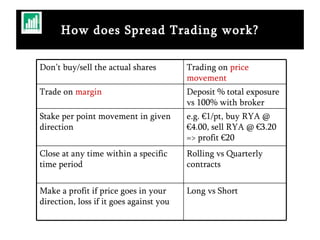
How does Spread Trading work? Long vs Short  Make a profit if price goes in your direction, loss if it goes against you Rolling vs Quarterly contracts Close at any time within a specific time period e.g. €1/pt, buy RYA @ €4.00, sell RYA @ €3.20 => profit €20 Stake per point movement in given direction Deposit % total exposure vs 100% with broker Trade on  margin Trading on  price movement Don’t buy/sell the actual shares
Steps in placing a trade Choose your instrument Check the price Check the IMR Take a view e.g. Long vs Short Decide on your stake e.g. €1/pt  (€1/pt vs buying 100 shares) Calculate overall exposure Manage upside and downside i.e. Stop Losses and Limit Orders
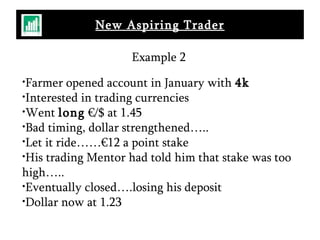
New Aspiring Trader Example 2 Farmer opened account in January with  4k Interested in trading currencies Went  long  €/$ at 1.45 Bad timing, dollar strengthened….. Let it ride……€12 a point stake His trading Mentor had told him that stake was too high….. Eventually closed….losing his deposit Dollar now at 1.23
New Aspiring Trader Example 3 Galwegian started trading this year Aimed for a 20% return Looked at various things like Gold, Oil but realised too volatile Started researching stocks Settled on  CRH ;  Standard Chartered Bank ….low exposure to UK property and well developped in Asia and Africa CRH at 17.50 and SCB at 15.20….stop losses 100 points away Went on holidays On return CRH stopped out at 16.50….loss of 10% of his capital Standard had shot up to nearly 18 His capital had increased by  40%  in less than a month
Cautious Capital Augmenter When analysing stocks or other markets, the time frames you use are critical Start with the longest time period usually monthly or weekly and then work up to a recent daily which includes the last 20 days of prices Weekly (long term)  -> 3 – 5  years Daily (medium term)  -> 1 year Hourly (short term)  ->  1 – 3  months or for intraday traders 4 Hour  30 minutes 5 minutes Characteristics Very  specific return objectives , eager to outperform prevailing interest rates and other asset classes Typically trades in  stocks , holding positions for longer periods of time, building up balance gradually Careful  management and utilisation of risk management tools Generally has  convictions  re particular instruments
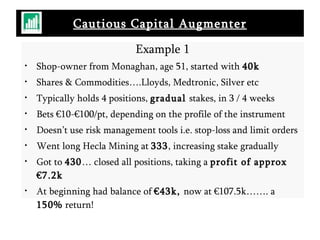
Cautious Capital Augmenter Understanding the concepts of support and resistance is vital in developing a disciplined trading strategy.  Prices are dynamic, reflecting the continuing change in the balance between supply and demand.  By identifying the price levels at which these balances change we can plan not only the price level at which to purchase but also the level at which we can subsequently sell (and vice versa for a short trade).  Whilst these levels may be created by the markets subconsciously they represent the collective opinions of the participants in the markets.  Example 1 Shop-owner from Monaghan, age 51, started with  40k Shares & Commodities….Lloyds, Medtronic, Silver etc Typically holds 4 positions,  gradual  stakes, in 3 / 4 weeks Bets €10-€100/pt, depending on the profile of the instrument Doesn’t use risk management tools i.e. stop-loss and limit orders Went long Hecla Mining at  333 , increasing stake gradually Got to  430 … closed all positions, taking a  profit of approx €7.2k At beginning had balance of  €43k,  now at €107.5k……. a  150%  return!
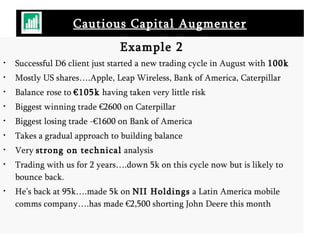
Cautious Capital Augmenter Example 2 Successful D6 client just started a new trading cycle in August with  100k Mostly US shares….Apple, Leap Wireless, Bank of America, Caterpillar Balance rose to  €105k  having taken very little risk Biggest winning trade €2600 on Caterpillar Biggest losing trade -€1600 on Bank of America Takes a gradual approach to building balance Very  strong on technical  analysis Trading with us for 2 years….down 5k on this cycle now but is likely to bounce back. He’s back at 95k….made 5k on  NII Holdings  a Latin America mobile comms company….has made €2,500 shorting John Deere this month
Characteristics Likes the idea of quick large gains  Higher than average risk appetite in return for higher than average profit Not overly concerned with market fundamentals, trades based on technical analysis/tips/’gut feelings’ Particularly interested in Indices, Futures & Forex due to leverage and volatility   High Risk/Reward Trader
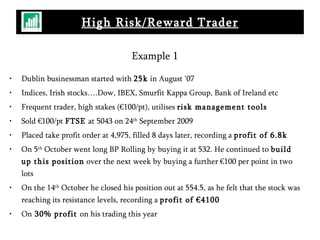
Example 1 Dublin businessman started with  25k  in August ‘07 Indices, Irish stocks….Dow, IBEX, Smurfit Kappa Group, Bank of Ireland etc Frequent trader, high stakes (€100/pt), utilises  risk management tools Sold €100/pt  FTSE  at 5043 on 24 th  September 2009 Placed take profit order at 4,975, filled 8 days later, recording a  profit of 6.8k On 5 th  October went long BP Rolling by buying it at 532. He continued to  build up this position  over the next week by buying a further €100 per point in two lots On the 14 th  October he closed his position out at 554.5, as he felt that the stock was reaching its resistance levels, recording a  profit of €4100 On  30% profit  on his trading this year High Risk/Reward Trader
Example 2 45 year old Dubliner in Financial services Follows gut instincts, listens to talk around town Took a large punt on INM going long at 50c Put  €3000 a cent  movement all in one go Position started going against him. Still convinced it was going to turn…let the position run.  Eventually closed the position at around 30c  Losing a very hefty 60k High Risk/Reward Trader
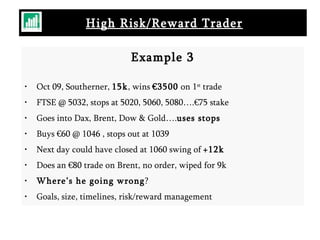
High Risk/Reward Trader Example 3 Oct 09, Southerner,  15k , wins  €3500  on 1 st  trade FTSE @ 5032, stops at 5020, 5060, 5080….€75 stake Goes into Dax, Brent, Dow & Gold…. uses stops Buys €60 @ 1046 , stops out at 1039 Next day could have closed at 1060 swing of  +12k Does an €80 trade on Brent, no order, wiped for 9k Where’s he going wrong ? Goals, size, timelines, risk/reward management
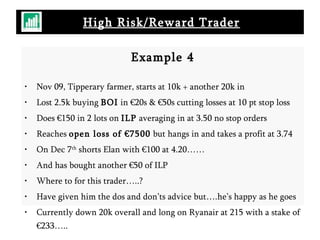
High Risk/Reward Trader Example 4 Nov 09, Tipperary farmer, starts at 10k + another 20k in Lost 2.5k buying  BOI  in €20s & €50s cutting losses at 10 pt stop loss Does €150 in 2 lots on  ILP  averaging in at 3.50 no stop orders Reaches  open loss of €7500  but hangs in and takes a profit at 3.74 On Dec 7 th  shorts Elan with €100 at 4.20…… And has bought another €50 of ILP Where to for this trader…..? Have given him the dos and don’ts advice but….he’s happy as he goes Currently down 20k overall and long on Ryanair at 215 with a stake of €233…..
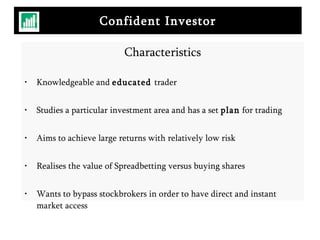
Confident Investor Characteristics Knowledgeable and  educated  trader  Studies a particular investment area and has a set  plan  for trading Aims to achieve large returns with relatively low risk Realises the value of Spreadbetting versus buying shares Wants to bypass stockbrokers in order to have direct and instant market access
Confident Investor Example 1 Banker from Dublin opened up her MarketSpreads account with  €3k Trades currencies & commodities, focusing on EURUSD and Gold Lost most of her initial funding due to overtrading  Further €5k  focusing on  smaller portfolio  of instruments Doubled her initial deposit to  €10k Now builds up position sizes to approx €20/pt over 2-3 days Closes positions once desired levels have been reached e.g.  shorted Gold having overall position of €17/pt.  Closed out all positions on 16 th  Nov realising a profit of €5.2k Account in healthy profit and making a consistent return.
Confident Investor Example 2 37 year old guy, works for a multinational, experienced investor Takes  quarterly views  on instruments, conviction trader, going long Small stakes, 10 or so instruments, stop orders 200/300 points away. e.g. MSCI Brazil bought at 2792, up to 3575, stop order at 2512 Others in Dow, Silver, Nasdaq, Dax, €/$, SMI, etc. Has orders on all positions, adjusts very occasionally, sticks to plan. Average of 41 days on positions, closes losers earlier. e.g. bought Silver at 1421, stop loss at 1279, triggered loss of €570 More than  trebled  his money last year. Stops trading year end.
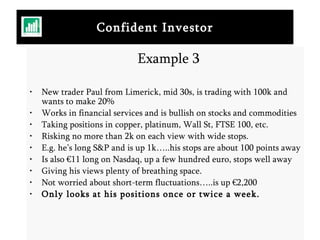
Confident Investor Example 3 New trader Paul from Limerick, mid 30s, is trading with 100k and wants to make 20% Works in financial services and is bullish on stocks and commodities Taking positions in copper, platinum, Wall St, FTSE 100, etc.  Risking no more than 2k on each view with wide stops. E.g. he’s long S&P and is up 1k…..his stops are about 100 points away Is also €11 long on Nasdaq, up a few hundred euro, stops well away Giving his views plenty of breathing space. Not worried about short-term fluctuations…..is up €2,200 Only looks at his positions once or twice a week.
Tonight we will talk about……. Characteristics Trades on the basis of small, short-term price movements  Very active, buys and sells same instrument very quickly, executes a large number of trades daily and generally has all positions closed by end of day Strong on technical analysis and keeps up to date on latest financial news Trades using particular systems  Day/Frequent Trader                                                                                                                                                                        
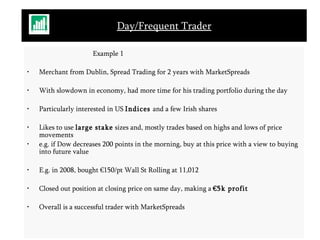
Day/Frequent Trader Example 1 Merchant from Dublin, Spread Trading for 2 years with MarketSpreads With slowdown in economy, had more time for his trading portfolio during the day Particularly interested in US  Indices  and a few Irish shares Likes to use  large stake  sizes and, mostly trades based on highs and lows of price movements  e.g. if Dow decreases 200 points in the morning, buy at this price with a view to buying into future value E.g. in 2008, bought €150/pt Wall St Rolling at 11,012 Closed out position at closing price on same day, making a  €5k profit Overall is a successful trader with MarketSpreads
  Day/Frequent Trader   Example 2 Engineer from Cork, age 42, opened MS account in 2009 with  €8k Likes to trade US and UK indices due to high volatility and leverage Trades stakes of between €5-10/pt, usually taking profits once instrument moves 35-40 points in his favour Trades based on  market volatility , using technical analysis as his primary tool Has been selling Wall St Rolling at points that he felt were indicated by RSI and Bollinger Bands Has made both profits and losses using this strategy, however overall he has  made a 7k loss  and has not traded in recent weeks.                                                                                                                                                        
Value Hedger Characteristics Has something of value and wants to protect that value against risk  Could be a  share portfolio , company  share options , property holding  Could be an asset in a  foreign currency  or company exposure to volatile FX rates or commodity prices .
Value Hedger Example 1: Protecting Options Value Guy works for  Microsoft , 30 years old, lives in Wicklow Got some options at strike price of $20  Share price had risen to $28 Worried about price crash, decided to protect value Started  shorting Microsoft  over the next 5 months Price went back down to around $20 In that time he made  €13k  and was happy that he had hedged his options value.                                                      
Value Hedger Example 2: Hedge on Currency Risk Client had US$ share portfolio worth  €500k  ($735k) Was worried about further devaluation of dollar beyond $1.47 Started  buying EUR/USD  and it went to $1.50 Then it started trending back towards $1.47 and he started taking profit Closed his full position as $ strengthened to almost $1.46 and  banked over €10k in profit With strong dollar he’s not active right now…no hedging need!
Trading: The Lessons Do Decide what kind of trader you want to be Set your trading cycle  parameters Set allowable downside per trade Ease  into positions Admit that you could be wrong on a view Trade only a small number of instruments Play well  within your resources Set  profit targets  per trade Don’t Bet big amounts in one go Over-trade Look only at the upside Let losses build and build indefinitely Set your stop loss orders too tight particularly on volatile instruments Be greedy Be fearful  Be vague on goals
Tonight we will talk about……. Systems traders Momentum traders Fundamentals traders Technical / swing traders Lots of variables…..time input / number of instruments / Steady v. Volatile, types of instruments, duration, etc. … .…so where to for you…..? Different Trading Strategies and Styles
Decide what kind of trading is right for you… What  strategies  suit you……. Where does Spread Trading fit in with your overall financial strategy….. We’ll help you any way we can.... Refund  offer for new traders Your own  trading mentor Seminars, webinars, phone tutorials, dos and don’ts Training course recommendations Execution only ……. you  take control of what you want to do!
Finally Brief Platform Demo Feedback Forms Q&A
 

Introduction To Spread Trading

  • 1.
  • 2.
    Basic Concepts ofSpread Trading Introduction to Technical Analysis Building your Trading Plan Overview
  • 3.
    Tonight we willtalk about……. Instant, cheap, simple Accessable No capital gains tax No stamp duty No currency risk Go long or short Stop loss and profit orders Great way to learn about financial markets Leveraged….less capital required than if buying stocks, etc. Why Spread Trading?
  • 4.
    Advantages over TraditionalShare Dealing Cost efficient Capital efficient Ability to ‘short’ the market Thousands of instruments to trade Instant Execution
  • 5.
    Why Marketspreads? Irishowned and based 24 dealing desk in Dublin Personal Trading Mentor service Ongoing education Regulated by the Irish Financial Regulator
  • 6.
    How does SpreadTrading work? Long vs Short Make a profit if price goes in your direction, loss if it goes against you Rolling vs Quarterly contracts Close at any time within a specific time period e.g. €1/pt, buy RYA @ €4.00, sell RYA @ €3.20 => profit €20 Stake per point movement in given direction Deposit % total exposure vs 100% with broker Trade on margin Trading on price movement Don’t buy/sell the actual shares
  • 7.
    Steps in placinga trade Choose your instrument Check the price Check the IMR Take a view e.g. Long vs Short Decide on your stake e.g. €1/pt (€1/pt vs buying 100 shares) Calculate overall exposure Manage upside and downside i.e. Stop Losses and Limit Orders
  • 8.
    New Aspiring TraderExample 2 Farmer opened account in January with 4k Interested in trading currencies Went long €/$ at 1.45 Bad timing, dollar strengthened….. Let it ride……€12 a point stake His trading Mentor had told him that stake was too high….. Eventually closed….losing his deposit Dollar now at 1.23
  • 9.
    New Aspiring TraderExample 3 Galwegian started trading this year Aimed for a 20% return Looked at various things like Gold, Oil but realised too volatile Started researching stocks Settled on CRH ; Standard Chartered Bank ….low exposure to UK property and well developped in Asia and Africa CRH at 17.50 and SCB at 15.20….stop losses 100 points away Went on holidays On return CRH stopped out at 16.50….loss of 10% of his capital Standard had shot up to nearly 18 His capital had increased by 40% in less than a month
  • 10.
    Cautious Capital AugmenterWhen analysing stocks or other markets, the time frames you use are critical Start with the longest time period usually monthly or weekly and then work up to a recent daily which includes the last 20 days of prices Weekly (long term) -> 3 – 5 years Daily (medium term) -> 1 year Hourly (short term) -> 1 – 3 months or for intraday traders 4 Hour 30 minutes 5 minutes Characteristics Very specific return objectives , eager to outperform prevailing interest rates and other asset classes Typically trades in stocks , holding positions for longer periods of time, building up balance gradually Careful management and utilisation of risk management tools Generally has convictions re particular instruments
  • 11.
    Cautious Capital AugmenterUnderstanding the concepts of support and resistance is vital in developing a disciplined trading strategy. Prices are dynamic, reflecting the continuing change in the balance between supply and demand. By identifying the price levels at which these balances change we can plan not only the price level at which to purchase but also the level at which we can subsequently sell (and vice versa for a short trade). Whilst these levels may be created by the markets subconsciously they represent the collective opinions of the participants in the markets. Example 1 Shop-owner from Monaghan, age 51, started with 40k Shares & Commodities….Lloyds, Medtronic, Silver etc Typically holds 4 positions, gradual stakes, in 3 / 4 weeks Bets €10-€100/pt, depending on the profile of the instrument Doesn’t use risk management tools i.e. stop-loss and limit orders Went long Hecla Mining at 333 , increasing stake gradually Got to 430 … closed all positions, taking a profit of approx €7.2k At beginning had balance of €43k, now at €107.5k……. a 150% return!
  • 12.
    Cautious Capital AugmenterExample 2 Successful D6 client just started a new trading cycle in August with 100k Mostly US shares….Apple, Leap Wireless, Bank of America, Caterpillar Balance rose to €105k having taken very little risk Biggest winning trade €2600 on Caterpillar Biggest losing trade -€1600 on Bank of America Takes a gradual approach to building balance Very strong on technical analysis Trading with us for 2 years….down 5k on this cycle now but is likely to bounce back. He’s back at 95k….made 5k on NII Holdings a Latin America mobile comms company….has made €2,500 shorting John Deere this month
  • 13.
    Characteristics Likes theidea of quick large gains Higher than average risk appetite in return for higher than average profit Not overly concerned with market fundamentals, trades based on technical analysis/tips/’gut feelings’ Particularly interested in Indices, Futures & Forex due to leverage and volatility High Risk/Reward Trader
  • 14.
    Example 1 Dublinbusinessman started with 25k in August ‘07 Indices, Irish stocks….Dow, IBEX, Smurfit Kappa Group, Bank of Ireland etc Frequent trader, high stakes (€100/pt), utilises risk management tools Sold €100/pt FTSE at 5043 on 24 th September 2009 Placed take profit order at 4,975, filled 8 days later, recording a profit of 6.8k On 5 th October went long BP Rolling by buying it at 532. He continued to build up this position over the next week by buying a further €100 per point in two lots On the 14 th October he closed his position out at 554.5, as he felt that the stock was reaching its resistance levels, recording a profit of €4100 On 30% profit on his trading this year High Risk/Reward Trader
  • 15.
    Example 2 45year old Dubliner in Financial services Follows gut instincts, listens to talk around town Took a large punt on INM going long at 50c Put €3000 a cent movement all in one go Position started going against him. Still convinced it was going to turn…let the position run. Eventually closed the position at around 30c Losing a very hefty 60k High Risk/Reward Trader
  • 16.
    High Risk/Reward TraderExample 3 Oct 09, Southerner, 15k , wins €3500 on 1 st trade FTSE @ 5032, stops at 5020, 5060, 5080….€75 stake Goes into Dax, Brent, Dow & Gold…. uses stops Buys €60 @ 1046 , stops out at 1039 Next day could have closed at 1060 swing of +12k Does an €80 trade on Brent, no order, wiped for 9k Where’s he going wrong ? Goals, size, timelines, risk/reward management
  • 17.
    High Risk/Reward TraderExample 4 Nov 09, Tipperary farmer, starts at 10k + another 20k in Lost 2.5k buying BOI in €20s & €50s cutting losses at 10 pt stop loss Does €150 in 2 lots on ILP averaging in at 3.50 no stop orders Reaches open loss of €7500 but hangs in and takes a profit at 3.74 On Dec 7 th shorts Elan with €100 at 4.20…… And has bought another €50 of ILP Where to for this trader…..? Have given him the dos and don’ts advice but….he’s happy as he goes Currently down 20k overall and long on Ryanair at 215 with a stake of €233…..
  • 18.
    Confident Investor CharacteristicsKnowledgeable and educated trader Studies a particular investment area and has a set plan for trading Aims to achieve large returns with relatively low risk Realises the value of Spreadbetting versus buying shares Wants to bypass stockbrokers in order to have direct and instant market access
  • 19.
    Confident Investor Example1 Banker from Dublin opened up her MarketSpreads account with €3k Trades currencies & commodities, focusing on EURUSD and Gold Lost most of her initial funding due to overtrading Further €5k focusing on smaller portfolio of instruments Doubled her initial deposit to €10k Now builds up position sizes to approx €20/pt over 2-3 days Closes positions once desired levels have been reached e.g. shorted Gold having overall position of €17/pt. Closed out all positions on 16 th Nov realising a profit of €5.2k Account in healthy profit and making a consistent return.
  • 20.
    Confident Investor Example2 37 year old guy, works for a multinational, experienced investor Takes quarterly views on instruments, conviction trader, going long Small stakes, 10 or so instruments, stop orders 200/300 points away. e.g. MSCI Brazil bought at 2792, up to 3575, stop order at 2512 Others in Dow, Silver, Nasdaq, Dax, €/$, SMI, etc. Has orders on all positions, adjusts very occasionally, sticks to plan. Average of 41 days on positions, closes losers earlier. e.g. bought Silver at 1421, stop loss at 1279, triggered loss of €570 More than trebled his money last year. Stops trading year end.
  • 21.
    Confident Investor Example3 New trader Paul from Limerick, mid 30s, is trading with 100k and wants to make 20% Works in financial services and is bullish on stocks and commodities Taking positions in copper, platinum, Wall St, FTSE 100, etc. Risking no more than 2k on each view with wide stops. E.g. he’s long S&P and is up 1k…..his stops are about 100 points away Is also €11 long on Nasdaq, up a few hundred euro, stops well away Giving his views plenty of breathing space. Not worried about short-term fluctuations…..is up €2,200 Only looks at his positions once or twice a week.
  • 22.
    Tonight we willtalk about……. Characteristics Trades on the basis of small, short-term price movements Very active, buys and sells same instrument very quickly, executes a large number of trades daily and generally has all positions closed by end of day Strong on technical analysis and keeps up to date on latest financial news Trades using particular systems Day/Frequent Trader                                                                                                                                                                        
  • 23.
    Day/Frequent Trader Example1 Merchant from Dublin, Spread Trading for 2 years with MarketSpreads With slowdown in economy, had more time for his trading portfolio during the day Particularly interested in US Indices and a few Irish shares Likes to use large stake sizes and, mostly trades based on highs and lows of price movements e.g. if Dow decreases 200 points in the morning, buy at this price with a view to buying into future value E.g. in 2008, bought €150/pt Wall St Rolling at 11,012 Closed out position at closing price on same day, making a €5k profit Overall is a successful trader with MarketSpreads
  • 24.
    Day/FrequentTrader Example 2 Engineer from Cork, age 42, opened MS account in 2009 with €8k Likes to trade US and UK indices due to high volatility and leverage Trades stakes of between €5-10/pt, usually taking profits once instrument moves 35-40 points in his favour Trades based on market volatility , using technical analysis as his primary tool Has been selling Wall St Rolling at points that he felt were indicated by RSI and Bollinger Bands Has made both profits and losses using this strategy, however overall he has made a 7k loss and has not traded in recent weeks.                                                                                                                                                        
  • 25.
    Value Hedger CharacteristicsHas something of value and wants to protect that value against risk Could be a share portfolio , company share options , property holding Could be an asset in a foreign currency or company exposure to volatile FX rates or commodity prices .
  • 26.
    Value Hedger Example1: Protecting Options Value Guy works for Microsoft , 30 years old, lives in Wicklow Got some options at strike price of $20 Share price had risen to $28 Worried about price crash, decided to protect value Started shorting Microsoft over the next 5 months Price went back down to around $20 In that time he made €13k and was happy that he had hedged his options value.                                                      
  • 27.
    Value Hedger Example2: Hedge on Currency Risk Client had US$ share portfolio worth €500k ($735k) Was worried about further devaluation of dollar beyond $1.47 Started buying EUR/USD and it went to $1.50 Then it started trending back towards $1.47 and he started taking profit Closed his full position as $ strengthened to almost $1.46 and banked over €10k in profit With strong dollar he’s not active right now…no hedging need!
  • 28.
    Trading: The LessonsDo Decide what kind of trader you want to be Set your trading cycle parameters Set allowable downside per trade Ease into positions Admit that you could be wrong on a view Trade only a small number of instruments Play well within your resources Set profit targets per trade Don’t Bet big amounts in one go Over-trade Look only at the upside Let losses build and build indefinitely Set your stop loss orders too tight particularly on volatile instruments Be greedy Be fearful Be vague on goals
  • 29.
    Tonight we willtalk about……. Systems traders Momentum traders Fundamentals traders Technical / swing traders Lots of variables…..time input / number of instruments / Steady v. Volatile, types of instruments, duration, etc. … .…so where to for you…..? Different Trading Strategies and Styles
  • 30.
    Decide what kindof trading is right for you… What strategies suit you……. Where does Spread Trading fit in with your overall financial strategy….. We’ll help you any way we can.... Refund offer for new traders Your own trading mentor Seminars, webinars, phone tutorials, dos and don’ts Training course recommendations Execution only ……. you take control of what you want to do!
  • 31.
    Finally Brief PlatformDemo Feedback Forms Q&A
  • 32.