- Matrix
What is this seminar about ?
 How to approach trading
 What are the most common mistakes new traders
do and why/how to avoid them
 What skills are needed to be profitable
 How to achieve these skills
 How to trade small accounts
 What should be the ultimate goal
 Questions
A Little Background
 Five years of experience in trading
 Profitable since three years
 Swing trader
 Software Engineer
How to approach trading
 Just as you would approach any other high
skilled job
 Don’t see it as easy money
 Have reasonable expectations
 Understand which type of trading would
make sense for your situation
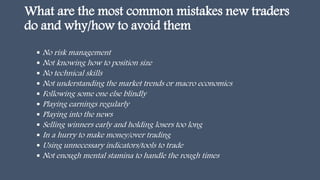
What are the most common mistakes new traders
do and why/how to avoid them
 No risk management
 Not knowing how to position size
 No technical skills
 Not understanding the market trends or macro economics
 Following some one else blindly
 Playing earnings regularly
 Playing into the news
 Selling winners early and holding losers too long
 In a hurry to make money/over trading
 Using unnecessary indicators/tools to trade
 Not enough mental stamina to handle the rough times
What skills are needed to be profitable
 Proper technical skills to identify setups
 Risk management
 Position sizing
 Adaptability
 Enough knowledge about trading methods
 Continuous learning of new patterns or strategies
 Economics of the ticker you are trading to form your bias
 More observation than trading
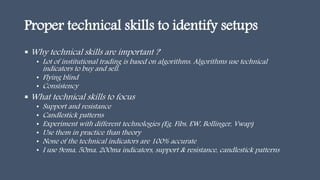
Proper technical skills to identify setups
 Why technical skills are important ?
• Lot of institutional trading is based on algorithms. Algorithms use technical
indicators to buy and sell.
• Flying blind
• Consistency
 What technical skills to focus
• Support and resistance
• Candlestick patterns
• Experiment with different technologies (Eg. Fibs, EW, Bollinger, Vwap)
• Use them in practice than theory
• None of the technical indicators are 100% accurate
• I use 9ema, 50ma, 200ma indicators, support & resistance, candlestick patterns
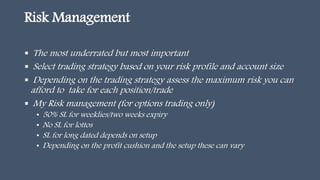
Risk Management
 The most underrated but most important
 Select trading strategy based on your risk profile and account size
 Depending on the trading strategy assess the maximum risk you can
afford to take for each position/trade
 My Risk management (for options trading only)
• 50% SL for weeklies/two weeks expiry
• No SL for lottos
• SL for long dated depends on setup
• Depending on the profit cushion and the setup these can vary
Position Sizing
 Not every trade is equal size
 Sizing up at a wrong time could lead to account blowup
 Lost opportunity if sized down at a wrong time
 My position sizing
• 30-40% of the port in long dated options (one month)
• 10% in two week expiring options
• 3-5% in lottos
• For a 10k account that would be $3k-$4k, $1k, $300-$500 respectively
• Depending on the profits and market conditions I change them
Other Misc
 Adaptability
• Change trading strategies based on market conditions
 Enough knowledge about differences in trading
• Stocks
• Options
• Futures
 Continuous learning of new patterns or strategies
• Market changes, Algos are updated, New Patterns emerge, New strategies might be
better depending on the account situation
 Economics of the ticker you are trading to form your bias
• This is very important if you are a swing trader
 More observation than trading
• Most of the successful traders trade very less. Most profits come from few trades
How to achieve these skills
 Most of the technical stuff listed earlier are available on YT
 Join a trading group
 Best way to learn is to actually trade with real capital (this is how I
learned most of the stuff I know today)
 Find which strategy/setups work best for your style
 Train your mind by introspecting every big loss/big gain
 Read/follow financial news
 Takes about 2yrs to gain these skills
How to trade small accounts
 Options trading
• The riskiest form of trading
• Can help make large sums of money with small initial investment
• Lot of nuances/strategies compared to stock trading
 Few rules to follow
• Trade with only 60% of the capital at max.
• Five open positions with only one large position
• Don’t trade or stop out when not confident about the market
• Trade less
• Focus on long dated rather than weeklies/0dte
• Don’t FOMO trade
• Scale out of the positions depending on the account situation
• Always have a reason to enter/exit a trade
• Don’t play lottos/earnings often
• Swing trades will have much higher ROI with relatively lower risk in $ amounts
• Make safe trades to build profits and use those profits to make riskier trades or size up on the positions
What should be the ultimate goal
• Consistency
• Stress free
• Independent trader
• Never lose initial capital
Questions ??

Discord.pptx

  • 1.
  • 2.
    What is thisseminar about ?  How to approach trading  What are the most common mistakes new traders do and why/how to avoid them  What skills are needed to be profitable  How to achieve these skills  How to trade small accounts  What should be the ultimate goal  Questions
  • 3.
    A Little Background Five years of experience in trading  Profitable since three years  Swing trader  Software Engineer
  • 4.
    How to approachtrading  Just as you would approach any other high skilled job  Don’t see it as easy money  Have reasonable expectations  Understand which type of trading would make sense for your situation
  • 5.
    What are themost common mistakes new traders do and why/how to avoid them  No risk management  Not knowing how to position size  No technical skills  Not understanding the market trends or macro economics  Following some one else blindly  Playing earnings regularly  Playing into the news  Selling winners early and holding losers too long  In a hurry to make money/over trading  Using unnecessary indicators/tools to trade  Not enough mental stamina to handle the rough times
  • 6.
    What skills areneeded to be profitable  Proper technical skills to identify setups  Risk management  Position sizing  Adaptability  Enough knowledge about trading methods  Continuous learning of new patterns or strategies  Economics of the ticker you are trading to form your bias  More observation than trading
  • 7.
    Proper technical skillsto identify setups  Why technical skills are important ? • Lot of institutional trading is based on algorithms. Algorithms use technical indicators to buy and sell. • Flying blind • Consistency  What technical skills to focus • Support and resistance • Candlestick patterns • Experiment with different technologies (Eg. Fibs, EW, Bollinger, Vwap) • Use them in practice than theory • None of the technical indicators are 100% accurate • I use 9ema, 50ma, 200ma indicators, support & resistance, candlestick patterns
  • 8.
    Risk Management  Themost underrated but most important  Select trading strategy based on your risk profile and account size  Depending on the trading strategy assess the maximum risk you can afford to take for each position/trade  My Risk management (for options trading only) • 50% SL for weeklies/two weeks expiry • No SL for lottos • SL for long dated depends on setup • Depending on the profit cushion and the setup these can vary
  • 9.
    Position Sizing  Notevery trade is equal size  Sizing up at a wrong time could lead to account blowup  Lost opportunity if sized down at a wrong time  My position sizing • 30-40% of the port in long dated options (one month) • 10% in two week expiring options • 3-5% in lottos • For a 10k account that would be $3k-$4k, $1k, $300-$500 respectively • Depending on the profits and market conditions I change them
  • 10.
    Other Misc  Adaptability •Change trading strategies based on market conditions  Enough knowledge about differences in trading • Stocks • Options • Futures  Continuous learning of new patterns or strategies • Market changes, Algos are updated, New Patterns emerge, New strategies might be better depending on the account situation  Economics of the ticker you are trading to form your bias • This is very important if you are a swing trader  More observation than trading • Most of the successful traders trade very less. Most profits come from few trades
  • 11.
    How to achievethese skills  Most of the technical stuff listed earlier are available on YT  Join a trading group  Best way to learn is to actually trade with real capital (this is how I learned most of the stuff I know today)  Find which strategy/setups work best for your style  Train your mind by introspecting every big loss/big gain  Read/follow financial news  Takes about 2yrs to gain these skills
  • 12.
    How to tradesmall accounts  Options trading • The riskiest form of trading • Can help make large sums of money with small initial investment • Lot of nuances/strategies compared to stock trading  Few rules to follow • Trade with only 60% of the capital at max. • Five open positions with only one large position • Don’t trade or stop out when not confident about the market • Trade less • Focus on long dated rather than weeklies/0dte • Don’t FOMO trade • Scale out of the positions depending on the account situation • Always have a reason to enter/exit a trade • Don’t play lottos/earnings often • Swing trades will have much higher ROI with relatively lower risk in $ amounts • Make safe trades to build profits and use those profits to make riskier trades or size up on the positions
  • 13.
    What should bethe ultimate goal • Consistency • Stress free • Independent trader • Never lose initial capital
  • 14.