PRESENTATION
Presented By:-
Kashaf Imtiaz
(Gold Medalist)
Course:-
Software Engineering
Introduction to
Software
Engineering
SOFTWARE ENGINEERING
SOFTWARE
Nature of Software
Dual Role:-
• As a product.
• As a vehicle for delivering a product.
 Definition of Software
Software is any program that runs on
the computer.
But this is not a good description.
 Essential Components of Software
• Instructions :- 1).Function 2). Perfomance
• Data Structures :- Maintains the data
• Documents :- 1). User Manual
2). Design Manual
 Characteristics of Software
• S/w is developed or engineered; it is not manufactured.
• S/w doesn’t “wear out.”
• S/w is custom built.
Software can have huge impact in any
aspect of our society.
Software
Data
Structu
re
Docume
nts
Instructi
ons
[PROGRA
M]
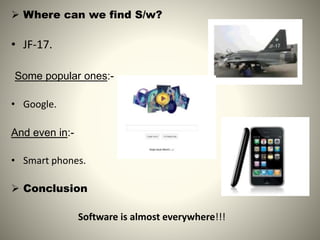
 Where can we find S/w?
• JF-17.
Some popular ones:-
• Google.
And even in:-
• Smart phones.
 Conclusion
Software is almost everywhere!!!
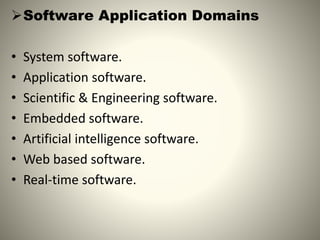
Software Application Domains
• System software.
• Application software.
• Scientific & Engineering software.
• Embedded software.
• Artificial intelligence software.
• Web based software.
• Real-time software.
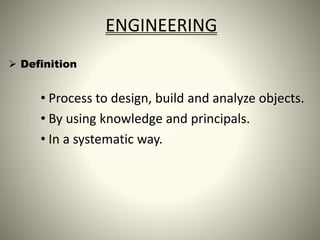
ENGINEERING
 Definition
• Process to design, build and analyze objects.
• By using knowledge and principals.
• In a systematic way.
SOFTWARE ENGINEERING
1). The application of a systematic, disciplined,
quantifiable approach to the development, operation,
and maintenance of software; that is the application of
engineering to software.
2). The study of approaches as in (1).
---IEEE Definition (1993)
 Why we call software engineering is a
engineering?
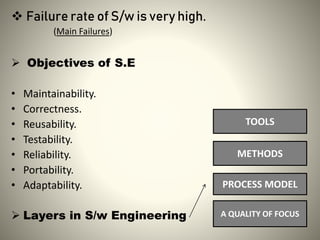
 Failure rate of S/w is very high.
(Main Failures)
 Objectives of S.E
• Maintainability.
• Correctness.
• Reusability.
• Testability.
• Reliability.
• Portability.
• Adaptability.
 Layers in S/w Engineering
METHODS
PROCESS MODEL
TOOLS
A QUALITY OF FOCUS
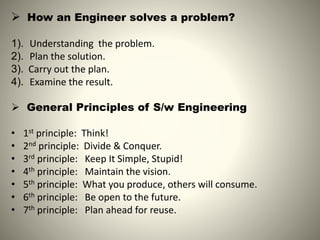
 How an Engineer solves a problem?
1). Understanding the problem.
2). Plan the solution.
3). Carry out the plan.
4). Examine the result.
 General Principles of S/w Engineering
• 1st principle: Think!
• 2nd principle: Divide & Conquer.
• 3rd principle: Keep It Simple, Stupid!
• 4th principle: Maintain the vision.
• 5th principle: What you produce, others will consume.
• 6th principle: Be open to the future.
• 7th principle: Plan ahead for reuse.
THANK YOU

Introduction to Software Engineering.pptx

  • 1.
    PRESENTATION Presented By:- Kashaf Imtiaz (GoldMedalist) Course:- Software Engineering
  • 2.
  • 3.
  • 4.
    SOFTWARE Nature of Software DualRole:- • As a product. • As a vehicle for delivering a product.  Definition of Software Software is any program that runs on the computer. But this is not a good description.
  • 5.
     Essential Componentsof Software • Instructions :- 1).Function 2). Perfomance • Data Structures :- Maintains the data • Documents :- 1). User Manual 2). Design Manual  Characteristics of Software • S/w is developed or engineered; it is not manufactured. • S/w doesn’t “wear out.” • S/w is custom built. Software can have huge impact in any aspect of our society. Software Data Structu re Docume nts Instructi ons [PROGRA M]
  • 6.
     Where canwe find S/w? • JF-17. Some popular ones:- • Google. And even in:- • Smart phones.  Conclusion Software is almost everywhere!!!
  • 7.
    Software Application Domains •System software. • Application software. • Scientific & Engineering software. • Embedded software. • Artificial intelligence software. • Web based software. • Real-time software.
  • 8.
    ENGINEERING  Definition • Processto design, build and analyze objects. • By using knowledge and principals. • In a systematic way.
  • 9.
    SOFTWARE ENGINEERING 1). Theapplication of a systematic, disciplined, quantifiable approach to the development, operation, and maintenance of software; that is the application of engineering to software. 2). The study of approaches as in (1). ---IEEE Definition (1993)  Why we call software engineering is a engineering?
  • 10.
     Failure rateof S/w is very high. (Main Failures)  Objectives of S.E • Maintainability. • Correctness. • Reusability. • Testability. • Reliability. • Portability. • Adaptability.  Layers in S/w Engineering METHODS PROCESS MODEL TOOLS A QUALITY OF FOCUS
  • 11.
     How anEngineer solves a problem? 1). Understanding the problem. 2). Plan the solution. 3). Carry out the plan. 4). Examine the result.  General Principles of S/w Engineering • 1st principle: Think! • 2nd principle: Divide & Conquer. • 3rd principle: Keep It Simple, Stupid! • 4th principle: Maintain the vision. • 5th principle: What you produce, others will consume. • 6th principle: Be open to the future. • 7th principle: Plan ahead for reuse.
  • 12.