INTRODUCTION TO
SOFTWARE ENGINEERING
Ms. Sabah Arif
CSSE3113
DESCRIPTION & OBJECTIVE
Describe the field of Software Engineering
Give an overview of Software Engineering Activities
Give knowledge of software engineering concepts,
principles and techniques
Enable students to apply the learnt concepts to
develop software
GUIDELINES
The course outline is tentative
Evaluation will be based on all class discussions, handouts,
recommended readings, slides etc.
Rote learning
Active participation
Announcements etc. will be made via Portal
PLAGIARISM
 Cheating is not only unethical; it is also against the University rules
and will not be tolerated. Any form of cheating in programming
assignments, homework problems, quizzes, and exams will result in
strict action. Plagiarism detection tools will be used to determine
who has cheated in programming assignments.
 All the parties involved will be awarded Zero in first instance.
Repeat of the same offense will result in (F) grade.
 USE PROPER REFERENCING IF ANY MATERIAL TAKEN FROM
ANYWHERE
 NO REFERENCE MEANS DECEPTION
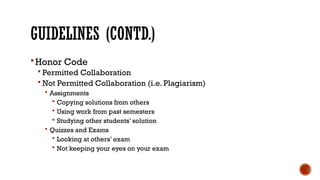
GUIDELINES (CONTD.)
Honor Code
 Permitted Collaboration
 Not Permitted Collaboration (i.e. Plagiarism)
 Assignments
 Copying solutions from others
 Using work from past semesters
 Studying other students’ solution
 Quizzes and Exams
 Looking at others’ exam
 Not keeping your eyes on your examn quizzes 1st
offense will result in award of -1, 2nd
offense -2, 3rd
-5 and 4th
offense will result in cancellation of the quiz)
GUIDELINES (CONTD.)
Honor Code (Contd.)
 Not Permitted Collaboration (Contd.)
 Penalty
 Grade reduction
 Referral to concerned authority in the University
 F Grade
 All of the above 
 Other Offenses
 Penalty
 Same as above
An honor code document with details will be placed on Portal if
and when required
COURSE WORK
 Quiz x 4 (Announced + Unannounced) – 15%
 Assignment x 4 (VIVA/QUIZ) – 10%
 Project Deliverable x 2 (VIVA/Presentation) – 10%
 Mid Term Exam – 20%
 Final Exam – 40%
 Class Participation* – 05%
ATTENDANCE+PUNCTUALITY+WRITTEN EXCERCISES+QA
DON’T ASSUME ,THERE WILL BE BEST OFF
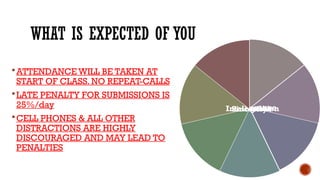
WHAT IS EXPECTED OF YOU
ATTENDANCE WILL BE TAKEN AT
START OF CLASS. NO REPEAT-CALLS
LATE PENALTY FOR SUBMISSIONS IS
25%/day
CELL PHONES & ALL OTHER
DISTRACTIONS ARE HIGHLY
DISCOURAGED AND MAY LEAD TO
PENALTIES
Analytical Skills
Punctuality
Perseverance
Dedication
Time-Devotion
Intelligence
Sincerity
TEXT BOOK
Shari Lawrence PFleeger and Joanne M. Atlee, Software
Engineering Theory and Practice, 4th
Edition (Selected
Chapters Only)
 Soft copy will be updated on portal
Roger Pressman, Software Engineering: A Practitioner’s
Approach, 7th
Edition (Selected Chapters Only)
 Soft copy will be updated on portal
COURSE OUTLINE
 Course Introduction. Introduction to Software Engineering (SE)
 Software Process Models
 Managing a Project
 Gathering and Specifying Requirements
 Process and Project Metrics
 Product Metrics
 Designing a System
 Quality Control and Quality Assurance
 Estimation of Software Projects
 Testing the Programs and System
QUESTIONS????
Welcome to the course! Lets start…
COMPUTER PROGRAM
What is a computer program?
A representation of an
algorithm?
SOFTWARE
What is a Software?
A set of programs working for a
single goal (solving a problem)?
WHAT IS SOFTWARE?
“ Software is a set of instructions to acquire inputs and to
manipulate them to produce the desired output in terms of functions
and performance as determined by the user of the software. It also
include a set of documents, such as the software manual , meant for
users to understand the software system.”
DESCRIPTION OF THE SOFTWARE
A software is described by its capabilities.The capabilities
relate to the functions it executes, the features it provides and
the facilities it offers.
Software written for Sales-order processing would have different
functions to process different types of sales order from different
market segments .The features for example , would be to handle
multi-currency computing, updating product , sales and Tax status.
The facilities could be printing of sales orders, email to customers
and reports to the store department to dispatch the goods.
EXAMPLES OF PROGRAMS OR SOFTWARE?
 Calculate the average of three numbers
 Find the minimum of three numbers
 Count the number of red balls in a bag
EXAMPLES OF SOFTWARE OR PROGRAMS?
 Operating System?
 Microsoft Office?
 UCP Portal?
SOFTWARE ENGINEERING
 “A systematic approach to the analysis, design, implementation and
maintenance of software.”
(The Free On-Line Dictionary of Computing)
 “ The systematic application of tools and techniques in the
development of computer-based applications.”
(Sue Conger in The New Software Engineering)
 “ Software Engineering is about designing and developing high-quality
software.”
(Shari Lawrence Pfleeger in Software Engineering -- The Production of
Quality Software)
WHAT IS SOFTWARE ENGINEERING?
Although hundreds of authors have developed personal definitions
of software engineering, a definition proposed by Fritz Bauer[NAU69]
provides a basis:
 “[Software engineering is] the establishment and use of sound
engineering principles in order to obtain economically software
that is reliable and works efficiently on real machines.”
The IEEE [IEE93] has developed a more comprehensive definition
when it states:
 “Software Engineering: (1) The application of a systematic,
disciplined, quantifiable approach to the development,
operation, and maintenance of software; that is, the application of
engineering to software. (2) The study of approaches as in (1).”
Software Engineering
The study of approaches as in
Application of a systematic, disciplined, quantifiable
approach to the development, operation and maintenance
of software; that is, the application of engineering to
software.
(IEEE 93)
BY “SYSTEMATIC”WE MEAN
Following a well-defined sequence of activities,
- in which desired outputs (deliverables) are well-defined
- by using well-defined inputs
(i.e. documented syntax, semantics, context and other relevant properties of
the input)
- in a well-defined process
(e.g. using organizational standards for interprocess communication, data
formats, error handling etc.)
- whose outputs are in turn used similarly as inputs in
subsequent process(es),
- until the final output is achieved,
- and where the correctness of the output is verifiable.
Note:The “inputs” and “outputs” most often refer to requirements,
software specifications, the software itself, documentation, test
inputs/outputs and similar software artifacts.
Software Engineering - Introduction 22
BY “D SC PL NED”
İ İ İ WE MEAN:
 Each process is followed using organizational principles (e.g. who
manages whom, who is responsible for what?),
 Intermediate results are carefully documented, as well as final
results,
 Actions are traceable as to their causes, individuals involved, time of
occurrence and circumstances.
Software Engineering - Introduction 23
BY “QUANT F ABLE”
İ İ WE MEAN:
 The size and extent of the required effort
(size of output code, data, documentation, manpower, duration,
budget for development, expected error rate and user support)
are predictable within justifiable and acceptable bounds
WHAT IS SOFTWARE ENGINEERING?
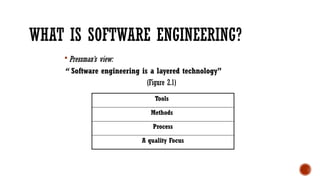
 Pressman’s view:
“ Software engineering is a layered technology”
(Figure 2.1)
Tools
Methods
Process
A quality Focus
SOFTWARE ENGINEERING
Solving Problems
 Computers
 Computing
How is a problem solved normally?
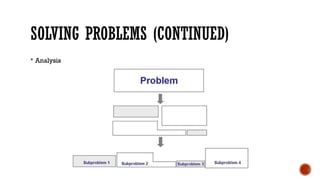
 Analysis
SOLVING PROBLEMS (CONTINUED)
 Synthesis
SOLVING PROBLEMS (CONTINUED)
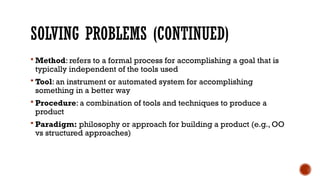
 Method: refers to a formal process for accomplishing a goal that is
typically independent of the tools used
 Tool: an instrument or automated system for accomplishing
something in a better way
 Procedure: a combination of tools and techniques to produce a
product
 Paradigm: philosophy or approach for building a product (e.g., OO
vs structured approaches)
SOLVING PROBLEMS (CONTINUED)
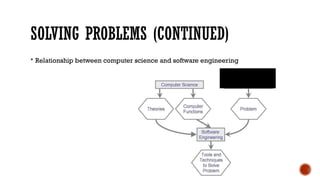
 Computer science: focusing on computer hardware, compilers,
operating systems, and programming languages
 Software engineering: a discipline that uses computer and software
technologies as problem-solving tools
SOLVING PROBLEMS (CONTINUED)
 Relationship between computer science and software engineering
COSTS ASSOCIATED WITH SE
Development Costs
Running Costs
Introduction to software engineering templates slides

Introduction to software engineering templates slides

  • 1.
  • 2.
    DESCRIPTION & OBJECTIVE Describethe field of Software Engineering Give an overview of Software Engineering Activities Give knowledge of software engineering concepts, principles and techniques Enable students to apply the learnt concepts to develop software
  • 3.
    GUIDELINES The course outlineis tentative Evaluation will be based on all class discussions, handouts, recommended readings, slides etc. Rote learning Active participation Announcements etc. will be made via Portal
  • 4.
    PLAGIARISM  Cheating isnot only unethical; it is also against the University rules and will not be tolerated. Any form of cheating in programming assignments, homework problems, quizzes, and exams will result in strict action. Plagiarism detection tools will be used to determine who has cheated in programming assignments.  All the parties involved will be awarded Zero in first instance. Repeat of the same offense will result in (F) grade.  USE PROPER REFERENCING IF ANY MATERIAL TAKEN FROM ANYWHERE  NO REFERENCE MEANS DECEPTION
  • 5.
    GUIDELINES (CONTD.) Honor Code Permitted Collaboration  Not Permitted Collaboration (i.e. Plagiarism)  Assignments  Copying solutions from others  Using work from past semesters  Studying other students’ solution  Quizzes and Exams  Looking at others’ exam  Not keeping your eyes on your examn quizzes 1st offense will result in award of -1, 2nd offense -2, 3rd -5 and 4th offense will result in cancellation of the quiz)
  • 6.
    GUIDELINES (CONTD.) Honor Code(Contd.)  Not Permitted Collaboration (Contd.)  Penalty  Grade reduction  Referral to concerned authority in the University  F Grade  All of the above   Other Offenses  Penalty  Same as above An honor code document with details will be placed on Portal if and when required
  • 7.
    COURSE WORK  Quizx 4 (Announced + Unannounced) – 15%  Assignment x 4 (VIVA/QUIZ) – 10%  Project Deliverable x 2 (VIVA/Presentation) – 10%  Mid Term Exam – 20%  Final Exam – 40%  Class Participation* – 05% ATTENDANCE+PUNCTUALITY+WRITTEN EXCERCISES+QA DON’T ASSUME ,THERE WILL BE BEST OFF
  • 8.
    WHAT IS EXPECTEDOF YOU ATTENDANCE WILL BE TAKEN AT START OF CLASS. NO REPEAT-CALLS LATE PENALTY FOR SUBMISSIONS IS 25%/day CELL PHONES & ALL OTHER DISTRACTIONS ARE HIGHLY DISCOURAGED AND MAY LEAD TO PENALTIES Analytical Skills Punctuality Perseverance Dedication Time-Devotion Intelligence Sincerity
  • 9.
    TEXT BOOK Shari LawrencePFleeger and Joanne M. Atlee, Software Engineering Theory and Practice, 4th Edition (Selected Chapters Only)  Soft copy will be updated on portal Roger Pressman, Software Engineering: A Practitioner’s Approach, 7th Edition (Selected Chapters Only)  Soft copy will be updated on portal
  • 10.
    COURSE OUTLINE  CourseIntroduction. Introduction to Software Engineering (SE)  Software Process Models  Managing a Project  Gathering and Specifying Requirements  Process and Project Metrics  Product Metrics  Designing a System  Quality Control and Quality Assurance  Estimation of Software Projects  Testing the Programs and System
  • 11.
    QUESTIONS???? Welcome to thecourse! Lets start…
  • 12.
    COMPUTER PROGRAM What isa computer program? A representation of an algorithm?
  • 13.
    SOFTWARE What is aSoftware? A set of programs working for a single goal (solving a problem)?
  • 14.
    WHAT IS SOFTWARE? “Software is a set of instructions to acquire inputs and to manipulate them to produce the desired output in terms of functions and performance as determined by the user of the software. It also include a set of documents, such as the software manual , meant for users to understand the software system.”
  • 15.
    DESCRIPTION OF THESOFTWARE A software is described by its capabilities.The capabilities relate to the functions it executes, the features it provides and the facilities it offers. Software written for Sales-order processing would have different functions to process different types of sales order from different market segments .The features for example , would be to handle multi-currency computing, updating product , sales and Tax status. The facilities could be printing of sales orders, email to customers and reports to the store department to dispatch the goods.
  • 16.
    EXAMPLES OF PROGRAMSOR SOFTWARE?  Calculate the average of three numbers  Find the minimum of three numbers  Count the number of red balls in a bag
  • 17.
    EXAMPLES OF SOFTWAREOR PROGRAMS?  Operating System?  Microsoft Office?  UCP Portal?
  • 18.
    SOFTWARE ENGINEERING  “Asystematic approach to the analysis, design, implementation and maintenance of software.” (The Free On-Line Dictionary of Computing)  “ The systematic application of tools and techniques in the development of computer-based applications.” (Sue Conger in The New Software Engineering)  “ Software Engineering is about designing and developing high-quality software.” (Shari Lawrence Pfleeger in Software Engineering -- The Production of Quality Software)
  • 19.
    WHAT IS SOFTWAREENGINEERING? Although hundreds of authors have developed personal definitions of software engineering, a definition proposed by Fritz Bauer[NAU69] provides a basis:  “[Software engineering is] the establishment and use of sound engineering principles in order to obtain economically software that is reliable and works efficiently on real machines.” The IEEE [IEE93] has developed a more comprehensive definition when it states:  “Software Engineering: (1) The application of a systematic, disciplined, quantifiable approach to the development, operation, and maintenance of software; that is, the application of engineering to software. (2) The study of approaches as in (1).”
  • 20.
    Software Engineering The studyof approaches as in Application of a systematic, disciplined, quantifiable approach to the development, operation and maintenance of software; that is, the application of engineering to software. (IEEE 93)
  • 21.
    BY “SYSTEMATIC”WE MEAN Followinga well-defined sequence of activities, - in which desired outputs (deliverables) are well-defined - by using well-defined inputs (i.e. documented syntax, semantics, context and other relevant properties of the input) - in a well-defined process (e.g. using organizational standards for interprocess communication, data formats, error handling etc.) - whose outputs are in turn used similarly as inputs in subsequent process(es), - until the final output is achieved, - and where the correctness of the output is verifiable. Note:The “inputs” and “outputs” most often refer to requirements, software specifications, the software itself, documentation, test inputs/outputs and similar software artifacts.
  • 22.
    Software Engineering -Introduction 22 BY “D SC PL NED” İ İ İ WE MEAN:  Each process is followed using organizational principles (e.g. who manages whom, who is responsible for what?),  Intermediate results are carefully documented, as well as final results,  Actions are traceable as to their causes, individuals involved, time of occurrence and circumstances.
  • 23.
    Software Engineering -Introduction 23 BY “QUANT F ABLE” İ İ WE MEAN:  The size and extent of the required effort (size of output code, data, documentation, manpower, duration, budget for development, expected error rate and user support) are predictable within justifiable and acceptable bounds
  • 24.
    WHAT IS SOFTWAREENGINEERING?  Pressman’s view: “ Software engineering is a layered technology” (Figure 2.1) Tools Methods Process A quality Focus
  • 25.
    SOFTWARE ENGINEERING Solving Problems Computers  Computing How is a problem solved normally?
  • 26.
  • 27.
  • 28.
    SOLVING PROBLEMS (CONTINUED) Method: refers to a formal process for accomplishing a goal that is typically independent of the tools used  Tool: an instrument or automated system for accomplishing something in a better way  Procedure: a combination of tools and techniques to produce a product  Paradigm: philosophy or approach for building a product (e.g., OO vs structured approaches)
  • 29.
    SOLVING PROBLEMS (CONTINUED) Computer science: focusing on computer hardware, compilers, operating systems, and programming languages  Software engineering: a discipline that uses computer and software technologies as problem-solving tools
  • 30.
    SOLVING PROBLEMS (CONTINUED) Relationship between computer science and software engineering
  • 32.
    COSTS ASSOCIATED WITHSE Development Costs Running Costs