Chapter 3:
Social Media in
Journalism
Team TRMJ
Chapter 3:
Social Media in
Journalism
Team TRMJ
Social Media in Journalism
-Moving past 5 W’s
-Story must be compelling, true, and sharing
knowledge.
Content Management Systems
-Facebook and Twitter
3
5 Needs of Journalism
-To inform, analyze, interpret and explain
-To investigate
-To create public conversation
-To generate social empathy
-To encourage accountability
4
Sharing News
-Breaking news initially posted to Twitter
-Shared links expand on story
-Pictures and videos are posted
-Allow the public to comment
5
Effects of Social Media
-Transforming the way journalism is distributed
online
-How Journalists want to obtain their viewers
-New tools are required
6
7
Threats to Journalism
-Threatens investigative journalism
-Female journalists targeted
-Newspaper sale decline
8
Journalism Theories
- Introduction of social networks and social media changed
journalism fundamentally. (Tewksbury and Rittenberg 2012)
“The shift from a top down media system to one that features
horizontal interaction of people and news represents a change in
the relationship that citizens and others in a nation have with
information”
- News agenda setting influences changed
- Users use social media for other purposes, but they find
news
- 86% of americans were internet users, half of that turned to
social media sites for election news.
9
Statistics on Social Media
Users
- 62% of online adults 65 or older use Facebook
- Among internet users, higher percentage of
women (83%) than men (75%) used Facebook.
- 76% of Facebook users visited the site daily
- 56% used more than one of the top five social
media platforms, 88% say Facebook is “THE
site”
- 29% used messaging apps, which were
popular among younger people
10
Journalism Theories (cont.)
- Attracts journalists all around the
world
- Journalists credibility may suffer
- Increases with photo and link
- Social media for a profit
- Future of selling stories
11
12
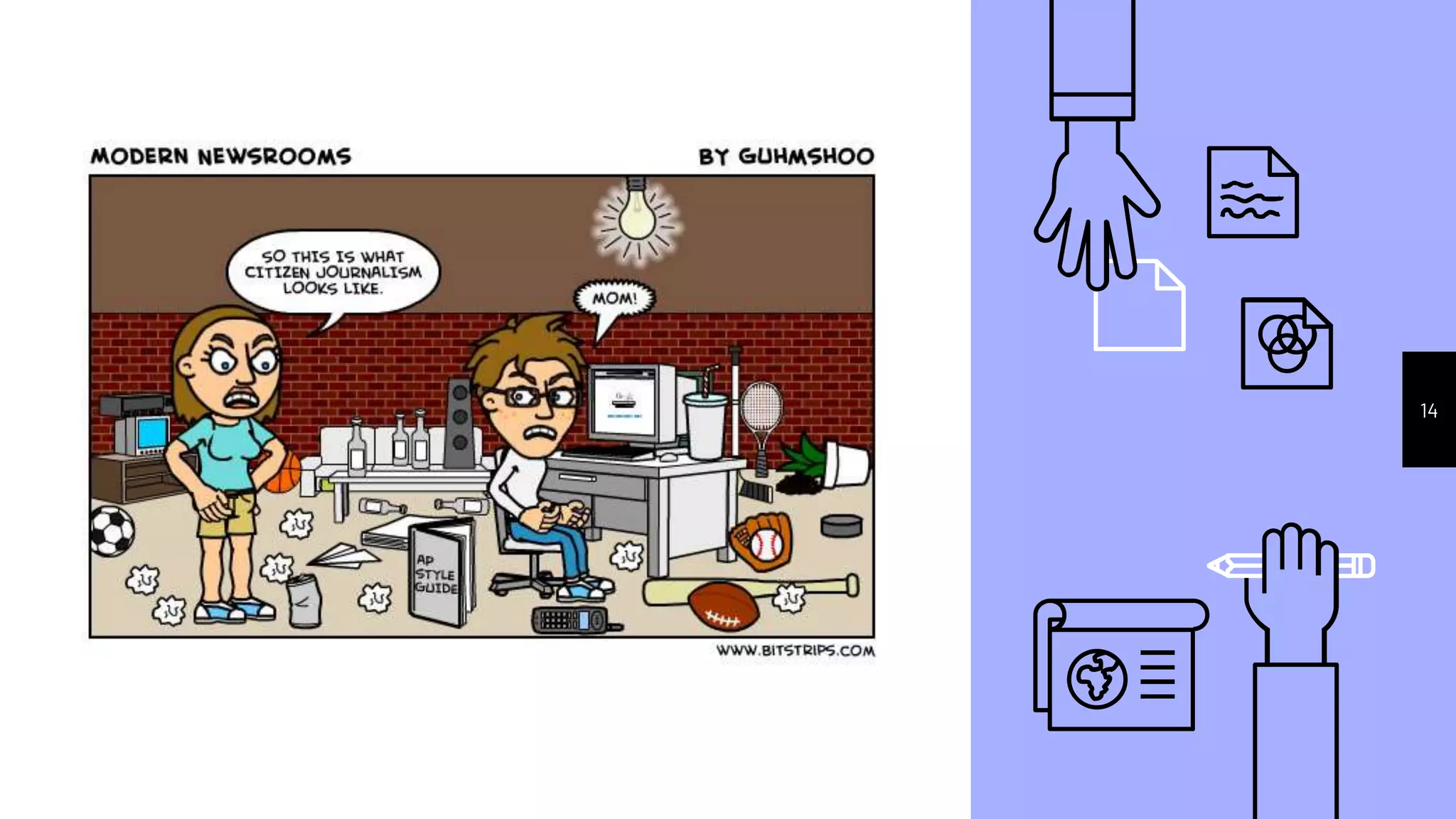
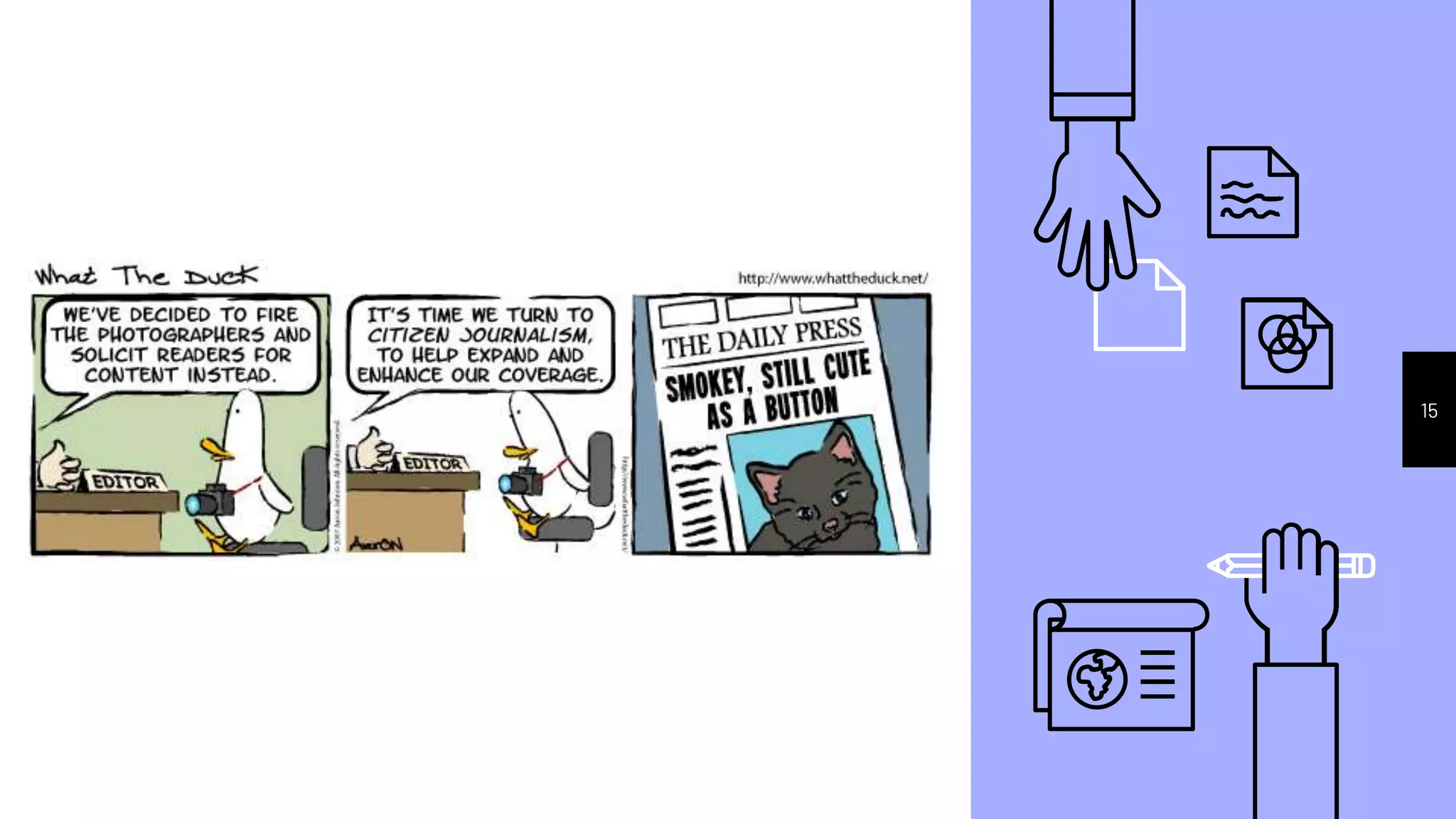
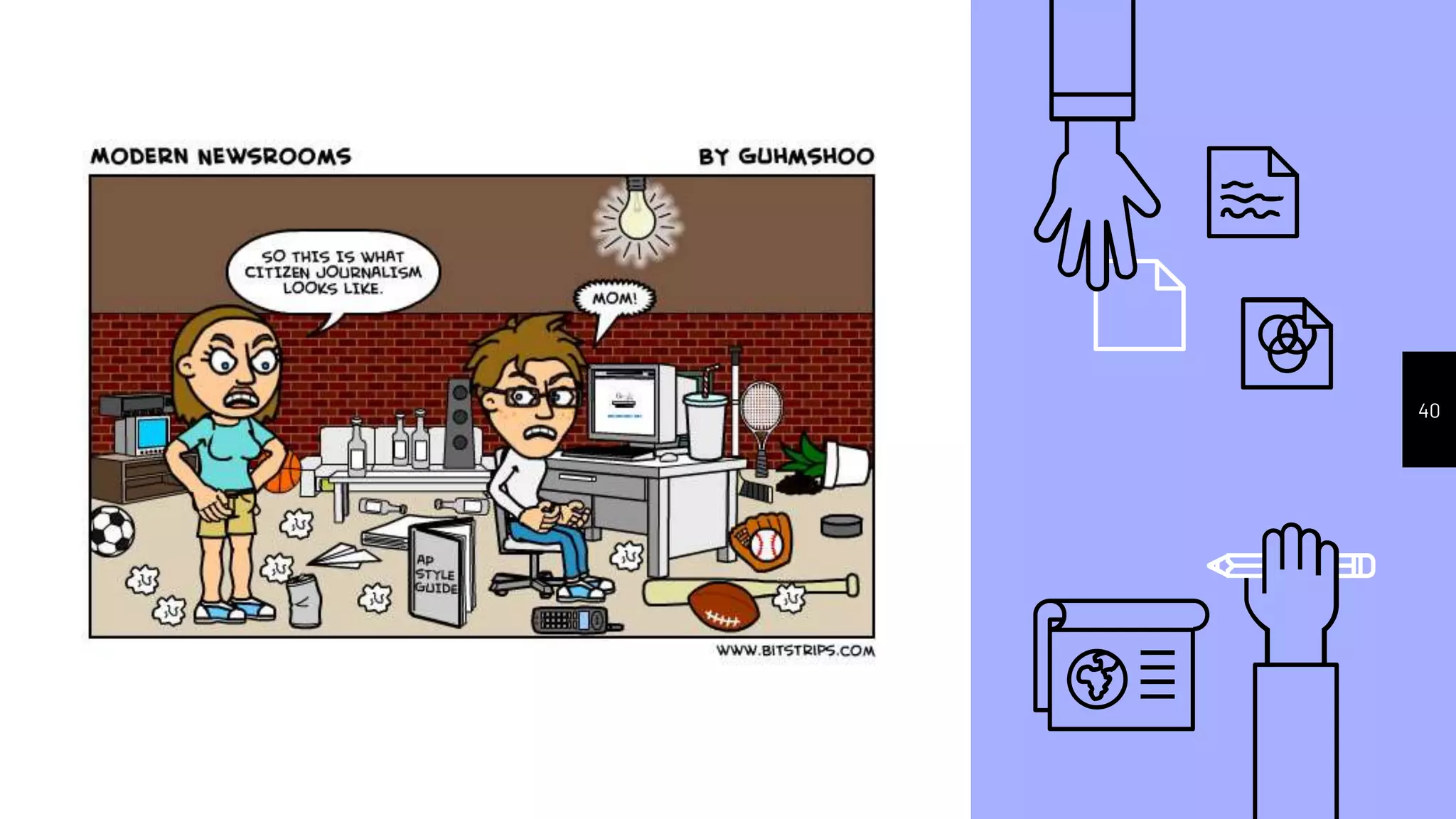
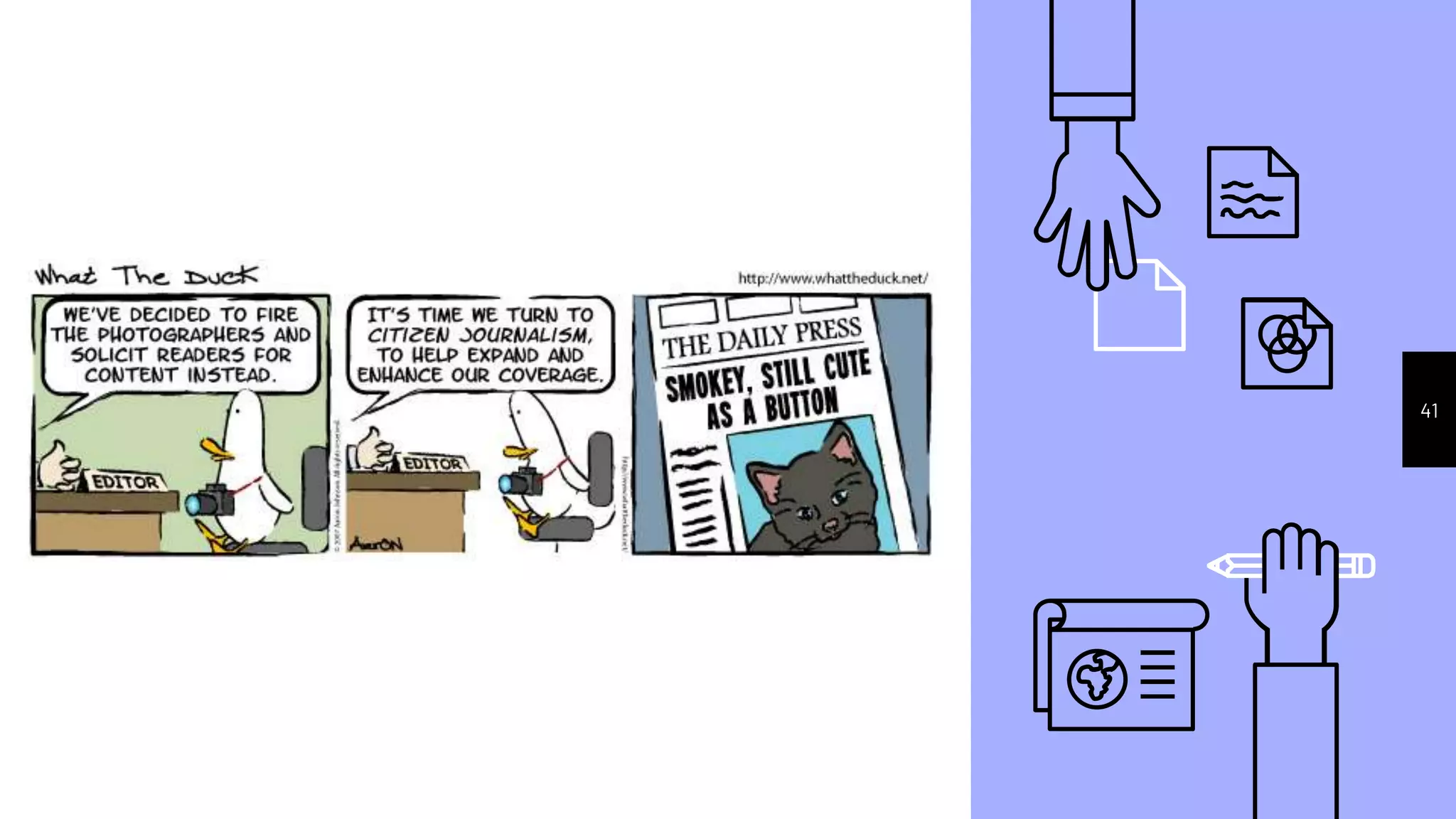
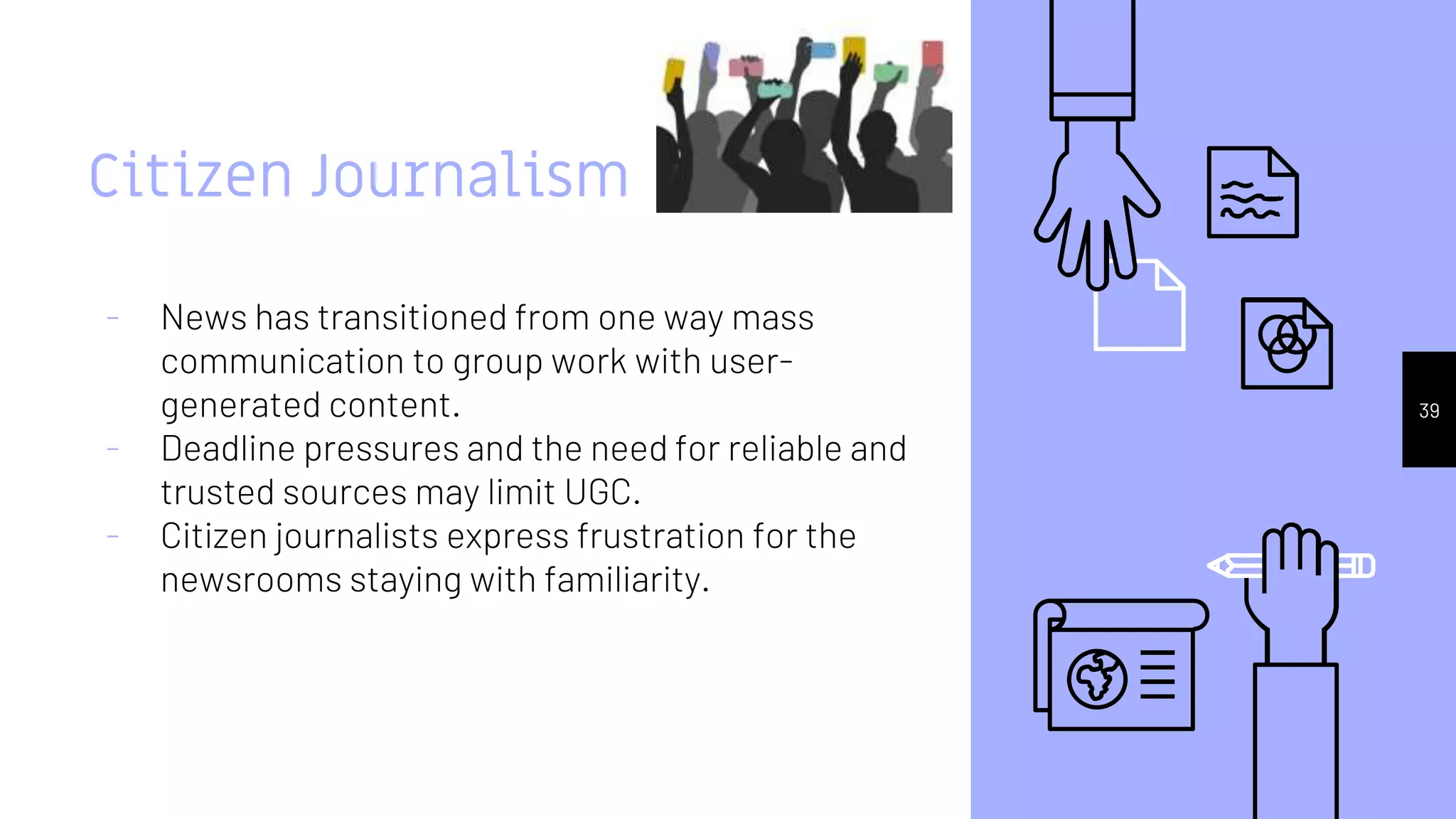
Citizen Journalism
- News has transitioned from one way mass
communication to group work with user-
generated content.
- Deadline pressures and the need for reliable and
trusted sources may limit UGC.
- Citizen journalists express frustration for the
newsrooms staying with familiarity.
13
14
15
Crowdsourcing
- During breaking news, user may provide
information that journalist might not have
access to.
- Everyone has a smartphone, everyone can
be a photographer.
- Pops up on social media instantly.
16
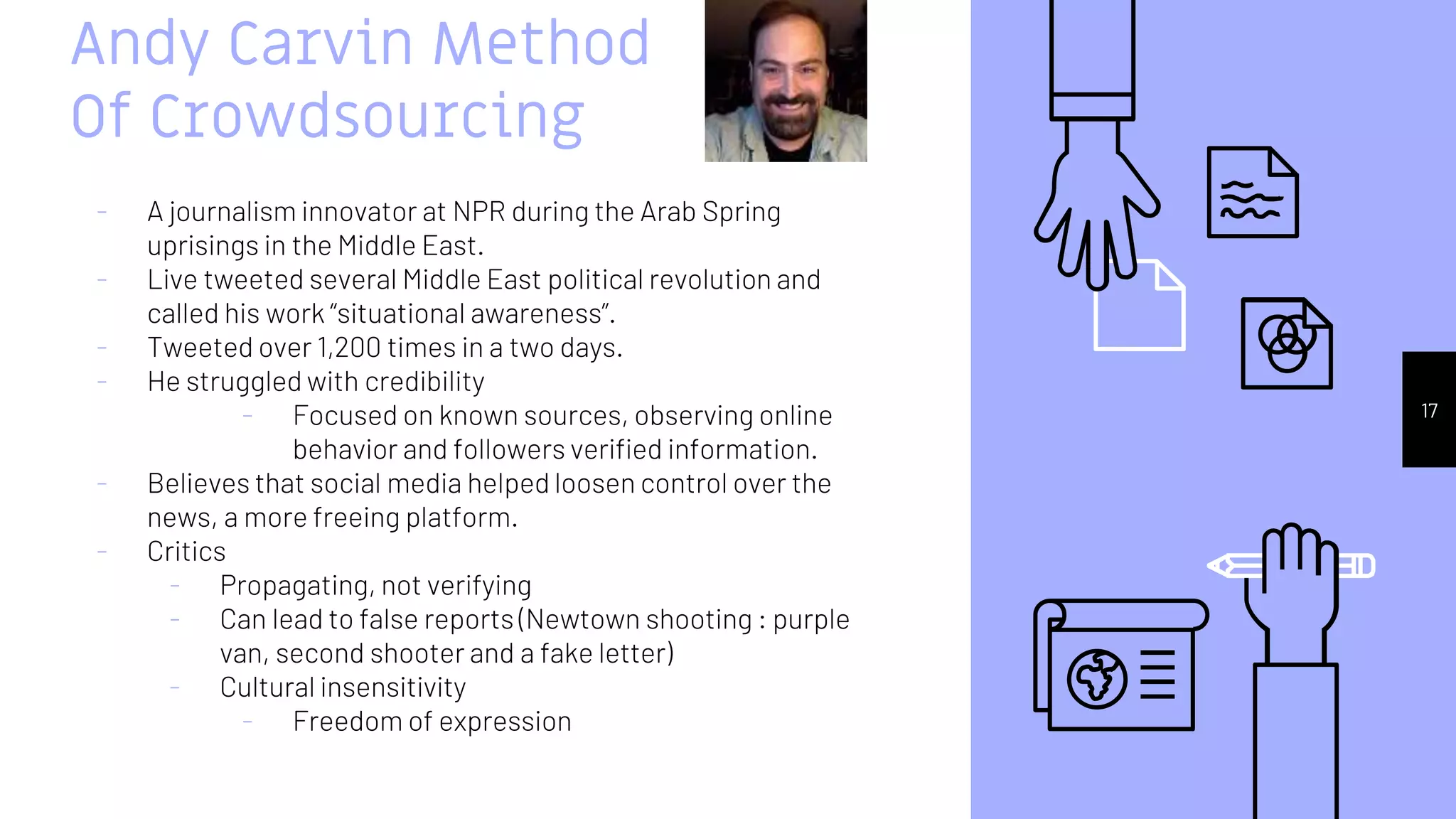
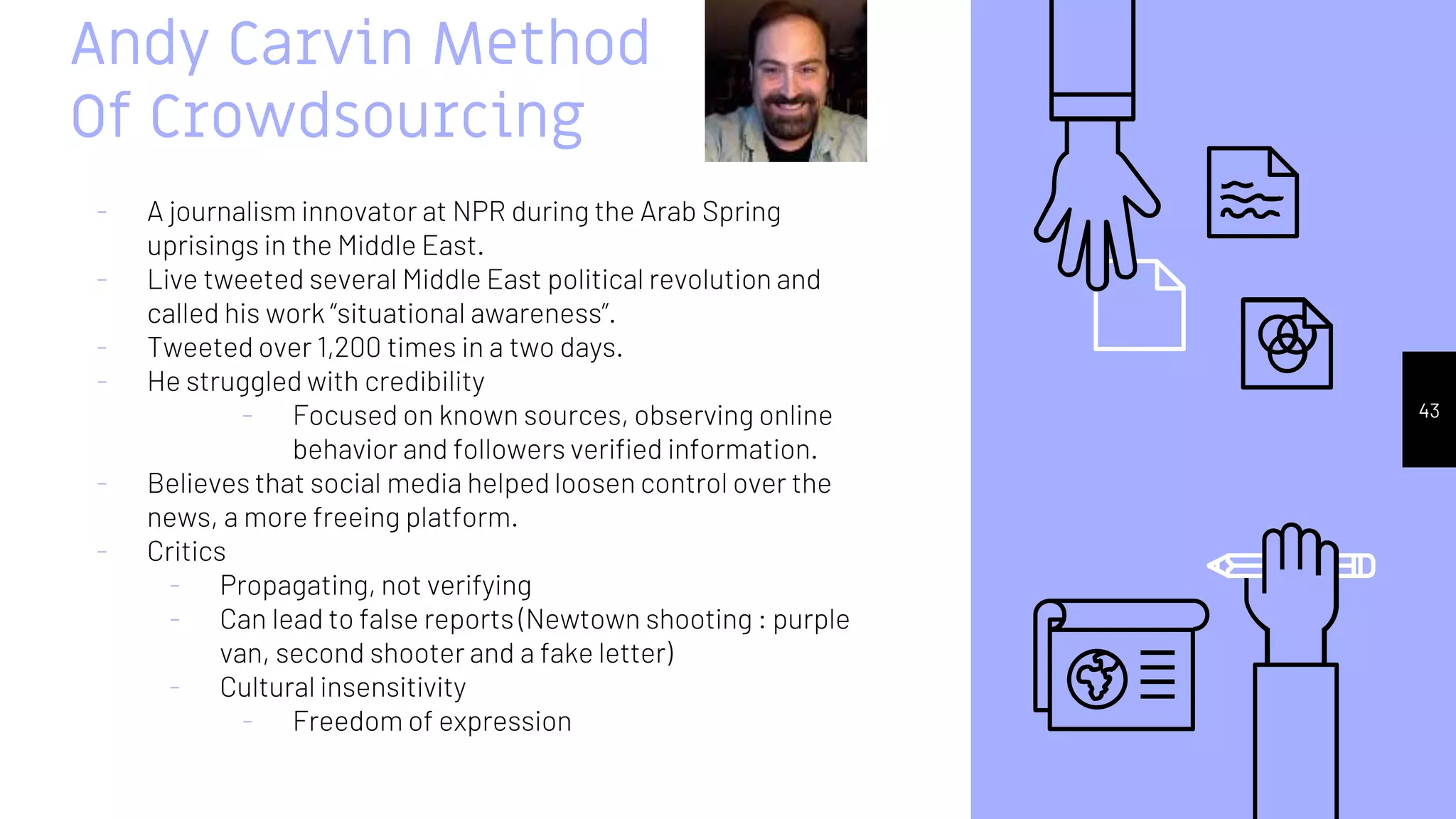
Andy Carvin Method
Of Crowdsourcing
- A journalism innovator at NPR during the Arab Spring
uprisings in the Middle East.
- Live tweeted several Middle East political revolution and
called his work “situational awareness”.
- Tweeted over 1,200 times in a two days.
- He struggled with credibility
- Focused on known sources, observing online
behavior and followers verified information.
- Believes that social media helped loosen control over the
news, a more freeing platform.
- Critics
- Propagating, not verifying
- Can lead to false reports (Newtown shooting : purple
van, second shooter and a fake letter)
- Cultural insensitivity
- Freedom of expression
17
Micro-blogging
▹ The micro-blogging influence of
Twitter goes beyond early
adopters to news media that use
it for content sharing
▹ An ongoing issue is that
information on Twitter is viewed
as less credible and trustworthy
than the mainstream sites.
▹ Even when the news distributor
was a large organization, such as
The New York Times, the research
suggests less trust attached to
tweets. The “trust of news
information” is theoretically
distinct from “trust of those who
deliver the news” and “trust of
media corporations” (Williams,
2012, p. 117).
▹ Most newsrooms are
happy to have journalists
using micro-blog sites,
such as Twitter, to push
out links to stories and
engage with audience
members.
▹ Some outrageous stories,
however, may be seen as
“click-bait”. (designed to
drive user traffic to a site)
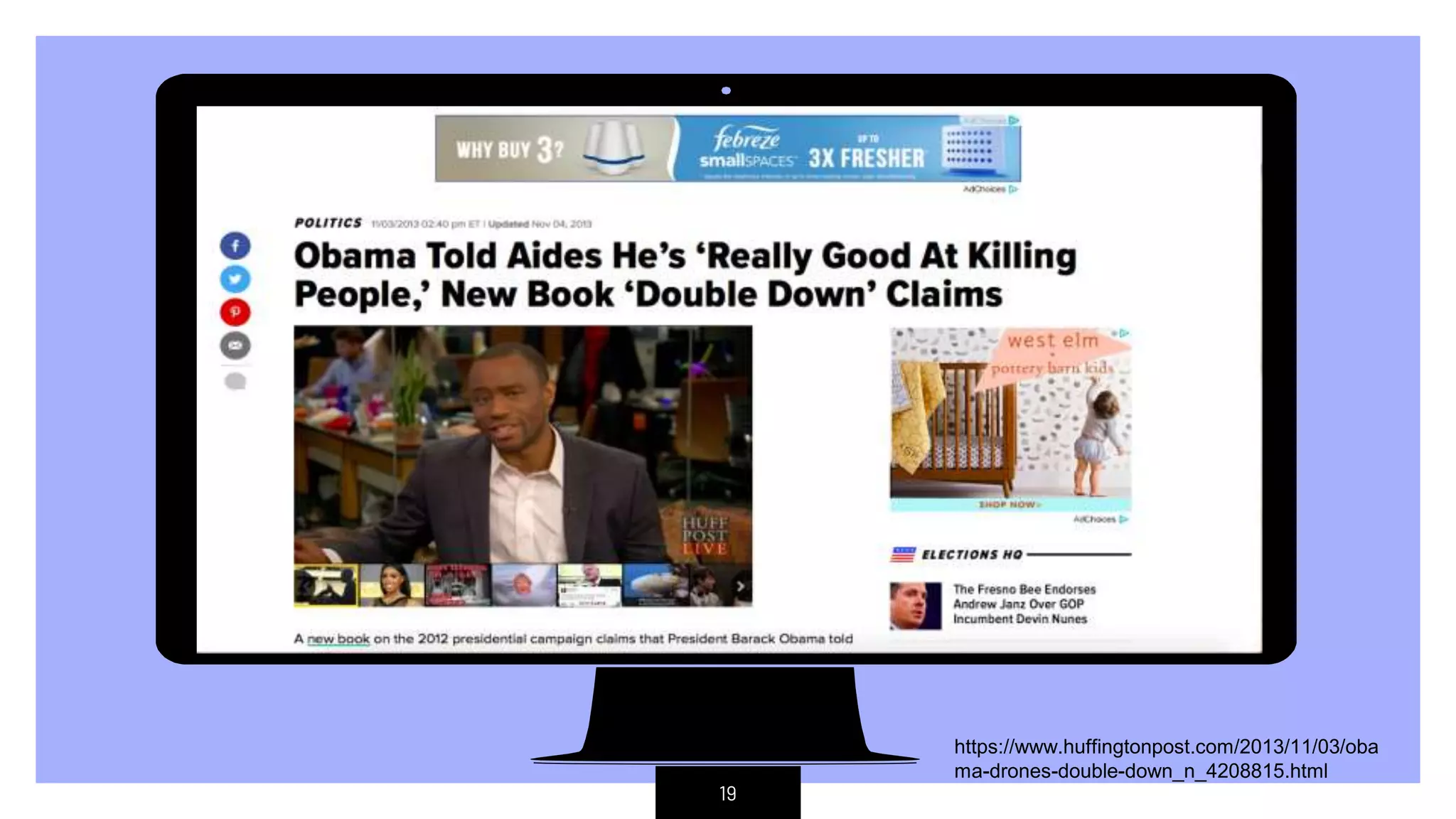
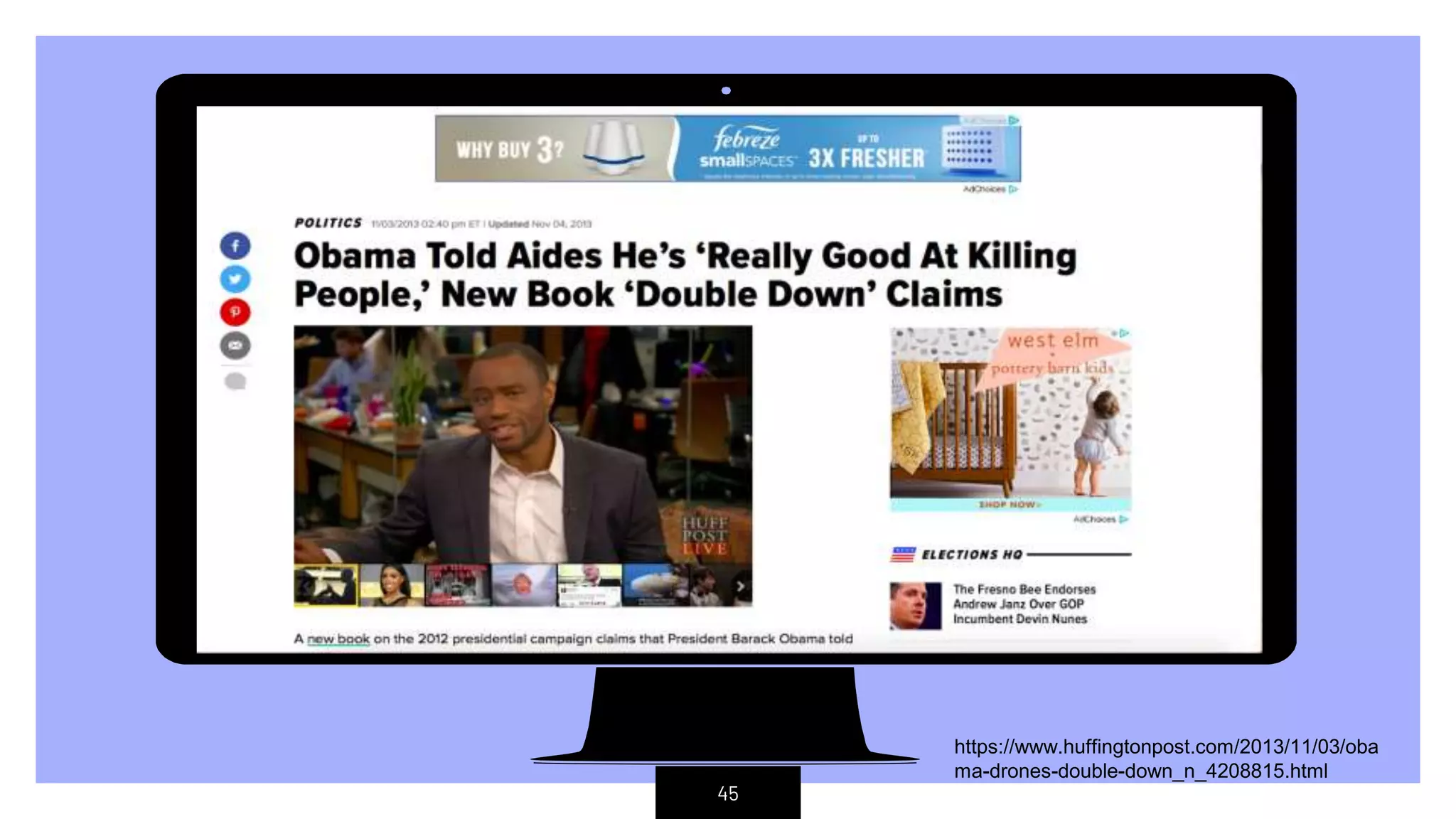
▹ This was the case when
publicity for a book,
“Double Down” featuring a
claim that President
Obama once told staff
that he was “really good
at killing people”
regarding drone strikes.
18
Place your screenshot here
19
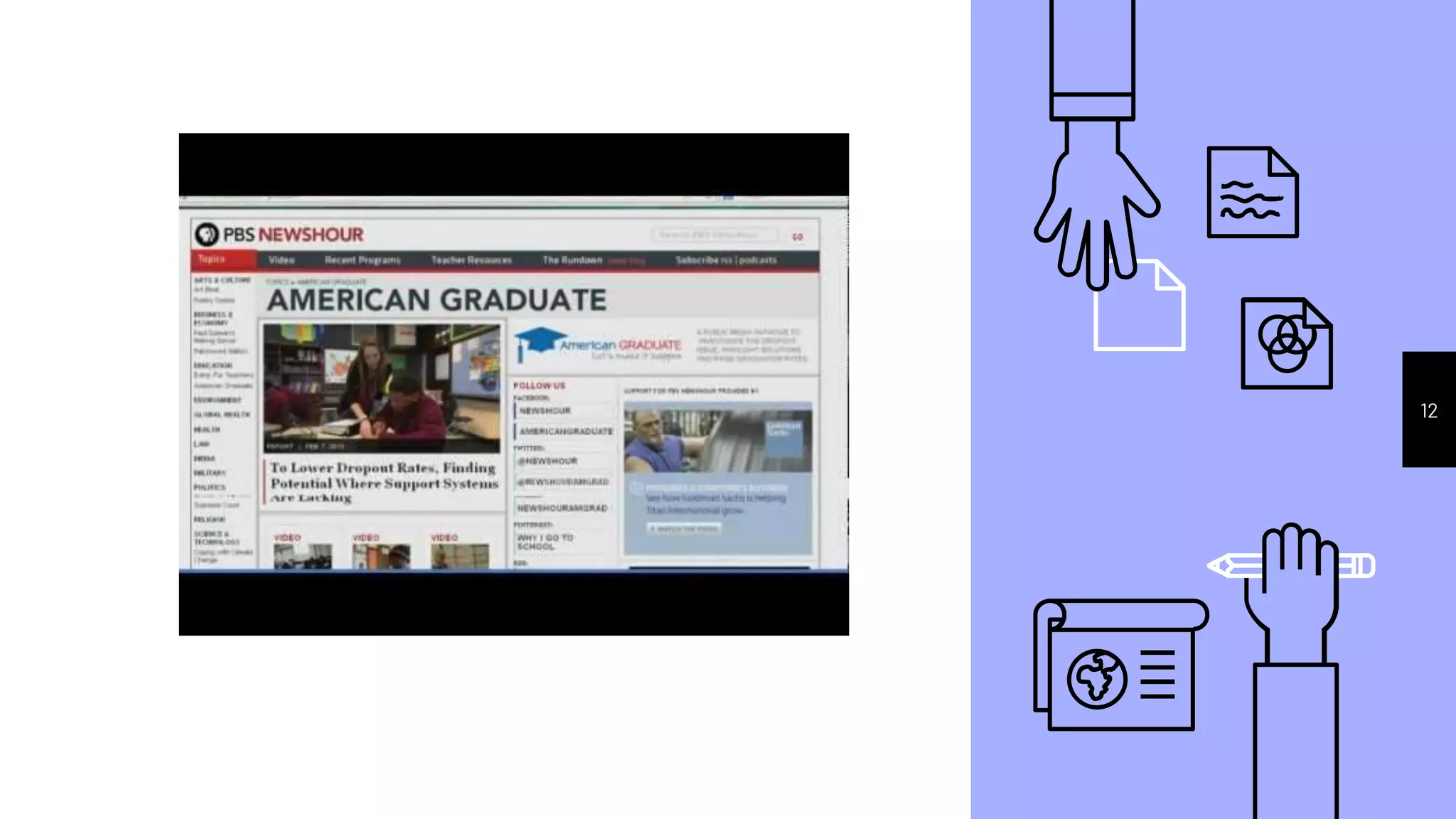
https://www.huffingtonpost.com/2013/11/03/oba
ma-drones-double-down_n_4208815.html
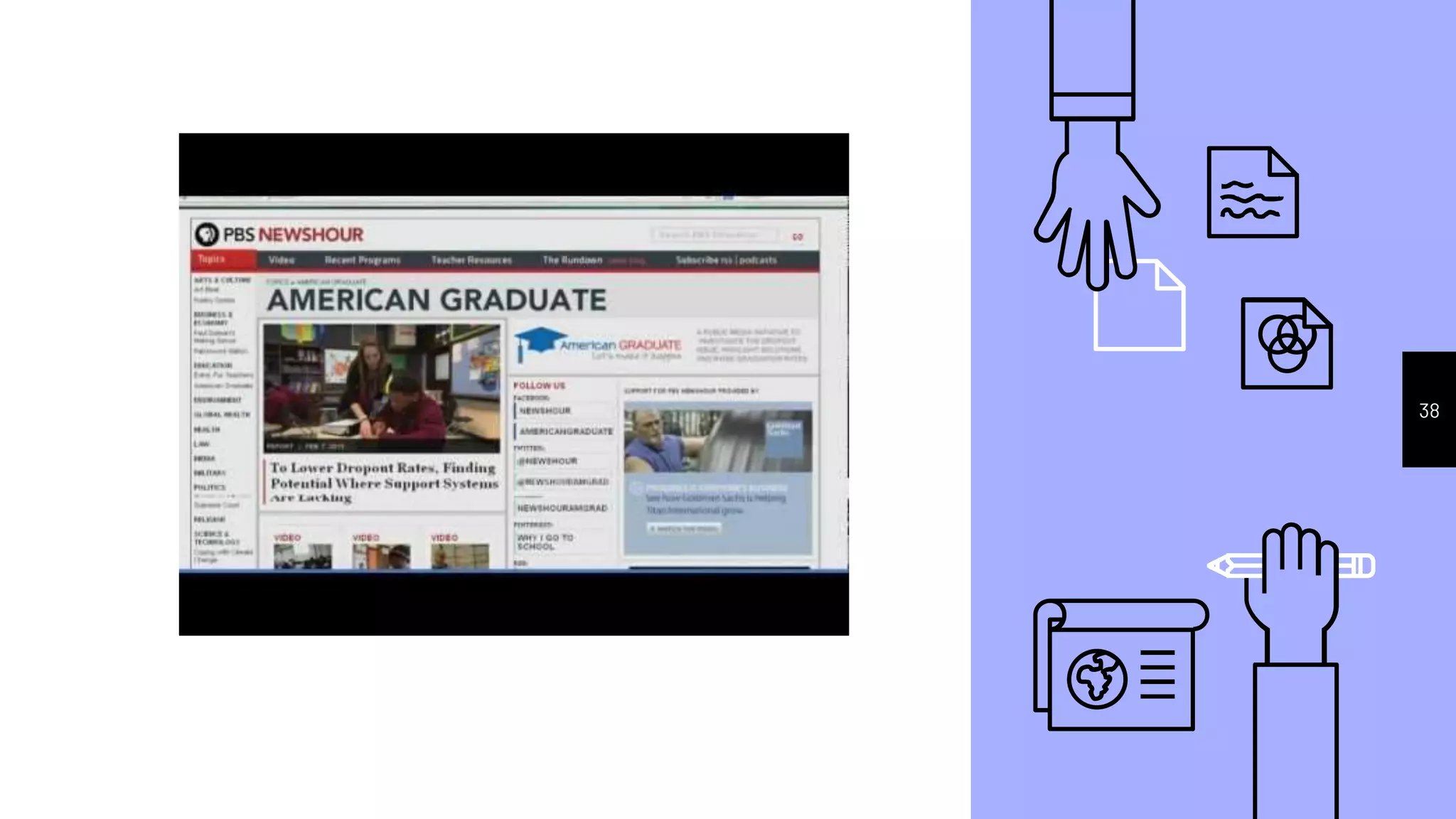
Bloggers
▹ Most blog posts tend to be 500 to 1,000 words, as online readers are
more likely to consume short rather than long reads.
▹ At the same time, online sites tend to have fewer editors than
traditional publications. Longer posts may not be edited as quickly.
▹ The Huffington Post, for example, uses block quotes, but these tend to
be short. Blogging sites tend to encourage use of hyperlinks as
references to content that is discussed, as shorthand for those
interested in reading more about the topic.
20
Social Media Celebrity
▹ Social media was an influential
place for conversation about
gun laws following the 2012
school shooting in Newtown, CT.
In 2012, Pew Research found
that 64% of Twitter was calls for
stricter gun control… (pg.1)
▹ The discussion on Twitter about
our country’s gun laws ranked
first on each platform,
accounting for 28% of the
conversation about the tragedy.
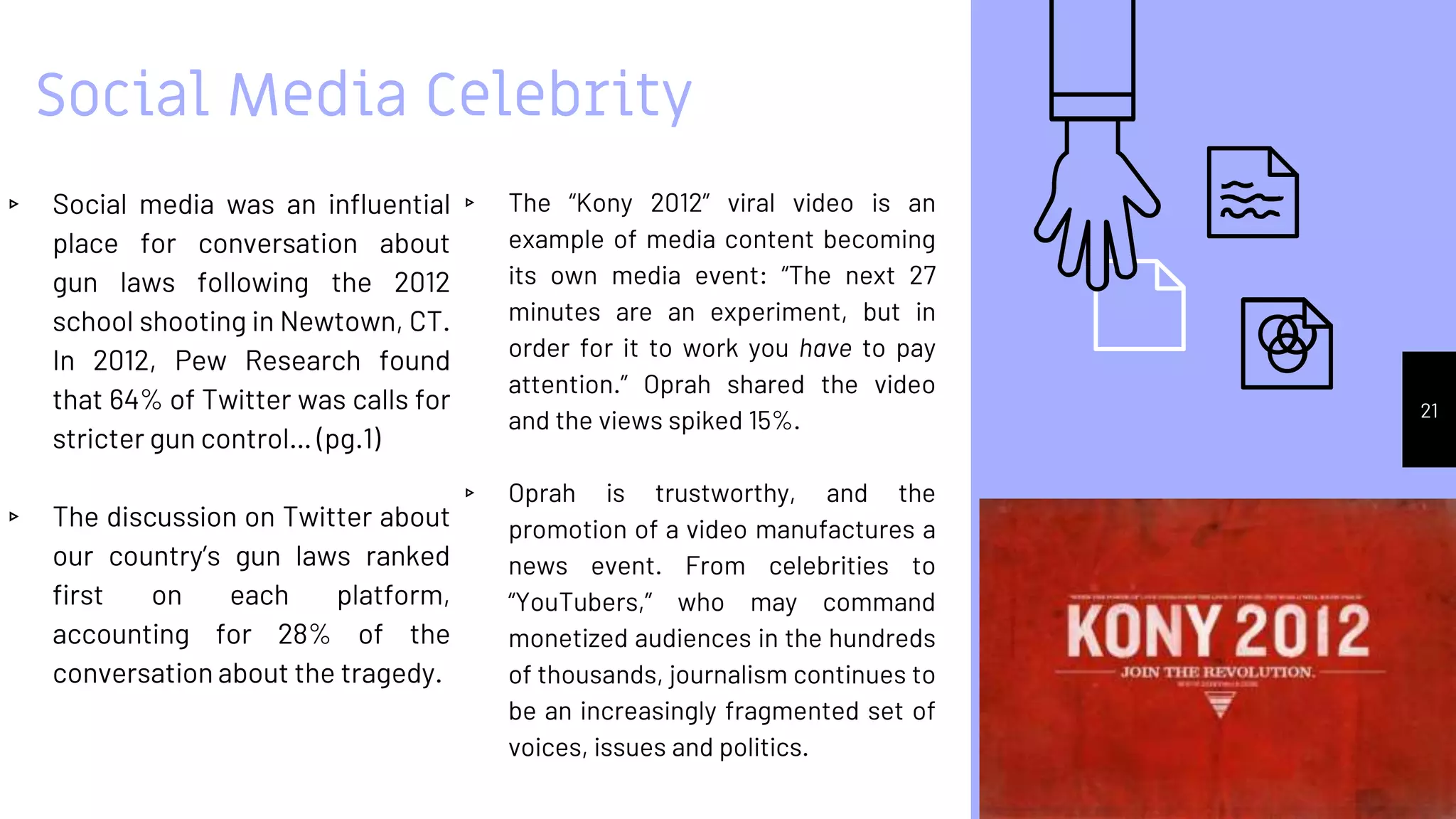
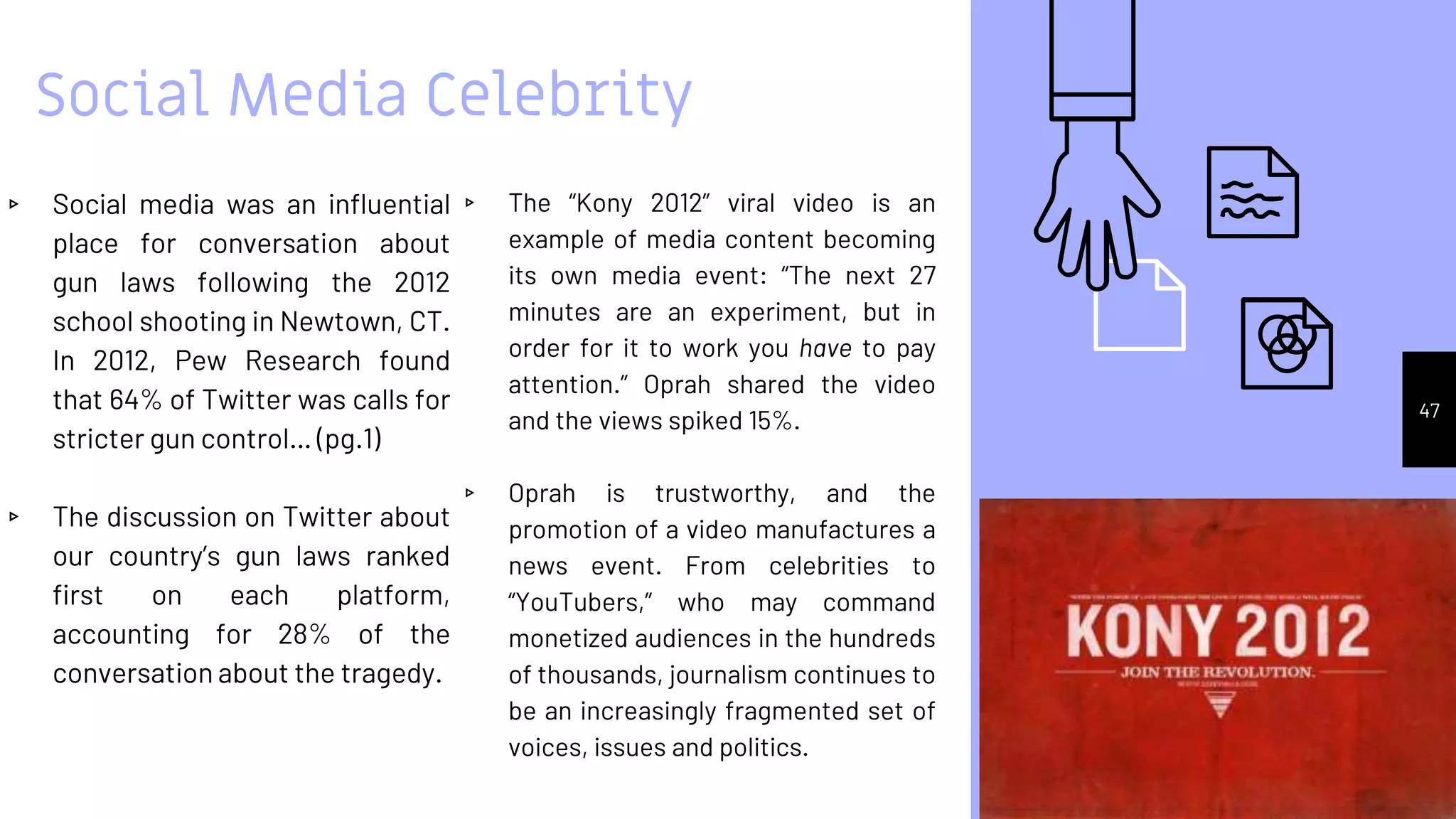
▹ The “Kony 2012” viral video is an
example of media content becoming
its own media event: “The next 27
minutes are an experiment, but in
order for it to work you have to pay
attention.” Oprah shared the video
and the views spiked 15%.
▹ Oprah is trustworthy, and the
promotion of a video manufactures a
news event. From celebrities to
“YouTubers,” who may command
monetized audiences in the hundreds
of thousands, journalism continues to
be an increasingly fragmented set of
voices, issues and politics.
21
Failures
▹ Journalism is not worth the investment anymore
■ Loss of subscriptions with
tangible news ie: newspapers,
tabloids, magazines etc.
■ Decreasing revenue with raising
operation costs.
■ Online competition increasing
■ In 2013, 72% of people get their
news by word of mouth.
.
22
Lessons of Engaged
Journalism
▹ Web, social media, E-
books, smartphones
and tablet technologies
are becoming the
preferred means of
news for most people.
▹ Companies must strive
for balance and fairness
by telling two or more
sides to a story and
letting audience
members be the judge.
▹ Always remain objective
and unbiased.
▹ Engage the consumers
as much as possible and
introduce
crowdsourcing for more
accurate news.
23
Chapter Summary
-Social Media changed the way of Journalism
-Facebook, Twitter, Instagram
-Anyone can be a Journalist
-Different platforms
-Story length
-Dialogue with Viewers/Audience
24
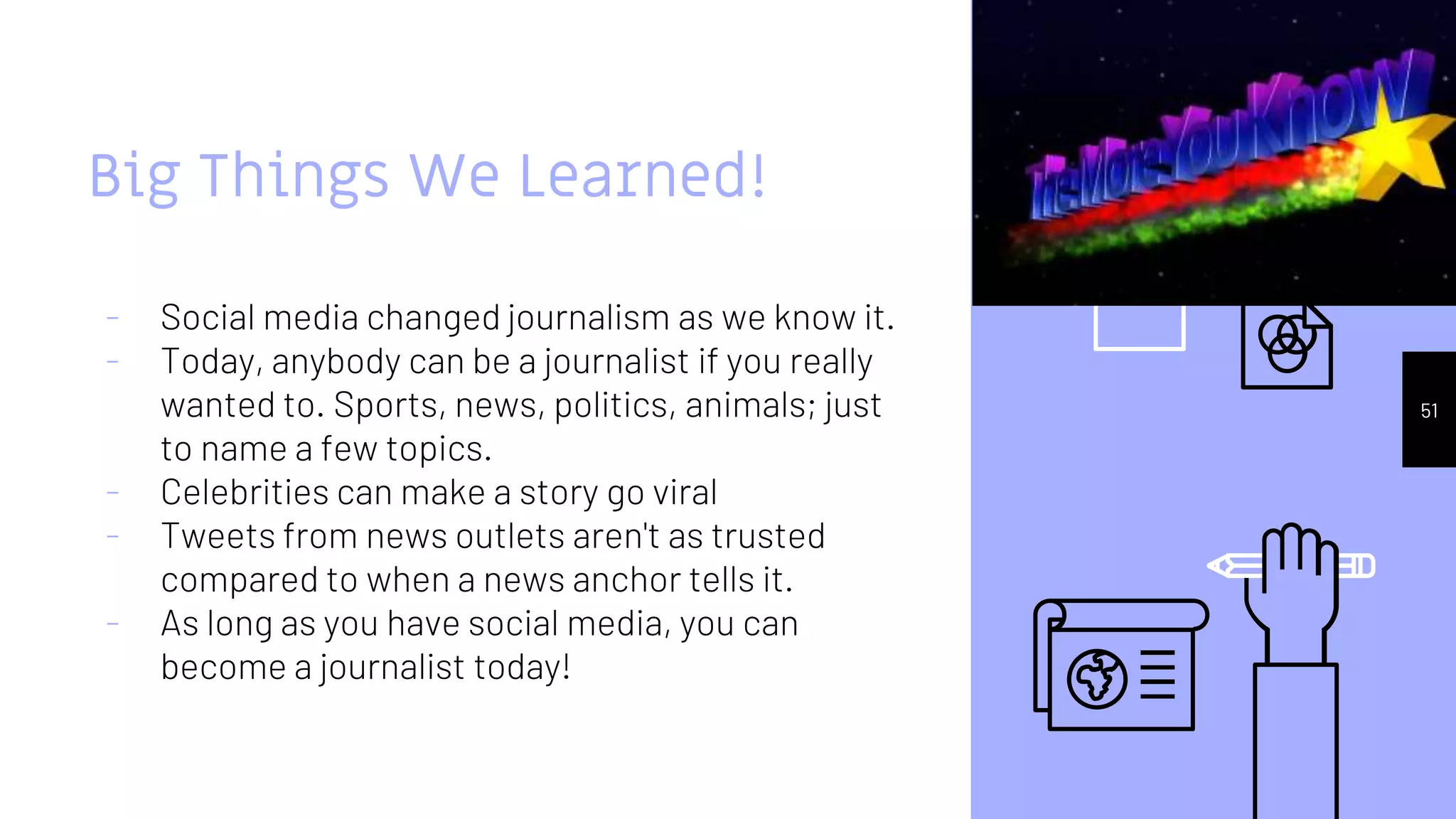
Big Things We Learned!
- Social media changed journalism as we know it.
- Today, anybody can be a journalist if you really
wanted to. Sports, news, politics, animals; just
to name a few topics.
- Celebrities can make a story go viral
- Tweets from news outlets aren't as trusted
compared to when a news anchor tells it.
- As long as you have social media, you can
become a journalist today!
25
Vocabulary Terms
▹ Engaged Journalism: Uses
Social Media to engage the
consumer
▹ User Generated Content
(UGC): Content through social
platforms used for journalism
▹ Direct Message (DM): Sending
private messages between
people.
▹ Keywords: Specific words
someone can look up to
condense their search.
▹ Cost Per Thousand (CPM):
How much a company is
charged per 1,000 clicks
through advertising.
▹ Social Media Celebrity:
People, events or movements
that gain popularity through
social media outlets.
Hyperlink: content that is discussed,
as shorthand for those interested in
reading more about the topic.
Blogger: Someone who regularly
writes or films for a blog.
Crowdsourcing: the practice of
obtaining information or input into a
task/project by enlisting the services
of a large number of people. Paid or
unpaid.
Clickbait: Content whose main
purpose is to attract attention and
encourage visitors to click on a link to
a particular web page.
26
Discussion Questions
1. How do you define journalism? How do you think traditional
definitions of the work of journalists are being altered through
participation in social media? What can working journalists do to
maintain professionalism?
2. What must journalists do to be relevant to young people? What
role should entertaining videos play in attracting new audiences
to journalism? Are there other tactics journalists can use that
would have a positive effect on business economics?
3. Does the norm of objectivity remain important within your
definition of journalism? Are there other strategies journalists
need to adopt to be considered as a trusted source for fair
information within their communities?
27
28
Any questions?
THANKS!
Social Media in Journalism
-Moving past 5 W’s
-Story must be compelling, true, and sharing
knowledge.
Content Management Systems
-Facebook and Twitter
29
5 Needs of Journalism
-To inform, analyze, interpret and explain
-To investigate
-To create public conversation
-To generate social empathy
-To encourage accountability
30
Sharing News
-Breaking news initially posted to Twitter
-Shared links expand on story
-Pictures and videos are posted
-Allow the public to comment
31
Effects of Social Media
-Transforming the way journalism is distributed
online
-How Journalists want to obtain their viewers
-New tools are required
32
33
Threats to Journalism
-Threatens investigative journalism
-Female journalists targeted
-Newspaper sale decline
34
Journalism Theories
- Introduction of social networks and social media changed
journalism fundamentally. (Tewksbury and Rittenberg 2012)
“The shift from a top down media system to one that features
horizontal interaction of people and news represents a change in
the relationship that citizens and others in a nation have with
information”
- News agenda setting influences changed
- Users use social media for other purposes, but they find
news
- 86% of americans were internet users, half of that turned to
social media sites for election news.
35
Statistics on Social Media
Users
- 62% of online adults 65 or older use Facebook
- Among internet users, higher percentage of
women (83%) than men (75%) used Facebook.
- 76% of Facebook users visited the site daily
- 56% used more than one of the top five social
media platforms, 88% say Facebook is “THE
site”
- 29% used messaging apps, which were
popular among younger people
36
Journalism Theories (cont.)
- Attracts journalists all around the
world
- Journalists credibility may suffer
- Increases with photo and link
- Social media for a profit
- Future of selling stories
37
38
Citizen Journalism
- News has transitioned from one way mass
communication to group work with user-
generated content.
- Deadline pressures and the need for reliable and
trusted sources may limit UGC.
- Citizen journalists express frustration for the
newsrooms staying with familiarity.
39
40
41
Crowdsourcing
- During breaking news, user may provide
information that journalist might not have
access to.
- Everyone has a smartphone, everyone can
be a photographer.
- Pops up on social media instantly.
42
Andy Carvin Method
Of Crowdsourcing
- A journalism innovator at NPR during the Arab Spring
uprisings in the Middle East.
- Live tweeted several Middle East political revolution and
called his work “situational awareness”.
- Tweeted over 1,200 times in a two days.
- He struggled with credibility
- Focused on known sources, observing online
behavior and followers verified information.
- Believes that social media helped loosen control over the
news, a more freeing platform.
- Critics
- Propagating, not verifying
- Can lead to false reports (Newtown shooting : purple
van, second shooter and a fake letter)
- Cultural insensitivity
- Freedom of expression
43
Micro-blogging
▹ The micro-blogging influence of
Twitter goes beyond early
adopters to news media that use
it for content sharing
▹ An ongoing issue is that
information on Twitter is viewed
as less credible and trustworthy
than the mainstream sites.
▹ Even when the news distributor
was a large organization, such as
The New York Times, the research
suggests less trust attached to
tweets. The “trust of news
information” is theoretically
distinct from “trust of those who
deliver the news” and “trust of
media corporations” (Williams,
2012, p. 117).
▹ Most newsrooms are
happy to have journalists
using micro-blog sites,
such as Twitter, to push
out links to stories and
engage with audience
members.
▹ Some outrageous stories,
however, may be seen as
“click-bait”. (designed to
drive user traffic to a site)
▹ This was the case when
publicity for a book,
“Double Down” featuring a
claim that President
Obama once told staff
that he was “really good
at killing people”
regarding drone strikes.
44
Place your screenshot here
45
https://www.huffingtonpost.com/2013/11/03/oba
ma-drones-double-down_n_4208815.html
Bloggers
▹ Most blog posts tend to be 500 to 1,000 words, as online readers are
more likely to consume short rather than long reads.
▹ At the same time, online sites tend to have fewer editors than
traditional publications. Longer posts may not be edited as quickly.
▹ The Huffington Post, for example, uses block quotes, but these tend to
be short. Blogging sites tend to encourage use of hyperlinks as
references to content that is discussed, as shorthand for those
interested in reading more about the topic.
46
Social Media Celebrity
▹ Social media was an influential
place for conversation about
gun laws following the 2012
school shooting in Newtown, CT.
In 2012, Pew Research found
that 64% of Twitter was calls for
stricter gun control… (pg.1)
▹ The discussion on Twitter about
our country’s gun laws ranked
first on each platform,
accounting for 28% of the
conversation about the tragedy.
▹ The “Kony 2012” viral video is an
example of media content becoming
its own media event: “The next 27
minutes are an experiment, but in
order for it to work you have to pay
attention.” Oprah shared the video
and the views spiked 15%.
▹ Oprah is trustworthy, and the
promotion of a video manufactures a
news event. From celebrities to
“YouTubers,” who may command
monetized audiences in the hundreds
of thousands, journalism continues to
be an increasingly fragmented set of
voices, issues and politics.
47
Failures
▹ Journalism is not worth the investment anymore
■ Loss of subscriptions with
tangible news ie: newspapers,
tabloids, magazines etc.
■ Decreasing revenue with raising
operation costs.
■ Online competition increasing
■ In 2013, 72% of people get their
news by word of mouth.
.
48
Lessons of Engaged
Journalism
▹ Web, social media, E-
books, smartphones
and tablet technologies
are becoming the
preferred means of
news for most people.
▹ Companies must strive
for balance and fairness
by telling two or more
sides to a story and
letting audience
members be the judge.
▹ Always remain objective
and unbiased.
▹ Engage the consumers
as much as possible and
introduce
crowdsourcing for more
accurate news.
49
Chapter Summary
-Social Media changed the way of Journalism
-Facebook, Twitter, Instagram
-Anyone can be a Journalist
-Different platforms
-Story length
-Dialogue with Viewers/Audience
50
Big Things We Learned!
- Social media changed journalism as we know it.
- Today, anybody can be a journalist if you really
wanted to. Sports, news, politics, animals; just
to name a few topics.
- Celebrities can make a story go viral
- Tweets from news outlets aren't as trusted
compared to when a news anchor tells it.
- As long as you have social media, you can
become a journalist today!
51
Vocabulary Terms
▹ Engaged Journalism: Uses
Social Media to engage the
consumer
▹ User Generated Content
(UGC): Content through social
platforms used for journalism
▹ Direct Message (DM): Sending
private messages between
people.
▹ Keywords: Specific words
someone can look up to
condense their search.
▹ Cost Per Thousand (CPM):
How much a company is
charged per 1,000 clicks
through advertising.
▹ Social Media Celebrity:
People, events or movements
that gain popularity through
social media outlets.
Hyperlink: content that is discussed,
as shorthand for those interested in
reading more about the topic.
Blogger: Someone who regularly
writes or films for a blog.
Crowdsourcing: the practice of
obtaining information or input into a
task/project by enlisting the services
of a large number of people. Paid or
unpaid.
Clickbait: Content whose main
purpose is to attract attention and
encourage visitors to click on a link to
a particular web page.
52
Discussion Questions
1. How do you define journalism? How do you think traditional
definitions of the work of journalists are being altered through
participation in social media? What can working journalists do to
maintain professionalism?
2. What must journalists do to be relevant to young people? What
role should entertaining videos play in attracting new audiences
to journalism? Are there other tactics journalists can use that
would have a positive effect on business economics?
3. Does the norm of objectivity remain important within your
definition of journalism? Are there other strategies journalists
need to adopt to be considered as a trusted source for fair
information within their communities?
53
54
Any questions?
THANKS!

Introduction to social media concepts

  • 1.
    Chapter 3: Social Mediain Journalism Team TRMJ
  • 2.
    Chapter 3: Social Mediain Journalism Team TRMJ
  • 3.
    Social Media inJournalism -Moving past 5 W’s -Story must be compelling, true, and sharing knowledge. Content Management Systems -Facebook and Twitter 3
  • 4.
    5 Needs ofJournalism -To inform, analyze, interpret and explain -To investigate -To create public conversation -To generate social empathy -To encourage accountability 4
  • 5.
    Sharing News -Breaking newsinitially posted to Twitter -Shared links expand on story -Pictures and videos are posted -Allow the public to comment 5
  • 6.
    Effects of SocialMedia -Transforming the way journalism is distributed online -How Journalists want to obtain their viewers -New tools are required 6
  • 7.
  • 8.
    Threats to Journalism -Threatensinvestigative journalism -Female journalists targeted -Newspaper sale decline 8
  • 9.
    Journalism Theories - Introductionof social networks and social media changed journalism fundamentally. (Tewksbury and Rittenberg 2012) “The shift from a top down media system to one that features horizontal interaction of people and news represents a change in the relationship that citizens and others in a nation have with information” - News agenda setting influences changed - Users use social media for other purposes, but they find news - 86% of americans were internet users, half of that turned to social media sites for election news. 9
  • 10.
    Statistics on SocialMedia Users - 62% of online adults 65 or older use Facebook - Among internet users, higher percentage of women (83%) than men (75%) used Facebook. - 76% of Facebook users visited the site daily - 56% used more than one of the top five social media platforms, 88% say Facebook is “THE site” - 29% used messaging apps, which were popular among younger people 10
  • 11.
    Journalism Theories (cont.) -Attracts journalists all around the world - Journalists credibility may suffer - Increases with photo and link - Social media for a profit - Future of selling stories 11
  • 12.
  • 13.
    Citizen Journalism - Newshas transitioned from one way mass communication to group work with user- generated content. - Deadline pressures and the need for reliable and trusted sources may limit UGC. - Citizen journalists express frustration for the newsrooms staying with familiarity. 13
  • 14.
  • 15.
  • 16.
    Crowdsourcing - During breakingnews, user may provide information that journalist might not have access to. - Everyone has a smartphone, everyone can be a photographer. - Pops up on social media instantly. 16
  • 17.
    Andy Carvin Method OfCrowdsourcing - A journalism innovator at NPR during the Arab Spring uprisings in the Middle East. - Live tweeted several Middle East political revolution and called his work “situational awareness”. - Tweeted over 1,200 times in a two days. - He struggled with credibility - Focused on known sources, observing online behavior and followers verified information. - Believes that social media helped loosen control over the news, a more freeing platform. - Critics - Propagating, not verifying - Can lead to false reports (Newtown shooting : purple van, second shooter and a fake letter) - Cultural insensitivity - Freedom of expression 17
  • 18.
    Micro-blogging ▹ The micro-blogginginfluence of Twitter goes beyond early adopters to news media that use it for content sharing ▹ An ongoing issue is that information on Twitter is viewed as less credible and trustworthy than the mainstream sites. ▹ Even when the news distributor was a large organization, such as The New York Times, the research suggests less trust attached to tweets. The “trust of news information” is theoretically distinct from “trust of those who deliver the news” and “trust of media corporations” (Williams, 2012, p. 117). ▹ Most newsrooms are happy to have journalists using micro-blog sites, such as Twitter, to push out links to stories and engage with audience members. ▹ Some outrageous stories, however, may be seen as “click-bait”. (designed to drive user traffic to a site) ▹ This was the case when publicity for a book, “Double Down” featuring a claim that President Obama once told staff that he was “really good at killing people” regarding drone strikes. 18
  • 19.
    Place your screenshothere 19 https://www.huffingtonpost.com/2013/11/03/oba ma-drones-double-down_n_4208815.html
  • 20.
    Bloggers ▹ Most blogposts tend to be 500 to 1,000 words, as online readers are more likely to consume short rather than long reads. ▹ At the same time, online sites tend to have fewer editors than traditional publications. Longer posts may not be edited as quickly. ▹ The Huffington Post, for example, uses block quotes, but these tend to be short. Blogging sites tend to encourage use of hyperlinks as references to content that is discussed, as shorthand for those interested in reading more about the topic. 20
  • 21.
    Social Media Celebrity ▹Social media was an influential place for conversation about gun laws following the 2012 school shooting in Newtown, CT. In 2012, Pew Research found that 64% of Twitter was calls for stricter gun control… (pg.1) ▹ The discussion on Twitter about our country’s gun laws ranked first on each platform, accounting for 28% of the conversation about the tragedy. ▹ The “Kony 2012” viral video is an example of media content becoming its own media event: “The next 27 minutes are an experiment, but in order for it to work you have to pay attention.” Oprah shared the video and the views spiked 15%. ▹ Oprah is trustworthy, and the promotion of a video manufactures a news event. From celebrities to “YouTubers,” who may command monetized audiences in the hundreds of thousands, journalism continues to be an increasingly fragmented set of voices, issues and politics. 21
  • 22.
    Failures ▹ Journalism isnot worth the investment anymore ■ Loss of subscriptions with tangible news ie: newspapers, tabloids, magazines etc. ■ Decreasing revenue with raising operation costs. ■ Online competition increasing ■ In 2013, 72% of people get their news by word of mouth. . 22
  • 23.
    Lessons of Engaged Journalism ▹Web, social media, E- books, smartphones and tablet technologies are becoming the preferred means of news for most people. ▹ Companies must strive for balance and fairness by telling two or more sides to a story and letting audience members be the judge. ▹ Always remain objective and unbiased. ▹ Engage the consumers as much as possible and introduce crowdsourcing for more accurate news. 23
  • 24.
    Chapter Summary -Social Mediachanged the way of Journalism -Facebook, Twitter, Instagram -Anyone can be a Journalist -Different platforms -Story length -Dialogue with Viewers/Audience 24
  • 25.
    Big Things WeLearned! - Social media changed journalism as we know it. - Today, anybody can be a journalist if you really wanted to. Sports, news, politics, animals; just to name a few topics. - Celebrities can make a story go viral - Tweets from news outlets aren't as trusted compared to when a news anchor tells it. - As long as you have social media, you can become a journalist today! 25
  • 26.
    Vocabulary Terms ▹ EngagedJournalism: Uses Social Media to engage the consumer ▹ User Generated Content (UGC): Content through social platforms used for journalism ▹ Direct Message (DM): Sending private messages between people. ▹ Keywords: Specific words someone can look up to condense their search. ▹ Cost Per Thousand (CPM): How much a company is charged per 1,000 clicks through advertising. ▹ Social Media Celebrity: People, events or movements that gain popularity through social media outlets. Hyperlink: content that is discussed, as shorthand for those interested in reading more about the topic. Blogger: Someone who regularly writes or films for a blog. Crowdsourcing: the practice of obtaining information or input into a task/project by enlisting the services of a large number of people. Paid or unpaid. Clickbait: Content whose main purpose is to attract attention and encourage visitors to click on a link to a particular web page. 26
  • 27.
    Discussion Questions 1. Howdo you define journalism? How do you think traditional definitions of the work of journalists are being altered through participation in social media? What can working journalists do to maintain professionalism? 2. What must journalists do to be relevant to young people? What role should entertaining videos play in attracting new audiences to journalism? Are there other tactics journalists can use that would have a positive effect on business economics? 3. Does the norm of objectivity remain important within your definition of journalism? Are there other strategies journalists need to adopt to be considered as a trusted source for fair information within their communities? 27
  • 28.
  • 29.
    Social Media inJournalism -Moving past 5 W’s -Story must be compelling, true, and sharing knowledge. Content Management Systems -Facebook and Twitter 29
  • 30.
    5 Needs ofJournalism -To inform, analyze, interpret and explain -To investigate -To create public conversation -To generate social empathy -To encourage accountability 30
  • 31.
    Sharing News -Breaking newsinitially posted to Twitter -Shared links expand on story -Pictures and videos are posted -Allow the public to comment 31
  • 32.
    Effects of SocialMedia -Transforming the way journalism is distributed online -How Journalists want to obtain their viewers -New tools are required 32
  • 33.
  • 34.
    Threats to Journalism -Threatensinvestigative journalism -Female journalists targeted -Newspaper sale decline 34
  • 35.
    Journalism Theories - Introductionof social networks and social media changed journalism fundamentally. (Tewksbury and Rittenberg 2012) “The shift from a top down media system to one that features horizontal interaction of people and news represents a change in the relationship that citizens and others in a nation have with information” - News agenda setting influences changed - Users use social media for other purposes, but they find news - 86% of americans were internet users, half of that turned to social media sites for election news. 35
  • 36.
    Statistics on SocialMedia Users - 62% of online adults 65 or older use Facebook - Among internet users, higher percentage of women (83%) than men (75%) used Facebook. - 76% of Facebook users visited the site daily - 56% used more than one of the top five social media platforms, 88% say Facebook is “THE site” - 29% used messaging apps, which were popular among younger people 36
  • 37.
    Journalism Theories (cont.) -Attracts journalists all around the world - Journalists credibility may suffer - Increases with photo and link - Social media for a profit - Future of selling stories 37
  • 38.
  • 39.
    Citizen Journalism - Newshas transitioned from one way mass communication to group work with user- generated content. - Deadline pressures and the need for reliable and trusted sources may limit UGC. - Citizen journalists express frustration for the newsrooms staying with familiarity. 39
  • 40.
  • 41.
  • 42.
    Crowdsourcing - During breakingnews, user may provide information that journalist might not have access to. - Everyone has a smartphone, everyone can be a photographer. - Pops up on social media instantly. 42
  • 43.
    Andy Carvin Method OfCrowdsourcing - A journalism innovator at NPR during the Arab Spring uprisings in the Middle East. - Live tweeted several Middle East political revolution and called his work “situational awareness”. - Tweeted over 1,200 times in a two days. - He struggled with credibility - Focused on known sources, observing online behavior and followers verified information. - Believes that social media helped loosen control over the news, a more freeing platform. - Critics - Propagating, not verifying - Can lead to false reports (Newtown shooting : purple van, second shooter and a fake letter) - Cultural insensitivity - Freedom of expression 43
  • 44.
    Micro-blogging ▹ The micro-blogginginfluence of Twitter goes beyond early adopters to news media that use it for content sharing ▹ An ongoing issue is that information on Twitter is viewed as less credible and trustworthy than the mainstream sites. ▹ Even when the news distributor was a large organization, such as The New York Times, the research suggests less trust attached to tweets. The “trust of news information” is theoretically distinct from “trust of those who deliver the news” and “trust of media corporations” (Williams, 2012, p. 117). ▹ Most newsrooms are happy to have journalists using micro-blog sites, such as Twitter, to push out links to stories and engage with audience members. ▹ Some outrageous stories, however, may be seen as “click-bait”. (designed to drive user traffic to a site) ▹ This was the case when publicity for a book, “Double Down” featuring a claim that President Obama once told staff that he was “really good at killing people” regarding drone strikes. 44
  • 45.
    Place your screenshothere 45 https://www.huffingtonpost.com/2013/11/03/oba ma-drones-double-down_n_4208815.html
  • 46.
    Bloggers ▹ Most blogposts tend to be 500 to 1,000 words, as online readers are more likely to consume short rather than long reads. ▹ At the same time, online sites tend to have fewer editors than traditional publications. Longer posts may not be edited as quickly. ▹ The Huffington Post, for example, uses block quotes, but these tend to be short. Blogging sites tend to encourage use of hyperlinks as references to content that is discussed, as shorthand for those interested in reading more about the topic. 46
  • 47.
    Social Media Celebrity ▹Social media was an influential place for conversation about gun laws following the 2012 school shooting in Newtown, CT. In 2012, Pew Research found that 64% of Twitter was calls for stricter gun control… (pg.1) ▹ The discussion on Twitter about our country’s gun laws ranked first on each platform, accounting for 28% of the conversation about the tragedy. ▹ The “Kony 2012” viral video is an example of media content becoming its own media event: “The next 27 minutes are an experiment, but in order for it to work you have to pay attention.” Oprah shared the video and the views spiked 15%. ▹ Oprah is trustworthy, and the promotion of a video manufactures a news event. From celebrities to “YouTubers,” who may command monetized audiences in the hundreds of thousands, journalism continues to be an increasingly fragmented set of voices, issues and politics. 47
  • 48.
    Failures ▹ Journalism isnot worth the investment anymore ■ Loss of subscriptions with tangible news ie: newspapers, tabloids, magazines etc. ■ Decreasing revenue with raising operation costs. ■ Online competition increasing ■ In 2013, 72% of people get their news by word of mouth. . 48
  • 49.
    Lessons of Engaged Journalism ▹Web, social media, E- books, smartphones and tablet technologies are becoming the preferred means of news for most people. ▹ Companies must strive for balance and fairness by telling two or more sides to a story and letting audience members be the judge. ▹ Always remain objective and unbiased. ▹ Engage the consumers as much as possible and introduce crowdsourcing for more accurate news. 49
  • 50.
    Chapter Summary -Social Mediachanged the way of Journalism -Facebook, Twitter, Instagram -Anyone can be a Journalist -Different platforms -Story length -Dialogue with Viewers/Audience 50
  • 51.
    Big Things WeLearned! - Social media changed journalism as we know it. - Today, anybody can be a journalist if you really wanted to. Sports, news, politics, animals; just to name a few topics. - Celebrities can make a story go viral - Tweets from news outlets aren't as trusted compared to when a news anchor tells it. - As long as you have social media, you can become a journalist today! 51
  • 52.
    Vocabulary Terms ▹ EngagedJournalism: Uses Social Media to engage the consumer ▹ User Generated Content (UGC): Content through social platforms used for journalism ▹ Direct Message (DM): Sending private messages between people. ▹ Keywords: Specific words someone can look up to condense their search. ▹ Cost Per Thousand (CPM): How much a company is charged per 1,000 clicks through advertising. ▹ Social Media Celebrity: People, events or movements that gain popularity through social media outlets. Hyperlink: content that is discussed, as shorthand for those interested in reading more about the topic. Blogger: Someone who regularly writes or films for a blog. Crowdsourcing: the practice of obtaining information or input into a task/project by enlisting the services of a large number of people. Paid or unpaid. Clickbait: Content whose main purpose is to attract attention and encourage visitors to click on a link to a particular web page. 52
  • 53.
    Discussion Questions 1. Howdo you define journalism? How do you think traditional definitions of the work of journalists are being altered through participation in social media? What can working journalists do to maintain professionalism? 2. What must journalists do to be relevant to young people? What role should entertaining videos play in attracting new audiences to journalism? Are there other tactics journalists can use that would have a positive effect on business economics? 3. Does the norm of objectivity remain important within your definition of journalism? Are there other strategies journalists need to adopt to be considered as a trusted source for fair information within their communities? 53
  • 54.