Satire
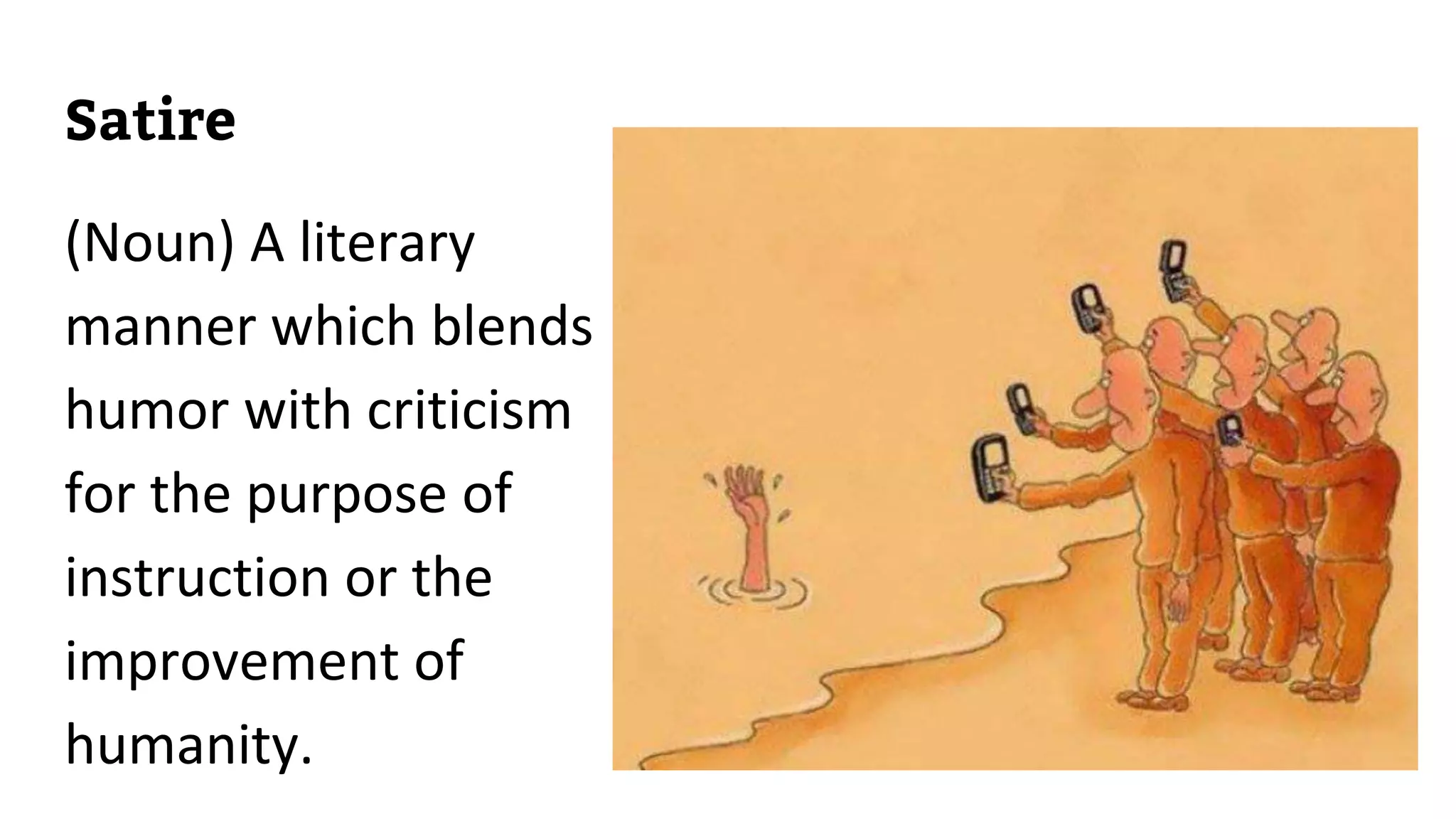
(Noun) A literary
manner which blends
humor with criticism
for the purpose of
instruction or the
improvement of
humanity.
Satire Subject of
Satire
Comment or Criticism
Being Made
Saturday Night
Live’s Weekend
Update
The Daily Show
Television News Identification of human flaws and vices
related to politics, entertainment, and
current events.
The Daily Show- Russia
SNL Big Baller
Scary
Movie
Horror Movies Exaggerates the techniques used by
horror movies to scare audiences
Scary Movie
Austin Powers 1960’s Spy
Movies
Sexism towards women. Ridicules
escapes by the spy and the stupidity of
the evil villain. Just the Two of Us
Satire Subject of Satire Comment or Criticism
Being Made
Songs by
Weird
Al
Yankovich
Musicians and
Music Videos
The excess of modern
musicians. Simplicity and
immaturity of lyrics in modern
music.
"Tacky"
Political
cartoons
Politicians and
Political Issues
The policy decisions and
personality traits of elected
officials can be flawed.
The necessary ingredients:
● Humor
● Criticism, either general
criticism of humanity or human
nature or specific criticism of an
individual or group.
● Some kind of moral voice:
simply mocking or criticism is
not “satire.”
The Satiric
Manner
● Ironic/Sarcastic
● Either good natured criticism (Horatian, after Horace) or bitterly
cynical denunciation (Juvenalian after Juvenal)
● Always opposed to pretense, affectation, and hypocrisy
● More than a little bit prone to references to things society finds
● Direct satire
● Indirect Satire
● Parody
● Caricature
Some Tools of the Satirist:
*several of these tools aren’t always used for satire- remember, satire includes
criticism and a moral voice.
Irony
Sarcasm
Exaggeration/Diminutization
Utopianism/Dystopianism
Direct Satire:
Stating a direct criticism
humorously. This is the oldest and,
historically, most common form of
satiric writing.
Example:
Comedian Dennis Miller’s popular
series of books, Rants, are an
excellent modern example of direct
satire.
Indirect Satire
The criticism must
be inferred from
reading the text,
closely examining
the characters,
setting, dialogue,
etc.
Parody- an imitation of a particular writer, artist or a genre,
exaggerating it deliberately to produce a comic effect
Ed Sheeran "Shape of You" Parody of Ed Sheeran's video
Spoof v. Parody
Mocks a genre rather than a
specific work of art.
Mocks a specific work.
Caricature - a device used in descriptive writing and visual
arts where particular aspects of a subject are exaggerated to
create a silly or comic, sometimes satirical effect.
“Mr. Chadband is a large yellow man, with
a fat smile, and a general appearance of
having a good deal of train oil in his
system. Mrs. Chadband is a stern,
severe-looking, silent woman. Mr.
Chadband moves softly and cumbrously,
not unlike a bear who has been taught to
walk upright. He is very much
embarrassed about the arms, as if they
were inconvenient to him.”
Irony
Verbal - the words you use are
different from the meaning you intend
Situational - compares what is expected
to happen with what actually does happen
Dramatic - the audience has more
information about the story than the
character knows
Sarcasm
an ironic or satirical remark
that seems to be praising
someone or something but
is really taunting or cutting.
Sarcasm can be used to
hurt or offend or can be
used for comic effect.
“Thrift, thrift, Horatio! The funeral bak’d meats did coldly
furnish forth the marriage tables.”
(Hamlet Act 1 Scene 2, by Shakespeare)
Exaggeration/Diminution
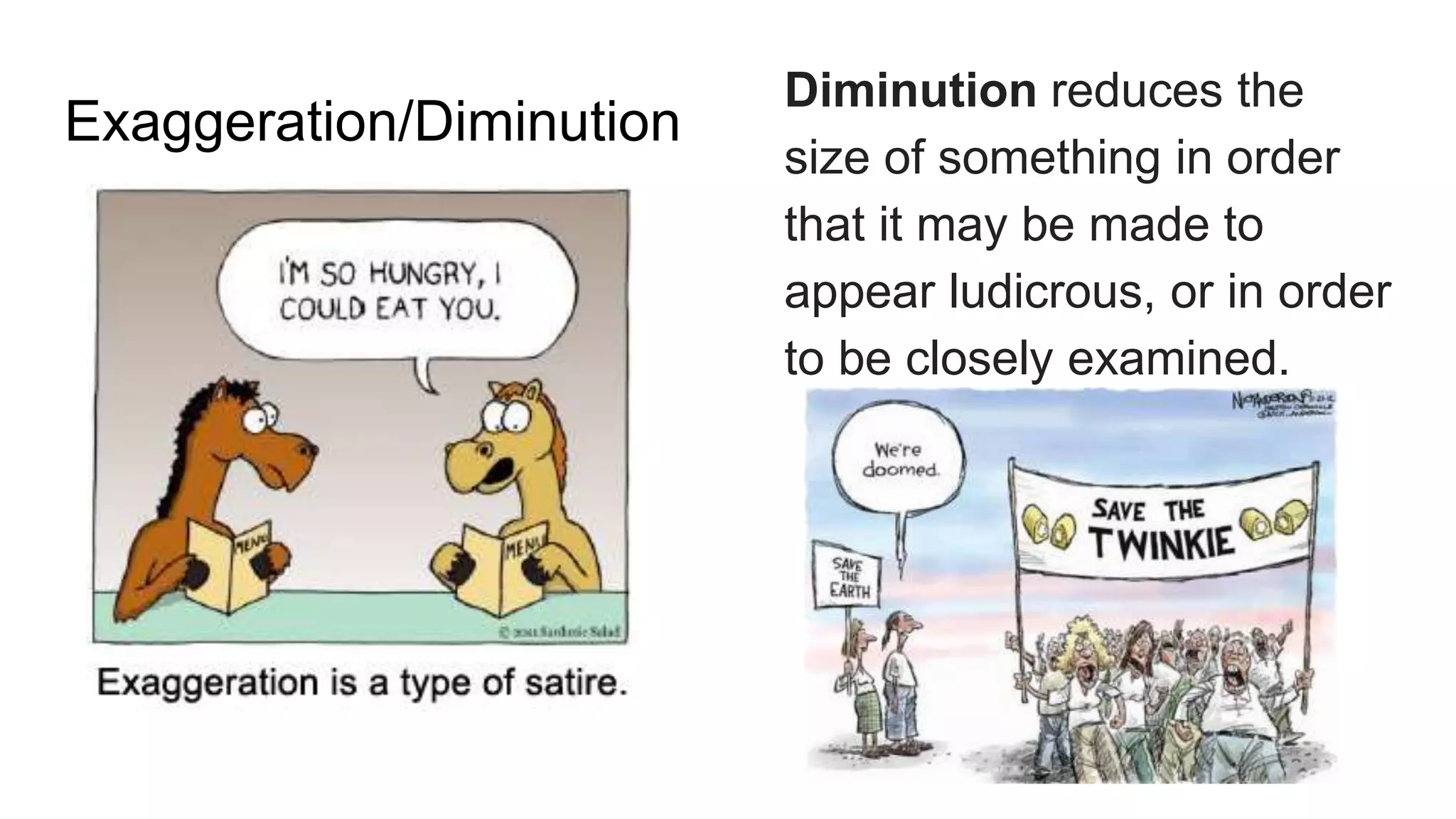
Diminution reduces the
size of something in order
that it may be made to
appear ludicrous, or in order
to be closely examined.
Utopian/Dystopian
These types of fiction explore future social and political structures, often providing
a critique of current society and providing moral warnings.
Utopian or anti-utopian- “perfect”
society
Dystopian- undesirable or
frightening society

Satire Intro

  • 3.
    Satire (Noun) A literary mannerwhich blends humor with criticism for the purpose of instruction or the improvement of humanity.
  • 4.
    Satire Subject of Satire Commentor Criticism Being Made Saturday Night Live’s Weekend Update The Daily Show Television News Identification of human flaws and vices related to politics, entertainment, and current events. The Daily Show- Russia SNL Big Baller Scary Movie Horror Movies Exaggerates the techniques used by horror movies to scare audiences Scary Movie Austin Powers 1960’s Spy Movies Sexism towards women. Ridicules escapes by the spy and the stupidity of the evil villain. Just the Two of Us
  • 5.
    Satire Subject ofSatire Comment or Criticism Being Made Songs by Weird Al Yankovich Musicians and Music Videos The excess of modern musicians. Simplicity and immaturity of lyrics in modern music. "Tacky" Political cartoons Politicians and Political Issues The policy decisions and personality traits of elected officials can be flawed.
  • 7.
    The necessary ingredients: ●Humor ● Criticism, either general criticism of humanity or human nature or specific criticism of an individual or group. ● Some kind of moral voice: simply mocking or criticism is not “satire.”
  • 8.
    The Satiric Manner ● Ironic/Sarcastic ●Either good natured criticism (Horatian, after Horace) or bitterly cynical denunciation (Juvenalian after Juvenal) ● Always opposed to pretense, affectation, and hypocrisy ● More than a little bit prone to references to things society finds
  • 9.
    ● Direct satire ●Indirect Satire ● Parody ● Caricature Some Tools of the Satirist: *several of these tools aren’t always used for satire- remember, satire includes criticism and a moral voice. Irony Sarcasm Exaggeration/Diminutization Utopianism/Dystopianism
  • 10.
    Direct Satire: Stating adirect criticism humorously. This is the oldest and, historically, most common form of satiric writing. Example: Comedian Dennis Miller’s popular series of books, Rants, are an excellent modern example of direct satire.
  • 11.
    Indirect Satire The criticismmust be inferred from reading the text, closely examining the characters, setting, dialogue, etc.
  • 12.
    Parody- an imitationof a particular writer, artist or a genre, exaggerating it deliberately to produce a comic effect Ed Sheeran "Shape of You" Parody of Ed Sheeran's video
  • 13.
    Spoof v. Parody Mocksa genre rather than a specific work of art. Mocks a specific work.
  • 14.
    Caricature - adevice used in descriptive writing and visual arts where particular aspects of a subject are exaggerated to create a silly or comic, sometimes satirical effect. “Mr. Chadband is a large yellow man, with a fat smile, and a general appearance of having a good deal of train oil in his system. Mrs. Chadband is a stern, severe-looking, silent woman. Mr. Chadband moves softly and cumbrously, not unlike a bear who has been taught to walk upright. He is very much embarrassed about the arms, as if they were inconvenient to him.”
  • 15.
    Irony Verbal - thewords you use are different from the meaning you intend Situational - compares what is expected to happen with what actually does happen Dramatic - the audience has more information about the story than the character knows
  • 16.
    Sarcasm an ironic orsatirical remark that seems to be praising someone or something but is really taunting or cutting. Sarcasm can be used to hurt or offend or can be used for comic effect. “Thrift, thrift, Horatio! The funeral bak’d meats did coldly furnish forth the marriage tables.” (Hamlet Act 1 Scene 2, by Shakespeare)
  • 17.
    Exaggeration/Diminution Diminution reduces the sizeof something in order that it may be made to appear ludicrous, or in order to be closely examined.
  • 18.
    Utopian/Dystopian These types offiction explore future social and political structures, often providing a critique of current society and providing moral warnings. Utopian or anti-utopian- “perfect” society Dystopian- undesirable or frightening society