Introduction to
Sampling Design
Sampling design is an essential part of research. It involves selecting
a representative subset of a population for study. This allows
researchers to draw conclusions about the entire population without
having to study every individual.
SS
by Siva Gurunathan S
Assistant Professor,
PG and Research Department of Economics,
Sacred Heart College (Autonomous),
Tirupattur-635601.
Importance of Sampling in
Research
1 Cost-effectiveness
Studying a sample is often
more efficient and
affordable than studying
the entire population.
2 Time efficiency
Collecting data from a
sample is generally quicker
than collecting data from
the entire population.
3 Feasibility
In many cases, it is
impossible to study every
individual in a population.
For example, it would be
impossible to interview
every person in the United
States.
4 Accuracy
When done properly,
sampling can provide
accurate results that are
representative of the entire
population.
Types of Sampling Techniques
Probability Sampling
Each member of the population has a known chance of
being selected for the sample.
Non-Probability Sampling
The selection of participants is not based on chance. The
researcher makes subjective choices about who to
include in the sample.
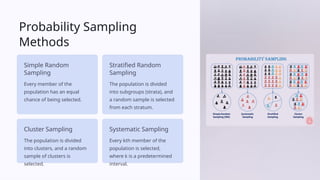
Probability Sampling
Methods
Simple Random
Sampling
Every member of the
population has an equal
chance of being selected.
Stratified Random
Sampling
The population is divided
into subgroups (strata), and
a random sample is selected
from each stratum.
Cluster Sampling
The population is divided
into clusters, and a random
sample of clusters is
selected.
Systematic Sampling
Every kth member of the
population is selected,
where k is a predetermined
interval.
Non-Probability Sampling
Methods
Convenience Sampling Participants are selected based
on their availability and ease of
access.
Quota Sampling The sample is selected to reflect
the proportions of different
subgroups in the population.
Purposive Sampling Participants are selected based
on their specific characteristics
or expertise.
Snowball Sampling Participants are asked to refer
other participants who meet the
study criteria.
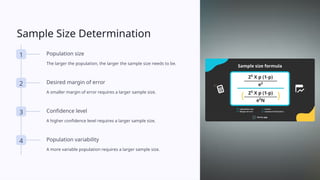
Sample Size Determination
1 Population size
The larger the population, the larger the sample size needs to be.
2 Desired margin of error
A smaller margin of error requires a larger sample size.
3 Confidence level
A higher confidence level requires a larger sample size.
4 Population variability
A more variable population requires a larger sample size.
Sampling Bias and Errors
Selection Bias
Occurs when the sample is not representative of the
population.
Nonresponse Bias
Occurs when some participants refuse to participate in
the study.
Measurement Bias
Occurs when the measurement instrument is not
accurate or reliable.
Sampling Frame and
Accessibility
Sampling Frame
A list of all individuals in the
population.
Accessibility
The ability to reach and contact
individuals in the population.
Permissions
Obtaining consent from
individuals before collecting
data.
Privacy
Protecting the confidentiality of
participant data.
Ethical Considerations in Sampling
1 Informed consent
Participants must be fully informed about the study
and give their consent to participate.
2 Confidentiality
Participant data must be kept confidential and not
shared with unauthorized individuals.
3 Beneficence
The study should benefit participants and society.
4 Justice
The benefits and risks of the study should be
distributed fairly among participants.
Conclusion and Key
Takeaways
Sampling design is a crucial aspect of research. Choosing the right
sampling technique and determining the appropriate sample size
are essential for obtaining accurate and meaningful results. It's
important to be aware of potential biases and errors in sampling and
to adhere to ethical guidelines when conducting research.

Introduction - to - Sampling - Design.pptx

  • 1.
    Introduction to Sampling Design Samplingdesign is an essential part of research. It involves selecting a representative subset of a population for study. This allows researchers to draw conclusions about the entire population without having to study every individual. SS by Siva Gurunathan S Assistant Professor, PG and Research Department of Economics, Sacred Heart College (Autonomous), Tirupattur-635601.
  • 2.
    Importance of Samplingin Research 1 Cost-effectiveness Studying a sample is often more efficient and affordable than studying the entire population. 2 Time efficiency Collecting data from a sample is generally quicker than collecting data from the entire population. 3 Feasibility In many cases, it is impossible to study every individual in a population. For example, it would be impossible to interview every person in the United States. 4 Accuracy When done properly, sampling can provide accurate results that are representative of the entire population.
  • 3.
    Types of SamplingTechniques Probability Sampling Each member of the population has a known chance of being selected for the sample. Non-Probability Sampling The selection of participants is not based on chance. The researcher makes subjective choices about who to include in the sample.
  • 4.
    Probability Sampling Methods Simple Random Sampling Everymember of the population has an equal chance of being selected. Stratified Random Sampling The population is divided into subgroups (strata), and a random sample is selected from each stratum. Cluster Sampling The population is divided into clusters, and a random sample of clusters is selected. Systematic Sampling Every kth member of the population is selected, where k is a predetermined interval.
  • 5.
    Non-Probability Sampling Methods Convenience SamplingParticipants are selected based on their availability and ease of access. Quota Sampling The sample is selected to reflect the proportions of different subgroups in the population. Purposive Sampling Participants are selected based on their specific characteristics or expertise. Snowball Sampling Participants are asked to refer other participants who meet the study criteria.
  • 6.
    Sample Size Determination 1Population size The larger the population, the larger the sample size needs to be. 2 Desired margin of error A smaller margin of error requires a larger sample size. 3 Confidence level A higher confidence level requires a larger sample size. 4 Population variability A more variable population requires a larger sample size.
  • 7.
    Sampling Bias andErrors Selection Bias Occurs when the sample is not representative of the population. Nonresponse Bias Occurs when some participants refuse to participate in the study. Measurement Bias Occurs when the measurement instrument is not accurate or reliable.
  • 8.
    Sampling Frame and Accessibility SamplingFrame A list of all individuals in the population. Accessibility The ability to reach and contact individuals in the population. Permissions Obtaining consent from individuals before collecting data. Privacy Protecting the confidentiality of participant data.
  • 9.
    Ethical Considerations inSampling 1 Informed consent Participants must be fully informed about the study and give their consent to participate. 2 Confidentiality Participant data must be kept confidential and not shared with unauthorized individuals. 3 Beneficence The study should benefit participants and society. 4 Justice The benefits and risks of the study should be distributed fairly among participants.
  • 10.
    Conclusion and Key Takeaways Samplingdesign is a crucial aspect of research. Choosing the right sampling technique and determining the appropriate sample size are essential for obtaining accurate and meaningful results. It's important to be aware of potential biases and errors in sampling and to adhere to ethical guidelines when conducting research.